Spreadable Chocolate Klout

I’ve got a ton of Klout. It says so on the card that came in the box that was delivered yesterday. Yep. Evidently, a ton of klout is worth at least 13 oz of Hershey’s chocolate spread. DSCN4902 Heard of it? Maybe not. I hadn’t. That’s the point. Heard of Klout? The point of Klout is to spread the word, this time about spreadable (hazelnut-inspired?) chocolate. Advertising, and possibly the economy, is changing. Here we go again. I wonder where we’ll end up.

Because you’re reading this blog you’re partaking of social media. These free sites and services like WordPress, Facebook, Twitter, LinkedIn, Google+, Pinterest, etc. can all be used for free, but we know that someone is paying for the people that make up the companies behind the logos. (Check out xkcd’s map to see the 2010 diversity.) Marketers and advertisers are happily gathering data that was inaccessible before the Internet. They’re paying for the services we use for free, because they hope to get us to pay for what they’re selling. Then, they take that money and pay to mine data (Wolfram Alpha will display your Facebook analysis. Type in “Facebook”.) and place ads – with the money we gave them. So, maybe these sites aren’t quite free.

I’m glad I was born at the right time to watch computers and the Internet grow and evolve. I saw the Internet was it was still the ArpaNet, and didn’t see any real use for it. Oops. But after www, html, and browsing were born I could see that it wouldn’t stop; but, it wasn’t obvious where it would go. I wish I followed through on some of my earliest intuitions. At least I bought AOL early, but that’s another story (which is in my book – Dream. Invest. Live.). Dream. Invest. Live.
Remember print ads? Advertisers would place ads everywhere, hoping to catch our attention. It worked well on television, when there were only four channels. Talk to a lot of people and hope a precious few buy.

Yahoo realized it could make lot of money by creating a directory, and then letting advertisers place ads in front of self-collected audiences. A chat room about cars is an obvious place for car ads. No need to waste money broadcasting to the vast majority when a select minority organized themselves.

Google realized that people were more likely to search than to scroll through a directory. Keep track of the search terms and the most popular ones can be auctioned off to the highest paying advertisers, especially, if ads were tied to the searches. Cross-referencing search histories enabled even narrower, and hopefully more successful ad placements. Fewer ads for the same sales, or more, was a good deal.

Klout takes advertising one step further by using data mining to identify key people, influencers. Now that so many of us are reading and writing highly personalized lives on the Internet, particularly on social media, they can identify people whose reach is larger than it may appear. Instead of putting ads in front of them, go one step further and give them the product for a discount, or free. They know I’m likely to talk about a wide range of topics. Evidently, in addition to personal finance, Scotland, social media, and science they think I’ll talk about food. Okay. So far I’ve received coupons (and a nice lunch bag) for Tillamook yogurt , a coupon for a MacDonald’s Big Mac, and now Hershey’s new chocolate spread that appears to be a competitor to Nutella. Good advertising, bad advertising, they don’t care as long as I might say something, anything.

Free food? Thank you. Except for the yogurt, which isn’t for sale within 15 miles of my house; or, the Big Mac, which is more like 40 miles up the island.

For the food curious, and possibly for any Hershey person reading this blog: Yes, it looks and spreads like Nutella; but maybe I was wrong about the Nutella competition. Hershey’s spread isn’t quite just chocolate, but it isn’t implying that it is hazelnut. The packaging looks Nutella-ish, but the ingredients are quite different. Nutella claims over 50 hazelnuts per jar. Hershey has cocoa as the fourth and fifth ingredients, sugar is number one, and there’s also hydrogenated oil which a friend didn’t consider appealing. There is a reference to peanuts, almonds, and hazelnuts, but only as a list of allergens because of the processing equipment used. As for the taste – this would be fun with peanut butter; especially, if I was on a ski trip or was fourteen years old.

That’s why they do this. To get someone to say something, because now you are aware of the product whether you intend to use it or not. Considering the health consciousness of South Whidbey I don’t expect any of my friends to buy any.

Klout can seem innocuous, something to scoff at, then ignore. People did that with Google. People did that with Yahoo. People did that with the Internet. It turned out that the new ideas couldn’t be ignored.

Klout is an example of a possible new, alternative economy: a reputation based economy. So much of our lives are lived online, and the data generated is so valuable, that supply and demand forces are already at work. My posts about my life have not led to noticeable book sales, but evidently they have some tangible value. Hershey just spent a fair amount of money to ship me one jar of sandwich spread. One consequence is that I baked a loaf of Bob’s Red Mill Cinnamon Bread (gluten-free of course) so I’d have something to spread the Hershey’s on. I’ve been nibbling as I type.

DSCN4908
If my Klout score was higher I’d probably get better stuff than a jar of chocolate. But oh, what could be better than chocolate? I don’t know if I’ll find out. My score is usually between 55-60. Getting to 70 is an order of magnitude harder, and I have enough other things to do. Maybe the perks are worth it. Maybe not.

I’m curious about what I might get, but I’m also curious about what Klout may be initiating. A reputation based economy trades influence instead of money for goods and services. Is this the ultimate exploitation or an appropriate appreciation? I know dozens of people who are influential, compassionate, and broke. If Klout expanded its influence to the same extent as Google, we could see an unexpected and favorable shift away from the nasty to the nice, from the over-paid to the overlooked.

The speed of change is speeding up, and we are in a need for change. I don’t know if a reputation economy will become pervasive. I don’t know if Klout is the first step. But I do know that I look forward to an economy that values reputation more than money.

Posted in Uncategorized | Tagged , , , , , , , , , , , , , , , , | 2 Comments

Dumb Luck Fixes Frozen Pipes

It dropped into the teens for a few nights.

from the first First Friday PhotoWalk at Greenbank Farm

from the first First Friday PhotoWalk at Greenbank Farm

Cold weather happens around Seattle, but down by sea level the water moderates the temperature – usually. Occasionally, a bit of Alaska drops in for a visit. Houses built for beach vacations may not be ready for ice in the pipes. I worried about my home, a mid-sixties waterview cottage that was probably heated with a wood stove for its first years.

A few nights ago I saw what I didn’t want to see, an ice cascade affixed to the side of my house under a faucet that I feared was broken before I bought the house. My anxiety level rose at the fear of a plumber’s bill. Within an hour, the plumber had me laughing. Sometimes we do the right things at odd times without knowing it. I hope that’s true for more than just pipes.

Every house has surprises. Seven years ago I had this house inspected when I bought it. The report was long and detailed, and I bought the house anyway. It has been the only house that’s really felt like home. I dutifully began fixing some of the problems specified in the report. Not surprisingly, I found a few things to work on that weren’t in the report, and didn’t get to everything all at once.

I bought in January, so there was no reason to use the outside faucets before spring. That’s when I found that the faucet on the back of the house was faulty. I turned the knob and water gushed out through the handle. Ah, so that’s why they had it capped. I turned off the water, which also turned off the heat to the house because it is radiant floor heating, and promptly drove to the hardware store. Where I also promptly found out that the faucet was so old that they didn’t have spare parts. Grumble. A full repair would actually be a full replacement, which would involve cutting into interior and exterior walls. The estimate was in thousands of dollars because of the possible complications. Instead, I bought a plastic cap that replicated the previous fix, and closed up the faucet again.

Last week the plastic cap broke. Ice covered the outside wall. It only looked like a cup of water, so luckily I’d found it early. Even while my anxiety and blood pressure levels were spiking, I called some friends to talk me through as I dutifully turned off the water, checked the crawlspace, checked the other faucets, installed a brass fitting I had in the utility room, and called a plumber. The plumbers were busy. No surprise. But they could be out the next morning. I cancelled some plans, and settled in for a vigil, possibly a quite cold one if the heat was off.

I decided to risk the heat because, without the heat, the other pipes might freeze. I left the water on, and checked the meter every hour or so to see if any frozen blockage had suddenly thawed and gushed out a leak.

Imagine this. The plumber showed up when he said he would. (Thank you Harbor Plumbing.) He was nice, friendly, and even let me follow him around as he diagnosed the problem. Evidently, whatever had I had done was good and quick enough because it looked like there was nothing for him to do without digging into a wall that didn’t seem to be damaged. I was relieved and perplexed. Where had all the water come from, and why had it stopped with such a simple fix? I told him the story about the water flowing out the handle, and the trip to the hardware store, and the fact that I hadn’t used the faucet in years because of what I’d seen. But neither of us was going to argue with what appeared to be no problem.

A few moments later, we both glanced at the faucet that didn’t have water coming out the handle. Why wasn’t it coming out the handle, and why hadn’t it all these years? He asked me to tell the story again. After I’d told it twice, he pointed out that, years ago, when I’d taken it out and put it back in, I’d probably resealed what needed to be sealed. Not only that, but from my description of the part, it is probably a frost-free faucet; which also means that the heater tape and protections on the other faucets may be overkill because they were probably frost-free, and that I had much less to worry about than most home owners. The water that turned to ice was just the remnants from in the line. He also made sure I knew that calling them had been the right thing to do. Small flaws in critical systems can cause massive damage if not fixed quickly.

A house always has things to fix. Since the drop in my portfolio, a lot of elaborate plans have been put aside. When the mortgage payments were also put aside, I had to resort to more frugal fixes. Here though, was a fix that I’d performed without knowing it. How many other things that I worry about are actually in much better shape than most because I’ve managed some fix at the earliest opportunity?

Problems are matched with solutions, and many of the solutions are put aside because they are too expensive, complex, hard to understand, or time-consuming. Thistles continue to attempt an overthrow of my lawn, but every spring I’ve simply pulled out the earliest ones – and my lawn has fewer invaders every year. Fitness is something to be done 20 minutes every day or so, but I manage to get in a run, or some dancing, or some karate, too infrequently, but often enough to be losing weight (though a gluten-free diet may take credit too.) Personal finance seems to be one of those things that require inordinate amounts of time to produce, but regular progress on spending less and making more is more powerful than an ever-procrastinated plan.

Maybe the grand plans we need to counter climate change, dysfunctional economies, and injustice are not as important as the individual efforts of people who reduce, reuse, and recycle; and the people who work at developing alternative currencies and local sharing; and the people who foster justice around the world by speaking simple truths about the way things are versus the way things ought to be.

The simple things we do can seem to have too little of an effect, which is why the plumber and I stood and laughed in my backyard when we realized how I’d managed to fix something without knowing it even though I was frustrated when I did it. What we do may seem small, yet it may fix far more than we can know.

Posted in Uncategorized | Tagged , , , , , , , , | Leave a comment

How Far We Have Come

Spy cameras were probably never this good. Saturday I’ll help teach a class in iPhone Photography, but I’ll take creative license and talk about how to take pictures with tiny cameras. I’ll take license partly because tiny cameras are everywhere, not just in iPhones; and partly because I don’t have an iPhone. But I do have a camera in my laptop Photo on 2013-12-04 at 20.36 #2, one in my ruggedized flip phonePhoto on 2013-12-04 at 20.37, and two in my iPadPhoto on 2013-09-24 at 18.31. Dig them out, put them together, and they’d probably all fit in a 35mm film canister. It is easy to forget how far we’ve come, partly because in so many ways we haven’t changed.

Where would Facebook be if tiny cameras weren’t everywhere? Folks would carry and upload photos from point and shoots, but they’d have to remember to carry yet one more device. A camera in a phone sounded preposterous, and then someone took a picture of their lunch, someone else caught a gaffe, someone else focused on a kitten. The Big Brother we worried about in George Orwell’s 1984 has become an infinity of little brothers eager for a snapshot that will garner the most Likes.

A walk without a camera, a phone, a GPS receiver and a moving map display is considered roughing it. We’ve accepted these things into our lives because they have become so convenient that they’re straddling the line between necessity and luxury. Of course, I know some folks who would be more comfortable carrying a sketch pad, a notebook, and a compass and a sextant. Yes. They do exist. (The sextant part is probably more prevalent because there are a lot of sailors around here.) Take a look at my bicycle ride across America Just Keep Pedaling and my walk across Scotland Walking Thinking Drinking Across Scotland. I relied on technology, but even now my approach looks archaic. No itinerary? No idea if the next town had a place to stay? No idea if the road is even complete?

I work almost every day. Since July 4th I’ve taken off about one day per month. A close friend who is keeping close track thinks I’ve only taken two days off: Labor Day and Thanksgiving. Could be. I’ve been too busy to notice. As part of my work day I pull together news feeds for New Road Map Foundation (values-based personal finance) and the History of Computing in Learning and Education Virtual Museum (what happened when computers entered the classroom). That means I read a lot of news. Thank you Facebook, Twitter, and Google News. Every day I delve into the faults and solutions of economy and education. Being human, we talk about the faults far more than we talk about the solutions. Such constant exposure can be tiring; so, I try to focus on the enlightening.

Our economic system seems to have many fundamental flaws. President Obama spoke about Economic Mobility, or the lack thereof. It was refreshing to hear him talk about some of the systemic issues that have gone beyond ideology. I rarely listen to politicians, but he held my attention for a 48 minute speech. Wealth and income inequity have increased to the point that they are self-accelerating and possibly creating a new class culture, which was one of the reasons the colonies revolted against England. How far have we come? The good news is that the President is acknowledging the situation. The sad news is that we may be back where we started over 200 years ago.

Education is in disarray. As Ken Robinson talked about, education is fundamentally out of synch with modern needs. What had been a systematized approach that worked well in the Industrial Revolution, does not mesh with a knowledge based economy which doesn’t operate on fixed schedules and which relies on businesses that must live by very short technology cycles. Teaching and learning are no longer centered on the instructor, and no longer end upon graduation. Learn a skill today and tomorrow it is a few percent closer to obsolescence. Fortunately, learning doesn’t have to be coupled to a teaching schedule thanks to computers and the Internet – and everyone who uploaded encyclopedias-worth of content.

Put the economy and education together and two old models look ridiculously out of date. Put two new models together, and there are more than two to pick from, and maybe something will fit. We don’t know. But we can hope whatever pair we pick is preferable to what it replaces.

My worries about the world can get me down. Yes, we’ve always had problems to face; but, until recently those problems were limited by a household or a community. Our community now includes every latitude and longitude, and is precariously constrained to one vulnerable planet.

Shudder. Quick. Get onto the next paragraph, because why would I write about personal finance if there are no solutions?

I see the way we adapt and accept change, as long as it makes sense. People are hunting for solutions to economy and education: alternative currencies, tiny houses, sharing economies – and – homeschooling, flipped classrooms, MOOCs. We humans are marvelous at finding new ways to do things. Somehow we’ve always found solutions, and sometimes didn’t even realize the problems they would solve (and others they would cause). Computers exist because someone developed the math of logic, and someone else developed a semi-conductor. The Industrial Revolution existed because someone figured out the power of steam, and someone else found a better way to make steel. Take it back far enough and the species probably survived because someone learned how to hunt and someone else learned how to cook.

I’d love it if the first real hunter was a woman and the first real cook was a man. But, no one was taking pictures back then, unless you think the cave drawings weren’t subject to artistic license.

The world may be falling apart. Our collective consciousness may be transcending our problems. I don’t know. But I do know that I’ll teach a class about tiny cameras that were initially ridiculed, and I’ll wonder what surprise will come along that will carry us somewhere unexpected and better. How far can we go?

Taken with my phone's camera - or is it my camera that has a phone?

Taken with my phone’s camera – or is it my camera that has a phone?

Posted in Uncategorized | Tagged , , , , , , , , , , , , | 2 Comments

Cheer Good Cheer

Good Cheer! Not just a holiday greeting on the south half of Whidbey Island. Good Cheer is a food bank, thrift shop, garden, and – the folks I’m more familiar with – a group of gleaners: the Good Cheer Gleeful Gleaners, a group of volunteers who harvest fruit from willing residents’ trees.

Me strategically positioned waiting to load the truck.

Me strategically positioned waiting to load the truck.

They had a potluck this afternoon (which is why I’m typing so late on a Saturday night). There were tales of abundance and want that become entwined as free food is delivered to people who need it. It is such a simple idea, and yet, can be so hard to implement when it is more than apples, pears, and plums.

Fruit trees are so popular that the fact that I have four of them in my backyard is considered a selling point. They produce lots of flowers, shade, and sometimes people even eat the fruit. For Sale - alas Most times they don’t. The deer and the yellow jackets are happy to devour the rest, but most fruit ripens and falls without being used. If anything, homeowners can find an abundant harvest means a messy lawn. Enough folks pick their crop to spawn a flurry of dessert photos and recipes on facebook every autumn. But many more are mowing apples when they mow the grass.

I’d like to give credit to the person who came up with the idea, but it is an egalitarian group. No one claims the spotlight. (The local paper probably did all the right research.) The idea is simple. Every year, they compile an expanding list of trees. Scouts check for ripeness. A coordinator finds an agreeable owner and then cajoles a small crowd to gather to gather. The fruit is separated into ones that look ready for a store, ones that are more rustic, and ones that are fed to less picky sheep and goats. There’s more than enough supply. There’s more than enough demand. The limiting resources are gleaners and storage.

The part about there being more than enough demand sunk in yesterday. Good Cheer’s Facebook page included a post that included this quote.
We have served over 1,000 in the month of November and we still have one more day in this month. In the past 2 months, over 110 families who have not used the Food Bank this year or ever before came through our doors to ask for help with food.
They were talking about the Food Bank, which supplies much more than gleaned fruit. It is an impressive operation. Those numbers impressed me. More than 1,000 families. 110 families that hadn’t used the Food Bank before. That doesn’t sound like a recovering economy.

A few minutes later, a factoid percolated back from memory. After a bit of research I confirmed what I remembered, and I had to respond.
The number of people you feed just sank in. According to the census, South Whidbey only has about 17,300 people (Clinton + Langley + Freeland + Greenbank). If the average household is close to two people, then you’re feeding over 10% of the south half of the island. Is that true? Amazing, sad, and a mix of emotions.

Later, the implications expanded. (Unfortunately, I was in the shower, which made it difficult to scribble notes. It is late enough tonight that I had to give up my research foray. Enforced conciseness.)

There’s enough demand for the food. There’s enough supply (especially considering how much food we waste.) There’s always a constraint. For the gleaners it is getting enough people and finding enough storage. (I don’t know if the Food Bank’s overall supply has a surplus, and don’t know their constraints.)

There are too many people without enough. Enough food, clothes, housing. We know there is a demand.

One of Good Cheer’s other success stories are their Thrift Stores. In the dichotomy that is South Whidbey’s economy, there are a lot of people proudly wearing donated clothes. I go there for household stuff that works fine even if it has a scratch or is an off color. Demand and supply meet, but not always in my size.

There are over 14,200,000 vacant homes in America. There are less than 700,000 homeless people. I am glad to see that the number of homeless isn’t higher. What keeps us from finding some way to open a few percent of those vacant homes, or let people build smaller, more affordable housesCabin by Angela So many homes on South Whidbey are vacation homes that neighbors meeting new owners are very likely to ask, “So, are you a snowbird, a weekender, or will you actually live here?” Some neighborhoods, especially in winter, seem to drop to 25% occupancy. Yet, people are living in the woods because they can’t afford housing, and because there is no homeless shelter.

South Whidbey prides itself on being an open and accepting community. Some people living here travel the world giving classes in how to build community. Yet here we are, a microcosm of the American macrocosm. Over 10% of the population needs the Food Bank. How many more need food stamps? How many are homeless? How many are unemployed, or barely getting by? We have the resources. There’s enough wealth of money and spirit. Yet, lack persists.

If a place like South Whidbey, with its wealth of enlightened millionaires and a passionate volunteer population, can’t feed and house everyone then how can anyone expect such a large community as a county, state, or country to succeed?

Maybe what it takes is seeing something like Good Cheer as a very good and necessary first step, something to celebrate; but more importantly, something to replicate and emulate. Here, maybe it can be a model for more than food. In those other places that don’t have food banks, thrift stores, and gleaners, maybe Good Cheer can be cheered as a good example.

Posted in Uncategorized | Tagged , , , , , , , , , , | Leave a comment

Thanksgiving 2013

A short and random list of thanks:

Most prominent considering Monday’s meeting: Thanks to whoever pushed for and passed the homeowner protection regulations and legislation

And then, thanks to:

  • The flora and fauna that sustain me
  • Friends and Family that support me
  • Good health
  • People who know how to have fun
  • Everyone who made it possible for us to share without traveling
  • Everyone who made it possible for people to travel and visit in person
  • The power that’s on
  • The water that’s clean
  • The air that is clear (after I finally got the fire to catch – hmm)
  • The folks that taught me the fun of frugality
  • Drew, who I hope is taking a day off
  • That I remember my katas (and thanks to Sensei for teaching them and everyone else for helping me practice them)

and much more, but why bore you with a list that could go on ad infinitum?

I’ve been asked “How do you keep your spirits up while going through what you’re going through.” (massively paraphrased, of course) I assume everyone has their ups and downs, their own battles regardless of appearances and I assume we’re all doing the same thing, but if not – even when there’s bad, there’s also good. Maybe it’s standing off to the side, but it is there, somewhere.

I’m not talking about the “closed door, open window” mantra. When I pull a bill from the mailbox I look around at the world. If something unseemly is happening financially, I remind myself that the scenery may be even more appealing. If I watch a stock go down, I remember the compliments I’ve received for my writing. If something uncomfortable is happening in one area, I don’t ignore it; but, I do remind myself that nothing in my life is everything in my life. I don’t always succeed. Sometimes it takes hours to remember to pick a different perspective, then I feel foolish for not having done so earlier.

I haven’t been able to will my problems away, but I have been able to tip the balance back by tipping my point of view.

An exercise we played at the Thanksgiving table was, “What would be different, while sitting at the table, if you were worth ten million dollars?” I’m happy with the friends who were there. The food would be almost exactly the same. There’d be no need for a fancier house, or a nicer neighborhood. At that moment, I was as rich as I needed to be, and millions wouldn’t change that.

And now, hours later, there are dishes to wash and food to put away and an evening without work. And, of course, one of the best things about Thanksgiving: a toasted turkey and cheese sandwich with a glass of the remaining wine, and sending out good wishes to you all.

That’s more than enough to give thanks for. Thanks. And, thanks for reading.

Focus on the brightness, not the darkness.

Focus on the brightness, not the darkness.

Posted in Uncategorized | Tagged , , , , , , | Leave a comment

Mesmerizing Mortgage Mediation Meeting

Well, that certainly didn’t go according to plan. Housing limbo continues. Today was the long awaited and comically delayed mediation meeting with the mortgage company. Finally, I’ve got enough work to make enough money to pay my mortgage, but would they agree? The arithmetic suggested they should say yes; but, the process has been irrational enough that any answer was possible. So, what happened? Something none of us in the room expected. Puzzle this one out. My account is closed and I’ll get more time to prove I can make my payments. If those two sound contradictory, congratulate yourself on your cognitive ability.

Thanks to the wonders of blogging, I don’t have to belabor everyone with the entire history of my personal mortgage crisis. Between tags, keywords, and categories (check: mortgage) you should be able to step back through the story. For those not comfortable doing such things, here’s the quickest version. I stopped paying my mortgage about a year ago because my investments were almost totally depleted. Since then the discussion with the mortgage company has been – illustrative of business tactics I’ve never witnessed before. Fortunately, Washington State makes counselors available, and they’ve maneuvered me into the mediation process that forestalls the foreclosure process, hopefully long enough for me to find or make enough money to pay a modified mortgage. Today was supposed to be that meeting.

Skipping the suspense, there was yet another classic miscommunication. I was there. My counselor was there. The mediator was there. The mortgage company’s lawyer was there. The mortgage company wasn’t. A half hour of phone calls later we learned that the mortgage company had “closed out the account” less than a week ago, and therefore there was no one assigned to my case. Evidently they didn’t tell anyone, not even their own lawyer.

For those following the folly, you may notice a trend. This is the meeting that was held because the previous meeting was convened without informing me, which invalidated that meeting. That meeting was held because the previous meeting had two different meeting times. My counselor and I were told to show up in the morning. Everyone else was told to show up in the afternoon. Hard to have a discussion that way.

So there I sat, somewhat aware of the standard foreclosure process thanks to my counselor and a bit of research, and confused because I’d never heard of an account being closed. Was that one step closer to foreclosure? Evidently not. Is it encouraging? No. Is it reversible? Evidently, though I still don’t know how it gets reversed and by who.

What I was pleased about was the professional manner of everyone in the room. They agreed that the mortgage company would like to have three months of profit and loss statements, and several months of bank statements substantiating my income. The only way to do that is to give me more time. We already have the October data. We’re almost through November. Add in December, wait for checks to post, and submit a new package by early January and there may be no need for mediation – assuming the mortgage company re-opens the account, somehow. But hey, since we were all in the room, and we were all looking ahead, we decided to schedule yet another meeting (which costs me $200, and that’s okay.) Next best date is early March, just in case.

One consequence of having a scheduled mediation date is that the mortgage company can’t proceed with foreclosure while mediation is in progress. Effectively, my situation doesn’t change. I continue working hard, as I’d planned to anyway. My incentives for working on the house are somewhat contrary, so I’ll work on what I want or need to. Eventually, the mortgage company will present me with a bill or an option or a deal or who knows what other surprises they may present. Even though I think I have enough money in my account to make a payment, I don’t know what number to write on the check. A couple of months ago they sent me a letter stating that the offers they’d made were to be ignored because the payment calculations were incorrect and that they’d send me updated payment requirements – which I haven’t received.

The process works within a well-defined legal system, but considering what we learned in the meeting about the account being closed, I keep in mind that some bureaucratic machinery may yet be churning its away to posting a foreclosure notice on my door. Even if it is invalid, I’ll probably react emotionally, the real estate market may react, and interrupting the process will take time.

On the larger scale, the housing and mortgage crisis look unstable. On an individual basis, it isn’t much clearer. I feel sorry for anyone going through this who isn’t aware that counselors may be available, and that isn’t comfortable with finances, and that isn’t experienced in business negotiations. My anxiety level rises whenever I deal with my mortgage shortfall, and I have admirable support. What’s it like for someone without experience, education, or help?

Believe it or not, I’ve simplified the morning’s events. To adequately describe that one hour meeting would probably take all day. That’s one reason for this blog post. Calling all of my supportive friends and trying to answer every question would be a full time job. Step one is reminding people that this is a process that surprises and confuses the professionals that deal with it every day. Hopefully, this synopsis lays a good foundation, and provides some reassurance to others in similar situations.

My situation is one of the simplest: single guy, one house, one mortgage, and a beginning credit rating of about 800, now severely reduced. And yet, as the meeting closed, the mediator pointed out that the name Trimbath is a cause for entertainment in their office. Whether that is through meeting mishaps or some other story, I’m happy to give folks a reason to smile amidst the chaos – as long as I get to keep my house out of foreclosure.

Such a small house, yet such a large issue.

Such a small house, yet such a large issue.

Posted in mortgage, Uncategorized | Tagged , , , , , | 2 Comments

Simple Social Media Choices

Social media. We’ve got to come up with a better term for it than that. That’s like calling a dance party an “aerobics and conversation congregation”. Yes it may be correct, but “dance party” is a lot more fun. I’m teaching a class tomorrow in Social Media Strategies, basically a class for people who’ve cleared the hurdle of finally getting an account, but then don’t know what to do with it. Not a surprise. I didn’t know what to do with Facebook when I signed up in 2008. New technologies and new ideas are sometimes easiest to accept when people haven’t made up names for them yet, kind of like new friends are easiest to get to know if no one has told you what to expect from them first. There’s a lot of “new” coming our way. Maybe I shouldn’t listen to what folks have to say about it.

Open disclosure: I use Facebook (11 more friends and I hit 666), Twitter (@tetrimbath), LinkedIn (my profile, aka resume), Google+ (“plus me” – groan), and Pinterest (they say Pin me – groan again). I have accounts on several other sites, but there’s not enough time to keep up with all of them. They are wonderful and worthless and distracting and informative and free. I particularly like the free part. I’ve even got a good enough Klout score to generate an occasional freebie (a Perk.) I should get some free Hershey’s within a couple weeks.

They are not panaceas. They are not Pandora’s box. Collectively, they exert an influence that is usually subjective, but is just frequently lucrative enough to convince many people to exert great efforts trying to exploit them.

Congratulations. You’re already using social media. There’s no other way to read my blog (and yes, I consider emails and blogging to be social media, too.) Maybe you print it out, but either you or someone else received it electronically first. That’s the media part. The social part is that somehow, through some social networking within a few degrees of separation, you were provided with this copy. That doesn’t mean I like the term.

Life is simple. We make it complex. My life is complex, and I know who made it that way. Me. Fortunately, even though my life is complex, it is much simpler than it was a decade or two ago – as hard as that is to believe as I type this at 8pm on a Friday night.

Some people leading incredibly simple lives have very little time to simply relax. Ironic, eh? Simple doesn’t mean quickest.

It is too easy to spend too much time over-analyzing a life. Too many fall into the trap of over-examination because Socrates said, “An unexamined life is not worth living.” There’s also having too much of a good thing. The over-examined life isn’t being lived.

I could optimize my life for minimum impact on the planet (maybe I should move off-planet), for maximum justice for my fellow humans (hear ye, hear ye), for maximum profit (very Ferengi), for self-indulgence (hello Hedonism), for any of the causes that passionate people devote their lives to. I suspect that I shouldn’t take any of these to extremes, and that luckily human diversity ensures that each will have someone that will dive in with vigor.

There are many trends heading our way: environmental, political, spiritual, economic, technological, and cultural. It is impossible to understand, control, and embrace them all – regardless of how many TED Talks are watched.

I started using Facebook because someone required, er, strongly recommended it, prior to a gathering of fascinating people. Along the way I added LinkedIn, so my resume had another place to live. I added Twitter out of curiosity, and now find it fascinating as headlines break. I added Google+ out of curiosity, and have yet to find a good reason for it beside the Hangouts (which are cheap video teleconferencing and therefore handy, but not unique). I was drawn to Pinterest because people over there like photos, and I take and sell photos. I took each of these steps naturally, in their own time, without a label slapped over them. It was only after using each for a while that I learned how to make them play well together.

The changes in our world are overwhelming. Merely tackling investing, or personal finance, or frugality are three challenges that can fill weekends, or years. Trying to understand climate change, currency alternatives, political movements, and what to have for dinner can be too much to add on top.

I approach a lot of the changes simply, with an awareness of trends based on curiosity, but without adherence to external labels and other’s agendas. After a while, various choices based on my own values coalesce into something that maybe, sort of, possibly could look like someone else’s movement. Despite having some aspects of a stubborn streak, some external pressures will inevitably influence my life. As long as they align with my values, fine.

In class, we’ll talk about social media, but I’ll spend most of the time demystifying the terms, simplifying usage, and finding how to make the sites fit the needs, rather than the needs fit the sites.

Along the way, I’ll may bring up reputation economies and how Klout could supersede Google and maybe even the dollar, and how social media is green (but not as green as it looks), and how political action and activism are enabled, and how being a little closer to the edge gives a better view. It’s all about paying attention to values, ignoring labels, and making choices. It’s simple.

July's Floating - from Twelve Months at Deception Pass

July’s Floating – from Twelve Months at Deception Pass

Posted in Uncategorized | Tagged , , , , , , , , , , , , , , , , , | Leave a comment

Discounted For Risk

What can I say about the tiny company that is MicroVision? I don’t know any more than any other non-insider, and the insiders shouldn’t be saying anything. Investing in stocks can be a powerful way to manage your money, but you’ve probably heard the caution, “With the potential rewards, come risks.” The less commonly heard insight is, “As the potential rewards increase, so does ignorance.” A lot of people want to know what’s going to happen to MVIS, just like a lot of people want to know what’s going on with any small, highly speculative stock. The speculations make for great conversations, but they make for a difficult investment strategy. Long Term Buy and Hold of small stocks test risk tolerance, patience, and objectivity – all in the hope of rewards.

MVIS is a story stock, because MicroVision is a story company. This is the obligatory paragraph that acts as the opening scene in any serial TV drama. For those just tuning in – I described MicroVision in a post in October 2011, called Micro Vision. For those who don’t like clicking on links, the short version is that MicroVision has a disruptive technology that can create the next generation of displays. Computers in the house were revolutionary, but worked from TV sets. Then came high-quality CRTs. Then thin screen LCDs. Now laptops, tablets, phones, and even watches have thin displays.

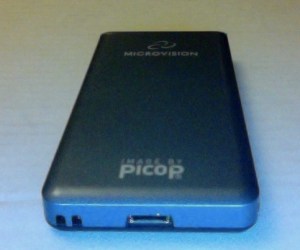
First Gen ShowWX (about the size of an iPhone - so maybe the next gen fits inside a watch?)

First Gen ShowWX (about the size of an iPhone – so maybe the next gen fits inside a watch?)

MicroVision has the technology that projects laser-sharp images that are always in focus, and can do so with less power, materials, size, and cost (we’re told) in packages so small that they can become as ubiquitous as the cameras embedded in those very same laptops tablets, phones and even watches. The previous posts dive into the technicalities and possibilities. Visit the discussion boards for more depth than I can provide. (The Motley Fool, Investor Village, Silicon Investor)

MicroVision has held such promise and claimed such possibilities for years. For about ten years, I’ve heard yearly estimates of their expected profitability – almost always about 9-18 months away. Supposedly, every day is progress towards that goal, but the stock has been on a bumpy downhill ride since the bursting of the Internet bubble. The downside has been a lot of losses for shareholders who’ve had to sell. The upside has been cheaper entry points for people who can buy. For the price of a pair of skis and boots someone can, in one purchase, accumulate a position larger than the one I’ve acquired from over a decade of acquisitions (which has a total cost equivalent to a very nice car.) The price has decreased while the potential value has remained roughly the same, which means the potential reward continues to grow.

Unfortunately, the logic that suggests buying very low now is barely changed from the logic that suggested buying seemingly low in 2005. We as shareholders can see the price, and can estimate the company’s present value based on a discounted future revenue. The logic and the math have suggested buy, yet the reality has yet to reveal a real reward. Ah, but now success should be so near and the price so low that the risk is minimized. Maybe. I don’t know.

One of the problems with buying stock in small startups is that they have no history of product revenues for a credible analysis. They do produce financial data, as every corporation must, but the reported revenues and expenses mean little when trying to assess the potential of the mature company and its resultant stock price. Small startups tend to work in secrecy for competitive reasons, because they are restricted by partner and customer agreements, to preserve reputations and careers, and because frequently there is little to say.

We as humans don’t like unknowns. Unknowns are verbal vacuums that we fill with stories. Shareholders know that no secret is perfectly secure; so, without quantitative reports, we dive into news from suppliers, we parse press releases, we dissect videos and other companies’ conference calls, and try to develop a picture that isn’t being officially revealed. It can sound like a foolish game, yet that game is precisely what the larger institutions are doing with teams of researchers and analysts.

So, why invest in something with such great unknowns while competing against teams of professionals? Because we investors in small companies aren’t necessarily competing against teams of professionals. The firms that are too big to fail spend little if any time with companies too small to bother with. Big institutions with big accounts want to invest in big companies because it is easier. If they need to invest $1,000,000,000 they have to research, analyze, and completely buy about 30 companies the size of MicroVision; or, they could buy a slice of a mega-corp in much less time and have much less risk. The mega-corp’s stock may not go up as much, but they’re less likely to lose their jobs if it drops.

In any competition, find your advantage that matches up against the other’s disadvantage. Individual investors buying stocks in well-known companies are competing on the territory owned by the institutions. That’s one reason I invest in small companies, but only in small companies that can potentially become big companies. I buy stocks that may be ignored now, but that can’t be ignored if the company succeeds.

Until the last couple of years it has been a strategy that served me well. (Want data? It’s in my book.) Dream. Invest. Live. As others who have analyzed my portfolio have noted, my stocks were hit by a perfect storm of bad luck. I think my portfolio’s performance has also been exacerbated by the current money flows within the market. The Fed’s quantitative easing and the disordinate accumulation of wealth has meant large piles of money are hunting for large havens. As a result, the market cap driven indices are setting records while many stocks languish.

At some point, the money that’s trying to get higher returns will have to look for alternatives. The money should flow back to the small startups. But there’s no guarantee. Maybe all of those investors will convince all of those companies to produce handsome dividends; and investing in small companies will fade, in which case, so will innovation.

I can’t say that at some point MicroVision will succeed. The discussion boards and private correspondence suggest that I am not the only shareholder who interpreted management’s comments as signs of success in 2013 (or 2012, or 2011, or 2010). We’re running out of year. Since the recent conference call, the private communications have increased, frequently including a dichotomy: re-analysis confirming potential rewards, versus an emotional awareness that the company, through competitive pressures, technical hurdles, or poor decisions may never succeed.

I can say that the daily fluctuations in the stock price of such a small company can look large and significant when measured against its pre-success value, but are small and meaningless when measured against the future value of its mature, successful self. I’ve seen it happen. I enjoy the speculations in words and investments (despite the current financial pain), but I know that the only thing to truly react to will be quantitative positive news and the consequential stock price move. Then, when it is a stock the institutions absolutely must have, I’ll be much more agreeable to taking enough of their money for some of my shares. Their unwillingness to take risk and encourage innovation will mean that their rewards will be discounted.

Or, the stock they overlooked will vanish, never to be looked at again; and their cautions will be justified.

I wish I knew.

Posted in Uncategorized | Tagged , , , , , , , , , , , , , , , , | 1 Comment

A Believe It Or Not Party

Thanks to everyone who showed up for the party. The dancing was memorable, as always. It was “A Believe It Or Not Party”, held because waiting for a big reason to celebrate was taking too long. Life shouldn’t be held captive by circumstance.

I enjoy parties, particularly giving them. They’re a great way to visit lots of friends all at once, get in some dancing, and end up with some tasty leftovers. (Thanks so much for the gluten-free pumpkin bread.) And I don’t even have to drive.

Articles describing how to decorate the house, what to cook, even how to invite guests are foreign to me. Over the years my parties have developed around some simple rules.

  • I’ll provide some munchies and some wine.
  • People are welcome to bring whatever they want to eat and drink, which is the easiest way to make sure there’s something that fits their taste and diet.
  • They are welcome to invite others because I will forget someone that should’ve been invited.
  • Kids are okay too, but guests have to leave with as many kids as they brought.
  • Folks are definitely encouraged to bring music and something to play it on. The more music and sound systems, the better the dancing, if it happens.

My house is only 860 square feet, and with the spontaneous help of those who showed up, we’ve had dance parties of thirty people with three different types of music. Living room = swing. Back room = blues. Carport = latin. And yes, last night’s weather was a few degrees above freezing, with wind, and rain – and salsa outside in November sounds silly until you realize that you’re warm by the second song.

Sometimes the dancing doesn’t happen because the conversations are so engaging.

I have fascinating friends. I invite a lot of them, but always a somewhat different set; not through any grand plan but because I trust them to fill in with invites to their friends, which leads to a bigger and different circle every time. For those who don’t know me, I am an extreme independent moderate. I am passionate about what people have in common and try not to make assumptions about affiliations and associations. One conversation was about opposing the legalization of marijuana (though marijuana is legal in Washington), while at the other end of the room people were comparing prices and describing the anti-anxiety benefits of partaking of the herb. More than two sides of the gun conversation were represented, and yes it is not an either or issue. There were liberals, conservatives, and innovatives. There was a great supply of corporate stories, the modern day fountain of clashing archetypes. And the circles shifted such that people from opposite sides of one issue were on the same side of another. No TV show is ever better than that. (Though I must admit that Aaron Sorkin gets close.)

Sometimes all of the conversation evaporates within minutes when a critical mass of dancing kicks in, people move the furniture, and we crank the volume. Having light furniture and being surrounded by vacant lots and empty vacation houses has its advantages.

If I’d described it as a frugal party it wouldn’t have been as appealing, yet frugal it was. The most valuable and precious elements are always the people. It cost less than some people spent on dinner out. The biggest cost was probably time, and the house needed cleaning anyway.

Everyone there had a reason not to be there, but they showed up anyway. It is too easy to step back from socializing when in the midst of turmoil and drama, or even just wind and rain. I stepped away from having parties for the last year or so, and after seeing the bill (which someone else surprised me by graciously picking up most of) I realized that I could’ve held a party or two during the hiatus.

We all have reason to worry, to step away while we sort through our troubles, or just to re-energize. Faking a smile may work for some, but an honest expression is worth more and is healthier. But stepping away too long is too wrong.
Shared pain is lessened; shared joy, increased.” – Spider Robinson
We all have reason to worry, but we all have reason to share, and that is equally true of celebrations. I’ve waited for news to celebrate that was either getting an affordable mortgage or selling the house, having my portfolio sufficiently recover, making enough money without spending too much time, or even celebrating a serendipity that I have yet to experience. I’m glad I didn’t wait longer.

The party may be my last in that house. It may be the first in the resurgent series. I can’t know and must continue to live my life day by day, and sometimes hour by hour.

One intrepid fellow, and fellow MVIS shareholder, dropped by, commiserated a bit, weighed the crowd’s reaction to MicroVision’s promise (including the reaction of an ex-MVIS shareholder), mingled as well, and left me with a bottle of scotch from a city I walked through when I crossed Scotland. We may not have much to celebrate regarding MVIS, unless it ends up being buying at a record low, but we left the evening with the idea that celebrations can grow because good news can happen. Imagine the dancing at that party. We’ll probably have to buy a case.

Kirkintilloch, Scotland

Kirkintilloch, Scotland

Posted in Uncategorized | Tagged , , , , , , , , , , , , , , | 3 Comments

Value Planning

Plan for the future? Sure. Lately, I’ve been planning for the next hour or day. Planning for my far future, like next year, only happens if I want to get a headache. Long term life plans for coming decades are important, but they are extrapolations that must be made from a stable present. Right now, the best stability I can find is internal and doesn’t involve numbers but it does involve math. Me understanding me and managing me is a priceless exercise that costs nothing but time and courage. A sense of humor helps.

Retirement planning for the average person leading a normal life usually involves adding income, subtracting expenses, guessing at raises and inflation, putting in a safety margin, and extrapolating to some guessed at lifespan. Let’s see.

  • Median household income in the US ~ $51,000.
  • Median household net worth in the US ~ $69,000. (A figure which, ironically, ignores the value of the household’s house.)
  • Median age in the US ~ 37
  • Median life expectancy ~ 79

So, we just throw all of those numbers into a retirement calculator and what do we get? Nothing very useful. A person with the median income probably doesn’t have the median net worth, isn’t the median age, and doesn’t have the median life expectancy.

Personally, my income and net worth are far below the median while my age is significantly above it. As for my life expectancy, well, skip the statistics. At my age, lifestyle probably has a greater effect than my age on determining my life expectancy.

Several times I’ve calculated retirement plans, set that course, and embarked. Oh well. Calculating such a plan now would be meaningless. As so many people I know, extrapolating from where I am produces an answer of working for the rest of my life by necessity. That can be fun, if it is the right job in the right place with the right people. It happens, and I am glad I am closer than most to that model. Being closer to that ideal also explains a bit of my current financial deficit. Compromises happen. If I’d stayed in my engineering job, I’d probably be a millionaire – and possibly either crazy or dead from stress. My finances would’ve looked great, but my life expectancy would’ve been compromised.

Yet I am optimistic. How’d that happen? Am I just fooling myself?

I am optimistic because, for most people, life isn’t all bad luck. I had a string of it, but I can also have a string of equally good luck. If I only trusted to luck I’d be working without worrying about tracking hours or maximizing income. I’d be reading more books, volunteering more, and spending a lot more time hiking, skiing, bicycling, dancing, and generally socializing. Maybe that would be a better plan. Maybe that would more readily lead to serendipitous opportunities. There’s no way to know.

What I understand about my personal finances is amplified by what I know about me. I know that my needs can be easily met. My wants don’t cost much more. Frugality has its value. I’ve already found a place where I can enjoy life.

a short walk from my front door

a short walk from my front door

I have a wonderful network of friends. I have enough skills that I can’t exercise them all in a day, and that is a wealth for a lifetime. Many of them are even valuable enough to command a much higher income. Someday I may get the opportunity to enjoy that combination.

Because I need so little to enjoy life, it won’t take much for me to make more than enough. I’ll be able to follow one of my favorite old-school rules: Spend less than I make. Then, after I have cleared old, outstanding bills, I’ll be able to follow another of my old-school rules: Invest the rest. If I am spending less than I make and investing the rest, and doing so in ways that are healthy, then I can sustain a comfortable life. That retirement plan doesn’t fit into a calculator, and it doesn’t need to. Check out my book (or buy it). Dream. Invest. Live. Those rules are in there, and there isn’t a retirement calculator.

Of course, I look forward to making a lot more than I need, benefiting from successful investments, and being comfortably comfortable. And I also buy lottery tickets. Why pass up an opportunity and a chance to dream?

My Rule of 7 and Retiring One Percent both get about as detailed as I think is necessary for retirement planning for those of us without those median jobs and lifestyles. New Road Map’s Nine Step ProgramNRM logo is a good example of planning that isn’t only a retirement plan. Life is uncertain. Pretending that it isn’t is appealing, but it is also an illusion. I’ve had enough retirement plans fade for me to think otherwise. Personal understanding, living according to simple values, and persistence are more in my control, have as much certainty as I can give them, and are far more valuable. That’s my plan – at least for now.

Posted in Uncategorized | Tagged , , , , , , , , , , , , , , , , , , , , | Leave a comment