
Small Town Coworks Considerations

Write a few words, kick off a lot of conversations. Well, I guess that’s why humans developed communication. Last week’s post about a coworks closing inspired a suite of  incoming phone calls, emails, and meetings about possible reincarnations – and I wasn’t even the one running the show; I just happened to use the space. Good ideas are rarely perfect when they are new, and a bit of testing and trials can create new variations that are hopefully improvements. Coworks in cities have worked out the worst imperfections. Coworks in small towns have a bit more work to do; and it is work that should be done because telecommuting creates opportunities to pull income into places that could benefit greatly from even small increases.

The coworks I used closed for strategic as much as financial reasons; though, if it was making gobs of money it probably would’ve stayed open or simply shifted locations. Small town coworks, or really any small town business, deal with smaller populations. The fewer people in the area, the fewer people are likely to sign up for such a shared space. Of course, if coworks worked better in small towns, there’d be more incentive for telecommuters to move there. Catch-22s persist.

The response to my post tells me that there’s a demand and an interest in providing a supply.

The demand (extremely generalized and only representative of possibilities):

  • programmers – who may need nothing more than few distractions and a reasonable connection, and occasional coordination calls
  • writers – who may not want distractions, need a reasonable connection, and occasional coordination calls
  • graphic artists – who need big monitors, lots of bandwidth, and good lighting
  • consultants – who need space for discreet conversations and calls, and who benefit from networking
  • advocates – who need a mix of content creation, extensive personal and social media networking, and possibly lots of calls
  • agents – real estate, stock, whatever, who have to deal with clients, professionalism, and possible regulatory restrictions
  • and a list that doesn’t stop with architects, engineers, counselors, etc.

The supply (generalized and open to creative innovations):

  • coffee shops – the standard, which was also the inspiration for creating coworks because, while they are convenient, have a good business model, provide food and drink, aren’t private or quiet or ergonomically comfortable for hours of work
  • libraries – very handy, especially since they’ve embraced technology with high-speed connections, computers onsite, a variety of desks, tables, and chairs, and a special bonus of on-site researchers and – get this – a library of books, but not quite public and no longer the quiet bastions of introverted scholars
  • extensions of existing office businesses – print shops, office supply stores, and shipping centers have a natural overlap with many businesses, easy upgrade to professional equipment and services
  • spare offices – another standard, rents for about $1/sq ft (highly negotiable), and requires a manager who probably expects to be paid
  • community spaces – whether on purpose or by accident, lobbies, lounges, and foyers can provide free wi-fi and free seating and may even provide quiet alcoves for quiet conversations
  • restaurants and bars – an option I rarely see exercised, but a great opportunity for better utilization of the space, a semi-captive audience, and a possibility of swapping out tea and cookies for beer and fries, something the creatives may appreciate

And then there are the pesky details of 24/7 access, supply storage, crowd control, management of the other coworkers, and who is going to clean the toilet.

In the last week, I’ve been asked to consider about a dozen of those possibilities. Thanks for the honor of asking me for my opinion. Glad to be of service.

I haven’t worked out the specific numbers yet but it looks like, to open a commercial coworks, people have to find it attractive to spend:

  • more than $1/sq ft for rent,
  • add >15% for utilities,
  • add something for insurance,
  • add something for marketing,
  • be able to pay their share to a manager at least minimum wage (174 hours/month) plus free access to the space,
  • with adjustments for the level of access
  • and adjustments for the level of service.

It’s late enough that I’m not going to add that all up (maybe at a coworks I could ask for a volunteer), but it definitely suggests that size matters. The lower limit is what it takes to barely make it work. The upper limit is where it just becomes cheaper for a person to rent their own office space. That bracket is about $400/month for the coworks and about $400/month for an individual. A 400 square foot space with four people each using about 100 square feet could cover the bare minimum at $100/month, but would end up paying more. Halve the individual’s floor space and double the people without changing the price and there’s a few hundred to pay a manager, which is not minimum wage.

Fortunately, I don’t have to find the solution. There are more than a dozen people working on it. Hopefully there are more than a dozen people who want to use it. The best solution for a small town may already exist in the coffee shops, libraries, and common spaces; but maybe something scalable, more professional, and beneficial to the local economy can be found. Good luck. Tell me what you find. I’ve been working on my regular collection of jobs for the last 14 hours today and don’t have the energy left to close the deal. Of course, if I was working in a coworks, maybe we’d cooperatively find a solution. After we find it, let’s see if we can share it. There are a lot of small towns that could use the help.

Posted in Uncategorized | Tagged , , , , , , , | Leave a comment

Courageous People Fight Taboos

There are courageous people in this world. Just like with frugality, some people are courageous by choice and some by necessity. I gave a talk about a taboo subject and only drew a small crowd, but they were the courageous ones who were willing to show up, share stories, and see how much fun we could make of the situation. We came to talk about money, in public, and that’s not easy. The consequence of the talk? More than one person found the advice they needed because they were willing to show up, be vulnerable, tell their story, and listen after others had listened. It is amazing what happens when we actually communicate regardless of fear.

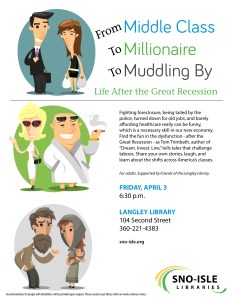
The talk was a simple one, but one I’ve never given before: From Middle Class to Millionaire to Muddling By.23697 Middle Class to Millionaire The title will probably shrink the more times I give it (unless the local library system, Sno-Ilse, decides to leverage the work they put into the poster.) I’ve lived in all of those classes; and in retrospect, realize that my early childhood was probably on the lower edge of that first class.

I find myself as a member of a transitional generation. Prior to my generation, people had a good chance at a lifelong career; or even better, a career that let them live long enough to enjoy retirement too. After my generation, the concept of a lifelong career is seen as a marvelous fantasy because they know their business will probably radically change before they reach retirement. The only-somewhat-of-a-joke is that if your job requires information more than five years old your industry is stagnant, and so is your job.

Money, finance, and income have changed dramatically in the last three decades. Go back to 1985 and realize that people had to visit banks, stocks were traded by people, and working hard at a job was a way to get ahead. Welcome to ATMs and digital currencies, discount brokers and high frequency trading, and an American Dream that has more to do with guarding against falling behind rather than making progress.

The talk was a first attempt at finding another venue for talking about the dramatic changes we’re facing wrapped around a topic with far too many taboos. Rather than sit around and commiserate and complain, I decided to use the possibility of a sequel to Dream. Invest. Live.Dream Invest Live cover as an opportunity to share and collect stories gathered from the weird world of our money, to find the fun in our dysfunctional finance system. I could test which stories would work well in the sequel, and also open the door and the floor to others who had a need to talk.

I’m an optimist. I always hope for a large crowd. I’m also a realist. I’m not surprised if only a few show up for an unproven presentation. That’s the life of an author; book signings and talks do not always create crowds or long lines.

I told stories about the bizarre world that is trying to survive foreclosure, the world of apparently felonious finance that’s ignored by the SEC, and the patchwork process that is the current job market where a series of shifting jobettes is becoming the norm.

The treasures of the evening came near the end. Two people shared their stories. We were all hunting for the funny, but the struggle showed through. The treasure, however, came from the responses. One woman described her situation, where she hadn’t found an answer for over two years; and then found that she was sitting beside someone who had found a way through almost the exact same situation. The cost of the talk (keeping the library open later and what they paid me) was far less than the value of one person, one family, possibly finding resources that may ease their efforts.

I, too, received a valuable insight. Two of the people in the front row (always a courageous act at a talk) passed along an observation. I was looking for a Jon Stewart/Stephen Colbert/Jon Oliver type of humor, and it wasn’t working as well as I wanted. They pointed out that Mark Twain (and later I realized Will Rogers) were far better models for a writer. Guffaws are fine on television, but wry insights reach farther when people are reading.

“Reader, suppose you were an idiot. And suppose you were a member of Congress. But I repeat myself.” – Mark Twain
“This country has come to feel the same when Congress is in session as when the baby gets hold of a hammer.” – Will Rogers

That couple are Ann Medlock and John Graham, the people behind The Giraffe Heroes Project, a project that goes around the world supporting the people who are sticking their neck out for the common good. (They are also both accomplished authors, Ann’s new book is Outing the Mermaid, and John’s is On the Edge.) The range of income, wealth, and power inequality we experience in America is probably still not as extreme as what they’ve witnessed in places that few people dare to visit.

Societies change slowly, even though events like Bastille Day seem abrupt. The underlying issues accumulate for decades. Most of America is content enough to not advocate for change; but more of America is finding change is happening without their choice. People are changing by necessity, and frequently the change is counter to the conventional wisdom perpetuated by the media and political parties. It may seem like it is only happening to them, but until they tell their stories, they may not know how much company they have. Speak up, people! And listen to each other, too.

My emphasis, at least for this blog, continues to be personal finance. As much as it would be nice to not have to worry about finances, money continues to drive almost every life. I’m fortunate enough that I am just old enough to begin collecting an accelerated pension. For at least a few years, my pension will closely match my mortgage payment. That doesn’t mean I get to relax much. The next biggest block of expenses are non-negotiable: taxes and insurance. The government mandates both. I gain some benefit from the taxes; but the insurance is almost exclusively an expense. I can afford, house, car, and health insurance, but I can’t afford house, car, or health repair and care. My choice is to look at that and mutter to myself, or complain – or to reach into the inexhaustible yet too-little exercised practice of pointing a finger at the situation and finding the humor in it, wry or otherwise. And, I hope far more do so too. Maybe quiet laughter will be more powerful than shouting.

Now, to practice channeling my inner Will Rogers. Do I have to learn how to lasso cattle and do rope tricks first?

Posted in Uncategorized | Tagged , , , , , , , , , , , , , , , , | Leave a comment

Long Live The Coworks

My key chain just got lighter. The two keys that got me into the coworks were turned in because the coworks closed down. For almost two years The Langley Coworks has been my office, really just a bit of wide counter space beside a window, but it was my base of operations through some of the most difficult times of my life. It was also the opportunity to work in Langley without having to spend hundreds per month on rent, or subject myself to ergonomic and auditory contortions trying to work from a coffee shop. For whatever reason, it couldn’t survive, at least in this incarnation. The idea is sound, though, and is indicative of the new world of work.

office photo 062813

A coworks is a simple idea, yet was probably too simple for people to consider it seriously at the start. Just like many people who thought Starbucks’ high-priced coffee seemed like a ludicrous idea, coworks tap into a trend for a redefinition of space. Coffee isn’t something to get for the lowest cost and the greatest convenience. There’s a value to quality, and the right environment. I saw that, drink tea instead of coffee, and still bought into SBUX as soon as possible. It was the third place that mattered as much as the beans. No particular coworks company may command such a broad appeal, but there’s a demand for places to work that aren’t the traditional office or working from the kitchen table. Conventional corporations are encouraging employees to work elsewhere. It may be sold as freedom, but it is also a cost savings to the company.

Ideally, a coworks does more than provide a desk and some wi-fi. That’s the essence of why they work; but the additional draw has more to do with the sharing economy. A community sharing a resource can become more than just a collection of individuals. Coworks bring people together, and mix them up creating connections that are random and that can also reveal unexpected opportunities. Coworks in Seattle and other large cities gather crowds of hundreds. A coworks in Langley gathered, well, many times there weren’t even enough to finish off a six-pack. And yet, collaborations happened. It is the only reason I came across my second substantial client: Curbed Seattle.

Working from home works, as long as everything is handled over the internet. I don’t have to share bandwidth. I can wear what I want, and can swap into a good shirt if there’s an online meeting. During my rare breaks, I can do some chores or get in some exercise. It’s nice to be able to match my works schedule to the tide charts and sneak in a low tide walk. It’s definitely cheaper to work at home. Skip the commute costs. Lunches are more economical. There’s no extra rent, or need for double sets of office supplies. Phone calls can go on without interrupting anyone. And, all of my stuff is here, not divided by ten miles.

I’ll miss the bicycle commute (which was put on hold after my computer developed a glitch), the sound of the lunch crowd and the smell of bacon coming up from The Braeburn downstairs, the baristas calling out the orders and the smell of coffee roasting at Useless Bay Coffee Company, the crowds hanging out while a band cranks up at South Whidbey Commons, and the Second Street Market that closes the street and fills it with people and art and food in season. I’ll miss taking advantage of knowing the timing of the sales in the Star Store grocery. I’ll miss being able to take a break by visiting friends who work their businesses in town.

Langley Second Street Market 060713

Coworks are a recent innovation, and some implementations will succeed, and some won’t. Innovation is like that. One of the most important things was that someone was willing to try. The folks at Fusion Spark Media ran the coworks, and also knew when to stop running it. For some reason it didn’t quite become self-sustaining, or at least wasn’t as strategically aligned with the rest of their business.

Society succeeds when it tries things, learns, and then adapts the concept before trying again.

Take a look at most coffee shops. The people are are likely to be spending time with their devices as with each other. The mobile workers are either positioning themselves for a good wi-fi signal and maybe a power outlet, or are paying for cell-phone data transmissions and hoping their device’s batteries last. If they want privacy, they have to rely on lots of background noise, or expert whispering. But, at least the coffee is good. Just make sure to time conversations to miss the hiss of the espresso machine.

There’s a variation that I haven’t seen, a middle ground between a coworks which is dedicated to working and a coffee shop which is dedicated to sipping.

  • Take a coffee shop. Make sure it serves good coffee (and tea.) Provide lots of power outlets, good wi-fi, maybe even some direct cable connections, and acoustically buffer the machine. Provide a space where someone can come in for coffee, or maybe linger long enough to recharge their phone. That’s common enough.
  • Then, have a section that is accessed with an hourly fee, a place for respite, more of a lounge with upholstery as some coffee shops do, but with more of that acoustic buffering. Done right, it can also be a place to meet for quick business meetings, or a refuge for a spouse that doesn’t want to shop. Maybe have two or three computers for better access than a cell phone plan. Include a printer for the rare use of paper.
  • If there’s room, add another level of service where there are spaces ergonomically designed for the work lives of  today’s computer-centric jobs. The rents are by the day, the week, or the month, depending on the need. All the other spaces are temporary, but here a person can store their stuff, have their office supplies available. Phone booths are a major bonus for calls that require discretion, or at least to minimize disruption.

While I’m dreaming, I’ll add a bicycle garage, a locker room, and a shower, but that’s because I prefer to exercise on my commute, and to not impose the olfactory results on my neighbors.


Society is changing, including the nature of work. Spaces where we can share resources, opportunities, and support may become as ubiquitous as coffee shops because the era when everything, including a life-long string of paychecks, was paid for by an employer is passing.

The coworks is closing. Long live the coworks.

Posted in Uncategorized | Tagged , , | 3 Comments

Walking Into A Frugal Spring

Spring is here. It is knocking on the frugal storm window in the bedroom. The sheet of plastic is popping as winds from the south blow in the new season. March’s lions and lambs are secondary to getting me, my house, and my yard ready for growth. The potatoes, apples, and raspberries are looking healthy. So are the caterpillars, the slugs, and the hopeful deer.

Silly human. I scoff at your fencing.

Silly human. I scoff at your fencing.

The shift in the season is happening whether I do anything or not, so I guess I should spend some time tending my home, my base. I’m doing so as frugally as ever, by necessity as much as by choice. That’s true for this spring, and true for this recovery.

Here’s a measure of my frugality. Yes, I’ll try to squeeze every last bit of toothpaste from the tube. No, I won’t slice it open and scrape down the insides.Photo on 2015-03-27 at 20.00 I’ll finish my plate, but won’t lick it clean (unless we’re talking batter in a bowl after baking.) Frugality taken to an extreme can save money but cost too much time, and time is too precious to waste. When frugality was from choice instead of necessity, I’d spend more money to save more time. When frugality is from necessity instead of choice, I’m more likely to decide not to do something than I am to try to squeak in some activity by barely clearing its hurdles. That level of tightness costs too much in emotional energy.

The fence fell down – again. Of the twenty sections, eight have fallen. I can take a hint. After I’ve saved up some money after paying my taxes (wince and groan) I hope to buy some simple metal wire fencing to replace the appealing yet faltering wood slat fence. In the meantime, the gaps are filled with a bit of chicken wire, some deer fencing, an old pallet, and some 2x4s propping up a few sections. The necessity is keeping the deer out, so that this year I get more than two apples and a handful of figs. Chicken wire will have to guard against rabbits. Vigilance and acceptance will have to guard against the caterpillars and the slugs.

Almost everything I’m growing is either a perennial, a volunteer, or a start from a friend. I hope to grow a few things most people skip: ginger, mushrooms, and maybe some gourds. My friends are better at the veggies, and my neighborhood doesn’t allow the tall nut trees I’d prefer. But, I’ll grow what I can, how I can, even if it means growing some of them indoors.

My community of friends are a frugal bunch, though I suspect few would give themselves the title. We live in a semi-rural area. The rural comes from the low population density, reasonable soil, plenty of rainfall, and relative lack of development. The semi- part comes from the proximity to Seattle, which makes the south part of Whidbey Island a commuter’s community too. The people working in ‘Merika may be the biggest source of income for the island. Tourists are obvious, but commuters are here throughout the year. The frugal folk, however, frequently are the ones trying to earn a living on the island, and fill in their resource gaps with impressive gardens, arts, crafts, and services. They may also be the ones best prepared for a shift in the financial climate.

The gardens may look a lot alike, but the motivations differ. Some grow their own to get the best food possible, without having to spend a lot of money on ‘organic’ or spend a lot of time making sure the food deserves the label. Some grow their own food because they can’t afford to buy it, organic or not. Some, of course, grow their own for the joy of gardening – or in at least one case, as a way of spending less time in the house with the spouse. Almost all are aware that, if some disaster was to hit the island or our greater civilization, what they grow will become vital and much more valuable. Enough people here are globally aware to be concerned. It is sobering to see the diversity of topics that all lead to the conclusion that growing your own is a good idea. We also live in an earthquake and tsunami zone and realize that emergency responses will probably start in downtown Seattle and only eventually reach the island. Some wind storms have knocked out power for days. A disaster that damaged the ferry terminal would mean an even longer recovery time. The response times for Katrina and Sandy were educational.

Our economy is coming out of a winter as well. The data are so confused that it is hard to say whether things are better or worse; which is probably an indication that both are correct but for different people. Unemployment is down. Yay! Employment is also down. Huh? There are fewer people in the workforce now than there were in 2007, before the Great Recession. Spring can feel like winter in the morning and summer in the afternoon, and maybe what we’re witnessing is a bit of that economically.

Interest rates are low, but so are the rates on savings accounts. Inflation is low, but only when measured against an artificial standard of living. For some, inflation is much higher. For some deflation happens. For most, it is a mix.

The worry is that, while physics enforces the return of summer, economics does not ensure the return of prosperity. If the consensus was that happy days will be here again, then there’d be less emphasis on fences, bug defenses, and viable seed supplies.

I fantasize about winning the lottery jackpot, and make sure I have a ticket. A persistent realization is that, my intuitive response to winning the lottery would be to switch my frugality from necessity to choice. I see mansions for sale, and find nothing that appeals to me. Maybe if I won I’d change, but I’ve had the big house and watched how much of my time it cost. I see acreage for sale, and appreciate the land that is workable, and am not drawn to great expanses of lawn. A view would still be nice. I see new cars drive by, and realize I’d rather fix the truck, and maybe get a smartcar, scooter, or better bicycle. The best use I see for the money is to undam my plans, regain my health, have fun more often, and provide some real security – the type of security that matters when the infrastructure isn’t secure.

I return to the totally unofficial movement I’m witnessing: the Walk Away Movement. As power, water, sanitation, food, and communications become more decentralized, people are incorporating that potential into their household. The counter-movement, which is gaining far more attention, is the extreme urbanization in evidence in places like Seattle. As our society bifurcates along so many lines, yet another division is along self-reliance versus complete dependence. If we know we’re heading to a summer where everything is warm and growing, the complete and mutual dependence may be the better bet. If, however, economics isn’t as reliable as physics, then I’ll be glad for good deer fencing, homegrown mushrooms, and a lot of practice at frugality.

I wonder if I could brush my teeth with a slice of ginger?

Posted in Uncategorized | Tagged , , , , , , , , , | Leave a comment

A Sad Reverse Split For AMSC

Do stock splits confuse you, as if they don’t make any sense? Yet another company finds their stock sliding and tries to make it better by splitting the number of shares to raise the price, as if the price was the problem. I want to lose weight, but my weight gain has less to do with what I eat and more to do with how I exercise. AMSC’s board approved a reverse split of the stock, as if the price of the stock will affect the health of the company. Theoretically that should work. In decades of investing, I have yet to find an example where a reverse split in the stock made the company healthy. Cutting back on what I eat hasn’t been nearly as effective as exercising regularly. I plan on working out more. I don’t know what AMSC is planning to do differently, yet I know that they probably felt like it was the only choice they had. They had other choices.

Stocks aren’t companies. Stocks represent partial ownership of a company, but the movements in the stock can be completely irrelevant to the operation of the company. Someone buys a share at a slightly higher price, the market cap goes up, but that doesn’t affect the people on the assembly line, in the office, or in the field – unless they let it.

Stocks do, however, influence financing; so, they do influence a few folks in the offices. The Chief Financial Officer and the Chief Executive Officer are definitely aware. A low stock price is not an encouraging sign to suppliers and customers. A low stock price also affects employee compensation. Getting loans becomes more difficult. Convincing people of the viability of the company becomes harder. So, when a stock falls far enough, long enough, to possibly be de-listed from the stock exchange, action is taken.

A reverse split is a simple mathematical trick. Assuming the total value of the company doesn’t change, decrease the number of shares by 1/x  and increase the share price by x. The share price stays above delisting criteria, and everything’s fine.

Except that everything isn’t fine. Everyone involved knows what happened. The concerns amongst financiers, investors, customers, suppliers, and employees are the same before and after the split; though now, the reverse split becomes an event that heightens the awareness.

The argument is made that delisting is something to avoid. Ideally, delisting should be avoided, but: 1) the fundamental issues are unresolved, 2) the share price shift doesn’t change anyone’s actions that I’ve witnessed, and 3) delisting isn’t as traumatic or final as the act of a reverse split.

My two favorite stock split stories are at opposite ends of the market. Berkshire Hathaway (BRK-A) is a $347B company with a stock price of $217,000. One share buys a modest house in most of America. Three shares buys a nice house almost anywhere. Berkshire Hathaway does not split its stock. Splitting the stock has more to do with trading than investing. Berskshire Hathaway wants investors, not traders; so, as the company has grown the stock has truly reflected the advance. GigOptix (GIG) is at the other end of the spectrum. GIG trades at $1.24 and is a $40M company. Sell 200 shares of BRK-A and buy 100% of GIG. GigOptix encountered a sliding share price, was advised to conduct a reverse split to maintain the listing criteria, and decided against it. The GigOptix management decided to accept the delisting and concentrate on running the company. They were delisted, and … the only thing that happened was that the stock was traded on a different part of the exchange. People could still buy and sell the stock. The company saved the money and hassle of arranging for a reverse split. Now, GigOptix is making about $33M per year.

I always vote against stock splits. From what I’ve seen, splits are expenses with no benefits. Theoretically, benefits exist, but they sound more like the sales brochure from a finance house rather than useful business advice.

Trying to convince me that a stock split is a good idea is like trying to convince me that, instead of buying something for $1,000, I’ll somehow be better off buying in ten 10% chunks of $100. That sounds like the easy payment plan from late night TV (another anachronism.)

I look forward to hearing about renewed efforts to sell AMSC’s superconducting cables, motors, voltage regulators, or any of their products. Those products, their potential, and their positive impact on the world are what I am invested in. (check my Semi-Annual Exercise EOY 2014) Improving the company will improve the stock price. ‘Improving’ the stock price, well, that improves the stock price, but only for a little while, and even that will fail unless they improve the company.

Now, as I look in the virtual mirror, I am going to make sure I get in my walk tonight. The best way to get my pants to fit better has more to do with how I move my legs than with buying a different belt.

Photo on 2015-03-25 at 19.59

Posted in Uncategorized | Tagged , , , , , , | Leave a comment

MicroVision Spring Catalysts

Spring is here. Time to put away the turtlenecks and sweaters and lose enough weight to fit back into my shorts. We’re one season and almost three months into 2015. As one commenter put it, calling $MVIS’ recent action ‘distracting’ is a gross understatement. The weather around Seattle turned warmer than usual, but we knew the season was coming. MicroVision’s spring has been anticipated for what feels like a small Ice Age, and now that we’ve seen the first cracks in the ice, we may see sudden spurts of latent growth. In the last month, MVIS has risen 85% and at its peak it had more than doubled. If only one news item was expected and delivered, then that would be enough for a while. There are good reasons to believe, however, that other catalysts will sprout up by the end of the year, which is closer every day.

Small companies move on news. An $8,000,000 order followed by a $14,500,000 order for MicroVision may have encouraged MVIS to rise 100%, but the same amount wouldn’t budge a company like Sony. Buying and holding stocks in small startups can be exercises in impressive patience, unless you buy in just before the pop as some lucky folks manage. Timing such events is difficult. I’ve held MVIS for 15 years, and have expected such pops several times, and been wrong. This time feels different.

MicroVision press releases, conference calls, and stockholder meetings have left me with the impression that management expects at least a few more catalysts this year. Catalysts can be anything: a favorable mention in social media, a product launch, earnings reports, etc. Each catalyst is an opportunity for analysts and investors to re-evaluate the company and re-value the stock. Speculation about the results attracts traders who swing the price around within the first few hours or days, but it is the research results from the larger institutions that eventually set new price targets for the stock. The sudden rise in MVIS faded a bit as the traders entered and left the arena; and now we wait to see what the major investors think.

The company has already announced revenues that exceed all previous years, if those revenues were to all arrive this year. Enough of them should to set a company record. Maybe that makes the company cash-flow positive; and maybe not. MicroVision is working with more than one customer, and some of them are expected to announce other products this year. Even the customer that has paid $22,500,000 can create additional catalysts when they launch their products. And then, there are the customers that are secret and surprising. Few if any expected Celluon to launch the first products of 2015, but the PicoAir IMG_0417is already available and the PicoPro should be available soon. They expressed an intent to launch more products. There may be another customer or two or more who are just as secretive. And then, of course, the hints and suggestions may become no more than words, as has been the previous history at MicroVision.

Here is my collection of speculative customers and catalysts, and speculations about their possible announcements.

  • Celluon mentioned in a PicoPros video that they are interested in developing and launching multiple products by the end of the year.
  • Sony, the Fortune 100 Global company?, announced a similar intent; which would match nicely with the $22,500,000 deals mentioned above.
  • Both are selling to the consumer electronics market, which suggests that they’d launch their products before the end of November.
  • UPS has been evaluating MicroVision’s technology to improve their package handling. Implementing any such process improvement would probably happen before the shopping season to ease training and reduce the risk of interruptions.
  • A Fortune 500 company is supposedly going to launch an enhanced smartphone this summer, now rescheduled to be the second half of 2015, which again would probably happen before December.
  • Two auto companies, Ford and a Tier One supplier, have been developing Head Up Displays for years, and may be close to launch, and may not be as tied to the holidays.
  • And then there are the unknowns, like Celluon.

There speculation is layered on speculation to the point that I won’t even speculate except to give them a place on the chart.

The chart. I decided to graphically represent the possibilities. This is crude, and is meant more as a source of discussion than prediction. I look forward to improved versions from people who are better at reading MicroVision’s tea leaves.

MVIS Catalysts
The one message I get from the chart is the matter of timing. Of the twelve months, two are gone, another is mostly gone, and the last one may be too late for most customers. That leaves a significant number of catalysts within a bit more than 8 months. Add in the company events like earnings reports and the stockholders meeting. As we get closer to 2016, add in news releases about 2016 products. Put them all together and I see the potential for many more events like the one MVIS shareholders just experienced. If revenues were solely dependent on component sales, then I’d be concerned about resource limits; but MicroVision’s business model also includes licensing, royalties, and support services.

Such potential can be hard to accept, especially considering MicroVision’s history. MVIS is a story stock, which also means that rational valuations may not mean as much as market psychology. In retrospect, the stock may be seen as being undervalued. It is just as possible that it can be overvalued. That debate has already begun. From what I see in MicroVision’s possibilities for 2015, that debate doesn’t look like it is going to end soon. Maybe by this winter shareholders will have learned that what sprouted in the spring wasn’t an annual, but an evergreen.

Stay tuned.

Posted in Uncategorized | Tagged , , , , , | 4 Comments

MicroVision Makes A Smile

Look at that smile. He bought his first shares of MVIS within the last year or so. It’s his first stock. He has the best possible track record. Within the last year or so, MicroVision has announced accomplishments that some shareholders have been anticipating for decades, and buying in at prices far above today’s price, even after the rise. Today’s rise happened after the company announced a $14.5M order for components. Add that to the previous announcement for $8M of services and get a number that possibly exceeds expenses, with the possibility of more announcements before the end of 2015. Yeah. He’s smiling. I’m smiling too, but I’m a far way from profit, but I think I can see it from here.

If you want to catch up on MVIS quickly, you can start with two of my recent posts: $8M licensing, and the PicoAir.

Let’s pull apart and parse out the words they released.

MicroVision, Inc. (MVIS) – has received orders totaling $14.5 million for components for its Fortune Global 100 customer.
That’s a real number, not speculation, but it is for orders so the money probably hasn’t shifted accounts yet. That, plus the $8M are greater than the revenues from 2011 + 2012 + 2013 (+2014 I believe).

plans to begin shipment of components – in the second half of 2015
The announcement preceded the shipment. If the revenues follow the deliveries, then the money may not arrive until 2H15 or 1H16.

expects fulfillment to continue into 2016
For whatever reason, supply or demand, this deal probably extends into 2016, which also draws out the funds.

The components MicroVision is selling – are expected to be incorporated into display modules
MicroVision’s technology is also about image capture, but these modules are more likely to be part of Sony’s Life Space UX. That’s assuming the Fortune 100 company is Sony, which is almost certain. I’m waiting for someone to buy a Sony product, break it down into components, and see a MicroVision or PicoP label inside.

MicroVision will also be entitled to royalty payments upon any sales
This is a bonus because, if the products sell well, then MicroVision makes more money.

By the end of the day, MVIS had traded up about 25% but closed up about 14.6%. Good, and yet I expected more; but I’m an optimist. The trading volume was about 30 times normal, and was more than a quarter of the outstanding shares. All of that combined made MVIS one of the busiest stocks on NASDAQ. The stock finally caught a lot of attention. The traders’ twitter feed ($MVIS) was busy, with lots of people jumping in and out. There was a lot of excitement, but much of it was about the stock, not the company. I’m excited about the company. Lots of long term shareholders are excited about it too, and they probably weren’t selling. The price is far lower than it was for years. The volume may have been a quarter of the outstanding shares, but it was probably a much smaller fraction that happened to be traded around an amazing number of times.

About the company. This is champagne news, or at least making sure there’s a bottle in the fridge. This year has already set records for accomplishments in development, manufacturing, operations, sales, and financing. And, it isn’t even spring yet.

The list of potential catalysts is fluid, but today I reminded myself that:

  • Celluon has already released the PicoAir, should be releasing the PicoPro soon, and was enthused enough to suggest releasing more products later this year.
  • The Fortune 100 company (Sony) is keeping MicroVision busy, will generate publicity when they launch their products, and by reaching this milestone allows MicroVision to shift staff to develop other customers.
  • A Fortune 500 company is supposedly launching a cell phone related product in the second half of 2015, which may be a slide from a summer launch, but is still probably within the next 8 months.
  • UPS has been testing a product, and could scale up its implementation this year.
  • A car company and a major supplier have been developing head up displays (HUDs) which could be announced this year.
  • And I keep the door open for the unknowns that haven’t leaked, just like the surprise announcement from Celluon.

As I’ve described before, my rule of thumb for estimating the value of a deal is a price to sales ratio of 6. Based on that, MicroVision’s market cap should be worth an extra $87M; which would have been about an 85% increase in MVIS. Adding in the previous $8M deal and the market cap is $135M, about 10% below the closing market cap. That valuation assumes zero value from any of the other possibilities. I don’t place a zero value on those possibilities.

There isn’t much more data to work with outside this deal, so I reached back to touch on another benchmark. Five years ago, MicroVision seemed to be on the cusp of success. The company is in far better position now. It would be reasonable for the stock to therefore be worth more now than then (allowing for dilution.) Five years ago, MVIS was trading at over $20 based on its potential. Its potential is being realized. I expect the stock will eventually reflect that reality.

The smiling shareholder I mentioned bought in near the stock’s low. He bought more shares than me, and for far less money. Smart man there. I look for good ideas, buy when I can because timing stocks in startups is more chance than skill, then hold on as long as it makes sense to. (Want details? Buy my book, Dream. Invest. Live.Dream Invest Live cover) My style does not produce the best returns; but until the Great Recession, it did well enough. I hope that record returns. If it does, I suspect I’ll never see him again because he, the company, the stock, and a lot of other shareholders will be off on a long, fine adventure.

Dreams aside, MVIS closed trading at $3.14. That’s enough to wink at the champagne, and enjoy a beer, and get back to work.

PS MVIS may have hit the spotlight today, but in the last five days, one of my other stocks has done even better. AST is up 33% and is trading at 6.34 times its low. There are always more stories out there, more overlooked stocks, and more reasons to look around.

Posted in Uncategorized | Tagged , , , , , , | 2 Comments

Intuitive Social Media

Thanks to Jeff Vander Clute for inspiring tonight’s post just by mentioning the phrase ‘intuitive social media’. If you listen to the sales pitches, if you basically buy into the virtual brochures from Facebook, et al, it can sound like social media is simple; especially, if you do it the way the sites describe. Personal finance has the opposite perspective where we’re told finance is so difficult that it must be left to the professionals. In both cases, managing your network and managing your net worth can be simple, but you might have to pay more attention to yourself than to the conventional wisdom.

I am a gregarious introvert. People are fun and fascinating. One of my favorite activities is sitting around with intelligent, wise, imaginative, and open-minded people playing with ideas. It would be nice to say that I’d never tire of it, but one sign of an introvert is the need to retreat when tired. (I could use a good retreat about now – but that’s another topic.) My interest in people is one reason I enjoy Facebook, Twitter (@tetrimbath), and such. My friends’ lives are played out before me, and I can vicariously appreciate what they are going through. They are definitely having better vacations than me. My life gets played out as well, with the subsequent mix of support, humor, and occasional chastisement. When the introvert needs to retreat, I turn it all off and hunker down for a while.

Listen to the advice from the sites and they’ll encourage you to hook up every site to every other site. They’ll encourage you to open your contacts lists and invite everyone on it. They’ll encourage group sharing (which sounds somewhat risque), location sharing (which seems innocuous until you read 1984), and photo sharing where you tag everyone else in the photo (apparently without regard for privacy or discretion.) They make it sound easy.

In addition to a lot of things, I help folks navigate their social media presence. Whether their social media interests are business or pleasure, the cacophony of claims intimidates people because they try to do everything, they find it too difficult to hook it all up, and then suffer performance anxiety when they don’t get as much traffic as someone whose kitten pictures just went viral.

Social media is social. Humans are social. We evolved to be naturally social, and the reason socializing feels unnatural may be because much of our daily lives exists within artificial, not natural, not intuitive realms. Socializing has always required some training. That’s what parents do, and why it takes a village to raise a child. That training, however, develops skills we naturally have. Socializing, with a bit of training, becomes intuitive.

Jeff (who is cofounder with Maria Back of Sourcing The Way) mentioned intuitive social media as if it isn’t common, and he’s right. The intuitive aspects of socializing evidently aren’t as profitable as boosting posts and promoting tweets. The trick, therefore, may be to concentrate on your intuition and your needs, and pay far less attention to what the sites want you to pay for.

Personal finance is less likely to be intuitive because finances are a fiction we’ve all agreed to believe in. Money is something we made up, and today’s incarnation of it is different from its first application and will probably be different from future implementations. Dealing with money, therefore, understandably takes more training than dealing with people. At least with people, math isn’t involved. (Though the species does count on one plus one making another one or two or more.) To optimize personal finances involves understanding budgeting, compounding, and estate planning. Corporations rely on selling optimization, and can dangle rewards before us that seem to justify the costs. It turns out, some of them actually deliver what they sell.

Money can be much simpler though. There isn’t much money to be made selling the simple lesson of “Spend less than you make. Invest the rest.” There are infinities within ‘spend’, ‘spend less’, ‘make’, ‘invest’. How you handle your income, expenses, assets, and liabilities fills bookshelves of strategies. The wealth of knowledge and insight is incredible, and was one reason I almost didn’t write my bookDream Invest Live cover. Eight words captures the idea. Why ask people to read eighty thousand words that say the same thing? (I edited it down quite a bit.) As intuitive as those eight words are to me, thanks to my parents, I now understand why each can require chapters. There are so many conflicting messages out there that intuition is inundated.

Money is math. Both are abstract. Money is treated as real, and mishandling money has very real implications within the abstraction that is our economic system. That abstraction has impressive accomplishments, but there’s no reason to believe it is a perfect system. Flaws exist. Mistakes will be made.

Social media and finance can both be made more intuitive. Modern pressures create complexity; but on a personal level, the closer we get to simplicity, the more intuitive it all becomes. (And then you get to spend more time with your friends, unless you’re a gregarious introvert who needs a vacation.)

Posted in Uncategorized | Tagged , , , , , , , , , | Leave a comment

An Example Conference Call – MVIS FY2014 CC

Sigh. Let me pour a drink or light a pipe because I was about to sit through a corporation’s quarter conference call. There are reasons why these things aren’t massive spectator events. For people who invest in stocks, however, the cost of an hour of your time can buy a significant amount of worth. Of course, if you do everything you can to avoid any type of meeting, well, allow me to point out that even I, an advocate of listening to such things, find it necessary to modify my attitude to get through. Here’s what I got out of one company’s call, besides an empty glass.

People flee the corporate world, just to avoid meetings that waste their time, aren’t engaging, and where their voice won’t be heard. Why show up when nothing will change? If there’s anything really important, you’ll hear about it later.

Being a shareholder is different. Own a share, own a piece of the company, own a vote, own a right to hear and be heard. Publicly traded companies are required to regularly report their finances so the public can decide whether to buy, sell, or hold the stock. There are thousands of publicly traded companies, so it only makes sense to listen to the ones you have time for. In some cases, that means listening to none of them. If you own stocks, or mutual funds, or participate in a pension plan you can benefit from knowing about the companies behind those investments. You could spend lots of time diving into documents, querying customers, flipping through the finances – all valuable activities. An alternative or addition is to listen to their quarterly conference call (which the majority, but not all, conduct). In about an hour you get a lot of legalese, some strategic statements, hopefully a financial report, and a bit of detail into what really happened. The best is sometimes the last, when there’s a question and answer session that allows almost anyone to participate.

If you know corporations, you know corporate speak; so, fling up the filters and listen to what they have to say.

Today, March 10th, 2015, MicroVision announced their earnings, and then held a conference call to discuss them. I couldn’t listen to the real time broadcast, but like many companies, they post the replay. Welcome to the notes I took while sipping a martini and eating dinner.

The link: Oh why must I register when I am listening after it’s over? It isn’t like I’m going to call in to ask a question.

How long is this going to take? 39 minutes and 27 seconds. Get comfortable. Here we go.


  • The first 2 minutes and 22 seconds were legally required statements; which, rather than add value, add disclaimers that devalue almost everything that’s about to be said. Another investor protection that went amiss.
  • The CEO kicked off a 7 minute description of what happened, and what they hope will happen. This is all big picture stuff:
    • an accidental or purposeful slip that the Fortune 100 customer is Sony,
    • old but welcome news that Celluon launched the PicoAirIMG_0417 and the PicoPro,
    • a hint about the Fortune 500 company that is working on an innovative smartphone market introduction that is due in the second half of 2015 which is a possible slip from the previous mention of a summer launch,
    • a reference to the package handler that we are certain is UPS,
    • and a touch on the head up displays (HUDs) being continually developed by an OEM and a Tier 1 supplier.
    • The nuance in the news for me was the possible slip and the possible hiatus while MicroVision waits for the car people to initiate the next step.
  • The next 3 minutes or so were a concise and correct description of the company’s finances. The best way to get those numbers is to read the press release because my typing may make small mistakes that can create large misunderstandings. I did, however, notice that the revenues were down more than I liked but that the backlog is up, so there is more of a delay than a loss; and that the loss in 2014 was about $18 million, which is larger than the recently announced expected payment of $8 million, which is not enough for break even alone.
  • The CEO spent another minute and 10 seconds summarizing the results. The main emphasis was on year-to-year growth, and that they will advance the technology to distance themselves from the competition.
  • The last 14 minutes were the unscripted, and therefore sometimes juicier, part where anyone can call in and ask questions. Anyone can call in, but the crowd self-selects and it is usually the institutions that command the discussion. Of the dozen or so questions, most of which involved contractually obligated obfuscation, I pulled out a few items:
    • the ~$8M payment in 2015 may slip to 2Q15, 90% of 2014 efforts supported Sony,
    • financing may still be necessary,
    • as R&D increases brightness the competitive advantage increases within the pico projector market,
    • the component costs are more manageable,
    • and a lot of nuances and suggestions that are similar to ones that I’ve misinterpreted before.
  • The final minute was the closing remarks by the CEO where he called 2015 a transformational year, and emphasized that they see their growth tied to consumer mobile video consumption which rose 114% last year.

Whew.

Put that in your spreadsheet and hit refresh.

And that’s what many analysts will do. The spreadsheets suck up the numbers. The analysts or the researchers flavor the answers with what they heard. Price targets pop out, and sometimes are made public. Such activities drive stock prices, and you can participate too.

MicroVision is a simple case. They are a relatively small company, with few people following them, with a singular technology, and a simple product line. That’s why I invest in small companies; they are easier to understand and track, and there are fewer competitors for the shares – until the company becomes successful, which is when I prefer to sell. As the company grows, complexity grows, and it becomes harder to absorb the situation and harder to compete with institutions that have far more resources for their analyses.

I don’t listen to every company’s every call. I tune in when I think something is about to shift. My time is precious and is secondary to my money, though lately it hasn’t felt that way and that’s another story.

Corporate conference calls are valuable, and they’re free as far as the money is concerned, and they can reveal profitable insights. Or, they can be as dull as any corporate meeting.

The publicly required communications like press releases, which I recently parsed; conference calls like this one; annual reports; and stockholders meetings are one advantage American shareholders can take advantage of. Just like voting in the general election though, most people miss their opportunity to participate. At the minimum, listen. At the minimum vote. And if enough of us did so, we might be heard, and we might benefit to a far greater extent than the cost required.

Posted in Uncategorized | Tagged , , , , , , , , , | Leave a comment

Middle Class Millionaire Muddling By

We’ll be able to laugh at this years from now. Why wait? Let’s start now. I even get to do it in public, laughing at it, that is. The “it” is the world, the wild, dysfunctional world of finance that may not look any different, but which has been hit in the face with a cream pie and is staggering around trying to miss the banana peel it knows is around here somewhere. I think there are monkeys on the sideline, snacking, and adding to the mess. If we held our breath until after the fall, we might find that we missed the best opportunities. There are some silly things playing out, and the local library system is giving me the opportunity to stand up there and tell some of the tales. It’s healthy to laugh, and I’ll start by making fun of myself.

One of my favorite Spider Robinson quotes; “If a person who indulges in gluttony is a glutton, and a person who commits a felony is a felon, then God is an iron.” In 2008 I published my book on personal finance for frugal folk, Dream. Invest. Live.Dream Invest Live cover After a blue-collar childhood that I considered rich, I retired at 38. Frugality is powerful. Retiring that young prompts a lot of interest and questions. I knew others who had done something similar, or far better, so I didn’t see a reason to write about it; but evidently I had and have some skill in describing finances simply. I wrote the book. The market crashed. Irony. Hence, the talk; From Middle Class to Millionaire to Muddling By.
23697 Middle Class to Millionaire
It is tough enough touching on the taboos we have about money. It will be tougher standing up in front of an audience and playing with the funny bits because they are going to be my funny bits, I mean my private parts, I mean – oh dear. This may be difficult.

As a society, we are carrying too much stress. Pick your problem. Weather, climate, food, energy, society, and the economy all have enough fear wrapped around them that psychiatrists and pharmaceuticals have more than enough business. And inspired Pretending Not To Panic.

PNTP

PNTP

(Insert your favorite rude noise here.)

A friend was dealing with a terrible commute, made more frightening by aggressive drivers. He was getting closer to road rage, but he was a geek. Spock saved him. Instead of getting mad, he became dispassionately derogatory by considering the other drivers as a species to study. Fascinating, and highly illogical. He said it aloud, in his car, and meant it as an insult. He did it again. It became a joke. He continued to do it, and after a while found that Spock was right. These other creatures are fascinating and highly illogical. Taking his anger, turning it into a joke, and playing with it led him to compassion. He found himself wondering why someone would drive that way. Their actions looked highly illogical, but they probably thought they were acting rationally. There’s a Robert Heinlein  quote that I can’t readily find, but it is something like; “Everyone always does what they think is best, even when they know it’s not right.” In other words, they didn’t want to do it, but felt they should. Humans are amazing at rationalization and justification. Knowing that makes others easier to understand.

A story I’ve mentioned here before is about the guy from the mortgage servicer. Take the story from while it was happening, and it was the opposite of funny. For several months I couldn’t pay my mortgage. When the mortgage servicer decides it is time to start default and foreclosure proceedings they have to do some strange things, one of which is proving the house is occupied or not. Some days I work from home. I watched a car drive up and block my driveway. The driver got out, sprinted to the house, touched it, sprinted back to the car, and sped away. Unnerving. By the time I told the story to a friend it was fascinating. After thinking about that’s guy’s life considering that guy’s job, the story became more thoughtful. Now, I see it as bizarre, feel sorry for the guy, and would have fun making a slapstick video of the event. I couldn’t get to the thoughtful end if I didn’t put laughter in the middle.

The healthiest jokes are the ones where we laugh at ourselves. I’ll start by making fun of myself because I am an easy target. I know my stories and I know which ones are getting funnier over time. Then, it’s your turn, whether you tell them to anyone else or not.

If you want to hear the stories, come by the Langley Library on Whidbey, Friday, April 3rd for the 6:30pm free talk. If you’re amazingly patient, wait until the sequel to Dream. Invest. Live. comes out because that’s where the best stories are headed. If you want to hear the stories sooner, well, let’s see what we can do about booking an event.

Posted in Uncategorized | Tagged , , , , , , , , , | Leave a comment