Preparing To Live The Day With MVIS

I’ve witnessed a phenomenon I call, ‘Living the day’. Philosophers will jump in before hearing the rest and say, “Every day should be lived because every day is precious!” Yep. Agreed. A frugal lifestyle daily reinforces the value of every day, every moment. ‘Living the day’ for my investment career has come to describe the key moment when long anticipated news finally arrives, when months, years, or decades of ‘It could happen’ become ‘It’s happening!!!’. In almost forty years of investing (wow, it really is that long, whew) it has happened a few times. I know of a small cadre of investors who wake every morning knowing this could be the day, and who have been denied every day – so far. Is it simply a matter of patience, or will MVIS somehow manage to continue to disappoint?

Set the wayback machine to April 2009. DNDN had a ‘Living the day’ moment. Dendreon received FDA approval for a cancer vaccine. Yes. In case you missed it, the FDA approved a cancer vaccine in 2009. The reason it isn’t widely available for the variety of cancers it can possibly treat is a phenomenal story, one that deflated much of the trust I had in the FDA and the SEC, but that’s another story. For that one day, and for months afterwards, DNDN became a case study in patience and why Long Term Buy and Hold can beat market timing. I mention DNDN more because it was one of the few ‘Living the day’ moments that I chronicled in my first blog (though it was in an early incarnation that was abandoned because the site become so popular that I had to switch to wordpress.)

If you are interested in reliving the emotional ride of a fantastic day in investing, go to that old blog post: “Living The Day“. It is effectively archived (at considerable expense), so don’t be surprised if links don’t work.

For those who want the short version, I’ll summarize. Forget about getting any productive work done. The most I’ve seen a stock go up in one day is 600%, but I didn’t own that one. Frequently enough, I’ve seen 240% in my portfolio. It is common enough, however, that the stock goes up about 140%. DNDN went from $7 to $24 and settled at $17 within a day. That drama was preceded by a rise from about $3 over the previous days. But, rumors never leak ahead of official news, eh? Within a few months it would top out at $55 (at which my Triple Whammy happened, but that’s yet another story.) It was a heady time, and it was vital to have a support network. Success can create as much stress as failure – but stress reduction for good news is easier than when the news is bad.

I waited years for DNDN’s news. If you want to see how confident I was and wasn’t, scroll back through that old blog. Memories are easily edited, but the posts haven’t been changed.

I write about MVIS frequently because it is almost an archetype of a startup. They have an ingenious solution to a complicated and ubiquitous problem in a multi-billion dollar global market – but others and myself feel that the stock is vastly under-appreciated. The concept is simple. Build a mirror on a chip. Oscillate the mirror. Bounce light off the mirror. Send light out, and create a display that is far lighter, simpler, and more efficient than any flat panel display. Look around your world. How many flat panel displays do you encounter in a day? MicroVision’s technology can’t replace them all, but even 10% of an enormous number is a really big number. Point the mirrors at sensors, and capture images instead of display them. Without getting into the details (many of which I’ve forgotten) the range of applications is smaller, but viable.

MicroVision has been around for about twenty years. I’ve owned MVIS since about 2000. It seemed like a good idea at the time. It has always seemed like it was six to eighteen months away from ‘Living the day’. Evidently, that hasn’t happened – yet.

Saying ‘yet’ is repeating the catch phrase of the optimist.
Pessimist: Good news didn’t happen today, so it won’t happen tomorrow.
Optimist: Good news didn’t happen today, so it is more likely to happen tomorrow.

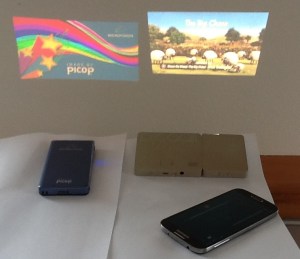
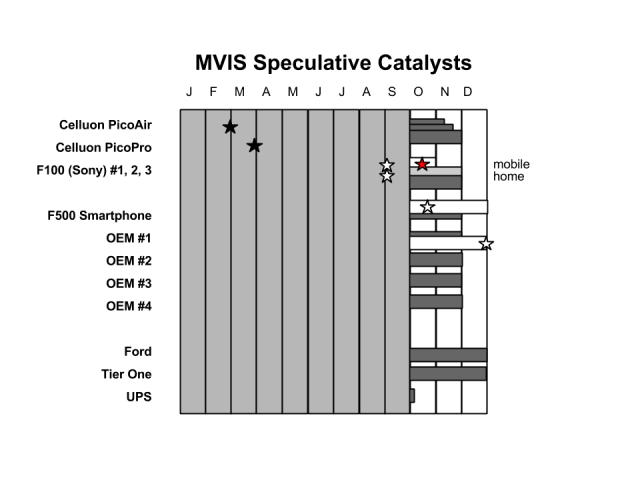
The window of possibilities for MicroVision’s good news is narrowing. Based on company statements, though with a lot of latitude because of ambiguity, MicroVision is due for at least three major announcements by the end of the year: Sony’s launch of its mobile pico-projector, an innovative smartphone from a Fortune 500 company, and the next generation of products from Celluon. There is also the potential for additional Sony products, automobile head up displays, and as many as four to six companies that quietly displayed MicroVision-enabled products back at CES in January.
MVIS_Catalysts_083115Today is September 15, 2015. That leaves only three and a half months for that much news. Today is September 15, 2015. MVIS hasn’t made any dramatic moves since early March, 2015. The pessimist says, “See, nothing is going to happen.” The optimist says, “Wow! These next three months are going to be awesome!” Neither really knows.

As I type, there is no news, but it could happen even as I post. (That’s the optimist taking control of the keyboard.)

This post isn’t about buying or selling. It is a bit about MVIS. It is more about that support network I mentioned before.

The lesson I want to pass along is more about being human than being an investor. I said it then, and decided it need to be said again.

“Be prepared for The Day. The celebration is easy to fantasize about, but there are more pragmatic aspects to manage. Emotions, trading strategies, and logistics are a few of the the real aspects of The Day. I knew that it was very unlikely that I would actually do anything with my stock. I had decided on my sell target and the size of the position. Part of that was simple personal finance. Part of that was recognition of my risk tolerance. Others sold. They made a profit. That’s a big part of what this is about.

The most important thing to have in place is a network of friends who are in a similar situation. It can be hard, and even impolite, to call up someone at work when your news is that you just made two years living expenses before lunch. They might not have the time and they may resent what sounds like a boast. You have to be able to celebrate with someone and talk over the possibilities and implications within your own life. They will help to ground you and may have insights that are blocked from you by emotion.” – Living The Day

I am fortunate. I have a several close friends who also happen to be invested in MVIS (and that’s been painful enough that other friends were pained by the experience.) I am also reasonably active on three discussion boards devoted to MVIS: The Motley Fool, Investor Village, and Silicon Investor. Knowing that you’re not alone is valuable. It is good to know others who are also going through emotional swings while trying to make potentially life changing decisions. It is just as important to have a support network when there’s good news as when there’s bad news. Whether it is for MVIS, or your lottery tickets, or accolades, it is good to have friends around.

I don’t know if MVIS will have as dramatic a day as DNDN. Consumer electronics don’t have decision dates as dramatic as FDA pronouncements. Even if MVIS gets good news, it may not involve trading halts, or headlines on CNBC. But, the time to prepare for events is before the event. The time to buy the umbrella is before you need it, even when it’s a beach umbrella to lounge under because the Sun is shining so brightly.

Posted in Uncategorized | Tagged , , , , , , , , , , , , , | 4 Comments

Just Keep Pedaling Anniversary

“Do nothing and nothing remains undone.”
– Tao Te Ching, Lao Tzu

Fifteen years ago I played hooky from life for a few weeks. I got on my bicycle on an island in the northwest corner of America and aimed myself at an island in the southeast corner. I was trying to do a new version of nothing, a simple monotonous chore in place of the multitude of tasks required of a homeowner. I was retired, but I was spending most of my time tending stuff. I wanted to spend some time tending me. I did a lot of nothing, and something happened. I changed my life, and found optimism in the world.

It doesn’t seem like fifteen years. It seems more like fifteen decades. The other side of middle age feels that way. Fifteen years ago was also one year before 9/11. The world was different then. In 2000, I finished the ride from Roche Harbor on San Juan Island to Pensacola – Washington to Florida (with a quick trip home from Ponca City, OK). I finished the ride. Finally listened to my friends, and wrote the first drafts of Just Keep Pedaling,Just Keep Pedaling my first book which continues to be one of my best sellers. But, I wasn’t satisfied. I hadn’t ended at an island in the southeast corner; so, I decided to finish the book by finishing the ride by returning to Florida in the fall of 2001. About when I was ready to leave, 9/11 happened. Everything stood still. My plans were discretionary so I purposely decided to not fly until the displaced people got home. Finally, in October, I returned to Pensacola and bicycled to Key West breathing humidity I could see, through smoke from the burning sugar fields, and had to dance with a hurricane before I reached my goal.
TheEnd
When I returned, I wasn’t just writing about a bike ride. I’d witnessed a shift in America’s psyche. Paranoia escalated. So did xenophobia. I rode through a scared Florida of emptied hotels and uncertain people. It was a sad time, but I trusted that we’d recover.

Within a year, Just Keep Pedaling was published. It was my first book, with a relatively unfiltered perspective on pre- and post- 9/11 coloring my narrative of America’s various cultures.

Now, in 2015, a lot has changed. I’ve written several more books; but the bigger changes are in our country and culture. The Internet Bubble popped. We launched ourselves into a new type of war, and spent heavily to do so. The economy was fragile, and then The Great Recession hit. Now, there’s much less certainty about national security, financial security, and environmental security – and we’re uncertain about where we’ll find the resources for the new fights.

I’ve also had a divorce and my Triple Whammy. That’s another source of uncertainties, but on a personal level.

“Do nothing and nothing remains undone.” That’s a fine bit of wisdom that runs counter to conventional Western wisdom; “Hard work will set you free.”

As with all pithy phrases, the reality requires a bit of pragmatism. Do absolutely nothing, and die because you didn’t eat or drink. Work 24 hours a day every day, and die because we are only human. Reality is in the middle.

There’s an ease to following intuition, trusting to the world, and not going to extremes. I bicycled across America. I didn’t do it by sitting on the bike in the driveway. I didn’t do it by never stopping (despite the title). I trusted my intuition, rode across America, and thought nothing had happened. I went to lose weight; but didn’t lose any pounds, percentage body fat, or notches on my belt – and that was with missing meals because some towns are smaller than most imagine.

It wasn’t until months or years later that the changes percolated through. While I was on the ride I became much more tolerant of variations in American culture, partly because they were tolerant of me (except somewhat less so in Salt Lake City, Kansas, and Arkansas.) After months, my attitude about my creative skills changed. I saw the political reactions to foreigners with a greater awareness of how little contact most of America has with anything non-American. It has become apparent that we are an impressive country and culture that is not cohesive but continuing to mature with some lingering adolescent attitudes.

Most people didn’t know what was happening forty miles from their homes (the typical distance between towns). Some days I rode twice that distance and saw things they’d missed because it was more than an hour’s drive. They didn’t explore because they didn’t have to – unless that was where the nearest Wal-Mart was. That may sound like a joke, but the things most likely to get someone out of town was either shopping for discounts or visiting friends. Even people that didn’t like where they were didn’t travel because they just assumed the next town was just as bad.

They weren’t ‘doing nothing’. They were doing the exact same thing, perpetually.

Playing hooky isn’t doing nothing, but it is doing nothing about the things that supposedly matter. Push on something hard enough for long enough; and, if it isn’t moving, you deserve a break; and, by taking a break, you may find that you’d already nudged it enough for it to move slowly on its own, or that you were pushing in the wrong direction.

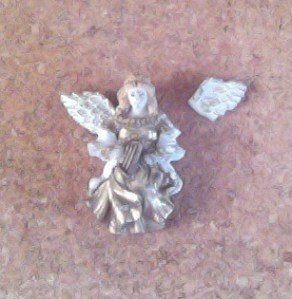
There were a pair of angels in Oregon, and they gave me one. They ran a small convenience store on the edge of onion fields that border the Snake River and Idaho. The longer version of the story is in the book (naturally) but the short version was this: They didn’t try to go out and evangelize to change the world. They didn’t even evangelize when people walked in the door. Despite having to work three jobs each, they spent time listening to customers, finding what the customer truly needed (even if it had nothing to do with what was on their shelves), and providing what they could. For one young, uncertain fellow, they bought things from him instead of telling him to buy things from them. He needed a start to his business, and they provided that. For me, they gave me an angel to carry on my bike. It was a kitchen magnet, but the intention wasn’t trivial.

The angel is broken now. Tiny sculptures don’t survive bicycle tools bags for thousands of miles. Think it trivial if you will, but I didn’t have an accident in over 3,800 miles of riding. To them, it was a little bit of nothing with a big intent. They’ve probably forgotten me, but they’re bit of nothing is something that I remember every time I see the angel on my shelf.  Our most influential actions don’t have to be grand gestures, epic struggles, public demonstrations. Our most influential actions can be something that feels like doing nothing. Our most influential actions may be to take a break and let our previous energies carry us through. Do nothing, and nothing remains undone.

Photo on 2015-09-11 at 18.52

Posted in Uncategorized | Tagged , , , , , , , | Leave a comment

Green Brown Grey Green

DSC_5827My lawn is turning green again. With the drought we had, it went from green to brown, and beyond that to grey. And then the rains came. A few days later and back to green and back to mowing, no time spent in the grey. Good news and recoveries don’t have to take as much time as bad news and declines.

Optimists find good news in a blade of grass. Washington State has been in a drought for months, which is one reason this year’s fire season set records. 100% of the state is in severe drought and ~68% is in extreme drought. I don’t remember mowing the lawn in August, and only had to do it in September because, as Erma Bombeck wrote, “The Grass is Always Greener Over the Septic Tank.” The rains came back in storms that felt like October. After the skies cleared (and I fixed my fence – again) I mowed the rest which had gone past brown to grey, I noticed new shoots of green arising. Welcome back.

That was quick.

The world’s economy and ecology are not just blades of grass needing a bit of rain. But, just because it took years, decades, or centuries to get into the current condition, doesn’t mean it will take just as long to recover. Left to natural processes and without changing our way of life, the necessary recoveries may never happen. But people are working hard at finding new ways of living. New technologies are being introduced. We may actually be learning from our mistakes.

My situation has been less-than-optimal for more than four years. My finances have gone from green, to brown, to grey. A frugal lifestyle and some reasonably steady revenues have helped keep the remaining grey from turning to dust and blowing away. It is too easy to assume that either 1) nothing will change and I’ll be stuck in this tedious situation that has me working seven days a week without being able to pay all of my bills, or 2) it will take four more years to recover from my quick decline. The optimist in me knows, and the mathematician confirms, that small bits of good news can create big benefits. The difference between not being able to pay all my bills versus being able to pay them confidently is a small amount by a great reduction in stress and a great increase in ease. The optimist in me also knows that any email, phone call, or conversation can dramatically improve finances, stress, emotions, and sustainability. Hey, I’m an expert; surely that’s worth something.

Within the last few months, I’ve come across news of:

  • health care costs coming down (or at least not growing as quickly),
  • graphene making progress on everything from desalination to hydrogen production to incredibly strong and transparent and light building materials,
  • US carbon dioxide production dropping to levels of the early 80s,
    renewable energy rising in a self-reinforcing cycle of decreasing costs and increasing effectiveness,
  • billionaires who recognize that income and wealth inequality are getting too extreme,
  • more people bicycling or walking rather than driving,

The good news continues. I capture a lot of it in my blog, Pretending Not To Panic.

PNTP

PNTP

The bad news is easier to report, but the good news is in there.

It is far easier to concentrate on the downside, the potential disasters, the apocalyptic. It makes for compelling stories and news. That doesn’t mean it isn’t true, but it is only part of the story.

I’m witnessing a return to values, habits, and attitudes from more frugal times. The mainstream continues on, but there are significant communities of people growing their own food (without calling them Victory Gardens), people moving into smaller homes (which is the Tiny House trend), people focusing more on community rather than television, people getting by with less either by choice or by necessity. Each trend is easy to dismiss, but their effects are becoming strong enough to elicit immune responses from the conventional institutions. The natural health community has to defend itself against regulatory agencies that don’t know how to respond to food that isn’t mass-produced or herbal treatments that weren’t funded by multi-billion dollar corporations. The Tiny House community has to work around the housing industry that continues to sell the concept of bigger is better and that smaller is degrading to the neighborhood. Television and conventional media know they have to do something different, but only experiment gingerly while YouTubers and podcasters follow their intuition usually failing but sometimes creating empires from simple ideas.

Personal finance is about personal choice. Conventions that were relied on fifty years ago didn’t have much competition, and yet the Sixties happened despite more difficult communication. Conventions now are meeting competition and innovation that may be nuisances but may be historically disruptive, and can disrupt far more quickly because of the Internet. We are in a time of great experimentation at a time when we need to test new solutions. It is happening. We don’t know if the experiments will generate solutions to the problems of our current cultural drought. But, as I plan out my finances and consider my future I know to assume that a lot will change, I’ll probably be surprised, and that good things can happen quickly. It might mean having to do some work, like mowing the lawn after a rain, but that’s okay. Droughts don’t last forever and it can be fun to dance in the rain.

Posted in Uncategorized | Tagged , , , , , , , , , , , , | Leave a comment

Who Is An Expert

Expert? Me? That’s not a term I use for myself, unless we’re talking about who is an expert at being Tom TrimbathPhoto on 2015-06-12 at 20.24, and even there I have some suggestions for improvements. Expert is a title some claim for themselves, have the label affixed by other people, or just play with because the idea is so silly. Thanks to the Internet, the term now is applied by data, an automated assessment of reach and impact – or at least so they claim. In this case, ‘they’ are Klout, and their claim about my expertise has me pondering social media, the reputation economy, and the struggle between ego, self-esteem, and skepticism. Welcome to the world where the computer becomes the authority figure.

I’ll put the plug in now for my talk and class next month because it is a direct example of the new world. Allow me to copy and paste from a previous post.
On October 6th, I’ll teach a class in Social Media Marketing for Artists – which has that dreaded work ‘marketing’ in the title, but the topic will be to artists who have a bit more of a business mindset. That will be at the Oak Harbor campus of Skagit Valley College. On October 20th, I’ll give a much shorter (and cheaper) version of the talk at the Mill Creek Library; and that title is even more business-like; Social Media Marketing for Entrepreneurs and Small Businesses.

Do it simply and right and social media is free. Free is great, but you know someone has to pay for the service. Ads make billions of dollars for Facebook. Twitter, LinkedIn, and the rest have a number of ways to make money because you opened an account. Your account is valuable to them, particularly because your account is part of a network, the social aspect of social media. Understanding you, your network, and the entire community mathematically is valuable because the sites can sell the insights to advertisers and companies. Ads aren’t just broadcast like they were in Mad Men. Ads are targeted as niches and individuals. You’ve seen it. Do a search for something on Google, and an ad will show up beside your Facebook page – sometimes at embarrassing times. (One of the perils of consulting about social media is having a search done for one client kick off an ad seen by another client that makes me start backpedaling and explaining without violating client discretion. Oy.)

Want to see what they see? You can’t – usually. There is one feature that shows up occasionally. WolframAlpha.com, a site that is to numbers what Google is to words, will analyze your Facebook activities to a level of detail that is embarrassingly revealing. During one presentation I gave about social media at the local library, one chart showed up, a quick and astute member of the audience noted it, and later with discretion properly guessed what I tended to do at a particular time of day on a particular day every week. Yep. (Thanks for the discretion.) Go to WolframAplha.com. Type in ‘Facebook Report’ and be amazed (though not today because it seems to be broken. Are they having a disagreement?)

Another way to measure your reach is with sites like Klout.com. Instead of just adding up followers on the various sites, Klout measures the impact of your posts. Sure, you may have a lot of followers, but is anyone listening? Are they passing along your posts to their friends and networks? Maybe you have few followers, but what you say reaches far and is shared often. Klout collects the data from several sites. (My account is based on Facebook, Twitter, LinkedIn, Google+, YouTube after I fix the link, and possibly Pinterest.) The score is relative to everyone else. Get a 99 and you’re hanging out with Bill Gates and President Obama. Get a zero and – maybe it’s impossible to get a zero. The lowest I’ve seen was about 20, and that was from someone who just got started. Everyone’s scores bounce around depending on what they’ve posted lately. My score tends to hang out 60 +/- 2. The scale is logarithmic, sort of, so every extra ten points is a factor of ten higher impact. A 70 is ten times more influential than a 60.
Screen shot 2015-09-03 at 7.24.00 PM
It is enlightening to see which sites have the most reach, which topics have the most impact, and which posts have the deepest engagement. For me, simple posts are best. My photos are appreciated and shared. There are Perks, but that’s another story.

Today, I paid more attention to one of their recent updates. Klout has been listing which topics I am best known for. Sure, this is a bit of nonsense fun to update my profile with some new acknowledgement. LinkedIn has something similar where people nominate other people for their skills and talents, a feature someone called resume whack-a-mole because of the way LinkedIn implemented it. Klout, however, is based on data – no human intervention. The part that intrigued me, and continues to intrigue me is that Klout now also provides the relative score within that topic. I find my results are incredible, as in in- as not and -credible as believable. Am I really within the top:

  • 0.1% in Entrepreneurship (Hey, at least I can spell it.)
  • 0.1% in Photography (Let me tell you about my upcoming class in Nature Photography.)
  • 0.4% in Personal Finance
  • 0.6% in Economics
  • 0.8% in Environment
  • 1.0% in Singularity (Check my previous posts for some of that description.)
  • 1.4% in Energy
  • 1.7% in Aeronautics
  • 1.7% in Climate
  • 1.8% in Project Management

Being labeled an expert in any one of those would be a reason to celebrate. Being labeled an expert in ten of them is overwhelming. Even if some are over-stated, an equal number probably aren’t, and we’re talking about being ranked above more than 98% or even 99.9% of posters. Whoa. Nah. Really?

Then I remembered LinkedIn’s whack-a-mole exercise. Both there and in Klout, I’m listed in so many fields that I’ve maxed out their allowables. When I’m asked to add yet another skill, I have to remove one first. On LinkedIn the skills as ranked by others is:

  • Public SpeakingScreen shot 2015-09-03 at 7.32.10 PM
  • Program Management
  • Blogging
  • Entrepreneurship
  • Photography
  • Aerospace
  • Research
  • Leadership
  • Marketing
  • Editing
  • and enough to fill out the fifty.

Pardon me while I pause and reflect a bit, mostly because such an online reputation is encouraging, yet something that is only now being realized within my business.

My reflection, however, isn’t as important as your reflection. Self-doubt and self-proclamation have always warred with ego and self-esteem, especially when resumes and job applications are involved.

Prior to social media, any such claims were more subjective than objective. With social media, such claims are being made objectively – though without any assurance of accuracy. Regardless of your opinion of the accuracy, the reality is that, if you’re online, you’re being measured. That measurement isn’t just the NSA. That measurement is companies, advertisers, politicians, employers, employees, customers, and suppliers – and friends. The reputation economy is here, quietly. The measurements are being made, quietly. The impacts, however, are only now being realized. Sometimes, it may just be a label. Soon, it may mean much more than that.

(Hey, I just realized it had nothing to say about dancing, karate, hiking, … Oh yeah, that’s because there’s a life outside social media. Not everything important happens online.)

Posted in Uncategorized | Tagged , , , , , , , , , , , , , , , , , , , , , , , , , , , , , | Leave a comment

News News And No News

Waiting for news from one source, get twice as much from somewhere else. The clock is ticking, or the calendar pages are flying, as MVIS shareholders wait for news about a disruptive technology in consumer electronics. The wait continues. In the meantime, news hits about wind power and regrowing damaged nerves. So goes life when investing via that strange mix of a diversified portfolio of innovative companies. AMSC and Asterias had good news today while MVIS shareholders continue to check every breeze for hints.

It is the last day in August, so I planned to write about MVIS and MicroVision. MVIS_Catalysts_083115MicroVision has a projector technology that can be as ubiquitous and adaptable as cameras small enough to fit in mobile phones, tablets, and laptops. There is long list of possible product launches this year, and the remainder of this year is getting shorter; especially if the launches, or even the announcements, will happen before the holiday season kicks in at the end of November. Less than three months to go before Thanksgiving, and no news since the spring.

MVIS is the easiest stock to talk about in my portfolio. The idea of a projector accompanying every camera is simplistic and inaccurate, but close enough to get the idea across easily. Even with my dwindled portfolio, I’ve maintained at least some diversity. Diversification is the cheapest insurance against risk. It usually works. Oh well, sometimes the odds work against expectations. I hope they swing back.

Today, two of my other stocks began exercising that swing. AMSC, which was called American Superconductor until they decided to rename the company after the stock, announced a $40M order for wind turbine control systems. Good news for a $76M company. The stock went up over 24% to settle at a close of up 16%. Asterias, which has a name that is indecipherable to almost everyone, announced that their treatment has worked well enough in clinical trials that they will up the dosage. AST was up about 30% to settle at being up 14%.

Nice big swings, on tiny holdings.

More background on my portfolio and what I’ve said about all of my stocks is available in other posts, particularly my Semi-Annual Portfolio Exercise. One thing I’ve tried to maintain as I recover from my Triple Whammy, is diversification. Within about a half dozen stocks I am invested in wind power, power infrastructure, stem cells, cancer treatments, high-end esoteric electro-optics, pico-projectors, miniaturized image capture, and solar energy. As diverse as that is, The Great Recession whacked each one in different ways. From a portfolio that was on the cusp of comfortable retirement, I now have a collection of mostly promising stocks that have a long way to get to get back to even, and not enough to pay more than a few months of bills. The good news is that 2015 seems to be the year for good news. The bad news is that the good news hasn’t been good enough, yet.

My investing strategy is basically ‘Present Value of Future Revenues Discounted for Risk’. (details in my book, Dream. Invest. Live.)Dream Invest Live cover Find a company before it has made money. Estimate its current value based on what it might make. Estimate the risk. If the current price is below the present value etc, then it is a candidate to buy. Do that for several stocks. Pick the ones that seem best. It is a speculative strategy, but it is one I choose because it attempts to take advantage of a weak spot in the massive financial institutions. Buy something they consider trivial and sell it to them when they consider it to be significant – assuming the price has gone up enough.

The market’s strategy is almost infinite in variety because the number of investors, stocks, and trades creates a chaotic system. Even the major financial institutions can find themselves working from emotion rather than logic. That discount for risk is easily swayed by someone saying, “Oh, that will never work.” or “That’s awesome. We’ve got to get some of that.” Since the end of 2008, “…never work….” has been the norm. The attitudes may be changing.

Much of the march to market records has been in the massive stocks: MSFT, AAPL, etc. They can’t rise forever, and at some point that money begins looking for new places to visit. Take 1% out of GOOG and investors have to find homes for $4.4B. A small shift out of mega-caps can drive enormous gains in micro-caps worth more like $0.040B . The shifts aren’t that straightforward, but the effect can filter through, powerfully.

AMSC’s news was significant because, before the Triple Whammy, it was making more like $400M from wind turbines. This new order for $40M is from a company in India, and India is expecting to add about 3 gigawatts of wind power every year for the next few years. And, AMSC’s business is not limited to India.

AST’s news was significant because it is potentially the first treatment that will allow patients paralyzed in accidents to regain at least some nerve control. The clinical trials are tough because they must involve accident victims who have undergone paralyzing trauma. It is difficult to find enough patients, and then find enough who are willing to undergo the treatment. The good news was that, not only does the treatment appear to be safe, but one patient recovered better than 95% of similar un-treated patients. The dosage will be increased, hopefully leading to a new series of treatment for what has been permanent afflictions.

MVIS’s news was, well, nothing. But in the capricious nature of consumer electronics, and within the highly volatile nature of startup companies (even ones that have been around for two decades), a little bit of good news can mean viability, profitability, and seemingly overnight success.

Investing was never boring. Then came the Internet Bubble. Then came 9/11. Then came The Great Recession. Now, there are high-frequency trades, flash crashes, and global reverberations. There’s always news, some days more than usual; so, I stay tuned, continue my due diligence, and remember that there is more to life than investing. If there wasn’t, there would be no reason to invest.

Posted in Uncategorized | Tagged , , , , , , , , , , , , , , , , , | Leave a comment

Social Media Manners Matter

Will someone please come up with a better name than ‘social media’? Yes, it is correct because the media that is Facebook, Twitter, LinkedIn and such are media driven by socializing, but too many people either don’t use the term and instead just mention the sites they use, or redefine the phrase to mean ‘modern advertising’. I haven’t found a better term yet, but I’m trying; especially, because I am giving talks and teaching classes about it.

On October 6th, I’ll teach a class in Social Media Marketing for Artists (page 64) – which has that dreaded work ‘marketing’ in the title, but the topic will be to artists who have a bit more of a business mindset. That will be at the Oak Harbor campus of Skagit Valley College. On October 20th, I’ll give a much shorter (and cheaper) version of the talk at the Mill Creek Library; and that title is even more business-like; Social Media Marketing for Entrepreneurs and Small BusinessesEntrepreneurs Toolbox That’s one end of the social media discussion, but it has to take place with the understanding that social media persists because of the social part, not because of the media part. Humans are social creatures, even the ones that don’t care about business.

Facebook et al is not just a trend. Trends and fads are temporary. Few other technologies have reached so many people so quickly. Facebook just had its first day when one billion people used it on the same day. One billion. Not one billion accounts. There are already over 2.2 billion accounts. One billion of them used the site on the same day. Skeptics can question the number that were fictitious, but every human system has imperfections and few of them reach such an engaged audience, even only counting authentic accounts. One-seventh of humanity. That’s a community that shouldn’t be ignored. The other sites wish they had those kinds of numbers, and perhaps they will eventually.

I enjoy giving talks and teaching classes. Find something people want to learn about, check that against what I can talk about confidently, and talk to them and with them, not at them. This week, the local library system (Sno-Isle – which has nothing to do with a snowy isle but is based on the two counties of Snohomish and Island combining their resources and bits of their names) – the local library system asked those of us who have made presentations to fill out their database. Internet forms, such a joy, though this one had two benefits: 1) other libraries in the system will know what I can talk about and possibly schedule, and 2) I finally compiled the list of all the talks I’ve given within the system. It’s a long and diverse list. (Here’s version from this blog.)

Except for personal experience, I am not an expert in most of the topics in my presentations. Mostly, that’s because the topics are either so personal or because the topic is so new that any expertise is ephemeral. Maybe there are PhDs in social media, digital photography, and modern self-publishing, but any knowledge they gain in school is antiquated by the time they graduate. Such topics can be handled in talks that are guides in shifting landscapes rather than map directions marked by waypoints.

Helping people set up social media campaigns is fun, even with the frustrations. Twenty years ago, people with causes or businesses had to pay advertisers and buy ad space broadcasting to as many people as possible, touching on lowest common denominators, hoping to luck upon a small percentage of potential interested people. It cost money, time, and was very inefficient. That process is still in place. Social media gives advocates and businesses the opportunity to target niche audiences with specific messages for very little money and time – with enough practice.

And, there’s the trap. That ability to target an audience and sell to them is appealing to the organization. It is not as appealing to the audience. The audience rarely arranged itself specifically to be marketed to. (Though there are fans of teams and brands.) The audience is people, a group of individuals with something in common, usually gathered because they have something in common and want to share their thoughts; i.e. they are socializing. The communication has much more to do with what they want than with what an organization wants.

The trick is confusingly simple. Be social. Be authentic. Be curious about the community, but particularly the individuals. Sure, you have some message you want to get across; but, that’s secondary to their message, the sharing of which created the community. Be a part of the community, not an outsider trying to knock on the door hoping to get a foot in the jamb.

My favorite analogy is a party. If you walk into a party with a handful of brochures passing out business cards and a sample case treating the gathering as a sale call you’ll get a different reception than if you walk into the room with something for the potluck and spend your time asking people about their day and how they are doing. Just like in the non-electronic version of socializing, some people mingle naturally, some need practice.I enjoy crowds, online and offline, and there are periods when I find myself stepping back, deciding not to engage.

There was a street dance party a few days ago. (Okay, it was a parking lot, but close enough.) I talked to a few folks, tried to hear them over the music, got in some very sweet dances, and spent about half the non-dance time just watching the crowd. They are a community that I feel a part of. My business could use more business (got a project that needs to be unstuck?) but I wouldn’t play politician and shake every hand and kiss every baby. It would be rude, and a bit unsanitary.

I try to treat my social media presence the same way. I use it for socializing primarily, and use it for business somewhat. Facebook is mostly for friendly stuff (and am surprised at how much unfriendly material is posted – and then blocked). Twitter (@tetrimbath) is more for news, for my education, but also to learn about topics pertinent to my business and my clients’ interests. LinkedIn is all business, but with a nod to humor. Google+, Pinterest, Reddit, Ello, and others all have specific yet overlapping uses. I use them all as I need instead of wasting a lot of time placing them all at the same level of importance.

Ironically, the best way to give the Social Media talks would be to use social media; but that works best for me, not the people who want to learn more. That’s one reason I give the talks in person – because it’s more sociable.

So, here’s the part where I do mention my services because that’s one of the functions of this blog, which is yet another aspect of social media. Social media is a new part of the world. As long as the Internet is functioning, people will be socializing across it. Whether Facebook, et al persist or are supplanted by yet some new bit of ingenuity from some teenager, is impossible to know. The basics will be the same as the basics of human communication; be nice, be authentic, balance listening and speaking, and exercise good manners – with a sense of humor. That may be the best way to conduct the most important business – being a human in a community of humans, being sociable.

Posted in Uncategorized | Tagged , , , , , , , , , , , , , | Leave a comment

Economic Blip Or Slip

Here we go again? The weird thing about blogging about personal finance and frugality for so many years is that an entire economic cycle may be repeating, or not. (My first post was from November 2008, just as The Great Recession was gaining speed.) Inquiring minds want to know, are asking me questions; and I’m one of them. Recent events have me wondering whether we’re about to see the world’s financial pendulum swing again. I wonder. Let’s see if I can show you why.

Monday, August 24th, the Dow dropped over 1,000 points within minutes. It recovered, but it recovered to a level that would’ve been considered a major drop.

The Dow drop was supposedly because China’s stock market dropped, had been dropping, and efforts to curtail the losses weren’t successful – and that’s in a country that has an amazing level of control over its systems and citizens. The fact that the manufacturing index was down, and that investors had doubts about the extraordinarily high GDP growth encouraged many to switch their view of China from exemplary role model to possibly just another bubble economy.

For the last few months, the price of oil has been dropping because the Saudis were maintaining high production. Normally, OPEC and the Saudis would back off to keep prices high, but an internal price war broke out as the cheaper producers (OPEC and the Saudis) tried to squeeze out the expensive producers (North Dakota’s boom, Russia, Venezuela, etc.). It has been succeeding, but it also means there are several countries and regions that are going into recession because their revenues are down more than their expenses can be cut. Some blame the economic pressures on some countries’ military posturing, which may act as a distraction to their populations. More countries are then at risk, and the markets don’t like risk.

The price drops have happened just as solar and wind power prices are falling to the point that it is becoming cheaper to live off the grid than on it, at least for some. Some countries, like Costa Rica, Denmark, and Germany, are experiencing days or weeks of fossil fuel free electricity production. Costa Rica just set a record of over 90 days, and that was only interrupted by a one hour spike. Lower energy prices are good news, but the reduced demand for fossil fuels happening as there is increased supply of fossil fuels means the prices of fossil fuels will remain low, possibly undermining traditional power structures.

Some countries are just having bad financial times because of debt. Greece is frequently in the news, but Argentina also has problems. Puerto Rico isn’t a country, but it is in a similar situation. Bond holders are asking for their payments and are demanding austerity, which means less money for government services and less growth within the country – particularly as their citizens emigrate to better places.

With problems in Greece and a few other places, the European Union and particularly the Euro, seem less stable; which means yet another large economic zone isn’t as stable as markets would prefer.

From the inside, the US is always full of internal debate and concern about the nation’s money policy. It seems to be one of our defining characteristics. For decades we’ve had too much debt, according to some. The response to The Great Recession was to drop interest rates and increase ‘Quantitative Easing’. which funneled money into the economy, and which may have fueled the stock market rise. The Fed agrees with most people that the QE had to be temporary, and its curtailment was a reason to expect stock performance to diminish. At the same time, interest rates have been kept low to encourage borrowing and fuel growth; but the rates are so low that the Fed has eliminated the possibility of dropping interest rates if necessary.

One of the concerns is inflation. With so much more money in the system, inflation seems inevitable, yet it hasn’t been in evidence. Money is flowing in, but it isn’t appearing in paychecks. Without more money to spend, the economy isn’t growing as much. If the economy isn’t growing enough, and if inflation is so low that it switches to deflation, then the US economy is in a difficult position because interest rates are already too low. Aside from interest rates, there aren’t as many tools to fight deflation as there are to fight inflation. Inflation is measured across an arbitrary collection of expenses, and it is possible that parts of that collection are inflationary (food and health care) while others are deflationary (fuel and technology). As a result, it is possible that some Americans are already in a deflationary cycle.

Deflation has usually been academic, but it is already more prominent in Europe where interest rates are so low and inflation is hard to find to the extent that some savings rates are negative.

The economy is a system, and probably a chaotic one; which means it is inherently unpredictable. Systems theory, however, can look at such systems and draw some conclusions. There are a couple of TED talks that I’ve referenced in my posts. One proves that the world economy is not being run by a cabal, no conspiracy theory necessary; but the world economy is largely controlled by about 200-300 people who wield more than enough power to drive the system – and that they are probably unaware of their larger role. The analysis also shows that the system is unstable. The other analysis used a different approach to come to the same conclusion that the system is unstable. It just happens to be a system that drives the global economy, is unstable, and the instabilities are growing.

Wealth and income distributions reflect all of these effects because wealth and income are the money collections and movements that make up the economy. The last time income inequality was this bad was 2008 and 2000, just before The Great Recession and the Internet Bubble bursting. Wealth is concentrating into fewer hands such that 80 people have the same wealth as 3,500,000,000. Every year fewer people own half the wealth. A few years ago it was over 300 people. An increasing concentration is unsustainable because at its extreme one person owns everything (impossible), and as wealth accumulates, some fraction of it is taken out of the economy, limiting the economy’s growth because the rest of the people have less to spend.

That’s some of the bad news. If that was all there was, it would be time to climb into the bunker and close the door.

The good news is harder to find, isn’t any clearer that the bad news, and isn’t talked about as much because we humans more readily dwell on the worrisome.

Economies haven’t gone to zero. There is a lot going on. Billions of people are working. Technology innovations are improving lives and economies, and may not be properly represented in the numbers. And, humans are amazingly adaptable.

The Great Recession hurt. So did the Internet Bubble, the crash of 1987, the stagflation of 1980, the fill-in-the-blank of every economic crisis back to Egypt and Mesopotamia. We get through because we do what we must, frequently complaining about the old world fading while quietly incorporating new ideas like the wheel.

I haven’t watched the markets any more or less this week. I’ve seen enough cycles that many of the phases are familiar. Right now we’re in the phase where it is easy to create an appalling list of worries without knowing if this is a blip or the start of a major slip. I live a frugal life. I think I work hard enough, maybe too hard. I’m invested in several places, though not as much since my Triple Whammy. I’ll think about what’s going on, but I’ll spend just as much time thinking about working with my clients, teaching my classes, fixing my backyard fence, spending time with friends – and making sure I dance. Gotta dream. Gotta invest. Definitely gotta live.

(Most of the news items behind my understanding of the situation are posted on my other blog; PretendingNotToPanic.com, my daily newsfeed of “news for people who are eager and anxious about the future” .)

PNTP

PNTP

Posted in Uncategorized | Tagged , , , , , , , , , , , , , , , , , , , , , , , | Leave a comment

Maxwelton Meal

Blame it on the butcher. Without knowing it, they inspired the idea of a Maxwelton meal. South Whidbey, where I live, is considered rural; but most people living here seem to be either retired, commuters, artists, or some other more urban occupation. Very quietly though, the Maxwelton valley is one of the many places on Whidbey that has managed to maintain quiet enclaves of farms and ranches. When the butcher opened their business a few miles from my house, I realized that a bicycle ride through the valley could gather enough meat, produce, and wine for a local’s meal. The best way to see what the valley provides was to find a sunny August afternoon and fill the panniers. A frugal life can include fine food.

Whidbey Island DistilleryMaxwelton Meal
The first shall be last, or at least the first thing I bought was the last part of the meal. Five years ago Whidbey Island Distillery opened. That happened just as I was scaling back my expenses, so I never had the excuse to visit. They were known for their berry liqueurs, which seems appropriate considering all the blackberry bushes on the island. (Though their supply is off-island, but regional.) That sounded like a nice dessert, and I knew they had half-sized bottles, so it was definitely worth adding to the shopping trip. They were the northern most stop, so starting there made sense. The fun part was finding out that they also sell a rye whiskey. Oh, that was tempting, but the thought of having a $60+ bottle of boutique whiskey break in my panniers was too much. Maybe I’ll go back in the truck after pay day, or after saving from several pay days. I bought a bottle of their flagship product: Loganberry Liqueur. On the way out, one of the owners was setting up a bunch of chairs on the lawn. It turned out that it was their fifth anniversary of being in business, and that they’d won several awards. Happy Anniversary!

Spoiled Dog Winery
Drinking a liqueur throughout dinner seemed a bit much, but next on the list was a winery, Spoiled Dog Winery. That’s a winery named after a spoiled dog, not a dog winery that spoiled. There was a narrow window for the bike ride because of the various operating hours, but arriving ten minutes before closing wasn’t good enough. The gate was closed. They didn’t answer the phone. Oh well, that’s island time. For some businesses, posted hours are suggestions, not requirements. Rigid schedules get left behind in ‘Merika. That’s okay, another local vineyard and winery had just celebrated their anniversary, and I had a bottle of Whidbey Island Winery‘s Island White, the wine with a simple name but a flavor I like.

Co-housing U-Pick
Dinner needed something solid. The first U-pick was working from a limited crop this year. Drought and other interruptions meant they had to rely on beans, but they made up for that with variety. Sure, green beans are common enough, but it is so much easier harvesting yellow and purple ones, too. They even had zucchini. Oh wait. Everyone has zucchini. I wonder what they’ll have next year.

7 Generations Artisan Meats
The instigators were next: 7 Generations Artisan Meats. The place for carnivores who appreciate meat that hasn’t been mass-produced, and the place where the people preparing the food obviously care about taste and flavor rather than just profit margins. I think bacon sausage sums it up. Bacon = good. Sausage = good. Bacon sausage? I’m looking forward to breakfast. Sure, they have steaks, roasts, and burgers. But they also have about a dozen other things in the case like sausages, salamis, jerky, and bacon – the best bacon I’ve ever had. They even have beef bacon. Usually the thing that limits me is my budget. This time it was also my pannier. I had to make sure there was room for a couple other stops. With a bit more money and a bit more cargo capacity I would’ve picked up stir-fry, bacon, and maybe a steak for a special event.

Britt & Eric’s farm stand
Doh! I can’t remember the correct name for Brit & Eric’s farm stand. Brit & Eric run a small farm, and sell most of their produce to subscribers and in the local farmer’s markets. (We have at least four every week – Thursday in Clinton, Friday in Langley, Saturday in Bayview, and Sunday at Tilth, each different with some familiar faces.) They must have had a good week because the only things in the self-serve stand were kale, green beans, and zucchini. I skipped the kale.

Maggie’s U-Pick
Maggie is hitting her stride. Her U-pick had more vegetables and fruits to pick from than any other place except the grocery. Every year her operation improves. I bought onions, peppers, beets, squash, and an apple. It took a while to decide because in each case there were so many options. Yes, she had onions, but not just one type. The same was true for all the fruits and vegetables that I can recall. Her white board listed more. A signup is available for eggs. All of that was already picked and in the farm stand. With a bit more effort there was an entire garden to harvest, with instructions about what to harvest, what to leave for later, how to harvest, and suggestions about preparation and storage.

Bailey’s Corner Store
The last possible stop was far enough out of the valley to not be considered in Maxwelton (which is also somewhat true about Maggie’s) but Bailey’s Corner Store was on the way home and they had one thing I was willing to consider as a stand-in for the wine: locally brewed beer in a growler. They’re becoming much more than a corner store. My panniers were packed. I don’t know how I could fit the big heavy bottle into the pack, but it might be worth it – as long as it didn’t shake too much on the last mile and a half ride home. It was moot. They were out of growlers. Beer and sausages go so well together. Oh well.

For those expecting haute-cuisine, go check with a chef. I’m a cook. I cook for myself, and occasionally for friends. I unpacked the bike, heated up the oven, sorted through my haul, and proceeded to fry up the onions, peppers, and sausage. Then I added the beets, covered the skillet, and let it all roast in the oven while I started writing. Near the end, I threw in the beans and zucchini to let them steam. During all of this, I enjoyed the wine. After I’ve posted and shared this blog, I’ll uncork the liqueur.

P82A0176

In some ways, this is a splurge; but it was a frugal splurge. The total came to less than eighty dollars for a harvest that will become about two weeks of meals. Divide it out and I’ll have spent less per meal than almost anyone going into a restaurant. I know where everything was grown. Even the cattle are local. The farmers and ranchers are more likely to treat the food well because we are all in the same neighborhood. There is community instead of anonymity.  I know who is getting paid. There is no intermediary, and if there is, I probably know them too.

This is what is happening in one slice of one part of one island. It is also happening throughout the country. Don’t like GMO? Shop local from someone you trust. Don’t like corporate farming? Buy from the family farmer – directly. Want to make food shopping fun? Deal with people for whom food is a passion. If farmers and ranchers were solely interested in profit, they’d sell out and get a job in IT, or anywhere that has better returns than hoping plants and animals will grow. Maybe you only do it as a splurge every few months, but it is a fine way to explore your community, realize there is one, and be part of it.

If you’d rather have a tour first, take the Whidbey Island Farm Tour, September 12-13. And, it’s free, a fine frugal word.

Now, where’s that bottle of Loganberry liqueur?

Posted in Uncategorized | Tagged , , , , , , , , | Leave a comment

A Minimalist Photographer

Nature photography is natural. It’s amazing how complicated it become: f-stop, shutter speed, depth of field, et al.
Nature is sweet, DSC_2695
awesome, Finale
introspective, DSC_0007serendipitous, DSC_0126serene. DSC_4293Photographing it should be the easy part, and yet photography requires a camera, and a camera is technology, so understanding a few details makes a big difference. As a minimalist, I try to rely on as simple a camera as possible, as few details as possible, and enjoy it as much as possible. Life as a frugal is like that, reducing the experience to the essence, seeing past the clutter. Evidently, I do that well enough that I’ve been asked to teach a class on nature photography. (Page 62 in the off-line catalog and page 64 in the online catalog.) How that happened is as example of persistence and intuition at work; which applies to much more than taking pretty pictures.

I celebrated the news by telling some photographer friends that I was going to teach the class. One laughed, and then apologized. I understand. Most photographers have armies of lenses, filters, tripods, and flashes. I have a Nikon D-40, a camera so far down the line that it could be replaced for the price of one of their lenses. My favorite tripod is an old ski pole, so it’s really a monopod. I don’t have an MFA. I do have forty years of taking photos. I can’t talk tech specs. I can talk about how to schedule a sunset session that spans the wildlife, lighting, and environmental issues that vary over three hours of photography. I also know that I can sell my photos. (Whidbey Island & Washington’s Cascades)

Life has changed dramatically within the last decade. The change has been rapid, yet not so rapid that people haven’t embodied the change. Once upon a time, Kodak sold film. It is anachronistic to point out that people had to use a camera, tended to only take as many pictures as would fit on a roll, then would drop off the film to get processed and printed (maybe getting dupes on Tuesdays!), and share them by handing them around with friends. It wasn’t that long ago, and yet it was a different era. Food porn wasn’t possible. Selfies were self-portraits. News events captured on film were rare. Now, if you’re carrying a cell phone, tablet, and laptop you are probably carrying anywhere from three to six cameras. And, you might even carry a camera that does nothing else except take photographs (though it probably also does time lapse, panoramas, and videos with audio.) Photography has become easy and very common.

Frugality is the appreciation of the value of everything. When you realize how valuable some things are, there frequently isn’t a need to acquire more things. In my case, that applies to cameras, too.

I enjoy nature, and haven’t been getting enough doses of it. I’ve almost always carried a camera on my hikes, ski trips, and bike rides. When I’m carrying my camera, I’m carrying it; the work is being done by a car, a plane, a bus or a train. The bicycle helps, but there and with the rest of my trips, every pound I carry I have to spend energy and effort to move. The more things I carry, the more things I have to take care of, and the less time I spend enjoying the journey. I naturally reduce and refine until I’m usually carrying one camera and one lens – and then relying on intuition and trusting to my choice. As many artists practice, it is the self-defined constraints that help define the art. One five year photo essay I completed was done without tripod, almost exclusively with one lens, with no flash, without cropping, and only minimal color correction. The biggest alteration was having a professional remove the inevitable mist and dust marks from the images. Photographing by the seashore has some messy elements, just like almost all nature photography.

The good camera on an iPhone 6 captures more pixels than my old Nikon. The bad camera on the iPhone 6 is better than the camera that I used before that. Yet, both of my cameras produced images that sell. Allow me a big of self-acknowledgement. Using both of my cameras, I’ve produced images that have sold. Photography is as much about the camera as cooking is about the oven. Yes, a high-end Viking oven is an awesome thing, but I’m making tonight’s chicken and rice dinner from scratch in an oven that may be original to this 1965 house.

Too many people downplay their abilities, and lately assume it is because they are not good enough for their equipment. Bah! I’m amazed at people’s abilities. Much of what’s required to use today’s technology is knowing what to turn off, not trying to understand every option and menu built in. That’s true of cameras, ovens, cars, and software. It’s more important to understand what you want to do, than understanding everything the equipment will allow you to do. Just because your car can go over 100 mph doesn’t mean you have to practice driving that fast. If all you need is 55, then don’t think about 100 and beyond. (But I do still enjoy Top Gear, but that’s another story.)

The world is overwhelming. Before we were global we weren’t as aware of every crisis in every community. It is easy to get to the point where you just want to unplug. Good. A nature walk is not an escape. A nature walk is a return to reality. Nature Walk Feb 2012The photo that became that poster is from a 3 mega-pixel point and shoot (that sadly was subsequently accidentally dribbled across a parking lot.) The most important thing in using any tool is your intent, what you want to do or say, rather than what the machine can do. Whether it is photography, or writing, or living your own life, your intent is the most important thing. Discovering a person’s passion and intent is something I enjoy doing. That I can teach, regardless of the camera. That’s something we all can learn, regardless of the topic.

Now, if only I had a point and shoot to show you the chicken and rice with roasted tomatoes that’s coming out of the oven. But, the important part of dinner is the flavor, and that I can’t catch on film.

If you want to take the class (and missed the link above), here’s the link again. If you want me to teach it somewhere else, contact me. If nothing else, we’ll have a good time chatting.

Posted in Uncategorized | Tagged , , , , , , , | Leave a comment

Housing Oil Yuan And Tea Prices

There isn’t just one number for the price of tea in China. The only number that matters to me is how much it costs when I buy some. A bunch of prices are bumping around in my head. They’re all connected because the world’s economies are all connected. The price of housing in San Jose, Seattle, and south Whidbey; the price of oil; and the price of the Yuan, China’s currency. For a frugal person who doesn’t need much to get by, I certainly think about money a lot.

Seattle’s housing market is – hmm – bizarre, gonzo, bubbly. Instead of a healthy six months of inventory, there’s 1.18 months. The median time to sell a house has dropped to about nine days. More than half the houses on the market are bought within two weeks. The median price is about a half a million dollars. In the pricier neighborhoods, the number is closer to three-quarters of a million. I’m sure there are some neighborhoods where it’s closer to a million. That’s not the most bizarre part. The Bay area is worse. Median home prices are about a million, and I suspect pricier neighborhoods make that number look small.

South Whidbey’s housing market, not quite the same. Zillow puts the median price at just under $300,000, which is a bit below their estimate for my house. My Make Me MoveDSCN5593 price is $325,000. No one’s made an offer yet. I won’t dwell on the consequences until someone makes me the right offer. Houses are starting to sell. Two on my street sold within the last few weeks. Others pop up, but there’s still only about three months of inventory from what I last read. The greatest increase in my net worth has been in an appreciating house value, not from my portfolio and not from working almost every day. (Hey, I took about five days off this year – wait, make that four.)

The price of houses are a bit above and below a million dollars. The other price I’m watching is only a few dollars a gallon.

The price of gas dropped months ago. The price of a barrel of oil dropped from over $110 to under $50. Today, the price closed at $42.50. Screenshot 2015-08-14 at 19.04.45Fracking and the Saudis mean more oil is being produced that usual. Renewable energy is becoming cheaper and easier to use, so people are using less fossil fuels. Supply is up. Demand is down (or at least not growing as quickly.) Prices drop. The major players like OPEC are involved in a price war that is targeted at companies and countries that produce expensive oil like: Russia, Venezuela, even Canada and its oil shale. Recessions are occurring as oil revenues drop in regions that have little else to sell. I’m surprised the local gas price hasn’t dropped by the same proportion.

Even the price of money is changing.

Currencies always have shifting values, but most of us tend not to worry about it much. Retailers near borders or who export and import need to know about such things, but if you’re personal finances are all in one currency, the main thing to watch is inflation or deflation, not currency exchange rates. China, however, has many people worrying because it began adjusting its currency, the Yuan. Maybe it’s nothing. Maybe it’s something. One of the worries is that China’s phenomenal growth economy may have been a bubble instead of a stellar success story. Maybe they’re adjusting the currency to strengthen the economy because other mechanisms aren’t working well enough. A currency that is changed a few percent doesn’t sound as severe as a house price that doubled or an oil price that halved, but when the largest country and one of the largest economies shifts itself a bit, many people worry, and react.

Personal finance conventional wisdom works best when the world is simple. Dream Invest Live coverSpend less than you make. Invest the rest. Keep ahead of inflation. Bubbles and busts interrupt those plans because the numbers change dramatically.

A friend passed along a comment made by someone in San Jose. If you want to visit the Bay area, sit still, it is coming to Seattle. The Bay area has become so expensive that people and businesses are moving out, and Seattle is one of the favored destinations. The atmospheric, demographic, geographic, technical, and financial environments are similar enough. The industries driving the growth are key to the Information Age which has proven itself to be much more than a fad. Seattle’s housing booms.

The price of energy, not just oil, is dropping. Falling prices are welcomed by consumers, especially frugal ones. Falling prices, however, worry economists. Inflation can be a threat, but there are many more tools for trying to control it. Maybe the US quantitative easing and the overall debt will eventually trigger high inflation, but the prices of many commodities are falling. Few expected oil to ever come down. After it exceeded $100/barrel, many expected it wouldn’t stop until it exceeded $1,000/barrel. Massive investments, like fracking and drilling in the Arctic, assumed that higher prices would produce higher profits that would pay off the investments. Now, as prices drop, oil industry bankruptcies are expected to rise. Falling prices are central to deflation, there are fewer tools to control it, and those tools work best when interest rates are high – which they aren’t.

Then, there’s China.

China has been producing significant wealth, an interesting result from a communist country. Some of the wealth is looking to leave the country, and one way it does so is by buying real estate. The west coast of North America already has a large Pacific Rim culture, so buying in places like Seattle is buying into a comfort zone, whether the properties are occupied or not.

China is also one of the major consumers of fossil fuels, and also one of the greatest proponents of renewable energy. They benefit from low fuel prices and also from more efficient and cheaper wind and solar power. Their economy and their people benefit from the recent trends.

China is also worrying economists, financiers, and many others because of the possibility that they are in a bubble that is bursting. Chinese citizens may also be worried, and worries are another reason to move money out of the country.

Influences that are usually inconsequential to most people are bumping into my considerations. What’s going to happen to the global economy? Are we about to watch another bubble pop, just like in 2008, 2000, and before? Are we about to enter into deflation, something I’ve never experienced but have considered and then felt myself shudder? Are we about to enter a period when expenses are down, pollution is down, excesses are moderated, and wealth becomes more distributed?

I don’t know. (Yeah, I probably should’ve said that at the top.)

What I do know is that, with all these phenomenal influences jostling each other, my best response is to keep working, continue investing, live frugally, and remain open to opportunity. Who knows? Maybe someone from Harbin will come over and make me a full-price, no inspection, sight-unseen offer for my house. Hey, it could happen.

In the meantime, while a rare storm blew through on this August afternoon, I sat and sipped a cup of tea while enjoying the play of massive forces that did nothing more than make a lot of noise, water the lawn, and give me an excuse to put aside work so the lightning wouldn’t fry my computer.

(The Drum Mountain White Cloud I just bought from Dandelion Botanical cost $3.25/ounce, some of which was shipping fuel costs from China to Ballard with a bit of profit included. The tea was fine. Glad I took the time to enjoy the show.)

Posted in Uncategorized | Tagged , , , , , , , , , , , , , , | Leave a comment