Saving Money Causes A Headache

So that’s where this headache came from. Silly me. I tried to save money. Instead, I’ll be spending a day or two of reduced productivity, and maybe reduced income, because I packed and ate a sandwich. Lunchmeat, (or was it the stinky cheese?), signed me up for about two days of mental resistance training. Saving money isn’t just a matter of math. Experiments may be involved.

The good news is that I am back in a coworks, again. The longer version of the story will come out soon (after their official press release or at least a good tweet.) Ideas don’t always grow when they’re first planted, but give them some time and they may sprout. In this case, a non-profit that I’d talked to months ago about coworking found a model that may work well with their facility. The news may not be out, but I am in as the first coworker, which made me a solo-worker until the second person signed up. (Thanks, Pattie.)

If you need a primer on coworks, check out some of my previous posts. They might help. At the simplest, a coworks is a shared office that emphasizes collaboration interspersed with great expanses of concentrated work time. Some of my best gigs came from sitting with a diverse set of people and tangentially being invited to take on something they didn’t want to do, or couldn’t do. One good gig can pay for a year’s dues.

Many nomadic workers in the Gig Economy and the 1099 Economy work from a variety of places: home, libraries, coffeeshops, anywhere they can comfortably find power and wi-fi. Home can be distracting, and can lead to being a recluse cursed with self-inflicted cabin fever. Libraries are free, and great if there’s a need for lots of books; but there can be privacy issues when dealing with clients or when someone might not approve of what’s on your laptop’s screen. Coffeeshops have food and drink, for a price; and usually don’t want outside food and drink, so those prices add up. They also have espresso machines, music, and seating that is designed for style more than typing ergonomics.

A coworks costs money, but less than a shared office. There are far fewer distractions (some day I’ll get to those dirty dishes at home.) It’s quieter than most places, even modern libraries, but background noise happens. (Currently, I’m overhearing 2016’s version of teen pop. Earlier, it was someone practicing piano.) Coworkers tend to be respectful of others, so privacy is less of a concern. A coworks that allows people to bring in their own thermos and lunch means frugality leads to significant savings when compared to buying every beverage and eating out for lunch. And, that’s where I stumbled.

Langley, WA July 2013Langley, WA on Whidbey Island is an international tourist destination for good reason. The tiny city has very good food; plenty of coffee, tea, wine, and beer options; and is priced accordingly. In general, for every restaurant meal I eat, I have to work an hour or two to pay for it. Somedays, like today, I only have three billable hours. There goes that money that should go to the mortgage, various insurances, and a variety of utilities. Ah, but I like to cook, can eat simply, and can enjoy my food (which my waistline demonstrates.) Therefore, brown-bagging works for me.

Buy some eggs, cheese, veggies, and maybe some bacon and bake up some quiche that travels well. Buy some bread, lunchmeat, and cheese and layer up a lunch that is simple and satisfying. Commute by bicycle, and justify eating it all (while fighting that waistline bulge.) Combine it all and make meals for nearly the price of eating at home, with the bonus of getting in shape.

The hurdle is that I eat gluten-free. I’m not one of the evangelists that have done years of research. I accidentally experimented with my diet and menu, and stumbled across the realization that anything with wheat ruined my mood. Decades of bad moods explained by a grain. No problem. Eggs, cheese, veggies, bacon, bacon, bacon, (oops, sorry, got carried away there), and cheese don’t have gluten. Gluten-free bread is expensive, but readily available and tastes fine. Lunchmeat shouldn’t be a problem because meat is gluten-free; but (and you knew I was going to get here), lunchmeat can be different. Sliced ham, beef, and turkey are usually okay; but, lunchmeat is one way to extend meat, cutting back on the protein and the cost by adding fillers. Currently, I am cursing those fillers.

My meal savings were substantial, but the side effects made for a dismal Fourth of July (with the fireworks not helping), and a week of a fragile mood amplifying any bad news. Work ended early most days, limiting my income more than the savings. Grump.

Fortunately, the effect is temporary, for me. The unprocessed lunchmeats tend not to have gluten issues. One solution is to use a different (and more expensive) local deli that emphasizes organic, free trade, open-range, sustainable, basically healthy food. Shopping there costs more, but building lunches from there is still cheaper than eating out, so the savings remain.

People who live frugally, who live simply, tend to experiment. There isn’t one answer for everyone. People are individuals, not stereotypes. Vegans certainly aren’t going to follow my example exactly; but some of the same ideas apply. Extreme networkers know their best use of time is to purposely dine in public; they balance the cost of the meal against the potential value of every encounter. Maybe that would work for me, too; but, I’m not comfortable with that financial risk. Fortunately, simply walking around Langley is sufficiently powerful networking. Smiles and showing up are powerful and affordable tools.

Without getting into the icky details, I know what I must do with the gluten flowing through my body – get rid of it. Plenty of fluids and exercise sound familiar? Time helps, too.

The other thing that helps is the inspiration to get back into my kitchen. It has been a while since I’ve made meatloaf. Local ground meat, local eggs, leftover homemade gluten-free cornbread, an onion, some garlic, maybe some mushrooms or olives, some messy fingers and a messy kitchen, giving the mix some time in the oven, and I end up with lunchmeat that is cheaper and tastier than sandwich meat I’ve found in a deli. Oh yeah, and bacon, gotta top it with bacon (an idea I got from my Mom) – and I happen to have some nitrate-free bacon sitting at home, waiting.

I guess that math does work out, thanks to the lesson learned from a headache.

Posted in Uncategorized | Tagged , , , , , , , , , , , , | 1 Comment

Semi Annual Exercise Mid 2016

Welcome to my semi-annual portfolio review, a bit of due diligence that is easier when the portfolio is growing, and an exercise in openly assessing the situation when the stocks are sinking. Personal finance is easy when everything works. The last few years have been the test of the personal side of personal finance; looking at an unpleasant situation, but looking at it objectively. Just like it is easy to ignore the fundamentals when stocks are rising, it’s important to pay attention to the fundamentals when stocks are sinking. Fundamentally, the majority of the companies I am invested in are improving. Quantitatively, their stocks aren’t. Trusting fundamentals isn’t easy when there’s a large gap between cause and effect; but, that’s why long term buy and hold emphasizes the holding for a long term.

Allow me to restate my statement from six months ago.
“As usual, I expected my portfolio to end 2015 in a much better position that it was in at the end of 2014. Relative to 2014, 2015 looks good. Relative to where my portfolio was before my Triple Whammy, 2015 didn’t make much progress. The stocks bounced around a bit, with ups and downs. The companies, however, are in much better shape. Eventually, that improvement should show up in the stock price, too.”
Should is not necessarily would, and definitely isn’t did. Except for AMSC, every stock is down, RGSE disastrously so. And, even RGSE had revenues in the tens of millions. Many people will be blaming Brexit, but this has been the case for several months. Good news is followed by a declining stock price. Bad news is followed by a declining stock price. When almost everything is heading in the same direction, it probably isn’t the individual actions but is something more systemic. The world is not a happy place.

Let’s see if anything else can be copied and pasted from December 31, 2015. (The old stuff is in italics.)

AMSC may not have received the positive news from the Chinese courts about the intellectual property theft case, but they are receiving new orders. AMSC is up 23% since mid-2015.
Basically the same story, but with different numbers. Now up 37% since EOY-2015.

AST is still in early clinical trials for regrowing damaged nerves, but some of the responses have been so encouraging that for a while the stock quadrupled, until a competitor had good news, too. AST is down 14% since mid-2015.
The trials continue though, so evidently the competitors haven’t clinched the race. AST, however, is down 32%.

GERN is also in clinical trials, but it is further along and navigating the FDA and international regulatory agencies on its way to possible approval of a cancer treatment that has great implications – if they can get approval for at least one specific cancer. GERN is up 13% since mid-2015.
The trials continue, hopefully one year closer to applying to the FDA; but the stock slumps by 44%.

GIG under-promised and over-delivered by saying little, then achieving GAAP profitability. The little company is getting a lot of attention as the year closes.  GIG is up 143% since mid-2015.
Except that now it is down 18%, which may have more to do with yet another merger and acquisition action that confuses finances.

MVIS was perceived as over-promising and under-delivering, but even with that, they are making progress, have record revenues and backlog, and continue to maintain an impressive potential – that will be realized within the next few months (which has been the case for several years.) MVIS is down 7% since mid-2015.
Realized within the next few months? Yep. Supposedly “several OEMs will announce products this year.” Again. With nothing significant announced. Again. But this time will be different. Again. Right? In the meantime, down 34%.

RGSE has managed to somehow stumble in the high-growth, high-demand industry of solar power. The company is worth less than many homes in America. It dropped so far and so fast that even selling now wouldn’t buy me much of anything else. RGSE is down 50% since mid-2015.
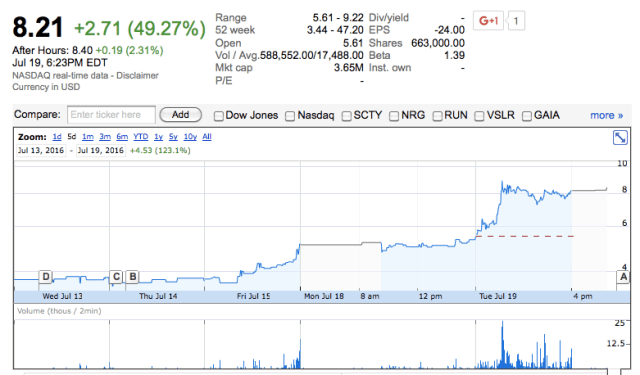
Now it is down another 64% to about $3M, so I am regularly paid to write about houses that are worth more than a company with more than $40M in revenue.

My patience has been tested so thoroughly that it has put down its No. 2 pencil and is sitting back to see what happens with the grading. Aside from some minor adjustments, and one fortuitous profit-taking trade, my portfolio remains in a reasonably good position in terms of company progress, which has only begun to show hints of portfolio progress, and which is well-enough positioned that 2016 may be the year when I get to regularly share good news again.
Not so far. My patience is shifting to resignation. What will be, will be. Of course, that could be good.

I feel that I am witnessing a race between the advancement and progress of the companies I’ve invested in, and the troubling signs I see in an economy that is at least bifurcated and possibly destabilizing. (Much of the economic news is over on my blog for “news for people who are eager and anxious about the future” (aka PretendingNotToPanic.com). In the best scenario, everything is awesome for my companies and stocks, and the economy. In the worst scenario, everything falls into the Reprise of the Great Recession, or as I call it, the Third Depression. In a bizarre scenario, as the economy trips on itself, some of my stocks provide the economically appealing new solutions to energy, health, and information issues thereby ratcheting up their stock price premiums. It could happen. What’s most likely to happen is something I haven’t listed.
And then, there was the oil price wars, China’s slowdown, negative interest rates, and Brexit. While most of my stocks are down, they could become lifeboat stocks, stocks that are in companies that are finally succeeding while markets are falling. Supply and demand can create as much irrational optimism as the recently experienced irrational pessimism.

The likelihood of my portfolio doing well has improved. My positions haven’t changed much, and my portfolio continues to hold enough potential to allow me to re-retire, or at least to begin transitioning to something less than a seven day a week work schedule. That’s been the case for years. Patience and a Long Term Buy and Hold strategy remain that classic conundrum of doing the same thing and expecting something different (a delusion) or proving the value of perseverance. Some time between now and the next semi-annual portfolio review, I should know better. In any case, stay tuned as the story continues.
And, the story continues, and continues, and – well – patience is inherent in long term investing, though patience can be quite inconvenient when paying bills is involved.

In the meantime, I continue pretending not to panic. Photo on 2016-06-30 at 15.01

For the details of my investments, I post the semi-annual review of each of my stocks on various discussion boards. I could post the entire collection here, but 1) it would be very long, 2) the more public the conversation the more valuable it becomes, and 3) reading my posts on those boards introduces you to individuals who have different perspectives, strategies, and experiences. Collectively, those communities are more powerful than large financial institutions because the motivations and incentives are those of similar individual investors rather than that of profit-minded corporations.

Here are the links to the discussion boards I use. Feel free to comment here or there, and to pass along links to others. The bigger the discussion, the better the chance of valuable insights (as long as the trolls and flamers are moderated appropriately.)

Investor Village
AMSC
AST
GERN
GIG
MVIS
RGSE

The Motley Fool
AMSC
GERN
MVIS
RSOL
Economy and Markets

Silicon Investor
AMSC
GERN
GIG
MVIS

Posted in Uncategorized | Tagged , , , , , , , , , , , , , , , , , , , , | 1 Comment

Brexit Quebexit Texit Cascadiexit WhatsNextit

Photo on 2016-06-24 at 17.27I raise a gin and tonic to the Brexit. I raise it because the Brexit was an accomplishment, or at least historic. The gin seems British, though in my case it is really just vodka infused with juniper. The idea of a tonic seems to be what a lot of people could use right now, though in my case it is just sparkling water that was on sale. The glass is a mason jar, because fancy bar ware is saved for more formal occasions. The United Kingdom decided to untie itself from the European Union by a vote of 52% to 48%. The election startled many people because of the immediate implications for economies and border control; but I suspect there is a deeper, more unsettling realization that dissatisfaction is greater than people realized, and that if it happened in England it could happen anywhere. Plans are important, but one of the great fallacies of any plan is assuming things won’t change. The Brits just proved that change is inevitable, can be unexpected, and dramatic. Welcome to yet another opportunity to redraw maps, revise plans, and reconsider possibilities at every level.

One frustration I have is not being able to find a particular TED Talk from a few years ago. The topic was countries and globalization. While we assume globalization will continue and possibly lead to a New World Order that will encompass all nations, the speaker made the point that the number of countries is increasing, not decreasing. Globalization is continuing, but that is an economic unification. Politically, countries are fracturing. After we passed through the eras of tribes and kingdoms, the concept of countries was appealing. The world began redefining itself thanks to revolutions like those in North America and France. People reorganized themselves based on shared identities within specific physical boundaries. Then came World War I, after which empires vanished and faded. Then came World War II, after which colonization faded and many new countries were born – whether they liked their borders or not. The Cold War enforced a draconian consolidation until it ended with the disintegration of the Soviet Union into many new countries again. The video illustrated the consolidation then fracturing of political borders until only a few large countries remained: Russia (but with a much reduced population), China (with significant internal divisions), Brazil and Canada (with great unoccupied areas), and the United States of America (which has always had a debate about state sovereignty.) The European Union was one movement attempting to counter the trend, but it is evidently failing at political or economic unification.

The United Nations started with 49 members and now has 193 members with several non-member states.

Countries, corporations, and people are trying to quickly revise their financial plans. The effects are greatest in the United Kingdom, but economic globalization means global repercussions. The British Pound was down to levels last seen in the mid-80s. My portfolio of American stocks is down enough that I don’t want to look, but I know there was lots of red the last time I glanced at the daily chart.

I’ve written about such possibilities before. (Changing Odds) I informally study enough history to see that few nations last longer than several generations. Many have long histories, but except for dynasties, governments tend to undergo dramatic changes frequently. Historically, those were internal struggles between power centers. Now that information can flow more freely, populations are initiating such events. Sometimes the populations resort to uprisings like the Arab Spring. Sometimes the populations resort to more peaceful ballot measures, as we’ve just seen. I think part of the surprise is that analysts have a habit of watching the politicians while the real power has shifted to the people, which was the idea of democracy (though arguably not the idea of a republic.) When enough people are dissatisfied and are given the opportunity to act on it, they will – even if they don’t fully understand the consequences. To me, this election cycle for US President has less to do with him, her, her, and him (and yes, I include at least four in the running), and more to do with millions of perspectives loosely gathered around a few options. Tens of millions think a wall is a good idea. Tens of millions think Wall Street is a terrible idea. Tens of millions want moderation and change. They all want change.

The United Kingdom is not unique. The United States of America has several dissatisfied populations. So does China, Canada (yes, even there), and the rest of the European Union.

One scenario has been that if one such division happens it will encourage others. Originally, I thought Quebec could initiate a fracturing of Canada, which would inspire Texas to depart the US; but Texas separatists have been coordinating with the Brexit organizers. Texit could happen. Quebexit could happen. In my part of the world, Cascadia is considered an option that is fanciful to many and serious to others. The logic for a separate region is based on a reasonably a similar culture that extends from north of San Francisco along the coasts of Oregon, Washington, British Columbia, and into Alaska. Restrict it to similar climates and the eastern border follows the Pacific Crest Trail. While some Seattlites may welcome getting rid of Texas and its culture, some Texans would be happy to get rid of the left-leaning left coast. “You want to leave? Fine. Go.” may be a common response regardless of the division. There are enough scenarios for redrawing borders within North America that I’ve resorted to collecting them on a Pinterest board (Alternative Americas.) Base it on state borders, culture, watersheds, tribal heritage, or whatever, the states and the country don’t have to be drawn along the lines we have now.

The United Kingdom is exiting the European Union, which may untie the Kingdom. Scotland, which recently almost voted for independence from the UK (45/54), solidly voted for staying in the EU (62/38). London voted to remain. So did Northern Ireland. Check history and find that Scotland has allied with the continent before. Ireland’s status may be mean that Northern Ireland may prefer to reunify the island rather than remain with England (56/44). (You know I did a bit of Walking Thinking and Drinking Across Scotland, right?Walking Thinking Drinking Across Scotland

It has been a long time since the number of states in the United States has changed. Fifty is not a magic number. Puerto Rico would probably appreciate a change. As some have pointed out, trying to get 50 states to agree may be too many to resolve issues of budgets, rights, and goals. A series of smaller countries probably wouldn’t collectively spend as much on a military; and various regions would place different emphasis on public programs and private liberties. Deciding the details would probably take decades, and hopefully, only debates.

Whether anything similar happens anywhere else is somewhat moot, important, but moot. On a personal level, it is difficult to plan for such events and scenarios. Imagine someone in the UK planning for Scottish independence then a few years later having to deal with Brexit. To me, it is more important to be aware, realize assumptions aren’t absolutes, be flexible, consider (but not obsess about) the possibilities. Could Brexit inspire Texit which inspires Quebexit which means the US and Canada spawn Cascadia? Yes. Do I expect it? No. But, I consider it by doing things I’d do anyway: investing in local stocks and my community, thinking about the opportunities within the region, and reminding myself that the only constant is change.

Fortunately, I think juniper grows around here, as do potatoes, and the sparkling spring water is local. Limes may be an issue, but something like a gin and tonic will be possible (just ask the Hitchhikers’ Guide to the Galaxy). Cheers!

Posted in Uncategorized | Tagged , , , , , , , , , , , , , , , , , , , | 1 Comment

Tiny Houses And New Old Ideas

Wow! Someone mailed me an actual letter, and it isn’t even Christmas. The someone (Steve Smolinsky, ace EOS consultant, and an excellent candidate to advise the US Postal Service on how to improve), sent me a real world clipping from the Wall Street Journal. Photo on 2016-06-21 at 17.01Well, it wasn’t as much as a clipping with scissors as a ripping from the headlines; but hey, low tech works thanks to the USPS. Sending a piece of paper probably also gets around firewalls, copyright restrictions, cookies, and pop-up ads. The article is about tiny houses, something that I’m a fan of, have stayed in, and am paid to write about despite living in a relatively palatial 864 square foot seaside cottage. That’s not tiny enough for the new crowd that’s embracing and celebrating houses that have less than 300 square foot of living space. A crazy idea? Not much crazier than being able to send a bit of newspaper across the continent in a few days for less than 50 cents.

Tiny House people are easy to stereotype, but are much more diverse in their ideas of housing, lifestyles, communities, and philosophies. Whether by necessity or choice, they are finding that conventional answers are increasingly anachronistic. Some want to live more sustainably, either for the environment, their time, their finances, or some combination. That can mean building small to keep down impact, maintenance, and costs. That can mean conventional wood frames; but also can mean rammed earth, earth bags, Earthships, cobb, straw bale, yurts, tipis – anything that provides the basics of shelter from the elements. The smaller the build, the less it costs; and ironically, the easier it is to add small luxuries that have a big impact. Build a 3,000 square foot house and get careful with floor, window, and roof selections. Build a 300 square foot house and using bamboo, etched glass, and slate becomes affordable. As a group, they vary so much that they probably couldn’t agree on politics. But, they’ve all come to the same conclusion despite following diverse paths.

Part of the problem with American housing is that it was built upon an experiment that made sense for a few decades, and then didn’t. Suburbia was a great solution to the Baby Boom, a booming economy, flight from the cities and the farms, and a shift to working in factories and business parks. There was so much growth going on that people decided it had to be controlled and managed, and the easiest way to do that was to regulate housing through zoning and covenants. Houses had to be above a certain size. Everyone had no choice except to be part of the local infrastructure of electricity, water, telephone, and sewer. Especially during the Cold War, there was a desire for conformity; ironically as a way to prove our allegiance to liberty.

Things have changed.

When the housing bubble burst, many people decided they couldn’t or shouldn’t adhere to the logic of buying the biggest house they could afford. In the long term, as there are more people and less available land, the value of the land will rise. In the short term, however, investing that way can involve taking on mortgages based on guesses about income, expenses, and economies for the next few decades. The world’s economies are unstable enough that such assumptions would look unwise in most other fields. One great encouragement I saw within the recent rise in tiny houses is that people are asking the critical questions about their needs and wants. The great majority of Americans continue to live the lifestyle of 40 hour work weeks, sports and maybe church on the weekend, a vacation or two during the year, and steadily accumulating more luxuries. Those who by choice or necessity have questioned the underlying assumptions have been trending towards downsizing, minimalism, frugality, and simple living. They don’t assume 2046 will be like 2016; so why should their houses be like 1986? Maybe 1916 has some answers worth reconsidering.

Most movements in America are not totally new. One of America’s great advantages is the diversity of opinion coupled with the liberty of personally testing new ideas. Alternative housing and communities have existed throughout US history; but they’ve been called communes, utopias, and intentional communities. Some of those have been highly positive. Some have descended into dystopias, cults, and barricaded enclaves. Here on Whidbey, there’s a town called Freeland. It was a social community founded to provide an opportunity for a community to mutually grow. It didn’t succeed officially, yet it probably has something to do with Whidbey’s distinctive alternative culture. Closer to Langley, a tourist town known around the world, there’s Talking Circle, a collection of houses built decades ago by a group of frugal friends who all wanted their own kind of housing. Now, they have a new neighbor in Upper Langley, a neighborhood of tiny houses, the 2016 answer to alternative housing that is partly necessitated by overly strict regulations and covenants elsewhere.
DSCN5593
My house is a 1965-ish 864 square foot cottage built within sight of Cultus Bay, Puget Sound, and the Olympic Mountains. According to a board member from the homeowners association, my house doesn’t meet the covenants’ 1,000 square foot minimum; but that’s probably because the house was built before the rules were written. Fifty years ago, Whidbey and other islands around Seattle were destinations for people hunting for alternative ways to live. It took more of a commitment back then to decide to live on an island. Go back far enough and there were far fewer ferries and bridges in the area. And yet, people moved here and similar places because they needed new solutions.

Now, so much of America has been urbanized, modernized, regularized, and popularized that finding places that accept outmoded norms is difficult. The article Steve sent was about a Texas town a little larger than Langley (that’s natural for a Texas town), that decided to declare itself the Tiny House capital of America. Evidently, they weren’t aware of what’s happening in Portland, OR. The idea is a good one; turn abandoned lots into housing sites which are then tax revenue generators. They’ve drawn a lot of attention, but a source of the contention is the adherence to old zoning and covenants based on old notions of infrastructure. For tiny houses, electricity can be decentralized through solar panels, wind turbines, and the use of ultra-efficient appliances and lighting. Water is always a tough issue, but capture, reuse, and xeriscaping make that less of an issue. Telephones don’t need wires; and neither do televisions or computers if there’s a clear signal. Sewer and septic systems are expensive; and now that we better understand chemistry and biology we have options like composting and incinerating toilets. People exploring and improving these solutions are how we will find more sustainable solutions for the increasing number of Americans who aren’t part of the mainstream.

There’s an irony to the land of life, liberty, and the pursuit of happiness being defined by the concepts of regulation and conformity. One thing that confuses many people watching the tiny house movement is that it is unorganized, chaotic, and driven by nothing more than a mass of engaged individuals trying to find solutions to greater problems. I celebrate that chaos that just happens to have found a similar direction.

In some ways, the tiny house movement is going back to old ideas. Cabins, cottages, and bungalows were the norm. Using very little, but not too little, resources made sense when people had less. And, being able and willing to explore concepts, innovations, and lifestyles was what brought people out of Africa, into Europe, across Asia, and by numerous paths into North America.

I like new ideas, even when they are old ideas refreshed by new circumstances. Who knows? Maybe some day, putting stamps on paper envelopes containing more paper as a means of communication may be just the solution we need to a problem we haven’t identified, yet.

In the meantime, I may just mix myself a drink, sit on my deck, enjoy the view – and then retreat to my somewhat tiny house to remotely work for yet another client utilizing yet another technological innovation. But, that’s another story.

DSC_5652

Posted in Uncategorized | Tagged , , , , , , , , , , , , , , , , , , , | 3 Comments

Finances Dancing In The Rain

It’s raining again. Ah, that feels good. Rain means water for me, my garden, and for everyone else. I like rain. When I am hiking I prefer the endless sunny days people romanticize; but even then, I hope it’s rained or snowed enough so I can find drinking water. Yes, some of us who live in Western Washington actually like it wet and drizzly. I find clear blue skies a pleasant contrast, but when they go on for too long I begin to worry. A bit of a storm, occasionally, is a good and necessary thing – even when it involves thunder and lightning. I suspect a broad sectors of our economy expect eternal sunshine. They’d even abolish the night if they could manage it. I also suspect, there are storms headed their way, our way. At times like this, the frugal motto of ‘saving for a rainy day’ becomes more than just a good idea.

Western Washington has fewer lightning strikes than most of the lower 48 states. (Here’s a bad example of siting; Southern Florida, NASA’s main launch site, has more lightning strikes than most of the rest of the lower 48. Rockets filled with fuel, big electrical bolts; it’s a wonder nothing has gone boom. But hey, orbital mechanics favor Southern Florida, so there the rockets launch.) While many will complain about the fast changes in weather, the climate is fairly benign. The good news is that most long-term residents find simple ways to deal with the rain: better clothes, a good hat (skip the umbrella), good shoes, and an accepting attitude. I’ve been asked why Seattle inspires so many entrepreneurs. I think it is because the area requires pragmatism and perseverance. Other regions do, too; but, they tend to have either brutal winters or brutal summers that interrupt projects. Here in the land of the blue tarps, we can more easily accommodate the conditions and continue.

Some of my most thoughtful posts pull in the least traffic. I’ve been writing long enough to know that the things I consider important, others consider inconsequential. If you’re a writer, don’t be surprised that your most impassioned thoughts are dismissed, while seemingly trivial comments strike deep and wide chords. If you’re a reader, don’t worry about what I consider important. You have your own priorities. Respect them, regardless of what I write.

My previous post was about Assets Chasing Assets, the global money merry-go-round played by wealthy institutions and individuals as they seek the best return on their investments. The merry-go-round is revealing itself to be a game of musical chairs as wealth tries to find safe havens. For a while, quantitative easing and the resurgent stock market provided profitable homes for wealth. Keep dancing. Waltz the money around regardless of the asset as long as it grows. Money makes money without regard for providing a service to anyone except the owner. That can work, for a while. But, like any place that is predominantly sunny, a bit of rain can cause flash floods, and the rain doesn’t always come in as a drizzle. Cloudbursts happen. Bloomberg echoed the worry about one of the last havens for wealth, bonds; which are now increasingly likely to pay negative interest rates. The music continues to play, but the players are noticing the song isn’t the same.

Another news piece went by today. I didn’t catch the link, but I remember the essence of the article. When in doubt, grow a garden. DSC_6474Money worries are solved by money, but if you can feed yourself then you are rich in the most vital product. If everyone is worried about money, then your goods and services are in demand. Gardeners and farmers are aware of the figurative economic rains and the literal meteorological rains. Water from the sky is an opportunity to grow plants. Mild economic shifts are opportunities to adjust and adapt.

I wouldn’t be surprised to find that the majority are either unaware or expect that any financial storm we encounter will be manageable with little upset to daily routines, personal finances, or plans. For everyone who survived the Second Great Depression (aka the Great Recession), can survival prove resiliency. The good news is that Americans are more likely to concentrate on getting out of debt rather than assuming raises in wages or house prices will fund living on credit. America’s middle and lower classes were definitely aware of that storm blowing through. Personal finances have improved, or at least spending habits have changed enough that shopping malls are having to redefine themselves. People got wet, some were even underwater (or at least their houses were). People have learned. Not everyone, but enough to give me hope that they’ll adjust to whatever may happen.

The people who experience the greatest change may be the least ready to cope. If they’ve always been protected from the elements, have always been able to adjust the environment or shift to a better position, then their reaction can be much more dramatic when the rains come in with wind and thunder. These are also the people who are practiced at exercising power because they have the necessary resources to engage lawyers, lobbyists, and publicists. When the elephants dance, or even stomp around, the rest of the critters scatter – at least for a while.

There are a couple of TED Talks describing system analyses of the global economy (James B. Glattfelder: Who controls the world? & Didier Sornette: How we can predict the next financial crisis). In both cases, they found the economy is unstable. The instabilities are expected to grow. The markets and the economy have always gone through swings; but now they may be getting larger. One of the analyses suggested that the next downturn would be worse than the Great Recession (all the more reason to start numbering it, as in the Second Great Depression.) If that was bad, this will be worse.

For people who adapted and adjusted based on their experiences of the last decade, any subsequent upset will likely be more manageable because they aren’t expecting eternally sunny skies. It may still be a massive storm, but they’re more likely to weather it. For people who thought they were insulated from any upset, some will be right, but many may be traumatically surprised. I suspect that any recovery will be partly defined by their reactions and the leverage they’re established.

Whether a financial storm hits or not, it is a good time to remember to; “Spend less than you make. Invest the rest.” And to remember that the best investment may be in yourself, your garden, your community. If we’re lucky, instead of a storm we’ll just have a long period of steady drizzle with a few sunbreaks – just like living in Western Washington.

(As for Western Washington’s weather, let’s also keep in mind that there are pockets that are temperate rainforests with over 120 inches of annual rainfall within a hundred miles of places with only 16 inches. Generalities matter, and so do details.)

Posted in Uncategorized | Tagged , , , , , , , , , , , , , , | 2 Comments

Assets Chasing Assets

The world of finance confuses many. The world of economics confuses many. A complete understanding of either is impossible because both are chaotic enough that at some point chance has an effect. To me, the essence of both are four familiar terms: assets, liabilities, income, and expense. Personally, I am very aware of my income and expenses, which is the nature of being an entrepreneur by necessity. Globally, I am watching assets, where they’re flowing, where they’re stuck, and what that’s possibly doing to the economy, my portfolio, and changes in society. These are interesting times.

Personal assets are usually easy to understand: maybe a house, a car, other possessions, some investments, and cash. The flow between them is simple enough. Cash is used for most of them, and debt (liabilities) is used for for a few of them. (Cheer the person who bought their house for cash.)

Assets for corporations, institutions, and the wealthy are harder to understand. The value of the assets is much greater. The leverage is therefore higher; and therefore the incentive to find the best distribution is also greater. Making an extra 0.2% on a personal savings account doesn’t greatly affect someone with a $1,000 account, but 0.2% of $1,000,000,000 is a useful number (especially if that’s the difference between your company paying or not paying you a salary.)

I’ve been listening to the consternations of the 0.1%. They are telling an interesting story.

At the most recent MicroVision stockholders(‘) meeting, the Chairman of the Board repeated something a message I’ve seen in other channels.

“The big money doesn’t know where to put its money.” (Paraphrased because no recording devices were allowed.)

The implications for small corporations like MicroVision is that potential investors are lacking confidence, and are less likely to invest. According to him, tech company IPOs have dropped dramatically. For months there have been reports of a private capital bubble. Small tech firms were receiving large valuations by institutional and accredited investors; just like before the Internet Bubble. This time, however, it didn’t make as much news because retail investors weren’t part of the party. Instead of making money through a public IPO, companies were waiting for private buyouts. The public stock market had gone private, at least to some extent.

Stocks are only one major asset class. Others are commodities, bonds, real estate, and precious metals. Each is having upsets.

Commodities were hit by two main influences. The oil price war dropped prices enough to destabilize governments and implode portfolios. The war was fueled by fracking, which encouraged some consumers to switch to renewable energy, which raised production volume, which when coupled with technological improvements dropped the price of renewable energy enough to encourage more consumers to switch. Now, solar is cheaper than fossil fuels in some places. As electric cars become more attractive, yet more demand drops. The demand drop happening during a supply glut means depressed prices (despite a rebound). Unstable countries have to sell even more to run their governments, further limiting the potential oil price recovery. The other main influence was China’s slowdown. As they reduced their demand for fossil fuels and other raw materials, the world’s mining and refining operations had to scale back, further reducing revenues. Oil and coal, and the other commodities look like risky investments.

Bonds and other lending options are in a weird position. While some destabilized countries are experiencing hyper-inflation (Venezuela is estimated to hit 720% this year), many of the more stable countries are worried about deflation. Too much money is being saved rather than spent. Without money flowing, businesses can’t grow, hire, or enable other businesses. One solution is to drop interest rates below zero. They try to scare the money out of its resting places in banks by paying back less than was deposited. As weird as that is, it hasn’t been enough to move the money. Another sign that financiers are afraid.

Real estate has been visibly weirder. Large parts of the US have barely recovered from the Great Recession (the Second Great Depression) of 2008. Eight years of patience has yet to bring many households back to positive equity. People feel trapped in their houses, neighborhoods, and jobs; and are unable to move to better situations. At the same time, many of the houses that were sold or foreclosed in distress were bought by firms that turned them into rentals. Rents are rising to the point that no state in the US has a median rent that can be met by a full-time minimum wage worker. At the same time yet again, some real estate markets are in hyper-acceleration. Prominent cities like London, New York, and San Francisco have housing markets defined by large cash purchases. If that was because of accelerating economies and the increased workforce that would be appropriate, but in many cases the money is coming in to buy houses and leave them empty. People are buying real estate because it is tangible, it is an easy way to park large sums of money, and things like renters are nuisances that can be ignored. The liquidity of the houses hasn’t been tested, yet. If there’s a crash, the prices may drop enough to let the original buyers back in; but in the meantime the local economies are struggling because the local employees can’t afford the neighborhoods and the neighborhoods have fewer neighbors to support the businesses. Businesses and employees can’t wait forever.

Precious metals have always been a hedge, a safe zone. Over the last few months, gold has begun to recover. It hit a peak in 2011, dropped as the stock markets recovered, and has begun climbing again as the markets have stalled. Even here, though, there has been a hesitancy because of exploitation of people in conflict zones. With everything else going on, that hesitancy may not be significant.

As if it wasn’t bad enough for the 0.1% (cue the very tiny violin), the Panama Papers proved that secrets about tax havens are only as secure as the emotions of the employees. One person proved that 2.6TB of data can walk out the door and into the world. A $300 drive can capture that and more, and fit in your pocket or purse. The Panama Papers have already affected governments and politicians, and that was a small leak that was mostly about people outside the US. A scandal for them, but less important to most Americans. The money hidden in havens managed in Delaware, Wyoming, and Nevada are equally vulnerable, and more likely to reveal Americans who are hiding money from America.

If you’re managing those kinds of finances, moving the money doesn’t look good, and neither does letting it sit somewhere. There are some radical notions, like acting like a business and accepting the risk of investing it, acting like a citizen of some country and paying the taxes, acting like the head of a corporation and properly paying the employees; but, none of those options are evidently attractive. All the more reason to buy another company, sports team, mega-yacht, or more influence.

One measure I’ve been tracking is Bitcoin (and other cryptocurrencies.) Within the last year, major financial institutions and some governments have been experimenting with Bitcoin, et al, and its Blockchain technology. There are some attractive aspects for their businesses; but the aspect I’ve been curious about is whether wealth will consider the privacy and increasing legitimacy of digital currency to be a new place to park wealth. Within the last month, Bitcoin has risen from ~$450 to ~$700. That’s an attractive return. Bitcoing has always been volatile, but it is also new. Growing up is a bumpy process. It may be attracting suitors who realize it isn’t just kid stuff.

Screenshot 2016-06-14 at 15.08.51

If none of the other assets change, and Bitcoin, et al, continues to rise, it may be a sign of desparation or legitimacy or both. In either case, that suggests a significant shift in the basic nature of investing and our economy.

In this election year, there’s increased political incentive for someone who opposes a candidate to reveal the reality behind some candidate’s wealth or lack of it. If that happens before November, the repercussions will affect US politics, the US economy, and the rest of the world. As if the world wasn’t uncertain enough, what would happen then? I don’t know (though I have a long list of guesses). I suspect there will be shift in my personal finances; but it will be far less dramatic that the shift some billionaires, corporations, and governments will have to negotiate. Interesting times, in deed.

Posted in Uncategorized | Tagged , , , , , , , , , , , , , , , , , , , , | 1 Comment

Really Looking Good

I hesitate to say this but – evidently, I’m looking good. That’s what people are telling me. Maybe it is spring. Maybe everyone decided to be polite the same way at the same time. I suspect it has to do with money. Thanks to the addition of a part-time, temporary gig I can pay all of my bills, at least temporarily. There’s even good reason to believe that, whether through that gig or others, I’ll be able to relax for longer. I’m near my heaviest weight. I have been so busy I haven’t gone for a run in weeks. My wardrobe hasn’t changed. I suspect the comments and compliments are coming from the simple fact that I am more relaxed, and that relaxation shows in fewer wrinkles, quicker laughs, and a straighter back and a raised chin. Even though money is an abstraction, its influence has real consequences. Being poor makes you look poorer. I’m glad people think I am looking good, or at least better.

I continue to have a shy side

I continue to have a shy side

l’m going to skip most of the history behind my self-image. I’m a guy, and yet appearance has affected my career, relationships, and self-worth. I feel sorry for those women who are held to ridiculous standards, are only judged by their appearance, and who may never realize their true self-worth. Now, when I see a highly prepared celebrity I am more likely to feel sorry for her than be impressed. I also know I am not immune. It was until after I bicycled across America Just Keep Pedaling(Just Keep Pedaling) that I realized I was in shape. My exterior showed far more gut than I wanted, but bicycling 3,800 miles was an accomplishment that convinced me that in at least internally I was in shape. While I was walking across Scotland The TouristI had the same dismaying reaction to seeing myself in a mirror, and then the same realization when I reached the far shore. If I did a rewrite of Just Keep Pedaling I’d probably concentrate on personal, cultural, political, and national self-images and the disconnect between the illusion and the reality.

Stress makes us do silly things. During some of my most stressful times, my muscles tighten, I worry more than laugh, and I spend a lot more time working. A clenched jaw, strained face and neck muscles, a tight back, and poor posture do nothing to make the stress go away or to make the money arrive sooner. Laughing while stressed can be seen as frivolous, irresponsible, and disrespectful of others in similar situations. A facade of worry is our badge of diligent behaviour, even though facial expressions shouldn’t affect income and expenses. Spending a lot of time working while doing poorly financially makes sense, unless it is spending free time on worrying instead of living. Relieve some stress and others see things improve.

Many of us are probably hesitant to pass along compliments because humility is seen as a virtue, we may not believe the compliment, and we don’t want to people to dismiss it or challenge it or refute it. “Hey, evidently I am looking good today.” “Really, even with that hair and your gut? What were they thinking?”

Personal finance is supposed to be linear, logical, academic, and mathematical. I don’t even think that is true with institutional finance, except for the funds run by bots. As for the other term, personal, that definitely is non-linear, emotional, practical, and subjective. Personal finance affects more than numbers and money. Ignoring that ignores the person in their finances.

I met a man at a finance conference who I think went too far the other way. He claimed that people who live within impressive and expressive cultures have all the wealth they need, as if being homeless, poor, and hungry described non-essentials, luxuries. His assertion was that, if a society encourages a positive self-image under any circumstances, then they don’t need money or aid, even if they’ve been hit with a hurricane or earthquake. If their lifestyle was so appealing and his logic infallible, then logically he should give up the American culture he criticized to life in their conditions.

To some extent, however, he is right. There are people who have developed the perspective or revelation that joy is always available, that stress is something we create within ourselves, and that money is a very silly concept. It is why some beggars smile; but it is probably also why so many of us are impressed with monks, ministers, nuns, and shamans. Celebrate the great gift of being alive. Change the things you can. Don’t try to change the things you can’t. Do that and you’ve either just improved your life, or you’ve freed up time that you would’ve spent worrying. Sounds great. It isn’t easy. If it was easy, there’d be no need for clergy, teachers, coaches, counselors, and support groups.

I feel a cautious personal optimism growing that benefits from some objective improvements. (As for global optimism, well, go check out my other blog: PretendingNotToPanic.com) Assertions that “everything will work out alright”, “everything happens for a purpose”, “be positive and attract positive things” are all subjective ideologies. That last one is even contradicted by physics. Positive attracts negative. Relationships and societies, however, operate by different rules than science.

For me, the objective improvements have the real consequence that I feel better. I sleep better. I am getting more done. I’m considering un-damming some of my plans. Little improvements have meant buying dirt and seeds, filling my pantry, and taking small steps to repair a long list of neglect.

We judge by appearances. We evolved that way. We consider the future and the risks. That’s why our species has lived long enough to continue to evolve. In many ways, however, we now know that the world is an illusion, advertisements are illusions, money is an abstraction, as are our financial institutions. So many religions and philosophies distill down to looking past the illusion. Intellectually, I understand them. Spiritually, I’ve been impressed with certain experiences. Realistically though, my thoughts and feelings continue to be influenced by the abstraction that is money. I can’t fault the sentiment of millions or billions of others who are in worse situations. Do the poor look poorly? Yes, many do. That only means their finances are poor. Given the opportunity, most of them would probably look pretty good.

Posted in Uncategorized | Tagged , , , , | 1 Comment

Friends Grow My Garden

I thank my friends for my garden. I’ve tried gardening for decades, never growing enough to make it worthwhile, but being persistent because I want to know how to grow. This year is a culmination of efforts and gifts, and lots of sun and rain, and a lot fewer pests. I  might even get more than one apple this year. Even that would’ve been tough without my friends. Thanks.
DSC_6474
Some of my friends grow the majority of their food. I don’t. The weeds and pests have a tendency to win because they have the advantage of uninterrupted diligence. I have a series of jobs, which I appreciate; but which also leave little time for life maintenance. Gardening only gets a slice of that time. This year, it may be enough.

One advantage of having friends who garden is getting what they can’t use. They get more seedlings to sprout than they can plant, and I get some starts. They trim some of their healthier bushes, and I get cuttings. They decide some of their seeds are getting too old, and I give them a new home and a chance. As I receive each gift, I apologize to the plants. They aren’t totally on their own, but sometimes their best defense against pests and dry spells is luck. Surprisingly, many survive.
DSC_6471
A garden is an act of home-based frugality, as well. One of the best donors to my garden is my kitchen. Scraps grow. Potatoes and onions and garlic sprout in the pantry, which means the best place to store them is in the ground where they have a chance to make more. I also buy a few seeds because seeds and dirt are cheap – or, at least they are cheap now that I am making a bit more money. For a few years, even dirt was expensive. The news reports are right; it is expensive to be poor. Get poor enough and you may have to buy food rather than grow it because the scramble to live takes up all the time and leaves no money.

Welcome to a tour of my garden, and a demonstration of the generosity of others (at little or no cost to them.)

Apples
Long time readers and Whidbey residents know about the caterpillar onslaught of a few years ago. My trees were finally maturing, then the bugs ate everything. Just to make it worse, the fence fell down and the deer came in to dine. Two of the trees have yet to produce fruit. I started them from bare root stock, but they were beside the fence that fell. The best tree is the gift tree. Two of my neighbors had a borderline conflict. One forced the other to move a fence six inches, which meant taking out three reasonably mature trees. I found out about it just in time to save the third tree; the other two were cut down. Now, the one tree has the biggest crop I’ve seen it produce. I should probably thin it, but I don’t want to get in the way of its exuberance.

FigsDSC_6473
Another bare root planting that I bought back before my Triple Whammy, the fig tree is sprouting dozens of figs. I can see the appeal for fruit trees; they are perennial, and potential produce more each year. Amortize that cost out over years and the ROI is impressive.

Raspberries
Raspberries, especially on Whidbey, like to throw up new canes and can crowd themselves out. A friend has an impressive raspberry patch that is meticulously maintained, defended, and supported. Just as a matter of thinning the row, I ended up with a dozen plants or so that are somehow surviving my neglect.

DSC_6468Tomatoes and Peppers
Last year, a friend gave me their leftover tomato starts. This year, I bought a pack of cheap seeds. The more generous contribution was from another friend who was tossing out some cracked pots. The pots may not last many more seasons, but pots are expensive. They gave me seven, and cages to go with them. Finally, I have enough to buy dirt and compost, and I have a line of containers sprouting seedlings on my deck.

Herbs
More pruning means more cuttings for me. As others gardens expand, they’ve trimmed mint, oregano, and maybe marjoram (I’ll know better after it’s grown so more.) Another friend gave me fresh herbs for cooking. I used most of them, but they were so fresh that cutting took root. Add basil to the pantry.

Onions and Garlic
The world must want me to grow more garlic and onions because I had a variety of sources. Between my pantry, their gardens, and one person’s lucky garden run, I have a variety of onions and garlic sprouting. They particularly need luck because, with my weeding skills, I’m likely to mistake their stalks for the grass that’s invaded the garden.
DSC_6475
Potatoes, Squash, and Ginger
Kitchen scraps grow. We eat plants. Plants like to grow. I plant potatoes that sprout because I took too long to cook them (but they were on sale for $1.50 for 5 pounds!). Squash and pumpkin seeds are saved from last year’s harvest – which included a squash from Langley’s edible landscaping. Langley is a tourist tour maintained to attract people with lots of money; but rather than emphasize the ornamental, the town’s public spaces are growing edibles. Free food. Free food is so uncommon that most people walk by without realizing they can pick strawberries, peas, artichokes, and pumpkins. I tend to nibble a bit, but didn’t really harvest until after the tourist season last year. Now, I have a line of pumpkins and squash that grow faster than the slugs can eat them. The ginger is similarly easy. Buy a bit of ginger in the store, plant it, water it, wait because it grows slowly, and then harvest a bit and replant the rest. Another good bit ROI.

By the way, one defense against slugs seems to be working. Most of the pots are on crowns of wire. I took a bit of fence material, turned it into a ring, and placed the pots on top. Slugs can slime and slide up things, but the wires are much narrower than the slugs. There’s less for them to grab onto, and much of their bottom is exposed and drying out if they try to climb the wire. They seem to be hunting elsewhere. Stay tuned.

Some grow gardens for fun. Others for necessity. I know several who do it as an emergency resource. One way to store three days (or three months) of food is to grow it. Whether from a natural or societal disaster, there’s something comforting about knowing there is a pile of potatoes already delivered and stored.

There are enough dystopic scenarios to raise worries. The Earth quakes. Volcanoes erupt. Winds blow. Governments become dysfunctional. Finances fail. Societies revolt. I’d be amazed if there wasn’t a major upset, because there always is. And yet, we continue.

My optimism comes from the simple acts that have helped produce my garden. While some will hoard during a crisis, a healthy community tends to tend to itself. There will be tough times, and bad timing can be terrible, but the intent and generosity convinces me that seeds may be shared, cuttings distributed, and lessons taught. My garden can only provide a small portion of my needs; but, it can provide a sense of accomplishment, lessons in sustainability, and the opportunity to pay it forward by sharing.

In the meantime, I might just have a few special additions to my recipes: homegrown tomatoes, jalapenos, ginger, plenty of herbs – and don’t forget the mushrooms. I had to pay for them, but knowing I am growing a source of tasty protein is a harvest I look forward to. If there was only a way to know when they’d fruit. Oh well, there are always more lessons to learn – and more thanks to give. Thanks, everyone.

Posted in Uncategorized | Tagged , , , , , , , , , , , , , , | 1 Comment

Corporations Meet Owners MVIS 2016

Typically, I post these notes on Investor Village, The Motley Fool, and Silicon Investor; and post an additional commentary here. This year I am going to try something different. I’ll post the notes here, and add commentary in response to comments. Besides, after this particular meeting, I want to let thoughts and emotions settle before approaching the topic again.

MicroVision Annual Meeting of Stockholders June 1, 2016

CAVEAT
I am human. Mistakes will be made. The SEC and Investor Relations are the bastions of truth. So, feel free to correct me, ask them, or better yet, do all of that and then ask the other attendees what they think. Multiple points of view, a diversity of opinion. Good stuff. (Yada. Yada. I’ve done this often enough that the CAVEAT has become mostly a copy & paste, partly because I am lazy, mostly because I hope it’s good enough.)

INTRODUCTION
This was the year when, between ASMs, there were anticipations of numerous product launches and significant revenue increases. As we walked in I could only recall two products that went on sale in the interval: Sony’s projector, and Sharp’s robot. As I mentioned earlier, my expectations were lowered. I’m glad I did that.

Without any surprising news, the demos and the other shareholders are always the best parts of the meeting, for me. There were basically two tables: one table for products or near products, Sony’s projector, Celluon’s projector, the ViewSmart projector, the Qualper smartphone, and a photo of RoBoHoN; the other table was effectively for research and development with a dual mode demonstration (which to me looked like auto-keystone control, but the presenter emphatically described it differently), yet another auto HUD (though this one had a 10 degree field of view – an improvement), and a 3-D scanning capability that is early enough in development that they didn’t have resolution specifications (which seemed to be lower resolution than existing systems I’ve encountered as a museum project manager.) My response to the demos were muted because previous prototypes showed greater innovations, like the Intel game controller. The best part was meeting other shareholders, hearing how many have flown in, how many have held the stock for over two decades, and generally sharing insights.

I unexpectedly identified two camps of shareholders: one camp was focused on the future and dismissed short term stock performance, the other camp was focused on the future but was disappointed that the short term stock performance has been going on for a long time even while executive compensation has increased. I know there was a third camp that wouldn’t attend because they’ve either sold the stock, or given up on the stock but are holding just in case, or don’t consider the meetings useful. I’m not surprised. MVIS has been in the “We’ve never been in a better position” position for several years.

About four dozen people attended in a room that could hold about twice that.

OFFICIAL MEETING
Everything passed. Usually, that’s about all there is to say about the official meeting; but, this time there were some interesting trends in the numbers. Usually (as I recall and I may check my notes to confirm) they announce the total number of shares represented in the room. This time they only announced that a quorum was present, and that only 33.3% was required for a quorum, according to the by-laws. (Has that always been the quorum requirement?) All of the directors were voted in, but this time they announced that all got more than 70% (rather than the typical 80% to 90%.) Were there that many dissenting votes? Were they evenly spread or were particular board members particularly lacking typical support? The incentive package was passed, but only by 55%, one of the smallest percentages I’ve seen for a motion that passed. For some reason, 45% didn’t want it to pass.

BUSINESS PRESENTATION – described as “near term results & aspirations”
The CEO spent more time than usual introducing the management team, including short work histories for each. He considers it the best team MicroVision has ever had.
Evidently, there are “More products in the pipeline to be introduced this year.” (A similar comment from previous years.) Also note: the products will be introduced, which in some cases has meant revealed but not yet for sale, but in other cases has meant for sale immediately.
As of 2015, MicroVision made the transition to a product revenue company rather than a development contract company.
A display of the rank on Amazon of various MicroVision enabled products showed high sales ranks. (Note: Amazon sales ranks are a measure of recent sales frequency, not a measure of total units sold.)
The “market is still evolving.”

For the first time I can recall, they provided revenue guidance at an ASM of 40% revenue growth with a target range of $12.9M to $15.6M. Gross margins are up to 30% and are expected to continue improving. (Another milestone was their discussion of the finances, something they haven’t included some years.)

MicroVision’s strategy is to sell OEMs on end products and then show how MicroVision can enable those products. Sony’s and Sharp’s arrangements demonstrate some of the differences MicroVision will encounter; Sony sells MEMS and send MicroVision royalties, Sharp wanted more involvement with the MEMS and the ASICs.

The intellectual property remains impressive, but is not considered bullet-proof.

The possible product panoply includes: AR/VR eyewear, PicoP, embedded phones and tablets, wearables, interactives, HUD, touchless, ADAS(?), robotics, and 3-D measurement.

The PicoP industry market grew 50% in 2015, with most of the growth in China.

The general populace remains unaware (97%) of the possibilities of pico projection.

RoBoHoN is now on sale for ~$2,000 in Japan.

QUESTIONS & ANSWERS (heavily paraphrased, including the quotes, because I spent more time listening than writing, as usual)
Q: What are the compensation metrics relative to ROI, especially considering that with a declining stock price the CEO received a raise some consider egregious? A: Management compensation is based on market conditions, the operational plan, and advice from an outside consultant.
Q: (A similar question asked from a different perspective.) A: The disappointing stock performance hit them, too; “No one every felt more pain than us.”
Q: Why are no OEMs beside Sony signing up for orders of millions and millions? A: Leaders aren’t taking chances. We don’t know who will be the one that breaks it free. We are hoping and betting that someone will pony up. For reference: in 2009, MicroVision had five OEMs ready and waiting for the green laser to come in under $100: Motorola, Nokia, Kodak, plus two others. By the time the price dropped from $300, those customers weren’t available. Advertising is key and only large firms can advertise sufficiently (~$50M marketing budget). Celluon was selling ~300units/month until Office Depot advertised them, and the rate went to 5,000 per week, and then dropped back down after the advertising campaign was over.
Q: Qualper A: They think Qualper is a high-quality smartphone, and hope it is an example that will convince other OEMs to sign up, but keep in mind that Qualper is a small company and may not be able to advertise it properly.
Q: MicroVision’s relationship with the University of Washington (which originated the particular MEMS technology) A: MicroVision continues to test in UW labs. (Nothing was mentioned about the previous equity relationship. Didn’t they have one originally?)
Q: Patent expirations A: They are confident in their patent portfolio and their legal team, and repeated the fact that nothing is bulletproof. (The answer didn’t address expirations.)
Q: Is there a poison pill? A: No.
Q: Ramping up production. A: Technically, ramping up production is possible. Financially, they are cash limited.
Q: Wall Street sentiment A: The ATM is the cheapest way to make cash because the IPO market, especially for tech, is doing poorly. Currently, MVIS shareholders are 80% retail.
Q: Is there a way to limit balance sheet risk by collaborating? A: “We just have to be there.” (which I took as meaning being in the right place at the right time when the market for pico projectors improves.)
S: A statement – one attendee thanked them for the most open and honest meeting he’s attended.
S: A request was made for more communication clarity about progress.
Q: How many different STKs exist? A: Testing kits are provided as OEMs approach the company, many times with no specific product in mind.
Q: Can we expect a re-order from Sony? A: “Sony will introduce a much brighter engine shortly.”
Q: Engine ecosystem A: The package has shrunk and will continue to shrink.

CLOSING COMMENT
The COB closed the meeting with an intent to “shepherd our trust”.

MY SUMMARY & CONCLUSIONS (opinion, not fact)
These are the best of times and the worst of times.
Finally, revenue and growth. Unfortunately, not enough to appease the general investment community as evidenced by the stock price. ($1.89)Photo on 2016-06-01 at 16.05
Products are available, but fewer than expected. Sony hasn’t announced any new products as was expected. Celluon’s ad versus no ad performance suggests that small company wins are nice, but may not be significant. They suggested Qualper may be similar.
“More products in the pipeline to be introduced this year.” A common refrain, which some day will come true. That suggests good news within the next seven months, though the ambiguity about introduced vs launched vs for sale could mean news without sales.
While they have everything technical they need for ramping up production, they are possibly limited by available cash, thereby limiting growth.

One continual surprise is the lack of personal use of the products. The only projector in a manager’s hand was during a demo. If they are going to convince others that the products are useful, use them. I made a light-hearted comment to one board member about looking forward to all of them being given cellphones with MicroVision projectors embedded. The response was, “We don’t make those.” and then walked away. I know that. But, if we’re supposed to look forward to using the products, shouldn’t the management team be enthused, too?

The presentations followed a too familiar theme. They’ve convinced me that the market is there, and enormous. They’ve convinced me that MicroVision has some of the best technology available. They haven’t convinced me that the current management team is the best for the job. Their strategy too frequently referred to “hope”, “waiting”, “we don’t know who will show up”, “we just have to be there.” If no actions are required other than patience, then shouldn’t compensation reflect that?

It felt as if “the management team, doth protest too much” – or was overly repetitious in their defense of themselves and the compensation. One direct question in the Q&A inspired a long defense that did more to undermine my confidence. The votes for the compensation package suggest I am not alone. The COB talked about shepherding trust, but at least for me they accomplished the opposite. The CEO startled me with the insensitive comment that “No one every felt more pain than us.” The man making over $900,000 per year may have lost more in total value, but he has a significant income and raises while at least one person in the audience (me) almost lost a house, hasn’t visited a doctor in years, all while being patient and investing in the long term. His comment made me shake and I had to drop into breathing exercises to calm back down. I know investing is risky (read my book, Dream. Invest. Live.)Dream Invest Live cover but to suggest that executives feel more pain than shareholders demonstrates an lack of awareness of what life is like outside the corporate suite. Do they have a similar misunderstanding about what people can and will buy?

Having said all of that, in investing, money rules. MicroVision can be, and probably will be, a 23 year old overnight success. The potential increases every day. The market is growing. The potential pipeline is expanding. If the management team remains in place when such success arrives, they will probably end up on the covers of Fortune, Forbes, the WSJ, and a variety of media outlets. They will be heroes. I suspect the company will succeed; otherwise, I wouldn’t care as much about the meetings, the people, and the issues. I am now aware, however, that my MVIS holding is hope based on hope. It was bad enough when MVIS went from investment to speculation, but now management has compounded that feeling by emphasizing that they are relying on hope as well. We may have just crossed the border into gambling. Well, I buy lottery tickets. Let’s see what happens.

Hey, at least I got a hat! This year’s MVIS dividend (that cost me ~$40 in commuting costs to acquire.)

Photo on 2016-06-01 at 16.08

DISCLOSURE: LTBH since 2000, rarely mentioning the company to friends and shareholders because friends have already heard enough and many shareholders consider MVIS a touchy topic.

Posted in Uncategorized | Tagged , , , , , , , , , , , , , , , , | 2 Comments

Lowered Expectations For MVIS

Next week is MicroVision’s annual stockholders meeting. The amateur grammarian in me would like to tweak it to read the annual stockholders’ meeting, as if the stockholders owned the meeting the way they’re supposed to own the stock and the company; but I realize it will be a meeting of a small percentage of the stockholders and that the meeting will be owned by the corporate officers and board members. Of course, the corporate officers and board members are also stockholders, and probably own or control more shares than any collection of individuals invested in the stock. Maybe that explains the way such events are run, despite the spirit of the SEC regulations. After years of optimistic expectations followed by disappointment, this year I am preparing myself with lowered expectations that I hope will be positively refuted. Why, not? It’s worth a try.

For several years, MicroVision has seemingly been on the cusp of dramatic success. Being able to embed projectors into devices the way cameras are now part of so many devices suggests that the owner of the technology and the patents should be in a very good position. MicroVision has been in that position for years, and hasn’t moved from it. Any minute they could announce a significant deal that finally realizes their potential, but that hasn’t happened, yet.

From the perspective of conventional investing, MicroVision has been growing. The growth has been uneven, which means it doesn’t fit well into analyses and spreadsheets, which also means investors are more likely to look elsewhere; but, it has been growth. In 2015 they booked over $9M in revenue, a significant improvement over the nearly $6M from 2013, and ever closer to the number necessary to reach positive cash flow, and then profitability. That progression is impressive, especially considering their hurdles, limited resources, and competition.

The stock (MVIS), however, has followed a different path. Since last years stockholders meeting, the stock is down over 36%. Over the last five years it is down over 80%. Over the last ten years it is down over 90%. Ten years ago I thought it was a buy, which with even a moderate rate of return should put the stock up 100% instead. I expected much higher by now because MicroVision is not a conventional company with a conventional product.

When you can disrupt a major portion of the electronic display industry and enable applications that are as inventive as the smartphone (in my opinion, emphasis on ‘my’ and ‘opinion’) then valuations and growth can be dramatically higher. Evidently, that hasn’t happened.

One measure of the success of a company is whether they can continue operations. They’ve crossed that hurdle for decades. Dozens or hundreds of employees have been paid, received benefits, and grown their careers through that period. Corporate officers and board members have received similar compensation though with the special characteristics associated with executive compensation like stock.

I expect that everyone working in the company even more strongly feels the difference between the future potential and the current reality. The difference with the stockholders is that the only compensation has been free coffee, tea, donuts, and pens once a year.DSCN5160 We also get to deal with the emotional stress of trusting analyses while witnessing painful portfolio performance. And then there’s the emotional stress that happens within relationships – but the anecdotes I’ve heard will remain private because discretion isn’t just polite, it’s vital between friends.

Since last year’s stockholders meeting, only one product has become available for sale, a portable projector from Sony. It is about the size of a smartphone, is far more capable than previous products, and may be the first of a line of Sony products. The walking, talking, robot smartphone called RoBoHoN should be available for sale about the time I publish this post. It will probably attract a lot of attention, but its high price and gimmicky design will limit it to a few, and probably won’t reach mass adoption that will lead to mass profits. Supposedly, another projector, the Viewsmart should be available by now, but I haven’t heard much about it. The Qualper smartphone is also supposedly available – somewhere. The smartphone with an embedded MicroVision projector was supposed to be a key milestone because years ago the CEO estimated that MicroVision would reach profitability about nine months after such an introduction. (Forward looking statement caveats apply.) Even Celluon used Twitter to tease that the PicoBit would be released by the end of April, with a surprise; and here is nearly the end of May without the news. (A pause while I check Twitter for an update. Nope. Not yet.)

MVIS_Catalysts_042916

If half of those products were readily available and selling reasonably well, this stockholders meeting might finally be the celebration many shareholders have been waiting for. We have one, and its reviews are more impressive than its sales.

Investing in companies, ideas, and people requires a variety of perspectives. As a stockholder, I have several reasons for owning the stock: investment returns, championing positive disruptive technologies, supporting local companies. Employees have a different set of incentives and motivations. Those of the officers and board are from yet another perspective. Success and failure are measured many different ways. It is nice when everyone smiles, but frequently at least one faction has a frown.

A week remains before the stockholders meeting. I try to attend every year even though each trip has cost the equivalent of several shares of stock. Between now and then are 160 hours, each an opportunity for good news to arrive; a wait that has been going on for 16 years. If you are a shareholder, I encourage you to attend because the story of the company and the stock is not being told in the numbers. I encourage any investor in any company to at least consider attending such meetings because the numbers aren’t the only story. The variety of perspectives in the room reveals the incentives, motivations, optimisms, and pessimisms that influence the company, the stock, and your portfolio.

If no new news arrives, I’ll arrive at the meeting expecting to take notes, as usual; to meet fellow shareholders, as usual; to politely and lightly meet with the officers and board members; and maybe to see a demo of a product or prototype that will entertain me. The lesson I’ve learned from MicroVision has been to lower those expectations, which is a sad lesson. But, all of the other times I’ve been wrong. Maybe this time I’ll be wrong, too – and that would be a good thing.

Posted in Uncategorized | Tagged , , , , , , , , , , , , | 2 Comments