Flush. Oh, how I look forward to that sound in my house, again. My neighborhood is on Day 5 of “Mandatory Water Conservation”. Our neighborhood of a few hundred homes gets its water from a local well. Over the holiday weekend (I don’t know exactly when), the pump broke. Since then, we’ve been waiting for the water to come back on. Since then, we’ve been involuntarily practicing the emergency preparedness we’re told to have in place, and getting a small but intimate lesson in what life was like for people affected by Katrina, for Puerto Rico for the last year, and for millions around the planet forever.
We’re lucky. The power goes out on the island often enough that people joke about it, bands sing songs about it, and plenty of people have generators or at least a proper attitude – as well as a good supply of wine, books, and lanterns. But, that’s only losing one main utility at a time (except for those who need power for their pumps.) Losing power starts as an interruption, rises to an inconvenience, and can reach worrisome levels; especially, if the power is out when it’s cold outside. Freezing nights without power can be bad, but there are simple fixes like letting the water run to keep the pipes from freezing, not opening the fridge or freezer unless necessary, and then bundling up while hunkering down.
Losing water happens less frequently. It’s hard enough for some to get motivated enough to gather earthquake kits , go-bags, and food caches; and that’s for emergencies that are either frequent or so well-documented that everyone gets a chance to hear about and prepare for them. Electricity is fundamental to our society and civilization. Water is fundamental to life. We got by without electricity until a bit over a century ago. We came from water, are bags of water, and can’t survive more than a few days without water. And yet, notice how few households have backup water when news media is covering disasters. Entire populations can turn from residents to refugees within days because of wars or damaged dams.
Our situation is far simpler, and yet, also an insight into how complicated something as simple as well water can be.
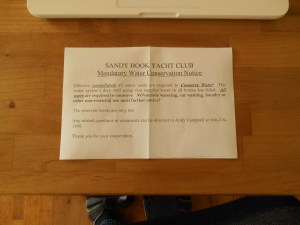
If you want the full description, visit the neighborhood’s web site.
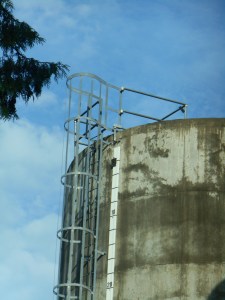
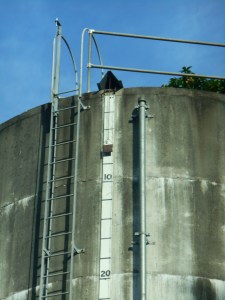
Here’s another description. We live on an island, so our water has to come from here, not from some massive mountain reservoir. We don’t have a sewage system, so every house uses septic systems that are close to the surface. It’s a bad idea to get water from the vicinity of where toilets get flushed, so there’s separation between the two. Our water comes from a aquifer filled with rainwater, an aquifer that is over 300 feet down. That puts the bottom of the well below sea level. The pump lives in the well, and the well lives at the bottom of the hill. One way to simplify a water system is to put the water at the top of a hill or by using a tower; hence the iconic water towers in middle America that announce every town that sits beneath them. Getting enough water for a few hundred homes, to rise up a few hundred feet of well, then climb the hill, then fill two 50 foot tall tanks requires a big, expensive pump sunk into a very deep hole.
Fully filled, those two tanks seem like they could keep the neighborhood watered for days, especially if people aren’t watering and washing. Unfortunately, the tanks were drawing down rapidly during a heat wave over a holiday weekend.
inside air temp with windows closed, shades and curtains drawn, and awning deployed
Some time in there, the pump failed. When the emergency was announced, the necessary response was drastic. I don’t know about my neighbors, but I haven’t flushed for days thanks to friends in other neighborhoods. It also helps to work from the office rather than from home.
As I type, the pump repairs were scheduled to be completed. I’m definitely staying tuned to the news.
I’m one of the lucky ones. I live frugally. I have an earthquake kit, two rain barrels, a backpacker’s sensibilities, and a real estate business that’s busy enough to keep calling me back to the office. I’m lucky enough that I felt I have to hide the fact that I can water my garden (with some very icky and organic rain barrel water that is somewhat alive.) Honest, folks. I’ve only accidentally used the faucet once or twice out of habit, and quickly turned them off.
They didn’t know, or at least didn’t tell us, the prognosis the first day; but I remember the last time the pump failed (which also makes me wonder about warranties and alternative water sources.) I already had a few gallons of drinkable water stashed in cupboards. After work that day, I bought a couple more gallons. I also bought a big bag of ice cubes. No need to feel guilty about having a cocktail if the ice came from somewhere else. By luck, I’d also just refilled all of my hiking, bicycling, and commuter water bottles. Serendipity happens.
Events like this are reasons to be upset, but they are also lessons about what we take for granted. When I lose power, or electricity, or water, or the ability to flush, I better appreciate them when they return. That’s one of the side benefits of backpacking: come back home and marvel at clean water flowing on demand, and not having to dig a pit to poop into.
 Cheers to the neighbors who delivered free gallons of water to each household. Special cheers to the neighborhing neighborhood that let us tap into some of their supply – though that seems to be consumed as quickly as it’s delivered because the tanks aren’t filling.
One neighbor’s comment about the free water pointed out how much better off we are than the people in Flint who, even though they get water, they take risks by drinking it. If all goes well (hard to avoid that pun), we’ll be able to get by with a few gallons of water from bottles before being able to have so much fresh, clean water that we can use it to flush slightly less clean water.
Pardon me as I check email, and the neighborhood’s web site and Facebook page for a status update.
As of 20:47 June 21, 2018 there’s no news since 23:31 June 20, 2018. I can tell from the power company’s map that the power has been restored, but no news. As I close this post, I don’t know if I have to continue my nomadic life and work schedule for another day or more. It is a very good thing that I have generous friends who aren’t picky about protocols when reality arrives.
I get my answer soon enough. Puerto Ricans continue to wait. Syrians are no longer Syrians, or aren’t as tied to a national identity as they are to a basic human need. Look back up a few paragraphs. I’m one of the lucky ones.
PS
1) Life hack to lighten the mood: Beer from a bottle doesn’t use up any of the water, doesn’t have to be washed, and the end product can be disposed of by watering a patch of lawn, discreetly.
2) A bit of more expansive optimism, American fresh water consumption is down even as the population rises. It’s down to “only” 82 gallons per person per day. A number which continues to startle me; but at least is heading in the right direction.
PPS – YAY!
“As of 7pm this evening, power has been restored to the Sandy Hook Community. The well is now pumping and our tanks are being refilled. However, we do ask you to conserve water until 5pm on Friday, June 22nd, providing the tanks some time to replenish.
The pool will reopen tomorrow (Friday, June 22nd) at 12pm.”

 Photo: Glasgow, Scotland, April 1945, about the time a young sailor was introduced to Guinness








 I’ve skipped it in the past because it looked too fragile, too easy for slugs and bunnies to feast first. A few years ago, I realized that containers on my deck are more productive (or more easily defended) than seeds in the backyard’s dirt. The backyard looks like the typical solution: raised beds, fruit trees, and a row of raspberries. The raised beds, however, didn’t raise the plants out of reach of the critters. Now that I’ve found ways to make it harder for pests, fragile plants like lettuce proliferate. I became a much bigger fan of salads when the lettuce was effectively free, fresh, and convenient. Having a
  Slugs and bunnies don’t stop apples and figs. The trees are growing too well. I had to severely trim them this winter to keep within the neighborhood’s covenants. The apple trees seem unaffected. Their blossoms are the heaviest and densest I can remember. My main concern is that there should be a surge in the bee population, but the trees are too quiet. I think the fig tree is scoffing at me. It had such a great surge that I had to cut back branches tall enough for ten foot poles. What’s left is looking reluctant. We’ll see.
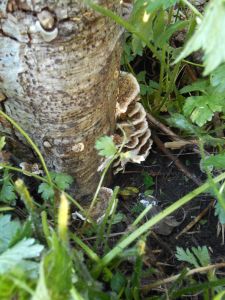 My mushrooms
 may finally be sprouting, but they may have lost the battle to a different species. My mushroom logs were planted so long ago that I forgot what they’re supposed to look like. I expected mushroom shaped mushrooms. Instead, some look mushed. Others look like tree fungus. I’ll check with the experts before putting one in my mouth.
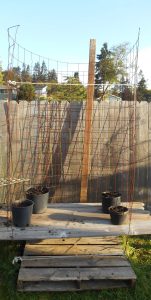 I’m trying the peas and beans again. Last year I extended the wire pedestal idea by making a ten foot tall wire hoop with the pots inside, elevated beyond bunny reach, and with plenty of room for the vines to climb. The engineer in me made sure it was stable despite being very light. That worked, but the hoop made it hard to get to the plants for watering and weeding. This year, the hoop has become a half-hoop, a tall semi-circle of a cylinder. Maybe better access will make them grow and me garden better.
 Trimbathcreative's Blog (Tom Trimbath)