Looking Fine-ish

It looks fine from here. The rich are getting richer. Those with jobs and businesses are getting busier, and seem to have more discretionary cash. And, of the rest that aren’t in hiding – well, smiles look good. Even my septic tank looks good, but it is buried. But the septic alarm went off though, so later today I’ll find out if looks are deceiving. My computer looks good, considering the use it gets and its age. But it let out a chirp and froze for a while a couple of days ago, so I’m backing it up as I type. My future looks fine when I am feeling optimistic, but chirps and alarms and uncertainties may mean I’ll sell some stock, giving up a slice of future potential to make things look a little better in the present. That’s a dangerous game. But there may be a way out.

Langley looks good. (Want a quick tour? Watch our video: Two Guys Walk Around Langley)  Millionaires walk by. Billionaires reportedly drop in while visiting another of their houses. This is a nice town for relaxing. From my perch, high on the second floor of the Giraffe Building, I get to watch enough exotic cars roll by that Ferraris aren’t worth mentioning. It looks so fine that a couple I talked to thought everyone here was wealthy, or at least comfortably employed. That’s an image most tourist towns want to portray, and in Langley’s case, enough of it is true to encourage people to move here.
Langley, WA July 2013

Of course looks can be deceiving. We use that phrase so much that I wonder why it exists. Evidently, we must continually remind ourselves that what we see isn’t always real.

One of the tricks to enjoying frugal living is to live frugally by choice instead of by necessity. Living frugally by necessity can still be enjoyable, but it isn’t as relaxing because it is paired with caution, doubt, and maybe a fair share of worry. I’ve always lived frugally, even when I didn’t know I was doing it. A frugal lifestyle looks cheap from the outside, but the insides are buttresses of self-defined and reinforced values. Many have commented on my apparent style and ease as I pass through my financial turmoil. Evidently, my facade is fine. The interior is doing well enough too, but there are days when I’m surprised the turmoil doesn’t poke through.

I see the wealth that extends into the middle class. It isn’t just millionaires visiting the coffeeshops and stores. It’s harder to find parking. Unemployment is down. Consumer spending is up. Typically, more people making money means more money being spent which means more people making money – which is the upward spiral looked for in a recovery. It looks fine, and may even be fine.

It is too easy for me to see the concerns though. My diminished financial position has provided me yet another perspective. The wealth and income inequities do not seem to be resolving themselves. Discretionary income may be returning, but many are working from less stable foundations. They’ve been through foreclosures, bankruptcies, or have spent their way through home equity, credit limits, and now their IRAs. The increased consumer spending may be temporary and a reflection of years of pent-up demand.

A world-traveling friend called for a friendly chat. I was so impressed with what he’s been doing, especially, because I know a few years ago he was in need of a financial fix. He stayed positive, gradually built his business, and is enjoying the upward spiral of people asking him to do more good work because they’ve seen him doing so much good work. Now, if they’d only pay him what he is truly worth. And, maybe they will as his upward spiral continues. In the meantime, he looks like things are fine, or fine-ish.

As I check around with my friends, frequently as they check in on me, I continue to find increased busyness. The businesses though, aren’t necessarily seeing increased profits. Frequently they are at capacity limits. To truly make more they have to hire more or invest more, but those hurdles are costly risks prior to becoming possible rewards.

Rarely do I hear anyone describe their job or their business as a path to comfort. One honestly laughed when I asked if she could imagine her business becoming profitable; and then she caught herself as she realized that profitability shouldn’t be so foreign a concept. People do dream of comfort but I notice their hopes live within two main scenarios: win the lottery, of find some way to become self-sufficient. Self-sufficiency takes more work, but has better odds. If we lived in the era of homesteading many of my friends would be heading out to the territory, wherever that may be. Instead, many of them are building tiny houses or creating garden farms.

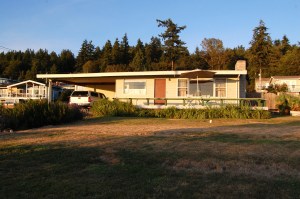
I consider myself lucky. My business is picking up. I’m being considered for more substantial, and profitable, assignments. (Got a project you need help planning or some choices you need to sort through? It is fun helping creative people create.) My portfolio is closer to realizing its potential. (Come on MVIS.) The housing market is improving. (My house is still for sale.) Home For Sale Yet, at this stage in the race with financial sustainability I may have to sell some stock to pay for foreclosure mediation, pumping the septic tank, and replacing the rear shocks in the truck.

I’d hoped that here, at the end of July, there’d be news that I got “the call” for the right job or assignment, or that one of my investments would finally make their major celebratory announcement. I look forward to writing that post. In the meantime, the computer went chirp. The septic alarm went squawk. And my checking account goes squeak because right now it can’t handle a new septic system or a new computer.

But stay tuned. The day isn’t over yet. Today is Wednesday, July 31, 2013. The Powerball jackpot is estimated to be $235,000,000. The drawing is tonight. Even the Washington State lottery is up to $2,500,000. I have tickets for both. Either will suffice. And in our conversations, those who are buying tickets aren’t doing it for appearances. They’re doing it as a hope for comfort and a chance at self-sufficiency. We’re also doing it as entertainment. A movie costs $10 and lasts a couple of hours. A lottery ticket costs $1 or $2 and it allows days of dreams, at least. At least.

Posted in Uncategorized | Tagged , , , , , , , , , , , , , , , , , , | Leave a comment

Planning For Unexpected Futures

Well, that didn’t turn out the way I expected, and the biggest issue was probably my expectation. Silly me, thinking I had some control over my life. I held a self-publishing class and workshop today, and everyone cancelled; but another person unexpectedly showed up, we had a strategy session for his business, and my business set a record. If – when – I succeed, it may be in unexpected ways. In which case, does it make any sense to plan for, or work at anything? Maybe I should work out a plan for that.

Self-publishing changed dramatically about the time someone noticed that high-speed laser and high-speed inkjet printers were just about as good as the average printing press. Back around 2000 a new type of printing enabled a new type of publishing. Print-on-demand printing enabled what I call Modern Self-Publishing. Load a couple of files into a computer. Print the insides. Print the cover. Glue the two together. Only print as many as are needed. Print one at a time just in time instead of printing a few thousand and hoping they sell before something ruins the inventory. Some ingenious person realized that most of the sales were online, therefore coming from people with computers, in which case skip the printer and just sell them the files. Ebooks were born. Thanks to a series of rejection letters, I was in the first wave of writers to use the news technologies. On average, since 2002, I’ve published one book per year.
Walking Thinking Drinking Across Scotland Twelve Months At Double Bluff on blurb

The publishing industry is undergoing a revolution as dramatic as the ones that hit the movie and music industries. Digital technologies decentralize authority and control. Fears of unencumbered shoddy work call the traditionalists to guard the gates. Empowered artists exercise the new technologies to go up, under, through, or totally ignore the gates, the walls, and the old fortresses. Hollywood exists. Record companies exist. Publishing houses exist. But they no longer hold the majority of the control. The majority of the control is held by unorganized crowds of individuals that do not require consensus. Some work is shoddy, from a certain perspective; but purer voices and unheralded talents are also unleashed.

I’ve watched the industry go from scoffing at a version of self-publishing that accounted for a few percent of the total, to an industry that sees the new technology producing more than the establishment. The industry is finally responding by using the same technology and buying the competition, but the momentum is too great and the change can’t be controlled or denied.

In some ways I’m an early adopter. I enjoy watching trends, and have used that habit as a basis for investing. (Read my book, Dream. Invest. Live. for details.) Dream. Invest. Live. That worked well until deregulation and the Great Recession. It may yet prove itself again because everything is temporary, including our financial environment and economy. My style of investing is called Long Term Buy and Hold. (LTBH). I didn’t make it up. I just use it. It is the anti-thesis of day-trading. My most encouraging investments were started over a decade ago. They are due.

I watch trends and I try to guess which way they’ll go, but I know they’ll take directions I can’t predict. New ideas rarely play by the old rules, and adaptation requires understanding the new more than the old because the old eventually passes away.

I expected to teach a class today, and run a workshop too. People signed up. Everyone cancelled. Maybe it’s the Sun’s fault. Yet, when my unexpected client walked in, he brought with him a conundrum that didn’t exactly fit with the class; but it did fit in nicely with a one-on-one strategy session, something I enjoy. A couple of hours later we were done, he had a plan, and I had a check. That check put my business over the top. As of that check, my business has already made more this year than it did on all of 2012. Hallelujah! At this rate, my business revenues are growing at 70% during a year when my expenses are down. At that rate, my business will be able to pay me more than enough by 2015. I’ll enjoy that but the mortgage company may not applaud that timing.

New ideas and changes to plans happen more rapidly than many can react. A retirement plan, honed for years, must be reassessed regularly as life, investments, and the world changes. (Watch Mike Brady’s videos for good descriptions of how that can be done.) My plan fell apart (at least apparently temporarily) within a few months two years ago. In perfect hindsight, an even quicker reaction would have meant a more comfortable present. That’s always the case. What I am glad about, despite my situation, is that my plan is flexible and that it had more than one element. Currently I am trying to sell my home, get a job, grow my business, and encourage my investments. I can develop plans based on a variety of scenarios, but it isn’t prudent to act until changes reveal themselves.

I planned to teach a class about publishing and ended up helping develop a business strategy. I didn’t plan for the unexpected, but I prepared myself so I could react.

Some indications are that the economy is returning to a new normal. Other indications are that the system’s oscillations are increasing and may lead to a collapse, whatever that may be. Planning for only one outcome produces a plan with poor odds of success.

Instead, I plan for long term goals and targets, and regularly adjust. I prefer to adjust at a slow and rational pace, something that works well with long afternoons considering possibilities while taking notes and sipping wine. Lately my plans are a bit rushed and flavored with spiced vodka and hope and energy.Cultus Drive deck and drink

There is great uncertainty in the world. A few of us are holding informal think tank sessions to sort through what we may do. I know we won’t come up with one answer. I want to keep my house, which I may do if finances return to normal soon enough. In some scenarios I lose my home and don’t have enough income to reach the poverty line, in which case finding a room with an understanding landlord would be a blessing. In some scenarios, my long term approach to investments may produce a recovery that lets me keep my home, and may even make it, or another home, comfortably self-sufficient. Acquiring self-sufficiency is one plan for disconnecting from the centralized turmoils. Each scenario, and several others, run through my head several times a day.

My client is also a friend. He, too, had a time when his plans seemed to have fallen apart and extrapolations were dire. And then he got “the” phone call. One change changed everything else for the better. That was a few years ago. Now, he is planning for the next thing; not in an attempt to firmly create a future, but to develop a plan that allows for flow, change, acceptance, and awareness. (Discretion keeps me from passing along more, but I hope he posts the pertinent links in the comments.)

As for me, I planned to do something else this afternoon. Instead, I’ll post this post, hit the deli to see if they have an after-five special, and then head out to two or three other events. You see, unexpectedly, a friend opened a gallery and is exhibiting my art; Light October Corduroy and unexpectedly, a friend and entrepreneur is hosting a party to celebrate their return to town; and, if I have time and energy, I’ll drop in on some friends playing music where a friend is tending bar where some of my other friends will be. But those are only my plans. Something even better may show up, and I want to be able to fit that into my plans.

Posted in Uncategorized | Tagged , , , , , , , , , , , , , , , , , | 1 Comment

My Jobs Report Month 23

I’m turning the final corner into the second calendar lap of years of looking for a job. Two years ago I eagerly awaited the good news that would send my investments higher and cross me over to having “enough” and the retirement of a need to work. Well, that didn’t go the way I expected. Since then I’ve lost over 90% – 98% of my net worth (depending on the estimated value of my house and a few other things), I haven’t found a full-time job or even had an interview, haven’t paid my mortgage in months, and yet am working seven days a week. Numerous times within a day I’ll swing through pessimism, optimism, and confusion. Maybe that’s the motto for the long term unemployed.

Let’s get the bad news out of the way. Official job applications haven’t resulted in interviews; therefore, they haven’t resulted in a job. The other bad news, There Are Still 3 Times More Unemployed Workers Than Job Openings. I haven’t delved into those numbers but I know the sad fact that the official numbers used for counting the unemployed miss millions of people who’ve given up looking for work. Add in the upper estimate of eight million disaffected unemployed and the ratio is 5 people for every job.

The not-so-bad news is that unofficial job applications have been a more productive use of my time. They also haven’t resulted in interviews; but, they are more encouraging and actually provide feedback about why I didn’t get the job. Every rejection has included personal assurances that someone else will undoubtedly be equally impressed with my skills – and will hire me.

The better news is that my business is keeping me busy seven days a week, with most days longer than eight hours, frequently as much as ten hours, with occasional twelve hours days. The workload is good and bad news, but the trend is good. Spending that much time last year was almost all unpaid speculation on my part: writing a bookWalking Thinking Drinking Across Scotland, taking photographs, advertising classes, and planning collaborations. This year the billable hours are filling the time, the rate is increasing, and some of my clients have hired me for ongoing assignments. The sad fact that keeps this from being the best news is that the sum of all that good news is still less than what I need to pay all of my bills, even without paying the mortgage.

The best news so far is that this month, if the checks come through in time, my business will finally have made enough to pay all of those non-tax, non-mortgage, non-homeowners-association bills. This is progress. The other best news is that I’ve actually been able to decrease the number of twelve hour days without cutting back on revenue too much. Balancing time and money is a struggle when basic needs aren’t being met, but one basic need can’t be bought: health. At this level of effort, and under these conditions, “mental health days” are not euphemisms. Without time to recuperate physically, mentally, and emotionally, my body begins to deteriorate, my mind has a tougher time concentrating, and I can be a lot less pleasant to be around. At least now, I am making time almost every day to sit on the deck with a nightcap and just sit. Besides, eventually it is too dark to do yardwork or call anyone.

The best news probably hasn’t arrived yet. Two week ago I posted Good News Sooner Please where I listed many of my reasons for optimism. Since then there’s been reason for more optimism, not less. Seattle’s housing market continues to impress. My investments are with companies that are making progress, and some have actually had hints of good news. If my business continues its trend and switches to more consulting, and as sales increase, I may be able to pay all of my bills, even the mortgage. At the same time, I’ve been assured that my name is being included for various job possibilities. Thank you. Spread the good word.

The swings from pessimism through optimism and confusion happen with each bit of mail, phone call, and bit of news. The most useful recent revelation was that the things I can control most: filling out job applications, filling out paperwork for foreclosure forbearance, etc. are also the things that may be the least effective use of my time. Properly filled out forms don’t pay bills. The other part of the revelation was that the things that can resolve my situation: whether that is money through investments, the lottery, my business, sales, or a job; are out of my control. Control lives with my clients, customers, the market, and luck. Without enough money, the forms don’t matter. With enough money, the forms don’t matter. Filling out the forms can find me a job, though the resume bots guard that gate. Filling out forms can hold off foreclosure, maybe, but eventually I have to find the money or lose my home. Home For Sale The confusion steps in when I realize the most important aspects of my financial situation are out of my control, in which case pessimism and optimism are arbitrary.

If pessimism and optimism are arbitrary, then I might as well pick the one that’s more fun.

Many will say that pessimism and optimism are the attitudes that manifest the lives we live. That may be true. I’ve seen no way to prove it. There are sufficient examples of people dreaming of and achieving success, and of people with self-destructive habits that create self-fulfilling prophecies. There are also dismal people who are surprised at their success, and upbeat people who became homeless and hungry. I know that until two summers ago, I spent a lot of time manifesting (daydreaming) a relaxing, enjoyable, productive life that had far more security and comfort than I’ve experienced lately. Maybe I’ll manifest that positive future, and that I have to go through this turmoil to get there. Stay tuned.

Next month’s report will be My Jobs Report Month 24, and will be the last jobs report – unless there is something awesome to report. “What? You want me to run an incubator for triple bottom line innovators, it’s only a part-time job, and yet it pays more than I need to survive and thrive where I want to live? Thank you. Yes!” But I will give up the monthly reports. Our world is changing, and the search for traditional jobs may have changed to the point that a middle-aged guy reporting on a job search may be anachronistic.

So, now it is time to get back to work at this job and that job then that job and celebrate completing the other job and get ready for the next job – and check the web and the email and the phone and my friends for that bit of great news that we can all celebrate.

Posted in Uncategorized | Tagged , , , , , , , , , , , , , , , | 1 Comment

Dust Bowl Beer

I feel the need, the need for beer. I normally don’t drink beer, but when I do – you know something’s up (like someone’s buying, offering home brew, or I’m in the UK). As a writer, I like to think that I am in control of what I’m going to write about. Pick a topic, launch in, and move on. Lately the topics are stacking up faster than I can write. There’s a collision of content in my brain today so rather than methodically sorting it all out I decided to succumb to a rare afternoon beer and let lubrication facilitate expostulation.
Cheers
Comedies sell well during traumatic times. Just ask the Marx Brothers. Oops. Too late for that; but, their movies did come out during the Great Depression. I’ve been leaning towards the comedy genre streaming across Netflix, so go ask why I ended up watching the excellent, though tragic, Ken Burns’ documentary on the Dust Bowl. Families were stressed with seven years of repercussions from early adopter farming mistakes and drought. Those that could move, did. A few stayed from eternal optimism. Many lived lives out of their control, staying if they had no other option, moving if they were forced out of their homes. What was easy to overlook were the people who saw no future, or nothing but dead ends and who then made their own end. My situation is tame in comparison. I am astonished at how so many people survived such greater trauma for so many more years.

I’ve spent the next few evenings watching videos from stand-up comics.

One of my more enjoyable and better paying jobs is spending an hour or so a day culling through the day’s news to find items that resonate with values-based financial literacy. I post the results on New Road Map’s Facebook page. New Road Map stands as a guide at a gateway between two worlds: the conventional consumer and paycheck world, and the highly individually customized world of people who’ve decided to spend their time and money according to their internal values. The failings of the old world are heightened. The appeal of a variety of new worlds is revealed. Each day I skim across both chronicling the push and the pull that is moving portions of our population. Emotional highs and lows are part of every day.

I have a much better idea of the kind of life I want to lead, but I also feel trapped like a Dust Bowl farmer.

From my base of operations in one of the tallest buildings in downtown Langley (my office is on the second floor), I’ve made daily trips out to my various friends in town, many of whom own businesses. The image of a quiet little tourist town persists, but it does so with tremendous effort. Langley Second Street Market Volunteers take on jobs for which there is no budget. Locals who love living here may also have three jobs – and worries about paying the bills. I know of two that suddenly found themselves trying to fund failed septic systems. There wasn’t money set aside for that. I recognize frugal. These folks aren’t wasting their money, and even with all of the time they are working, they don’t have a cash cushion.

Spending habits have been blamed on people living off their home equity, until that ran out. Credit card debt can only go so far. IRA withdrawals may be the last resource for those making less than their expenses. All are good reasons to live frugally. Not enough of the population is doing so, nor is the government, so each financial wave crashes against a weaker foundation. But we’ll prop it up in time, right?

My home equity is debatable, and not necessarily bad. We won’t know if it has any equity until my house sells. Home For Sale Hopefully I make enough money so I don’t have to sell or encourage the mortgage company to foreclose. My credit card debt was well-managed – until my stocks were hit by the Triple Whammy and a few extra bills like medical bills, car repairs, and taxes jumped in. The credit card company has subsequently reduced my credit limit, effectively negating an emergency cushion. My IRA was sustaining me for a while, but I stopped tapping it when I sold the last of my DNDN (at a price I think was 90% too low.) My financial foundation is weakened, but there is a good chance it will be more than just propped up if my portfolio recovers.

I know of about five businesses that are closing because of retirement or so the entrepreneurial owners can concentrate on other successes. Turnkey business offerings do happen. A few others have either just changed hands or are about to. At the same time,
I know of about a half-dozen businesses that look healthy, until you find out that the owners aren’t paying themselves, or that the business is only surviving on proceeds from the owner’s IRA. One financial slip, or even an offer of a marginally better paycheck, are enough to inspire another business passage. At least across South Whidbey, there will be an opportunity for a renaissance – as long as someone is willing to fund it.

The stereotype of the hard-working entrepreneur succeeding has enough success stories to sustain it, but many of the stories are reminiscent of Dust Bowl farmers persevering and eventually experiencing ten years of bumper crops, out of sixty years of trying.

Yesterday afternoon, as I waited for the bus home, I talked to another of the famously happy shop owners in Langley. We agreed that those of us who’ve been working six or seven days a week for months or years really should have a party. And then we laughed. She had only fifteen minutes between jobs. I was constrained by a bus schedule that only ran every two hours and stopped after 5:30 (but hey, it’s free!). We could all use a party. We could all use a laugh. Our best guess was a five minute party when we all met in the middle of the street, passed around hugs and chuckles, made a very quick toast, and then scurried back to maintaining the facade of a peaceful tourist town. Five minutes is too short for a beer. We may have to resort to liquor because it is quicker, to drink that is.

So, what did I end up writing about? Well, I guess I wrote about what’s on my mind, or at least what’s in my bloodstream. Recently, traveler, raconteur, and consultant extraordinaire, Steve Smolinksy wrote about a trip to foster prosperity in Africa, where;
. . . it was around 105 (45.5555…) every single day. But I did get to drink that great beer they make in 55 gallon barrels in the townships. 30 cents a pitcher and the bugs floating in it add a little protein at no extra cost.
Dust Bowl, years of perseverance, optimism regardless, and beer at 30 cents a pitcher – he may be over there helping them, but we may have lessons for us.

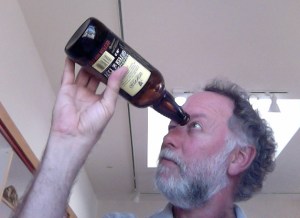
Where's that last drop?

Posted in Uncategorized | Tagged , , , , , , , , , , , , , , , , , | 2 Comments

Fun In Dysfunctional

And now for something completely different. Dysfunctional. Dis fun shun Al. This fun shuns all? Or this fun shuns Al? If the second is the case, then I feel sorry for Al. Weirdness, absurdity, incredulity, many more multi-syllabic responses to recent news, global trends, and my current situation reached a limit with me recently. At some point the word “Ridiculous” pops up, and maybe that’s a good time to step away and find a way to recharge, and maybe laugh.

Remember laughter? Thank you Monty Python and Laugh-In for making fun during the sixties and seventies. Thank you Saturday Night Live for 38 years of breaking the rules and skewering convention. Thank you John Stewart and Stephen Colbert for taking the hyperbole of broadcast “journalism” and making it more hyperbolic by comparing it to reality. How else can we get through such times?

October Smiles

My situation is so bizarre that several of you have suggested making it a movie. One of you has already pitched it in Hollywood. I’m an imaginative guy. A lot of what’s happened were things I knew were possible, but I spent more time imagining the optimistic possibilities. To have some many of the apparently negative possibilities occur was unbelievable. Put all of that into a story and audiences would dismiss it as fiction. Throw in the illogic of the foreclosure process, the irrationality of the stock markets, the disconnect between what should work for finding jobs and selling houses and the story becomes so complex and incomprehensible that listeners and readers would find more reasonable entertainment elsewhere. As a movie or a book, it could play out as a series, and most series are dramas, not comedies. Where’s the fun in that?

I haven’t studied the stages of grief but somewhere along the healing process must be the ability to make a joke about it.

I think our society will demonstrate its maturity when crowds start demonstrating with messages that are more terrific than terrible. The Rally to Restore Sanity and/or Fear was an excellent start. That was over two years ago. Isn’t it bizarre that things have gotten more bizarre since then? We’re due for another dose; and then it should be franchised, and I think it would be hilarious if someone found a way to make a lot of money from it, and then use the money to set up super-Pacs like Colbert’s Americans for a Better Tomorrow, Tomorrow. I guess we need a new and expanding breed of court jesters that outnumbers and speaks louder than the combined special interests and dysfunctional institutions. There’s plenty of raw material delivered every day. Money may be hard to find but opportunities for punch lines are littering our lives. Yes, the Guy Fawkes’ masks are iconic; but, I think jester’s bells or clown’s noses might be more appropriate.

Rhetorically, I’m asked how I’m getting through this. Skip the philosophical responses. They haven’t turned off my oxygen. Gravity continues to keep me on this planet. My body continues to continue. What other choices do I have?

Within the last few days I came to realize that my backup plans that require the most effort can’t seem to produce a solution. Even if I fill out all of the appropriate forms and deliver them on time, foreclosure will happen if I don’t find enough money. Working twelve hours a day only produces half of what I need, and simply doubling my efforts will simply eliminate me, which is a drastic way to eliminate my finances. Even selling my house only solves my foreclosure and debt issue, not my housing situation because I’ll still have to find money to pay rent somewhere.

Within the last few days I came to realize that my backup plans that can produce a solution are all out of my control. My best job prospects have been unsolicited. My business is like any other, in control of the customers. My portfolio will recover if the market raises the price of my stocks. And my lottery tickets are in the control of random chance – as far as I know.

So, as a consultant I could recommend to myself to only concern myself with the plans that can make a difference and only work on them as much as necessary. Especially in the case of my portfolio and lottery plans, sitting on the deck with a gin & tonic should suffice.

My view - for sale

Now, that’s an appealing plan!

And we know that I won’t do that. I’ll continue to work because planning on luck is not planning. It is an exercise in faith, but faith has its own timing, and in the meantime I should spend my main resource, time, making the resource society demands, money. It should only be a temporary exercise anyway, and my efforts are generating lots of stories.

My efforts may not have much to do with the right causes that will produce the correct effects, but they are what I can do, so they are what I will do. But this new realization also inspires me to relax. I should do more things that are fun. Fun is healthy, yeah, that’s it; I’m keeping down health care costs. Fun can be free; excellent if I can find ways to spend time that don’t cost money. Fun can be shared; and too many people have told me too many stories for me to doubt that millions of us need to laugh.

So, I’m not going to apologize for skipping a stock analysis, or not providing a personal finance tip, or delving into a lifestyle trend (though I guess I accidentally am doing that.) Oh wait, maybe that’s the point and I didn’t even realize it. When we try to outthink and outwork our problems we can wear ourselves out. Have a bit of fun and find unexpected treasures, unexpected wealth.

Here’s something a friend and I did for a bit of fun.  Wynn likes being in front of the camera. I wanted a way to play with the camera without thinking in terms of galleries and sales. We both enjoy the tourist towns around Puget Sound – and decided that too many of their videos were “rainbows and wind chimes”; so, we started making a series of videos of Two Guys Walk Around – fill in the blank. The most recent: Two Guys Walk Around Anacortes. Enjoy, just for the fun of it, and as Wynn says at the end; “Who knows where that may lead us?”

As I type this last, the music next door has started. There’s a free dance tonight. From my office window I can see my friends arriving. Time to go. It looks like fun.

Posted in Uncategorized | Tagged , , , , , , , , , , , , , | Leave a comment

Chicken And Eggs And Beer

“Beer? Fine idea, but really, I can’t afford it.” “What? You’re buying and I don’t have to drive? Why, thank you!” So began a conversation that ended a day of fine ideas, grand plans, and limited resources. As ever, fine ideas and grand plans dance with limited resources as each tries to get closer to safer commitments. Those first steps are the hardest, and lately they’re happening when money is least likely to move. Change continues regardless, moves will be made, and the greatest rewards will probably go to those who didn’t stand still.

If you don’t know by now, I enjoy coming up with ideas, inventions (got one patented), strategies, and plans. I enjoy jumping back and forth from the big picture to the details and then back out again, steering towards a goal as if I was alone on a large ship running back and forth between the bridge and the engine room. Set a course up on the bridge, and then run below decks to make sure the engines are fine. The bridge is the big picture, generally picking a direction and looking for hazards. The engine room is the details, making sure everything is oiled and lubed and tight. But from down below, you can’t see where the ship is headed; and from up above, it’s easy to miss a loose wire or an overheating axle.

The life of an artist or an entrepreneur is like that, ready to switch roles at any time between production, maintenance, administration, sales, and advertising. The chicken and egg problem is self-contained and progress can be made as long as few resources are needed. Unfortunately, cautious customers, expensive real estate, and restrictive lending mean most grander plans are put on hold. It is tough to inch a business towards sufficient revenues or square footage one square foot at a time. Ideas and businesses can be stymied and income subsequently capped by such hurdles.

Recently, a courageous friend tried. She has a marvelous business (even if she no longer makes my favorite chocolate macaroons) making and selling chocolate in downtown Langley, and shipping around the world. Sweet Mona’s does good work. She had a plan to expand, to fill one of the anchor business properties, and yet didn’t find the money. Real estate is described in fractions of a million, and chocolate is sold by the dollar. I know she’ll try again.

Another friend owns another business in Langley, poised for growth, drawing traffic from around the world to our little town, and shipping back out as well. She too is caught in long work days with no days off, on this side of the crux that could do marvelous things for our economy and her finances. Chocolate Flower Farm is more than a farm, more than flowers, and not just chocolate. But businesses of a few employees don’t expand smoothly because each new employee is a noticeable spike in expenses that precedes the anticipated increase in sales, or at least sanity. Lose an employee for a weekend and the reverse impact can be enormous.

I’m engaged in my own business expansion. I’m spending more, hoping to make more, hoping to make more than enough to appease the mortgage company and return my finances to comfortably enough. My needs are smaller. That’s one of the advantages of consulting. I need enough room for me, my computer, a few supplies, and my clients. Pull up a chair. Have a cup of tea. Let’s talk. I’ve been doing that from my home, but the possibility of foreclosure generates bizarre traffic around the house. Buzzards are more discrete as they wait for their meal. So, I am renting a small bit of counter in a co-work space with an excellent view in downtown Langley,  getting myself and business into a more reasonable environment. So far I’ve had lots of traffic, but no more business – yet. Step by step, this can work, but no step comes with guarantees.

Downtown Langley is like many small towns I’ve seen. Change is generational. Ideas and plans pop up and play, but persistent habits can squelch plans based on old stories. “Oh, no one has ever run a successful business from that spot, so you won’t either.” Generational changes happen in waves that don’t have to coincide with larger economic trends. In Langley’s case, there almost may be synchronicity. The economy does seem to be improving. This tourist season seems busier than the last few years. The coffeeshops are busier. The farmers’ markets seem to be drawing larger crowds. At the same time, the recent economic turmoil, and a desire or need to step away means many businesses are hunting for new owners. Corner businesses are empty, waiting for new tenants, and the potential tenants are waiting for whatever support they can find. Ideally, the spots would have been filled before the traffic returned, but maybe the tight parking will prove to someone that it will be profitable to fill the vacancies now.

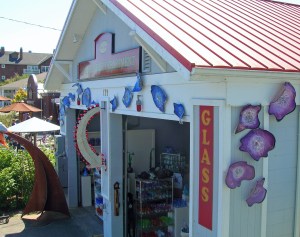
One of the advantages of working downtown, both streets of it, is the opportunity to visit my friends in their shops during my breaks from the computer. During one of my breaks, a friend and I kicked around an old idea that continues to appeal. Langley may be know for chocolate in various ways, and has more than enough coffeeshops, restaurants, and bookstores, (and even a fine outdoor gear shop), but it’s identity is more as an art community. Years ago, I was part of another group that proposed turning downtown Langley into an art campus by housing a variety of types of art in the various empty buildings. Each would be a place to sell, watch, learn, and maybe make art. There’d be more to do in addition to drinking coffee or wine and indulging in chocolate. We presented our idea to City Hall. It failed. Ironically, one of the more successful businesses is now a glass blowing facility in the old firehouseCallahan's Firehouse Tourists would have more to do. Artists would have another stream of income by teaching classes, a high profit margin business. And by distributing the venues, tourists would naturally walk by the existing businesses. Ah, but we knew we were talking about big chickens and big eggs, so we both got back to work.

I took the bus home because it’s safer than bicycling on a Friday night during tourist season. The bus stop closest to my house is at Bailey’s Corner store. For years, Bailey’s was a dusty convenience store, barely surviving on the thousand or so people living at the south end of the island. A few years ago, a new generation became the owners. What was a convenience store is now becoming a pub. They sold out of ribs during their grand opening last week. What was a mechanic’s garage is now a sculptor’s studio, which means the patio railings for the beer garden are a lot nicer than chain link. They’ve had ideas, pushed, succeeded, moved to the next idea and repeated. They were out of the way, so there was no one to get in their way. They had enough revenue so they could make progress.

I’ve wanted to drop by, but my finances are so slim that I rarely eat out. I wanted to stop for a beer, but that costs money and there’s always more work to do at home. Then I heard my name called out. Paul, the sculptor and philosopher, offered to buy me a beer. I wasn’t driving so I said yes. For the next hour, as we sat in someone’s dream coming true, we talked about his plans, the value of optimism coupled with persistence, and my situation. Paul had a great idea for me. Evidently my enthusiasm for others and art is evident, and could be a valuable service, leading others in the exploration of how they can express themselves after years of stifling corporate careers. I’ve made the transition from engineer to artist. I could help others discover their outlet. That would be fun. But I have so little to start with. Of course there is that one photography student who said, “I learned more from Tom over the nine or so hours in the classroom and walking the beach than I did during a week-long and much more expensive digital photography course in Pennsylvania last year.” Maybe that’s worth more than I know.

So, maybe, just maybe. Of course, I could also get busier because we finally found funding for the virtual museum, New Road Map‘s financial literacy webinars, an extension to the Two Guys videos, and maybe a revitalization of a sweet town that’s ready for its next era. It is a chicken and egg situation to consider over a beer.

Posted in Uncategorized | Tagged , , , , , , , , , , , , , , , , | Leave a comment

Good News Sooner Please

Sooner or later all of this good work is going to pay off. That’s the conventional wisdom. That wisdom doesn’t come with calendar dates but other deadlines in my life do. The foreclosure calendar continues to mark off dates. The later part of sooner or later eventually becomes soon. When is that? That uncertainty exists for many financially distressed people. There’s even a study about that, and I was chosen as a subject. How do unemployed people handle uncertainty and does social class make a difference? I look forward to the scholarly results. In the meantime, I know that uncertainty requires a strong mental gear box that’s ready to shift emotions to the extremes of high or low anytime during the day; and if necessary, a good steering control to miss the biggest potholes.

A friend echoed the sentiment I expressed in a post (The Day Before). Any given breath can be the divide between a troubled past and a positive present followed by a promising future. Every email, phone call, facebook message, chance meeting can be the moment when “I don’t know how I’m going to get through this” becomes “Yes! Time to live again!”

The researcher was nice enough to spend almost two hours learning more about my situation. PhDs are made from collecting, transcribing, analyzing, and reporting on dozens or hundreds of such conversations. He assured me of anonymity. I assured him I wanted the opposite. I can understand many of his subjects wanting to keep their predicament private, but I’m not going to be quiet about it. The best way to keep a ship from sinking is to get all hands to their stations – now. Besides, if everyone kept quiet, no one else would know there were things to fix or reasons to help.

I’ve listed my reasons for optimism, but most of them include significant uncertainty. Most of the optimisms are backed by events that are out of my control. Stocks are driven by the other investors and the companies’ news. Jobs are like the lottery, I can submit an application or buy a ticket, but some authority figure or chance is really in control. Selling my house, selling anything, is in the control of the buyer. I can decide to sell, and pick a price, but the buyer makes the deal.

I do what I can, and move on to the next thing so there are as many opportunities opened as possible. It keeps me busy throughout the day. Some of those opportunities are actually paying me for my time, but so far they only total half of what I need. They are the encouragement to continue. The same situation plays out for almost every unemployed person I know: not enough cash, and so busy we can’t take time to collect and commiserate – except on facebook.

Most of the negative possibilities are also outside of my control. The “If”s make it hard to come up with quick answers to “So, how are you doing?” To anyone asking the question, thanks for asking and also thanks for listening. If you think the lack of certainty is hard to listen to, imagine the internal conversations that happen every hour. Then realize that those conversations can go on for days, and in some cases years. I’m in my 23rd month of unemployment. My home has been for sale for over a year. My portfolio has been irrationally undervalued for longer than both. And my business, while growing well, will do much better as consultations increase. Charitable pricing is a nice way to start, but it doesn’t pay the mortgage.

Evidently I am good at listening. photo credit - Sue Averett

Evidently I am good at listening.
photo credit – Sue Averett

I’m lucky. Even though my IRA has shrunk, within it remains stocks that have great potential. One in particular, MVIS, is on my mind because its timing is similar to the foreclosure’s timing, but in a good way. There are incredible estimates for MVIS’ value. Let’s take the upside optimistic view of one shareholder and blogger. That estimate is for $1,200 to $1,500 in 2017. Let’s use the $1,200 as a bit of conservatism. If the stock was growing 40% per year, then MVIS would be about $600 in 2015 (Rule of 72). Continue that trend back and MVIS could be worth half of that in 2013, $300. Let me check. As I type we are more than halfway through 2013 and MVIS is ~ $2.20. At $300 per share every ten shares of MVIS is worth about one month’s living expenses. With a thousand shares and MVIS at $300, my mortgage and debt issues are resolved.

The $300 from $2.20 looks like an extreme jump, and it would – or will – be; but MVIS went through a one for eight reverse split. That $300 estimate is more like $37.50. (Note: If your reaction changed, then you have a good example of how the market is affected by psychology and not just math. The market cap stays the same with any split.)

MVIS hasn’t hit those levels because investors are waiting for news. Many of us have bought our tickets (er, shares), but the rest is out of our control. Supposedly very significant progress is being made, but the company can’t tell us about it. We shareholders must look for clues through other companies’ reports, US patent filings, and YouTube videos. (Does this video include MicroVision inside?) Most guesses are for very good news in 2013 (see discussion), which we are more than halfway through.

I told you that to tell you this. Imagine that, even if those estimates are too much, even if they are two times too high, if MVIS hits $150 by the end of the year, then the stock will have to average going up more than a dollar a day. Every day it does that is about a week’s living expenses.

But, I don’t know if it is going to happen. It hasn’t happened so far, but sooner or later the company and the stock can succeed that phenomenally.

Engage the mental clutch and shift gears.

I also don’t know what’s happening with the foreclosure proceedings, but it looks like their schedule probably includes a resolution by the end of the year (the same timing as MVIS). The only entity that does know the foreclosure timing is the mortgage servicer, and they have no incentive to tell me their ultimate plan. Every communication from them includes purposeful uncertainty. Sooner or later I’ll know, unless I get the money to them first.

And that’s the simplified version. Every life has uncertainties, but I’ve never had so many simultaneously and for so long. How do I handle such uncertainty? With a lot of effort, patience, and a hope that the good news comes sooner because at this rate I am running out of later.

Posted in Uncategorized | Tagged , , , , , , , , , , , | Leave a comment

Skip A Step

A mother talking about her child; “Can’t I just skip a few steps and see how they turn out? That way I wouldn’t have to worry in the meantime. – Assuming everything turned out right, of course.” Patience is a virtue, but that doesn’t make it easy. There’s a lot going on and the interim is messy at least, scary for many, and unfortunately necessary – usually.

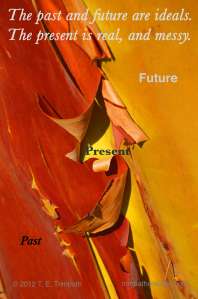
The past and future are ideals. Selective amnesia clarifies the past. An inability to guess myriad details simplifies the future. Things were simpler then. Things will be simpler after we get through “this”. The present sits between them, and in the present we are aware of annoying imperfections, troubled by unknowns, and eager with anticipations. There is great uncertainty about where the present will lead, and yet, the present is the only place we exist.
Past Present Future
A few conversations were inspired by my semi-annual portfolio review. The difference between the current stock prices and what I think they should be simultaneously raises eager anticipations while also inspiring cautions about the credibility of my opinions. Regardless of what any analysis looks like, if it is about the future or what should be, it includes assumptions; and assumptions are basically arbitrary, opinions not facts. Of course, what people want to do is skip ahead and see how it comes out. “Tom. So, do you think I should buy some stock?” That may be one of my most frequently dodged questions. I don’t hand out stock tips, though I do enjoy having conversations that help people decide what advice they want to give to themselves. Logically, everyone knows there are no guarantees, but the question gets asked anyway.

Questions about global warming, political evolution, alternative economies, and technology advancements all play out over months, years, or decades. Knowing what to do now would be so much easier if we could skip ahead to check on what worked or didn’t.

For months, ever since I stopped paying my mortgage, I’ve been asked about my plan. If I want to keep the house, how do I plan to find the money? Despite writing it out in a thousand words or so, the question is continually asked. If I could skip ahead, I’d know which plan to work and which plans to abandon. That would’ve saved me a lot of time, and probably even a relationship. Yet here I sit, working my business, talking to people about jobs, keeping my house on the market, and wondering when my portfolio is going to recover or even excel. If I could just skip these steps in the middle that require negotiations with the foreclosure community, then I’d have more time to enjoy things like the art fair going on outside my office, and the various authorities would know what they should do and when.
UBCC 070613
Foreclosure update: For those of you following the story of my housing situation, I have yet to hear any formal word about the forbearance of the foreclosure, but the Notice of Trustee Sale hasn’t been posted on my door (when last I looked). I have been assigned a new housing counselor, who seems inexperienced and seems more likely to parrot the mortgage servicer’s perspective instead of the homeowners’ advocacy I’d witnessed earlier. The servicer (the organization that actually initiates the foreclosure, or not) has decided to not correct the errors in the legal documents, dismissing them as typos. We’ve sent a letter to the State Attorney General asking them to enforce the legalities, requiring the servicer to start over and do things right. Both the forbearance and the Attorney General action processes would suggest that there’s nothing official required of me for months, but my counselor went ahead, contacted the servicer and then advised me to apply for mediation that will be scheduled within weeks, which requires me to produce an enormous set of documents, pay $200 for a mediator, and attend (and probably abide by) a meeting with the servicer, the mediator, probably the counselor, and ironically probably not the mortgager who had suggested the forbearance. Do you think I’d like to skip ahead? All of those steps are required, but if I do all of those steps and don’t have the money, I lose my home. If I skip some of those steps, but find the money, I keep my home. The money is more important than the steps, but the steps are required.

Because I blog about some of my personal financial turmoil, I’ve been honored by those who quietly tell me their tales. There is a quiet otherclass developing of people who’ve found that they can’t get a job, may not be able to keep a house, can not carry health insurance, and basically can not reintegrate into mainstream America. The goal of reattaining the 1950s dream of house, family, career, and vacations is higher than the also unattainable goal of the 1990’s dream of steady income, stable housing, long term relationships, and some sense of a national identity. The steps required to reach those seemingly unattainable goals are being skipped by necessity in favor of innovative entrepreneurship, alternative housing, non-Western health care, and support from a community rather than only a spouse or family.

I’ve mentioned the Walk Away movement before, an unofficial unorganized trend of people walking away from the mainstream seeking what they can’t find there. Thanks to Stephan Schwartz, I read an article pointing out that less than half of American adults have full time jobs. Only 47% are living a life that fits the stereotype displayed in mainstream advertisements. Considering the fact I mentioned in an earlier post, that 58% of those with jobs are dissatisfied with their jobs, very few are working to the lives that government seems to be trying to sustain. By the way, since I posted that piece two bits of data have been updated. Instead of it being 58% dissatisfied, it’s 70%; and instead of there being 3,900,000 uncounted unemployed it is more likely 8,000,000. Which We The People does the government think it is governing?

Many of the folks who’ve told me their stories have also told me about times when they seriously stayed in bed for days, or cut themselves off from everyone because they felt so removed from “normal” life. Dealing with abusive bill collectors doesn’t help. Having to politely walk through displays of discretionary wealth without interacting with it, can become too much of a chore. They skip that step by only going into town when it’s quiet, and by increasingly finding other ways to meet their needs. The shadow economy must be growing.

Increasingly, millionaires are living such lives as well. They recognize that their needs don’t require extraordinary wealth, and that, considering the way the world is shifting, their wealth may have much less value soon anyway. There are many reasons to learn to have a backup plan that doesn’t rely on accumulations of abstractions.

In the meantime, that abstraction called money continues to be important. Ironically, I am optimistic about the probability of accumulating more than enough for myself. I understand my value as a consultant and teacher who enjoys listening while implementing pragmatic progress. I am encouraged by my semi-annual analysis of my portfolio. I am optimistic because, even though I’ve witnessed unexpected and extraordinary bad luck, I know I can experience unexpected and extraordinary good luck. But it is that meantime that is the present that is messy, that requires me to not skip any of these steps. But the steps I take don’t lead back to what convention expects.

Posted in Uncategorized | Tagged , , , , , , , , , , , , , , , , , , | Leave a comment

Happy Belated Third Of July

Crackle, crack, snap, pop, whistle, pop, pop, pop, snap. Not a Rice Krispies commercial. It is 11:15pm on the third of July, the night of the main celebrations on South Whidbey. Celebrate here on the third, and you can also go to Seattle for the bigger displays on the fourth. We do things a bit out of step with everyone else, and it is our differences that give us character. I was about to comment on silence, but another barrage just began. Exuberance happens, whether it is legal or not. I lead a unique life. It too is out of step with many aspects of those around me, but it is that difference that helps define me. I guess our nation was built from a similar idea.

My normal time to post would’ve been this morning, like every Wednesday. But, there was a meeting, and then there were chores, and then there was a long interview for a PhD candidate doing a dissertation on what it’s like to be unemployed and how that is reflected across social classes. An interesting day. Then a rare event, two dinner invitations within the neighborhood, both using my neighborhood’s fireworks display as a dessert. It’s part of our dues, and a part that I appreciate more than the pool or the tennis courts. A full day, and just the time to unwind, but pop, crackle, boom, I suspect I won’t be sleeping for a couple more hours.

My normal topic is some variation on personal finance, which has been highly personal lately. I’ve become my own case study. There’s been news about the foreclosure and my business and my portfolio, but the foreclosure news is so convoluted that I probably can’t type it up with these pop, snap, whistle distractions. My business news is enough to encourage me, but nothing definite enough to pass along, and my portfolio news hasn’t changed since I posted it on Sunday (except for the understandably incredulous reactions to anything I write about MicroVision.)

So, as I sit here, listening to the chuff of an illegal firework launching into the neighborhood sky, probably to settle in a yard that doesn’t belong to the launcher, I swing back through history. What was it like to write while watching “the rockets’ red glare?” What was it like for my ancestor, Francis Hopkinson, who signed the Declaration of Independence?

The United States was founded from a collection of colonies that were thousands of miles away from the seat of government. The travel time and danger of crossing the Atlantic meant the colonists would be out of step with England. In some ways that held them back. In other ways it freed them to try new systems of governance, and it required them to become more resourceful. It had to be a scary notion hanging on to the edge of a continent which had no reliable map or measure of its extent. Anything could be in the great empty spaces on the parchment. And yet, they felt the need to take on the risk of countering the wishes of the mightiest empire while hoping nothing unexpected snuck up from the wilderness. It wasn’t a want. It was a need. The likelihood of being hanged for treason was greater than the likelihood of achieving independence. The need was great enough to encourage them to commit to a new way to live.

They succeeded, and promptly embarked us on a history of the states never quite being in step with each other. And yet, somehow surviving.

It was Britian’s backlash in the War of 1812 that launched the rocket’s red glare. Again, this country that was slightly out of step with the rest of the world, and was almost tripped by its earlier overlord. The rockets failed. The British had already burned Washington D. C.,  but somehow the United States succeeded. It would be romantic to imagine Francis Scott Key, writing the lyrics to the national anthem while real fire works burst in the air, but he waited until the smoke cleared, the Sun came up, and the larger US Flag (possibly designed by my ancestor) was raised over the last line of defense.

Entire minutes have gone by without another firework, and it isn’t even midnight. My neighbors grow more considerate. Vets with PTSD can begin to relax. Pets will eventually come out from under the furniture, unless they ran away in fright. (Evidently, the Fourth of July, and probably the Third of July, are the busiest times for dogs to jump fences and run.) I’ll finish this post and try to get some sleep.

Many people are living lives that are out of step with the mainstream. Some are by choice. Many are by chance. Personal finances and everyday realities are requiring the re-evaluation of priorities and values, replacing conventional wisdom with resourcefulness and re-designed systems. The over-arcing system (boom, pop – okay the fireworks aren’t done yet) the over-arcing system expects compliance and is confused with lives that don’t fit old models. In the past, that would have unfortunate consequences. But now, in a government “of the people, by the people, and for the people”, at least according to Abraham Lincoln, change should be possible.

It is past midnight now. It is the Fourth of July. I guess that puts us back in step with the other celebrations – but people seem to be obeying the unofficial midnight curtain call. Maybe the island’s not that far out of step. We only celebrate on the third so we can join everyone else on the fourth. Maybe by being a little out of step we can try a different rhythm, while being close enough to the mainstream that they don’t lose sight of us, and also while not being so far afield that something unexpected comes at us from the wilderness.

Even off the island, the stories I hear from others who have lost their jobs and houses are of people who’ve been put out of step and who find that it is nearly impossible to run fast enough to get back to their old place and pace in the pack. They are leading unique lives, redefining finances for people, and in some cases questioning the need for conventional finance, or even conventional currency. Two hundred years from now will anyone look back and write about an anthem written in the midst of such turmoil? Two hundred and thirty seven years from now will anyone note the courage of the people who felt the need for change?

To all who live courageous lives, even if you feel a bit out of step, Belated Happy Third of July.

My favorite way to see red in the air.

My favorite way to see red in the air.

Posted in Uncategorized | Tagged , , , , , , | Leave a comment

Semi Annual Exercise Mid 2013

It’s Sunday, June 30th, a marvelous day in Langley, WA and I sit here typing and calculating from my office while an excellent jazz group is playing very danceable music at one of the local coffeeshops. I watch dozens of tourists and locals lounging about, and yet I sit here and type. Why? Because I take my exercises seriously. Today is the end of the first half of the year. Every six months I review my portfolio in an exercise inspired by Peter Lynch. Basically, know why you own the stocks you own, and check back on their stories to see if their story has diverged from your intent. I do this via a series of short paragraphs posted to discussion boards because: 1) the best measure of whether I understand something is whether I can explain it to someone else, and 2) by making my reviews public I can learn from others’ feedback and they may learn from me. This blog acts as a summary and a collection of the links. But again, why do this on such a nice day? So I can eventually afford to do what everyone else is doing (except for June 30th and December 31st of course.)

Did you know I wrote a book about this stuff? Dream. Invest. Live. is my personal perspective on personal finance, and is a mix of my experience, insights from Your Money Or Your Life, and strategies from One Up On Wall Street. My book had the unfortunate timing to come out as the market crashed a few years ago. My portfolio had the unfortunate timing to be called upon after I bought my first true home as my business had yet to gain traction. The sales have been understandably embarrassingly slow; but, while many expect me to disassociate myself from what I wrote, I find myself more confident that it is written well, is valid, and informative (as others have told me.) As several financially literate friends have comforted me, their analyses agree that I’ve just been hit with a perfect storm of bad luck. For now.

My preferred analysis for a stock is “Present Value of Future Revenues Discounted for Risk.” I intended to do such an analysis for each stock until I pulled up their financials. Something is definitely amiss. We’ve had years of irrational markets and my stocks, and probably many small cap stocks, continue to experience the symptoms. I realized that some of these stocks, er, all of my stocks, are so undervalued that I didn’t have to dive into such an analysis. A much simpler analysis meets my immediate goal of finding a possible way to pay off the mortgage (or at least avoid foreclosure) and return to a thriving lifestyle, or at least one that isn’t fraught with worry. If you want the more complicated, yet approachable, analysis, go buy my book – or at least get it from the library.

My simpler analysis looks at two ratios: price/sales and price/book. Price/Sales is the ratio of the stock price (though I use market cap) to the company’s sales. I use sales instead of earnings because earnings are too susceptible to bookkeeping abstractions. Price/Book is basically the company’s net worth per share. If it is one then buying a share of the company is buying a dollar’s worth of assets – sorta. Both ratios can vary greatly depending on the company’s maturity, market, industry, competition, and history.

For my simplest analysis I checked to make sure each had a positive net worth. Good, though shaky in some cases. Then I checked against my preferred P/S of 6. Six is a good conservative number for healthy, mature, growing companies. The average P/S of the companies actually making money from customers was only about one. If those stocks regained those ratios, that portion of my portfolio would increase six-fold. What investor requires more of a return than that? Of the companies that were within a year or so of getting their products into market, reaching a reasonable market cap of one billion dollars would create a ten-fold increase in their value. Granted, a billion is an incredibly rough guess, not even an estimate, but disruptive companies are hard to analyze and can easily attain such values when they are successful.

I am heartened.

My portfolio possibilities can far exceed any financial influences of mortgage modifications.

  • Currently, my portfolio is enough to pay off my credit card debt, but would leave only a few thousand for emergence funds and my retirement account.
  • If all of the stocks reached P/S = 6 at current revenues and products, I’d have enough to catch up on the mortgage and even pay off the credit card debt. This is close to what I consider a conservative rational market valuation. It assumes no growth.
  • The same is true if two of the disruptive stocks, MVIS and GERN, reached market caps of $1B. Then, I’d also have enough for a few more years of living expenses.
  • If they all reached market caps of $1B, I’d have enough, that if necessary, I could pay off all of my debt and still have savings. This is reasonable if the market was valuing companies and stocks based on the present value of future revenues, which does not seem to be happening for such small companies – though that may be changing.
  • As I said, valuing disruptive companies is difficult. While my estimates for MVIS are in the incredibly modest range of $640 (only $80 pre-split for you knowledgeable in MVIS), others estimate as high as $1,500. At that price my portfolio is so much greater than “enough” that philanthropy can become a wonderful occupation.
  • If GERN matches MVIS’s success, well, it will be time to give away lots of money.

So goes the money story. Of the list, only one scenario leaves me with my current worries. It is the current scenario. I considered such a scenario to be unbelievably unlikely, yet here it sits.

There is a time story. Waiting isn’t an option, or at least much of one. Ask my mortgage company. For my portfolio to provide a source of income in time to allow me to keep my home, my portfolio must grow quickly. There is reason to believe this is possible. these undervalued stocks have moved up impressively within the last year. RSOL alone went from $0.40 to over $7.00. It came back down, but its competitor trades forty times higher. There is plenty of room to grow. MVIS’ first major success is hinted at happening within this year, probably the next few months, possibly the next few weeks, and is supposedly going to be followed by up to four such deals within twelve months. The possible foreclosure of my home is working to a similar timing.

Conclusions? I am heartened, but I am also working on a Sunday because where I am is what I have to work with and I’ll only change as good news arrives. Analyses are guesses, and these analyses are cruder than most, yet suggest I don’t need to do more. If I did, each of those scenarios would be even better because the above analyses did not account for subsequent products and premium pricing for closely held stocks.

I encourage you to make up your own mind. Here are links to my descriptions of my remaining holdings (as I fondly look back on FFIV, PIXR, SBUX – and yes, even DNDN.) As I said above, I post these on discussion boards because of the value of the discussions. Read on and speak up! I truly do want to read what you have to say.

Investor Village
AMSC
GERN
GIG
MVIS
RSOL

The Motley Fool
AMSC
GERN
MVIS
RSOL
Economy and Markets

Silicon Investor
AMSC
GERN
GIG
MVIS

Posted in Uncategorized | Tagged , , , , , , , , , , , , , , , , , , , , | 1 Comment