Foot In The Mouth Palm To The Forehead

A far too common condition: putting my foot in my mouth while giving my forehead a slap with my palm. Photo on 2015-05-13 at 18.09 #4I may not be able to lift my foot to my mouth like I did in college days (was I really that flexible? Yep.) but I can do something more impressive – socially. Last week I finally managed to deliver a long-delayed compliment; and then added one extra sentence that made the compliment sound like the prelude to a sales pitch. Groan. Gag. Slap. Doh! Sad to say, but another downside to the protracted busy-ness we are experiencing is the skepticism created as ulterior motives are assumed, and generosity and sincerity are challenged. I’ve decided to not let that stop me, even if it means a social sock in the mouth.

Part of living a frugal life is appreciating every part of the day, every part of the world. For me, frugality means valuing what I have, what’s around me, what’s in the world. I may want a better financial situation, but I am glad for where and how I live even while knowing that something much better is possible. I may want a better world, but am glad for the greater awareness that is now available. Ignorance of the rest of the world’s troubles was a version of bliss we no longer have, but the greatest hope for resolving those troubles is awareness that leads to action. I may want a better community, but am glad for the community I feel a part of – and that’s where I got into trouble.

Discretion recommends that I skip the details, but I’ll at least describe a familiar situation. As well as my local community communicates, Facebook has made it easier to see what’s happening in others lives. One Facebook friend and real world acquaintance has operated a successful business for years. That’s a tough enough trick anywhere, particularly on an island. A but of luck gave me the opportunity to pass along a compliment about the business. The compliment stumbled out of my mouth, was received graciously – and then I said one more thing. I mentioned how it would all make a good story. Locally, I’m somewhat known for being a writer, and even I thought my follow up sounded like a sales pitch for a paid writing gig. Foot in mouth. Palm to forehead. Compliment potentially minimized.

People are scrambling. Large portions of the populace are well and conventionally employed. Large portions are financially stable enough to not have to worry about money (though many do because they fear losing it.) An equally large population is actively striving to get by, and maybe, just maybe, get ahead. About 40% of Americans have shifted their economic dream to one of stability rather than advancement. People are increasingly drawn to entrepreneurship because they are seeing lower probabilities of attaining even modest goals through conventional careers and jobs. They start businesses for weight loss supplements, alternative health care treatments, spiritual awakenings, and financial counseling which can be offered sincerely; but, it is too easy to question each when there are more than one in each category. Is the motivation the presenter’s profits, or the recipient’s improvement? How many of your defense mechanisms just kicked in?

Compliment too often, and each message can be diluted. Compliment too often, and be seen as insincere and a suck-up. Compliment too often, and others may feel obliged to compliment in return.

If everyone complimented everyone else for everything positive they’ve done, we’d rarely get anything done and would generate some of the most ridiculous dialog human language ever produced.

If we say nothing, however, the results are even worse. Complimenting a person, appreciating the world around us, being thankful for the good parts of the lives we’ve led – and doing it all vocally and sincerely – reinforce and confirm the value we’ve felt. If we say nothing, we may feel that there is nothing to value. It becomes easier to overlook and under-appreciate basic, vital things like air, water, land, food, life, and each other. Politicians and pundits are more likely to emphasize the fears, doubts, and divides. The media passes it along. I wonder what public debate would sound like if they placed more emphasis on amplifying positives rather than embellishing negatives. Would they be more likely to defend the basics? Maybe they think they’re already doing that, though their results suggest a lack of success.

Some folks have asked how I manage to maintain a positive attitude despite my situation. (Others, by the way, chastise me for my negativity, but they’re no longer reading this blog.) It is easier to be positive when you know how impressive the world is and how much our civilization has accomplished. We may be in the midst of some epic mistakes, but it hasn’t been because we haven’t tried to make things better. We are an imperfect and adaptable species that may yet figure things out in time. It is tricky balancing the positive and the negative; but, solar is kicking coal’s butt, social injustice anywhere in the world has a tougher time hiding than every before, human compassion and beauty have an easier time being noticed and acknowledge. We’re simultaneously learning how scary the universe can be while beginning to realize the vast potential that exists off this planet which will make it easier to preserve this planet.

A week or so ago started with one or two business meetings planned every day, in addition to my regular clients and assignments. That was encouraging. If even half of the meetings occurred on a regular basis I could finally pay all my bills and begin working my way out of debt, and maybe even start working on the long repair list. Every meeting except one cancelled. And yet, I felt better about the week. More than a half dozen new clients had sought me out. None of the new work was from cold-calls or ads. All was from people familiar with my work (consulting, writing, program planning, etc.). I appreciate that progress from a year or two ago. Fortunately, most of the meetings were subsequently postponed rather than cancelled, as I’d originally feared.

The following week one of the rescheduled meetings was at a local coffee shop. I was there early. My friend and client was there a bit late. Until they arrived I considered the possibility that they forgot. Rather than worry, I looked around. The coffee shop is in a garden center. The day was gorgeous. I had my cup of tea and an excuse to do nothing (the wi-fi was a bit dodgy outdoors).  Sure, I needed the money. Sure, I want to see the project completed. And sure, sitting there in the sun, surrounded by beautiful displays was pretty nice. I should compliment them on the arrangements.

IMG_0439

Nah. I’d probably just put my foot in my mouth.

Posted in Uncategorized | Tagged , , , , , , , , , | Leave a comment

They Might Not Make More

Don’t worry. They’ll make more. Or not. Change is accelerating. Tomorrow’s thing will be better than yesterday’s thing, and yesterday’s thing will be cheaper as a result. If something breaks, replace it or upgrade. The economy loves it, even if the upgrade isn’t an improvement. You know I’m probably about to flip that logic, and you’re right, but this isn’t a Luddite revival. The change in perspective is, however, to point out that some things we take as progress are as much rationalization as real. And that, looking back at what they’re not making more of is an inspiration to appreciate what we have here and now.

Earlier today I was talking to my dad. He served on Liberty ships in World War II. Liberty ships were built to only last a few trips across the Atlantic in convoys. The strategy reflected the times and may never be repeated. The Allies knew the German U-boats were too efficient, so in addition to trying to sink the U-boats, the US decided to build ships faster than they could be sunk. It was a war of attrition and it wasn’t a secret to those involved. My dad served on them, switched to work on land after the war, and then helped run the Merchant Marine Veterans association. Last week they had one of their conventions. Fewer men arrive every year. There are even fewer of the ships. Only two are operable. They won’t make more, unless it is for a museum.

I miss my TR7. I never should’ve had a TR7. It was a two seat sports car with some innovative design that pushed a little too far; but it was fun. It was called the Wedge and the only reason I bought one was because I wanted to learn how to use a manual transmission, and it was one of the cheapest cars on the lot. Besides, something in my 22 year old’s brain suspected being young and single was the best, and possibly only, time to own such a car. I’m over six feet tall. My head almost hit the ceiling. The only way my foot could stay on the gas was to tilt my thigh to the left and bend my shin back to the right to get around the transmission housing. I drove cross-country twice that way; one time with the interior heater on full blast to keep the car from overheating as I drove across the Great Plains in summer. They don’t make those anymore.

My main part-time job is as project manager for the History of Computing in Learning and Education Virtual Museum, eventually an online museum for the history of how computers changed what, how, when, why, and where we learn. The computers that enabled the computing are of about the same age as the TR7. We’re building the museum from a collection of things that can be digitized and put online: documents, videos, and software. We’re also collecting stories from the people who lived through the early years of the revolution that saw the teacher’s role change from lecturer to facilitator. The people with those memories can’t be replicated. Even the software that has the illusion of permanence because it is digital, is perishable because magnetic media deteriorate and the hardware that reads it becomes rarer every year. In some cases, there are no spare parts and no one knows how to build duplicates to sufficient precision. (As I recall, the Living Computer Museum in Seattle would be greatly relieved if someone found a supply of RP06 or RM05 read heads.)

As an aerospace engineer I look around and see what we can no longer see. There are no successors to the Concorde or the Space Shuttle. While many will cheer the departure of both, they also represent a collective retreat from capabilities that aren’t easily replicated. It is easy to say we don’t need them and never should have had them, but it is also easy to imagine the benefits of quicker responses to trans-oceanic crises, and the utilization of space rather than our home for resources – and even defense of the planet. The Concorde’s first flight was 1969. The Space Shuttle design effort was started the same year. If we found we needed either of them, it would take years, if not a decade to redevelop the technologies, design the vehicles, build them and fly them. I know. I worked on next generation versions of each, and watched airplanes stall at slight modifications to the 737 and spacecraft revert to Apollo-era concepts. (Come on Space-X et al.)

Step outside technology and see similar achievements in architecture, infrastructure, and even politics. The ornamentation in cathedrals is rarely attempted. The US Interstate system is collapsing, not even being upgraded. The US Constitution was designed to be revised, improved, and upgraded for contemporary society; yet, we have yet to get around to rewriting the Second Amendment to eliminate confusion, or reflect technological influences like our digital lives.

As I said above, I’m not advocating for a Luddite revival, even though there are a wealth of low-tech answers to modern problems. My intent, which may be personal as much as public, is to appreciate what we have now.

This is an era when:

  • I can write a post like this and publish it to the world for the cost of a bit of my time and a bit of electricity. (Though some would say I should pay for the privilege.)
  • I can eat food from almost any continent, and be so casual about it that I may not know how far that ginger traveled. (Though I am glad for the local butcher who makes excellent sausage, steaks, and bacon from local herds.)
  • I can heat my house by flipping a switch or programming the thermostat. (Though I do notice that propane bill.)
  • I can store food for months, thaw it, and cook it within a few square feet for very little money. (And glad I can watch videos about how to improve my cooking.)
  • I can get into my truck, load it up with hundreds of pounds of whatever I need and drive hundreds of miles if necessary. (And be glad for cruise control and a cd player.)
  • I can open my home’s doors and windows to let in the good weather, or close them and be warm and dry inside. (Though there are a few panes that need fixing.)
  • I can go on, and won’t; because I’d rather you created your own list rather than reading more of mine.

We can’t save everything. Some things we should save at least a few of for historical purposes. The most perishable things are us; because at least for now, we humans are fragile and impermanent. Other things we should maintain, if for no other reason than we don’t lose the momentum. Frugality is not being cheap, but being appreciative of the resources available. The biggest gift is to not take what we have for granted; whether that is a house, friends, a community, a society, or a planet. There are plenty of things we can make more of, but the most precious are those that are in such short supply that they are unique. Thanks for you all.

Posted in Uncategorized | Tagged , , , , , , , , , , , | 1 Comment

Working On Small Town Coworks

Go work in the coffee shop. That’s what everyone else does. If you can’t afford that, go work in the library. Welcome to the new job site search familiar to nomadic workers. Solutions that work in the big city don’t necessarily work in the small town. Our local coworks closed, office photo 062813and several of us are on a search for a solution. If convention doesn’t provide a solution, if need drives innovation, then we’re probably close to finding something new. Here’s the progress so far.

Whether as an independent entrepreneur, or as a displaced corporate employee told to work off-site, or as someone playing hooky from home and office, people are much more likely now to gather up their phones and laptops, buy some caffeine as a nominal table rent, and try to get work done. That works for some, especially if it’s temporary, but as a prolonged solution its appeal fades quickly. Welcome to the concept of the coworks, where office nomads collectively create an office by sharing space, utilities, supplies, and ideas. No one has to pay for the entire space. As needs change, the crowd changes, but the concept continues. Get the right mix of people and networking becomes powerful. Take the idea to a small town, though, and the reverse inefficiencies of scale arise. Each individual pays a higher share. The presence or absence of someone has a bigger influence. Regardless, solutions must be found.

Out of curiosity as much as need, I decided to try out a few of the usual places in my community. Being somewhat of an organized geek, I compiled a list, created some criteria, and built a spreadsheet of the possibilities. It isn’t exhaustive, but it might be informative, even for other small towns because some patterns emerge. Here’s what I was able to compile for the cost of a bit of gas, some time, and many cups of tea.
Whidbey Coworks
(For folks familiar with Whidbey, these are listed from south to north, but only as far as ‘North’ Freeland. The rest of Whidbey is outside my commute criteria, but go ahead and create a version from your options.)

The two main suspects are simple enough: coffee shops and libraries. A lot of folks use them because they’re there, no innovation required. South Whidbey is lucky enough to have other options, businesses that are providing work space as a way to draw in customers, or just to support the community. If all you need is wi-fi, a chance for a power outlet, and not being bothered, you have lots of options. That covers a lot of work, especially for folks who only communicate with computers, not with people. If you have to deal with people, that still may not be a problem, as long as you don’t need privacy. There are enough business deals happening over coffee that no one notices. If, however, the conversation is a phone call, or something that requires some discretion, well, you can pick a place and hope no one shows up.

My benchmarks are working from a conventional office, where everything is fine as long as I can afford the fee; the coworks, which was good, but could’ve been a bit more private; and working from home, which works for me, but not for all of my clients. Some people don’t want to work from another person’s kitchen table. Those three benchmarks highlighted what the coffee shops and libraries don’t have, 24 hour access and privacy. As simple as those two things are, they point out that working from most other places only works when work happens within the other place’s hours, and in the vicinity of who ever happens to be there. For some, that’s not an issue. For others, they are necessities.

After my survey, I am much more familiar with where to find good wi-fi (WiFire), good tea (Useless Bay Coffee and Kalakala), good equipment and support (Island Printing), good networking (South Whidbey Commons), good writers (Through the Reading Glass), good art and gluten-free cookies (Timbuktu – got a URL?), and undoubtedly I missed a few key benefits, but I do what I can with what I have. The best and cheapest solution may be the libraries. They’re free. They have copiers and printers. They’re increasingly set up for power and connectivity, and have computers available for short periods – and are excellent places for research because they have books (duh) and librarians (professionals who are overlooked and underutilized.)

There is some good news. I’m not the only one hunting for solutions. There’s talk of a coworks in Clinton, my mailing address. Some entrepreneurs are creating an excellent space for physical work, part of the Maker movement, where people can create small devices through conventional means or from 3-D printers. They might provide some space. A variety of offices are available, and the ones owned by non-profits may appeal to people who are working for other non-profits; especially, if the space is shared by enough people. If you’re interested in those specifics, contact me and we can talk about the possibilities.

I don’t expect a solution, even though I look for one. I understand both sides of the economy of scale and can see why the concept works in a city but maybe not in a town. This may be one of the prices of living somewhere quieter. I also know that what I’ve found is only one answer. Maybe this post will inspire someone to come up with a better sustainable idea. Maybe they already have it, but haven’t announced yet. For now, though, I provide this survey in case it is helpful to anyone else, on Whidbey or elsewhere. One thing that small towns are great at is creating community, and I suspect that this community can find an answer, maybe even one that’s never been considered before. Until then, it’s back to work at the kitchen table. At least I like the view, and the commute can’t be better.

Posted in Uncategorized | Tagged , , , , , , , , , | Leave a comment

Watching The Early Maturation Of MVIS

Rarely do I pay as much attention to a stock as I have been lately with MVIS. (Okay, I watch DNDN a lot, too.) My increased attention may be because MicroVision is entering exciting times, or because I’ve grown impatient over the 15 years of owning the stock, or because I need the money, or because of a combination of all of those reasons and more. Today was the coincidence of a few events: I read the Annual Report recently, the company announced earnings and had a conference call, we’re one-third of the way through the year, and the stock went down 8.2% today but is up 86.8% since the beginning of the year. It is a good time to compile the progress and assess the situation, or at least guess. (Because, guessing is what every analysis is if any assumptions are involved.)

For those unfamiliar with MicroVision and MVIS (and if you’re reading this blog regularly how could you miss the topic) I wrote a bit of a synopsis a few years ago. The synopsis is due for an update, but like I said, MicroVision is not the only thing in my life. Go read Micro Vision for a slightly out-of-date primer. For the ultra-short primer, MicroVision may help make projectors as ubiquitous as those cameras in laptops and phones – and more.

Things I Knew already

There are two identified customers: Sony and Celluon. Sony has yet to announce any products, but they have paid $8M for a multi-year contract, and $14.5M for components, and will also pay royalties as the products sell. Celluon was a surprise, but they’ve launched two products (the PicoAirIMG_0417 and the PicoPro) and have stated an intent to launch more because they are so enthused by the technology. The products are getting excellent reviews, but no sales figures are available yet. There is lots of tantalizing talk about other customers and products, but no details because everyone is guarding competitive secrets. Secrets turn investing into speculation. Business in 2015 has already set records for true commercial production and product revenues. Congratulations. MicroVision is not, however, profitable – yet.

The Annual Report

I just finished reading the Annual Report. Yes, that can be dull. Yes, it can be repetitious. No, I don’t read every word; but, I do skim for key phrases in familiar places or in sections where I have questions. The quick summary: there was very little that was news, partly because I read the press releases, follow the twitter feed, and because discussion boards (particularly Investor Village) keep me informed well enough informed that there were few surprises. (Follow my blog tags for MicroVision and MVIS for posts about previous news items.)

The only small surprise worth mentioning was that under ‘not currently major areas of focus’ was the ‘pair of glasses’, which I take (and there’s an assumption) to include Hololens (an impressive Microsoft initiative). This is a disappointment because I think eyewear displays will be easier to use than projections that have no privacy. The embedded projectors have a large market for replacing or supplementing conventional displays (and are a great improvement for sharing videos) but I think (think) personal use will exceed public use.

The Earnings Report and Conference Call

Dutifully, MicroVision announced their quarterly earnings and held a conference call to discuss the results. Yes, that can be dull. Yes, it can be repetitious. Yes, I did listen to the entire 42 minute call; but, considering the implications, it was worth the investment in time. For the full set of financials, check their press release. If you prefer data, read the report. If you need to hear from management, listen to the call. If you have the time, do both. If you don’t have the time and are only relying on me, well, remember that this is free and you may get what you pay for.

The Report

Revenue was $0.9 million.
– Which is less than the price of many homes in the Seattle market. The $8M and $14.5M orders came in, but the accounting is spread out.
– Revenue was from selling goods rather than services, which is a switch and a sign of maturity.
Operating loss was $4.0 million.
– Oops. That’s bigger than the revenue, but includes non-recurring costs of building the business.
Net loss was $0.09 per share.
– But -$0.09 is better than last years -$0.23 quarterly loss. Keep up that trend and be positive, and extrapolations are dangerous.
Backlog was $18.7 million and cash and cash equivalents were $16.7 million.
– Those are like, real numbers from a real business. Yay! Dilution may be held at bay.

The Call

  • The $8M Sony deal (and they’re actually calling them Sony instead of a Fortune 100 company) is a deal for eight years.
    – Some were hoping for $8M every year, with follow-ons.
    – Some were hoping for $8M over a couple of years, with follow-ons.
    – Some are cheering the 8 year deal, while others are lamenting the fact that $8M spread out over 8 years is only $250k per quarter.
  • The $14.5M Sony deal includes shipping display modules (made by another firm) to Sony from 2H15 through 2016. There is no public information about when Sony will announce and release the product.
  • Celluon’s 2 products (PicoAir and PicoPro, available on amazon) were launched in February and April and have received almost exclusively positive reviews.
  • The Fortune 500 company working on an innovative smartphone continues to work on an innovative smartphone.
  • Several companies privately demonstrated products at CES15.
    The customer list is growing.
    All of the customers are maintaining secrecy.
  • There were no updates from auto and industrial, which does not sound encouraging.
  • MicroVision is increasing supply capacity, and expects growth in product and licensing revenues – but stockholders don’t know the details.
  • Research and Development is working on increasing brightness and helping develop applications beyond projection. (See Mark Bridger’s guest post for an example.)
  • Questions & Answers – paraphrased (and drastically reduced)
    – Every quarter should exhibit increasing output and revenues.
    – With Sony entering a new phase, employees are being shifted to other customers and neglected projects.
    – Royalty revenue has a one quarter lag before it is reported.
    – MicroVision is looking beyond projection. (Pun thanks to paraphrasing.)
    Sony is very bullish.

First Third of the Year
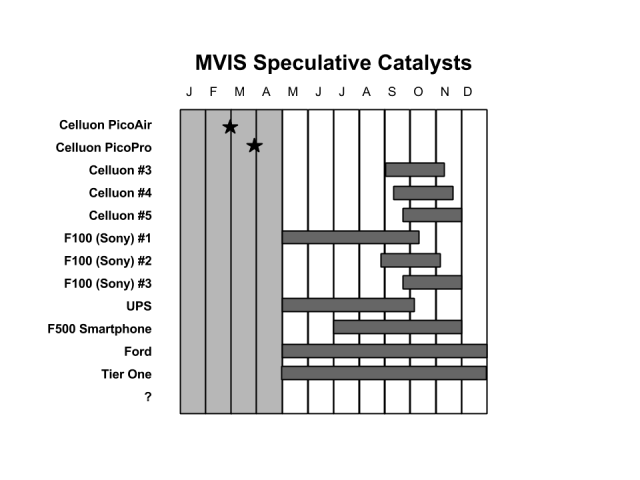
Nothing I read or heard inspires much of a change in the list of catalysts I posted earlier, except to mark off another month and Celluon’s launch of the PicoPro. There are lots of tantalizing potentials, but the graph already has too much speculation built into it. It sounds like the pace should pick up, and that bars will be replaced with stars (or deleted), and that a few other bars can be added; but that level of speculation is the too frequent norm.

MVIS Catalysts
The Stock

I’ll add my synopsis below, but the market made its synopsis apparent today. As I said above: MVIS was down 8.2% today but is up 86.8% since the beginning of the year. The stock is trading about where it was three years ago when the company executed a one for eight reverse split. The Sony news has been the biggest catalyst, and has the potential to be followed by far larger news items; but today’s news wasn’t good enough for many investors. Every day on the market is different. Noise happens. News happens. Rumors happen.

My Synopsis
Let’s take the above items in reverse order.
The Stock: I look longer term. Five years ago, back when many of today’s shareholders bought shares, MVIS was trading at over $22. A seven-fold increase in the stock price would make headlines, and yet it would simply take the stock back to the entry point for many. If they expected a 15% return because it was a startup, they were looking forward to a $44 stock today, a 14-fold increase. Dilution affects that but the reaction to a $44 share price is still more emotional than logical. I have to remind myself that the math doesn’t care about what makes sense. Multiple previous analyses (see Peter’s MVIS blog for a collection) have suggested far higher eventual targets, like $400 and eventually $3,000. That last one is possible, but would require so much success built on success that MicroVision would become one of the largest companies in the workd.
The Call: I spent the time. I heard the words. I took my notes. My opinion hasn’t changed. There are so many hidden details and NDAs that any story can be produced.
The Report: Without perspective, the financials do not tell much of a story. But, for anyone who’s followed the company for years, the data are encouraging, and yet not sufficient because profitability has yet to be reached.
The Annual Report: Aside from the eyewear disillusionment, I’m glad I read/skimmed the report; but found the details about the stockholders meeting to be the most actionable item. (Only a bit over three hours by bus to get there. Oh, goody. Thanks for the ride offer, folks.)

My Conclusion
This has been more work than I wanted to spend on a Thursday night, but it is part of the due diligence of investing. I don’t do this all the time for every stock. As the title of my book Dream. Invest. Live.Dream Invest Live cover suggests, investing is only a part of the story. I’ll continue to hold because I am cautiously optimistic and because the potential is so great. Logically and mathematically, the present value of future revenues discounted for risk is improving because the risk is diminishing. Emotionally, however, my optimism for MVIS has been worn out by years of slight progress and large disappointments. I look forward to being pleasantly and profitably surprised. My math says it can happen. My emotions won’t believe it until they see it. That’s why I am watching.

Posted in Uncategorized | Tagged , , , , , , , | Leave a comment

Guest Post – Mark Bridger On MicroVision

The following is a guest post from Mark Bridger of Australia that was prompted by an email exchange. I appreciate the current find with the historical perspective. – Tom Trimbath


From Mark,

As a fellow ‘long haul’ MVIS investor, I’ve been following MVIS Retinal Scanning Display (RSD) technology since its inception at the Washington HIT labs and waiting for a killer app ever since.
I was convinced the RSD was a killer, but instead it got killed; still don’t know why, but I have my suspicions.
Then along came the bar code scanner, then the projector and still no explosion.
I’ve got faith the MVIS Laser Projector tech is a game changer, just have to find the right place to ‘crack the nut’.
Recently, I received my regular subscription email from Gizmag ( http://www.gizmag.com ).
My eye was drawn to a piece titled ‘Inexpensive new depth-sensing camera could outperform the Kinect’. – gizmag
I read the article and thought ‘interesting’, then watched the imbedded video.

At time 1:02, I heard a reference that made my ears prick up.
I quickly backed up the video to see what equipment was being used.
No prizes for guessing the brand of laser projector!
This new use gives me cause to hope.
Gaming, particularly immersive gaming/simulation, has been gaining ground, for want of better interface tech.
Given this new 3D vision system can go outdoors, it’s one more barrier to broad usage dropped.
With Microvision at its core, as a ‘reference’ projector and potentially graphic content projector, my fingers, toes and anything else I can cross, is.

Mark Bridger
Melbourne, Australia


As someone else recently pointed out, MicroVision has been around long enough that some employees must be getting close to retirement. I know that some of the shares are old enough to drive and vote. It is time for graduation day. – TET

Posted in guest post | Tagged , , | Leave a comment

Evolving Conventional Wisdom

They’re here. Oh dear. Conventional wisdom is based on conventional thought from conventional situations. Check your calendar. It is now 2015. Old conventions based on the reactions of pesky humans don’t necessarily apply to a world where computers are making the decisions, and acting accordingly. That doesn’t mean stop. It does mean think. Things are different now. Some of the old advice remains true. Much of the old advice is just old. Bots are trading in more than just stocks. The markets’ defenses are designed for humans; and may never quite catch the evolution of technology. These will be, and are, interesting times when new wisdom will be required.

Read enough news and trends appear. We humans are good at discerning patterns, even when there aren’t any; but various bits of news from the last few months are possible signs of how different things are.

Bots Buy Houses
I wrote about this here a few weeks ago. The real estate market is no longer controlled by humans. Computer programs have stepped beyond their advisory roles and are actually placing offers on houses. Humans are required to inspect, verify, and close; but the inclusion of computer generated offers means buyers are competing against machines.

Bots Beat Wall Street From Tweets
This item was added to the news feed of Pretending Not To Panic (#PNTP), another blog I run. Computer programs are reading Twitter. Even if you aren’t, programs are reading the tweets, watching for news about companies and stocks, and trading options before humans can act. If you thought it programmed trading was pervasive before, it just stepped out into social media for something more significant than ads or spam.

Undercover AI
Another PNTP post brought up the ethical and cautionary issue of developing advanced artificial intelligence (AI). Many tech pioneers have raised concerns about developing AI to the extent that we can’t control it; at least not until we understand it. Mega-geeks are worried and want to make sure any AI is developed in ways we like. Want to see their worries in a more graphic display? Watch the Matrix. It isn’t an exact display, but it gets across the idea.

As a individual investor, I try to keep my life simple. That’s why the title of my book is Dream. Invest. Live.Dream Invest Live cover Investing is only one-third of the title. Dream and Live are the beginning and the end. Investing is merely one way to tie them together. Most investment strategies were developed when people met people to make transactions. Technology has become more useful and was therefore incorporated. Technology made it easier to buy homes by cruising the web instead of cruising the streets, at least until the short list is created. Technology helped enable NASDAQ and discount brokers, which allowed millions of individual investors to take control of their portfolios at lower cost – with an ongoing debate about changes in risk.

I’ve been buying and selling stocks from about 1978, from when the New York Stock Exchange actually remembered exchanging shares of stock. The first programmed trading induced crash that I recall was in 1987. The market recovered. Protections were put in place. Everything will be fine, right? Skip forward 23 years and witness the flash crash of 2010. Evidently, we’re not as protected as we think.

This week the SEC finally uncovered the cause

PNTP

PNTP

of the flash crash. Allegedly, one trader placed a long string of illegal sell orders, hoping to drive the market down, then making money by buying back in as it recovered. Five years later he was found. There’s good reason to believe that he did it more than once, because why stop something that is working. There’s also the crash in DNDN, an individual stock that experienced the same phenomenon, but without the subsequent investigation. Small companies don’t get the same attention as the entire market.

The market’s flash crash was caused by a human, but couldn’t happen without computer executed orders. Imagine then, someone who wants to make a lot of money, using the same technique, and designing the software to stop just shy of being noticed. Money is a sufficient motivation. The technology and ineffective regulation creates the opportunity. Hire the right programmers, buy the right hardware, and attain the ability. I would be surprised if this isn’t already happening.

Take the undercover AI scenario, add someone’s desire to accumulate wealth at all costs, and it is easy to imagine a well-funded development effort that would unleash an evolutionary leap in computerized trading in stocks and any other connected market. Whether they worry about designing in controls or limits or not, I don’t see anything that will stop them. So, rather than ponder the debate about whether they’ll exist, I think the new conventional wisdom is to assume they do.

I collect science fiction. Because of my recent troubles, I had to sell about half of my collection. One book was in the collection because it coined the term computer ‘worm’; Shockwave Rider by John Brunner. It was an early hacker novel from before hacker was a term. The main character used his skills to hack the network, as we expect hackers to do; but, he was smart enough to never leave a trace. His kind of hack is much more worrisome. Hacks that are so subtle, even when pervasive, that they can’t be found because no one has any reason to suspect the need for a search. In that scenario, there’s no way to tell if such a subversion exists.

This can sound doom and gloom, with tones of conspiracy theories, and apocalyptic overtones; but my take is simpler. Much of the activity is short term. Therefore, invest for the long term. Know that sudden aberrations will happen, because they have; and that they won’t be corrected, because only a few have. And, know that each bit of conventional wisdom is worth studying to understand its implicit assumptions because assuming is the most dangerous action of all.

Posted in Uncategorized | Tagged , , , , , , , , , | Leave a comment

Taking A Hint About AST

Okay, okay. I can take a hint. A few days ago I wrote about AST, the stock for Asterias. It had a nice run to new records, and I wrote about deciding not to sell, and not knowing the details of the news. The details were easily uncovered by a reader. (Check the comments on the previous post .) And then the stock decided to rise higher. At one point today, it was up 50% from my last post. There was enough of a rise that taking some profits was effectively painless. I may have a hint of what’s going on with Asterias, but I still don’t know about what’s happening with AST. Spinoffs and divisions make simple stories complex, and provide opportunities for arbitrage. I’ll keep my story simple, and yet ponder the other possibilities.

For the advocates of medical advances, Asterias is definitely working to advance the technology. In particular, they are trying to help regrow damaged nerves. Succeed at that, and treating accident victims or people afflicted with strokes becomes possible in new and revolutionary ways.

For the stock hounds, AST has gone from a 52 week low of $1.37 to a 52 week high (today) of $15.10. Buy low, sell high and turn a dollar into eleven (minus commissions, of course.)

I balked at selling at $10, realizing that it should eventually go higher, especially if the trials succeeded. I bought below $3, having missed the low; so, selling a portion at $10 could recover my profits, give me a bit of profit, and let the rest ride with no real risk. And yet, go back and read my rationale for not selling then.

The same argument seemed less certain when the stock added another 50% in three days. While the stock was up 50%, the rise was also about twice my investment. I could sell even less, and still have as much left over as my total holding from three days earlier. Take a $2.50 entry. Compare that to a $10 stock, and selling 25% recovers the initial cost. Watch that stock hit $15 and see that the initial cost can be recovered by only selling 16%. Round up, sell 20% and make a profit as well. I listened to the math, partly stepped away from my Long Term Buy and Hold strategy (details in my bookDream Invest Live cover), and sold about 20% of my shares.

Congratulate myself on making about 25% in about 9 months, with substantial profit positioned for a possibly impressive future.

Here’s where the weirdness comes in. I’m guessing that the professionals already know this and that nothing is out of balance in the market. There’s too much money at risk, and too much of an opportunity for the professionals to miss profits from arbitrage plays, so surely they’ve reflected what I’m about to show. And yet, something seems amiss when I look at the market cap of Asterias, and some of its connected companies.

I own AST because I own GERN. GERN is the stock for Geron, another leading edge biotech, and one that is making too slow progress with its treatments. Through some merger, acquisition, and spinoff mechanics, the stem cell technology being used by Asterias was spun off from Geron, through BioTime, which has a division that is Asterias. As if the technology wasn’t complicated enough, welcome to the byzantine world of corporate finance. I ended up with shares of GERN, and AST, and BTX (sort of). Here is where the possible weirdness is manifested.

Asterias is using a technology that was spun off. Its value should be a fraction of the value of the origin, Geron. Asterias is a division of BioTime. Its value should be a fraction of the value of its parent, BioTime (BTX). In the time it took AST to go up ~30%, GERN and BTX went up ~3%. For a while, Asteria’s market cap exceeded its parent, BioTime, and may have exceeded its original company, Geron – all for a treatment that is only in phase 2 clinical trials.

Arbitrage lives off deviations in value across markets and equities. Surely someone has noticed. Ironically, the resolution of any imbalance may result in a decrease in AST’s price; though arguments could also be made to increase BTX’s price. Geron, in the meantime, is missing out on a substantial increase in value. They stewarded the technology for years, and simply ran out of money and time to develop all of their good ideas. Geron focused their strategy on telomerase, because it is equally revolutionary, and potentially more important because it can treat a wide variety of cancers and auto-immune ailments. If they’d only been able to hold onto both technologies, their stock would be much higher, their finances would be stronger, and more of their technologies could be advanced to the potential good of more patients.

I invest in small companies because they are easier to understand, usually. Even situations like Asterias’ are simple when compared to the intertwined machinations that are the collaborations, competitions, and complexities that are typical for mature mega-corps. For large companies, only the large financial institutions have the resources to discern the influence of one product on the whole. As complicated as Asterias’ situation is, I prefer it to trying to understand Apple or Microsoft. As an individual investor, I may not know everything about all the companies I’m invested in, but I know a larger fraction – and I know enough to notice a hint when it comes my way.

Whether AST should be lower, or BTX should be higher, or GERN should be valued for its identification of revolutionary technologies; I do know enough to take a hint when the market sends one my way. I sold a bit. Recovered my money. Took some profits. And am positioned to benefit in the future. Evidently, I may not know everything, but I may know enough.

Posted in Uncategorized | Tagged , , , , , , , | 1 Comment

I Know Nothing About Asterias

“I know nothing!”, the famous quote from a weird era of television when World War II, Nazis, and concentration camps were comedies. (Could anyone even pitch such a thing now?) AST, the stock for Asterias, rose to five times my average purchase price, and I know nothing. But, I suspect someone knows something because the stock is up 20% for the week, 24% for the month, and 150% for the quarter. The only news was an announcement of a conference presentation. No news came out, that I know of, but the stock rose to record highs. Timing the action of small stocks assumes at least some knowledge of the situation. I buy knowing that, relative to the professionals, I know nothing but I may know enough.

I don’t write much about Asterias (here’s one of the few posts) because they are probably years from applying to the FDA for approval for any of their biotech treatments. They have a lot of good, leading edge ideas, but I’m only tracking one of their treatments that is in clinical trials: using stem cells to regenerate nerves. If their treatment succeeds in restoring substantial nerve function in accident victims, they have the potential to be a very beneficial, revolutionary, and profitable company. If they don’t get FDA approval, they’ll be like the majority of biotech companies – good ideas that didn’t succeed for the patients, the company, and the shareholders.

Somehow, within the vagaries of the investing world, Asterias is valued at over $300,000,000, at least after this week’s run. Evidently, someone else thinks they’ll succeed, and is willing to wait a few years for the company to become far larger.

Basic investing advice ignores that potential. If the stock is up five-fold, sell off 20% and get back out the initial investment. Sell off 30% and recognize a 50% return on investment. Those are good bragging rights, especially for holding a company less than a year. The stock is ‘only’ up about 375%, but I acquired some shares as the company did an interesting spin-off from Geron (GERN), another of my holdings. Nice profits.

Reality recognizes that, while mathematically correct, selling a chunk now produces so little money that my portfolio would end up with the equivalent of spare change. If I knew of a better investment with less risk that would help balance my portfolio, I’d consider it, and may yet; but I don’t, so I didn’t.

Something was said before, in, or after that meeting. Maybe the purchases were all speculation. The price rise didn’t exhibit the common pop as news hits, or the suspicious variation that sometimes happens prior to the event if something leaks, or the rush for orders as a session lets out. I know nothing. The latest news on Asterias’ web site is a shift in the time of the presentation; hardly a reason for a bunch of buys, unless it was to become the closing plenary.

It is appealing to invest in a company that may help accident victims regrow damaged nerves. The treatment reaches further into helping patients with multiple sclerosis, stroke, and other such ailments. If Asterias shows sufficient success in clinical trials they may produce broadcast-worthy news that will increase demand for the stock. Maybe that’s why the renewed interest arrived.

Investing in story stocks is a mix of speculation and valuation, psychology and logic, subjective and objective perspectives. There are companies actually making money that are worth far less than Asterias. Investors and speculators are willing to buy and hold based on their opinions and estimates of how much more the company and stock can be worth years from now. Waiting until FDA approval means potentially missing out on great gains. Buying too early means exposing a portfolio to risk. Sometimes both happen: FDA approval and a stock failure. (Look to DNDN as an example. Oops, you can’t because the company went bankrupt. Check Dendreon, which was making a few hundred million a year the last I checked.)

Someone knows something. I doubt the presentation was made to an empty room by a machine. People were involved. Regulatory Full Disclosure suggests that any news should be made public to all; and since nothing was announced, nothing new was said. The presence of a steady ramp in price suggests at least one entity decided to buy. I take that as encouraging, but not as definitive. I recognize the demand can fade quicker than it arrived. I even suspect the price could drift back down as we wait for more news, public or private.

For now, I’ll hold, as I was doing before the presentation; and watch, because someone somewhere will eventually say something. Maybe that will be a press release from the company. Maybe the news will be a leak, or at least someone’s interpretation of the presentation. Those are all fine details, part of the noise, because what I do know is that, if Asterias succeeds, I’ll have many reasons to be happy to be an AST shareholder.

Posted in Uncategorized | Tagged , , , , , , , , , , , | 1 Comment

Bots Buy Houses

And you probably thought buying and selling houses was bizarre before. Bots are now buying houses. Algorithms, computer programs, are estimating the value of houses as they are listed for sale, comparing that against the price the computer thinks the house can be resold for, and then making an offer if the potential profit is high enough and the risk is low enough. It isn’t happening in every market, but just like with stocks, there are more reasons for corporations to get the computers to work for them, with a bit of human oversight. The Digital Singularity may eventually be a singular moment, but on this side of it, we’ll probably see change accelerate, computers proliferate, and humans become less dominant. How does that fit into your retirement plan?

Originally, the stock market operated by people getting together, comparing prices, making deals, exchanging the stock and money, and repeating. There was corruption, but there was also an openness and a pace set by humans. Computerized trading was probably one of the first tasks given to the machines. At the start, the computer could only recommend because trading was done by humans. Eventually, in the interest in efficiency and therefore profit, computers were given more access. Trades were made by humans, but instead of face-to-face, the communication became electronic. Speed increased. Costs decreased. Commissions were undercut by discount brokers, and eventually individual investors could submit orders without human intervention. Ah, the good old days. After computers were allowed to initiate the sale and the purchase, trading volumes jumped because decisions were made at CPU speeds instead of neuron speeds. One symptom that things may have gone too far are the flash crashes that occur when only the sell orders are executed. Now, nanoseconds matter. Light travels at about a meter a second. Electricity travels almost as fast. It has become profitable to shorten the physical distance between computers so one set of computers can outperform another set of computers. Humans are less involved every day. The people on Wall Street are, however, going to continue collecting their bonuses.

In a world like that, why invest in stocks? All of that frenetic trading concentrates on nanosecond movements in stocks. The long term prospects of companies continue to operate at human speeds with processes and progress measured in months and years. The stock may bounce around every nanosecond, but the company travels a steadier path. An individual investor can hear a company’s story, apply some understanding of human actions in the marketplace, decide if supply and demand apply, and then decide to invest in the company or not. Fluctuations of fractions of a percent are insignificant compared to long term growth rates of doubling, tripling, or climbing into much higher multiples. An individual can’t think faster than a computer, but at least for now, an individual can look further ahead, and act accordingly. Day traders, however, may find themselves being increasingly outcompeted.

Real estate moves at human speeds. A stock trade can happen in a few nanoseconds, but a house trade can take weeks or months. I consider the closing on this house to have been a stellar accomplishment because I went from making an offer to getting the keys in less than three weeks. Besides, each house is unique. History has an affect. Condition isn’t readily apparent. (Thanks, Kath.) There may be multiple constraints on the title. There can even be confusion about what the exact property is. The surveyors were on my street again. Imagine how busy they’ll be after an earthquake.

As I said above, there is a place for a computer. The earliest cases were probably in the biggest markets, with lots to choose from, and were measured against the widest margins. If the error band is 10%, but the house is listed at 20% below what the computer considers to be a reasonable resell price, then trust the computer – at least to make an offer. At this point, that’s all they are doing. The computer checks every new home in the market, quickly makes an offer based on the data in the listing and the records, and then sends out the pesky slow humans to inspect, verify, and close the deal. Do that often enough with wide enough margins and get the majority of the best buys, leaving humans to work out the deals that are closer or more troublesome.

Computers made Wall Street wealthy; not as if the brokers were poor. Computers may make someone in real estate wealthy, but the task for the real estate agent changes. A bot won’t care about an open house or the smell of fresh cookies. Staging won’t matter to a bot. The tactics devised to appeal to humans won’t apply. Just the facts and data, please.

The Digital Singularity will surprise most people. The concept and the term are uncommon. The rate of change isn’t a surprise anymore, but few expect everything to radically change in a minute. Between those two are changes seeping into specific jobs like stock broker and real estate agent. Wall Street has less to do with people and more to do with data. Real estate may undergo a similar change. Similar changes are also happening in trucking as autonomous vehicles reduce the need for drivers, and farming where sensors can track a crop or a herd.

I don’t know of any way to invest in the trend, unless I was to go back and learn how to program the bots, which might be profitable but counterproductive.
DSCN5593
I do know that I’ll pay more attention to the Zillow estimate of my house’s market value. It is now within 5% of my Make Me Move price. I have my doubts about the validity of the estimate considering the house across the street is about the same size and hasn’t sold at 30% below my house’s Zestimate. (Though that house’s Zestimate is still 8% below their asking price.) What I’ll be watching for is whether there’s any interest in my house when the Zestimate matches or exceeds my Make Me Move price. I’ll be curious to find out how they found me, whether it was a human or a computer that first took note. I’ll also be curious to see whether I’ll say yes. That decision will be made by me, not a computer, because for some things emotions matter.

Posted in Uncategorized | Tagged , , , , , , , | 2 Comments

Tax Weirdness 2015

Ah, spellcheck, you’ll be asked to work hard tonight because filing today’s taxes was taxing and the recovery cocktail couldn’t wait for me to finish dinner and the blog. Taxes were so much simpler (and sometimes cheaper) when I was a millionaire. (Tax Inequity Increase)

Selective amnesia may account for a simpler tax season back when I lived off my investments; and yet, the perplexing minutia involved in figuring out taxes for the self-employed consultant/artist is enough to inspire a suite of coping mechanisms and a release from logic. The US Tax Code isn’t supposed to make sense, but this is what we get to deal with every year.

Rather than try to describe the bizarre nature of the task, I’ll simply provide the chronology of working my way through via TurboTax, and maybe summarize the experience if I can find some order in the chaos.

Begin the tax weirdness that was – My Bizarre Tax Day 2015

6:30 AM

  • Wake up knowing that, on a workday Sunday (Rule of 7) that would normally be full because of work, I am required to find time to calculate and pay my taxes.
  • Rather than get caught up in the anxiety immediately, roll back over, close my eyes and remember to focus on necessities: rest, food, work, then taxes. Realize that I can simplify the self-imposed task of writing the blog by writing a chronology instead (which is what you’re reading.)
  • In proper frugal fashion, after a fine breakfast, begin the creation of homemade soup by simmering yesterday’s chicken carcass and last month’s veggie scraps to create a healthy stock and broth. Spend the next eight hours listening to it barely burbling in the background.

8:30 AM

  • Using work (which is necessary) to avoid paying taxes (which are legally required.)
  • Watching tweets about taxes go by as asides to my regular newsfeed (Pretending Not To Panic, #PNTP)
  • As part of the Pretending Not To Panic newsfeed come across an article about the federal debt.
  • Unsustainable Federal Debt needs my taxes, but if the government isn’t sustainable eventually taxes aren’t collected.
  • Reminding myself that this entire task was delayed until April’s pay for March’s work arrived. The check arrived Friday, April 10th. Collecting every dollar readily available in the hope that I can pay in cash, or on my credit card.

9:30 AM

Work on clients’ communiques because I’m not the only person working on a Sunday morning.

10:00 AM

Work in the museum (the History of Computing in Learning and Education Virtual Museum, where I’m the project manager) as usual, and particularly because there’s just been a major conference (Museums and the Web 2015, aka #MW2015) and set of opportunities.

Noon

Gotta eat. Might as well so some laundry while everything else is going on.
Make a purposely procrastinating phone call to commiserate with a good friend about taxes. He’s just going to have to file for an extension. Good news or bad, take your pick.

2:15 PM

  • Finally get to working on taxes, grudgingly.
  • Maybe I should put on the right music first.
  • The day started off with blue skies, and now is overcast with building clouds. Looks about right.
  • Cue the blues on Pandora.
  • Notice the symptoms of an anxiety attack. Yuck.
  • Sort through TurboTax’s emails to figure out which one to actually respond to. In the last four months they’ve sent me fourteen emails. Nag.
  • Sweat kicks in. Shed a layer.
  • Forgot my password. Nothing new considering I only need it once a year.
  • Confirmation number via email. That was easy enough. It’s almost as if I’m not the only one who doesn’t keep track.
  • Time to buy TurboTax Home&Business yet again.
  • Call up a friend to share a tidbit they were trying to figure out that I learned from TurboTax. Evidently, it is already paying for itself.

2:37 PM

  • Past the Personal Info section and dive into Business.
  • Realize that Schwab probably went paperless because I can’t find the forms in my manila folder.
  • Compile the nuisance yet necessary 1099s. Some of these forms are for less than $20. It probably cost far more than that to produce, verify, mail, and then verify them again.
  • Interesting side note: half of book sales were from Europe. Well, at least I got some business insight out of this.Walking Thinking Drinking Across Scotland
  • After all of the 1099’s are entered, TurboTax produces the first tax estimate. About a 66% increase in taxes on a 31% increase in revenue. The details will shift this. Right?

2:56 PM

  • The anxiety symptoms have risen to audible burps.
  • Now, time to figure out the business incomes that weren’t reported on 1099s. One of the consequences of having so many jobettes: consulting, teaching, books, photography, writing, miscellaneous, is that there are lots of little boxes to fill out even when they don’t add up to enough.

3:13 PM

  • After all of the additional revenue, the estimated tax has climbed 86% for a 60% increase in revenue.
  • The good news, thanks to TurboTax, my business’ gross revenues went up 81% from 2013. Maybe I’m doing something right, even though I’m not making enough to have enough in the bank account to pay the taxes. Ah, but the deductions will make the difference – I hope.
    I need a break.

3:25 PM

Oh dear, the dreaded self-employment tax, the bane of my recent tax history, the tax I didn’t know existed until I had to employ myself because I couldn’t find a full-time job. It is up 82% from last year. Ouch. And that’s an understatement.

3:33 PM

  • The business section of TurboTax is over. My headache is climbing. Begin deductions, and hope that alleviates the pressure.
  • Side note: Glad to see all the renewable energy credits, even if I can’t take advantage of them.

3:57 PM

Still working through deductions and the estimated tax payment hasn’t budged. Please budge. Please.

4:04 PM

  • Drumroll. time to tackle the healthcare section which is now influenced by ACA, aka ObamaCare. Does it make things worse or better?
  • There’s a drop of ~5%. The right direction but far from making a difference.
    Hit Continue and the tax comes down 32%. Whew, thanks!
  • Done with Health. Yeah, living in America feels that way.
  • There’s a quick check on the risk of triggering an audit based on regular patterns. I bottomed the chart for audit risk. Random audits happen. (And I suspect I’d get money back.) But then, maybe writing about taxes raises the risk. Does the NSA talk to the IRS?
  • The total is bad, but I expected worse. I don’t have enough to pay it directly. It could squeeze onto my credit card, which I could quickly pay half of. Ah, but there’s a button for an installment plan. For the first time, I make that request.
  • Much commiseration. I’d prefer to do a 50/50, but they lead to an all or nothing situation; so I guess I’ll avoid the credit card and ask my government for some consideration. Let’s see what the delay does.
  • Hmm, no form, just a request for a phone number and a preferred time to call, as long as it is on the hour.
  • Terms, and I get to suggest them? Okay. How about one-twelfth per month and due in the middle of the month?
  • Given the choice I choose to pay by check – for control.
    • “You’ll hear from the IRS about your request within 30 days (or longer if you file after March 31). ” Sounds like a one month delay. Breathing room.
    • “You can use the installment plan only once every 5 years.” Unfortunate, but understandable.
  • Hit the button to file and suddenly find out that:
    1) I have a payment voucher with a due date of 72 hours from now for the value of the one-twelfth payment.
    2) I have a payment voucher with a due date of 72 hours from now for a quarterly estimated tax payment.
  • Eep. It’s a good thing I didn’t wait until the 14th, because at least I can make a sprint to the post office tomorrow to express mail the checks. Forms only have to be postmarked by the 15th. Payments, from what I can tell, are due that day.
  • At least the total payment due in 72 hours is less than a full payment. This is a new experience for me. I have no idea how owning the government money really works. Yet another episode opens.

5:23 PM

  • Done, and set everything for a while.
  • Relieve the tension by calling my two of my closest friends, mixing myself a martini, having dinner, and watching a bit of nonsense television (Netflix.)

Summary
Doing this every day would definitely be unhealthy. TurboTax makes it easier, but answering the questions without knowing if the final number will fit inside the bank account is taxing. This has definitely been an exercise in coping mechanisms and perspective shifts. By the end, my taxes went up by less than my business revenue reversing the trend from last year when I paid some of the highest taxes on the lowest income in my life. At this rate, next year I may continue the trend where I’m making enough money to pay lower taxes. If my stock portfolio recovers (come on MVIS), my income may increase while my taxes decrease. Maybe that won’t be the case. Maybe, as I make more (being an optimist), I’ll pay more. That’s acceptable when I making more than enough. It’s been years since I made more than enough. My truck, house, and health are proof of that. But, the government has received its share. This year, the government’s share will be a bit delayed, I think.

Rather than putting this all behind me now that I’ve filed, it looks like tomorrow will be a workday dash to the post office, possible negotiations with the IRS over the payments, and regular payments that extend into next tax season. Tax Day just became Tax Continuum. Yet another episode in Middle Class to Millionaire to Muddling By (the working title to the sequel to Dream. Invest. Live.).Dream Invest Live cover

I think I’ll mix myself another drink, and make some popcorn after I clean the stock pot. Whew. If you’re in the US, good luck with your taxes. If you’re not in the US, I’ll assume your country’s tax system is perfect – just because I’ve seen enough tax weirdness for a while.

Posted in Uncategorized | Tagged , , , , , , , , , , , , , , , , | 1 Comment