The Value of a Free Concert

Thank you, South Whidbey Parks & Recreation and Goosefoot. Every Wednesday night, for about two months in the summer, those two local organizations put on free concerts in the park (SW Parks & Rec) and in the parking lot (Goosefoot). Tonight’s concert was Joy Mills, an excellent band that probably sounds best in a tiny bar with a tiny dance floor. All that applause was spread out over the outfield of a baseball field. It probably sounded diluted to them. To me, at least, a free outdoor concert was better than some high priced arena event. When you have little to spend, you find things that were always free but overlooked. There are treasures out there.

Someone asked for a synopsis of this blog. Evidently, they think I should be writing for another of the national web sites. Fine by me! The blog is the continuing story behind Dream. Invest. Live.Dream Invest Live cover; but it is also ‘personal finance for frugal folk’. Frugal folk aren’t cheap. Frugal folk appreciate the value of resources, including time and money. What they frequently discover are things like the free concerts, not only because they are free, but because so many things are valued based on their price tag instead of their true value. Spend $50 on tickets to a show, and you have personal image reasons to prove that it was money well spent. Get the same music for free, and suddenly people think it isn’t worth their time.
Time to visit, or revisit, the video of Joshua Bell playing violin in DC. Instead of playing in a grand concert hall, he played in a public building, just like too many other street musicians. A master artist, playing for free, is ignored by almost everyone. Several, though a minority, looked to have dropped some money in his case. A few, very few, stopped and the let crowds flow around them, anchored to concentrate on a beautiful performance. The video has been played over five million times, and I wonder if five million people now look at street musicians differently.

The Joy Mill Band played tonight, and I suspect they were paid, though probably not paid what they are worth. They played from the hill that acts as the outfield fence. The nearest member of the audience was yards away. There was enough room between the band and the audience that a crowd of kids were playing a completely unorganized and energetic game that involved a football then a frisbee and a lot of running around. In September, the band heads off on their European tour. I don’t know how much of their fee was paid by taxes, donations from Whidbey Telecom, or patrons of art and community. It probably came to less than ten dollars a person. Their performance was worth far more than that.

For an hour and a half, a bunch of grownups sat on their lawn chairs or blankets, had picnics, and applauded at the right times, usually. For about an hour and a half, everyone got to watch dozens of kids being kids. The game of football frisbee keep-away. Rolling down grassy slopes without regard for stained pants. Squeals of laughter and surprise because they were outside and could use their outside voices as they played. It is amazing to hear an eight year old get louder than an amplified band. And, of course, cuteness throughout as kids with pacifiers try to get more than a few dozen steps in a row, only to fall down, stay there as if nothing happened, and then get up and keep going – probably in some completely new direction. Thanks to a couple of slower songs (and a willing dance partner) we were able to get in a waltz, and nice bit of two-step. (Dancing fast on turf with bicycle shoes is a bad idea – though probably a good video.)

There isn’t as much to brag about as having attended The Opera. There aren’t any ticket stubs to frame. There probably won’t be an article in the Big City Newspaper. There was, however, a fine night with good music, good people, and no stress about parking or traffic or passing through security checkpoints. My main concern was getting home on the bicycle before sunset – and even that turned into a nice sunset ride as the tide reached its peak.

There are many grand events and great considerations in the world. They are impressive and noble. There is much work to be done. There is also a value to setting aside the grand to take in the simple because there lives the value that – with a bit more support – can be far more sustainable, and which can sustain us when we go back to work.

Posted in Uncategorized | Tagged , , , , , , , , | Leave a comment

Coiled Springs

I see so many coiled springs around me. On a sunny, hot, summer afternoon I met with one of my friends and clients. Their business has all the right stuff: talent, tools, experience, and a dedicated base of clients. They took the big step to get farther up the ladder, and maybe to the point where they can take vacations and replace old cars. The potential is all there, but making it real requires making unfamiliar moves. They’re not the only ones. I’m witnessing a collection of energies behind many businesses and projects. Some already have news to share, but can’t. Others need a bit of patience, a slight shift in habits, and a bit of encouragement and good luck. It isn’t just a business thing. The world is changing.

It’s 85F indoors today. That’s the weather for sitting and sipping, not pursuing potentials. My original agenda for this Saturday evening was to build out my merchandise site for Pretending Not To Panic. This week, the prospects of earthquakes, tsunamis, and volcanoes were added to the list of droughts, rising oceans, and political and economic upheavals. It seems like a fine time to wear that popular attitude of pretending not to panic. There’s enough reason to panic, but our society has found many mechanisms for submersing those emotions while maintaining an attitude of positivity and hope. Optimism is required, but I’ve been surprised by how many are also significantly worried – and need an outlet for that expression. I’ve already designed the t-shirt and hip flask, but it’s too hot to do anything else except type.

Pretending Not To Panic is a project that has potential. Energy is being added. Engagement is growing. Every day I try to post at least two items that are “news for people who are eager and anxious about the future”. Collecting it daily has become an ongoing research project into the constructive and destructive influences in our world. There’s more than enough good news and bad news being reported. One aspect that is fascinating is how little of the debate includes data, and how much of the discourse is extremist. There is a small supply of objective news, and (from what I can tell) a great demand for it. Low supply. High demand. Sounds like an opportunity to me.

As with any venture though, patience is required. There was a bit of virality to the first set of posts; but after that faded, the traffic has returned to more common social media trend of slow and steady growth as long as I consistently post. Still, it would be nice to get the polo shirts and coffee mugs designed.

My appreciation for slow and steady growth partly originates in my stock investing career. To some it looked like an overnight success – followed by a catastrophic fall, but the success built over decades and the fall may be temporary. (It better be temporary; but just in case I’ll continue working to my Rule of 7 and buying lottery tickets.)

A few years into investing I had doubts. I had successes, and failures; and it seemed to be fruitless – or at least insufficiently profitable. Then I reviewed my history. I’d gone from successes sufficient to buy a six-pack of beer, to successes sufficient to eat in a good restaurant, to paying for a weekend at a B&B, to paying for a short vacation, to – a few years later, enough to buy a nice car for cash (if I wanted), to buying a house, to eventually buying an early retirement at 38. In two decades, consistent investing and frugal living produced something seemingly unreachable at the start. Compound interest is powerful.

Hey! I just gave myself a bit of encouragement I can do it again – and hopefully better.

I find encouragement in many of my clients’ projects. Where they may see the bare budge of motion, I see movement to build upon and accelerate. An airplane taking off started with a speed of zero. Even the ones that use catapults are stuck in place at the start. The trick is to recognize motion. Respect progress, and build upon it.

Take a look at the adoption of solar energy. For a long time it looked like it was only a curiosity. The same was true of the large wind turbines. Within the last ten years, entire states and countries have installed enough capacity to power their regions with renewable energy, regardless of subsidies. Social movements that seemed stuck, make sudden progress. Choices about basic things like housing, transportation, food, and health have all shifted recently. In the US, acupuncture was considered a joke despite its proven efficacy, until it inspired enough advocates to get insurance to pay for it. Eating local has always been a good idea, but it took too many cases of unfortunate corporate crop concerns that convinced people to know how and where their food was grown. Cars now seem silly to those who can walk, bike, or bus to work; especially as prices of vehicles and fuel rise. Housing had a major crisis, and out of it, affected people found a slowly growing movement to smaller homes and less reliance on lawns.

My pessimisms come from the big concerns I see: climate change, unstable economies and governments, too many people consuming more than a planet can provide. My optimisms come from the movements that seem too small for the news to notice – those very same innovators in housing, transportation, food, and health. There’s even good progress in understanding the nature of reality and consciousness, which could dramatically alter every debate.

After I post this I’ll step out onto the deck and water my container garden. Earlier this week, I harvested my first tomato. For years, I’ve tried growing a garden in the backyard; and was unsuccessful. That seemed like the right place to plant vegetables. For years, I’ve enjoyed and battled the sunny deck that has great views but can become far too hot in summer. Finally, success. I realized that shifting a habit by moving the garden in the backyard’s ground into plants in pots on the front deck might give the plants of a bit of a hot house environment, give me a reminder to water them, and even give the house more curb appeal. But, it’s only one tomato – with dozens more ripening on the vine. Sproing!

Photo on 2015-07-15 at 10.44

Posted in Uncategorized | Tagged , , , , , , , , , , , , | Leave a comment

Thinking About Quakes And Tsunamis

The outside expert gets the most attention. Within the last few days, an article was published in the New Yorker that described the possible impacts of a major earthquake in the Pacific Northwest. Suddenly, the earthquake possibility is a topic of conversation. There are plenty of local experts, but the only reports I think that have generated more commentary were the reports right after the earthquake and tsunami in Indonesia, and again in Fukushima. Good. I’d rather hear we’re talking about it because someone was talking about it, rather than because a similar disaster had hit some other group of people. The big question is, what do you do about it? The answers are highly individual. I have mine, I think.

As I’ve written before;

I live over an earthquake fault, have to drive through a tsunami zone to get home, am within about a hundred miles of three large volcanoes, and live on an island that is only tied to the mainland by one bridge and two ferries. Do I worry much? No, at least not about that. – What Me Worry

Sounds like a long list of potential threats, and it doesn’t even mention The Big One described in the article. Each of the local threats is big enough to make the news, but a major earthquake along the Cascadia Subduction Zone and the Juan de Fuca Plate hits much more than my piece of my island, and can be more damaging that an eruption on Mt. Rainier or Mt. Baker, even with the mud flows included. The local faults kicking off a 6.0-7.0 are only 1% as powerful as a Cascadia quake that could be 8.0-9.0. As we saw in Indonesia and Fukushima, the quake is devastating, and so is the tsunami. I wouldn’t be surprised if such a large quake kicked off other quakes, upset at least one of the volcanoes, and triggered a series of landslides. One estimate showed Seattle getting abut 30,000 landslides. The area would be a mess, and the area would be enormous.

As one of the local officials was quoted in the New Yorker article,

“Our operating assumption is that everything west of Interstate 5 will be toast.” – Kenneth Murphy, FEMA

Scared? Not a surprise.

With threats like that it is understandable if people decide to move somewhere safer. It is easy to point fingers at people who live in flood zones, try to farm in deserts, or expect to get around during blizzards; but every area has its dangers and potential disasters. This one is just a bit spookier because it is so extensive and will probably happen without warning. It could happen as I type. Nope. Not yet.

Let’s walk it back a bit. Cascadia + quake does not equal 9.0 and tsunami. There could be a series of quakes that release the energy in smaller packets. They’d still be bad, but they may not be disasters. We know the fault kicks off such quakes, but they’ve also learned that there are some slow, soft, long-period quakes and slides that move the earth in ways they don’t understand, yet. The Cascadia tsunami will hit the western shore within about 15 minutes after the quake, but not every quake produces a tsunami. That fault line is tens of miles out to sea, and Seattle is tens of miles in from the coast. Every mile is a bit more protection. Puget Sound and the Salish Sea could see a tsunami, but it may not make it around the corner and down to the major population centers of Olympia, Tacoma, Seattle, and Everett. Bellingham and Vancouver will have an issue. I haven’t checked Portland.

You can learn a lot by listening to the local experts that have been studying this for years. The University of Washington, USGS, NOAA/PMEL, and others have released their studies, given lectures, and talked to local officials. Many residents may not have heard the tales; but, their findings are one of the reasons Seattle is taking down the harborfront highway called the Alaskan Way Viaduct (and then for some bizarre reason replacing it with a tunnel – but that’s a fiasco to post about later.)

  • The Washington State Department of Transportation produced a video that shows what would happen to Seattle’s waterfront. WSDOT Alaskan Way Viaduct
  • NOAA PMEL produced one that shows the regional coastline effects. Simulated Cascadia Tsunami
  • NOAA PMEL also produced one that shows what happens to Whidbey Island, at least the north half. RawTsunami grabbed it and reposted it. Anacortes Whidbey Inundation

In every case, bad things happen; but not everywhere. The advantage we have is the ability to look ahead and prepare now.

One of my more entertaining writing jobs is with Curbed Seattle. Mostly, the assignments are light-hearted articles about real estate; but, occasionally my accommodating editor lets me write about other things. So, I wrote a series about quakes and tsunamis and Seattle.

One of the ironies is that some of the most stable ground is in the most affordable neighborhoods. The tsunamis, however, are purely a function of elevation. Waterfront properties have problems, but so do low-lying neighborhoods that have no view, no grand infrastructure, and no great say in governance.

Seattle’s issues and Whidbey’s issues are linked in ways that ignore the Cascadia fault. Seattle sits on a fault. South Whidbey sits on a fault. Quakes on either are felt by both. Each throws tsunamis at the other. I live beside Cultus Bay, (and did a twelve month photo essay of it)November Sunset which is pointed like a funnel for any tsunami coming up the Sound. It’s even a region for a field study in paleo-tsunami. A similar field report convinced me to buy high, as in 100 feet above sea level. The tsunamis haven’t been that big, and at this elevation the details don’t matter as much.

There is a lot of debate about climate change and sea level rise. That’s another reason I don’t want to own no-bank waterfront (beside not being able to afford it.) Quakes change the debate, or give the local debate a different perspective. Some estimates suggest that global sea levels will rise a few feet in a century or so. A subduction quake, like Cascadia, does more than shake the land. The land on one side of the fault bounces up. The land on the other side of the fault drops down. Similar quakes have dropped land six feet in less than ninety seconds. Waterfront becomes underwater, regardless of the equity and the mortgage. Harbors become deeper. Coastal forests drown. The shift is also lateral. In Chile, one quake moved the land fifty feet to the side. The shift causes damage, of course, and then it kicks off great debates about who owns what. People who are meticulous about surveying their property boundaries might just collapse with the prospect of not knowing whether they can tell the kids, or anyone, to get off their property.

As I said, luckily, we can look around and look ahead, and act now. FEMA and the Red Cross have suggestions about preparedness. Simply enough, I have earthquake kits in the truck, and outside the house.DSC_5740 Living on the south end of a 58 mile long island that has its power come in from the north, I’m practiced at dealing with minor power outages. The Big One, even if it is local, may mean a major outage of weeks. I may not be totally prepared for that, but if I keep a full pantry, keep the rain barrel full, and make sure I have shelter, I can probably get by. Good thing I have backpacking gear.

The response to the New Yorker article surprised me. I’ve studied the situation, considered the possibilities, arranged for some contingencies, and then move on to other things. The knowledge, the history, my earthquake kits, and the choices I’ve made mean I know I’ve reduced my risk as much as I think is reasonable. One of the benefits of a frugal lifestyle is realizing how little is necessary. (Frugal Disaster Preparedness) If I had more money, I’d buy a solar station, and a solar oven. Maybe later.

The greater surprise is how vulnerable many people are. I hear that in their reactions to the article. A 9.0 would be a major disaster. I expect to be affected. But, I don’t worry about it. Frequently though, and especially after such an article or event, I look across the bay at a group of houses that have awesome views. They sit on or below the bluffs of the other southern point of the island. They have views due south down the Sound. Some can probably see Seattle. I’m sure they can see Mt. Rainier. I take photos of it occasionally because I get the feeling I’m looking at a “Before” picture, and hope the “After” picture looks the same, but suspect not.

DSC_5742PS – For those who want to really get confused, check out what’s happening with the Axial Seamount. It is an underwater volcano near one corner of the Cascadia fault line. It’s erupting.

Posted in Uncategorized | Tagged , , , , , , , , , , , , , , , , | 1 Comment

Brown Lawns And Purple Poop

Welcome to the Pacific Northwet. Shut up, spellcheck. I left the s out on purpose. The Seattle area only gets an average amount of rain compared to the rest of the US, but we get a little, constantly. Except this year. I don’t care if it is officially a drought, or not; getting less than an inch of rain since the beginning of May is not normal. Ab-normal is becoming the norm in weather and finances. The planet is shifting, and so are we  – because we must. Fortunately, humans excel at adaptation, eventually.

Californians have dealt with drought before; but this time is different. There’s an awareness that the combination of a larger population and a longer drought could be a good reason to shop for housing outside the state. Some farmers are already moving. It is easier to relocate farmers to better climates, than to ship enough water to California to maintain green deserts. The majority of people are staying, even as the wells run dry; because until enough of them run dry, most people won’t move. A shift in California becomes a shift in America because California grows much of America’s food, and houses over 12% of America’s population.

My lawn is brown. California’s drought is worthy of its headlines, but much of the west coast of America and the east coast of the Pacific is in drought. There’s a blob out there, and an El Nino brewing, but the details don’t matter to homeowners. They simply have to adapt. My adaptation is easy. The only way my lawn gets watered is from underneath, as the water flows in the septic system. The grass really is greener over the septic field.

There are rumors that the situation is temporary. Maybe, we’ll get a few drops of moisture this weekend. We need it just like the rest of drought areas. The Fourth of July kicked off several brushfires. A downed power line became a repair executed in charcoal because sparks sparked a fire around the pole. We’ve been lucky enough to not have lightning, but cigarette butts and irresponsible campfires have an excess of fuel to amplify their effect. (Thanks to the local firefighters who kept the damage to a minimum.)

One worry is that, if everything returns to normal, normal for this time of year is a lack of rain from mid-July to mid-September that climatologically makes the Seattle area one of the driest parts of the country. I guess I’ll be watering the tomatoes and peppers for a while. That, and letting the lawn stay brown, and easy adaptations. A bonus is that I won’t have to mow the lawn as much.

The financial world isn’t normal lately, either. China has a bubble in its stock market that is bursting, but maybe not affecting the economy – depending on how well individuals adjust to a market and investing economy. Greece is busted, which is the first time a developed country has become so broke. The key, and yet subjective, word is ‘developed’. In America, there are a series of paradoxes. Unemployment is down, but employment remains the same. (Because they are measured differently.) Housing is recovering, but people are finding it more difficult to buy or rent. (Because lending is tight and many houses have become rentals, some by corporations.) Wages are growing, except for the fact that they aren’t. (Because the average may be up, but many people aren’t getting raises.) (Check various posts within Pretending Not To Panic.)

Just like with cutting back on water, people are cutting back on spending – unless they have more than enough. The tiny house movement, a retreat from one car per person, a greater likelihood that people are growing their own food, the rise of alternative medicines are evidence of people seeking abnormal approaches to conventional lifestyles.

The political shifts are abnormal, too. Gerrymandering is finding opposition, marriage liberation is growing, marijuana legalization is gaining momentum, and people are finally realizing that something appropriate in 1860 may not make sense in 2015. Step back ten years and the world looked completely different. If you’re reading this before August 2015, Comedy Central has been conducting an epic retrospective by playing every Daily Show episode. Tune in and see what was news and humor. (I managed to watch the episode from just before 9/11. The tone of America has changed.)

The world changes. We adapt. We continue. It has become the norm that we expect constant change. I haven’t seen the numbers, but I suspect there are fewer people expecting everything to return to some idealized 1985 or 1955. Too much has been set in motion to allow everything to return to that version of normal.

I don’t know what normal looks like, anymore. I look forward to getting back to paying all of my bills. I look forward to having free time to relax and enjoy. I look forward to the rains returning. I also suspect that, if all of that happens, it will happen in a way that isn’t normal. I’ll adapt.
DSC_5724
Amidst the brown lawn I saw an encouraging sign. There was a bit of purple poop in the grass. Despite the lack of rain, the neighboring vacant lot is evidently producing an early crop of blackberries. Some critter ate more than its fill and pooped out a bit of the excess on my lawn. Amidst a near total lack of rain, the berries of an invasive plant are ripening and feeding the local wildlife. The forecasts aren’t encouraging, and certainly aren’t normal, but somehow something good will be produced – and produced in enough excess to color my lawn.

Here’s to abnormal, adaptation, and acceptance. What other choice do we have?

Posted in Uncategorized | Tagged , , , , | 1 Comment

Amazingly Minimalistic Marijuana

The debates. The millions spent on advocacy. The billions spent on The War On Drugs. The reality of the last twelve months. Twelve months ago, a pot shop, a weed emporium, a marijuana business opened on Whidbey: Whidbey Island Cannabis Company. And I was there. And the weed wasn’t. A year has gone by which is a good time to check in on the actuality of a trend. What happened after all of the debates and money spent? Theory, ideology, and rhetoric challenged by reality. So go contentious ideas. The personal impact is more intimate, and less interesting to economists and lawmakers.

Colorado was first, but Washington State was second. Glad to be a citizen. Now, a year later, Alaska and Oregon allow recreational marijuana, and a sweep of states are following them. America Changes Slow Then Fast. If every state is an experiment in civil liberties and governance, then the other 46 states now have lab data to review. Go dive into the numbers if you want. Legislatures must. Economies shift. Business policies are adjusted. Taxes change. Criminals are redefined. These are big issues.

I wanted to pass along one person’s experience. Mine.

It was a guilty pleasure to sit by the front door waiting for the shop to open. Want the details? Read last year’s post. It was months before they had something to sell, even though they were open and incurring expenses. That day, too, was a guilty pleasure. Something the government had labeled a pariah, a scourge, was finally given a new label of legal – with cautions. My cautions were adjusted by experience. Thirty years earlier in college, marijuana was illegal and readily available. Part of its appeal was its forbidden nature. Part of its appeal was partying. Part of its appeal was unwinding at 3AM to get up at 6AM to get to early morning classes. I knew folks who abused it; but we were teenagers. There were far more who abused alcohol, which was also illegal if it was liquor. The debates in 2014 raged as if now would look like then.

Welcome to now plus one year, 2015. In the last year, I’ve probably met one person who was stoned, and even that encounter is uncertain. I can’t recall anyone who was drunk because alcohol is such a part of life that it isn’t worth noting. No news headlines about nefarious deeds that I can recall. Though there are headlines about new businesses and changing regulations. Buffers may shrink. The difference between recreational and medical marijuana may become moot. And, that’s about it. Decades of debate and barely any local news of an impact. The greatest impact I’ve heard about has been a re-evaluation of people imprisoned for something that is now legal, and the drug cartels having to change their business models because a major source of revenue evaporated. We’re winning The War On Drugs by declaring peace.

It was about three months before my local shop had product to sell. I was there the first day, again, and got onto the front page of the paper – to great chiding for the next few weeks. I heard stories that modern marijuana was incredibly more powerful and had to be handled carefully; otherwise, anxiety attacks or worse could occur. I bought my first gram and a small glass pipe, partly as a stunt, partly for curiosity; and then brought them home to try. It was a few days before I got around to blocking out enough time to take a puff, one puff, carefully. It was fine. I smiled. I didn’t lose control. The effect was about the same as a good martini, regardless of shaking or stirring.

I had plans. I embarked on a project Cooking With Cannabis, but as someone who enjoys cooking, not as a stoner as is the style of so many videos. There was even interest from the local paper. I made tea.DSC_5122 I made buttered popcorn. I made cookies and cakes. I didn’t write much about the experience. Most of the recipes call for a half an ounce. I only bought a gram at a time. One or two grams in a cookie batter, even with prior prep of the pot, resulted in an effect that was so subtle that it was hard to write about. I prefer to not watch some expensive product go up in smoke, but it didn’t make much sense to dilute it to insignificance either. My plans were put aside, because every entrepreneur knows that ideas aren’t certain successes.

My first gram cost $32. That was above black market rates (so I was told) but it was legal, which is worth a lot. As supply increased, the price dropped. Now, my two most recent purchases were for $8/gram (for something I smoke) and $10/gram (for something I used in baking.) I’m not interested in getting blitzed. All I’m hunting for is a way to unwind at the end of a day. Two or three puffs do that. One or two cookies do that, eventually. At that rate, I use about one gram a month. As far as vices go, marijuana is one of my cheapest. It may even be cheaper than dancing. It’s definitely cheaper than alcohol, even cheap alcohol.

The main impact is that I sleep better. Considering my financial situation, it is no surprise that I haven’t slept well in years – until recently. It took me months to get past the internalized societal stigmas and cautions. As I relaxed, I was able to relax. People worry about anxiety attacks because marijuana loosens inhibitions. If they’re Pretending Not To Panic,

PNTP

PNTP

they may find themselves panicking. I am known for smiling, but I wondered about what was underneath. I was startled to find out that, under my anxieties and inhibitions was a person that smiled. It was a joy to realize that under everything else, I have joy. That revelation has been an invaluable bit of therapy.

We debate great issues because we should. But, many of the things that come wrapped in fear only have fear in the wrapping. The thing itself was fine. Sometimes, it makes more sense to try and test rather than debate and argue. How bad can it be? How good can it be? It may be neither, and not worth the resources spent on the debate. There are far greater challenges to devote our impressive abilities to.

In the meantime, I’m going to sip my spiced martini (home-infused cinnamon, vanilla, cloves, and ginger) while I make dinner. Later tonight, maybe after a walk on a warm summer night, I’ll sit on the deck and puff a bit, and get something everyone can appreciate, a good night’s sleep.

Posted in Uncategorized | Tagged , , , , , , , | 1 Comment

Finances And Fireworks

Boom. The Seattle area has been one of the driest in the country since the beginning of May. We’ve had less than one inch of rain in more than two months. That isn’t normal. The temperature is near 90, and that’s on the island where it is cooler.

In-house temp after 7PM

In-house temp after 7PM

I feel sorry for people trapped in the concrete oven that is any urban metropolis during a heat wave. Folks ask, how do you put up with it? Answer, you do. I get the same question about personal finances. I give the same answer. I do what I can, and hope no one else does anything that will make it worse. We’re in a Red Flag Warning from the National Weather Service. Fireworks are discouraged. Those booms are from people who either don’t know better, or don’t care. What will I do? I’ll do what I can.

Welcome to the Fourth of July on Whidbey Island, a place where people go to get away from the rules of the rest of their lives. For ten months out of the year the island is quiet. Then, July and August hit. Part-timers and tourists spend hours in the ferry line waiting to come over. Collectively, they bring tons of explosives to the island and celebrate its peacefulness and natural wonders by setting off explosions and scattering the naturally wild life. With the island drier than ever for this time of year, it is also prone to fire. Yesterday afternoon, we had the biggest fire in decades. Luckily, no one was physically injured, but there was undoubtedly an emotional toll on the people who had to evacuate.

What will I do? The same thing I do every year. My house is surrounded by vacant lots of dry grass. Every evening, even during this drought, I water the fence, the fenceline, and the roof. I fill a bucket or two. I position ladders for quick climbs up onto the roof. I keep welding gloves and safety eye shields handy. And, I stay home, guarding my home. Many of us have tried advocacy, but the elected officials tell us that the rights of the businesses are more important than the rights of the residents.

DSC_5674I’m one of the lucky ones. My neighborhood hosts a professional fireworks display every year. I like fireworks, legal fireworks, especially legal fireworks that are shot out over water. The fish, crabs, and clams may not like it, but at least water doesn’t burn here. I’m also one of the lucky ones because these last two years have been quieter. A few extra teenagers growing up and moving out leaves parents who don’t seem to have the same enthusiasm. The night is yet to begin. We’ll see how it goes.

I’m one of the lucky ones. My finances are troubled, but as I pointed out recently, I may have finally retained the label of middle class – barely. My net worth is above the median, which means it is positive. My income is at the lower threshold for middle class. And yet, I can’t pay all of my bills. Frequently I’ve been asked how I manage my money and how I manage my attitude. (ed: a real time fireworks boom just went off – might as well record them) The answer is similar (boom) to the fireworks; a bit of advocacy, taking control of what I can control, and hoping no one does something negatively disruptive.

My lifestyle is frugal, and resourceful. My luxuries are mainly a dance every week or so. I work as much as I can. I continue to look for better opportunities, and continue to wait on the ones that have suggested themselves but haven’t made commitments yet. I drive as little as possible. Bicycle when feasible. Rarely eat out, except for expediency. And, generally, hold off on anything that costs money. In the meantime, I hope that larger economic developments are positive, while being very aware of the great swath of negative possibilities.

While I’m herding my money back into something resembling order, I’m also aware of China’s collapsing markets, Greece’s debt impact on the European Union, Argentina’s and Puerto Rico’s debt issues, the threat of deflation, and economic instabilities in private equities and income inequalities. The last time some of these and similar issues hit the news was just prior to the Internet Bubble (boom, boom, boom, boom, boom, boom, boom, boom) and The Great Recession. What will I do? I’ll do what I can with the money I have and the options available. (boom) Most of my plans will remain dammed.

It is the evening of the Fourth of July. The evening of the Third of July is actually the bigger event on the island. The official fireworks displays are impressive, and held one day early so people can then head into Seattle for the bigger shows. And yet, unofficial fireworks will happen because some people left Seattle for the very reason of being able to set them off. The Burn Ban does not deter everyone, as if it didn’t apply to everyone.

There was no dilemma over my choice of staying home. I maintain my attitude by concentrating on what I can do. (boom, pop) Rather than bemoan the long list of things I might prefer to do, except for longing for the mountains, I pick from what I have available. (boom) The only way to protect the house is to stay at the house. That’s good, because it doesn’t cost anything. Dinner was a simple choice, a garden salad with lettuce from a friend, chicken from a few days ago, and a dressing that was about due. Put some chips beside it and wash it down with a vodka and lime tonic; and the dining is no longer a concession. No cooking involved! As for entertainment, in this heat, there isn’t much interest in anything aerobic – at least now that I got my run in for the day. Writing is entertaining, doesn’t cost anything, and can be very freeing on a night when it is doubtful that anyone will be reading it. (boom)

(pop) There is little dilemma over my money choices. Some of my friends who are overwhelmed when they try to understand my situation are burdened with the anxieties and complexities of their money. They don’t feel secure, for good reasons like not having enough to retire despite being near sixty; but, when they try to decide what to do, they have so many options that they retreat from the task. One reason my situation is easier is that, now that I have lived with so little for so long, I’ve had my priorities, luxuries, necessities, (crack, boom, boom) abilities, and resourcefulness tested. I’ve just been through a training ground in (pop, boom) what matters to me, what is the minimum society expects from me (pop, crack, boom), and what society thinks I should do that makes no sense at all. (boom, crack)

Sunset approaches (boom) the incidence of fireworks, (crack) which are probably illegal to reach these volumes, increases. I’ll publish this post, then reinforce my defenses and hope no one starts a fire. Tomorrow, maybe I’ll check my finances, pay (boom) a few bills, and hope that finance ministers (boom) around the world don’t do anything drastic or illegal, either. (crack) (boom) (crack) (whoomp) (crackle) (whoomp)

Posted in Uncategorized | Tagged , , , , , , , | 6 Comments

Semi Annual Exercise Mid 2015

It is time for my regular exercise and I am already sweating. That has much to do with the house being at 80F during one of the hottest and driest Junes for Seattle. Yes, we do get sunshine, and it doesn’t always rain. Regardless, June 30th is one of the two days when I conduct my semi-annual review of my portfolio. The other, naturally, is December 30th, another very distracting day and evening. These past six months have included some great stories, and yet, my portfolio’s value has barely budged. It’s actually down a bit. Evidently, not all of the stories were good ones. Great is not the same as good. I have been posting these for about a decade now, and doing it for longer than that. A pleasant surprise has been that others have decided to do the same thing, too. I hope it works for them.

One value of regular exercise is the visibility it brings to slow and steady progress and trends. If something only improves 1% per week, it improves 67% in a year, or 29% in a half year. Exercise is far easier when the results are positive. The hard part comes when hard times come. since my Triple Whammy of a few years ago, this exercise has rarely been easy and care-free. My fortunes weren’t tied to The Great Recession directly, but they did coincide, which meant my recovery options were dramatically reduced – just like everyone else’s. Finally, despite the continuation of my financial distress and the uneven-ness of the recovery, I have reasons for optimism. Of course, being an optimist means I’ll always find reasons for optimism; but these ones are real, honest.

The short version of the downside is that I watched two of my stocks do one of my least favorite finance moves. AMSC and RGSE had reverse splits. Both stocks are down. But they will recover. Right?

The short version of the upside is that two of the companies had good news. GigOptix should announce net positive income as of 2Q15. MicroVision has enough backlog and cash that I am no longer as worried about their bankruptcy.

The short version of the biotechs (AST & GERN) is that there’s lots of news, and none of it means much until they get to Phase 3 clinical trials, which hasn’t happened yet. Until then, they are as risky as ever – and ironically have the highest market caps of any of my investments.

This is also my time to consider the Economy and the Markets; but so much is going on there that it has become part of the daily newsfeed for Pretending Not To Panic.

PNTP

PNTP

Based on conventional criteria, the US looks troublesome; but relative to the rest of the world, the US looks relatively secure.

Regardless of the rest of my stocks, my asset portfolio has potentially increased dramatically because Zillow suggests that my house is now worth $66K more, a 26% rise in six months. Not that anyone has offered me that – yet. My stock portfolio hasn’t done that, and yet it may. If the house appreciates and the stocks don’t, I may have to sell. If the house appreciates and the stocks do too, then I may sell, but probably not. If my business improves – ah, but you see how complicated this can all become. That’s why every six months, for one day I only really consider the stocks (except to send out the end of month invoices, because, hey, business.)

For more about my investing strategy, read my book, Dream. Invest. Live. Dream Invest Live cover

For the details of the stocks, I post the semi-annual review of each of my stocks on various discussion boards. I could post the entire collection here, but 1) it would be very long, 2) the more public the conversation the more valuable it becomes, and 3) reading my posts on those boards introduces you to individuals who have different perspectives, strategies, and experiences. Collectively, those communities are more powerful than large financial institutions because the motivations and incentives are those of similar individual investors rather than that of profit-minded corporations.

Here are the links to the discussion boards I use. Feel free to comment here or there, and to pass along links to others. The bigger the discussion, the better the chance of valuable insights (as long as the trolls and flamers are moderated appropriately.)

Investor Village
AMSC
AST
GERN
GIG
MVIS
RGSE

The Motley Fool
AMSC
GERN
MVIS
RSOL
Economy and Markets

Silicon Investor
AMSC
GERN
GIG
MVIS

Posted in Uncategorized | Tagged , , , , , , , , , , , , , , , , , , , | Leave a comment

Secrecy And NDAs

The secrets aren’t mine. They belong to other people. I’m honored to be granted the news before anyone else knows, but it can be frustrating waiting for the word to be able to spread it farther. But good news is coming, at least for some people I’ve been working with. Creativity, innovations, and competitive products are ideas to nurture and protect, to keep secure until the right moment. It is also why investors can be frustrated by startup companies that can’t or won’t mention whether the company is really starting up. They hold secrets I don’t know, would like to hear, but realize they’ll wait for the time to be right.

A friend/co-worker/client(for a quick talk) emailed me with great news. Years of effort, and a series of false starts finally found a committed partner that will carry their concept nationwide. Can I tell you more? I won’t. They have good news that they must hide for months. The email to me was a small pressure relief so it wasn’t just bottled up inside them. I get to bottle some of it up too.

I work with a diverse set of clients. I can’t take any credit for the good news I just didn’t described, but it is amazing how artists, inventors, entrepreneurs, and unsuspecting individuals can receive similar news. Something good happened. Something great happened. Now, what do they do? Step one, keep quiet. Step two, plan for the shift in lifestyles – quietly. Step three, wait and somehow avoid answering the question; “So, what’s new?”

I like new ideas so much that I invest in them. For many reasons, I invest in small companies before they become large companies. Want details? Go read my book, Dream. Invest. Live.Dream Invest Live cover Mature companies are easier to invest in. They have histories that can extrapolated (even when inappropriate), and there is a wide community uncovering facts, data, trends, and insights. I wonder if there are more people wondering about what Apple will do, than there are people in Apple. That large community, however, also includes armies of professionals with immense resources to uncover the key information. That’s a competitive advantage I can’t match; so, I don’t try. I concentrate on small companies with big ideas. Their stocks tend to be low, then can grow faster than the company when the crowds and armies finally notice them.

Unfortunately, learning about such small companies is a problem. They may have a history, but the data is only slightly better than random noise. They have few things to talk about, but until their goods or services are launched into the marketplace, they have little advantage to reveal their plans or their progress. The SEC makes sure they say something, but they’re allowed to be vague if the details would diminish their competitive advantage. As a result they say little, and shareholders spend a lot of time parsing rare press releases and trying to interpret winks and nods. If an entrepreneur has to hide their joy and must avoid spending money before they get it, it is much tougher for a company that has hundreds of people watching it for any sign or shift.

A lack of understanding is not a reason to do nothing. Being constrained from announcing good news is not a reason to not try. No real world endeavour happens with perfect knowledge or perfect communication. There are always unknowns, misperceptions, and doubts. And yet, things get done.

I get hints about my situation. There’s a list of possibilities that solely or in combination could dramatically improve my finances and my life. Unfortunately, it is hard to know what’s going on inside a hiring department, hard to know whether some project is about to receive its funding, hard to know if management will finally make a decision that’s been held up for months. Even being on certain lists is something that is to be kept secret. It’s especially hard to know if there are significant possibilities that haven’t been mentioned because the work is something that will always be kept quiet for discretion’s sake.

We live in a world of uncertainties. It is too easy to fear the conspiracies and ulterior motives; but, there are also people working on positive things. Solutions are being tested in labs. Legislation is being drafted. Connections are quietly being made. And then, there’s serendipity; where no one could leak the news because no one could’ve predicted the accidental discovery of a critical solution.

Within the uncertainty is the possibility of good news. Uncertainty is a terrible strategy, but amidst the responsible planning which must continue, good news can arrive without any more effort than saying “Welcome” when it arrives.
Flight
With that in mind, I am going to dutifully make myself a meal, clean up the kitchen, and maybe find some time to sit on the deck; while also knowing that a single phone call or email could be news that I’ll happily get to share. Until then, thanks for letting me in on the secret.

Posted in Uncategorized | Tagged , , , , , | 1 Comment

Flip Flopped Ideas

Do you ever want to flip off the world? Yeah. There are days like that. But, flipping some old ideas around is entering the conversation. Within the scope of history, we are a young species and a much younger civilization. It shouldn’t be too much of a surprise to find out that we’ve got some good ideas, but we have to flip them to make them work right. Some of them will affect personal financing. Some will just affect the world around us, which means they’re worth considering.

Flipped Classrooms
This isn’t just an idea. People are doing this. Now that kids can look up anything online, some classes are flipping the schedule and the roles. The old model was: have a teacher give a lecture, then send the kids home with homework, which they hand in eventually, then the teacher grades them even while the next set of lectures and homework are sweeping by. Instead, the teacher tells the kids what to look up and learn about at home, the homework becomes classwork where they can get group support or maybe individual attention, then the work is submitted, graded, and returned online. The classroom becomes much more interactive. The students get a chance to explore their curiosities at home. Communications with the teacher can be handled privately online. There are always issues: boredom at school replaced with distractions at home, digital divide makes it easier on kids who have better equipment, and cheating is always a possibility. It also changes the role of the teacher who becomes more of a facilitator than a lecturer, a role that can be more gratifying for some. The idea is new, but old enough that data should be available so the debate isn’t just ideology and philosophy.

Health Care
I’ve heard about this idea, but don’t know how to even look it up, but – rather than pay a lot when we’re sick, pay when we’re healthy. The idea is basically to pay for healthcare just like we pay for insurance; but, the money goes to personal preventative care, not to a financial institution. Prevention is cheaper than treatment, and results in a higher quality of life. Currently, there’s a lot of money to be made from people who are sick; but not a lot of money to be made from keeping people healthy. If doctors and care facilities were paid to keep people healthy, and weren’t paid when they were sick, then there’d be much more incentive to figure out how to help people do the simple things: eat right, exercise, relax, socialize. I pay a few hundreds of dollars every month that provides me no benefit. Because of it, I can only afford to go to the doctor if I am healthy because I can’t afford any treatments they may prescribe, even with insurance. If, however, I was tasked with spending a few hundred dollars a month on preventative care I could eat better, join a gym (or dojo), worry less about my health, and have healthier relations with my community. Supposedly some culture did this. I wonder how well it worked.

Investing
The current culture of corporations is dominated by one simple rule: one share equals one vote. The good news is that almost anyone can buy into corporate America. The bad news is that if some other shareholder has more than half the shares, they have more than half the votes, and effectively have all of the power. It is uncommon (though Steve Jobs ran Pixar that way), but the same effect occurs when a small group of investors holds the same advantage. A majority of the shareholders may oppose a resolution, but it is the majority of the shares that wins the votes. The flip is another simple rule: one shareholder equals one vote. That’s closer to the way we run the country, ideally. Those with the most shares still make most of the money, but decisions are based on benefiting the most people, not the most power. Wealth and income inequality are moderated because compensation and finance decisions are judged by all, not just a few. This radical concept actually exists. It is called a T-Corp, and is quite uncommon. Maybe we don’t need to get rid of corporations, stock, or stockholders; but merely need to change an S or a C to a T. (Of course it is more complicated than that, but at least there’s something to work from.)

Term Limits
If term limits make so much sense for the Presidency of the United States, then why not apply them elsewhere? The Supreme Court has positions for life, which made more sense when the society changed slowly but now means judges are ruling on technologies they can’t understand. Congress doesn’t have positions for life, but the entrenched incumbency proves they have it effectively. The same logic applies. Move the people and move the debate. One way to keep power from accumulating is to enforce its mobility. The bureaucracy may persist, but even there, maybe shifting roles every decade or so would be a healthy change and cross-fertilization of ideas.

Retirement planning and personal finance in general are based on a series of assumptions about the way the world works. The world of 2015 is not the world of 2005 and not the world of 1995. The world of 2025 is very likely to be very different. We’re facing crises in many fields, as we always have, but now the issues are global. I suspect that, rather than embark on revolutionary concepts, we’ll probably at least try to flip some of the existing concepts. Examples are out there. We need solutions here. In any case, things are changing and won’t stop doing so. In that case, I keep in mind that my assumptions about my dreams, my investing, and the way I live will also have to change. Realizing that early is educational, healthy, profitable, and an acceptance of an inevitable shift. That’s worth considering.

The Seattle version of flip-flops

The Seattle version of flip-flops

Posted in Uncategorized | Tagged , , , , , , , , , , | Leave a comment

Stock Price And Market Cap

Surprising things happen when I have to put something sweet aside. Or maybe I’m just easily entertained.

What a way to spend a gorgeous day – inside on the computer. Oh well, so it goes, especially when there’s work to do inside and a hay fever onslaught outside. I took the time to create the first draft of my semi-annual exercise, my review of my portfolio that I create and post every six months. It is a bit of due diligence that doesn’t take much effort (unless you’re sneezing every few minutes), but that I find valuable for any stock I hold for more than a year; and I tend to hold my stocks for years, and sometimes decades. (Details in my book, Dream. Invest. Live.Dream Invest Live cover)

Every six months I conduct the exercise recommended by Peter Lynch: explain every investment I own in simple terms – then see if the story has changed from last time. Day traders can skip this step. Long-term-buy-and-holders like me can witness stories unfold, for better or worse. Lately, it’s been worse, but it may be getting better.

This time I added an extra layer to my most visible stock, MVIS. About eight years ago I added an extra line to the synopses I wrote; I included the market cap of the stock. The market capitalization is simple enough; it is the price of the stock multiplied by the number of shares. The answer is a valuation of the company. Most folks are familiar with stock prices going up and down, but many don’t know that the number of shares changes too. Dilutions, mergers and acquisitions, and stock splits change the number of shares available. Only the rare, and very strategic companies like Berkshire Hathaway rarely change the number of shares in the company, which is why it trades at $212,199,91. Most do it to keep the share price ‘affordable’ as the company grows, but it also shifts as shares are handed out to employees, or used as part of business deals. If you had one share of Microsoft stock when it went public, you’d now have 288 shares. Conversely, if the stock had never split, that one share would be worth $13,276.80 instead of the quoted price of $46.10.

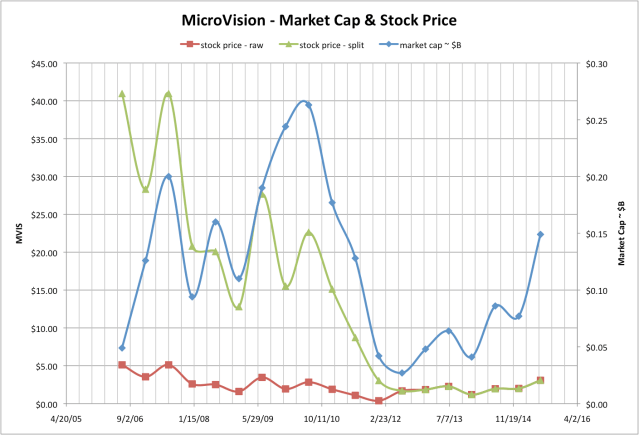
I track the market cap of all my stocks because it is the easiest way to see if the company is progressing, even if the stock isn’t. MicroVision seems like it is progressing, yet the stock doesn’t seem to reflect that. That was my feeling, but when it comes to investments I like to judge based on data when reasonable. The results surprised me.

MVIS 062115
At my six month checkups, MVIS hasn’t been above $6 since I’ve tracked the numbers in 2006. Its high was barely above $5 and its low was below $1. There was a 1:8 reverse split in early 2012, so if you look back online you’ll see a high eight times higher, just above $40. That looks dismal. It feels that way too, because I’ve been buying MVIS since 2000 and have shares at the equivalent of $56. That’s tough medicine from a regular exercise for a stock that traded on Friday at $3.08. The quoted stock price has been low, but constrained, compared to the price with the splits included. Neither line on the chart is encouraging.

The market cap tells a different story. The market cap shows a company that had a turbulent past, but was progressing until about 2010 when it released its first serious product; and then a slide as the suppliers and startup inefficiencies undermined their success. Then, just after the reverse stock split, the company’s market cap begins a climb. It isn’t monotonically increasing, but it is headed in the right direction and accelerating. The introduction of one of the customer’s products,IMG_0417 and the news from a Fortune 100 company are encouraging.

Stockholders, however, do not buy and sell market cap. We buy and sell stock price. Company management, however, may be more focussed on market cap; while recognizing that their compensation is affected to the stock price. While the stock price languishes, though, they enjoy the benefits of salaries and benefits. Stockholders wait for the price to shift.

Investing is like many human endeavours; it makes sense to understand the motivations and compensations involved. It also makes sense to remember that there is more than one way to measure most things, including companies and stocks. I’m glad to see MicroVision’s progress, but must live my life according to the progress of MVIS – at least that aspect that is invested in MVIS as a means to improve my personal finances.

Now, it is time to step away from the computer, hope the winds have died enough to still the pollen, and sit outside as the sun sets. Investing may have taken up most of today, but it should never take up the entire day, even when it is part of a good, and regular exercise.


Posted in Uncategorized | Tagged , , , , , , , , , , | Leave a comment