Truck Repair And The Value Of Community

Ugh. The week before Christmas, time to get the tree (hoping for a late shopper’s discount), and the truck’s dashboard lights up red. The battery symbol flashes, the rpms drop, the engine dies, and I steer and brake the 4,800 pound truck without power steering or power brakes to a spot on the side of the road that should leave enough room for a tow truck and safety. Ho. Ho. Ha. A little more than a day later I have a renewed appreciation for the compassion within community and the humor of the universe. Ho. Ho. Yeah.

I have a truck. I didn’t buy it. My father gave it to me when he moved off the ranch after his second wife died. He married her after my mom died, and moved from suburban Pittsburgh to her twenty acres of rural California because he fell in love after 70. Without her, he didn’t need the land, or the truck, and moved back to Pittsburgh. In a situation like that, the appropriate response is thank you for the truck, and bid farewell to 27 years of owning Jeep Cherokees (the regular Cherokees, not the Grands).

The math is simple. In 2015, a 200 Chevy Silverado 1500 is about 15-16 years old. Things break. I’ve held off on a long list of repairs because I didn’t have the spare cash. After my dad died, there was and is hope of enough of an inheritance to fix a few things, and I hoped the truck would hold on until then. It did what it could, and then it couldn’t do anything.

The short version of the story is that, instead of a quick fix by replacing an alternator which would’ve had the truck operating the same day for about $250, it turned out to be a fuel pump in the fuel tank and $860 the next day at a garage that won’t take credit cards. Alternative modes of transportation quickly became either a ten mile walk in hypothermia conditions, catching a bus that only gets to within two miles of my house then walking two miles in hypothermia conditions, or calling an expensive taxi to take me to a part of the island they rarely visit. I’ve bicycled across AmericaJust Keep Pedaling. I’ve walked across ScotlandWalking Thinking Drinking Across Scotland. Cold and wet and travel can be done, but not if I’m trying to present a professional image. I vented on Facebook, called a few friends to vent, and support began to arrive.

Within a couple of hours I had four offers to drive me home. After I got home (thanks to someone who knew it was a good time to serve me a cocktail first), I got multiple offers to drive me back to the garage, or someplace to work including people opening their homes to me. As word spread about the financial impact, I received offers of loans from friends, offers of pre-paid invoices from friendly clients, and a reminder of a promised non-holiday-related gift of money that would cover the costs. Modern economics can place a value on such offers from community, but economics misses the greater value of the compassion displayed.

The truck is now fixed. My cash has been maneuvered to pay for it (though I’ve yet to figure out the repercussions to my other bills.) There’s more than a whiff of fuel around the truck, but I’m hoping that is temporary and is only the consequence of a spill during the repair. I’ll let the truck sit for a day to let the seals set, and then try to let it sit for a weekend because, if it has to be fixed again, I don’t want to deal with that while the shop is closed.

Ironies and synchronicities have been evident throughout. The truck broke down. That’s sad. It broke down just after I’d mailed off my Christmas packages, deposited a major check from a primary client, and paid myself. The truck broke down in one of the few places where it could safely get onto a shoulder. This is one of the windiest and wettest Decembers on record, and the weather was calm and dry. The breakdown almost occurred beside a friend’s backyard, and only a mile from the garage – a garage which was beside the sites of three meetings I was supposed to facilitate that afternoon. As the truck was being delivered by the tow truck at the garage, my old Jeep drove up and parked across the street as if in sympathy. As I woke up about the time the stock market opened, my portfolio was up about the same amount as the price of the repair. The offerings of help enabled a serendipitous encounter with one person, a long-delayed deeply emotional conversation with someone else, a prompting with an advocate of my idea for a coworks, and a better payment arrangement with a long term client.

coworks logos lightning

There was even a mad dash reminiscent of silent movies. As I was working from yet another coffeeshop, I set down my tea to steep, opened my computer to check for emails about an eagerly anticipated meeting about the coworks Kickstarter campaign, I noticed that there was only one bus that would get me to the garage before they closed, and the bus was leaving in minutes. I left the full cup on the table, dropped the computer into the briefcase, and scurried to the bus stop. A few minutes later, the bus arrived. After it dropped me off, and as I walked up to the garage, the truck came down the road from its test drive. The mechanic recognized me, handed me the keys, I walked inside, asked a few clarifying questions, and quickly drove back to the coffeeshop to find my tea still there and my table still available. Minutes after I unpacked the computer, the person I was meeting with arrived as if it was all orchestrated and choreographed. The conversation about the potential for Langley, Whidbey, the new economy, and the coworks was so good that they had to kick us out when they closed two hours later.

Spending $862.32 on a truck repair in the week before Christmas can change holiday plans. If I lost myself in angst and anxiety, I would miss the precious nature of the ironies and synchronicities that arrived. During the holidays, it is easy to overwhelmed with shopping and tradition; or too aware of the financial inability to participate in traditions. You can’t wrap the gifts I’ve received in the last few hours and days. You can’t photograph them. But, I can certainly appreciate them, the value of friendship, relationship, and community. Thank you, all.

Posted in Uncategorized | Tagged , , , , , , , , , , | Leave a comment

Christmas Movies And Treasure

Christmas is not supposed to be about money. All that stuff with the money changers and the temple came much later. (Check the Bible for details.) Christmas has become what we’ve decided we want it to be – which means it is a wide variety of things to a very diverse set of people. For me, it is tradition, reflection, and a bit of indulgence. One indulgence is the list of movies I pick from every year. The thing that surprised me as I listed them was how many deal with money. I watch them for their silly, sappy, sweet nature. I like having reasons to smile, no analysis required. Money, however, drives the plot of many; which makes me go, hmm. What treasures are involved?

Christmas is not supposed to be about gifts, either; but those three wise men probably set the tone. Gold, frankincense, and myrrh were not cheap, which is why they were mentioned. A poor couple forced to travel in winter that couldn’t find lodging find shelter with the animals. That’s better than many homeless manage, but not an auspicious beginning. A few days later (as I recall from my readings), great gifts are bestowed upon them. It wasn’t until I reflected on the movies and the money that I began to wonder. What did Joseph and Mary do with the gold, frankincense, and myrrh? Were they treasured forever, or were they expected to exchange them for something they immediately needed, like food and shelter?

Christmas is also about more modern stories. Has any story generated more modern Christmas traditions and icons than A Christmas Carol by Charles Dickens? One of the reasons he wrote it was because his wife was pregnant, again. (They eventually had ten children.) Much of Dickens’ work was about the income and wealth inequalities of the time, much of which is mirrored today. It would be interesting to see which story has more movies associated with it, Joseph and Mary’s, or Scrooge’s.

My short list of holiday movies would probably be longer if I spent an hour browsing imdb.com, for the five that come to mind the easiest are;

  • Muppets’ Christmas Carol – “Light the lamp, not the rat, light the lamp, not the rat!” – Charles Dickens meets Jim Henson, which also means the best Ghost of Christmas Present I’ve seen; the ultimate being living in the moment – and nowhen else. Also true to the dissonance between the rich and the poor, and the possible revelation.
  • Scrooged – “Sometimes you have to *slap* them in the face just to get their attention!” – The runnerup for the Ghost of Christmas Present; Carol Kane hitting Bill Murray with a toaster to change his perspective. The rich and the poor, again; with a willingness to show the dark turn of homelessness, and the inevitable revelation that is broadcast to millions through the wealth of a major network because that’s the way the world works now.
  • White Christmas – “You know, in some ways, you’re far superior to my cocker spaniel.” – It’s a musical, so it is about song and dance; and the thing that gets them on the train is money, the reason for the big show is money, and the dissonance between the poor dancers and the rich crooner. (Definitely good dancing. Be careful how you hold that fan.)
  • Love Actually – “Thank you, sir. I did have an awful premonition that I was gonna fuck up on the first day. Oh, piss it!” – And hallelujah! A movie with Love instead of Dickens involved in the title; and even though it touches on class and wealth the message is that the season, any season, can be about something more basic and more valuable.
  • Hogfather – “Then take the universe and grind it down to the finest powder and sieve it through the finest sieve and THEN show me one atom of justice, one molecule of mercy. And yet… you try to act as if there is some ideal order in the world. As if there is some… some rightness in the universe by which it may be judged.” – Okay, this one is out there; but it goes someplace I enjoy because it is simultaneously a parody of the modern holidays and a reminder that we can make them as valuable as we want, that we have the power to make it so.
  • A Wonderful Life – Not one of my favorites, so I’m not going to even look up the quotes; but a reminder that the main motivation is the resolution of a banking, housing, and personal crisis.

There are other movies I traditionally watch: the entire Harry Potter series and the Lord of the Ring trilogy; but they are personal seasonal favorites for personal reasons.

Very few movies remove the influence of money, particularly for a season that is supposed to be about family, friends, emotions, charity, and generosity. The money is there, but that’s not why I watch. I enjoy the relationships, the humor, and of course the happy endings. (The goose may have a different opinion, naturally.)

This will be another very simple Christmas for me, and that’s fine. As I approach sixty, I understand why so many people approaching retirement don’t want more stuff and do want more connection. Hugs are treasures. My financial situation is about the same as this time last year, but the potential is greater; but potential doesn’t buy presents, so I’m doing what I can to make a few things for a few folks. (Gotta get to the Post Office soon.) As I’ve had less, I’ve had to view Christmas differently. What do I really care about? What do I really treasure? How much of what I’ve done in the past was by habit and expectation, but didn’t necessarily truly touch a person?

The tree from 2014

The tree from 2014

A few traditions remain. I enjoy cooking, so a feast of some sort will occur. I like the lights, and put up a few (and feel sorry for the outdoor tree that died and is simply acting as a scaffold for lights this year.) A few cards have gone out, but at least one less this year because my Dad died a few months ago. Cookies (gluten-free) have been baked, and some are being shipped, and some are definitely only to be consumed in Washington State because one particular ingredient isn’t supposed to cross state lines. The caroling has already commenced on my evening walks. With less than ten days to go, it will be interesting trying to get a tree again. Maybe I’ll do what I’ve done recently, help someone clear a bit of their property by picking a volunteered Charlie Brown tree that would be cut in the spring anyway.

Posted in Uncategorized | Tagged , , , , , , , , , | Leave a comment

They Decline Rewards

The action behind the scenes is always more interesting. The kickstarter campaign to create a new type of coworks continues. The public appearance is that of 1% funded. The backstage activity is appealing and encouraging; but, it is purposely backstage, I have no idea if it will walk out into the lights, and it may not have to. People are pledging, and some aren’t asking for rewards. After reading dismal newsfeeds all day, it is refreshing to hear from advocates, surprising to hear from people who want to help without expectation, and amazing to see the chords the idea strikes.

For those who are just hearing about this now, welcome to a Kickstarter campaign I launched to create a new kind of coworks. Others have preceded meoffice photo 062813, and I benefited from their creations. But, there are always lessons to learn, and hopefully good ideas can be improved to become even better ideas. We stand on the shoulders of those who came before – that sort of thing. If you want more details, browse back through the blog posts, or head to the official Kickstarter page, or contact me. Enthusiasts are knocking on each of those doors.

Rewards are part of crowdfunding campaigns. Pledge $100 and the campaign gets closer to its goal, and you get one of my books. Folks who contribute to PBS and NPR are probably familiar with the process. So, let’s keep in mind that one possibility that some folks are declining rewards is because they don’t want what I have offered, but they want the project to succeed. Let’s also keep in mind that some folks want to see all of the money go to the goal, no shipping charges required. Now that the campaign is launched, I might have the time to go back and add some more rewards that are more specific to coworks. Stay tuned.

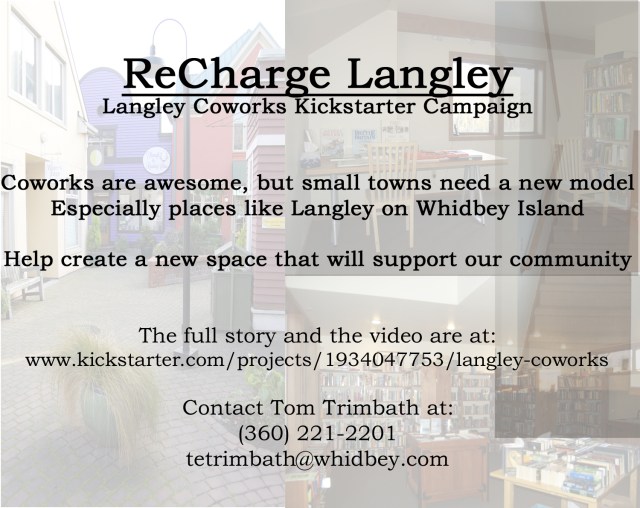
Have you ever tried to get shop owners to put posters up in their windows? Whidbey’s a good place, if the poster fits the style of the place and the cause helps the community. I was surprised when I was asked to put together something to tape, or pin, or prop up for others to see. Here’s the first draft. You are welcome to print it and display it, and if you want a better copy, contact me.

Langley ReCharge montage 121015
I know people who work full-time making logos, graphics, and ad campaigns. Me, I like to take photos, and have some practice at making simple graphics; but the advice I’ve received has steered me to an update to the icon. The earlier version showed a partly charged battery. Adding a hint that it is being recharged works closer to the purpose of the coworks as a place to recharge your business, charge and charge again if you’re fortunate enough to have repeat customers and clients, and for the simple service that it is designed to be a place to recharge phones and laptops – especially, when the power is out. (That’s assuming enough is pledged to buy an appropriate generator or power supply.)

coworks logos lightning
I don’t know if the campaign will succeed. You are a better judge of that because the crowd is in control of crowd funding. I have already received a benefit. It is sweet and touching to see and hear from people who share my passion. My passion is for people and ideas, and I enjoy bringing them together. I’m not the only one.

One of the most positive signs I’ve seen develop in the last few years is crowdfunding. Kickstarter, Indiegogo, GoFundMe, are based on an idea that was nearly impossible before the Internet. Asking people for money has always been difficult. Taboos around personal finance are constraining even if no one else is part of the conversation. And yet, it is happening.

Giving money to people you don’t know in the hope they’ll use it the way you approve has always been a tough dynamic in charity and philanthropy. That’s one reason rewards are part of Kickstarter, perks are part of Indiegogo, and NPR hands out tote bags. Even if they don’t spend the money as you expected, at least you get a mug or a bag.

With the mass acceptance of the Internet and social media, the appeals are no longer limited to wine and cheese events reserved for targeted high net worth households. It is possible to fund almost anything: from museums, to art shows, to gadgets, to medical bills, to whatever. The money has always been there, but now appeals can be made to the people who appreciate the situations of people with ideas and needs but not enough money. Crowdfunding is working because teachers understand what classrooms need, artists appreciate the value of a seminar or specialized tool, gadget freaks can fund gadget inventors rather than waiting for mega-corporations to convene a committee and a focus group.

Friends, family, neighbors, and the beleaguered rich may have a difficult time helping; but within the billions of people connected electronically, if even 0.1% of the people on the Internet support an idea they are a crowd of 3,170,000. One dollar from 0.1% funds a multi-million dollar project. The goal for ReCharge Langley (the updated working title) is $18,000. It isn’t limited to that. Crowds frequently pledge far above the goals, enabling stretch goals and accelerating ideas and benefits. Let’s see, if everyone on the Internet pledged a penny they would raise $31,700,000. ReCharge doesn’t need that much, and would have to immediately begin paying forward which is part of the stated goal. Okay, that works for me. (And, oy, would I be busy!)

Of course I hope you pledge, whether you accept or decline the rewards. Of course I thank those people who have pledged to ReCharge Langley. I also thank everyone who has helped crowdfund the good works that are going on because the world needs good ideas, good ideas frequently need funding, and individuals building to a crowd are making the ideas flow and making the world a better place. That’s a reward we all share, no shipping required.

Posted in Uncategorized | Tagged , , , , , , , , | 2 Comments

The Second Depression

If I was writing a book I could give this concept a better treatment, but practicalities inspire me to write about it anyway. We may be living within a spiral of history, when things repeat but not in the same way. It’s happened in other theaters before, and a trick of language emphasized the somewhat similar recurrence. Are we really recovering from the Great Recession, or are we in the midst of the Second Depression?

The ‘War to End All Wars’ was also known as ‘The Great War’. The ‘War to End All Wars’ didn’t happen only once; but the war that started in 1914 was the first one that was readily recognized as a world war. It was barely conceivable that a second such war could happen because surely we humans had learned our lessons. After the start of the second world war, the ‘War to end all Wars’ was seen to be a fallacy, and there wasn’t much about the first one that was seen as Great. It became ‘The First World War’ and ‘World War I’.

Pick your date, but 1929 is a reasonably accepted start of ‘The Great Depression’. The US had many depressions prior to it, but this one got the name ‘Great’. It defined a generation, dramatically redefined the nation and its government, and became something to avoid at all costs. America had eleven more recessions before the Internet Bubble, a bubble that will only happen once. Right? That was followed by a recovery and then – ‘The Great Recession’. For some, The Great Recession is past because stock prices are high, interest rates are low, unemployment is low, and housing is recovering. For others, the jobs and wages haven’t returned, many feel trapped by mortgages, and expectations of advancement are seen as fantasies.

Spirals are only circles from one perspective. Every rotation involves change. World War II was not World War I again. Many of the countries and battlefields were the same; but most of the people, technologies, motivations, and strategies changed.

The Great Depression is typified by the Dust Bowl, the market crash of Black Friday, bank failures, mortgage foreclosures, massive unemployment, and massive government intervention.

The Great Recession is typified by the housing crisis, failed financial institutions, massive unemployment, a market crash, massive government intervention, and is possibly exacerbated by changes in climate and weather (he types as yet another extraordinary storm storms through in an increasingly ordinary fashion.)

The Great Depression is also known by how people adapted. They grew more of their food. They lived in simpler houses. They shifted jobs as necessary. They fixed rather than bought. They saved rather than spent.

After the Great Recession, localvores are in fashion, tiny houses are in fashion, nomadic workers and coworks are in fashion, maker spaces are in fashion, getting out of debt is in fashion.

Within this spiral of history, many things are reminiscent, but are considered retro and fashionable instead of depressing and regressive.

Fashionable is a good word for people who grow their own food, live in tiny houses, abandon conventional careers, make things, and become debt-free by choice. For many people, there is no choice. Growing their own food is cheaper, living in tiny houses is cheaper, conventional careers aren’t available, making and repairing costs less than buying, and getting out from under debt is a financial necessity because that money is needed for food, housing, and the other necessities of life. Even with all of those efforts, they may not be able to afford health care, day care, or retirement.

If America never had another depression or recession, those past two events could maintain their unwanted titles of ‘Great’. On average, the US has a recession every 4.8 years. The Great Depression wasn’t the only depression, but it grabbed the title. For the many of the 37% of Americans who aren’t working, The Great Recession isn’t a bit of history, it is current events.

There are troubling signs in the economy; always. The wealth of China is hunting for safe havens because of uncertainties in China’s economy. Some housing markets are in bubbles. Commodities, even oil and coal, are declining. It’s possible that the main thing propping up the dollar is the poorer state of the rest of the world currencies. Financial institutions have changed so little that the Fed is calling them into meetings to warn them that the public may not bail them out next time. Climate continues to change, regardless of any human debate. Refugee crises have already begun.

Maybe everything will work out. Maybe we really have learned our lessons and a new economy will clear up the inequities and renewable energies will clean up the environment. This isn’t facetious. We humans are amazing and can make these things happen.

In case we don’t mature quickly, maybe it is time to consider at least a simple shift in nomenclature and recognize that we didn’t just pass through The Great Recession, but instead are trying to survive and thrive past the troubles of the Second Depression.

I’d delve deeper and edit more thoroughly, but there’s a job application to complete, a kickstarter campaign to manage, and an intriguing conversation with a local entrepreneur in the food industry to consider.

A Kickstarter campaign for a corworks for nomadic workers

A Kickstarter campaign for a coworks for nomadic workers

Posted in Uncategorized | Tagged , , , , , , , , , , , , , | Leave a comment

A Second Step For ReCharging

One idea inspires another. I launched a kickstarter campaign to fund a coworks for Langley, WA. A perfect campaign would be launched with everything a perfect business needed. Perfection, however, is an illusion. Flip the switch and let the campaign and all its attendant parts run. Instead, I started with more than enough, but far from everything. There’s an advantage to getting started and then adapting, rather than trying to make the world work to an unachievably perfect model. Fresh ideas arise as soon as the first few steps are taken. The coworks is already evolving and improving. It even has a new name.

I’ve been thinking about a new concept for a coworks that might work in small towns since I participated in the most prominent coworks in Langley’s recent history: Fusion Spark’s coworksoffice photo 062813. It wasn’t perfect, but it had many of the basic and necessary elements: 24/7 access, a quiet environment, good power and internet, a kitchen-ette-ette, a bathroom, and a place for making conference calls. It was a good model that was closed for strategic reasons in the parent company. Very understandable.

Thinking and doing are very different. Pundits and politicians, ideologues and philosophers, are impressive with assertions and seemingly logical conclusions that can be best when never tested. Try to act on their suggestions, though, and reality begins teaching lessons.

Overthinking the new model of the coworks was a trap I wanted to avoid. I knew it could be a waste of time, and I knew I’d learn something as soon as I took that first step.

Langley and Whidbey are known for their populations of heavy thinkers. Advice is easy to find, frequently delivered even when it is unsolicited, and commonly contradictory, and inevitably valuable. Before I launched the campaign, I talked to some of the local business owners. They shifted what I intended to offer. After I launched the campaign, more ideas came in. Sitting back the next day, the various ideas swirling through my head helped align into new insights that I may act on – later.

In the meantime, I realized a few things.

  • If it works in Langley, variants may also work in Clinton, Freeland, and other small towns – but each model would require customization.
  • I can’t do it alone; which is one reason for the campaign, but also a recognition of the value of community.
  • New ideas need new names.
  • New concepts can benefit from new symbols.

And, I decided what to do about them.

  • The other towns will have to wait (unless someone is inspired to get there first).
  • I am lucky enough to know people who are willing and capable of helping.
  • The name that I thought of as general ‘Langley Coworks’ is too close to the name used before. I filled a blank sheet of paper with dozens of names that attempted to capture the difference, and found I liked the first one I wrote: ReCharge Langley. A later post may dive into the layers behind ReCharge, but there are other ideas to develop first.
  • Communications have gone visual. While names are important, icons and graphics rule online. With a name like ReCharge, I played with a white board at another coworks (one for writers that is hosted by the Northwest Institute for Literary Arts) and came up with an image of a battery. It is a work in progress, especially for someone who is not a graphics illustrator, but I like it as a good first step.coworks logos green battery

And then, there’s power. There are the ideas the world reinforced. Islands make people aware of things like power. In the city it is easy to assume the electricity will work, and if it does go out, it will probably come back on through some path in the mesh of powerlines. On the island we know it can go out, that the lines are long, not much of a mesh, and strung across open water; and that the work crews will get to us – eventually. Eventually isn’t good enough for people who must keep their businesses operating. For many independent contractors, without electricity and the Internet they can’t make money, and if they can’t make money, they might have to take drastic action. It sounds extreme, but even among the highest income Americans, at least 25% have less than $2,000 available for emergencies. A few days lost business can make someone lose their business. The idea of making reliable power and internet available sounded like a nice embellishment – until the power went out. That idea of having a generator, just in case, became a much higher priority.

The concept of the coworks is developing; but the narrative hasn’t changed, the implementation has only slightly shifted, though it does have a new name and image. It would have been difficult to appreciate the important elements without taking that first step.

Ideas inspire others, especially when they are introduced to the world, treated with a reasonable amount of care, tested with a reasonable amount of caution, and adjusted and adapted as they develop. It is true for my concept of a coworks. It is probably true of almost any idea but only if the idea is taken past the first step and encouraged to take that second step. That’s how ideas and people progress.

Posted in Fresh Ideas | Tagged , , , , , , , | Leave a comment

Langley Coworks Kickstarter Launched

Fresh ideas are fragile. Fresh ideas require a fertile environment, which in America frequently involves money. I have a fresh idea for a coworking space, that might make such spaces work better in small, tourist towns like Langley, WA.

Here’s the link to the official campaign that’s running on Kickstarter.

If you’d rather just watch and listen to my talking head, here’s the video on YouTube.

If you want to know what’s going on inside my head, well, I might have a picture of something like that if I rummage through my photos of abstract chaos.

The reality of the idea is simple.

The old work environment is fading. People are increasingly working from home, coffeeshops, libraries, and anywhere they can find an internet connection. The problem is that those places may not have the right blend of accessibility, professionalism, and services. Home is great, but known for distractions and some clients don’t want to meet in someone’s house. Coffeeshops are convenient, but only open certain hours and can be noisy thanks to espresso machines and PA systems. Libraries are awesome resources, but aren’t open 24/7 and aren’t private. I know people that use park benches beside stray wifi sources, but that doesn’t work well in Puget Sound’s weather.

So, coworks were created. They’re a simple idea; somewhat like incubators, somewhat like communal shared spaces, somewhat like experiments in the New Economy. Coworks work best where there are plenty of people. By definition, small towns don’t have many people. That makes it tougher to become sustainable, at least with the conventional model.

For about a year, I used a Langley coworksoffice photo 062813 almost daily. It usually had several empty seats; and from my preferred window seat, I watched people walk by. I was surprised at how many visitors were simply searching for a seat where they could dive into their phone, tablet, or laptop. That was easy in August and tough in October. I noticed it myself. When the coworks wasn’t operating I knew I had to put off client video conference calls (unless I did them from my truck with the video off), had to scrounge for a signal if I was in town very early or very late (the work world operates outside of 9-5 or even 7-11), and if I used the bench outside the library I might have to share because I wasn’t the only one there.

Eventually, a possible concept of a space came to mind that was somewhat like a regular coworks that also provided space and services to the wandering visitors. I had one space in mind, and even a possible funder, but the pieces didn’t line up at the right time. Months went by. And then, a friend and bookseller announced that they were closing their shop. It was a two story where they’d opened the second floor to writers. I realized that the new model could work in that space. A professional setting upstairs. An informal area downstairs. Round the clock access at the highest subscription rate. Hourly access for those who just needed to check up on work. Various other services would be available, but that was the basis. Maybe providing better access and a street level presence would more than balance the business model.

Fresh ideas need fertile surroundings. Starting such a space would require more funds than I had. Well, I’ve been a fan of crowdfunding, wanted to have the money to be a contributor, but maybe I’d have to start as a recipient.

Clicking Launch on Kickstarter kicked off the project, but also kicked off a swirl of thoughts and considerations. What happens if it succeeds? What do I do if it doesn’t? What happens if it is over-subscribed? What would it be like to run a storefront in a tourist town? Fun things to think about, even the contingencies for if it doesn’t succeed.

It’s all good; but the internal swirl is fascinating to watch. It’s the same swirl seen by entrepreneurs, inventors, artists, and anyone struck by an inspiration that can act upon. It is easy to dream, but opportunity requires action. I’m glad I have the chance to act.

I am impressed with the talent and potential I see in my community. I know so many people who seem to be on the cusp, people with fresh ideas that need a space that supports them. They have a bit of that now, thanks to coffeeshops and libraries; but maybe they need a bit more. Helping provide that is enough to fill a brain with a swirl of thoughts. Amidst that, I’ve taken the first step by launching the campaign. I look forward to seeing where it goes.

I also have to practice being a bit more public, so here, allow me to give you another chance to click the link and help launch, not just a campaign, but a valuable part of a small town economy.

Posted in Fresh Ideas | Tagged , , , , | Leave a comment

Disappointed In MVIS

I am disappointed in MVIS and in MicroVision because of what has and hasn’t happened so far in 2015. I am also somewhat encouraged in MicroVision and a bit less encouraged about MVIS because of their progress towards their potential. Within the world of personal finance and investing, plans rarely operate according to plan – which may also explain what’s happening within the company.

Depending on how you look at it, MVIS is either up about 40% from twelve months ago, down 40% from its 52-week high, or down about 99% from its all-time high.

The stock is up because the company has made significant progress since 2014. Celluon launched two variations of a pico-projector in the spring, and SonyIMG_0417 launched a pico-projector in the fall. Both are commercial products in volume production. Both are receiving nice reviews. Both are earning money for the company. That’s a good reason for the stock to rise 40%.

The stock is down because many interpreted the company’s communications to suggest that there’d be “something to celebrate every quarter (or every month)”. A long list of possible products could become catalysts for the stock. Several large OEMs privately demonstrated products at last January’s CES event. Ford and another auto supplier were working on head up displays (HUDs). UPS was testing a prototype system to implement in their shipping centers. Celluon and Sony both alluded to the possibility of other products in 2015. The year isn’t over yet, but aside from a robotic mobile phone from Sharp (RoBoHoN) that won’t be available until mid-2016, nothing was announced. There were no products revealed prior to Thanksgiving, timed to capitalize on the shopping season. Announcements remain possible, but any sales have less time to reach significant volume, and any extra revenues for MicroVision won’t be recognized until 2016.

I’ve been tracking some of the catalysts for several months because it looked like there was about to be a lot more activity. If you’re going to get busy, get your tools in place early. As each month progressed I darkened it. The only real news to produce a change in the chart was the RoBoHoN announcement, and it shoved its line out into 2016.  An innovative smartphone was suggested as a Christmas product years ago. If that’s the only one, then it will have to be for next Christmas, and for someone else.

MVIS_Catalysts_113015
The most recent conference call didn’t include positive surprises. Congratulations on finding errors in your process. Improved processes are good, but the errors suggest near term delays, increased costs, and lowered credibility. The stock which had been above $3 is now hovering at $2.50.

The company and the stock have a long history of expectations exceeding accomplishments. At the peak during the Internet Bubble, the stock was about $510. I know. I bought my first small holding in the company as it was rising. The future looked bright, and profitability was estimated to be reached by about 2003-2004. I bought at an effective price of $220. That was before the 1-for-8 split, so the price looked like a more reasonable $27.60 (and the peak was closer to $64). Fortunately, through many subsequent purchases my cost basis has dropped about 90%.

Long term buy and hold investing (LTBH) is an exercise in patience. The lack of a positive surprise followed by the silence of all of the prospective customers is disheartening. I continue to wait for the stock to recover a bit more so I can sell 5%-10% to reinvest in companies with more progress that are creating positive surprises.

I plan to continue to hold onto the remaining 90%-95% because I continue to be encouraged by the company’s potential. Revenues are up. Technological hurdles have been cleared, and have led to technological advancements. Name recognition within the industry seems to be improving. The number of suppliers is growing, and the potential number of customers is far more than Celluon, Sony, and Sharp. The need and desire for very small, portable projectors is also growing. A more impressive list of potential catalysts is on PetersMVISblog. Management alluded to eyewear and game controllers, again. Maybe this time they aren’t just talking about bench models or prototypes.

There is a distinction, though, between the company’s potential and the stock’s potential. I don’t have time to update the chart today, but previously I published a chart that shows how, even when the stock price is stagnant, the company’s value is increasing. That increase is a sign of corporate health. That stagnation is a sign of investor dilution. Management may be proud of the growing value of the company at the same time that the shareholders experience no change.

MVIS 062115

Investing in small, startup companies carries many risks. Product failures, competition, poor financing can all collapse a company. Even in companies that succeed in terms of revenues, employees, and recognition, the stocks may not reflect the success. The reason I have invested in such companies for decades is because the success can become significant, can overwhelm any maturation foibles, and can create a positive impact on the world, for the company, for the employees, and for the shareholders. (Case studies available in my book, Dream. Invest. Live.)Dream Invest Live cover

Emotions are not on/off circuits. Emotions don’t have to exist in solitude. My disappointment lives in the same space as my enthusiasm. In December I hope to revise my estimate of MVIS’ value. Dilution has reduced the potential for the stock price for a given company value; but the growing roster of committed and potential customers may be enough to compensate. It is easy to guess, but in investing I prefer to use math whenever I can. Objectively estimating a stock’s potential value seems to be an obvious thing to do, yet I am surprised at how many base their buys and sells on subjective assessments of what feels right. Passion and emotion can be what make personal finance personal; but they get to co-exist with math and logic. When they do, they can tell a powerful story. Currently, the emotions are making their case. Soon, the logic will make its case. Until then, I am disappointed and encouraged in MicroVision and MVIS.

Posted in Uncategorized | Tagged , , , , , , , , | Leave a comment

What Everyone Else Expects

Squashed Pear Pie

From a previous celebration

Welcome to the holidays, one of my favorite times of the year; but then, I also enjoy something about every time of the year. (Except for rainy days in May and prolonged droughts into October.) I am looking forward to Thanksgiving, a time of traditions. Norman Rockwell set the standard, and many people try to emulate it. Martha Stewart is one of many who take that standard and amplify it. I enjoy innovation, but tradition has its value. The fun part for me is to honor tradition, do so in my own style, and not worry about what everyone else expects. It’s a tradition of mine, making up my own mind.

Everyone expects – right there you know no statement can follow those two words and be correct. Absolutes are only good at being absolutely wrong. Except for basic bodily functions, there are very few things that apply to everyone (and even then, some people only manage the basics with assistance). I’ll begin again.

Everyone is expected to expect – turkey, stuffing, mashed potatoes, cranberry sauce, a token green vegetable, gravy (which some consider a vegetable – really) and then a nice nap while trying to watch the football game while trying to be polite to the gathered family and friends. If you haven’t already found your personal deviation, I’m surprised. Turkey can be replaced with goose or ham. I’ve cooked duck to get something different, less genetically modified, and the source of crispy skin and marvelous stock. Stuffing is evil, at least according to Alton Brown (a great Food Network controversy). Skip potatoes and have yams or rice, or make potatoes by go au gratin. Cranberry sauce seems like a requisite purchase in a can, but from fresh berries it becomes something much better than a tick mark on the tradition to do list. Green veggies, the vegetarians and vegans would give them much higher priority. So would successful gardeners. Gravy, just in case something is too dry or seasoned wrong. The nap is natural; don’t fight it. The football game is probably one of the few times family and friends are watching a screen that isn’t held in their hands.

This year my Thanksgiving could be made to sound wholly traditional, or part of some counter-culture. Turkey, yes; but the smallest one I could find and I almost bought a duck. Stuffing, yes; and I know why it’s evil and I know why I’ll make it anyway – cautiously and gluten-free, of course. Mashed potatoes, yes, yes, yes; because it is one of the few times I don’t just roast them. Beside, where else would I be able to use that much butter on the plate? Cranberry sauce, nope; because canned is bizarre, fresh is too much work, and I may just replace it with a glass of juice. The token green vegetable will be Brussel Sprouts sauteed with onions, peppers, and garlic; because, even though green bean casseroles are required, I want something different. Gravy, no; too much work for too little chance of success. More butter, and maybe some cheese please. I hope to also make a pumpkin pie in a pumpkin shell, gluten-free that way. A bottle of 2004 Whidbey Island Winery Reserve Chardonnay, because I found it while poking around my wine collection that happens to live under my hardware shelf. Football, ha! No TV, no football, and I like it that way. Eventually every team wins about half the time and loses about half the time. Realizing that took the drama out of it for me. Realizing the weird finances and health hazards reinforced the feeling. Family and friends, well, they and you kind readers are all dear, but sometimes being alone is the best way to give thanks.

What everyone expects is a good thing to keep in mind. When it comes to celebrations and reflections it is better to keep in mind what you want. Friends and family matter, but you do too.

This post is being written a day early to free up Thanksgiving Eve. For me, Thanksgiving begins on Thanksgiving Eve. Making the stuffing and dessert the night before makes The Day much easier. It’s also an opportunity to crack open the cranberry juice and mix in some vodka or rum. Tradition reaches back to when my family served the meal around noon, so I am up early to stuff the turkey, put it in the oven, and hope I got the timing right enough. That leaves time for a walk or a run, maybe a couple of phone calls to folks on the US East Coast, and inevitably some computer game that will be played with occasionally. When I finally figure out the turkey’s schedule, I’ll make the rest of the sides, leaving the mashed potatoes as close to last as possible. The wine is open, the kitchen work begins, the turkey is pulled out, rested, sliced, and served with the rest. Then, a quiet, thoughtful, thankful meal when I can say what I am really thankful for without having to wordsmith something that fits what everyone else expects.

The nap is inevitable, even if it isn’t Thanksgiving.

The rest of the day is cooking and cleaning. There are lots of leftovers, but there’s also the best opportunity to make turkey stock, prep for weeks of sandwiches, and making progress on that bottle of Chardonnay. For me, celebrating food is essential to celebrating life.

Thanksgiving is called a holiday, which is derived from a Holy Day, but it is a national observation. I consider it to be one of too few feast days, days that balance frugality with an appreciation of abundance, a reminder that even when life has been difficult there are things to celebrate. If all I wanted was a meal, I could bake a chicken thigh or two, steam some rice, and microwave some frozen veggies. But, while we are living we get to celebrate life. So, Celebrate!

Even though I described balancing feasting with frugality, when frugality is defined as an appreciation of what we have available, then even a feast is frugal. That may not be what everyone else expects, but it is an insight I’ve gained that helps me celebrate, be thankful, and appreciate what it means to be alive, here and now.

Happy Thanksgiving, everyone.

PS As I wrote this post, the power flickered twice. (Oh no, not again.) I am thankful the power stayed on. I think I’ll fill a thermos or two after I post this, just in case. – T

Posted in Uncategorized | Tagged , , , | 2 Comments

Investing Speculating Gambling

Step right up and take a chance. If you have money, you’re taking chances. Bury it or burn it. Spend it on assets or experiences. Money involves risk, even when we treat it as a boring piece of paper. The trick in personal financing, however, is to manage that money without it spending too much of your time, your emotions, or your energy. What we do with our money can be frugal or frivolous, necessity or luxury. Within that slice of money that we label as savings, it is easy to label all stocks and bonds as money spent on investments. Even there though, we can be investing, speculating, or gambling. Unfortunately, it’s hard to know which you are doing until years after you’ve done it.

First, if you are paying all of your bills and have enough money left over to buy stocks and bonds, congratulate yourself. “62% of Americans have less than $1,000 in savings.” You’re already in the 38%. I can almost pay all of my bills, and shortly will probably cross that threshold, but I have managed to maintain at least a small portfolio because I understand the power of using money to make money. Strange as it sounds, that means more than 62% of Americans are in worse financial shape. Such a majority in a representative democracy is an interesting thing to witness.

If folks ask me about my investments, I know that most are talking about stocks and bonds; so, I don’t get particular about the nomenclature. Even within the stock discussion boards on Motley Fool, Silicon Investor, and Investor Village, I only make the distinction during my semi-annual portfolio review. There are those, however, who rightly make that distinction in private emails, comments, and replies.

The distinction is made because the more people know about a topic, the more words they have to describe the nuances within the continuum. I buy stocks in small companies, with the intent to sell the stock when a large portion of the financial community thinks the company or the stock is worth a lot more than what I bought it for. Buy Small. Sell Large. It’s a slight variant on Buy Low. Sell High. The former is about the company. The latter is about the stock. Stocks aren’t companies; they’re merely the continually changing prices tags.

We’re told to invest. We’re told not to gamble. They’re treated as if they are different things, but to me, they are regions in a continuum and are reflections of perceived risk. A ‘solid investment’ is something that is probably boring, but if you give it thirty years can beat inflation and maybe help you retire early, or at least comfortably. ‘Gambling’ is usually exciting, or should be because it is probably more entertaining than profitable. The distinction, however, is really only risk. An investment supposedly has less risk than a gamble, but also a smaller near term return. Gambling at the extreme is pure chance, unless you believe in higher powers that will win the lottery for you. Speculation sits between, with risks that are higher than are expected with investments, but rewards that are smaller than pure gambles.

In money management, risk is mostly a function of information. The more you know about the probable outcome, the lower the risk; and because others probably know about it too, the lower the reward because the expectation is already accounted for.

Buy a bond and you are provided with a guarantee of a small reward. Sometimes they fail, but not often.

Buy a share of stock in a mature and large corporation, and eventually its value will probably rise as long as nothing dramatically changes. There is less certainty, but a greater reward. Both of those are considered investments.

Buy a share of stock in a company with great potential and promise, but without a history of making money and the risk is that they’ll never make money. They haven’t made much in the past. Maybe they won’t in the future. But, and it’s a big but (have fun with the puns on your own) if they succeed, the rewards can be headline news and a reason for celebrations. So much guess work in involved that buying such stocks is considered speculating, even if the word ‘investing’ is used in conversation. The risks are higher, but the rewards are much higher.

Buy a lottery ticket (come on PowerBall!) and there’s no information about the potential outcome except an estimate of the jackpot. The only way to increase your odds of success is to buy more tickets, and doing so doesn’t change your chances significantly. Buy one ticket and the probability of winning goes from zero to at least greater than zero (and someone will eventually win, right?). Buy two tickets and you’ve only improved the probability of winning by a few millionths of a percent. Welcome to gambling.

I invest; but as I wrote in my book, Dream. Invest. Live., Dream Invest Live cover

“My style could also be called speculating. It is riskier than conservative investing, but the strategy works when my portfolio contains enough successes to more than pay for the losses. Diversification, owning more than one stock, helps make the risk manageable.”

Notice, I used ‘Invest’ instead of ‘Speculate’ in the title of the book because most people don’t make the distinction. The more important message from the title is that to get from dreaming to living frequently involves investing. For a while, that worked for me (until my Triple Whammy), and I suspect it will work for me again.

Scroll back through my blog posts about stocks and find several posts that are about conference calls, earnings reports, and stockholders meetings. Those three sources are three of the primary sources of information for stockholders. Reliable substantive information reduces risk. Information is one of the key distinctions between an investment and a speculation. Speculating happens because stockholders have to fill in information gaps with suppositions, estimates, and guesses.

As a company progresses from a gamble to a speculation to an investment, its risk diminishes and its stock usually rises. When that information becomes suspect or decreases in credibility, the risk increases and the stock usually falls. I suspect (which is a speculation) that partly explains why MVIS dropped instead of rose after the recent earnings report and conference call. My perception, and apparently that of others, was that despite an agreement of the company’s great potential, the report and call were more obfuscation than information, that rather than knowing more we know less than we thought, and that what we do know diminishes the near term potential. A company that has the potential to attain a value of multiple billions of dollars is considered to be worth less than some houses in America. Those houses don’t have the potential of MicroVision, but the buying the house can seem like a low risk because it will probably still be a house and land in a year or a decade.

If you bury your money, there’s the risk it loses value from inflation or because a gopher ate it. If you burn your money, you’re certain it doesn’t have any value; except for the story you get from the stunt. Between those two extremes are many possibilities and probabilities. Unfortunately, within the endpoints of that great continuum, you won’t know for days or decades whether the way you spent the money was an investment, a speculation, or a gamble. Risks and probabilities are statistical abstractions that hope to suggest order. Any single event, like buying a stock, a bond, or even a house, is one bit of randomness that doesn’t have to fit into the rest of the order. It would be comforting to provide labels that made sense ahead of time, but reality isn’t interested in providing us that comfort.

Are you investing, speculating, or gambling? No one really knows; but I’m reasonably sure that ticket for a $240,000 jackpot is a gamble – unless I win it, then it’s may be some of the best money I ever invested.

Posted in Uncategorized | Tagged , , , , , , , , , , , , , , , , | Leave a comment

Power outage

Simply said, the power’s out; and may be out for two more days, making a total of three. There’s work to do; but evidently, it will get done later. In the meantime, I’m appreciating simplicity. (And very glad for LED headlamps.) Okay, that’s enough battery power devoted to the blog. Back to conserving power for later checks on the power company’s progress. Come on Puget Sound Energy!

Photo on 2015-11-18 at 21.37 #2

Posted in Uncategorized | 2 Comments