Happy Working Birthday

Hurrah! I survived another year. Thursday was my birthday and I celebrated by working a day that was fuller than most. The fact that I was glad to be working surprised many people. I’m not surprised. For people in the 1099 Economy, conventions like days off belong to another era and another world. Thanks to someone else’s temporary reassignment, I was given the opportunity to spend four days doing their job, too; and making more than I needed. That’s something that only happens about once a week. If that sounds a little sad, then consider that the majority of Americans make less and own less than I do, and that the idea of taking any day off for a celebration. Our world, society, and conventions are being redefined by necessity. So are our celebrations, and they are celebrations.
Photo on 2016-01-13 at 20.09
I thank my editor at Curbed Seattle, the founder of the History of Computing in Learning and Education Virtual Museum, and a variety of my clients. Thanks to you, I had a good day. It was hectic and involved so many hats that I’ve considered installing a rack beside my desk so I can switch from one to another to remind myself of whether I am a Guest Editor, Contributing Writer, Project Manager, Strategic Consultant, Social Media Manager, prognosticator, or creative sounding board. If I rented an office, I’d probably do that.

Conventions change slowly. At the same time, we know that all types of changes are accelerating. Why would our conventions stay the same? Work and benefits have changed enough to be included in the 2016 State of the Union address to the US Congress.

“It’s not too much of a stretch to say that some of the only people in America who are going to work the same job, in the same place, with a health and retirement package for 30 years are sitting in this chamber.” – President Barack Obama

Outside institutions like the Senate and House of Representatives, most people know their jobs are increasingly unstable. The upper income jobs were more reliable, but even they are prone to layoffs, now. I know at least three international experts who have lost their jobs when they were in their 50s or 60s. Suddenly, the price of health care, more correctly, health insurance became less abstract and very real. Retirement and benefits exist for some, but the number is shrinking.

Welcome to the 1099 Economy, where the freedom to work is welcome and a marvelous development – as long as you can pay your bills. If you can pay your bills, and save money, congratulate yourself; and get to it because you are your retirement plan. As one talented consultant put it;

“I paid for my seventies by working in my sixties, and now I’m working in my seventies to pay for my eighties.”

Health insurance costs can be a shock. Realizing that a day off is a day without pay, work that was only postponed (unless it was lost), and that any celebration incurred additional costs – all of that combined can make time off something precious and something to cherish far more than when it was delivered as a use-it-or-lose-it policy. It can also become something too expensive to afford, a luxury.

A few years ago, I was talking to a shop owner during a break from staring at my computer and while they didn’t have a customer in their shop. I joked about their customers that tended to show up on Saturdays and Sundays, their days off and the shop owner’s most profitable days. I asked my friend if they could imagine getting two days off every week, and on top of that getting a dozen or more days throughout the year where they’d get paid to not show up. My friend tossed their head back and laughed at the concept, and a few seconds later realized that they couldn’t experience that, but relied on people who took it for granted. It was a sobering realization.

Our economy is changing. Whether it is income and wealth inequality, or increased automation, or a bifurcation where some live in a deflationary economy while others witness inflation, or if globalization means even local retail loses revenue and jobs to overnight shipping from the other side of the planet – jobs, careers, and sustenance are changing, and our lives and celebrations are changing, too.

My life is much better than it was two or three years ago. When I make a statement like that, many listeners are relieved. People are tired of hearing bad news. I can’t blame them. I’m tired of living with bad news. I continue to work almost every day according to my Rule of 7, and because some of my jobs involve daily news feeds that can miss a lot by missing a day. To do good work for my clients it makes sense to do good work every day.

Despite the improvement in my situation, I can’t pay all of my bills. The problem with my truck was alleviated by a friend who rode in like the cavalry. Serendipity happens, and I know dozens of people who rely upon it. I’ve watched an interesting reaction when I honestly answer, “So, how are you doing?”. If I start out with, “I can pay almost all of my bills.” the reaction is as if they edited the line down to, “I can pay all of my bills.” That “almost” is the difference between getting ahead and falling behind. The conversation continues as if everything is fine; yet, I spend almost everyday on the wrong side of “almost”. That’s why it was such a treat to be making more than enough on my birthday. For a few days I was getting ahead. That’s a good feeling that I get about once a week on average thanks to my clients.

I don’t write about such episodes as calls for sympathy, but as examples of what many people are going through. As strange as it is, I am middle class. There are millions of Americans who are less fortunate (and billions outside America who recognize our necessities as luxuries.) The old economy models of days off, casually seeing the doctor, and planning for retirement continue to exist for enough that most political commentary and institutions assume that’s the norm for everyone. Days off, healthcare, and retirement are marvelous concepts; but they are based on a thin slice of history. When I think about working every day, not visiting the doctor, and working until who knows when, I also think about pioneers encountering (someone else’s ) wilderness, dairy farmers from before automation, and independent agents who never had benefits: accountants, realtors, lawyers, and sales staff. The conventions that existed then, and that have persisted outside the corporate culture are the conventions that are returning to prominence.

It won’t take much of an improvement in my business or portfolio to move me from falling behind to getting ahead. I am an optimist and have good reason to believe it will happen. That’s an attitude shared by many entrepreneurs and workers in the 1099 Economy. Without that optimism, it is difficult to continue. Until that optimism is proven correct, I’ll probably keep celebrating the unconventional birthday that helped me get ahead.

Posted in Uncategorized | Tagged , , , , , , , , , , , , , , , , , , , , , , | Leave a comment

Lottery Dreams

Okay. I admit it. I buy lottery tickets. It is some of the cheapest entertainment I can buy. (The best entertainment is free, but that’s another story.) Tonight is the drawing for the largest lottery jackpot in US (world?) history. Tomorrow is my birthday. So, I just gotta. I just gotta. I also gotta be real, and realistic. Numbers are real, and here’s how I look at the numbers.

Screenshot 2016-01-12 at 16.01.25The odds of winning are so small that there’s no doubt; buying a lottery ticket is a gamble, and a bad one. Articles, blog posts, tweets, and every human communication have enough calls for people to wise up and not buy the tickets. How could we be so foolish?

  1. Being foolish is human. If we were always reasonable, logical, methodical, and analytical we’d all be Vulcans and predictable and dull. It is okay to be a little frivolous occasionally.
  2. Expecting the same thing repeatedly but expecting different results is one informal definition of insanity. I think the majority of people are sane, and that we all have quirks that make others question our sanity on, but that’s part of being human. The seeming insanity is part of our daily lives. That’s one reason I blog on PretendingNotToPanic.com; because things really are that strange and weird. As Sun Tzu pointed out in the Art of War, people need an outlet or they react irrationally. If hard work, frugal living, and honesty don’t seem to be leading to success the way they did, maybe a fling at a ticket is a relatively small risk with the prospect of a big reward – a reward they can’t find anywhere else in their lives.
  3. As entertainment, a $1, $2, or $3 ticket is far less than the price of a movie. A movie costs more and is over in less than 3 hours. The ticket, however, can inspire dreams for days. One friend makes the dreams last for weeks and months because he only checks his tickets long after he bought them. It is the lottery version of Schrodinger’s cat. As long as he hasn’t checked the tickets they could be winners or losers, so he might as well enjoy the dream of at least one of them being a winner.
  4. Lottery tickets are a voluntary tax, and because the money is collected by the state and not the federal government, a buyer can know that the money isn’t going to defense spending, or whatever federal program they may disapprove of.
  5. For a dollar or so, I know I am contributing to someone who is about to have the best day of their life, at least monetarily. I want it to be me, but even if I don’t win, it is nice knowing that someone will receive more than enough – something that is happening far too infrequently.

The odds of me winning the lottery are small. Millions to one are some of the smallest odds we voluntarily deal with. The odds of someone winning the lottery are much higher. Jackpots aren’t won every time, but they are won often enough that the odds of any particular jackpot being won are probably more like dozens to one, maybe less. There’s nothing that differentiates one person from another; so, if someone is going to win, it could be me.

Dream Invest Live coverAs I said, lottery tickets inspire dreams. What would I do if I won? Considering how much I consider finances (have you read my book, Dream. Invest. Live.?) I tend to pull apart the possible winnings in specific ways – all of which are like any plan, something to be invalidated as soon as it is tested.

Because it is my birthday, I have one ticket each for Powerball, Mega-Millions, Lotto, and Hit 5.

  • Hit 5 current jackpot = $100,000 ~ Hey, that means someone won the previous drawing. That could be me! It could be my friend who rarely checks his ticket. Congratulations to whoever won. With $100,000 I would take a vacation, and not quit my day jobs; though I would work one less day per week (My Rule Of 7). Two or three immediate house repairs would be accomplished. The truck would be fixed. The 2014, 2015, and 2016 taxes would be paid. I’d pay off the credit card. The remainder would be set aside for living expenses and invested. There’d be at least one vacation, probably sitting in a cabin or hiking.
  • Lotto current jackpot = $4.9M ($2.4M cash option) ~ The annuity would be nice, but the cash option would be definitive. All of the above bills are paid. Everything is repaired, even me. Retirement returns. Some luxuries come back into my life, but very few extravagances. I might not even move – well, maybe. There’d probably be a boat in there somewhere. I’d definitely do a lot more skiing. I also know how quickly bad luck can make a couple of million evaporate; so I’d remain somewhat cautious. I’d still
  • Mega Millions jackpot = $15.0M ($9.2M cash option) ~ At that level the annuity becomes attractive. Can I live on ~ $43,000 a month? Yep. That first $43K would vanish within a month considering my Dammed Plans, but a few months later surpluses would accumulate. Of course, I do have worries about the economy and currencies; so maybe I’d take the lump sump, give away a large part of it, and live comfortably. Oh yes, and I’d probably spend a lot less time investing. After there’s more than enough money, quit spending time on trying to make more. There’s a word for that.
  • Powerball jackpot = $1.5B ($930M cash option) ~ Yowza. No wonder people are buying tickets. For a little bit more you can win a hundred times more. The Mega Millions jackpot is more than enough; but what a story it would be to win. I might even continue the blog just to document the progression I’ve written about before: from Middle Class to Millionaire to Muddling By to Mama Mia! And yes, I suspect I’d give away almost all of it. I’ve already sketched out the philanthropy, the key people, and the timing.

I know rich people. I was one for a while. One of the saddest things is to realize how much damage too much money does to a person’s perceptions of the world, the defenses they have to raise, the lack of compassion shown to them. While it seems that money can make all the problems go away, no matter where you go, there you are. Money becomes a multiplier. Positives are amplified. Negatives are amplified. I’ve witnessed the realities of the chart that shows happiness increasing as money increases, but only to a point. After an income of about $75,000 per year, happiness can fall quickly unless a person avoids the dysfunctional conventions within our society. That’s a tougher task than it seems, especially if you care about what others think.

Of course, even this post is just an example of the main benefit I know I’ll receive from buying a ticket. I get to play with the idea of winning. That’s something I couldn’t do as well if I hadn’t bought a ticket.

Decades ago a friend who was equally schooled in math (we both had masters in aerospace engineering) pointed out that buying a ticket instead of buying none increased the odds of winning infinitely, to a very small number that was at least greater than zero, and that the odds were so small that doubling the small odds didn’t increase the odds much. The solution: buy a ticket, ignore the probability, enjoy the possibility, and be real.

Posted in Uncategorized | Tagged , , , , , , | Leave a comment

Spreading News – MVIS And CES2016

It works in investing. It works in the rest of the world, too. People are better information sources than companies. Thank you, residents of the Internet. Companies can be guarded, ambiguous, or more concerned with private than public conversations. People have a much better idea of that people want to hear; and by telling us what they know, they help create community. Unofficial voices can be the best news sources, even with something as simple and public as one of the biggest, most publicized, trade shows in the world. My thanks to Peter Jungmann and other individuals who visited the 2016 Consumer Electronics Show (CES) in Las Vegas and posted what they learned. Because of their efforts, I have a better idea of what one of my companies is doing.

The gadgets we talk about today probably showed up at CES last year. CES attracts over 170,000 people, over 3,600 companies, and uncounted new ideas. Even ideas that are kept secret or at least quiet, are exhibited – though probably in side conversations between corporate officials. And yet, there’s enough displayed that attending the show is an easy (if somewhat expensive) way to see the technology trends that are accelerating into our lives. If I had the money, I’d enjoy attending. Instead, I’ll thank Peter Jungmann, fellow MVIS investor, who went there and shared a few, key insights that would otherwise only have been available to attendees.

The good news:
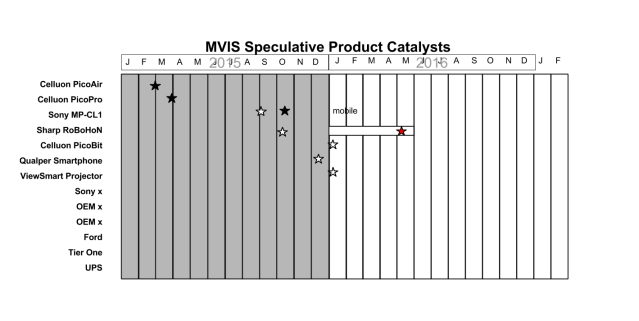
IMG_0417MicroVision components are showing up in more devices. In addition to last year’s pico-projectors: PicoAir, PicoPro, and MP-CL1 (an ugh of a name); we now know that there are also the PicoBit (a pico-projector with an embedded touchpad, and the recognition as a CES Innovation Award honoree), ViewSmart (another pico-projector with an embedded mouse), and Qualper (an Android smartphone with an embedded MicroVision projector.) Three more catalysts to MicroVision’s revenue stream. The particular good news I like is the possibility (with caveats from the Forward Looking Statement clause) that MicroVision would probably be profitable 6-9 months after the introduction of a smartphone with an embedded MicroVision projector. Definitely good news for sometime before the end of 2016 because the Qualper was introduced in China in December 2015. How do I know all of this? Because Peter went to CES, took some photos, talked to some people, and wrote some words.

Time to update the catalysts chart.

MVIS_Catalysts_010716The disappointing news:
For me, the major disappointment was that MicroVision plus Celluon plus Sony plus the manufacturers of ViewSmart and Qualper released fewer words and photos than Peter. One person with two posts exceeded the communications output of several corporations.
For the market, something was a major disappointment because the stock dropped 10% in one week, most of which was Friday – a bad day for the markets in general, but also a day when the investors had very few official reasons for optimism. Aside from one tweet about the PicoBit and one retweet there haven’t been any press releases, blog posts, or emails announcing the very things that they had incorporated into their exhibit. If it was in their exhibit and on public display, the material is supposed to be available to everyone, not just the people who can afford to travel to the event.

There is reason for optimism and enthusiasm. In previous years, there were many allusions to many private conversations. In 2015, there were more substantial comments that dramatically raised the confidence that Sony was using MicroVision technology and components. The surprise was when Celluon launched their product; a bonus. In 2016, there were few if any allusions, while there were several real products (PicoAir, PicoPro, PicoBit, MP-CL1, ViewSmart, and Qualper.) They’ve also announced the introduction of RoBoHoN, separate from CES (was it even at CES?). Within reasonable speculation is applications within Sony’s Life Space UX line, Pioneer and others’ HUDs, the resurgence in eyewear; and the applications like that few envisioned prior to the surprise prototypes of a game controller, UPS’ package sorter, and tabletop retail displays.

As I type this, Peter has posted about Day 1 and Day 2. CES ran from January 6-9, so there may be more. I’d be surprised if there isn’t. He’s probably typing as I’m typing.

Whether you are invested in MVIS or not (and I’m impressed with your due diligence in understanding personal finance if you’ve read this far and aren’t an MVIS shareholder), this year’s CES was an important show for MicroVision and also an important demonstration of the power of individuals disseminating public information that would otherwise only be available to a few. (Granted, 170,000 is only a few if measured relative to seven billion.)

Peter has a personal interest in the information. His is not a purely selfless endeavor, but his sharing of knowledge and insights is a good example of what each of us can do to help others. When you find data and information that is potentially valuable and isn’t being shared, there’s a value to sharing it. Within the world of investing, the usefulness is obvious. Outside the world of investing, the usefulness may actually be more valuable; especially, when the data and information are facts that help clear away speculation, when reason can replace rhetoric.

MicroVision may not be saying much as a tactic to shift the investment community’s perception from over-promising and under-delivering to under-promising and over-delivering. Pleasant surprises are appreciated, and stocks appreciate because of them. They may have over-corrected if they released information at CES that wasn’t released in the public press; but it is probably just a case of me missing a press release or a part of a transcript. Regardless, I’m glad for the news, glad for Peter’s work, sad to see the market’s reaction, and looking forward to better news in 2016; and looking forward to more people doing more of the same.

PS
Sure enough, Peter just published Day 3.

Posted in Uncategorized | Tagged , , , , , , , , , , , , , , , , | 3 Comments

Fresh Idea – Dockside Tidal Power

Tidal dock power

start of a sketch

Fresh ideas come along that might be worth a lot or a little; and some should be launched into the world because they may be needed now and shouldn’t wait for me to develop them fully. Sometimes, ideas have to flow and go. Maybe I can catch up later.

Of all the renewable energy sources, tidal power is one of the most predictable and ubiquitous – at least along shorelines. From my research, it would appear that I’ve come up with a variation that generates power without interfering with wildlife and also without having to be submerged in the corrosive environment that is salt water. Tides are inexorable. As long as something is buoyant, the rising tide will lift it, regardless of its weight. In its simplest form, my fresh idea (invention?) uses the tide to lift heavy objects; then, as the tide goes out, the potential energy of the lifted object can be converted into electrical energy. No need to guess about the weather and the winds. No need to check the latitude. No need to wait for the Sun to shine.

Some tidal power concepts rely on tidal currents turning submerged rotary machinery. They are successful but many people worry about wildlife hazards (though the rotation rates are so slow that it would be hard to get hit), and operators worry about maintenance and repair which is necessarily deep enough to necessitate divers and some danger.

Some tidal power concepts trade potential energy for electrical energy by trapping the high tide in a reservoir and using the outgoing current to power rotary machinery, as above. The machinery is easier to access, but the tidal reservoir takes up acreage and can also interrupt sea life.

Even with those caveats, I am fans of those systems.

Imagine instead, a floating dock like those we have in my neighborhood’s marina. As the tide goes in and out, the docks go up and down. If we tried to lift and lower the decks with electric motors it would require a ridiculous amount of energy. Yet, they go up and down about twelve feet every day.DSC_6079 My idea for Dockside Tidal Power leaves the docks as nothing but inspiration and as a physical foundation for the power generator. For discussion, imagine a weight that is allowed to slide up and down along a piling. The pilings are there to keep the dock in place. They are overbuilt for the purpose because all they do is make sure the dock doesn’t move back and forth too much. As the tide lifts the dock, it also lifts the weight. As the tide goes out, the dock drops. The weight drops, too; but the weight’s motion is retarded by any of a series of mechanisms that brake its motion and turn that braking action into power. In the simplest form, it only generates power as the weight descends. In the more advanced form, it generates power as the dock lifts. In a more sophisticated form, the dock is the weight with the proviso that the dock always remains in contact with the water. This latter form is more elegant, but also has some failure modes that could affect the use of the dock.

I came up with this fresh idea years ago. It wasn’t until a conversation during a land trust work party that happened to overlook the bay that the idea became defined well-enough to pursue. To me, the idea was simple enough that I thought that someone must have already developed it, and found some fatal flaw. After hours of research into tidal energy I became more of a fan of that version of renewable energy, and was surprised that I couldn’t find an example. One reason for posting this fresh idea is to find out if someone knows of such an application.

I did find a proof of concept that had nothing to do with tides. There are many gravity powered lamps. Raise a weight, let it slowly fall, transfer the motion to electricity through gearing and braking, and provide pollution-free light anywhere. One such device is a floor lamp that uses a 50 pound weight and a 58 inch drop to generate 40 watts for four hours. http://science.howstuffworks.com/environmental/green-tech/sustainable/gravity-powered-lamp1.htm A 55 gallon barrel weighs about 450 pounds, suggesting 360 watts. A typical American house needs 1.24 kilowatts. So, this could work for partial supply or backup; or gang four and power the house.

Given my Aerospace and Ocean Engineering background I’d thoroughly enjoy designing, testing, developing, and maybe even producing and selling such a device. If I had the money and the time, I’d turn off most of my other projects, build a team, and get to work building the device and the business. Unfortunately, I don’t have enough money which is I am working so many hours that I also don’t have the time. I considered crowdfunding the idea, but my recent crowdfunding campaign already delayed development and its lack of success makes me hesitant to embark on another campaign so soon. I could take the long and slow approach, something I am known for. Someone I’ve known for decades is also an inventor, and also has an extensive blog about the process and the probabilities. I think, however, that the world needs low-impact renewable energy now. Any delay simply so I can claim ownership is putting my needs over those of the coastal communities of the world. I think I should let the idea out there so it can grow, or be proven to have a fundamental flaw.

So, I pass along the fresh idea along with a sketch or two. If anyone wants to develop it, do so. Do it right and quick and pass it along, and no one will own it but many can benefit from it (if it works.) If you want me to help, definitely contact me. Of course, I’d like to help. Compensation would be appreciated, though. I ask for that from need, not choice.

There are too many variants to adequately describe here. I enjoy brainstorming and have had to pull myself back from generating yet another way to convert the power, arrange the system, and develop new applications. If you want more details, contact me.

My neighborhood has a marina, but I don’t use it. I don’t have a boat (and least not one that floats for very long.) When I bought my house I expected to buy a boat, too; but my Triple Whammy hit. I still hope to buy a boat, but that’s another story.

My neighborhood also has a beach, a twelve foot tide, a view of dozens of miles of Puget Sound to a hidden horizon. It is awesome to stand at the shore, look down to the horizon, and realize that quietly, every day, enough water flows in and out of that basin to cover square miles with feet of water – for free, predictably, without polluting anything, in a way that the sea life has evolved to live with. If we harness a small portion of that energy, we could probably power a city, or a marina could power a neighborhood, or at least someone with a dock might be able to power their house.

November Sunset

Posted in Fresh Ideas | Tagged , , , , , , , , , | 19 Comments

ReCharge Langley Lessons

Well, I’m glad I tried. The Kickstarter campaign launched to create a new kind of coworks for Langley didn’t meet its financial goal. The people who pledged get to keep their money. I get to keep my idea. And, I get to keep the lessons I learned. But, I share; so here I’ll share the idea, a bit of the conversations, a bit of what I learned, and what may happen next.
coworks logos lightning
First, I have thanked and am glad to thank again, everyone who officially pledged: Alan, Nancy, Petra, Mary Jo, Deborah, Ann, Lori, Kim, Jo, Patricia, Jonathan, Andy, and Irishman. Special thanks go out to Steve, who would’ve been the first, but couldn’t get the site to take his pledge. I’d pass along the last names, but some folks have asked for anonymity. Take this as an opportunity for anyone named Alan, Nancy, Petra, Mary Jo, Deborah, Ann, Lori, Kim, Jo, Patricia, Jonathan, Andy, Irishman, or Steve to claim some credit for supporting the campaign.

Coworks are more than ideas.

Coworks are an active and successful part of the new economy, the 1099 Economy, where employees are asked to work outside the office and usually called contractors who get 1099s instead of W-2s. Coworks are supporting the new economy, and while Whidbey likes new ideas, new businesses can be tough to start. Hence, the Kickstarter campaign, because the service would have a better chance of succeeding if it was adequately capitalized.

Coworks have operated on the island, and the best example was the one run by Russell Sparkman. It provided two things that aren’t available at libraries and coffeeshops, 24/7 access and a place to hold uninterrupted phone calls. For strategic reasons, that incarnation was closed. Other variations exist, but none have that level of anytime and professional service.

The conversations, however, were highly encouraging.
Photo on 2015-11-18 at 21.37 #2A recent power outage proved that scores of people are working from laptops in libraries, coffeeshops, and homes; because WhidbeyTel, the local communications company, opened their conference room/lecture hall to anyone with a laptop and a need. They probably sold a lot of coffee that day, because there’s a coffeeshop in the same facility. That episode proved the size of the hidden economy, the reliance on uninterrupted power and communications, and the technical capacity of the communications network that is starting there and branching out now.

Building owners contacted me about possibilities. For some, it was a new idea and a new possibility for the unused use of their spaces. For others, coworks are familiar, but they appreciated realizing that different models may be more successful than what they’ve witnessed.

The people who might work in a coworks were obviously interesting to talk to, and supported the idea; but because the 1099 Economy is also frequently associated with subsistence lifestyles, they weren’t able to pledge, even if they might be able to subscribe to and benefit from the service.

What I learned was both the superficial and the deep.
Some simple reasons were presented that might explain why the campaign failed: fundraising in December means asking for pledges while people are spending money on things like gifts, the rewards and perks offered for pledging weren’t specific to the space or valuable enough to people living off the island, asking for money to start even a salary-free business was seen as charity and proof that the idea isn’t sustainable, and maybe the word didn’t get out fast enough or far enough and that a second attempt may be more successful.

The deeper reasons will require more thought, naturally. When seen from the perspective of a 1985 economy, coworks sounds like communism. Starting with co- strikes some people as un-American, even if the idea is already pervading the country by necessity as much as by choice. A community known as a tourist destination may prefer consumer retail rather than business services. A coworks is not exactly the sort of thing Conde Nast is going to profile in a travel piece. And, of course, the deepest thing for me to consider is that someone else may be better at running a campaign or a storefront. Introspection and humility are always required.

What will happen next, at least for me, is a shift to another project that was put on hold while I ran the campaign. I have a possible invention for generating tidal power that shouldn’t have much if any impact on wildlife or the environment. (If you want to understand the complexities and possibilities of inventing, visit Alan Beckley’s blog – Ideaworth.wordpress.com).  I already have ideas for other coworks possibilities in other places in Langley and on Whidbey Island, and it may be best to see if they develop quietly in the meantime.

What may happen next may not involve me directly. With the idea introduced, and the conversations started, someone may take the idea, modify it again, and launch a coworks. Fine by me. I wanted to initiate the service, not necessarily to make money from it (though I wouldn’t have complained if it paid me, too) but because I think the community needs it. It would be nice to be included in the conversation, but the main benefit would be the service which I, others, and the local economy would benefit from.

While the campaign was active and as pledges came in, I tried to thank everyone who pledged via Facebook and Twitter. I hope I thanked everyone. For those who pledged at levels that would give them a book or a photo, I’d like to honor that as reasonably convenient. So, if you’re on the island and pledged, send me a note and we’ll see what we can do. And maybe, just maybe, we can kick around some ideas on how to start a coworks that works in the small towns on the island that is Whidbey.

Posted in Uncategorized | Tagged , , , , , , , | 2 Comments

Popular Posts 2015

As much as I enjoy writing about many aspects of personal finance, including living in a conscious community like Whidbey, the most popular posts of 2015 almost all dealt with one of my investments: MVIS, the stock for MicroVision.

  1. Pico Air Meets ShowWX – where MicroVision’s pocket projector from years ago was compared to the next generation, a pocket projector from Celluon.
  2. Mysterious MicroVision – where MicroVision started the year with great potential, and hints of news.
  3. MicroVision Has Real News – I Think – where I parsed a MicroVision press release that would mention a Fortune 100 Global company, but not call it Sony.
  4. MicroVision Spring Catalysts – where I decided to try to make some sense of all of MicroVision’s possibilities by producing a chart of the possible catalysts (which I continue to update.)
  5. and then, the outlier, the only post about Whidbey or housing to make the list, Will Zillow Make Me Move – where Zillow’s Zestimate exceeded my MakeMeMove price, prompting the possibility of finding an interested buyer in a hot real estate market.

There are about 95 other posts from 2015, and several years to browse through. This may become a collection of notes for another book. Who knows? Stay tuned. Thanks for dropping by.

Posted in Uncategorized | Tagged , , , , , , , , , , , , , , | Leave a comment

Semi Annual Exercise EOY 2015

Another half a year, another dive into my portfolio to see how things are going. I actually check more often; but I have a semi-annual exercise schedule for my portfolio (and lately it feels like my physical exercise schedule, too). Silly me, I got into the habit of checking in and writing it up every June 30th and December 31st. What was I thinking? I was thinking it was a good idea, and it is. The timing has a bit of a conflict on New Years Eve, though. So, here it is, the public disclosure of how I feel about how my stocks and portfolio have done this year. Words are handy, but here are some numbers and simple analyses (as appropriate) for AMSC, AST, GERN, GIG, MVIS, RGSE, and the economy in general.

The short answer: things are better, uneven, a bit worrying, and equally encouraging. That’s an improvement over years where the worries were stronger than the hopes.

The quick background: I can’t take credit for coming up with the semi-annual exercise independently. Peter Lynch suggested something similar, though less regular and less public. I simply built upon his idea that an investor should always be able to concisely describe their investments and why they own them. The details are in the lists of links to various discussion boards (see below). The summary is here. While others have thanked me for my efforts, I do this for my benefit (or humility); it just happens to be worth sharing – evidently.

The markets were relatively flat this year. That’s understandable considering how much they’ve risen from the depths of the Great Recession (or the Second Depression). As the Quantitative Easing has eased, so have the gains. As China has slowed, so have the markets. As oil prices fell, well, gas prices went down; but the commodity wealth of countries also fell, limiting their economies. The good news is the rapid adoption of renewable energy and the simultaneous divestment from fossil fuels. Maybe a bit of the bifurcation in the markets is a new economy stepping in to replace and old economy.

As usual, I expected my portfolio to end 2015 in a much better position that it was in at the end of 2014. Relative to 2014, 2015 looks good. Relative to where my portfolio was before my Triple Whammy, 2015 didn’t make much progress. The stocks bounced around a bit, with ups and downs. The companies, however, are in much better shape. Eventually, that improvement should show up in the stock price, too.

  • AMSC may not have received the positive news from the Chinese courts about the intellectual property theft case, but they are receiving new orders. AMSC is up 23% since mid-2015.
  • AST is still in early clinical trials for regrowing damaged nerves, but some of the responses have been so encouraging that for a while the stock quadrupled, until a competitor had good news, too. AST is down 14% since mid-2015.
  • GERN is also in clinical trials, but it is further along and navigating the FDA and international regulatory agencies on its way to possible approval of a cancer treatment that has great implications – if they can get approval for at least one specific cancer. GERN is up 13% since mid-2015.
  • GIG under-promised and over-delivered by saying little, then achieving GAAP profitability. The little company is getting a lot of attention as the year closes.  GIG is up 143% since mid-2015.
  • MVIS was perceived as over-promising and under-delivering, but even with that, they are making progress, have record revenues and backlog, and continue to maintain an impressive potential – that will be realized within the next few months (which has been the case for several years.) MVIS is down 7% since mid-2015.
  • RGSE has managed to somehow stumble in the high-growth, high-demand industry of solar power. The company is worth less than many homes in America. It dropped so far and so fast that even selling now wouldn’t buy me much of anything else. RGSE is down 50% since mid-2015.

My patience has been tested so thoroughly that it has put down its No. 2 pencil and is sitting back to see what happens with the grading. Aside from some minor adjustments, and one fortuitous profit-taking trade, my portfolio remains in a reasonably good position in terms of company progress, which has only begun to show hints of portfolio progress, and which is well-enough positioned that 2016 may be the year when I get to regularly share good news again.

I feel that I am witnessing a race between the advancement and progress of the companies I’ve invested in, and the troubling signs I see in an economy that is at least bifurcated and possibly destabilizing. (Much of the economic news is over on my blog for “news for people who are eager and anxious about the future” (aka PretendingNotToPanic.com). PNTP shirt In the best scenario, everything is awesome for my companies and stocks, and the economy. In the worst scenario, everything falls into the Reprise of the Great Recession, or as I call it, the Third Depression. In a bizarre scenario, as the economy trips on itself, some of my stocks provide the economically appealing new solutions to energy, health, and information issues thereby ratcheting up their stock price premiums. It could happen. What’s most likely to happen is something I haven’t listed.

The likelihood of my portfolio doing well has improved. My positions haven’t changed much, and my portfolio continues to hold enough potential to allow me to re-retire, or at least to begin transitioning to something less than a seven day a week work schedule. That’s been the case for years. Patience and a Long Term Buy and Hold strategy remain that classic conundrum of doing the same thing and expecting something different (a delusion) or proving the value of perseverance. Some time between now and the next semi-annual portfolio review, I should know better. In any case, stay tuned as the story continues.

For the details of the stocks, I post the semi-annual review of each of my stocks on various discussion boards. I could post the entire collection here, but 1) it would be very long, 2) the more public the conversation the more valuable it becomes, and 3) reading my posts on those boards introduces you to individuals who have different perspectives, strategies, and experiences. Collectively, those communities are more powerful than large financial institutions because the motivations and incentives are those of similar individual investors rather than that of profit-minded corporations.

Here are the links to the discussion boards I use. Feel free to comment here or there, and to pass along links to others. The bigger the discussion, the better the chance of valuable insights (as long as the trolls and flamers are moderated appropriately.)

Investor Village
AMSC
AST
GERN
GIG
MVIS
RGSE

The Motley Fool
AMSC
GERN
MVIS
RSOL
Economy and Markets

Silicon Investor
AMSC
GERN
GIG
MVIS

Posted in Uncategorized | Tagged , , , , , , , , , , , , , , , , , , , , , , | Leave a comment

Personal Finance Perspective

Fasten seat belts, or the mental equivalent. Today I read something that convinced me to put personal finance (the inspiration for this blog) in perspective. They’ve finally proved that the universe is weird. As if you didn’t know that, but these folks have proved it. The universe is weird, and yet within that we have to make sense of money – supposedly in some logical fashion. The ride will take us through seemingly disparate regions, but they are all part of our reality, imagined or real.

Part of today’s news feed on my other busy blog, PretendingNotToPanic.com

#PNTP

#PNTP

, there was a very geeky bit of physics news. Researchers at Delft University proved Bell’s Theorem. Here’s a quote from my commentary about their news (reformatted to hopefully improve clarity) ;

“As if Relativity wasn’t weird enough, and as if quantum mechanics (and its reliance on probabilities) wasn’t weird enough, Bell’s Theorem suggests there’s something more fundamental than space and time. Space and time may be consequences of reality. Just like realizing that:

  • things are made of molecules;
  • which we then learned were made of atoms;
  • which we then learned were made of protons, neutrons, and electrons;
  • which we then learned were accompanied by bosons, leptons, etc.;
  • which we then learned were made of three kinds of quarks;
  • which we are now hypothesizing are made of strings;
  • – space and time may be like those molecules, composed of something which we are only now beginning to recognize the existence of.

As even the researchers at Delft stated when they recently proved Bell’s Theorem;
The universe is conclusively weird.” – Delft University

Skipping the details, because otherwise this one post would become a series of books (which isn’t a bad idea, but this post is intended to take up a lot less time than that), it suggests that the space-time continuum played with in science fiction is also an illusion. The concept of reality as an illusion will resonate with some Buddhists, Hindus, Shamans, and others. Spirituality and physics meet again, something that is happening more frequently (with members of each camp claiming, “I told you so.”)

I follow physics because I am curious and considered a career in high-energy particle physics. In retrospect, that may have been a better choice considering the effective abandonment of America’s space program. I also follow physics because pure research enables the innovations that more conservative minds and policies can’t imagine and won’t fund.

Those innovations are opportunities for investing. The potential can be enormous (ask early investors in $MSFT – which I was). The risk can be enormous (ask early investors in Kaypro, Osborne, dozens of failures for each success.) If you want more details, buy my infrequently purchased book, Dream. Invest. Live.Dream Invest Live cover

As great as those potentials can be, personal finance is dominated by the need for a person to make more than they spend, and using the excess to invest.

My personal finance was dominated by decades of success and frugal living; then dominated by years of what more than one friend has called a “perfect storm of bad luck“; followed by my persistent, though fatigued, patience and perseverance.

Finance is just another label for resources, and in the mainstream economy, the main resource is money. How I manage my money is largely determined and dictated by procuring the essentials of life: food and shelter. To live within the modern world there are additional essentials like health care (sometimes just for appearance’s sake because it is unseemly to be unhealthy), and insurance (which comes in many varieties but which are as likely to support the system and maybe the individual.) The essentials are expenses exchanged for money gained from income. Passive income is awesome. Passive income is one of the primary reasons to invest because it costs the least amount of time which is the most precious and personal resource. Few people can access passive income and must rely on active income from jobs.

In today’s society, essential expenses are largely determined by external influences: competition for resources, interest rates, corporate and governmental policies, societal expectations. The great majority of my expenses are housing (including a government-enabled mortgage, property taxes, and insurance), food (because I must eat to live), transportation (because most of us don’t live in self-sustaining villages), communications (because we’re in the Information Age and my business is primarily information), and insurance (my second largest expense after housing and largely dictated by government policy. Oh yes, and income taxes, because I live in the United States and, now that I’m no longer rich, I have to pay higher taxes.

In today’s society, essential income is largely determined by my luck at being born a white male in America, my education which was paid for without going into debt (which is why I got a degree in Engineering instead of Physics), my efforts, all of which must occur within the bounds established by laws, regulations, and ethics.

Income and expenses then encourage me to be very aware of politics, societal shifts, non-governmental advocacies, and global trends.

Global trends have never been easier to track. Economic interconnections aren’t limited by borders. Prosperity in one country flows money into less-prosperous regions shifting power and assets, so a slowdown in China or an excess in Saudi Arabia, mean changes in San Jose housing prices and unemployment in North Dakota. Politician’s aggressive policies chase millions of people thousands of miles into countries that can’t or won’t welcome them, and put the average refugee into refugee camps for an average of 17 years.

Global influences have never been as powerful. Deforestation in the Amazon induces a drought in Sao Paulo creating an exodus from a city of 11 million people. Oceans may only be rising by millimeters a year, but each millimeter displaces thousands because the planet is populated by billions.

The influence of the Information Age means we’re more aware of the problems and possible solutions. The influence of the Information Age’s attendant technologies means new solutions are being created that have inspired, enabled, and communicated improvements in health, energy, education, and sustainability.

One of the signs of maturity, both personal and cultural (Charles M. Johnston), is the progression from taking care of the self, to the family, to friends, community, region, nation, species, planet (and…?).

Considerations of personal finance are essential in today’s society; but the conventional wisdom behind many of its aphorisms are based on a world that had closer borders. Now, what’s happening beyond the personal matters.

  • Whether my income exceeds my expenses matters.
  • Whether my community is sustainable matters.
  • Whether our society is becoming more just matters.
  • Whether our civilization improves or degrades our planet matters.
  • Whether our sciences connect us to fundamental truths matters.

If, as some scientific and spiritual researchers have pointed out, we are all connected – and that “we” may include all life and matter in the universe; then, it may not be a surprise that I am as equally fascinated by what’s happening in my neighborhood, what’s happening in politics, what’s happening in the plane’s climate, and what’s happening at the borders of science and spirituality.  If you ever wonder why this blog is so eclectic and diverse, it is because for me it is all connected.

There’s a Zen quote; “Before enlightenment, chopping wood and carrying water. After enlightenment, chopping wood and carrying water.” In the modern world I take it as, “Pay bills. Wash the dishes. Learn. Repeat.” (An interesting take on a book title. Hmm.)

The nature of reality may be that space and time are consequences of reality. Others have suggested that life and consciousness may also be consequences of some underlying fabric that we mis-interpret. With all of this to consider, is there any reason to wonder why I consider physics and spirituality more fascinating than sports and sit-coms; and that personal finance is simultaneously vital and inconsequential?

Now, it is time to conclude this post and then go wash some dishes. I’ll pay the bills after my clients pay their invoices.

Posted in Uncategorized | Tagged , , , , , , , , , , , , , , , , , , , , , , , , , , , , , , , , , , , , | 2 Comments

Surprising Samaritans

The Sun has set. Christmas Eve has begun. Listen to the older Christmas carols and hear about ghost stories. Tonight was saved from being my scariest Christmas Eve. A good Samaritan, actually someone I know from Whidbey Island, heard about the things I’m trying to do, the troubles I’ve had, and remembered something I did years ago. The result: a check in the mail that covered my biggest bill. Pardon me as I pause and think about that, yet again. They made the difference. They turned a holiday framed in worry into a holiday framed in hope.

For those of you just tuning in, about four years ago I was hit by a Triple Whammy. It happened during The Great Recession (or the Second Depression), but that was a coincidence. As more than one financial professional described it, I was hit by a perfect storm of bad luck. In today’s America, that’s unforgivable. Thanks to some help, I saved my house. Thanks to some folks that needed my help, I’ve been able to pay almost all of my bills by consulting. Thanks to patience, a long-term perspective, an appreciation of how much worse it can be, and a lot of work, I have hope.

And then the fuel pump on the truck died and needed to be replaced. It is one of those pumps that lives inside the gas tank. It had to be fixed. I couldn’t do it myself, but the nearest shop was able to get it fixed and running again – for more than I could afford, and they would only take cash or check. There’s finally enough room on the credit card for emergencies, but they didn’t take plastic. My truck was held hostage to their money policy. I scrambled, paid their bill, and then wondered how I’d pay the others.

Earlier in December, I launched a Kickstarter campaign to raise enough money to start a coworks in Langley (ReCharge Langley). I have approaches for other locations, like my current address of Clinton, but a good building in Langley became available at just the right time. Fundraising campaigns are public events, at least this one is, and in the midst of the various pledges and messages of enthusiastic support there was one email from a friend from years ago.

Before the truck, inspired by the campaign but not related to it, the email thanked me. Evidently, what I do, how I do it, and why I do it made an impression. Evidently, years ago I listened in just the right way, at just the right time, about a personal matter that was dealt with discreetly. When they saw what I was doing now, knew what I’d been through recently, and remembered what I’d done years ago, they decided they had to do something. They sent me a check for me, not the campaign. Value delivered for value received.

What I did wasn’t difficult. I didn’t do it to take advantage of a friendship (which others had evidently done). It is the sort of thing we all do for friends. Pardon the cliche but, that’s what friends are for.

Humans are social. We survive because we help each other. Does the phrase, “We The People” come to mind?

Here I sit, typing this post on Christmas Eve, not bemoaning the task of writing but wondering how many people don’t have my good fortune. Almost every day I post “news for people who are eager and anxious about the future” on my other main blog: PretendingNotToPanic.com. Today there was only one story. Homelessness and hunger are rising in America. Earlier this week I also posted that the upper class is doing better, and more people are joining it. There’s a bifurcation in America that, as one commenter mentioned; “So we’ve returned to Dickens-era conditions? Bah, humbug!” An appropriate comment on Christmas Eve.

Dickens’, “A Christmas Carol“, is about an era in England when there was the upper class and the lower class, and few living in the gulf between them. As much as it is about Scrooge and Cratchit, there were also the folks gathering money for the less fortunate. It was a time in England that preceded a more benevolent period. By the end, Scrooge becomes one of those helping the unfortunate. England eventually changed, too.

I can’t quote the conversation that resonated with my benevolent friend, someone who was always more likely to help, and was never a Scrooge. I am that much more impressed with them, thankful for the money of course, but impressed because they acted in a way that was more than words, sincere, and vital. We have wrapped money in stigmas and taboos, and it is refreshing to see someone who makes their own judgments. I am humbled that I am the recipient of their generosity.

I’d like to present them with a gift, but evidently I delivered that years ago. Just for fun, though, I sent them one of my books as part of an inside joke that would be too hard to describe here.

To everyone who cares about others, thank you. To everyone who helps others, thank you. Amidst the rhetoric and ideologies in our ceaseless debates, there are people who treat people as if they were people without labels; just like a Samaritan who tended a Levite, as a person taking care of a person simply because they were a person.

Enjoy the holidays, and each other.

DSC_6157

Posted in Uncategorized | Tagged , , , , , , , , , | Leave a comment

Eccentricities Planning And Joys

You are encouraged to consider the following declaration as eccentric. I like program planning. Okay, I’m not going to make it one of my hobbies, but I evidently have a tendency to enjoy hearing about a disparate collection of activities dancing around a goal, and then coming up with a way to line them up so they all head in the same direction. I’ve been told that this is not normal; but hey, it’s what I do. Finding, and accepting, our eccentricities is a great gift that can’t be wrapped, is difficult to deliver, but may be more valuable than anything under the tree. Program planning isn’t as appealing as some of the other things on my wish list, but I am glad to admit that I enjoy solving such puzzles that help people get things done. It may be eccentric, but it may also be a case study in discovering your valuable eccentricities.

I didn’t recognize it until recently. When I look back over decades, I can spot hints and suggestions, episodes and events, that I wished I’d recognized at the time. About ten years ago a friend pointed it out to me, and I thank her.

We were sitting around a kitchen table, a small group working on a new venture. It was fun. Ideas were bouncing around the table, escalating and flying off, then brought back again by more new ideas. Brainstorming (formal or chaotic) makes me think, dream, and smile. After an hour or two I had to leave and catch a ferry. Some schedules will not be ignored. After I got home, I collected my notes, sketched out the various ideas, connected the boxes, and then lined them up. Then, I sent them back to the group. My friend pointed out that it was impressive that I’d caught all of those ideas, and that it was bizarre that I’d sort them into something that made sense – because the meeting certainly hadn’t.

It turns out that I like playing with the little details and the big picture, that I enjoy putting a goal on paper and then figuring out the steps that can get to the goal. To me, that’s natural. To others, that’s bizarre.

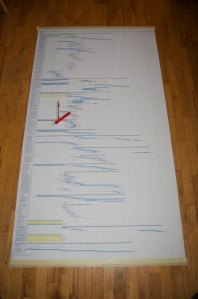
DSC_6141One of the gifts a client gave me was the managerial license to update the program plan for their project. (The History of Computing in Learning and Education Virtual Museum – a project that may appreciate a shorter name.) We built a plan a few years ago. I’ve kept it updated, but it was time for a major overhaul. The plan wasn’t a sketch on paper, but a file that contained dozens of tasks that were linked to each other in a program called TeamworkPM. I may have exceeded its designer’s expectations because the project is large. Preserving, studying, and exhibiting the history of how computers and computing changed the way we teach and learn is an enormous endeavour. Given the right funding it will take about 3 years and – I’m working on the cost estimate, but expect it to exceed one million dollars, maybe three. TeamworkPM is a program designed to manage tasks that fit on a computer screen. The museum’s plan is five feet tall and three feet long. Fortunately, I know a printer who helped me convert a dozen screen shots into one piece of paper that was ready for the red pen.

Pardon the digression into a bit of geeky management, but that’s the point. Some of the most valuable things a person can find are the things that their talents and skills that are uncommon. Evidently, few folks enjoy looking at dozens of tasks, keeping them mind, and then sorting them back out in a useful manner. But then, too few folks know how to engage dozens of five-year-olds and teach them something. Too few folks know how to sit and listen, and only offer advice when asked. Too few folks will step into the uncomfortable moments in life and find a way to comfort someone. And yet, we need kindergarden teachers, counselors, and hospice workers.

I know I have other eccentricities. We all have eccentricities. The average normal person doesn’t exist. If they managed to be the average height, average weight, average education, average wealth, average whatever, something in the next second would change their height, weight, education, wealth or whatever.

I envy counselors that get to spend the day listening to people who are dancing around the blind spot that hides their defining characteristic, and are able to introduce the person to that aspect of themself. I try to do a bit of that with my consulting; otherwise, the consultation isn’t nearly as effective. But, I am no psychoanalyst.

And, that’s the point. Especially, during this week of Christmas, it is easy to focus on things, stuff, boxes and wrapping paper and credit card slips. That’s the tradition (though it didn’t originally include credit cards.) I don’t want to deny some kid the joy of waking Mom and Dad up far before dawn (and only a few hours after Mom and Dad went to sleep.) I don’t want to deny that to the adults, either. But, if you find yourself secretly wanting to do something “nobody” considers fun, but that you enjoy, consider treating yourself and doing it (as long as it is legal and doesn’t hurt anyone, including yourself.)

There’s snow in the mountains, and it’s been years since I skied. I’d like to get back up there, and will. In the meantime, there’s a gratifaction in pulling blackberries at the local Land Trust property, a joy in helping someone with firewood or reaching the top kitchen shelf, fun in hearing some danceable music and dancing wherever – even if it is in the lobby of the bank (video recorded and locked down).

I don’t know what your fun eccentricities are (unless, of course, we’re already friends.) The main thing that matters is whether you know what your fun eccentricites are. If you don’t already know them, finding them may be the greatest gift you can give your self.

As for those plans, they’re a good idea because they tell you that there’s a least one path that will get you from your dreams to your goal, but the other trick is to remember that life laughs at plans – but you may not be able to take the right next step without them.

Posted in Uncategorized | Tagged , , , , , , , , | Leave a comment