An MVIS GIG Dilemma Slowly Solved

No need to rush. Wait long enough and dilemmas become clearer, or at least decisions become easier. Last year, I had a dilemma. In the last twelve months, I did little about it except pay attention. While my dilemma was about stocks, the lesson has more to do with patience and only moving when it is to my advantage to move. Within the last year, I’ve heard a lot, read a lot, saw a few things – and nothing much changed in the meantime. An opportunity to make a decision has arisen, and I intend to act. Some dilemmas are complicated, like in politics, what to eat for dinner, and trying to understand how to deal with other people. My dilemma is simpler. It only has to deal with personal finance.

Almost exactly a year ago I posted an article titled, “This Investor’s Dilemma MVIS V GIG“. I was invested in each of the companies, MicroVision (MVIS) and GigOptix (GIG). Each was getting close to potentially significant profitability, but it was hard to tell which would get there first. MicroVision’s management was known for speaking much and saying little; great stories with lots of pronouns and few details. GigOptix’s management was known for saying little, being too technical when they did communicate, and not communicating much. The company sizes were similar (~$100M). They even have a common heritage reaching back to an innovative set of researchers at the University of Washington. They were each making progress; but would they both continue to progress; and if so, which would progress first and further?

Because I interpreted MicroVision management’s communiques to suggest they would have several new revolutionary products out within the next twelve months, I bought a small extra holding in MVIS. The size of the purchase was small relative to the market, but about as large as I could afford within my budget. In particular, I thought they said there’d be a new product out in time for the holiday season. Not quite. A couple of new products were announced, but not launched. I think it is understandable that some, like me, could interpret ‘announced’ to mean ‘for sale’. Evidently, ‘announced’ means the manufacturer said something about a product that should be available, sometime. Note: That doesn’t mean the announcement is in English. That doesn’t mean the product will be for sale in North America. That doesn’t mean MicroVision will pass along the news, even though it is supposedly material and important to the operation and viability of the company.
MVIS_Catalysts_072916
The products announced were a very nice smartphone with a MicroVision projector inside, and a stand-alone projector that doesn’t need another computer attached to it. The products were finally available for sale within the last few months. The Qualper smartphone was available sometime in June. The ViewSmart projector was available as of sometime in July. Both were several months of a delay. The details are unclear to me because I have yet to find clear communications from any of the companies involved, including the one of which I am a part-owner. Aside from the too-innovative robotic smartphone known as RoBoHoN that was made available for sale in Japan in May, there have been no other products launched. Innovative? Yes. Major market? No. Positively disruptive? No. Source of significant revenue and profits? No.

This week, MicroVision announced their quarterly profits. Product revenue was up 62% from last year. Sounds impressive. They made about $4.2M in the quarter. The stock fell from $1.75 to $1.56. That 62% sounds great, but it was from a too-small number last year. Within the call, management only discussed two customers, no significant new orders, and no projection that encouraged stockholders hoping for profitability. Several OEMs are expected to announce products; but now, more of us understand the glossary. As has been the case for MicroVision for years, “really good news” should happen within the next few months – again. Some day that will be proven true; but not as of July 2016.

This week, GigPeak announced their quarterly profits. Before I get into those, though, check the name. Whatever you want to call the company behind the stock called GIG, it has been growing for years through mergers, acquisitions, and internal efforts. Their technology enables high-bandwidth internet services like streaming and working within the cloud, but it is esoteric enough that most analysts and individual investors can find simpler companies to understand. The merger activity confuses the finances, with a similar result. For some reason, they also changed the name from GigOptix to GigPeak; which doesn’t decrease the confusion.

Back to GIG’s finances. For a company of a similar age and heritage, though a different management style, they have grown to making $15.4M in the quarter, 35% over last year’s quarter. They even earned $0.1M in the quarter. That’s profits. Imagine that. Not much, but profits.

MicroVision’s management convinces me that they understand the details of the technology and manufacturing, and the potential within the industry and the market; but they seem to lack news, communications, or any apparent dedicated efforts at sales and marketing, the things that make companies money. I know the officers and managers must be doing what they can, but it is evidently being done very quietly, so quietly that I could believe it is a major unfunded task at a critical time in the company’s development. Meanwhile, GigPeak’s management doesn’t say much, but at least they mentioned customers and sales in their press releases.

My parents taught me enough about investing for me to get started when I was about 19 years old. To honor that, I’m taking roughly 10% of my inheritance and investing it. That’s not enough to buy me a new bicycle, but it is enough to appreciate significantly considering GIG’s potential. MVIS’ potential is greater, at least according to my amateur research; but GIG is actually doing something now. Maybe MVIS will surpass it with one epic reveal of one of their mysterious NDAs. That’s why I’m holding onto the MVIS shares I already own. Now, it is time for me to give GIG another chance by adding to my holding.

Ironies exist. Since MicroVision’s announcement of 62% revenue growth, the stock is down 11%. Since GigPeak’s announcement of 35% revenue growth, the stock is down, yes, down, 7.4%. Of course, that sounds like something that is increasing in value while decreasing in price. Buy!

My dilemma is resolved and will be acted upon after I figure out how to make a deposit into an account that I haven’t added to in years.

Those other dilemmas, well, politics will sort itself out by early in November, probably; dinner will be resolved after I publish and share this post; and other people – that’s one I won’t rush because listening takes time. I wonder if the politicians have tried that, really tried that.

Posted in Uncategorized | Tagged , , , , , , , , , , , , | Leave a comment

Another Coworks Opens Again

Open and close, open and close. The concept of coworks on Whidbey continues to sputter to life like an outboard motor that is just about ready to catch. Each time is different. This time it comes with a bookstore and coffeeshop downstairs. The South Whidbey Commons has opened a coworks and I’m the first customer, again.

The South Whidbey Commons is an idea that makes a lot of sense. Provide a place for students to learn about work life, provide a place for people to meet, furnish it like a living room, and ring the walls with books for sale. (Many of which are used, but they sell new copies of the works of local authors, too, like me and mine.) It becomes a natural place to sit and relax. It also becomes a natural place for the nomads of the Gig Economy and the 1099 Economy to buy a cup of something to effectively rent a table for a temporary office.

Several months ago they asked me about the various coworks that I’ve used, including the one I proposed as a kickstarter campaign. They had an attic classroom that wasn’t being fully utilized. Could it be a coworks? The answer is always yes, followed by “but” or “as long as” or “especially if”.

A little more than a month ago we closed one of our discussions with me handing them a check for the rest of the month’s rent. A new coworks was created.

Putting a coworks in a commons must make sense. They use the same prefix, ‘co-‘; well, at least the same first two letters.

A coworks works best when there is a co-. For several days, it was a solo-works because I was the only one signed up and paid up. Non-profits, like the South Whidbey Commons, have certain processes and procedures to address, so the word didn’t get out until last week. Sorry I missed it. I would’ve blogged about it then. No matter, here’s the announcement that I missed.

South Whidbey Commons Co-Works is starting up.
Open during business hours 8:00 AM – 5:00 PM daily.
Monthly membership $60 Day Rate $10
Questions? 360-661-0969

Which was followed by;

Co-working is a style of work that involves a shared working environment, often an office, and independent activity. Unlike in a typical office environment, those co-working are usually not employed by the same organization.[1] Typically it is attractive to work-at-home professionals, independent contractors, or people who travel frequently who end up working in relative isolation.[2] Co-working is also the social gathering of a group of people who are still working independently, but who share values,[3] and who are interested in the synergy that can happen from working with people who value working in the same place alongside each other.
Co-working offers a solution to the problem of isolation that many freelancers experience while working at home, while at the same time letting them escape the distractions of home.
(wikipedia)
SWCommons is offering free WIFI, electrical outlets and a quiet work space in our upstairs classroom space, along with easy access to food, coffee and restroom facilities!

Evidently, there was one bit of confusion. Some saw “free” before “WIFI” and thought it might apply to everything else on the list. Nice deal if you can get it. The first notice is shorter but contains the data coworkers need most, the cost: $60/month or $10/day.

Every coworks is different, and non-profits have to be careful with expenses. For now, they’re starting small: a few tables and chairs, use of the space, freedom to bring in our own food and drink (as long as the main room customers don’t see us do it and get confused.) The main benefits are distance from the noise of the espresso machine (but drinks are just downstairs), more room than a cafe table (at least until the crowds show up), and a mutual expectation of at least some professionalism because there will be online meetings, necessary discretion, and also sharing of information and support. Two of my three biggest gigs were arranged while sitting in a coworks. In this economy, that’s farm more valuable than the monthly rental.

Each coworks had a different inspiration. Despite the phenomenal success in urban areas, each coworks has yet to firmly establish a self-sustaining community. Finding the right mix of services and fees for a coworks to succeed in a small town takes trial and error, and a bit of luck.

One idea, each initiative, inspires others. Now that the Commons has announced their opening, other entrepreneurs are asking me about what business services they could provide to the people working in the Gig and 1099 economies. Small towns go through generational shifts, which seems to be happening on South Whidbey. Younger people who can’t afford to live in Seattle are looking for solutions that allow them to both live and work on the island. The right set of services attracts other services. Langley,UBCC 070613 which is a tourist town known around the world, is also appealing to year-round residents. It may be that two or three businesses that serve business can establish a mutually supportive core that helps the locals who work via the Internet, while also providing an additional and therefore stabilizing revenue stream for the local economy. Ironically, some of the tourists who come here to relax will probably appreciate those same services when some urgent task arises back at their home office. Having something more than a mobile phone can be worth a lot.

Maybe the South Whidbey Commons coworks provides all of those services, or simply manages to plant that critical seed. It will take time to find out. That motor, that engine for an economy, may finally catch, do more than make a bit of noise, and help move things along. Pardon me as I keep pulling on that starter cord.

The 'Before' photo. Stayed tuned for what comes 'After'.

The ‘Before’ photo. Stayed tuned for what comes ‘After’.

Posted in Uncategorized | Tagged , , , , , , | 1 Comment

Balancing Hiking Costs And Benefits

Knees. My body is reminding me that I have two of them, they aren’t happy, and I shouldn’t be surprised. I have a confession to make. It has been about a year since my last backpacking trip. Please forgive me. I’m asking forgiveness from my self, because I know how much better I feel when I am hiking regularly. Once a year is regular, but too infrequent. As my finances improve, I intend to spend more time past the end of the road. As frugal as hiking is, it is not cheap; but the benefits far outweigh the costs – as long as I can pay my bills.

For those who missed part of my writing career, I wrote a series of three books about Washington’s Cascade Mountains. Each was about what Nature around the lake was like for twelve months. I visited once or twice a month, as conditions permitted, to basically compare wintry Wednesdays with summer Saturdays. Twelve Months at Barclay Lake was about an unofficial temperate rain forest. Twelve Months at Lake Valhalla was at the ridge crest where the lakes can be frozen more often than thawed. Twelve Months at Merritt Lake was past the pass and into the dry terrain where forest fires are too common. Three lakes along one highway create a cross section of nature.

Unfortunately, writing about and taking photographs of nature aren’t enough to pay for the hiking and skiing necessary to take the notes and collect the images. About seven years ago, finances suggested I hike and ski less. Through the Great Recession (or as I call it the Second Depression), I’ve managed about one overnight hike a year. Hiking seems cheap. Throw everything on your back and go for a walk. Sleep on the ground. Drink from a stream. How can that cost money? Permits. Gas. Food. Gear repair. And, the biggie, lost work time. Last year, I wrote about the cost of a two day hike. It was $86. The lost work hours equal about twice that.

And yet, I hiked.

You know it is time to take a break when more than one friend looks at you and says, “You REALLY need a vacation.” Like so many other pieces of advice: “Get a massage”, “See a doctor”, “Treat yourself to something nice”, the advice comes with a frequently forgotten caveat and suffix, “As long as you can pay your bills.” Thanks to an inheritance and an occasional extra gig, I have enough saved up to give myself a day or two off every month through the Autumn.

I write these posts to chronicle the reality of living in these economic times. It is easy to join the chorus of Nature cures all ills. It is also easy to join the chorus of don’t spend any money and don’t put yourself at risk. Within the 48 hours from Friday noon to Sunday noon, I swung through all of that.

To my friends who patiently listened to me rescheduling my normal routine and planning the trip, thanks. That went on for more time than it took to pack. Fortunately, oddly, two of my three major clients had hiatuses, and the third was very negotiable. The universe was giving me a hint. I’m learning how to take them.

The trip started off with a dark reminder of the daily grind I left behind. My route took me past Boeing’s plant for the big airplanes, just as the shifts changed. Ugh. Nasty traffic. People desperate to get somewhere else on a Friday afternoon. Bumper-to-bumper for miles. That’s when I smelled the burning plastic. My truck is 16 years old, but I only got it a few years ago. It has smells, sounds, and shakes that I can’t identify. I didn’t see any smoke, but the passenger window no longer would move. A mechanic had thrown an anxiety bone to me by talking about some extra work to do with the drive train or suspension – but they always do that. For miles I couldn’t find a place to pull off and back on to stop and check. I hoped the smell was from someone else’s vehicle. At least my tires were new.

Skip ahead a few dozen miles and I’ve finally managed to get to a USFS Ranger Station before they closed. After a bit of discussion of the remaining light, the length of the various hikes, and the length of the various access roads I decided on Dorothy Lake. DSC_6580The access road was long, but it had been serviced recently. The trail was only about two miles and less than a thousand foot elevation gain. If you think serviced recently means paved, Ha! They had done impressive work, but the potholes in the gravel road were big and deep enough that taking each slowly became a necessity. The 9.5 miles went slowly, eating into my remaining daylight. My fears of something burning were replaced with fears of something breaking.

When I got to the trailhead, I was relieved, hoped the truck wouldn’t get broken into (which they’d warned me about – more anxiety), and suited up for a hike that was a climb up a muddy and wet trail. My anxieties switched from worrying about truck breakdowns or breakins to Tom breakdowns or breakins. I was out of shape, and glad I hadn’t picked what I would’ve considered a moderate hike just a decade ago.

DSC_6556The trail was the transition. I’ve hiked it for decades. It was familiar. I was visiting an old acquaintance who hadn’t changed much, but who had been tended well. Instead of just mud and slick rocks, there were boardwalks and staircases. Many people had done a lot of work. After about an hour of wondering my heart and knees were going to make an ultimate complaint, I got to the lake. There were few photos because the misty air absorbed too much light, but I witnessed its primordial nature. In a bit of manifestation, I asked the world for the first campsite to be open, otherwise I might have to hike to the far end of the lake, another mile or so. There were 17 cars in the lot. The campsites could all be full. Marvelous. The first site was empty, and so were its neighbors. I had solitude on a busy weekend.

DSC_6570The next day was contentment and relaxation. No clocks. No obligations except the fundamentals of eating, drinking, reading, sleeping – and there was even a toilet nearby. Granted, getting to the toilet required climbing over a half dozen fallen trees, but at least it wasn’t over-used! The toilet, by the way, is a simple box over a hole; but, to anyone who has had to dig a trench latrine, it was luxury. I stayed in my tent most of the day because of the bugs. The site provided solitude, but it didn’t provide a breeze and the mosquitoes were hungry.

By the end of the day, I was physically aware of how tense I’ve been and still was, how my variety of gigs means continually evaluating my time, how distant I could be from the basics of life – even while I worked to attain, maintain, and sustain those basics.

Sunday morning I woke with the brightening of the sky. I couldn’t see the Sun, but the day was obviously beginning and I had work to do at home. I broke camp, packed up, and gingerly stepped down the staircases and along the rocks. A twisted ankle could be financially devastating. About 25 years ago I found myself helping a search and rescue squad because someone had stepped wrong, and he was a back country medic. Be careful out there.

Just like the relaxation of a vacation can be erased by passing through airport security, the drive home was done with a perceived wobble in the truck.

There’s probably nothing wrong with the truck or me, aside from our ages. As I said, I write this to chronicle what it is like to live through such economic times. Otherwise, selective amnesia rewrites history.

I know people who won’t hike because they tried it and found it didn’t match the Disney image so many portray. I spend a lot of time looking at my next step. In camp, there’s a lot of time spent providing the basics of shelter, food, water, and hygiene. Trips to the bathroom at midnight aren’t done without a lot of thought. Those are some of the costs.

The benefits far outweigh the costs, at least for me – as long as I can pay my bills. For the last several years, any small upset could’ve maxed out my credit card, effectively totaled my transportation, and had far worse impact than a trip to the shop. When I had more than enough discretionary income, an accident or incident would make me unhappy, but money would solve most problems. Now, I sit in the middle, able to hike, still vulnerable to realities and anxieties that aren’t easily swept away; but able to experience the benefits of being in Nature.

My camera was a bit dodgy and decided to limit how many photos I could take, but I pass along these few to show the large and the small things that made me smile, that took me out of the civilized world, that reminded me of the real world of Nature that civilization happens to sit on top of.
DSC_6560 DSC_6565 DSC_6566 DSC_6574 DSC_6577 DSC_6581 DSC_6590

Seventeen thousand years ago, the Puget Sound area was under 3,000 feet of ice. The glaciers retreated, scoured mountains and created lakes. Eventually life filled in as it could; forests in many places, but bare rock persists. Throughout the forest, which started from a few seeds, a wide variety of life lives, even those pesky mosquitoes. Termites will eat the entire forest. Bear, deer, and various cats roam for miles while squirrels ad chipmunks guard far smaller territories. Birds wing throughout. To sit in its midst is a marvelous reminder of what’s important, what I can and can’t control, and what exists even when I am at home typing on the computer. Sure, that slides into the sappy narrative about nature that so many tune out. Maybe they’ll find value somewhere else. I’m simply glad I know where I can find something I value, and find silly when I forget how much it is worth. I look forward to doing more hiking – assuming I can pay my bills. If nothing else, my knees might appreciate some ibuprofen or turmeric.

DSC_6590
For the curious, I also posted more practical trail notes over on NWhikers.net.

Posted in Uncategorized | Tagged , , , , , , , , , | 2 Comments

Mysteries Investing In Real Goods

Real Goods is up over 100% in the last five days. That’s Real Goods as in the stock, RGSE, for the company Real Goods Solar, Inc. That’s not for real goods as in really good things, well, maybe but that’s a very subjective thing; one person’s real good is someone else’s real bad. But, that’s another story. I wrote a very short synopsis about RGSE in my Semi-Annual Portfolio Review because the company has been shrinking despite being in an expanding market. Somehow they were chasing away investors and not making profits in an industry and a technology that is in high and growing demand. I couldn’t find a definitive answer for the fall, but I suspect management in such situations. Now, the stock is rising, and I can’t find any news about that, either. Small companies can be the easiest and, paradoxically, the hardest stocks to invest in. Welcome to my exercise in futility and hope.

As I relayed in my other main blog, PretendingNotToPanic.com, solar power is becoming so inexpensive, is so much in demand, and has become so pervasive that it and wind are now seen as far more appealing than hydroelectric power. For decades, dams were the premier low-pollution choice for power. Solar was too inefficient. So was wind, but for different reasons. In 2015, the two combined added 118,000 megawatts of power while hydroelectric added only 22,000 megawatts. Solar power panels have increased efficiency, decreased cost, and have expanded their map of most affordable option. Solar power can be decentralized so well that individual buildings and homes, even street signs, can be electrified without tying into the greater grid. Tie into the grid, and switch from being an expense to being an income. That sounds like an easy business to be in. Evidently, not.

Real Goods Solar has been in business since 1978. I knew about them back then, and have followed them sporadically since. Thirty years ago, solar was a statement. It was inefficient, but people installed systems to disconnect in comfort, to demonstrate their desire to disconnect from Middle East and corporate influences and wars, and to experiment. Real Goods was there with a mail order business that provided everything someone needed to go off the grid: solar panels, batteries, converters, regulators, efficient appliances, tools and supplies for sustainable gardening – even tiny hydroelectric systems that fit in streams. After the boom and bust of the Internet Bubble, America Online’s ex-CEO got involved in the company, there was a merger with the alternative health care and healthy lifestyle company called Gaiam during which Real Goods wasn’t emphasized, then Real Goods was spun off as a separate company just in time for the recent boom in solar power. The emphasis was on equipping businesses and municipalities in subsidized areas, with a moderate return to the off-the-grid market. Good timing, or at least it should have been.

I bought and sold at various times as the company changed ownership. Strategically, I believed the company was going to be in the right place and the right time by getting there first and waiting for the trend to catch up with and then pick up the company and the stock. Through mergers, acquisitions, spinoffs, and reverse splits my holdings have fallen 87%. I bought some during the 2008 IPO, have held most, but sold some for diversification – because it looked like they weren’t as well managed as they could be, but held because strategies can change within one meeting or revelation. At the end of 2008, their market cap was about $60,000,000. When I published my mid-2016 semi-annual review, their market cap was $3,000,000. There are houses in my neighborhood that cost more than that.

If the company was barely making any money, such a decline in the stock price would make sense. For the last three years, they’ve regularly had revenues of more than $40,000,000. In 2015, they lost $10,800,000. Something just wasn’t right in either the company or the investment community. Maybe they simply upset the wrong fund manager.

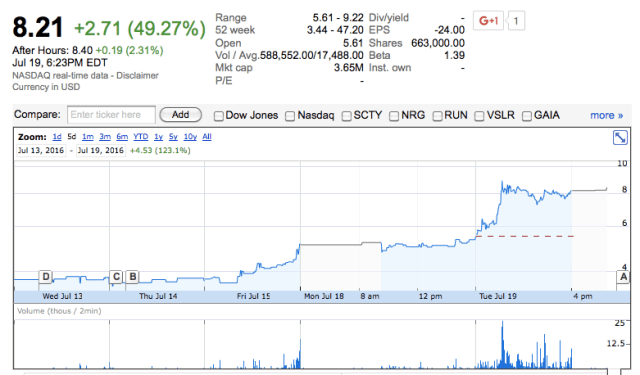
And then a few days ago, something happened. On Friday, July 15th, the stock rose from ~$3.60 to ~$5.10 on increasing volume. I expected it to fall on Monday as if some rumor turned out to be groundless. The stock rose a bit, but more importantly, it didn’t fall. Today, July 18th, it rose over 49% to close at $8.21 on over 33 times normal volume. I wonder what July 19th will bring.
Screen shot 2016-07-19 at 7.12.39 PM
I didn’t just wonder. I researched. The first source: check for press releases for news the company wanted or needed to reveal – nothing. Check news reports for news that the company may have lost control of – nothing. Check the various stock discussion boards that I frequent (InvestorVillage.com, MotleyFool.com) – nothing. Check the Yahoo stock discussion boards as a last resort because it can be like wading into a drunken college party – nothing, except one post from someone else pondering the same question. Check Twitter for the company’s newsfeed (@RealGoodStore) – and find their last post was from a year ago; and check Twitter for the stock hashtag ($RGSE) – and find a few traders speculating on the move, but without a concrete news item. And yet, the stock is up 123% in the last five days. Do that for five weeks and I’ll be a happy investor. I don’t expect that to happen – but – nah – but – well – nah. And yet, it is a sign of hope.

If they can manage to simply breakeven on their $40,000,000 revenues, and if the investment community values them at a Price/Sales of 6, then the company would be worth $240,000,000, a 65-fold increase over today’s valuation. If, if, if.

Solar City (SCTY) has a Price/Sales of 6.16 and a market cap of $2,700,000,000, proving such revenues and valuations are possible. But, Solar City has lots of news and a celebrity CEO, Elon Musk. Of course, Real Goods had their own celebrity for a while in Steve Case, the ex-CEO of AOL. I’ll save the celebrity comparisons for later.

There’s a mystery in investing in Real Goods, at least for me, now. I prefer to invest in small companies because they are easier to understand and because they can eventually become big companies with valuable stock. Small companies can also be harder to track. They have less news, can decide to only reveal what is legally required, can have management that wants to hide mistakes, and are more sensitive to upsets. Some of that is true for large companies, but in those cases there are crowds of researchers and analysts uncovering stories. That’s also why I don’t invest in large companies, the competitors within the investment world have far greater resources.

Either someone uncovered a story within Real Goods that they’re buying into, or someone is convincing others such a story might exist, or the investment community has decided some stock listing criterion has been cleared, or this is all a fluke. I don’t know. I’d like to know. Eventually, I will know.

Because of the mystery, though, I won’t be buying into the rise, won’t be buying hoping the crowd is wise, won’t be buying until the mystery is resolved, or not buying at all. Mystery changes a stock from an investment into a speculation. Since the Great Recession (or as I call it, the Second Great Depression) it seems that the small companies I am invested in are saying less. Maybe they’re hiding their successes until they are certainties. In the meantime, it feels as if my portfolio has become filled with mysteries- at least for now.

Posted in Uncategorized | Tagged , , , , , , , , , , , , , | 3 Comments

Chicken And Egg

Which came first, the chicken or the egg? Within one lifetime that’s gone from being philosophical and rhetorical to proven and solved. The egg came first. Dinosaurs were hatching from eggs millions of years before evolution created the chicken. Sorry if I put a major crack in a favorite conversation starter, but at least we can celebrate a bit of progress. The catch phrase will continue. I regularly work with entrepreneurs, creatives, and innovators – people who have solutions and no money or people with money and questions about what to do with it. Welcome to matchmaking; and just like in the world of romance, there are lots of tenuous steps, defenses, opportunities, and maybe eventually a connection. Now’s a good time for solutions and questions to get together.

There’s another answer to which came first, the chicken or the egg. This evening it is the egg. Someone was nice enough to give me a dozen fresh eggs, which added to the dozen I already had. The supermarket had a good deal on chicken breasts, and I’ve been craving salad that includes some of that. It’s summer and the oven only gets used as necessary. Rather than heat it up twice, I decided to bake some eggs first at about 300 degrees for about 25 minutes, then up the heat for the chicken breasts which will be part of tonight’s dinner and many salads and possibly nachos to come. And yes, I notice switch from using healthy leafy greens to decadent pub grub.

The world needs good solutions. Pick a topic and there is probably something bizarre going on around it. Economists, climatologists, and even politicians are trying to find answers, solutions, or at least strategies because the world is no longer acting the way it did just a few decades ago. My pessimism climbs and my mood sinks when I listen to their problems. My optimism climbs and so does my mood when I listen to the entrepreneurs, innovators, and creatives. (Hence, PretendingNotToPanic.com.)

Entrepreneurs are developing new business models that redefine value as more than money. Strengthening their supportive community creates a more sustainable business. Even though peak profits may never climb as high, they may continue for far longer. At least, that’s the hope.

Innovators are developing new technologies or reinvigorating old technologies to do far more with far less for far more people. That includes smarter farming, more efficient housing, and cleaner transportation. Infrastructure is in retreat, but when it advances again we may manage to replace old solutions with far more appealing versions.

Creatives are developing networks and new ways to communicate that are redrawing the lines around communities. Old national political parties, grand or not, are less likely to be seen as effective as local efforts. Self-governance has a new meaning when it is based on several people mutually supporting each other. One thread I am particularly interested in is from the people who realize the US Constitution was designed to be revised. The Founders knew it would eventually be archaic. I’ve seen initiatives to amend it to shift political pay and therefore influence, and to edit contentious amendments into something clearer. Writers can spot bad writing. Why should we govern by ambiguity?

There’s a bit of a simplification there. I matched entrepreneurs to the economy, innovators to climatology, and creatives to politics. Of course there is a matrix of possibilities. That’s even better. Entrepreneurial politics may not be appealing as creative new economies; but, hey, I could be wrong.

The great frustration is sitting in the middle of the conversations and seeing the struggle between enthusiasm for new ideas and the caution around sources of resources. That’s an ancient struggle. Most new ideas don’t succeed. Fundamental flaws hide easily. Sometimes they aren’t apparent until they’re tried; which means someone who provided the resources subsequently has fewer resources – and probably more caution. Luck is involved, good and bad, which makes it a guessing game regardless of the thought expended at the start. Of course, sometimes that creates unimaginable successes; but that can be hard to remember after a dozen failed projects.

I was lucky enough to run across an unexpected confluence this week. It may not succeed, and yet it may. Three or four businesses in different stages of maturation may have surreptitiously connected to alleviate several sets of worries while providing a new and expanded service to a community that has a demand for it. Maybe. Whether it happens or not, it is a good example of how such events occur. Each was in a chicken or egg situation, but one person’s egg was another person’s chicken. Which, now that I think about it, is how chickens and eggs work.

The issue is less about any one project and more about the need for us to progress. The world doesn’t lack problems. With over seven billion people, the world doesn’t lack new ideas. The worst scenario, though, is letting fear and panic reinforce inaction as if it provided stability. Stability is taking a break. The best way to get through what we’re going through is to keep going.

If you want to help educators learn how to teach better, I know someone to talk to. If you have an invention that needs help, I know someone to talk to. If you want to help, but don’t know how to find (or talk with) the entrepreneurs, innovators, and creatives, I know people. Of course, I enjoy being part of such conversations, so I’ll include myself – partly because I think I can provide value, and partly because connecting people and ideas is a passion of mine. A surprise to me was learning that, according to Facebook’s analysis, I have a network as broad as their CEO’s. I’m still trying to reconcile that with our widely different net worths.

By the way, a short list of ideas includes: my collection of Fresh Ideas, Tidal dock powersomeone who wants to test all of Nikola Tesla’s inventions, a revolutionary new programming language, a novel flying water taxi, various edits to the US Constitution, local food production, senior services, a fascinating twist on yoga, a Holocaust museum exhibit, and you probably get the idea.

Which came first, the chicken or the egg? Tonight was the blog before dinner, which is ready now; so, I’ll post this and dine in my nicely cooled house. I found a new way to keep the house cool that worked well enough and long enough for the clouds to come in and do an even better job. Sometimes, there’s more than one solution. Sometimes it takes the chicken and the egg. It actually always has taken both – unless you’re a dinosaur.

Posted in Uncategorized | Tagged , , , , , , , , , , , , | Leave a comment

Marijuana And Experiments In Life

Marijuana has been available in Washington State for two years. Sales of recreational marijuana exceeded $1B in Washington State. That’s a celebration that celebrates itself. If champagne celebrated its anniversary, would it open a beer? Of course, not. Yet, marijuana has been legal in Washington State for two years. The main thing that hit the news was most at home on the business page (~$1B), not in the entertainment section. There may be no more need to post on the next anniversary; but, it does seem appropriate to point out that the fears, worries, and cautions about legalizing cannabis have faded to be one of the less troublesome bits of news; and are more likely to be mentioned because of the upside effects. Experimentation, taking on a bit of risk and taking data, can be more effective than debates. That was true for marijuana. It’s true for many things.

Our society loves to debate anything. Every new thing can be labeled a panacea or a pariah; and spark eternal rhetoric. It’s terrible! It’s terrific! Replace the ‘It’s” with many of today’s topics and you have a synopsis of the news. The news loves debates, loves dynamic tension, loves conflict. Solutions aren’t nearly as exciting as problems. Compile a list of health issues according to the ads, and think we’re all going to die because either we have the symptoms, or haven’t thought to look for them. The solution is frequently to spend billions on testing medications that will hopefully make billions (disclosure: I am invested in biotech). But the easier solution is to eat right, drink plenty of fluids, get plenty of rest, take care of stress, and exercise. Compile a list of the global worries and watch the politicians travel from conference to summit meeting to negotiations, and think the world is going to fall apart (disclosure: I run a news site for people who are eager and anxious about the future, PretendingNotToPanic.com for balance in that news). But, the easier solution is to concentrate on your lifestyle by living healthily, shopping locally, building community, and extending that reach as you can. Small actions have big effects, and are a lot cheaper that major interventions.

DSC_5109I was first in line at my local pot shop simply from curiosity. Sure, I wanted to finally buy marijuana legally simply because it was possible; but it was also a case of personal experimentation. Friends who had tried the current crops that are “new and improved” when compared to the product available when I was in college forty (40?!) years ago talked about the increased potency, and the likelihood of kicking off anxiety attacks. I took their anecdotes as evidence, but not as a conclusion. So, I tried some myself.

Evidently, like many things we ingest, everyone experiences something different. To some, the first, middle, and last glasses of wine out of a bottle are significantly different. I can taste the difference between a red and a white, and whether a wine is sweet or not; but, box wine has always been fine by me. If I concentrate, I can detect more subtle distinctions; but, I usually open a bottle with friends, and my interest in my friends is greater than my interest in wine. Besides, my friends are easier to tell apart than a Lemberger from a Grenache (those are wines). After months of trying various strains of marijuana I can somewhat tell the difference between an Indica and a Sativa because I’ve convinced myself that one keeps me awake and one puts me to sleep. And, I could be convinced that it is all in my head.

As for potency, I have yet to detect a difference. Maybe I have a greater tolerance than most, maybe I’m too wound up with stress, or maybe the differences aren’t that great from before.

I know an amazing number and variety of intelligent people. Get a few of them together, toss in a juicy topic, and the conversations can go on for hours or days. Some things are easier to talk about than to affect: the origin of consciousness, the effect of the oil price war and negative interest rates on Europe’s economy, whether any particular diet or health regimen is better than the rest. There are, however, a few topics that come up where people talk around issues they can resolve themselves. At times like those, I am equally fascinated at the tendency to talk rather than to act. Some of my friends have broken through that mode. Don’t like fossil fuels? Then, find a way to work from home and use your bicycle more than your car, even if it is a hybrid. Don’t like GMOs? Grow your own food or find someone who’s growing in a way you prefer. Don’t like a particular political candidate? Then don’t vote for them, and between now and the election get busy with other productive activities – but make sure you vote. Retirement? Well…

One of the most frequent topics in workplace America, whether it is corporate or entrepreneurial, is trying to find a way to no longer have to be involved in workplace America. After we get past wishes of winning the lottery (Powerball is up to $311M), Screen shot 2016-07-10 at 8.59.54 PMthere’s great frustration and a feeling of being trapped. I know that feeling. Fortunately for me, I also know the feeling of having retired at 38 (read my book, Dream. Invest. Live. for details); so, for me, the debate is less esoteric and more pragmatic. I know how much I need, I know I don’t have it, and I know many different ways I may get it. I tried that experiment and learned that lesson. To people who don’t know their current living expenses, trying to imagine a future with a less certain or dramatically reduced income can be scary. Rather than try a new lifestyle, they stay where they are regardless of the comfort or lack-of-comfort level because a known isn’t as frightening as an unknown.

It is entertaining to look back on my own experience. When I was getting ready to retire I had many internal debates because there were few people in similar situations. All the plans I made had little to do with what happened. I am glad I made the plans, but teaching karate ran into a political roadblock; purposely stepping away from my engineering identity was good advice – as long as the income continued, which it didn’t; coupling the effects of the economy, terrorism, and an unfortunate relationship would have been impossible to predict; and surprise, surprise, the future and life laughs at any plans.

Washington State was willing to take a risk, test an idea, take some data, and be surprised. I’ve frequently taken risks, have contemplated them as I experienced them, and have created a life that has unbelievable benefits and detriments. Washington State is still here. I am still here. Things haven’t worked out the way I had it planned. Some could say they haven’t worked out at all. But, they are working themselves out. That’s something that doesn’t just happen to me. I applaud those with more trust, more faith, and less hesitation. I hope they prove to others that it’s okay to try rather than to just talk, and to get on with living and get past worrying.

Now, after an evening’s self-imposed writing assignment, I think I’ll celebrate with a chocolate cookie or two as the sun and the ridge slide past each other. In about two hours, the cannabis in the cookies will slowly take effect and produce one of the greatest benefits my experimentation has created: a good night’s sleep.

Posted in Uncategorized | Tagged , , , , , , , , , , , | Leave a comment

New Truck Tires

truck tireThe truck has new tires. Whew. That’s a purchase I’ve delayed as long as possible, without knowing how long was possible. It wasn’t an easy decision to make, but driving around on twelve year old tires can be equally difficult. Some money came in, the swap was made, and now I get to move onto the next decision. Frugality may be about living simply, but it isn’t completely simple.

Gardeners wonder about (and wander about) when to harvest. When are the potatoes ready to pull out of the ground? Ripe berries can come off with a slight tug, but a bit too much of a pull on one may shake off six more that were ready to eat. The longer the figs stay on the tree, the softer and sweeter they get; but the more likely they’ll be found by birds and yellow jackets. Walk through the garden and tug, prod, squeeze, and sniff checking for ripeness. In general, later is sweeter; so, waiting is a good thing.

Mechanical things don’t work that way. The things we make tend to wear down. Even if they aren’t used, materials can degrade, leaks can form, corrosion can progress. One solution is to continually replace everything, but that’s unrealistic except for the uber-rich – and even they won’t be bothered because the rich don’t have any more time than the rest of us. At the other extreme, there’s a solution where everything is used until it is used up. That may make sense with dinner plates, batteries, and windows; but it doesn’t make sense with truck tires. Blowouts happen. Maybe they happen away from traffic along wide roads on sunny days when the spare or the tow truck is readily available; but, a catastrophic flat tire can do more an interrupt a day’s chores.

A few years ago, my Dad gave me an old truck he didn’t need anymore. There were, and are, several things that need repair; but, he was confident that at least the tires were in good shape. He was right. There was plenty of tread. He hadn’t driven the truck much because they had a van, too. It was only after I drove the truck home that I learned that the tires were more than ten years old.

Rubber is amazing stuff, but it wants to degrade. Even if rubber isn’t used, it will degrade from contact with things like ozone and salt. The tread was good enough for me, but webs of hairline cracks were developing on all four tires. The ride got a little wobbly, or at least it felt that way. I was glad to live in a rural area, which meant there were plenty of back roads I could drive slowly, out of the way of traffic. Guests got scenic, slow tours. Every time I had to drive I knew I was wearing more miles off the tires, growing those cracks, and getting closer to a flat or a blow-out.

Worry about every part of a vehicle like and go nuts. Everything may be decaying, but things are remarkably robust, tend to degrade slowly, and frequently outlive the worrier.

My Dad died last September. He had a fascinating life, but he wasn’t financially rich. The average inheritance in America is $177,000. My family’s reality is considerably less. I’ll be glad to pay off some taxes, donate to one of his charities, treat myself to one or some hikes – and buy new tires for the truck.

As soon as I decided to buy new tires I had buyer’s remorse. Surely, they’ll last longer. I have plenty of other things asking for repair or replacement. In the last twelve months, I’ve driven the truck about 300 miles a month. Thanks to my bicycle and the fact that I can work from home, maybe I could repair something else. And then, I would imagine what could happen when a 4,800 pound vehicle is suddenly trying to balance on three tires. I bought the new tires.

Frugality is not about not spending money. Spend a bit now, save a lot later; or don’t have to spend as much for a long time. Most of the choices are guesses. When money is readily available, the optimization suggests taking care of all repairs and maintenance sooner rather than later. When money isn’t readily available, the balancing act and guesswork begins. The tires have been replaced. The ride is smoother. I’m unwinding the anxiety that’s been winding up for months. Things like an alignment, a rear brake seal, the stuck radiator cap, the random fuel gauge, the loose roof console, and whatever else will have to wait. The dent I put in the truck the first time we (the truck and I) disembarked from the ferry, well, that stays. Humility is a useful lesson.

Now that I’m more confident with the truck maybe it’s time to take some of those remaining funds, head to the hardware and garden stores, and load up the bed with wood and dirt. With this year’s nice crop of apples and figs I’m encouraged to make the garden a bit bigger, a bit easier to maintain, and a bit better protected from the other harvesters like deer, bunnies, birds, and slugs. I look forward to anticipation rather than anxiety, to producing something rather than just repairing some thing.

Posted in Uncategorized | Tagged , , , , , , , , , | 3 Comments

Saving Money Causes A Headache

So that’s where this headache came from. Silly me. I tried to save money. Instead, I’ll be spending a day or two of reduced productivity, and maybe reduced income, because I packed and ate a sandwich. Lunchmeat, (or was it the stinky cheese?), signed me up for about two days of mental resistance training. Saving money isn’t just a matter of math. Experiments may be involved.

The good news is that I am back in a coworks, again. The longer version of the story will come out soon (after their official press release or at least a good tweet.) Ideas don’t always grow when they’re first planted, but give them some time and they may sprout. In this case, a non-profit that I’d talked to months ago about coworking found a model that may work well with their facility. The news may not be out, but I am in as the first coworker, which made me a solo-worker until the second person signed up. (Thanks, Pattie.)

If you need a primer on coworks, check out some of my previous posts. They might help. At the simplest, a coworks is a shared office that emphasizes collaboration interspersed with great expanses of concentrated work time. Some of my best gigs came from sitting with a diverse set of people and tangentially being invited to take on something they didn’t want to do, or couldn’t do. One good gig can pay for a year’s dues.

Many nomadic workers in the Gig Economy and the 1099 Economy work from a variety of places: home, libraries, coffeeshops, anywhere they can comfortably find power and wi-fi. Home can be distracting, and can lead to being a recluse cursed with self-inflicted cabin fever. Libraries are free, and great if there’s a need for lots of books; but there can be privacy issues when dealing with clients or when someone might not approve of what’s on your laptop’s screen. Coffeeshops have food and drink, for a price; and usually don’t want outside food and drink, so those prices add up. They also have espresso machines, music, and seating that is designed for style more than typing ergonomics.

A coworks costs money, but less than a shared office. There are far fewer distractions (some day I’ll get to those dirty dishes at home.) It’s quieter than most places, even modern libraries, but background noise happens. (Currently, I’m overhearing 2016’s version of teen pop. Earlier, it was someone practicing piano.) Coworkers tend to be respectful of others, so privacy is less of a concern. A coworks that allows people to bring in their own thermos and lunch means frugality leads to significant savings when compared to buying every beverage and eating out for lunch. And, that’s where I stumbled.

Langley, WA July 2013Langley, WA on Whidbey Island is an international tourist destination for good reason. The tiny city has very good food; plenty of coffee, tea, wine, and beer options; and is priced accordingly. In general, for every restaurant meal I eat, I have to work an hour or two to pay for it. Somedays, like today, I only have three billable hours. There goes that money that should go to the mortgage, various insurances, and a variety of utilities. Ah, but I like to cook, can eat simply, and can enjoy my food (which my waistline demonstrates.) Therefore, brown-bagging works for me.

Buy some eggs, cheese, veggies, and maybe some bacon and bake up some quiche that travels well. Buy some bread, lunchmeat, and cheese and layer up a lunch that is simple and satisfying. Commute by bicycle, and justify eating it all (while fighting that waistline bulge.) Combine it all and make meals for nearly the price of eating at home, with the bonus of getting in shape.

The hurdle is that I eat gluten-free. I’m not one of the evangelists that have done years of research. I accidentally experimented with my diet and menu, and stumbled across the realization that anything with wheat ruined my mood. Decades of bad moods explained by a grain. No problem. Eggs, cheese, veggies, bacon, bacon, bacon, (oops, sorry, got carried away there), and cheese don’t have gluten. Gluten-free bread is expensive, but readily available and tastes fine. Lunchmeat shouldn’t be a problem because meat is gluten-free; but (and you knew I was going to get here), lunchmeat can be different. Sliced ham, beef, and turkey are usually okay; but, lunchmeat is one way to extend meat, cutting back on the protein and the cost by adding fillers. Currently, I am cursing those fillers.

My meal savings were substantial, but the side effects made for a dismal Fourth of July (with the fireworks not helping), and a week of a fragile mood amplifying any bad news. Work ended early most days, limiting my income more than the savings. Grump.

Fortunately, the effect is temporary, for me. The unprocessed lunchmeats tend not to have gluten issues. One solution is to use a different (and more expensive) local deli that emphasizes organic, free trade, open-range, sustainable, basically healthy food. Shopping there costs more, but building lunches from there is still cheaper than eating out, so the savings remain.

People who live frugally, who live simply, tend to experiment. There isn’t one answer for everyone. People are individuals, not stereotypes. Vegans certainly aren’t going to follow my example exactly; but some of the same ideas apply. Extreme networkers know their best use of time is to purposely dine in public; they balance the cost of the meal against the potential value of every encounter. Maybe that would work for me, too; but, I’m not comfortable with that financial risk. Fortunately, simply walking around Langley is sufficiently powerful networking. Smiles and showing up are powerful and affordable tools.

Without getting into the icky details, I know what I must do with the gluten flowing through my body – get rid of it. Plenty of fluids and exercise sound familiar? Time helps, too.

The other thing that helps is the inspiration to get back into my kitchen. It has been a while since I’ve made meatloaf. Local ground meat, local eggs, leftover homemade gluten-free cornbread, an onion, some garlic, maybe some mushrooms or olives, some messy fingers and a messy kitchen, giving the mix some time in the oven, and I end up with lunchmeat that is cheaper and tastier than sandwich meat I’ve found in a deli. Oh yeah, and bacon, gotta top it with bacon (an idea I got from my Mom) – and I happen to have some nitrate-free bacon sitting at home, waiting.

I guess that math does work out, thanks to the lesson learned from a headache.

Posted in Uncategorized | Tagged , , , , , , , , , , , , | 1 Comment

Semi Annual Exercise Mid 2016

Welcome to my semi-annual portfolio review, a bit of due diligence that is easier when the portfolio is growing, and an exercise in openly assessing the situation when the stocks are sinking. Personal finance is easy when everything works. The last few years have been the test of the personal side of personal finance; looking at an unpleasant situation, but looking at it objectively. Just like it is easy to ignore the fundamentals when stocks are rising, it’s important to pay attention to the fundamentals when stocks are sinking. Fundamentally, the majority of the companies I am invested in are improving. Quantitatively, their stocks aren’t. Trusting fundamentals isn’t easy when there’s a large gap between cause and effect; but, that’s why long term buy and hold emphasizes the holding for a long term.

Allow me to restate my statement from six months ago.
“As usual, I expected my portfolio to end 2015 in a much better position that it was in at the end of 2014. Relative to 2014, 2015 looks good. Relative to where my portfolio was before my Triple Whammy, 2015 didn’t make much progress. The stocks bounced around a bit, with ups and downs. The companies, however, are in much better shape. Eventually, that improvement should show up in the stock price, too.”
Should is not necessarily would, and definitely isn’t did. Except for AMSC, every stock is down, RGSE disastrously so. And, even RGSE had revenues in the tens of millions. Many people will be blaming Brexit, but this has been the case for several months. Good news is followed by a declining stock price. Bad news is followed by a declining stock price. When almost everything is heading in the same direction, it probably isn’t the individual actions but is something more systemic. The world is not a happy place.

Let’s see if anything else can be copied and pasted from December 31, 2015. (The old stuff is in italics.)

AMSC may not have received the positive news from the Chinese courts about the intellectual property theft case, but they are receiving new orders. AMSC is up 23% since mid-2015.
Basically the same story, but with different numbers. Now up 37% since EOY-2015.

AST is still in early clinical trials for regrowing damaged nerves, but some of the responses have been so encouraging that for a while the stock quadrupled, until a competitor had good news, too. AST is down 14% since mid-2015.
The trials continue though, so evidently the competitors haven’t clinched the race. AST, however, is down 32%.

GERN is also in clinical trials, but it is further along and navigating the FDA and international regulatory agencies on its way to possible approval of a cancer treatment that has great implications – if they can get approval for at least one specific cancer. GERN is up 13% since mid-2015.
The trials continue, hopefully one year closer to applying to the FDA; but the stock slumps by 44%.

GIG under-promised and over-delivered by saying little, then achieving GAAP profitability. The little company is getting a lot of attention as the year closes.  GIG is up 143% since mid-2015.
Except that now it is down 18%, which may have more to do with yet another merger and acquisition action that confuses finances.

MVIS was perceived as over-promising and under-delivering, but even with that, they are making progress, have record revenues and backlog, and continue to maintain an impressive potential – that will be realized within the next few months (which has been the case for several years.) MVIS is down 7% since mid-2015.
Realized within the next few months? Yep. Supposedly “several OEMs will announce products this year.” Again. With nothing significant announced. Again. But this time will be different. Again. Right? In the meantime, down 34%.

RGSE has managed to somehow stumble in the high-growth, high-demand industry of solar power. The company is worth less than many homes in America. It dropped so far and so fast that even selling now wouldn’t buy me much of anything else. RGSE is down 50% since mid-2015.
Now it is down another 64% to about $3M, so I am regularly paid to write about houses that are worth more than a company with more than $40M in revenue.

My patience has been tested so thoroughly that it has put down its No. 2 pencil and is sitting back to see what happens with the grading. Aside from some minor adjustments, and one fortuitous profit-taking trade, my portfolio remains in a reasonably good position in terms of company progress, which has only begun to show hints of portfolio progress, and which is well-enough positioned that 2016 may be the year when I get to regularly share good news again.
Not so far. My patience is shifting to resignation. What will be, will be. Of course, that could be good.

I feel that I am witnessing a race between the advancement and progress of the companies I’ve invested in, and the troubling signs I see in an economy that is at least bifurcated and possibly destabilizing. (Much of the economic news is over on my blog for “news for people who are eager and anxious about the future” (aka PretendingNotToPanic.com). In the best scenario, everything is awesome for my companies and stocks, and the economy. In the worst scenario, everything falls into the Reprise of the Great Recession, or as I call it, the Third Depression. In a bizarre scenario, as the economy trips on itself, some of my stocks provide the economically appealing new solutions to energy, health, and information issues thereby ratcheting up their stock price premiums. It could happen. What’s most likely to happen is something I haven’t listed.
And then, there was the oil price wars, China’s slowdown, negative interest rates, and Brexit. While most of my stocks are down, they could become lifeboat stocks, stocks that are in companies that are finally succeeding while markets are falling. Supply and demand can create as much irrational optimism as the recently experienced irrational pessimism.

The likelihood of my portfolio doing well has improved. My positions haven’t changed much, and my portfolio continues to hold enough potential to allow me to re-retire, or at least to begin transitioning to something less than a seven day a week work schedule. That’s been the case for years. Patience and a Long Term Buy and Hold strategy remain that classic conundrum of doing the same thing and expecting something different (a delusion) or proving the value of perseverance. Some time between now and the next semi-annual portfolio review, I should know better. In any case, stay tuned as the story continues.
And, the story continues, and continues, and – well – patience is inherent in long term investing, though patience can be quite inconvenient when paying bills is involved.

In the meantime, I continue pretending not to panic. Photo on 2016-06-30 at 15.01

For the details of my investments, I post the semi-annual review of each of my stocks on various discussion boards. I could post the entire collection here, but 1) it would be very long, 2) the more public the conversation the more valuable it becomes, and 3) reading my posts on those boards introduces you to individuals who have different perspectives, strategies, and experiences. Collectively, those communities are more powerful than large financial institutions because the motivations and incentives are those of similar individual investors rather than that of profit-minded corporations.

Here are the links to the discussion boards I use. Feel free to comment here or there, and to pass along links to others. The bigger the discussion, the better the chance of valuable insights (as long as the trolls and flamers are moderated appropriately.)

Investor Village
AMSC
AST
GERN
GIG
MVIS
RGSE

The Motley Fool
AMSC
GERN
MVIS
RSOL
Economy and Markets

Silicon Investor
AMSC
GERN
GIG
MVIS

Posted in Uncategorized | Tagged , , , , , , , , , , , , , , , , , , , , | 1 Comment

Brexit Quebexit Texit Cascadiexit WhatsNextit

Photo on 2016-06-24 at 17.27I raise a gin and tonic to the Brexit. I raise it because the Brexit was an accomplishment, or at least historic. The gin seems British, though in my case it is really just vodka infused with juniper. The idea of a tonic seems to be what a lot of people could use right now, though in my case it is just sparkling water that was on sale. The glass is a mason jar, because fancy bar ware is saved for more formal occasions. The United Kingdom decided to untie itself from the European Union by a vote of 52% to 48%. The election startled many people because of the immediate implications for economies and border control; but I suspect there is a deeper, more unsettling realization that dissatisfaction is greater than people realized, and that if it happened in England it could happen anywhere. Plans are important, but one of the great fallacies of any plan is assuming things won’t change. The Brits just proved that change is inevitable, can be unexpected, and dramatic. Welcome to yet another opportunity to redraw maps, revise plans, and reconsider possibilities at every level.

One frustration I have is not being able to find a particular TED Talk from a few years ago. The topic was countries and globalization. While we assume globalization will continue and possibly lead to a New World Order that will encompass all nations, the speaker made the point that the number of countries is increasing, not decreasing. Globalization is continuing, but that is an economic unification. Politically, countries are fracturing. After we passed through the eras of tribes and kingdoms, the concept of countries was appealing. The world began redefining itself thanks to revolutions like those in North America and France. People reorganized themselves based on shared identities within specific physical boundaries. Then came World War I, after which empires vanished and faded. Then came World War II, after which colonization faded and many new countries were born – whether they liked their borders or not. The Cold War enforced a draconian consolidation until it ended with the disintegration of the Soviet Union into many new countries again. The video illustrated the consolidation then fracturing of political borders until only a few large countries remained: Russia (but with a much reduced population), China (with significant internal divisions), Brazil and Canada (with great unoccupied areas), and the United States of America (which has always had a debate about state sovereignty.) The European Union was one movement attempting to counter the trend, but it is evidently failing at political or economic unification.

The United Nations started with 49 members and now has 193 members with several non-member states.

Countries, corporations, and people are trying to quickly revise their financial plans. The effects are greatest in the United Kingdom, but economic globalization means global repercussions. The British Pound was down to levels last seen in the mid-80s. My portfolio of American stocks is down enough that I don’t want to look, but I know there was lots of red the last time I glanced at the daily chart.

I’ve written about such possibilities before. (Changing Odds) I informally study enough history to see that few nations last longer than several generations. Many have long histories, but except for dynasties, governments tend to undergo dramatic changes frequently. Historically, those were internal struggles between power centers. Now that information can flow more freely, populations are initiating such events. Sometimes the populations resort to uprisings like the Arab Spring. Sometimes the populations resort to more peaceful ballot measures, as we’ve just seen. I think part of the surprise is that analysts have a habit of watching the politicians while the real power has shifted to the people, which was the idea of democracy (though arguably not the idea of a republic.) When enough people are dissatisfied and are given the opportunity to act on it, they will – even if they don’t fully understand the consequences. To me, this election cycle for US President has less to do with him, her, her, and him (and yes, I include at least four in the running), and more to do with millions of perspectives loosely gathered around a few options. Tens of millions think a wall is a good idea. Tens of millions think Wall Street is a terrible idea. Tens of millions want moderation and change. They all want change.

The United Kingdom is not unique. The United States of America has several dissatisfied populations. So does China, Canada (yes, even there), and the rest of the European Union.

One scenario has been that if one such division happens it will encourage others. Originally, I thought Quebec could initiate a fracturing of Canada, which would inspire Texas to depart the US; but Texas separatists have been coordinating with the Brexit organizers. Texit could happen. Quebexit could happen. In my part of the world, Cascadia is considered an option that is fanciful to many and serious to others. The logic for a separate region is based on a reasonably a similar culture that extends from north of San Francisco along the coasts of Oregon, Washington, British Columbia, and into Alaska. Restrict it to similar climates and the eastern border follows the Pacific Crest Trail. While some Seattlites may welcome getting rid of Texas and its culture, some Texans would be happy to get rid of the left-leaning left coast. “You want to leave? Fine. Go.” may be a common response regardless of the division. There are enough scenarios for redrawing borders within North America that I’ve resorted to collecting them on a Pinterest board (Alternative Americas.) Base it on state borders, culture, watersheds, tribal heritage, or whatever, the states and the country don’t have to be drawn along the lines we have now.

The United Kingdom is exiting the European Union, which may untie the Kingdom. Scotland, which recently almost voted for independence from the UK (45/54), solidly voted for staying in the EU (62/38). London voted to remain. So did Northern Ireland. Check history and find that Scotland has allied with the continent before. Ireland’s status may be mean that Northern Ireland may prefer to reunify the island rather than remain with England (56/44). (You know I did a bit of Walking Thinking and Drinking Across Scotland, right?Walking Thinking Drinking Across Scotland

It has been a long time since the number of states in the United States has changed. Fifty is not a magic number. Puerto Rico would probably appreciate a change. As some have pointed out, trying to get 50 states to agree may be too many to resolve issues of budgets, rights, and goals. A series of smaller countries probably wouldn’t collectively spend as much on a military; and various regions would place different emphasis on public programs and private liberties. Deciding the details would probably take decades, and hopefully, only debates.

Whether anything similar happens anywhere else is somewhat moot, important, but moot. On a personal level, it is difficult to plan for such events and scenarios. Imagine someone in the UK planning for Scottish independence then a few years later having to deal with Brexit. To me, it is more important to be aware, realize assumptions aren’t absolutes, be flexible, consider (but not obsess about) the possibilities. Could Brexit inspire Texit which inspires Quebexit which means the US and Canada spawn Cascadia? Yes. Do I expect it? No. But, I consider it by doing things I’d do anyway: investing in local stocks and my community, thinking about the opportunities within the region, and reminding myself that the only constant is change.

Fortunately, I think juniper grows around here, as do potatoes, and the sparkling spring water is local. Limes may be an issue, but something like a gin and tonic will be possible (just ask the Hitchhikers’ Guide to the Galaxy). Cheers!

Posted in Uncategorized | Tagged , , , , , , , , , , , , , , , , , , , | 1 Comment