Wasting Time On Facebook

Does Facebook seem a bit bloated, lately? More ads than updates? More about politicians and less about families and friends? Yeah. I’m a fan of social media, in general, but I’m also a fan of spending time wisely. That’s the frugal part of me. Spending time with friends is fun. Scrolling past ads isn’t any better on Facebook than it is on television. Aw. Maybe I’m just imagining it. Maybe not. The geek in me decided to take data. Just how far has Facebook drifted from what I like most about it?

This was easy, and unscientific. I scrolled through one hour of posts on a Friday morning. Here’s what Facebook decided to show me that was “Most Recent” – a setting which I have to repeatedly set every time I use the site.

  1. ad for a yard sale
  2. ad for Verizon
  3. personality profile news item
  4. selfie
  5. list click bait
  6. video of old cartoon
  7. advocacy group
  8. ad for local event
  9. shared cartoon
  10. vacation photos
  11. someone’s birthday
  12. fundraiser
  13. ad for event
  14. selfie
  15. a message between two friends
  16. political post
  17. shared humor
  18. advocacy
  19. weather forecast
  20. shared humor
  21. ad for a movie
  22. ad for an event
  23. fun personal photo
  24. ad for a car
  25. someone’s birthday
  26. ad for an event
  27. art from a proud artist
  28. ad for an event
  29. meme
  30. personal insight into a cause
  31. shared news
  32. advocacy
  33. ad for an event
  34. ad for software
  35. ad for an event
  36. ad for music
  37. vacation photos
  38. ad for a yard sale
  39. advocacy
  40. ad for a business

That was 40 posts in about an hour. Only about a quarter of them were from friends doing something fun, casual, personal, and real. Of the other thirty, most of them were from friends, too; but they were advocating for a cause or funds – effectively ads, again. Ah, but the geek in me prefers to have more than one data point. I’m lucky enough to have one. I’ve been on Facebook since 2008 – back when there were no ads, the news feed didn’t try to reorder my life into Top Stories, and things like photos and links were relatively new. From 100% news from friends to 25% news from friends in under a decade. At that rate only about 6% of the posts will be news from friends in 2028. No wonder it seems like spending time on Facebook feels more like a chore than a pleasure.

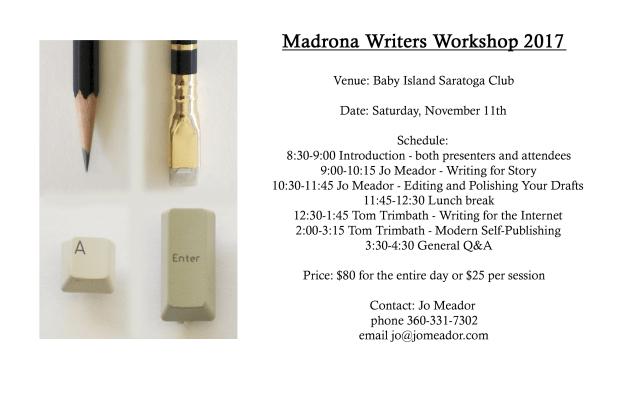
I am one of the guilty ones. I teach classes about social media. Social media is a great enabler that doesn’t charge, significantly expands a network and community, and helps people and ideas reach further. I don’t advocate promoting ads. The extra reach seems to reach a random set of people, regardless of the filters. I do advocate using Facebook, Twitter, LinkedIn, etc. for artists, entrepreneurs, and advocates to spread their word. The various sites reach hundreds of millions of people. (Facebook reaches billions, but there’s some doubt about many of the accounts.) It would be silly to overlook such a venue. (Side note: the next class is part of the November 11 Madrona Writers Workshop on Whidbey.) Instead of spending money promoting ads, I suggest spending time engaging with family, friends, and followers. It’s social media. Be social!

While I may be guilty of posting ads, too, I also try to do so off to the side. That’s what business pages are for. Most of my consulting, art, writing, and teaching posts are first published on Trimbath Creative Enterprises’ web site and shared to Trimbath Creative Enterprises’ Facebook page. If there’s enough interest, then I share it to my timeline where it might show up on followers’ news feeds. Now that I look at that data, I wonder whether to be a purist and only post to my business’ page, or give in and post everything to my timeline like so many others. They seem to be successful, but that also may just be part of the Facebook facade.

And then some crisis or celebration occurs. My friends amaze and impress me with their response. I’ve seen support groups form before an accident victim has gotten home. Power outages are managed by a community sharing notes, reports, and offers of help. Groups of passionate people may be too hard to organize in the real world, but can come together in a group. I frequently visit the dance community and the writing community. Someone added me to a group of Bohemians. Cool.

At least in the groups, paid ads seem to be less common. Self-promotion is a balancing act, which means there’s always someone sharing too much and others that I wish would share more. I’m not sure where I sit on that.

I’m a fan of people, which is why I’m a fan of social media. But I find myself using Facebook less and using Twitter more (@tetrimbath). Twitter has fewer ads and it is easier to sort sources to follow. LinkedIn keeps trying to be the office version of Facebook; maybe I’ll engage there more if others did, too. Reddit is a wild place with few ads, but also a site for crazy waves of comments and occasionally immoderate moderators. There are hundreds of sites. They are competing with Facebook. While it may look like none of them can become bigger than Facebook, similar things were said about IBM, until Microsoft redefined the world, and then Apple redefined it again, and now Google, and now Facebook, and now – who’s next?

Frugality is about respecting resources and personal values. It isn’t about being cheap. Frugality is about spending time and money in ways that complement an individual’s goals and interests. Facebook is free, expect for the time spent using it. From my one sample, that time is only a quarter as efficient as it was when I signed up. From that logic, it can take four times the time to receive the same effect. I don’t want to spend time that inefficiently. So, I must find other ways to use it efficiently.

Using Facebook more efficiently for me means paying less attention to the content it pushes.

I already ignore Top Stories. That’s the default, so every time I visit the site it shows me the story it thinks is the most important. Sometimes it keeps the same story up for days. Get on with it, eh?

I switch Top Stories to Most Recent to see if anything new has been happening with my friends. But, I don’t scroll down far. One great example was a report of a meteor the other night. Instead of a flash in the sky it turned into a splash in the water. I saw the post come up, jumped over to Twitter to contact the National Weather Service, USGS, and NASA to get the official story, and posted some details.

To get more efficient, I dive into the groups. Fewer ads, passionate people sharing news, and a more congenial atmosphere are attractive.

To get the best stuff, I head over to my friends’ personal and business pages. Facebook filters what it shares from them to my news feed. That just means I have to grab control back to find out about a friend’s new house, or recovery, or awesome painting.

Facebook, and all social media sites, are tools. Knowing how to use a tool best makes using the tool more successful and more fun. In the case of social media sites, the tools decide to change themselves. Every time I reach into that drawer for that tool I’m aware that I might have to use if differently, or reach for a different tool. Facebook is useful, but not as useful as before; so, I am also reaching for Twitter and LinkedIn. For now.

One of many ironies is that, soon after I publish this post I’ll share it to Facebook, LinkedIn, Google+, and Twitter. I’ll keep using them all, but not as before. They’re changing. I’ll change. And, I guess I’ll continue posting my business ads on my business page – and occasionally to my news feed and groups. Of course if you want to share those around to your news feed, well, share freely and often. Just don’t be surprised to find that we’ve all drifted over to some other site within a few years and have to play by a new set of rules.

Stay tuned.

Posted in Uncategorized | Tagged , , , , , , | 3 Comments

A Little Bit Of Help

It only took me a couple of minutes.” It would’ve taken me about half a day. Dropping my bicycle off at Bayview Bicycles was an excellent example of the value of expertise. I rode across America, so some know me as a cyclist, but my bicycle would cringe. Just because I ride it doesn’t mean I know how to take care of it, at least not efficiently. I appreciated his work and his attitude so I did the modern thing and Liked his Facebook page, and posted a short testimonial on my Timeline. (I would’ve done the same on Twitter, but the business doesn’t have an account.) It was a small gesture, but hopefully helpful. Then I saw what someone posted about me. Wow.

It can take courage to ask for help. There’s a vulnerability and an admission of being human. Being human runs counter to some people’s facades. They must project perfection because they don’t want to expose any chinks in their emotional armor. I get that way sometimes, too. But, I have finally become more comfortable acknowledging some of my ignorances and inefficiencies. That awareness saves me a lot of time. Asking for help also saves me money, eventually. It’s cost incurred in that time between now and eventually that makes me hesitate.

I can fix my bicycle. Give me enough time, the right tools, the right videos, and the right attitude, and I can eventually fix this, grease that, adjust those. I’m not efficient. I may be trained as engineer, but my expertise is in aerospace, not mechanical. I work well with orbits and airflows. My brain can understand getting gears to mesh, but my fingers and hands aren’t trained for those fine maneuverings of parts and tools. The rear rim was old enough that it was cracking. The only way to fix it was to replace it, and the bicycle is so old that any replacement wouldn’t quite fit. I took the old wheel in and let Bayview Bicycles build a new wheel and put on a new tire. I should’ve taken the rest of the bicycle, too.

When I got the new wheel (at a reasonable price and in a reasonable time), I took it home for its inaugural ride – and found that the wheel wouldn’t spin. The wheel was fine. The bicycle was fine. They just weren’t fine together. New parts on an old bicycle meant adjusting the brakes, the gears, the derailleurs, and I didn’t know what else. A while back I sold my bike work stand, which meant propping it up in the carport and trying to balance everything. A quick review of the steps involved made me realize that 1) I could do it, 2) the setup, training, adjusting, and testing would add up to a few hours, and 3) there was great opportunity for frustration. I had other ways to spend my time, and maybe even get paid for my other efforts. I took the bike and the wheel back to the shop.

One convenient thing about the shop is its location, right beside one of my frequent co-work/coffeeshop stops – Flower House Cafe beside Bayview Farm and Garden. No surprise, their landscaping is excellent. (Also the setting for one of my more popular photos.) The aromas are nice, too. It just happened that a friend asked for some help with publishing his book, so I suggested we meet there while my bike was worked on. A nice way to spend a morning.

If all works well and computers don’t crash (again) an entertaining cookbook could hit the market in time for the holidays. Stay tuned.

After the meeting I went over to check on the bicycle. It was already fixed. It was already fixed, tested, and improved. Evidently, the real work was probably done before my tea had cooled. The work was so quick that even charged by the minute it would’ve been cheap. I mentioned that I’d post a quick testimonial as thanks, and was thanked.

A few chores later I got home, booted the computer, and dropped in a few lines about my experience. Not much, but every bit helps.

Then I saw a notification. Someone had posted about me.

“SUPER QUICK UPDATE…..!” from Whidbey Island Baking Company

What goes around, comes around. Nice. And then I read and read and had to hit “See More…” because he’d written more. I wrote two lines for Bayview Bicycle. Don Scobie (Whidbey Island Baking Company) wrote 24 about how I’d helped him. I paused. I blushed. I typed Ah, shucks. And I meant it. It was an overwhelming response and greatly appreciated. A super quick update? Wow.

Screen shot 2017-10-24 at 7.13.43 PM

I help people publish their books. As a consultant, I help people pursue their projects, which means helping lots of writers on Whidbey. The island does attract artistic type and talents. It’s one reason Jo Meador and I are conducting a writers workshop on November 11. (Details) There is a joy in helping people, especially in showing them how to simplify complex tasks, and how to mutually benefit from matching talents and skills with needs. Got a question? Ask friends. Facebook and Twitter are good for that. Need more help? Ask someone with at least some experience. As it says on my web site; “A hour or a day invested well can pay in that most valuable commodity: time – and probably save some money too.”

The pleasant surprise comes from hearing how much the help is appreciated. Thank yous aren’t common enough. Some doubt their sincerity, as if thanks are followed by asks. I say thank you anyway because it makes me feel better. I forget how much they can be appreciated. We can never know the impact we have on others, but having the experience reflected back is powerful.

Someone passed along a simple insight. Librarians can truly enjoy people who ask them for help. It takes training to efficiently retrieve just the right amount and type of information. Google provides a fire hose. They provide a finely decanted glass of clear water. I enjoy helping people with their projects, and enjoy listening long enough to hear how best to help, and then seeing that help truly help. Evidently, I helped today. And, I received help today. Instead of frustration, I experienced a freedom. A working bicycle is more than a couple of wheels. It is transportation, recreation, a stout backup in emergency situations – and in my case – a reminder of a life-changing event. My bicycle is fixed. Thank you.

Posted in Uncategorized | Tagged , , , , , , , , , , , , , , | 1 Comment

South Whidbey Does It Again

If you were here, you couldn’t hear my grin and you probably couldn’t hear my soft chuckle. South Whidbey did it again. “We” made it to a finalist of a top ten list. This time, it’s Reader’s Digest’s Nicest Places in America. Shh. We’re not supposed to tell anyone. And yet, we do and will, just like any other community with a bit of pride. What’s that worth?

My chuckle was partly celebratory and partly watching a familiar event. It’s good to get on the lists, and worth celebrating. My chuckle comes from a few caveats that I’ll mention here to get them out of the way.

South Whidbey isn’t an island. Whidbey Island is an island, but being dozens of miles long (depending on whether you measure by top to bottom latitude or along the “highway”) means the north and the south are significantly different. Does that sound like a throwback? Playful debates draw a border line at either a few miles south of the Navy facilities, down by a farm that was turned into an art and tourism venue, or a solitary phone booth that offers free local phone calls and that looks like a border post. But, just like most areas, borders are more porous. There are Navy personnel, tourists, commuters, and retirees both north and south. The folks in the middle must have a blast laughing at the two fictional halves.

“We” didn’t make it to the list. That takes the effort of a proactive individual. This time I think it was Susan Knickerbocker who nominated us. “We” do define the culture by living it, but credit goes to the person who mentioned our name. Gotta show the love, all around. Of course, being appreciative is part of living here. It’s hard not to see beauty in such a natural setting.

Whidbey is in the same situation Seattle was when I moved there in 1980. The country made fun of the city and its rain, but the locals knew better. Some make fun of Whidbey because it is “out there” geographically and culturally, but that’s where our fun comes from.

I’ve lived in a few places in America, bicycled across the country in 2000/2001, and like talking to visitors. One common thread that comes through is that every place has someone that thinks it is the best. If they didn’t, there’d be a lot more ghost towns. From what I can tell, most ghost towns are ghosting from economics, not desire.

Five Times Twelve

I like the entire island enough that I produced a five year photo essay of it. Five one-year essays, each year a different place, from top (Deception Pass) to the bottom (Cultus Bay, my neighborhood), with three places in between (Penn Cove, Admiralty Head, Double Bluff.) And that was just picking from the (mostly) public venues. Private estates have views worthy of national attention. (Want more? Check out Two Guys Walk Around Langley, and Two Guys Walk Around Coupeville.)

The beauty draws tourists here, but the culture draws residents. The beauty helps, but I’ve noticed that the people who move here do so intentionally. That could seem obvious, but islands have natural barriers that must be consciously crossed. A few weeks ago I was being interviewed for a rare and appealing island job. I didn’t get it (overqualified, evidently). The interview turned into a discussion about the island, particularly getting people to organize for a common non-profit purpose. There was that grin again. I’ve been a consultant for many creative and innovative people who’ve moved to the island. They came here because the culture was open enough to let people live the way they want to live. They didn’t come here to conform, but to fit in with a community of tolerance and a fair amount of freedom. They came here to be individuals, not to give up their individuality. It makes for an interesting culture that isn’t always organized, except when it excels at it.

The article does a good job of describing the various social ventures supporting food, housing, health, education, the arts, and generally living as a community. Pick your cause, and be careful you aren’t overwhelmed with opportunity. When I moved here I was semi-retired. (See My Triple Whammy for how that was upset.) Within a couple of years I was volunteering 32 hours a week. Eep! And enjoying it. Yay!

The island does have its problems. Affordability is becoming an issue in something I’m calling the Aspenization of the island. The economy has great potential, but is too dependent on tourism for the south and the military for the north. Seattle’s hyper-growth may begin to wash onto our shores, or burst, or redefine the region akin to the Bay Area or Vancouver, BC. We have limits to growth that some see as defenses and others see as defects. Water is from local aquifers, and therefore hard to plan around, but can be sweet. Power comes across cables that stretch across treacherous waters at the far north end of the island, handy but uncertain. There are few sewers and more of a reliance on septic systems, which means some lots can’t be built on which means more open space. And, getting on and off the island is either via one of two ferries or across an impressive and narrow two lane bridge. But, maybe that’s why we can tell folks about the place. They can visit, but it’s tough for them to stay – hence the tourist economy.

Toss that umbrella. Live like a local. Wear a hat.

The power was out this morning. The first wind storm of autumn came through and knocked trees into lines, as usual. Some streets were so covered with branches that it was hard to find the pavement. Instead of hunkering down, people began posting information about roads, outages, forecasts, and offers of help. My power came back on early, but I decided to work from the tourist town of Langley just because it was a Tuesday. A common greeting was, “Good morning. Got power? Where do you live?” People helping people.

Several years ago a mainland friend wanted to see my place. I drove us from the ferry to my house. As we stepped onto the deck they stopped. There was a bunny in my yard! Grin. “Only one?” Then, I turned to step inside the house and simply opened the door. They stopped again, honestly surprised that I hadn’t locked it. They couldn’t imagine living such a life. They thought it was just stories. Their life in the city was completely different. Maybe we should tell people that there are alternatives and options. Thanks again, to Susan Knickerbocker for nominating South Whidbey.

As for other places, a friend just moved from a dense part of Seattle to the outskirts of another retirement community called Sequim. We talked the morning he moved in. It was about 9AM. He’d already seen five cars that morning. That was fewer than he’d see in one change of the red light at his old place, but he hadn’t expected to see so many. Then, he rationalized the traffic because it was a Sunday morning. I corrected him. It was Monday. That was the morning rush hour. I think he’ll adjust.

There are places out there. Maybe they won’t make a top ten list, but they may be worth a look, anyway. In the meantime, here’s a video from my morning rush hour the other day. One bunny? Nah. (Look for the miniature appaloosa.)

Posted in Uncategorized | Tagged , , , , , , , , , , , , , , , , , , , , | Leave a comment

MicroVision Timeline Towards Overnight Success

Overnight successes rarely happen overnight, unless a lottery ticket purchase hits the timing and the numbers just right. Investing in startup companies rarely results in overnight successes. If the company or the stock or both are in demand, then they’re already succeeding and some of the impressive initial gains have been missed. Overnight success has more to do with public perception. News articles may splash around headlines as tweets go viral and products sell out, but those familiar with the company may breathe sighs of relief rather than shouts and celebrations. Until the news hit and the sales surged, management, employees, and shareholders couldn’t be sure when or if success would ever happen. That’s where it seems that MicroVision is now. I wonder how many of my entrepreneurial friends are in a similar situation.

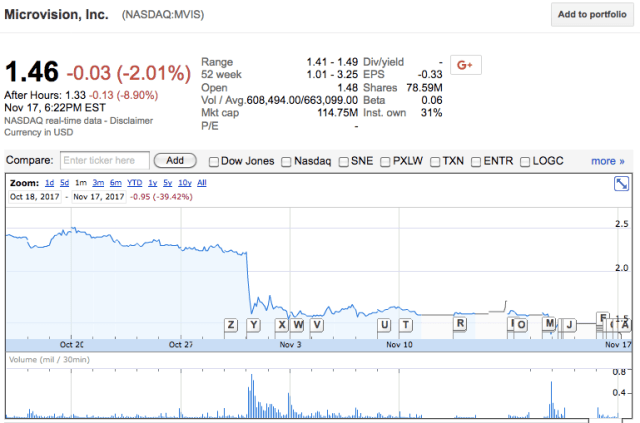
MicroVision and its stock (MVIS) haven’t provided financial benefits for me, though they have certainly provided more than enough stories. I heavily filter what I post here because, even with all of those stories, I don’t want to bore you, and there’s very little quantitative progress. If you want to read more, I recommend the various discussion boards (Motley Fool, Investor Village, Silicon Investor, reddit, etc.) or blogs like Peter Jungmann’s. They’re devoted to the company and the stock much more than I am. One of the familiar refrains in the almost twenty years that I’ve owned the stock has been; “This will be great, as soon as they have their first real product.” That makes sense. It’s hard to succeed without a product. It does happen, but not for MicroVision, yet.

The hope is that MicroVision will finally be involved in a product that succeeds well enough to make the company and the stock a success. “Hope” is not an investment strategy. “Finally” doesn’t exactly have a date associated with it. And success is subjective.

Recent shareholders may consider the stock to be a success because it has doubled in the last year or so. Long time investors like me thought the stock looked good every time we bought it; otherwise, why buy it? I bought my first shares during the Internet bubble. MicroVision isn’t a dotcom, but it was caught up in the irrational exuberance. The stock was a hundred times higher, then. My hopes are that high, but my expectations have been lowered by time and dilution. (A Study In Dilution MVIS) In 2012, the stock had a reverse split, one share for every eight owned. They did that to avoid delisting. One way to avoid delisting is to keep the share price above $5. My benchmark is that $5 mark times the eight-fold change required to reach that old threshold. Just getting back to that point is about a sixteen-fold increase. Others would cheer, as would I, but I’d also know MVIS wouldn’t have been a good investment for me because of the cost of time and money. Get the stock back up to one hundred times today’s $2.59 and then I consider re-retiring.

What’s going to make that happen? What’s happened in the meantime?

For the last few years I’ve maintained a chart showing some of the company’s confirmed and potential products. Each has the potential to be that catalyst that creates MicroVision’s overnight success. Each has passed by without moving the stock to those previous levels. The chart was getting unwieldy, so I hoped to find another way to build and maintain it. Thanks to one of my major clients (the History of Computing in Learning and Education Virtual Museum) I came across a timeline generator that was much nicer.

Neat ideas can take more time than expected. Thanks to a redditor, I had a much more comprehensive list of MicroVision’s products. Open the timeline template, dump in the data, rearrange the data, decide some of it could be improved, and generally spend hours of free time chasing down SEC filings, company press releases, and discussion board posts to arrive at something that is unofficial and inaccurate but better than what I had.

Those hours weren’t wasted. To many, it seems that MicroVision has yet to have a major product, or a major partner, or a major success. I was surprised to find that MicroVision released their first product near the beginning of 2002. With very few gaps, they’ve had something to sell, or something one of their customers was selling for over fifteen years. None have been viral successes, but they keep trying. And, they’re trying with partners like Sony, Sharp, Pioneer, Lenovo, etc. No wonder I’ve been hopeful for so long, and so tired of waiting.

Here’s a link to the chart. I’ll see if I can embed it, too.

This may be the nature of an overnight success, lots of activity that doesn’t catch everyone’s attention – until it does. At this point, patience is thin, the stock is a bad topic of conversation for some, and each day I look at it, I see those years of missed opportunities for me and the company.

And then I wonder. Is the same thing happening with me? I could fill a similar timeline with entries from every aspect of the incredibly short version of my resume: Consultant, Writer, Speaker, Teacher, Photographer, Engineer, Entrepreneur, etc. – a list so long that, yet again, I missed out on a job because I was overqualified. Is the same thing happening to many of my friends? They’re working hard, trying various business models, losing patience, and struggling to get by. Which idea or gig will finally let them succeed and break free?

There’s no guarantee for MicroVision, other startups, me, or my friends. That doesn’t mean we stop trying. Humans are amazingly resilient. We prove that by persisting.

In the meantime, we work hard, try to find a balance or at least not step too far away from it, and hope and wait, and wonder. Success? When it happens, it may seem like it happened overnight.

Posted in Uncategorized | Tagged , , , , , , , , , , , , , , , , | Leave a comment

Minimalism Meets Emergency Preparedness

Best Used By 09092009. Ah, I guess it has been sitting in my pantry longer than I thought. A couple of chores were on my mind this weekend: cleaning out the pantry, and pondering emergency preparedness. There’s an overlap. The news from Harvey, Irma, and Maria convinced me to check my emergency preparedness, again. The minimalist in me was inspired by giving away an old CD player that I hadn’t used in years. What to keep and what to get rid of gets asked in both cases. Will I ever use fill-in-the-blank? Would I wish I had it if I was cut off like the people hit by hurricanes, wildfires, or our inevitable earthquakes? A box of Saltines from about a decade ago was a reminder that there are limits. Judgment calls happen.

The island’s friendly version of craigslist, drewslist, offers lots of ways to trade, sell, buy, and generally keep a community together and communicating. Besides the Jobs listings (overqualified, again, sigh), my favorite category is Free. I’ve given away several things. Whether through drewslist or just through neighbors and friends, I’ve acquired enough goodies to grow a garden, fix a few things, and ease that retail itch. One of the listings was from someone who was partway through a book on tape, really a book on CD, whose player died. They wanted a free replacement so they could finish the book. I realized I had one from about twenty years ago. The charger was gone, but it worked well on batteries. Evidently, I wasn’t using it. Here you go. Go for it. And whoosh, another episode in decluttering transpired.

This is the season for sitting down with mail order (really online) catalogs and dream shopping before the holidays. I’m just as likely to wander around the house looking for things I haven’t touched and always overlook. There’s always something that should find a new home, get repurposed, or head to the land fill. Less clutter in the house means less clutter in the head, or at least fewer distractions.

Rummaging around the cabinet over the refrigerator I, once again, maneuvered around some old cracker boxes. For more reasons than I’m going to get into here, I accidentally went gluten-free years ago. Saltines and Ritz were great when I made lots of soups with noodles, but those crackers have wheat and my doctor has turned me away from the grains that go into noodles. Pull down the boxes and look at the dates. If the Best By date was 2009, the food was probably packaged years before. How much of my pantry would I have to eat through before I was willing to break into food that was over ten years old and made from something that gives me mood crashes? The answer: a very long time. Then, I thought about Puerto Rico and stored the crackers in my outdoor emergency food cache.

The folks in Puerto Rico are in terrible conditions. That was true even before the hurricane hit. Their economy has been trashed, and vulture funds were taking control. John Oliver has a great video about it from last year, which echoes amazingly after Hurricane Maria. Federal aid is arriving, but two weeks after the winds died down. The response isn’t enough considering the impact on the people. About 3.5 million people on the island are affected. As if that lack of response isn’t bad enough, the outer islands are even less likely to be noticed.

The Seattle area has about 3.5 million people. Our most likely disasters don’t benefit from weather forecasts. Whether from the off-shore subduction zones, inland fault lines, or volcanoes, people around the Salish Sea have to be prepared for unexpected and major natural disasters. The guideline of having enough food and water for three days keeps extending. I don’t know what the official guideline is now, but I do know that the experiences in New Orleans (Katrina), Long Island (Sandy), Houston (Harvey), Miami (Irma), and Puerto Rico (Maria) have convinced me that it is best to plan for weeks and maybe months, not days. If a major quake hit Seattle the world’s news media would focus on the Space Needle and anything that fell down. Aid would probably concentrate on the ports and radiate out from there because the mountain passes may be impassable and railroads interrupted. By the time someone got to my house the news would probably be talking about someone else’s disaster. (If you want to really want to geek out on the impact of an earthquake on the Seattle area, watch Nick Zentner’s video from Central Washington University. Want something lighter? Check out my post on Seattle.Curbed.com)

Considering how difficult it was for Puerto Rico to get economic help before the hurricane and logistical support after the hurricane, I’m surprised they have just decided to declare independence because evidently they can’t depend on their government.

Of course Seattle wouldn’t be ignored, even though we are far from DC (even further than Puerto Rico is), have ticked off the administration by being inclusive and a sanctuary city, and don’t have Trump Tower that I know of. If we were so ignored, calls for Cascadia would be stronger and reach farther – after communications were re-established.

I didn’t totally audit my earthquake kit like I did a couple of years ago. I did, however, refill the backup propane tank for the BBQ, am glad I got some firewood (and would like to get more), and picked up some extra heavy plastic sheeting and tape, just in case. I also opened the emergency food cache (just an old metal Coleman cooler left in the carport), and checked for mold and such. Weird as they may be, some of those mystery meats and cheeses I got for Christmas keep better than I expected – and I expect I’ll put something a bit fresher in there after another grocery run.

Some preppers look forward to disasters so they can play, er, exercise their preparations. I’d look forward to some great excuses to take time off – except that I know that people in such situations work until they fall asleep, and then work again. Repeat as necessary.

The statistic I saw for preparedness is roughly a four-to-one return. Every dollar spent on preparedness avoids four dollars of repair. That’s an average. If $100 in reinforcements keeps a wall from falling down, then tens of thousands can be saved. If $100 of emergency supplies means not having to wait for supplies, then life returns to normal much more quickly. Time is more precious than money, especially if a bit of effort leads to a longer life.

I don’t know if my preparations are enough. No one ever knows, not even preppers. I do know that being a minimalist means there are fewer things that I’m worried about, fewer things to take care of and replace, and more time and money in the meantime. As for those crackers, well, even if I don’t eat them, they have a a value as a science experiment.

Posted in Uncategorized | Tagged , , , , , , , , , , , | 1 Comment

Playing Is Hard

Stop me before I play again. That’s the feeling I hear echoed from several successful friends. They continue to accomplish and succeed because they’re good; but also beause they’re afraid to be seen as slacking off, or worse, finding that they can’t get started after they stop. I hear that echo in my head, too. Playing can be hard. Gotta work on that.

The concept can sound unnatural to those who figured out how to play before they went to kindergarten. Playing is easy. Get in touch with your inner child? Most have no need. Their inner child has great access to life and living. They’ve been practicing all of their lives. It is so ingrained that it takes as much thought as breathing. Some play so well that they have to be reminded to work. That’s not a bad situation – as long as they play nice and can pay their bills.

Two people in particular come to mind. Both have decades of life experiences and great stories to tell. Both are passionate. Both are stressed out from trying to get work done, and from taking care of others at the same time. When you see how much work needs to be done in the world, guilt is ready to step in if there’s any hesitation in the effort. Especially in America, it can be hard to prioritize play, to be self-indulgent occasionally.

I know the feeling. A few months ago I started taking a day off almost every week. Great! Play time! Ha! After a few years of working seven days a week, frequently 10-12 hours a day, I’ve found it difficult to disconnect with work and reconnect with the rest of life. I’m in a better financial situation than about half of Americans, and I can only pay all of my bills by exercising the credit card at tax time, and deferring lots of repairs. Unwinding after six days of work takes more than a day. Unfortunately, that means a week needs another day or two. Imagine what it is like for those who aren’t in as comfortable of a situation. Stress becomes a constant, and the current culture doesn’t provide much relief. No wonder people are upset and angry. If they had more free time they might even be able to do something about it politically, but that wouldn’t be playing.

When I dance, I smile. I’m lucky. I realized that a few years ago. Have a tough day. Grumble my way to the dance floor, and then laugh at myself as moving to the music makes me smile. For the typical three minutes of a song, there’s no past or future, just finding the flow that moves the dance and the dancers. There’s not enough time to do anything else. I’ve been asked to teach dance, but dancing was the first thing I found that was guilt-free play. I don’t want to turn it into work.

Coincidentally, the two people I talked to this week also find that music helps. Almost as a confession, each revealed their desire to sing. It was a guilty pleasure that they can indulge in that costs little, leaves no trace, and which they can control and access anytime. But, they aren’t comfortable giving it more time.

They are so globally aware that they have difficulty deciding to treat themselves while hurricanes, firestorms, and earthquakes are affecting friends and fellow humans.

I finished most of my work this afternoon. It was a sweet autumn Saturday, one of the last days for farmers markets, easy bicycle rides, and enjoying dinner as the sun is eclipsed by the horizon. There were about a half a dozen work items today. Between a few, I snuck in a computer game (Civilization III). Guilty? Guilty. Out of hours of work on a Saturday, I carved out about an hour of play time. The optimizer in me knows that time would’ve been better spent applying for jobs, advertising a writers workshop, or rearranging my desk. Even if I wanted to grant myself time to away from work, I could’ve meditated, gone for a run, (I actually did practice karate for a while), or even just sit on the deck for a few minutes. Instead, I played a game on a computer, as if I hadn’t already spent too much time working with keyboard and mouse. But now, I’m finally recognizing it as play, and not just a diversion.

There are probably plenty of self-help books, seminars, and coaches to help us foreigners to the work of play. That’s help that comes from the outside. I suspect the best help comes from inside. Be your own authority figure. Grant yourself the opportunity to play. The first step may be playing with the idea of what play looks like for someone more than fifty years past kindergarten.

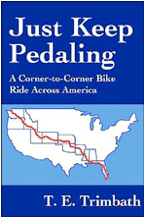
I’ve ridden my bicycle across America, been glad I did, and not felt a wave of celebration as I crossed my arbitrary finish line (which happened to be at Key West, right after a hurricane blew through. Echoes.) I had the same reaction when I finally made it to the train station in Aberdeen after walking across Scotland, glad I did it, but didn’t have the internal equivalent of a colorful buntings and a brass band. (Check out the books inspired by each – Just Keep Pedaling, Walking Thinking Drinking Across Scotland.)

Between those two events was a time when I worked with a counselor as I navigated me and my emotions through a divorce. It was enlightening and refreshing to hear a professional tell me that my reaction made sense because I’d never learned how to play. I was raised for success. Get the right grades. Get the right degree. Get the right job. Build the right network. Do what everyone else expected. It was a long line of “shoulds”. It was just assumed that I’d learn how to play. Playing in my neighborhood included a strong chance of being beat up. For me, that was physical. For others who haven’t learned to play, they’ve told stories that were more emotional or financial. I retreated into books, and even read the encyclopedia (something harder to do, now.) They had other safe and serious retreats.

There is a frugal aspect to play. Frugality is about respecting resources. That’s usually described as respecting things like money and time. Take it a level deeper and respect the self. Humans are meant to be multi-dimensional, more than just workers, more than only living a life of servitude. We’re social, silly, incredibly imperfect, trying to navigate a chaotic world, and are foolish if we believe we can control everything and that luck doesn’t get involved.

Playing can be hard. But I’ve found play that lives outside others “shoulds”. I should enjoy watching sports, but I’d rather go for a jog than watch a professional athlete. I should enjoy music, but not if I have to sit still through it. I should enjoy reading books, and I do, but I also enjoy writing. It’s now late Saturday night. I spent about an hour writing this blog. That may not seem like fun to many, and it’s not like I’m sitting here laughing while I do it, but I’ve finally realized that writing is playing with words. If it helps others, great; but I know I do it from a sense of play, a freedom to express myself as if no one was watching or reading.

If you’re struggling with finding play, don’t be surprised you’re not alone. As silly as it sounds, successful folks who drive their lives through to-do lists and action items may just have to include another task and give it a high priority: play with play. It may be hard, but it is valuable and fun – eventually.

Posted in Uncategorized | Tagged , , , , , , , , , | Leave a comment

Lines In The Water 2017

How many lines do you have in the water? Folks in the Gig Economy have several, and then toss in crab pots, and rent a boat – anything to bring in the next gig. The phrase came back again while talking to a friend this weekend. He pointed out that I’ve probably never had so many lines in the water. I’m not the only one, but there has been a recent surge thanks to a few opportunities. Opportunities are great, but until they are realized, they are sources of consideration and sometimes consternation. The Gig Economy has great opportunities, but that also means don’t be surprised if the need for a day away from it all is that much stronger.

Entrepreneurs are familiar with tending lots of lines. A different friend told me about finally getting his web site working just right. Getting dozens of leads every day is great! Turning enough of those leads into revenue streams is harder. Which ones to pursue? Which ones to encourage? Which ones to ignore for a while? They may be called leads or opportunities, but they are people. People are logical and emotional, rational and irrational, have plans and are frequently disrupted by things out of their control. Welcome to the guessing game that is modern commerce.

Life is random, despite our attempts at plans. Several years ago I wrote about having several Lines In The Water. Some of the lines have been reeled in. Others have been productive. The most enticing ones are regularly reeled in, freshened, and cast back out hoping to make that connection. Plans are great. The most useful ones are written in pencil. Good and bad luck, however, can trump them.

Listen to biographies and autobiographies. Few successes happen without some mention of good luck. Being in the right place at the right time with the right people and the right resources is hard to arrange on purpose. Anyone who goes to that much effort can be seen as controlling, something many people avoid. A plan can set the right direction. Effort adds energy and builds experience. Networking broadens the awareness of skills and talents while also increasing the possibility of connecting with wants and needs.

It isn’t socially acceptable to give all the credit to good luck, unless it’s from winning the lottery jackpot; and even there, a ticket had to be bought. Giving credit to good luck is seen as self-effacing or humble-bragging.

It isn’t socially acceptable to give all the blame to bad luck, even though we read stories about one illness, one accident, one mis-spoken gesture or phrase that ruined lives and careers.

And yet, it does seem like some people have all the luck. Lucky them.

Lines in the water is another strategy based on diversification. Especially in the Gig Economy, diversification is powerful. Gigs aren’t permanent. Gigs are probably part-time. If a gig isn’t enough to pay all of the bills, other gigs are necessary. Even if a gig is profitable enough, its lack of stability means it is prudent to have another gig ready.

Fortunately, a few gigs and a few paycheck jobs have been added to my lines in the water. It is all good. All seem to be reasonably good matches to my skills and talents and their needs and wants, hopefully with sufficient benefit to both sides. There are no guarantees, which is why so much time has been spent tending the opportunities. Which is also why my brain ran out of energy Saturday afternoon.

The good news is that I can finally give myself a day off every week. I needed it. Sunday morning was a small breakfast followed by some laundry, and playing a game. Sunday afternoon was spent reading a book, taking a nap, and feeling guilty every twenty minutes. Sunday evening started with dinner and sneaking in a bit of work that worked as guilt relief as well as training for a possible new gig. I’ll finish this, and make sure I make time for a movie and some popcorn. Monday is only hours away.

The Gig Economy is new, or at least the title is. Entrepreneurs have been working such lines for centuries. Real estate agents, retail shop owners, anyone who relies on an unsteady stream of work is familiar with managing uncertainty. Over on another of my blogs (PretendingNotToPanic.com) is an article about the growth of the Gig Economy. While the concept is old, and the name is young, the data show that much of the improvement in employment (~94%) has been in the Gig Economy. As this trend continues, our economy, financial institutions, and lifestyles will continue to shift. Adaption is necessary.

With no surprise, adaptation at a personal level is happening faster than adaptation at a governmental level. Financial models, personal finance wisdom, and basic services are already changing because basic human needs must be met now. People can’t wait for legislation.

If you’re working in the Gig Economy and feel out of sync with institutions, don’t be surprised. You’re ahead of them. They’re following you. If you know people in the Gig Economy and they’re not listening to your advice, it may be because your advice is, or was, fine for a different era.

One thing remains a constant. Each person has limits that must be respected. I understand that sometimes it is necessary to work seven days a week, 10-14 hours a day. Advice is great – as long as you can pay your bills. Occasionally, though, take a day, let the lines in the water rest, and rest yourself. Practice playing, even if it feels a little guilty.

Posted in Uncategorized | Tagged , , , , , , , , | Leave a comment

Fresh Idea Passive Pump Flipped

Take that idea and flip it around. Thomas Edison (an inventor with a great first name) wasn’t the first inventor to find a way to record sounds. He was, however, the first one to find a way to play them back. Earlier inventors managed the first part, but not the second. I can appreciate their situation. My air mattress has a slow leak. It almost lets me sleep through the night, but eventually my butt hits the floor. I wake wrapped on either side by the remaining inflated sections. My workaround has been to turn on the pump for a few minutes while I take my inevitable middle of the night bathroom break. There must be a better and quieter way to pump in air about as fast as it leaks out. And, I think I found it in one of my other inventions. All I have to do is flip the idea around. Oh yeah, and prove that it works, first.

I guess I’m an inventor. I have a patent (thanks to Boeing) for an idea I developed while working on the aerodynamic control of a supersonic transport. Anyone can be an inventor because anyone can have a fresh idea. Making it work and getting the government to issue a patent for it is a lot more work. It’s like the difference between having a great idea for a novel and actually writing it, editing it, formatting it, publishing it, marketing it, and selling it. (If you want hints on how to pursue your inventions, check out Alan Beckley’s blog.)

I enjoy inventing so much that it got me in trouble at Boeing. A group of us were developing a new kind of airplane. The legal types playfully chastised us for not submitting inventions on an airplane that couldn’t fly without them. So, in three months I helped invent ten things. I was told that I “was too comfortable with new ideas.” So much for American innovation.

Just because I’ve turned into a consultant, writer, and artist doesn’t stop the inventive mind. Browse through this blog for several Fresh Ideas. Whether any of them are practical or marketable is a question to be answered when I finally have the time, money, and inclination to pursue them.

One in particular continues to intrigue me. The Passive Pump relies on Brownian motion and nano-manufacturing to create a vacuum pump that could passively remove the air and gas from a container. If successful, it could make it easier to store and ship perishable items like food and medicines to regions were electricity is unreliable or expensive. Disaster zones come to mind. I came up with the idea in 2005, wrote about it in 2012, and have watched some interesting traffic to the blog post over the years. If someone is developing it for humanitarian purposes, great! Give me a call. If someone is developing it for commercial purposes, great! as long as I am properly compensated.

Some of you have jumped ahead. It’s a pump. It can work both ways. That thought didn’t arrive until this afternoon while I was getting ready to put the air mattress away for the season. (I sleep on it during hot summer nights because it and the room it is in are cooler than my normal sleeping arrangement, my living room couch. If you want to know what happened to the bed, read Minimalism Meets A Carport Sale.)

The idea is simple. A patch or panel is built into anything that needs to be inflated or deflated. The patch or panel has numerous microscopic flaps in it that only let air flow in one direction. Make the flaps small enough and Brownian motion may, may, be sufficient to let the more energetic molecules pass. Give it enough time and one side will have a higher pressure than the other without requiring any energy source.

I don’t know if it will work, but I do know how I’d test it and develop it. The manufacturing technologies exist. Let me check those lottery tickets again to see if I can afford the fab and lab time.

Want more engineering details than I’m going to put in a blog? Schedule a meeting.

A recent saying in Silicon Valley is “If you want to make a billion dollars, create something that improves a billion lives.” That isn’t my motivation, but I could use the money; and this idea does have that potential.

Flipping ideas is not limited to inventions. It is rarely as obvious as realizing that you’re using the wrong end of a hammer; but it is as common as pulling when you should push. In karate, opposing the flow isn’t as effective as moving with it while redirecting it.

It can be hard to see it for yourself. One of the things I do as a consultant is to watch and listen for struggles that can be turned into energy sources, for negatives that can be turned into positives by flipping a perspective.

It is easy to overthink thoughts. Thinking things through is a good idea, but don’t be surprised if that flipped perspective effortlessly reveals a solution. It may just take a fresh look at an old fresh idea. If Thomas Young had flipped his idea for recording sound in 1807, we would’ve had recorded music seventy years earlier, and maybe that Thomas would be just as well known.

Posted in Fresh Ideas | Tagged , , , , , , , , , , | 1 Comment

Laboring on Labor Day

It’s been a busy weekend, here in the Gig Economy. The good news is that I’ve had enough work to fill the days. The other good news is that I’ve had enough work to fill a good part of Labor Day. That could also be seen as bad news. One reply on Twitter pointed out that I should maintain balance by not working on the holiday. Ah, I look forward to the days when I can afford such luxuries. In the meantime, I work when work is available (with an occasional day off). I’m also about to get much busier finding other ways to fund the funds to finance my life. Life in the Gig Economy works to a different calendar, a different schedule, and with different holidays.

A bit of clarification. Labor Day suffers from the same fate as many US holidays. It was designated for one reason that we eventually reinterpret. Labor Day isn’t about celebrating laborers. Labor Day is about celebrating labor unions.

Labor history was a bigger part of my education than most, I expect. I was raised outside Pittsburgh just a few miles from several mills. My Dad’s career developed from his life as a trucker. His Dad was a miner. I worked in a steel mill, and was required to be a member of the United Steelworkers of America (though they may have changed their name by now.) My Dad was a shop steward in the Teamsters. His Dad could’ve been in the United Mine Workers, but by he died by the time I got old enough to ask about such things. It wasn’t until I was an adult that I realized the songs I learned in grade school were union songs about solidarity and the struggle against power. So much for Mary Had a Little Lamb. How about Sixteen Tons and being trapped by debt in a dangerous job? Great songs for kids.

I saw both sides of the union versus corporation battle.

The site of the Homestead Massacre was only a few miles from our home. Knowing my Dad’s work schedule was proof of how hard some people had to work. Visits to my Granddad’s hometown were proof that good, hard work wasn’t a guarantee of an eventual good and easy retirement.

I was also threatened in the mill by other workers because I worked too hard. My Dad told a story about trying to deliver home heating oil during a deep-freeze, but had to talk his way past a fellow union member who pointed a shotgun at his head when my Dad tried opening the gate to the depot. He delivered the fuel eventually. Just a few miles from my Granddad’s home, rival factions within the miner’s union killed one of the union officials and his family.

I thought I left all of that behind when I moved to Seattle to be an engineer at Boeing. There, the engineers’ union was active and trying to gain the respect of the corporation. When I hesitated to join the union, I was threatened. The threats convinced me to never join. (They said they’d slash my tires. That wasn’t much of a threat. I lived close enough that I walked to work. Maybe they’d slash my sneakers.)

Union versus corporation is one of those battles that I don’t engage in because I’ve seen too many sides of it to be fully in either philosophy. It seems to me that abuse of power is the issue, and that sometimes laborers have to organize to generate enough power to negotiate, which has resulted in some great social advances, but which has also resulted in some great abuses and injustices, too.

There is talk within the Gig Economy of the need to unionize. I can certainly see the benefit, but I can also see the difficulties. Previous unions were built around mill towns, ports, mining towns, farms, and other industry centers. Need to gather a crowd? They’re all in one place. The Gig Economy is decentralized. That is one of its strengths and freedoms, but it is also one of its weaknesses. A coal mine needed miners who lived by the mine. An online business needs workers who have access to a computer and the internet. Instead of having a few hundred people to pick from, modern businesses rely on millions of workers willing to do jobs for free or for very small fees. If a few stop work in one country, just as many are available in a few seconds from somewhere else.

One reality of the Gig Economy is that, when the work shows up, it needs workers who are ready now, not later. The work defines the schedule. The schedule defines peoples’ lives. Weekends and holidays are simply anachronisms on the calendar. To those who are practiced at it, the flexibility is natural. Expecting to only work on proscribed days is quaint.

The uncertain nature of the work is an incentive for some to organize. It is also an incentive for me to explore other options. Irregular work makes it hard to make regular payments. This weekend’s work included some rough patches. People are stressed. Some of the stress is financial. Some is based on overload. Put the two together and don’t be surprised if people aren’t relaxed and the work stumbles instead of flows.

After a particularly tough bit of news today, I decided to get more proactive. Thanks to my network, several appealing opportunities have been suggested, but none have made a commitment. It was time to check their status. Some other jobs have opened on the island. Time to refresh and customize the resume, yet again. If that’s not enough, I’ve decided to start taking classes again, though I haven’t decided which ones, yet. Programming, to leverage my geezer geek skills from my FORTRAN days? Math, because it is a comfort zone and also a possible entry into finance? I joke about embarrassing myself in German, Japanese, and Russian; but I think those hurdles are too high to jump. And then there are the conventional careers that have always had some elements of the Gig Economy: real estate, appraiser, etc. Training is required there, too. Pragmatically, I have to balance time and money more than interest and familiarity.

There’s a rush order due tomorrow. I don’t know if they need my help. I hope so. I could use the money, and it is work I am comfortable with. If not, it might be a good day to take advantage of the fact that I don’t have any other commitments scheduled. Maybe I’ll take the day off to consider my options, to consult with myself for myself. I could use the day off. Maybe I’ll call it a holiday.

In the meantime, at least I got to watch a fiery sunset because I worked from home.

Posted in Uncategorized | Tagged , , , , , , , , , | 1 Comment

Nap Time

A guilty pleasure, taking a nap after lunch. Working from home has its benefits. It may be flashbacks to kindergarten. It may be healthy adult behavior. Whatever. I tried taking a nap a few days ago and failed. Instead of sleeping, inspiration took over. I now have the first few lines to my first book of fiction. It looks like story time will be taking on a new meaning.

We make fun of silly little rituals. Kids should take a nap, and maybe get the modern equivalent of milk and cookies later in the afternoon. Siestas sound lazy, but they may also be the key to making work less dreary, the mind more creative, and life more enjoyable. The British tea time sounds like an anachronism, yet I recall a study that suggested 3pm-4pm was the best time of the day for enjoying caffeine.

My main indoctrination into break times within workdays was at Boeing. I worked in a steel mill before that, but those break times didn’t leave much of an impression. That probably had to do with 100F temperatures in the mill and a rough and rude behavior by too many (but not all) of the guys in the air conditioned break room. The Hustler posters weren’t my style.

Boeing was much more gentile, and at least more relaxed about engineers taking breaks as needed. Maybe it was because the company wanted to encourage caffeine consumption and its energetic consequences. Lunch hour, however, was a bit different. Mine was typically from 11:30-12:10. Do the math. That hour was over in forty minutes. At lunch I’d revert to introvert mode. Rather than play bridge while eating a sandwich, I’d retreat to my car. Boeing’s commercial airplane plants are big. It took ten minutes to get to the car, and ten minutes to get back. That left twenty minutes for lunch and a nap. Divide it in two and find a “lunch hour” that was split into four ten-minute segments. I still tend to get hungry at 11:30, and I left that job nineteen years ago. Friends are surprised that I will excuse myself for a nap, and come back ten minutes later, refreshed. Very handy, even it is only a few minutes with the seat reclined in the truck.

It doesn’t always work that way. Thoughts about work and money, or aches and pains, or the state of the world can make it hard to sleep. Even then, though, I take the time to at least give my digestive system time to do its job unencumbered by other tasks.

I’ve had an idea for a sci-fi novel for several years. Like many ideas, it is hard to know when the first inspiration hit, but there is a milestone. I thought of the idea a year or two before I saw a painting that looked remarkably like one of the main characters. Someday I’ll ask that painter for the history of that painting. Maybe it can become the cover, if they agree.

I won’t go into details. I learned that from some of my previous non-fiction books. (It’s a bit early, but here’s the list for your holiday shopping.) The more I told people about the details, the more they encouraged me, and the less likely they were to read the book. They already knew what was in it. Why buy it? (Because the story is in the telling, not just in the title.)

Years ago I developed the background technology, sociology, logistics, ecology, and history of the main characters. That’s a lot, but that’s not enough for a story. A story is about people, or at least entities. (Hey, it’s sci-fi, aliens are welcome.) I’ve seen the struggles my novelist friends have, so I don’t dismiss the task of turning an idea into a story into something readers care about. Readers care about characters, and good writing. I cared about the characters, too, but I couldn’t find the key connection, the critical scene that defined their relationship. I had a sketch of an idea, but I didn’t have a story.

Try to take a nap. There’s a lot on my mind, as usual. Various career possibilities are being suggested, but they’re all for a little later without many details and without commitment. It may be time to be more proactive, in which case it is time to pick from my resume and history and develop a new work life, hopefully one that allows for naps and cups of tea.

Turn off the ringers on the phones and the email. Close the doors. Drop the blinds. Plunk my body down on the couch and pull a blanket over my body and a hat over my eyes.

And not sleep.

Instead, one character’s frustration finally found a voice and in a rather resigned tone asked the other a question. The words matter. I knew they wanted to talk to each other, but didn’t know what about. The setting was simple. The phrasing was simple. The first few lines of their story were no longer only an idea. They were specific sentences that readers could read, and hopefully want to read more.

Part of me groaned. Yet another project cluttering up cranial space. How is this one going to fit in with the rest? Books rarely make money. Why do this? Repetitive stresses are already causing problems. More typing? Groan.

Don’t expect anything soon, unless some unsolicited publisher gives me an impressive advance. This will probably take years, and I already have two other non-fiction books that I want to write about the time I turn sixty. And yet, who knows what will happen?

Naps are silly, childish, non-productive, and not as fashionable as exercise or meditation. They are also, free, healthy, and possibly one of the most valuable ways to spend some time. Give yourself a break. Find someplace safe and cozy and take a nap. It may be the start of a new story.

Posted in Uncategorized | Tagged , , , , | 3 Comments