
Collaborating For Causes

The supply of causes has increased. Thank you internet. The demand for solutions has increased. Thank you caring people. I just attended a two day conference called Collaborations for Cause, a retreat for advocates and communicators trying to deal with the new world that has been created by digital media. Supply and demand were the implicit themes for every aspect of the talks. One thing is certain, issues have a harder time hiding, individuals have an easier time finding a voice,  professional camera equipment is competing with smartphones, and technology and culture are continuing to change. Stay tuned.

Going to a conference within a fifteen minute drive is definitely convenient, especially when others are willing to travel from around the continent to attend. Thanks to everyone for coming to my corner of the world. They didn’t come for me. They came because a local firm, Fusion Spark Media, organized the event. My money is tight, so I hadn’t planned to attend, but New Road Map Foundation (hi, I’m the board Secretary) decided that someone should attend. How can we can take a subject like personal finance (aka financial integrity / intelligence / independence / literacy) and make it emotionally and visually engaging? Stay tuned for that too. (And feel free to pass along ideas via the web site.) They paid my way so I said yes. Besides, I’m a photographer too so I had additional common ground with the other attendees.

The world needs fixing. Every generation has known that, but hundreds of years ago “the world” that needed fixing may have only been the protecting the neighboring valley from seasonal floods. The world community now knows about the planet. Get an internet connection and read about any part of the world. Someone there is telling the story of the land, the people, the politics, or the culture – or at least whether there are any cute kittens there. Our supply has maximized and the outcry over recently-unobscured issues is proof that human compassion continues to rise to match the need.

Fortunately, in addition to solutions getting matched to needs, it is also possible to benefit from the trend by watching it and investing in it. To some that sounds cynical, but the Bill & Melinda Gates Foundation does such good work because a nice couple profited from the trends and used that money for something besides yet another mega-mansion. They aren’t alone. And being in America means being able to make money the same way, and use it for philanthropic work comes with the government’s blessing, or at least a tax break. CSCO, FFIV, MSFT, APPL, AMZN, et al have produced people who want to make the world a better place. For a while, I was doing the same, and I hope to yet again.

There is a disconnect though. Prior to the internet, professionals were employed to produce high quality messages through words, images, and events. In their competitive environment it made sense to act professionally and responsibly by backing up quality work with well-researched data. Many made a living, though few got rich. I suspect that much of the money they made went back into equipment and travel to produce better stories rather than for boat payments. Now, with the advent of ubiquitous embedded cameras, digital media manipulation, and free global distribution, it has become common for crowdsourced content to feed the demand for imagery and insight with less regard for verifying sources. A few professionals compete against the rest of the population. It is the classic quantity versus quality debate. I’m a fan of both. I wait for Scientific American to verify discoveries, and I frequent wikipedia for most of my curiosity based research.

I sat there listening to all of the points of view because many of them exist within my head. I was representing an organization recognized for being careful with money and time, while also sitting there as an advocate for other groups, and also with a business as a nature photographer. I’m a fan of crowdsourcing because it is cheap, pervasive, engaging, and based on diversity. I’m a fan of high-quality work because it comes with fewer caveats which makes it more reliable and therefore more useful. It is also easier to watch and listen to. Quality is a reflection of value, and reliable quality takes time, a portion of a person’s life, to create; and we should value people’s lives.

I sit here now, knowing that the professionals are in a difficult business environment. Yes, there is a great supply of causes that need to be advanced. Yes, there is a great demand for high-quality messages that deal with those situations and possible solutions, but there is also a much greater supply of free enthusiastic advocacy that doesn’t necessarily value well-established verifiable data and background documentation. Maybe there’s more than enough for everyone, but considering how many professional photographers are working regular day jobs too, it suggests that the demand for quality is not high enough. Maybe we professional photographers should take ourselves on as a cause, as proof that we know how to properly craft a persuasive and pervasive message.

One trend was apparent. My favorite seat in that venue (WICA) is in the back row. From there it was easy to see how many attendees were lit by a blue glow from their ever-present laptop, tablet, smartphone, whatever. Many people were multi-tasking, or as I prefer to think of it serially ignoring a rapidly shifting set of distractions. Electronics are ubiquitous, duh, and attention spans are measured in seconds and characters instead of hours and chapters. I, too, was guilty. There was a drawing, my card was picked, and all I had to do was come down on stage and correctly answer a question that would be simple for those who were paying attention. Unfortunately, I was checking the twitter feed to see what else was happening in the room. Fortunately, my made up answer was good enough. Yes! Whew.

The value of intangible things that are in great supply can easily be reduced to zero, except when the demand is sincere and essential. Words and images are easy to find, but the right words, the right images can be invaluable. I see this when I consult with people who decided to take the step and become a client. They’ve probably already received plenty of free advice. Sometime that’s good enough, but there’s a definite value in money and time when the need for a solution is a bit more than simply trivial. I saw that when I was a client (thank you Mike and Michelle), and I’ve seen that as a consultant. (Really, a bottle of scotch? Thank you for the nice tip.) I hope we find a way to blend the value available in the professionals and the energy and power available in the crowd called the human race. There are more than enough causes for us to collaborate on.

PS
Supply and demand also kicked in for an unexpected MicroVision moment. As part of an exercise ten of us were trying to put together a ten-minute presentation in ninety minutes. One of my team mates turned to me and said, “You know, if we only had one of this little pocket projectors this would be so much easier. I gotta get me one of those.” I told him I had one, but had left it at home. Oops. He’s eager, and he didn’t even know they were for sale. Demand, meet supply.

Posted in Uncategorized | Tagged , , , , , , , , , , , , , , , , , , , , , | Leave a comment

UW MVIS LMRA GGOX GIG

 The story of an idea. Okay, okay. It looks like I should finally spend a bit more time describing the most esoteric of my stock investments. GigOptix (GIG) is the company that I usually skip over when describing what I own because most electro-optical modulators are not a typical cocktail party topic. The stock and the company are good examples of overlooked opportunities, unexpected developments, and the persistence of a good idea – and we need good ideas and they need persistence.

UW MVIS LMRA GGOX GIG is just a string of acronyms and symbols that represent the changing addresses of an idea. Welcome to the jittery journey of an innovative idea.

Back at the University of Washington (UW), Dr. Dalton (I believe) and probably a team came up with a neat mix of chemicals that allowed for some marvelous physical manipulations. Here’s my slightly out of chronological order post:
“Wrap the right environment and wires around it and light can come in one end, get modulated by an electrical (RF?) signal and out the other end comes basically ones and zeroes of light. This is handy and necessary for things like fiber optic telecom cables and data transfer within a computer.
The current standard for a switch is about 2.5Ghz. I think he said that an interested tech company demonstrated Lumera’s product at over 200 Ghz. Lumera is also working on going up to the next step 1000 Ghz , otherwise known as 1 TeraHz (Thz). Evidently it operates on one-fifth the power of typical systems, “

I believe (and I’ll continue qualifying that because the history search would take more time than I have this morning) that UW and Dr. Dalton et al also helped develop MEMS projector and scanner technologies, a mirror on a chip that could vibrate and either send or receive images. They did some very interesting work back there, but being a university also meant that developing a commercial product would best happen elsewhere.

MicroVision (MVIS) was formed with UW’s ideas and someone else’s money. I wasn’t there at the time. I don’t know how it happened. MicroVision focused on the MEMS work. There were plenty of applications for possibly profitably disrupting the electronic display industry with some awesome competition. They didn’t ignore the electro-optical work, but it didn’t get center stage at any of the demos. MicroVision’s projector work continues in a saga I’ve mentioned in detail throughout this blog. Start with Micro Vision or the tag cloud for more. MicroVision needed money. Electro-optics weren’t their main interest. So, they spun off the division to raise some cash.

Welcome to Lumera (LMRA) a company that was the new home for the development of electro-optics. Whenever I checked in they had at least six product lines under development. The expectation was that if one was profitable, the company would solvent. If two did well, the company would grow. If three succeeded the company would thrive. That’s an oversimplification, but I’m not writing a book here, just a long blog post. They tried lots of things, and in general, whatever they tried managed to impress technically but not commercially. Sometimes I thought they were providing solutions without checking understanding customers’ needs. The company struggled. They winnowed down to a few products, but it didn’t matter.  They needed cash. Fortunately, someone needed them.

GigOptix was a small company that had products and ambition. They sold modulators but realized that the internet would eventually need faster ones than their technology could produce. They also wanted to become publicly traded. Lumera had the advanced tech and the stock trading symbol. GigOptix merged/acquired Lumera and traded under GGOX. The GigOptix management took over, moved most of the work elsewhere, and shelved almost every Lumera product except for the modulators. Revenues grew, but slowly. The company was overlooked because it was so small, and the stock price slipped low. They were threatened with delisting, and accepted it. GGOX became GGOX.OB. Investopedia does a god job of describing the .OB . As for investors, it meant the company was much less likely to be bought by institutions. The stock quieted.

The company, however, was busy. From what I can recall, their regular products continue to sell; and Lumera’s technology has finally hit the market too. Within the last three years, GigOptix’s revenues have doubled. According to Yahoo!, in 2011 GigOptix made $32,270,000 while MicroVision made $5,620,000. GigOptix made more than five times as much as MicroVision. Their market caps, the market’s guess at the companies’ values, were almost the same at the end of the year. It looks to me like GigOptix is undervalued. MicroVision, well, that story continues to cycle through great pessimism and great optimism. I suspect the market is as confused as the stockholders.

In the meantime, MicroVision received a delisting notice, went through a one-for-eight reverse split, and has announced layoffs. But they expect to do much better by the end of the year, so they’ve said for many years now. I hope they are right. The technologies, products, and potential profits are impressive. Stay tuned.

In the meantime, GGOX.OB has become GIG, a three letter trading symbol off the .OB and onto the American Stock Exchange. Their market cap has doubled, and may be proof that I underestimated the impact of their recent Dutch Auction, but is probably also proof of the value of persistence.

Why be interested? Well, if you’re not, then congratulate yourself for persistence to have read this far. The modulators are the speed limiters in the internet. Want to transfer massive files? Get fast modulators. Want to video chat? Get fast modulators. Want information to flow quickly and cheaply? Isn’t that the true value of the Internet on a personal and global level? Get fast modulators.

And what else do we need that is vital and boring, that is easily overlooked, yet that may take time and the right environment to come to fruition? Thanks to those who champion the vital yet innocuous.

PS Now that GigOptix is doing this well, I’d love to see them pull some of those other applications off the shelf: Steerable antennas without moving parts; and cheap, fast, bio-labs on a chip. Very cool. We could use those.

For reference: check my posts on Silicon Investor’s Lumera board.

Posted in Uncategorized | Tagged , , , , , , , , , | 1 Comment

I Like Unlikely Iceland

It will never happen, and yet it did. My friends thought that one of my ideas was ludicrous and that it could never happen. I disagreed. In times of severe economic crisis sacrifices must be made. I suggested that sometimes it makes more sense to sacrifice one piece of a system rather than make the entire system suffer indefinitely. What would happen if we sacrificed one segment of the economy, maybe the mortgage industry, as a way to generate cash flow and invigorate the rest of the economy? The response was that the inequities would be too great. No one would ever agree to it, regardless of how much discretionary spending it would make available. Yet, Iceland did it this week. The mortgage debt of all citizens have been forgiven. We are in an unlikely situation. Unlikely things happen.

Any system can be upset. Small upsets resolve themselves in a stable system. Large enough upsets may recover, but may take very long if there is a lot of inertia in the system. Extreme upsets may exceed the stability of the system, in which case a normal recovery may take too long or may never happen. If the system was never truly stable, then trying to make it recover using the same things that propped it up has no guarantee of success and may make things worse.

My idea was simple, and possibly naive. Imagine what would happen if instead of throwing money at the problem, or by bailing out the institutions, one industry was sacrificed. Farming is food and we need that. Utilities are necessities. Manufacturing can export goods. So, I wondered what would happen if there was a federally mandated default on something more abstract like home mortgages or student loans. Individuals would have much more discretionary income. Anxieties over underwater real estate values would vanish. Mobility would increase. People might begin to think that the government cares more about people than corporations.

It is an idea that is easy to dismiss because of the great inequities in the system. Someone with a brand new mortgage would effectively be handed a house for the price of the downpayment and taxes, while their neighbor who dutifully paid  thirty years of those bills did it for nothing. That is an inequity, but is that inequity smaller or larger than the inequities we’ve witnessed within trillion dollar bailouts? Is it more direct and effective to have the government print more money, or to have people redirect their own funds? The Icelanders bailouts were smaller because their country is smaller and yet they made the choice. (I wonder what the per capita comparison would show.) I enjoy repeating: The mortgage debt of all citizens have been forgiven.

I don’t expect it to happen here. I also don’t expect things to return to normal normally. We are in an unlikely situation and any recovery will encounter unlikely things. Long range plans based on extrapolations from the fifties are more likely to fail than plans that are flexible.

Countries Disband.
There is great debate about globalization yet the number of countries continues to expand. (I recommend Parag Khanna’s Ted Talk.) The number of countries has grown from about 100 after World War II to about 200 now. Much of that happened as African countries gained independence, but many were also formed when the Soviet Union broke up. That was unexpected at the time, though I am sure some think it is obvious in retrospect. Take a look at how maps have changed in that time. Big blocks of land have cracked like shattered glass. Two of the most prominent blocks of land remaining are China and the US. Some will say that they can never fracture. They’re too big to fail. The European Union is big too, but it doesn’t look very stable. China has great divisions within its borders. Financial and cultural disparities are more apparent now than ever. And of course common wisdom is that the US can’t fracture, except for the fact that it almost happened once and that many haven’t forgotten what happened generations ago.

Currency Collapse
Most money is abstract. If it isn’t based on gold or seashells, it is based on – well – an agreement that it is worth something. That seems to work. Yet, some suggest that it won’t, and that our problems are tied to money’s abstract nature. Currencies have collapsed, probably as long as there have been currencies. We are an evolving civilization and our method of trading value is trading too. We’ll get it right, and what we have may be right enough. But I keep in mind that it can go away too. True security is hard to buy for nations and people. Besides, money may come under assault. So much of the world’s finances exist as data, and enough hackers are hacked-off, that I wonder if someday I’ll wake up to find that someone flipped the bits and collapsed the currencies while I slept.

Enough For All
Unlikely things can be good. Much of technology has developed through laborious research, but discoveries can be strokes of luck or ingenuity. Fusion has been researched for decades, and yet aside from cold fusion, none of the designs seem scalable, cheap, or easy. Will cold fusion work? I don’t know. Maybe it is unlikely. But it was also unlikely when we learned that matter, the stuff we are made of, is less than 10% of the universe, and that the majority of the universe is dark matter and dark energy. They are ubiquitous. Maybe we’ll find a way for everyone to tap them. Maybe other discoveries will provide everyone with food, water, shelter and security. It appears unlikely, but so have most advances.

Trying to predict the unlikely can be fun. Trying to develop a financial plan that accommodates all the likely and unlikely scenarios can hurt a brain. Being aware of the possibilities and being flexible are my preferred middle path.

This week I applied for a job with Planetary Resources. (And anyone can check my resume.) They plan to mine asteroids. It sounds unlikely until it is compared against the extremes we already accept in deep sea mining and drilling. And mining asteroids does not require poking more holes in our planet. Will I get the job? (I hope so. See My Space Remorse.) I don’t know if it is likely or not. But Iceland has proved that even unlikely things can happen. I like that.

Posted in Uncategorized | Tagged , , , , , , , , , , , , , , | Leave a comment

Editing Out Humanity

The rains are back in town. There’s photo I’d love to take from where I sit. Low clouds are weaving through the tress on the opposite side of the bay. Each fragment of mist frames a different green vignette; either fresh leaves on resurgent deciduous or deeper mature needles on pines. No wonder I like my view home. But I won’t get out the camera because the photo would include powerlines. My eye can edit them out of my memory, but the camera would dutifully record them. Much of what we witness and discuss involves inconvenient reminders of humanity, and even though I won’t take the shot, I realize that humanity shouldn’t be ignored; especially, in finance and society.

When I take photos for my Twelve Month series, either for the narratives or the photo essays, I treat the digital photography as if it was film. When I used film I didn’t crop or colorize. I relied on positioning and lighting to create the effects that some produce with Photoshop. I don’t use software to remove powerlines because I find ways to keep the powerlines out of the picture. Especially with my photos I try to show the beauty in the everyday, nature’s arrangements that are easy to overlook while driving by in an automotive box. I walk around in somewhat inclimate weather, and sunny days too, and photograph clouds, landscapes, trees, shells, waves, and anything that happens along. It is too easy to only pay attention to the bits of the world that we have built. Even a drive through the mountains requires the driver to watch their speed and the road. I try to show what’s beyond our manufactured borders.

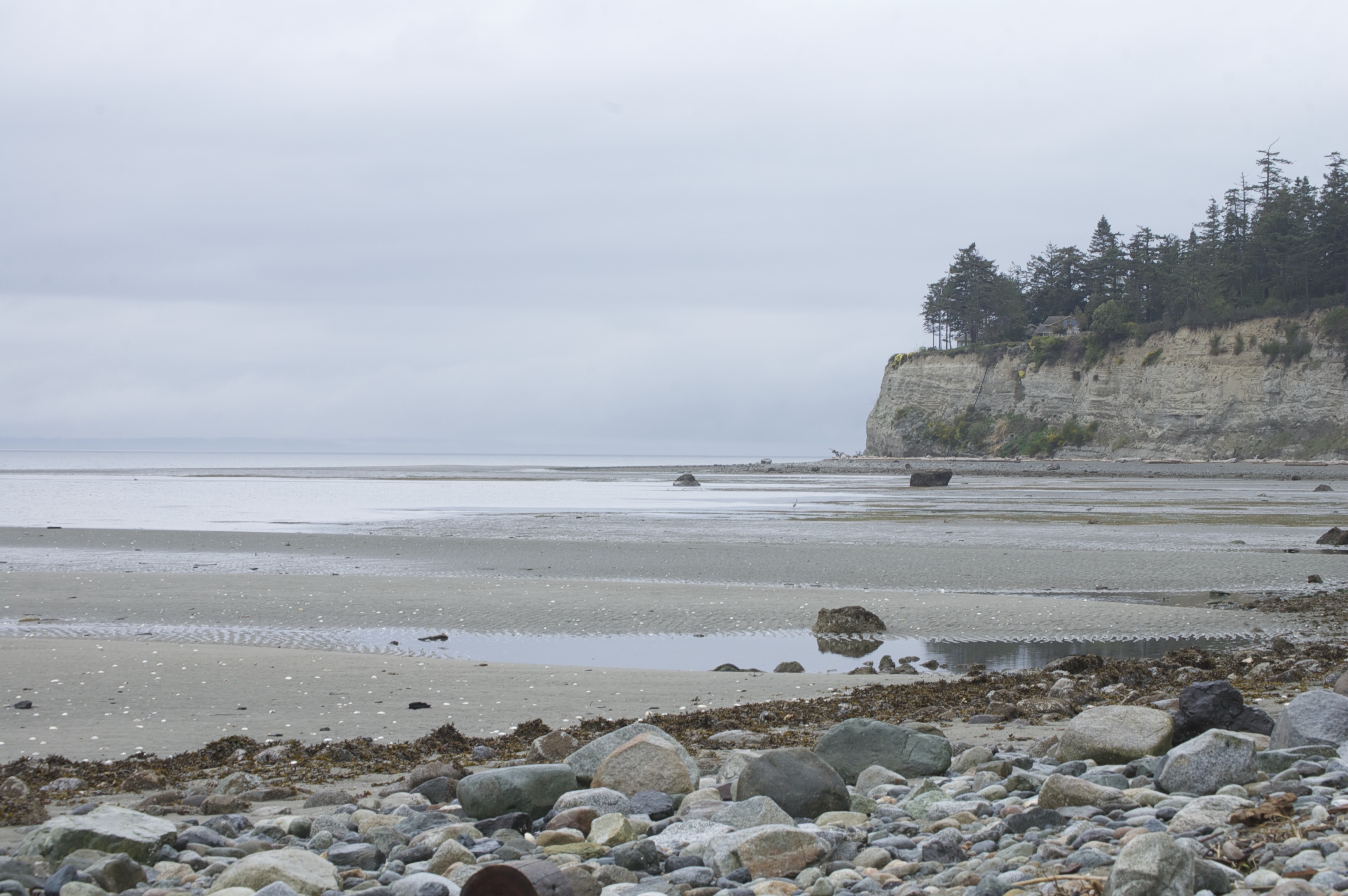
Yesterday my camera and I were busy at Double Bluff, a park on South Whidbey known for a dog park, views of Puget Sound, and an immensity of exposed beach at low tide. It is also known for bluffs that are made of sand that is perpetually sliding into the sea. The land is dynamic, and so is the water. It’s never the same, which is handy for a photographer. It is also bordered by private homes on either side and above. To show the nature without the structural distractions I count on fogs and mists, or conveniently tumbled trees, or an acceptance that I won’t take the shot. Here’s a picture I like, but after I loaded it into the computer I noticed a drain line draped down the hill. It probably won’t make the final cut. I liked the anemone shots better anyway. Stay tuned. The series will be complete this fall.

I edit out the humans because I want my photographs to show nature. I think there are people who want to edit the human species out of nature entirely, maybe because we’re too messy, but that’s another issue and possibly another post.

People edit humans out of personal finance too. Finance relies on mathematics, and mathematics is the ultimate well-ordered abstraction. It is easy to reduce everything to equations, logic, and optimal solutions. Put Personal in front of Finance though and each solution becomes unique. Real life can’t be reduced to equations. Job choices may be driven by proximity to family and friends. Spending choices may be driven by coping mechanisms that deal with unresolved childhood issues. Investment choices are affected by familiarity or availability. No one knows how long they’ll live or how their life will change. My life has taken dramatic shifts frequently, despite spending a lot of my life in stable and conventional environments. My personal finance solutions are plural because they change as my life changes.

I am hearing lots of people working their way through money choices. The underlying fear from the Dismal Decade persists, but they are beginning to act so maybe we are entering the Decisive Decade. When anyone asks, and I point out the benefit I received by working through the Nine Step program developed and popularized by Joe Dominguez and Vicki Robin. I followed the version in the original Your Money or Your Life (and am actually in the new edition.) What I liked about that approach is that it recognizes the human part of personal finance. Math is involved, but so are values; and values are personal. Following imposed values can lead to a dysfunctional life. Personal values are much more powerful. They may be hard to initially recognize, but recognizing them and living to them is engaging and empowering. When personal finance becomes an expression of personal values then personal finance is met with enthusiasm. No drudgery allowed – except for filling out taxes.

Of course I am a fan of the Nine Step program. That may be why I am Secretary for the New Road Map Foundation that acts as its repository of tools, examples, and community. The steps alone can transform your relationship with money, but I found that editing out every human except the individual misses an opportunity. My friends have similar concerns, but none of them have identical answers because they are individuals. Diverse community provides diverse examples. The Simple Living Forums are another group of like-minded people who work with each other to progress through the confusion. And sometimes it pays to work with a professional. I’ve mentioned my friend Mike Brady before because he is a good example of a portfolio manager who doesn’t impose solutions, but rather works from a person’s passions. Undoubtedly there are others out there. If you want help, ask for it. I am not a certified financial anything, but I have helped friends and businesses make choices – partly based on mathematics, but more strongly influenced by their values, goals, and circumstances.

One of the aspects of my book, Dream. Invest. Live., is that emotion can be an element of personal finance. Managing money doesn’t have to be reduced to math. Humanity can be involved. I don’t think investing shouldn’t go to the other extreme either. Investing purely based on emotion is simply gambling. My recent results haven’t been comforting, but I also know that over thirty years of data have convinced me that allowing emotion to have a voice also allowed me to identify very profitable opportunities that others overlooked. If nothing else, allowing a bit of humanity to seep into the equations makes it easier to be interested in what’s happening.

Punditry reduces the populace to statistics. People are grouped and their situations are generalized. The subsequent debates deal in abstractions, or absurdly exaggerate anecdotes and assume that everyone has to deal with the same issues. They tune me out.

People are individuals. The uniqueness of each individual is the ultimate diversity. While I may edit humans out of my nature photos, I don’t think we should edit us out of anything else. Why edit out something so wonderful?

Posted in Uncategorized | Tagged , , , , , , , , , , , , , , , , | Leave a comment

Huh Duh Yay

Someone sincerely asked about Dendreon and DNDN the other day. Their response to my synopsis was; “Duh. You should’ve seen that one coming.” Isn’t retrospection wonderful? It is 100% accurate, at least for a moment. History is a series of best guesses continually re-evaluated by proclaimed experts. Surprises happen. Unpleasant ones are greeted with “Huh?“. Pleasant ones are greeted with “Yay!“.

Christopher Columbus was a hero. Columbus was a villain. Columbus was lucky. Columbus was clueless. At the start he seemed foolish and yet people funded him because they were desperate. He almost didn’t make it and was lucky to find land when he did. He discovered America, but he was looking for India. He opened the New World, which he thought was the other side of the Old World, to his side of the Old World. That was great for the Europeans and lousy for the Americans and Africans. At the end of his life his accomplishments were challenged and uncompensated (though asking for 10% of the wealth of the Americas might be considered a bit much even if that was the agreement.)

During my life his story has changed dramatically. When I was a kid we celebrated his success. Yay! Then came the realization of the implications from the original American’s point of view. Huh? (When did we first realize how many died from smallpox?) And of course now some people dismiss him because, “Duh. Of course if he sailed far enough west he was bound to run into something.” No one could guess the outcome at the start. We’re not done revising his story yet.

Columbus had investors. They were willing to take massive risks because they needed massive profits. Wars were expensive then too. Investing may look much more refined and civilized today, even amidst the current turmoil, but investing has always embodied risks. Investments may begin with hope and enthusiasm, but there is no way to know if they will end up as a “Duh.“, a “Huh?“, or a “Yay!

American Superconductor, now known as AMSC, was building a business based on superconducting cable and its applications in powerlines, motors, and power regulators. It seemed like a good, long-term, power infrastructure investment. An auspicious opportunity arose and they bought a wind turbine company, that was in the right place at the right time to profit from the Chinese market. They started making hundreds of millions of dollars, “Yay!” from a non-mainstream division. Then the Chinese customer backed out “Huh?“, and the stock dropped 80%. During a chance inspection some AMSC technicians found some possibly pirated software running one of their customer’s machines. It turns out that there was a spy within AMSC who probably sold the technology to the Chinese, which meant the Chinese no longer needed AMSC and could actually compete with AMSC. Intellectual property theft in China makes many people say, “Duh. Didn’t you see that one coming?” This small company is now a prominent case in the Chinese courts over international patent protections. How did my little investment end up in the middle of such a large news item? I can’t guess which way it will go. AMSC is asking for over $1,000,000,000. In the meantime, the Chinese competitor can’t effectively sell outside China. Stay tuned.

Dendreon continues to make more money every quarter. They too are making hundreds of millions from a cancer vaccine, a technology that is so disruptive that it challenges the chemo and radiation industries. It appears to be more effective, cheaper, has far fewer side effects, and can possibly treat many more cancers. “Yay!” So, the stock, DNDN, should be trading high and at a premium, but it is not. It is barely trading above where it was before the FDA approved the treatment. “Huh?” The barrage of negative press is astonishing. Instead of celebrating a victory on the War on Cancer, the data are challenged. An earnings miss dropped the stock 80%. As I described it to my friend, some speculate that the negative press exists because solitary upstart Dendreon is challenging a crowd of multi-billion dollar corporations. My friend’s was response was, “Duh. Of course they’ll use every tool, ethical or not, against Dendreon. You should’ve seen that coming.” DNDN has become a story stock. In the meantime, I’m selling depressed stock to pay bills as the company grows.

MicroVision’s story is a long series of anticipated “Yay!” followed by”Huh?” followed by “Duh.” and repeated. The story looks good (the prototypes are awesome), and better news is about to be announced (memoranda of understanding are released with major companies), which fall through for some reason (poor assembly techniques, exclusive contracts are made and then reneged, technologies are lacking and are found to be too expensive). In retrospect, the various products and projects begin with enthusiasm, stumble into some unexpected pothole, and a chorus of “Duh.” arises. In retrospect I should’ve paid more attention during that tour of the Nomad assembly line. I should’ve asked more about the cables tethering the mobile devices during the demos. The company announces earnings on Monday. Maybe they’ll finally have some news that’s good enough to move the stock. Forget being down 80%. MVIS has dropped much more than that over the years. Despite that, demand may be high. I’ve seen plenty of evidence that there are crowds of possible investors waiting for that right bit of news.

It is easy to get demoralized when surrounded by a chorus of “Duh“s. Sometimes the chorus is right. Was the chorus from any Greek tragedy ever written to be wrong? In the real world though, anything can happen. We are each presented with choices. We choose. We take our chances, and then we have to live with them. We hope for “Yay“s and shouldn’t be surprised by a few “Huh“s. The “Duh“s are frequent. “I told you so” is a common theme, especially during troubled times.

The stories of AMSC, Dendreon, and MicroVision directly affect my life. My investing life is very public, and a choice I made when I decided to write my book, Dream. Invest. Live. I lay out the stories here because much of what is written about investing is abstract and theoretical. Specifics are always about the past. The future is described in ambiguous generalities. My portfolio has become a real world example. The stories of those three companies are only part of my story. I’ve maintained a diversified portfolio, as conventional wisdom recommends. And yet it has hit a poorly timed decline. Diversification is an acknowledgement that it is impossible to always pick winners, “Duh!“, and investing is an expectation that at least some choices will be winners, “Yay!“. It is easy to get agreement that the odds of everything succeeding is very small “Duh.“, but so are the odds of everything failing – though there are days when it feels like I may be in the midst of that.

Earlier this month I consulted with myself. My list of projects is long. Each may be able to provide me with a sustainable and thriving lifestyle, but it is impossible to predict which will be successes. The odds that everything will fail is very small. The odds that everything will succeed is very small. What is most likely is that something good will happen. There will be “Huh“s and “Duh“s, but with this much going for me, there will also be enough “Yay“s to make it worth all of that effort.

Stay tuned for that story.

Posted in Uncategorized | Tagged , , , , , , , , , , , , , , , , , , , , , | Leave a comment

What Comes Next

What’s next? Oh yeah, write the blog. Maybe only a few will notice, but this post comes out a few hours later than usual. Life is busy and a bit jumbled. Three of us compared notes at lunch and none of us had vacations planned. Scrambling is popular, or at least common. But we aren’t doing it to keep from being bored. We’re busy because of what comes next.

Wednesdays usually start with the blog – after breakfast and life maintenance routines that I won’t pass along. I blog, go for a run, manage comments or connections, and then have lunch. The rest of the tasks fit into the rest of the day – if they can.

Today started with photographing at the last of the Whidbey sites in my five year series of photo essays. You’ll see more after I finish in the fall. From there I drove up the island to meet with collaborators for an event we’re planning late this summer. (Stay tuned.) A good, healthy, green lunch to refuel with a side of personal conversations about life, the universe, and everything, or at least our lists. Then, up to Wind and Tide Books in Oak Harbor to hang more Whidbey photos, and arrange for a talk on June 9th. (I’ll talk about the why of a Twelve Month series instead of methodically stepping through dozens of slides.) So here I sit, amidst free Wi-Fi, finally getting to the blog, with a self-imposed deadline of uploading before they close. I’ll finish by teaching my class in Modern Self-Publishing at Jenne Farm and safely driving home.

That may sound packed. It is. My collaborators are equally active. Teaching, performing, writing, and volunteering swirl us all along in these uncertain times. For many people there is a general societal fear of the future. Economic collapse, ecological disaster, species extermination, or civilization evaporation are common topics for some of my friends. Many of them can remember worrying about Mutually Assured Destruction. I guess the title still applies even if the content has changed. There are also specific personal fears of the future. Bankruptcy, failing health, job loss have come up in personal conversations lately. Some sit back and hope it all works out. Some dive in and scramble for security. I suspect the answer is in the middle, but that will only be obvious in reflection. Until then, it is a guessing game.

I dropped in on a friend’s shop the other day. The store is busy and business is picking up. They’re scrambling to keep up with demand. As a kind gesture I was sincerely asked what I was doing. Nothing came out of my mouth. Everything tried to spill out at once, and they all collided, creating a blockage in my throat. Eventually I shrugged my shoulders and said, “I’m scrambling.”, and left a while later. It was lunchtime, and in a rare event I went out to lunch. It was a business lunch. I’ll hang my photos in the restaurant for June and July and needed to see how the space was used, where the light fell, and look for anything I might have overlooked in my plan. As I sat there, all of those projects finally lined themselves up and I wrote them out as a list in my notebook. After lunch I went back to revisit my friend and hand over my answer. There were fifteen items on that list, each of which was on the order of writing a book or managing my consulting.

Five years from now, a bit of reflection will probably show that most of those efforts could’ve been shelved. For now though, each has the potential to either provide for or lead to my financial security. My task list is the entrepreneur’s version of an investor’s diversified portfolio.

My portfolio is diversified. Diversification is not a guarantee, but it is a cheap way to buy a chance at security. Despite that, I has hit by a Triple Whammy. Diversification as an entrepreneur is more expensive because it can cost too much time; but, just like diversification within a portfolio, diversification is valuable within a business, especially in turbulent times. It is unlikely that everything will succeed, but it is also unlikely that everything will fail. Something good is going to happen. I just don’t know what it is.

The various global dynamics may render detailed plans useless. A well-designed, then ignored, thirty year financial retirement strategy may not survive a breakup of the European Union or an economic implosion in China. Global climate change is already affecting seaside real estate, shipping, and demographics. People are moving as the waters rise. That may not seem like a challenge to a thirty year mortgage in Kansas, but a major disruption in Florida might ripple through smaller markets regardless of location.

The optimist in me also throws in the disruptive and positive possibilities. Imagine the upset if technology, insight, or discovery provided free and pervasive global health care, food, or shelter. Nanotech, alternative energies, simple nutrition and common compassion have great potential.

In the meantime, as a recently connected global community, we are busy trying to resolve inequities, injustices, environmental distresses, and ignorances. We do that because we know we must do something, even though we won’t know which effort will work. We could just wait for the positive disruptions, and maybe that will be the best strategy, but that is a bet that puts too much at risk.

A friend told me a simpler story in the supermarket last night. He left the island to find a job, found a terrible environment, moved back to the island, and got busy looking for any opportunity. Without any experience someone found him a part time job, that came with a promotion within days as they fired someone, that expanded into a full time job when someone else left for another opportunity, which left my friend with a better situation than he could’ve imagined a few months ago.

He didn’t know how it would work out, and it worked out well. I don’t know how my situation will work out, but I suspect it will work out well too. On the grander scale, I am a fan of our infant human race and think that we’ll scramble our way to a way that works for all of us, or at least more of us. All we can all do is keeping work for solutions without knowing what comes next. With so much going on, something good enough is going to happen.

Posted in Uncategorized | Tagged , , , , , , , , , , , , , , , | 1 Comment

Consulting With Myself

Dear reader, remind me to mention prices and values.

Right after April 1st I scheduled some time with my self, and then I called in some help. Sometimes the best person for me to talk to is myself. If that isn’t enough, I find someone else who can hear and help. Step one was listening to my own advice. The best investments are frequently internal. Investing in the stock market is appealing, but personal growth is much more enriching and can be more profitable too. I’ve told others that. I’ve told myself that. And now others are encouraging me to listen to my own advice. I’m expanding my consulting business because I enjoy it, evidently it helps others, and because entrepreneurship is an excellent invest the precious and perishable commodity of time and be paid in currency that can pay the bills.

Back in the fall I blogged about a session with a friend. She had a small windfall and wondered what to do with it. Should she invest in stocks, or bonds, or real estate, or, or, or? She’d asked others but she was confused. I asked her about what she wanted to do with her life, regardless of any financial investment. She has world-famous talents, and maybe investing in her own business would be more powerful than investing in some publicly traded corporation. She could either invest in a company where she had complete control, or she could buy a tiny slice of control of a mammoth entity. Some people’s talents aren’t as readily developed. Hers are.

Here’s an excerpt from that blog post – Invest In Self.
A person investing in themself has an advantage that they can never match when trying to invest in someone else’s company. Knowing thyself is hard enough. Knowing the mind of management and the market is definitely harder.

The first week of April was rare. I had five days with only a few commitments. I claimed a mini-staycation and decided to use half of it as a retreat. I’ve been working hard and enjoying lots of qualitative action, but little quantitative traction. I was busy and getting lots of compliments and promises of eventually being paid – maybe. For a few days I treated my self with a vacation (where “self” received a bit of a spiritual introspection), and treated myself as a client (where “myself” sat down with a consultant that happened to be me.) My friends and clients passed along encouraging feedback. I wondered what I could do for myself.

I won’t go into the details. Clients’ personal lives are to be handled with discretion. On the business side of things, I have about fifteen projects which have a possibility of providing a sustainable, thriving income. Like I said, I’m busy. Maybe I was already doing all of the right things. As I’ve mentioned in earlier posts, I think the companies behind my portfolio are doing well enough that my portfolio may suffice if I don’t have to sell stocks to pay bills. But frequently my efforts seem almost, but not quite on target. My options settled out to:

  • do nothing – and trust the market, or a windfall;
  • do nothing different – and keep working on my projects, with a bit of trust in the 10,000 Hour Rule;
  • do something a bit different – which is probably sales, because I usually send book buyers to the library;
  • or take inspiration from Monty Python’s Flying Circus,
    and now for something completely different.

Something completely different is always an option within introspection because, again turning back to that earlier post:
A person investing in themself can also fall into a trap of being too close to the business. Good and bad things can be overlooked. Expansion opportunities may be just past the horizon, but others might have a better vantage point. Extrapolations from positive possibilities can create an exuberance that ignores dangers and cautions that are within arm’s reach but out of sight. Investing in self is powerful, but doing it amongst others is a very good idea.

I listened to myself and called in some help.

Several of my friends are consultants. One in particular offered to consult with me about my consulting business. I took him up on the offer. Mike Thelen and his business partner, Michelle Bergstrom, were kind enough to sit down over a lunch and talk with me about me and what I could do. They were collaborative instead of competitive, and more interested in listening than talking. I was pleasantly surprised. After a while they produced a concise set of suggestions based on my interests and their observations. There are a few tools that they use which helped illustrate their points. They were sincerely encouraging.

Evidently, one thing I enjoy doing is what I’ve already listed on my consulting page. I enjoy listening. Their confirmation was welcome. They pointed out that consultants that listen instead of tell have a valuable talent. And then they provided extra value by adding nuance. They noted that I particularly enjoy listening to people with unconventional lives, creative ideas, innovative businesses – people for whom traditional answers probably won’t fit. It was so obvious to me that I had to hear someone else say it for me to hear it. They defined my niche that I was too close to see.

Let’s go back to my friend from the fall via a series of snippets.

  • “She’d already visited a (financial) professional. And she came away from it with a thoughtful brow and many more questions.”
  • “We started playing around with what she’d been told and what she wanted to do.”
  • “She was smiling. Investing doesn’t have to be done with furrowed brows.”

I listened. We played. She smiled. We both here happy with the result.

Mike and Michelle took me back to that session and others, and pointed out the joy I have helping. I didn’t realize how rare that was. With a few questions and lots of listening they showed me how I can provide value and receive value in return.

As I wrote above, they aren’t the only ones. I know many consultants and all of them are encouraging people who are encouraging me to do more of what I do. I’ve listened to them.

So, if you’re trying to work through something, especially something that doesn’t seem to have an obvious or conventional answer, give me a call. We can sit. You can talk. I can listen. We can play, and maybe you’ll have something to smile about and we’ll both walk away with something of value. My site has a few more details; but not many, because unconventional situations are best handled with flexibility.

And if you want to work from a longer list (see what I said about the way I sell?) – here’s the quick list from my address book with guesses at their talents. They may prefer to describe themselves differently. Contact them to find out more.

undoubtedly others as my eyes glazed over them amidst my address book

and of course
Mike Thelen & Michelle Bergrstom of UnTapped Assets – who usually work with businesses and corporations and were nice enough to work with me too. (And for whom I can’t find a web site!)

Thanks for listening. Now it’s my turn.

Posted in Uncategorized | Tagged , , , , , , , , , | 2 Comments

Deciphering News

MicroVision, thank you for the timing of your press release. Last Saturday’s post was about what did and didn’t happen in the first quarter of the year (1Q12). The second Tuesday in the second quarter started with MicroVision’s news about an agreement with Pioneer. Yeah! And yet the stock, MVIS, remains low. Maybe it’s because the news is nothing grand, or because the company’s news is frequently received with skepticism, or because the press release requires parsing to yield understanding. I can understand all three possibilities. Let’s see what I can read from it, and also use it as an example of why it can be so hard to understand corporate announcements.

(For a popular primer on MicroVision, read my post: Micro Vision.)

MicroVision Announces Definitive Agreements with Pioneer for HD PicoP Gen2 Display Engines Using Direct Green Lasers
That’s the title? Give it a few more words and it would be a run-on sentence. Okay, I understand, MicroVision is a tech company, so English majors may not be common. Fortunately, there are some key words in there: Definitive, Pioneer, Gen2, Direct.

“Definitive” is more concrete than usual for MicroVision, but I’ll withhold judgment until I read the rest. Maybe what’s definitive is qualitative instead of quantitative.
Pioneer is more definitive than usual because the company name was used directly instead of “a major electronics manufacturer”, which has led to some misunderstandings in the past.
“Gen2” and “Direct Green Laser” only makes sense to people watching MicroVision’s technology and is good news because Gen1 cost too much, partly because they didn’t use direct green lasers. (Long story there which may be moot if MicroVision survives.) Gen2 also has much higher quality, and using Gen2 in a Definitive Agreement suggests, well, that involves reading more into the words than are there.

Let’s dive into the text.
“Under the agreements, Pioneer will produce PicoP Gen2 display engines for its own automotive aftermarket products and will pay MicroVision royalties from sales of these products. Pioneer plans to release its first aftermarket head-up display product later this year.”
“Agreements”, note the plural. This could be bigger than I thought. “Pioneer will produce” takes the work and capital expenditures out of poorly capitalized MicroVision’s finances. “and will pay MicroVision royalties” and revenues are good. From the “sales of these products” suggests delayed revenues until after sales are made? booked?, or is there an upfront fee to MicroVision so they won’t have to dive into onerous financing? “release its first . . . product later this year.” Like I wrote in my previous post, is that July 1 or December 31? For those who aren’t pilots, “head-up display” is like Google glasses for a car.
In summary, the news could mean MicroVision makes money before July 1, 2012 with a long list of other products to follow, or doesn’t see the first cash until after December 31 and many agreements were needed for one product, or anything in between.

Later in the text I found another encouragement.
“Under the agreements, Pioneer will also manufacture and supply key display engine subsystems to MicroVision for consumer, industrial, and other applications.”
The auto HUD is a consumer product. Maybe its display engine can be used for industrial and other applications, but hope steps in with the possibility of a larger product line.

“MicroVision’s continued transition to an “Image by PicoP” ingredient brand model, which is expected over time to reduce working capital requirements.”
Reducing capital requirements confirms some of the cash issues described earlier, but the “expected over time” part suggests that this agreement alone is not sufficient. If I saw another such agreement with another customer that didn’t include that phrase, then maybe I’d think the cash was finally taken care of.

“With the expected availability of direct green lasers in the second quarter of this year,”
Hallelujah! Direct Green Lasers in the second quarter of this year, 2Q12. If they said second half of the year, 2H12, I would guess that the product would be late in the year. But they didn’t say the direct green lasers were available in 1Q12 as was hoped. I’m confidently guessing that they are talking commercial quantities, not prototypes because the prototypes have been in product testing for a while.

So, there it is, as clear as, well, hmm, – and so it goes with corporate press releases. Press releases full of words are always subject to interpretation and misinterpretation. Language is not as precise as mathematics, which is one reason many investors rely on financial statements from companies that have years of stable numbers. Ambiguity is the bane of startups. It is too easy to create too many interpretations from such language. Booms and busts result.

I manage the ambiguity by looking at the company, its products, and its industry. If the company looks very cheap, but the technology and products are positively disruptive, then with good management and some luck the stock can be bought low and eventually sold high. Lately, that strategy (which I describe in detail in my book, Dream. Invest. Live.) has been severely challenged in my portfolio (read Irrational Markets), as much from small-cap market conditions as anything else. Yet, I am reading more good news, realizing that much of it is hidden with caveats and legalese, and hoping that my frugality and personal productivity will provide enough patience for my portfolio to prevail. (Pardon all the p’s but it was fun practice.)

Oh yeah, and my gut feel is that this is good news for MicroVision for this year. It isn’t the biggest news, but it might be big enough. The word they didn’t use was “exclusive”. That means they can do other deals too. A bit more news with another customer or two might be much more than big enough for the company, the stock, my portfolio, and me.

Stay tuned.

Posted in Uncategorized | Tagged , , , , , , , | Leave a comment

Post 1Q12

It’s spring. My neighbor’s lawnmower reminds me of yardwork yet to be done. It is stereotypically sunny and I am in shorts. One of the area’s wettest winters is gone, well, except for that bit of frost this morning. The stock market has a different set of seasons: earnings, christmas, fiscal, and calendar. We’ve just passed out of 1Q12, the first quarter of 2012. I’m watching for bulbs in the yard and progress in my stocks. For now, it looks like dandelions with a hint of crocosmia – a bit of work now and a promise of gorgeous foliage.

Every human endeavor seems to spawn its own vocabulary. Investing definitely has a unique nomenclature. Naked shorts is not what everyone would envision, and they aren’t necessarily pretty. 1Q12 is the shorthand for the first quarter of 2012 (1 = first, Q = quarter, 12 = 2012 – which I am sure you understand and yet someone will have learned something.) Companies are typically vague about milestones, product release dates, and announcements. Being too specific makes it easier for competitors to maneuver and also makes it easier for lawsuits to sprout from simple slides. Investors can be touchy.

When a company announces that they will announce something in 1Q12 it can mean anytime from January 1st to March 31st. As the days go by there is a greater probability that the day is getting closer – until the company restates the announcement as 1H12, which is the first half of 2012. That sounds like less of a slip that 2Q12, as if they meant 1H12 all along.

We are one week into 2Q12. Amongst my stocks there were various announcements in 1Q12, but nothing that significantly and persistently improved any of the prices. My optimism has shifted from 1Q12 to the three months minus one week remaining in 2Q12. Something good is going to happen, it is inevitable. I am an optimist. Can you tell?

Hello AMSC, how about a resurgence in orders, and maybe some superconductor cable sales? Hey, Dendreon (DNDN) are you ever going to announce that European expansion? Yo, Microvision (MVIS), Google is doing eyewear. I’d love to hear that it will be with Microvision (or PicoP) inside.

News is hidden. Both good news and bad news are only to be revealed to all at once because no one is supposed to have an unfair advantage. The legislation or regulation aimed for “full disclosure” which of course had the opposite effect of encouraging companies to say as little as possible because that was more manageable and less litigious.

We have less than three quarters to go in 2012. We’re already more than one-quarter of the way through the year. The pessimist in me laments the passage of time without substantive progress. As I said above, the optimist in me considers the probability that the good news is getting closer.

Despite the evidence of my portfolio, attempts at selling my home, and my job search, the economy is looking better. For a long time the pessimists looked right. A lot of euphemisms for “I told you so” went by. Some think this upturn is a blip before the big fall. For a long time optimism was out of fashion. Maybe it is returning. Maybe that is only because it is an election year. Maybe it is because enough dysfunctional organizations defuncted.

I don’t know what’s going to happen in the short term. Such predictions are inherently risky and based more on chance than data. So much substantive news is hidden that everyone is left with guesses and estimates.

I am a fan of history. We progress. Within each civilization and age people have predicted rises and falls, and only in reflection is it possible to see who was right. Even then it is hard to distinguish the lucky from the wise. Booms and busts are terrible bases for extrapolation. The predicted highs and lows are rarely seen and if they are touched it is not for long. Things rarely work out the way we expect. The internet bubble popped as many predicted (and counter to what many others predicted) but the trend remained. The stocks dropped, wealth vanished, and companies imploded; but the web traffic climbed, the internet has become the infrastructure of commerce, and information is becoming free and ubiquitous. The joke about refrigerators having their own IP address is coming true. Once upon a time a computer on a desk sounded ludicrous and a computer on every desk unreal. Our economy is passing through turmoil, but as a people we are progressing, and I suspect that the truth will be a mixture of the pessimist and the optimist.

Underlying progress can be ephemeral. Sometimes the news is hidden for regulatory reasons. Sometimes the news is taken for granted. Sometimes the news is overlooked because it is unbelievable, incredible. Hidden news produces the overnight part of the overnight success. The progress was there, but no one noticed until all at once they did.

I hope that is the case with my portfolio, my business, my life, and also with our common consciousness, awareness, and progress to a blooming of another age. In some ways, the last decade has been a walk through the weeds. It is time for some flowers. Hello spring, or in the investing vernacular, 2Q12 – and everything that comes after.

Posted in Uncategorized | Tagged , , , , , , , , , , | Leave a comment

Healthy Havens

One person, a small group, can make a big difference without spending a lot of money. A person on one side of a road is healing people, building community, and helping artists, including me. Across the street is an old community dance hall sustained and maintained by a small group of volunteers, including dancers, including me. Havens for two parts of my life are neighbors. I bow to such people who do such good work for the good of it, for the fun of it. Why not? They’ve caught on. Doing good can be a joy.

My photos have been in demand this year. Not photos of me, but my photos of Whidbey Island. Without making any cold calls my photos have been on overlapping exhibit in a series of locations since the beginning of the year. They’re booked through the middle of July with September and October already scheduled too. I’m glad to see that people like my work. About a week ago, Dr. Craig Weiner of The Chiropractic Zone, called and asked if I would exhibit my photos in his office. Of course I said yes. That may surprise many professional photographers who would only show in high-end galleries, but I know something they don’t. Labels are misleading and constraining. Stereotypes obscure reality and dismiss opportunity. A chiropractic office can be more than a place to tend an aching back.

Dr. Craig Weiner is well known on Whidbey, and probably beyond. (Check his YouTube channel for his speech at Bastyr University.) He’s well known for his healing work; otherwise, he wouldn’t be in business. He also recognized that his space could do much more than heal individuals. It could also be a garden to sprout communications and support a healthier community. Every month or so he invites key people to give thought provoking talks on issues that typically have the word Transform in the title. Go back out to his YouTube channel and watch a string of excellent interviews and talks (including Drew Kampion from drewslist who I blogged about in A Bow To Drewslist.) Patients use the tables. Speakers use the space. Why not use the walls by inviting artists to display their work? It may sound unconventional, but this is Whidbey, and I got the quick call to install because the previous artist sold so much art that there were too many blank spaces.

I enjoy showing and selling my art online or from galleries, but I won’t ignore such an opportunity. So, on relatively short notice, I installed a dozen or so pieces. The current favorite seems to be October’s Arms, from Twelve Months at Deception Pass.
We had a bit of interplay about which goes where. A bit of discussion about details like pricing and custom orders. A couple of hours later and we’ve decorated his healing space with peaceful pictures, and my artistic self feels healthier too.

His effort cost him less than the two hours. It cost him the time for a few friendly discussions, then I set to work. He ends up with frequently changing art, and the opportunity to help an artist. He doesn’t ask for commissions. His talks ask for donations to charities, so they aren’t money making events. Of course, such efforts draw attention to him and his work, but authenticity is hard to hide, and he authentically wants to help. His help will cost a bit though because he decided to host a reception next week (Thursday April 12th from 5PM-7PM). I suspect he’ll spend a bit on snacks like he did for some of the classes I’ve attended (Right Brain Writing), but I suspect it costs far less than most advertising and is much more fun.

Ironically, while I cheer his talks, I rarely attend them. He has them at the same time as the Tuesday Night Dance that happens across the street at Bayview Community Hall.

Almost every Tuesday night for the last four years an informal group of dancers got together to practice and dance. We all realized that we wanted a setting that was less structured than a class and less formal than a dance. We wanted a space and a time where and when we could practice, refine old moves, learn new ones, or simply unwind and have fun. Classes intermingle so beginning swing steps are thrown in with experienced waltzers and intrepid tango stylists. Others may have done the same with formal organizations, dues, and meetings, but the group casually arranged for keys to the hall, music, and the easy logistics of setting up chairs and turning on the lights and heat. Everyone pitches in about $5, and a fundraiser for the hall happens – though considering its insulation that may not cover the heating bill some nights. For less than some people spend on a dinner a community gathers, applauds, supports, and encourages each other. Back when I had more money I gave more than my share because such things are much more valuable than $5 and giving a bit extra was much more effective charity than paying into some administrative bucket. I probably wasn’t the only one.

Alas, operating any such organization can drain a person’s energy; and within any group some will devote more time, effort, and money to the cause. I know because I helped organize dances in that hall with those people for a few years. Amidst the thanks were lots of minutia, negotiations, and complaints.  As I went to last night’s dance I knew that it was probably the last, but probably not for long. Some of the key people needed a break and no one was stepping into the role, but the demand remained. After about a half hour of dancing, and a round of applause for a returning newlywed couple, there was a break. One man stood and announced that he valued Tuesday Night Dance enough that he would take on the task, maybe every other week and especially if he had a bit of help. Various hands raised, including mine – but not too high, but maybe I can help a bit – again.

I was tired last night. New Road Map‘s three day board retreat was over and one of the topics was finding people who could stand up and help others engage in financial integrity, financial intelligence, financial independence, financial literacy, and simple living. As Board Secretary I’d collected the notes and released the minutes. As part-time host I cleaned my house. All of the board members were unpaid volunteers. Some of whom had worked hard enough and long enough and were looking for a break. Thanks to two new members (Gordon Morrow and Steve Scoles) one member (Fred Ecks) was able to become emeritus, and the work is able to continue. Does anyone else want to stand up and help?

People standing up create healing and healthy havens for us all, physically, mentally, emotionally, artistically, communally, and financially. I bow to you all. Let’s give them a hand.

Posted in Uncategorized | Tagged , , , , , , , , , , , , , , , | Leave a comment