Corporations Meet Owners MVIS 2012

Welcome back my friends to the show that never ends. It’s June and time for the MicroVision Annual Stockholder’s Meeting (more correctly the annual meeting of shareholders.) It is the time for the owners of the company to hear from the people they hired about how well the company is being run. As usual, it was more sales pitch than business critique. But I get ahead of myself. The ability to drop in and listen is a key advantage to investing locally. Every year I do this if I can. You can too. Corporations aren’t abstractions. They aren’t people, but people populate them; and people are the best way to learn about the company.

For those that want the details, head out to the MVIS boards on The Motley Fool, Investor Village, and Silicon Investor. I post the full notes there so comments and replies can benefit broader audiences.

I encourage people to attend the meetings when they are convenient. Just showing up is a learning experience, and great people watching. Drag out the stereotypes and watch the suits gather in one corner, the fashion plates trying to relax in tiny seats, folks in business casual that may be employees, and the motley crew of individual investors who can and do dress anyway they want. MicroVision’s meeting didn’t have any fashionistas. They tend to show up at companies like Microsoft or Starbucks and may be early investors who hung on long enough. Granted that is just the stereotype. Living around Seattle means getting comfortable with the idea that the guy in shorts might be a billionaire. It breaks down the class structure in some fun ways. But that’s another story or five.

A more useful exercise was watching the way people avoided or were attracted to the various groups. Sometimes the CEO is a star with a crowd gathered as soon as they walk in. Other times they are avoided by all except the other suits. There was a bit of both today. What I missed were the demos. Some companies can’t have demos. Biotechs aren’t going to hand around pathogens. But consumer electronics and retail firms can have fun. The Starbucks meetings were the best, back when this tea drinker owned a bit of SBUX. Free food, good music, and a fun atmosphere. Rising stock prices helped. MicroVision’s meetings have been fun as they’ve developed the technology. I’ve seen projectors that fit inside cell phones, eyewear displays that pre-date Google by years, videos drawn on my retina (really quite natural), innovative gaming guns, tiny cameras, and user interfaces that worked in air with the flick of a finger. Very cool. This year that didn’t happen, and that told me something. Whether I mis-interpret it is my own consequence, but it is an insight delivered for free and not filtered by Wall Street analysts and spin doctors.

Going to meetings is not for everyone. It can be dull. I’m naturally curious so I always learn something, even if it is in what they didn’t say. Today’s meeting didn’t have a financial report. Evidently they don’t think that’s necessary at a stockholder’s meeting. I wonder if they will finally produce one when they have good news, but not before.

It was a bit of a trudge. Get up at 4:45, thankfully catch a ride to the ferry with a friend at 5:30, jump onto the bus that doesn’t wait long, try to figure out what and how to pay, jump onto another bus that doesn’t wait long and do the same, walk in at 7:30 and early enough for the demos, sign in, and find that there will be no demos. The demos will be part of the 9:00 presentation. Hang out with other shareholders, because the demos and employees aren’t available and because I can learn more from investors than from managers, and finally settle into my favorite seat in the back of the room. Back there we can resort to high school and pass messages back and forth, but these messages are like the asides delivered by Stephen Colbert’s “The Word”. I didn’t get home until 3:00 because of a good lunch and a missed bus.

Without the demos, and with such a small company, the audience dispersed quickly; but not before business cards were traded and lunches arranged. Individual investing can be solitary and intimidating, but online discussion boards provide community, and meeting off-line provides confidence. Each investor can only know a bit, but collectively a group of investors can produce better insights and analyses than the major financial institutions; especially, because they tend to overlook small companies. Investing benefits from gaining advantage, and community is inexpensive, powerful, and can be enjoyable. Besides, the price is right.

Oh yeah, and don’t forget the goodies. At some meetings I’ve been given about $40 worth of freebies. Smart retailers know that shareholders are also customers and keeping the customers/owners happy is a good idea. MicroVision gave out pens. Well, it isn’t much. Someone else snagged most of the ones around me as he walked out, but I grabbed a couple extra for the first MVIS friends that I meet. It isn’t much, but at least for a while I suspect it is the closest we will get to a dividend.

Next week is the Dendreon meeting, and this year they are actually going to have it in Seattle, you know, where the company is based? DNDN’s trading at $6, down from $55, yet the treatment seems to work. This will be interesting.

Stay tuned.

Posted in Uncategorized | Tagged , , , , , , , , , | Leave a comment

Would You Buy More

Want some advice? I don’t give it. The SEC, state regulations, and respect for professionals suggest that if people want financial advice they should go to certified financial planners and such. (Have you met Mike Brady?) I’m not even an “and such.” I’m simply a person who sees the opportunities in the stock market, has usually benefited from them, and am unfortunately currently out of synch with them. Okay, I also wrote a book about my style of personal finance, Dream. Invest. Live. But I don’t give advice. I do, however, ask people questions and let them answer for themselves. An answer that comes from the inside is far more valuable than one from the outside.

A friend and fellow investor asked me about some of the stocks we have in common: AMSC, DNDN, MVIS. So they asked me, “Should I buy more?” And they know me, so they knew to interrupt me when I started to respond with, “Well, I don’t tell anyone else what to do.” So they rephrased the question. “Tom, if you had the money (and they’re sensitive to the fact that I don’t), would you buy more?” Allow me to rephrase the conversation into something more general. The stocks are down. Is this the time to buy low that leads to selling high? And of course, only people from the future know for sure. Every response comes out as a dodge.

Would I buy more? Me, personally? Yes. No. Maybe.

Yes.
If I was working from discretionary capital, money I could afford to lose, I’d return to my standard criteria. I’d look for companies that are in positively disruptive businesses, expected significant revenue growth, and that have little or no debt. I’d check “the present value of future revenues discounted for risk” and compare that to the current market cap. If it looked like a deal, I’d consider buying. The general market is recovering, but I know of many small companies that have been overlooked. I’ll paraphrase the CEO of f5 Networks (FFIV) from a stockholders meeting he chaired after the internet bubble burst. He wasn’t allowed to directly comment on the company’s stock price, but he did offer this insight. “Given conventional business measures in a normal market environment our earlier valuation was higher than to be expected. Given conventional business measures in a normal market environment our current valuation is much lower than to be expected. We can not say if conventional measures or normal markets are applicable anymore.” FFIV had gone from over $100 down to $3. I bought along the way and rode it back to $40. It is now trading at $100, but it split, so its pre-split equivalent is $200. Maybe now is just like then, or maybe not.

No.
My money is so tight I’m staying home more, using the bicycle instead of the car if I can, and enjoying Netflix instead of the local $7 theater. And yet, I am delaying bills as long as possible because the optimist in me knows that, if I am right, the stocks will eventually recover, and that frugality and time are my greatest tools. An extra week can mean a lot to a stock price. That hasn’t worked well, but MVIS’s recent movements are encouraging. It is up about 150% in the last few days. Three more weeks of that and I am back to break-even. Three more weeks beyond that and I am almost back to enough. Hey. It could happen. Please?

Maybe.
If my house, my home, sells for the listing price, I’ll be able to pay off the mortgage and the credit card, and have about a year’s living expenses. In that case, I’d probably put some money back into the market. I also played an interesting mind game with myself. What if the house sells for enough to pay off the mortgage and a year’s living expenses, but not the credit card? The credit card rate is double digit. I expect the stocks to return better than that because they are so low (relative to my guesstimates). Simple arithmetic suggests that it makes more sense to put the money where it generates the highest interest rate. Yet, even then I would balk. Maybe I’d put some in the market and pay off some of the debt. I won’t worry the details because the question is moot until the house sells.

If or when the house sells. If or when I get a job. If or when my investments recover. If or when my business becomes sufficiently profitable. If or when some combination of those IFs and WHENs, and as I wrote recently there are too many of them for me to realistically contemplate. (Too Many IFs) If the house hasn’t sold, I haven’t found a job, my investments haven’t recovered, and my business isn’t profitable are an unlikely set of circumstances; and yet that it is where I sit as I type. That’s gotta change. For now, I won’t buy more. If the house sells, and I find a good job, and my investments recover, and my business becomes sufficiently profitable, then yes, I’ll buy. I’ve been investing since about 1978. This is only the second time my portfolio has so drastically slipped and the only time I’ve simultaneously been blogging about personal finance. As I type this I realize that it would be surprising if a typical life didn’t have such an episode or two, except for the blogging part.

I had a different question for some of my friends who are interested in buying more. If the company succeeds, and the stock reflects that success, do you already have more than enough shares to be worth more than enough? More is not always better. Sometimes the peak of happiness is at enough. And if there remains a compulsion to buy more, then maybe buy more of something else. Diversification is a good thing, and I can attest that more diversification is better. My portfolio had twelve stocks in it, but as this episode has played out, I’ve had to sell, and now the portfolio only has six. Each of those was a possible “enough”. From where I sit, having more chances is better than finding every one of my remaining chances looking too chancy.

I remain a fan of investing. I know the market is less than pristine. But fundamental to the American culture is the ability for anyone to participate in wealth generation through investing. And fundamental to our species is continual invention and innovation that can produce a better world. I may not have the money right now, but I’ll buy into those ideas and ideals. Would you?

Posted in Uncategorized | Tagged , , , , , , , , , , , , , , , , , , | Leave a comment

Am I Financially Independent

I am a personal finance case study. Turn to the back of the new edition of Your Money or Your Life (page 292 of YMOYL I think) and you can find a short description of my life as an FI-er (shorthand for financially independent,) someone who followed the 9-Step program that Joe Dominguez and Vicki Robin popularized in workshops, seminars, and books. Even if I hadn’t written my own book on personal finance, Dream. Invest. Live., a bit of my life would be lived in public. My public life doesn’t result in much fan mail. So far, total sales for my book are less than one week’s traffic to this blog. I decided to blog about the roller-coaster nature of life as an individual investor because too much of what is out there is academic and abstract. I never expected to be writing about such depths as my current situation. Many folks are nice enough to express sympathy and discrete enough to avoid the tough questions. It took a stranger to ask the question that I’ve asked myself frequently and that others may have on their minds. It is a key question that should be answered.

On May 26, 2012, at 8:40 PM, (name withheld by request) wrote:

Hi Tom

Your name is mentioned in the YMOYL book. Just out of curiosity, I
googled your name and landed on your blog
(https://trimbathcreative.wordpress.com/).

I can see that you are selling your house and looking for job. Would
you say that YMOYL didn’t work for you and that you didn’t really
achieve financial independence? Would you like to share your thoughts
so we all can learn from your “mistakes”?

Here’s the first part of my response.

Excellent question. So many dance around that issue instead of asking me directly.

The 9-steps worked for me – for a while; and even now I definitely benefit from the exercise and philosophy. Because I worked through those steps I am very aware of my values, my goals, and what I have to offer. It helps to realize that my current situation is one of not making enough money. For some it is a case of spending too much regardless of their income, and a feeling that they have no control. I’m glad that I can look at my situation and identify that my expenses are reasonable and that my income is the issue; and that my skills (consulting, engineering, writing, art, speaking) can all provide that income with a bit of luck. Come on luck, or perseverance, or whatever.

One of the cautions about any financial plan is that there are no guarantees. Achieving financial independence through Joe and Vicki’s 9-Step program is no different. At some level, reaching that goal is merely reducing the probability that there will be a financial upset based on a long list of assumptions. How long are you going to live? Will there be a major illness in the family? One friend pointed out that my portfolio of companies is fine, but that the portfolio of those stocks are drastically undervalued right when I needed them. Another friend pointed out that it took one of the greatest financial upsets of modern times to put me into my position. In our current economy, some worry that currencies may collapse or that hyper-inflation may kick in. Throughout modern history economies have had major upsets like those. The folks that do best are those that are aware of their situation, not merely those with the biggest piles of cash. (I might have to re-read Joe’s story about Russian bonds.)

I don’t know how my situation or this economic upset will turn out. The program helps me see a path through and clear, but like I said, even at this point there are no guarantees in either direction.

Thanks for the inspiration to think some of this through. I’d like to go on in greater depth and in a more public manner. Do you mind if I use your question as the basis for a blog post? I can leave your name out of it if you’d prefer anonymity.

Oh yeah, and as for my mistakes – Yeah, I’ve thought about them a lot, a lot. Hindsight is 20/20. Replaying my life, the biggest influences were not financial choices but life choices: relationships, career choices, etc. The best advice I’d give myself would be to skip the “shoulds”. My approach to money wasn’t as much an issue, didn’t lead to as great a loss, as trying to live according to someone else’s rules. If I’d done that, and gained the awareness of my relationship with money, I probably would have retired earlier, be debt free, and have established a better backup plan. But hindsight is 20/20 and even that is not a guarantee. If it helps, if I won the lottery, I’d probably invest the same way I always have, live in a small house, keep busy, do good work, have fun, travel and basically be who I was and am.

Stay tuned. It has been one amazing ride. And thanks again for your question. (I hope you are doing well. Check in with New Road Map Foundation newroadmap.org, where I’m the Secretary, or the Simple Living Forums simplelivingforum.net for more connections.)

Here’s what’s come to mind since then.

The 9-Steps described in Your Money or Your Life (YMOYL) reinforced my frugal nature, where frugality is redefined as respecting the world around us. People, time, and the physical bits of this planet are precious. Money only exists as an abstraction that we invented, and that represents life energy. Wasting money is wasting life. Winning a million dollars and then burning it would be disrespecting a lot of other people’s life energy. Oddly enough, that effectively happens in the financial markets daily.

The way I spend my money reflects my frugality, my respect for the world. The 9-Steps did a very good job of providing a vocabulary and structure to how I prefer to live. I am very aware of the alignment between my values and how I spend my money.

The amount of money that I make is the current issue. The 9-Steps confirm and help me focus on that. Until about two years ago I was making almost enough. Then too many of my stocks were hit by aberrant misfortune. There’s good reason to believe they will recover. Sooner is much better than later. Since then I’ve been scrambling to energize my backup plan (aka my consulting, writing, art, etc.) and trying to find a good job (see My Jobs Report Month 9). In the meantime, none of those efforts are working quickly enough so I prudently must sell my house (Home For Sale Alas.)

Going through what I’ve been going through without the 9-Step program would be unhealthily tough. It’s been bad enough even with that support. There’s an aspect to financial independence that can sound like a dodge, but it is real. Financial independence is not just early retirement or a massive pile of money (though I wouldn’t turn it down). Financial independence also has an emotional component. I know people who have hundreds of thousands more than me, who are making over a hundred thousand a year, who have anxiety levels far above mine. I feel sorry for them and encourage them to step through the 9-Steps, at least for the emotional benefits.

I definitely look forward to re-attaining the logistical aspects of financial independence. (Stay tuned for that.) My financial disparity constrains my life and can be depressing. (Pity my friends who have to put up with my down days.) But I can at least celebrate the knowledge that my self worth is not determined by my net worth. I like me. I like the world. Getting paid so I can pay my bills is merely getting one abstraction to deal with another abstraction, which would merely be an academic exercise if it wasn’t for the cost of food, housing, clothes, health care, etc. Sigh. Hey look. Someone just emailed me a link to a librarian’s job. You see, something good, or even great, will turn up; and then I’ll be able to claim both aspects of financial independence. I’m worth it.

PS

Maybe I’ve really got two out of the three.

  • What I spend? In comfortable control.
  • What I make? Not enough – yet, but been there and can get there again.
  • What and how I’ll save? I wrote a book about that, and still believe in it.


Posted in Uncategorized | Tagged , , , , , , , , , , , , , , , , , , , | Leave a comment

Too Many IFs

Imagining possibilities can be like staring at the sun. Too much can hurt. If you can’t tell from my recent posts, there are many ifs in my life. Imagining the possibilities is fascinating while sitting somewhere stable and secure. The same possibilities can exist from a less comfortable position, but without the stability and security too many negative possibilities are added. A brain can get hurt trying to encompass such a broad range. Old-style programmers may recognize the convoluted task of considering so many IFs, THENs, and ELSEs. I’ve never had so many simultaneously.

My previous post, Home For Sale Alas, has sparked a lot of private messages, both electronic and in person. Folks are sorry to hear that I am selling my home. I’m sorry to hear it too. The most common question is, “What will you do if you sell?” The most common answer is, “I don’t know.” The rest of the answer is that there are too many possibilities to mention.

Check the post before that. It was called, My Jobs Report Month 9. Many people asked, “What will you do if you get the job?”, but most don’t because they think they already know the answer. If there’s only one and it is reasonable (like it doesn’t involved daily commutes to Mongolia for minimum wage) then the choice is simple. I’ll accept, if nothing else has changed.

My life is currently filled with IFs. IF my stocks recover in time, or IF they don’t. IF my business makes enough to sustain my lifestyle, or IF it doesn’t. IF I get a reasonable (or even a spectacular) job, or IF I don’t. IF my house sells, or IF it doesn’t. Those four sets of IFs represent sixteen distinctly different scenarios, and actually more because of the nuances within reality. IF the stocks recover somewhat, and IF the business becomes at least profitable, and IF I get at job that pays a bit of the bills, and IF the house sells, THEN – well – maybe you begin to see my position. And of course there are plenty of other IFs in my life as there are in any life at any time. Logic alone has a rough time with so many possibilities. Many of them involve life choices, which means each is flavored with unique mixes of emotions.

The odds are very small that any life reaches a particular position. One aspect may seem well defined, but others have probably aimed at the same goal under similar circumstances and missed. Guessing every aspect of a position becomes nearly impossible. The odds that I would end up in my current situation are so small that lottery ticket odds look good in comparison, which is one reason I buy tickets. It is also why I am glad that I have learned to live a frugal life.

We talk about probabilities with mathematical precision, but the percentages are academic. Either something happened (one) or it didn’t (zero). Its quantum state collapsed and resolved itself into reality. No IFs remain.

Many of my fellow unemployed or under-employed are in similar situations. I know that many of them don’t talk about the possibilities because the negative ones are too familiar and the positive ones seem out of reach. Maybe here I can present a small aspect of their voice. I know one guy who is “over-qualified and over-55.” He was informally told by a recruiter that their orders were to only look at people between 25 and 45. They could do that because there are so people to pick from. Is it age discrimination? Of course. But they aren’t checking applicants’ ages, merely the year they graduated from high school. Is there anything else he can do about it? No. Except to keep mowing the lawn and hoping to eventually sell the house or stumble across a positively unlikely possibility. I wonder if he buys tickets too.

I don’t know where my life is headed. I didn’t predict it would get here. I won’t predict where it heads next. I know the range of possibilities reaches down to depths I don’t want to witness and up to heights that exceed my imagination, and I can imagine quite a bit. (Thank you Han Solo.) What’s most likely is something in between.

I am fortunate because I have been working at exercising as many of my talents as I can fit into a day. I’ve been doing so even before the Triple Whammy hit in August. Back in March of 2011 I was blogging about my many Lines In The Water. I’ve had a head start on entrepreneurship because I’ve been busy since the day I semi-retired fourteen years ago. That 10,000 Hour Rule might kick in at any time.

Many friends have asked me, “What can I do to help?” Much of what is discussed in the media is over-arching and academic, as if the answers are always political or social. I think I’d be in a much better financial situation if the SEC policed and enforced its regulations. Advocating for such change is admirable and pervasive, but that damage is done. Individual lives are lived within more immediate concerns. Sometimes the answers are much simpler. Some healers, coaches, and artists are now healers, coaches and artists because they have to be. Fortunately, many of them are exercising talents they wouldn’t have be brave enough to use otherwise. Hire them and you may both benefit. Some people are selling their crafts or time because that’s all they have to sell and because they may have no other way to pay the bills. Support them and they may turn hobbies into businesses while you acquire something you’ll appreciate. If they are hunting for a job, consider them rather than their resume. Some jobs never created titles that transferred to lines on a resume.

I thank those who have read my books, bought my art, or hired me as a consultant. That helps enormously. Supporting a small business feeds energy back into a positive and reinforcing cycle that builds into sustainability. I am glad for the opportunities that might, may, could, probably, hopefully, will begin improving my financial situation within the next few weeks or months. (Care to fund a foundation that will fund innovative and passionate grad student who want to improve the world?) If they do, then my finances improve, my possible paths begin to sort themselves out, and my brain can wrap around dreams again. If the house sells, and if the stocks recover, and if my business pays me well enough, then I’ll enjoy paying my bills, buying local art, and benefiting from talented people who can help me make my life better.

Enough with the IFs. It is time to be dazzled!

Posted in Uncategorized | Tagged , , , , , , , , , , , , , , , , | Leave a comment

Home For Sale Alas

Alas, it has come to this. My house is up for sale. My home is up for sale. Once upon a time I heard a saying, “Never love something so much that you can’t let it go.” Maybe it was a Buddhist lesson in non-attachment. This lesson isn’t being forced on me, but being financially prudent means being willing to sell my largest asset to free up money to pay for life. One thing I keep in mind. Giving up things, even houses that are truly homes, is frequently reversible. Another thing I keep in mind is that sometimes giving up something precious is necessary to find something even greater.

If you’ve sold a house, you’re probably familiar with the exercise in patience punctuated with moments of eager anticipation. Hurry and scurry preparing the house to sell. Make it look clean and tidy. Mow the lawn. Whack the weeds. Wash the windows. De-clutter throughout the house. My house and yard are cleaner now than when I am ready for a party. Then wait. Wait for the phone calls from agents who want to schedule a time to show the house to potential buyers. Even in a fast market when the house had over 200 visits, there was a lot of time spent between calls doing very little. Keeping a house as a showroom is counter to starting projects, so sit and read. Then, when the call comes in, leave the house and hope their thirty minute visit stands out amongst the other five or ten houses they’ll see that day.

So, here I sit, hoping to get this blog post done and uploaded before a buyer shows up, and hopeful that a buyer shows up unannounced and eager. I can always finish the post later.

This will be the fifth house that I’ve sold. Recent history has tarnished the image of real estate as an investment. I admit that it has rarely been an obvious choice for me. I invest in stocks because I can buy and sell them based solely on financial terms. Buying or selling a residence has the added complications of life. As I posted the news of the sale on Facebook many of my friends wanted to know where I was going. I don’t know. If my finances dramatically improve I might not move anywhere. Some people sell because they are moving. I will be moving if the house sells. Every time I have bought or sold a house it has been based on life choices, my needs and wants; not on market timing or purposely buying low or selling high. About half the time it has worked well, and that half has been countered by the other half that have not worked so well. This time looks to be a flat trade. The house price is the same that I paid five years ago.

Housing data encompass so grand a scale that individual stories are anecdotes instead of data points. And yet, each house is unique. Each seller and buyer have unique stories, wants and needs. Anecdotes aren’t data but they are slices of reality. The national housing numbers seem confused. Sales are up but prices are down, except that some areas have turned around, and some types of homes are selling better than others. Fortunately, I am a fan of small houses. Mine home is less than 900 square feet and it feels luxurious. Anything more for a single guy like me and the house would begin to own me. It already does that to some extent because buying a house is a way to acquire responsibility and without sufficient funds I can’t properly respond. Bigger houses are bigger responsibilities. That’s one reason people are downsizing, and may be why small houses are doing so well. I’ve already had a showing and the house has only been for sale less than 36 hours.

There is great uncertainty in my life (which I’ll probably go into in another post.) Stocks, business, jobs, lottery tickets, etc. work into so many scenarios that it is difficult to see which is the most likely path. There is great uncertainty on the grander scale. How will global climate change change our lives? That’s definitely an issue for houses at sea level or in the desert. How will the global financial crises (note the plural) trickle through from the macro to the micro to the individual level? Some anticipate most currencies collapsing. Some see the dollar as resurgent because it is the best of a poor lot. In answer I know people who want the small house away from the city so if there’s a major disruption they have a place to grow food (and in my neighborhood fish) while still being within the realistic reach of urban civilization (hello Seattle.)

Ah, but the anecdotes. I mentioned them before because they are so prevalent now. News reports may compile vast databases, but the neighborhood grapevine is much more focused and nuanced. It’s also a bit unreliable because it is delivered with gossip, but that’s the nature of our social species. Small houses seem to be selling. Real estate agents are busy. I know of two that have been working into the evenings throughout the week. Multiple offers are coming in. I feel sorry for another friend who finally was able to write up several offers only to be outbid on each. I suspect that there are a lot of long-delayed moves finally breaking free. We’ll be stirring the population pot, which is usually a good thing.

I feel sorry for every honest agent when there are this many uncertainties. Old rules may no longer apply. Buyers may want something different than the progression to ever-larger houses, but they may not know what to look for when downsizing. A lot of re-education will be going on.

This has been my dream home in many ways. I can always think of something I’d like better, sometimes here, sometimes on another piece of land. There are some days when owning my own island sounds great! I’ve tried creative visualization, active imagining, and precise planning. Maybe those efforts will produce what I want and need. Maybe that will happen here because my finances, my liquid net worth, dramatically improve to the point that I don’t have to sell. Any maybe the money shows up, my home sells, and maybe I move on to something grander that is revealed and available.

Except for money, this is one of the best times of my life. So, I am trying to fix that one remaining element. I’m working to make more money through the business (consulting is fun and my books and photos receive very nice compliments). I’m applying for jobs (and go back to my previous post for that story.) I think that most of my stocks are dramatically undervalued, and would probably be buying if I had money to spare. These last nine months have been financially dismal though. The one bright spot is that the market value of my home has returned to what I paid. Selling my home at that price gives me enough money to get out of debt and provides me with about a year’s living expenses (I’m glad I am comfortable with frugality) outside of my severely drained IRA. I’m willing to give up something precious. I hope it makes my life better.

a short walk from my home

Stay tuned.

Posted in Uncategorized | Tagged , , , , , , , , , , , , | 2 Comments

My Jobs Report Month 9

I never thought I’d be writing this post. It’s been nine months now. At the end of August I began tracking my job applications. Despite press reports that claim that anyone who wants a job merely has to go looking for one, in nine months of daily searching I’ve received one job interview and that was for a part time job which stipulated that I couldn’t apply for a full time job. (Want to know more? Check my Bio for resumes.) The media talks about statistics and abstractions. I guess one thing this blog can provide is one real life example. I share it because I know that I am not alone.

The country needs aerospace engineers. Glad to hear it. I have a Masters in Aerospace and Ocean Engineering and worked at Boeing for 18 years. Companies need people who can exercise both halves of their brains. Great. I’ve written five books and produced series of photo series. Everyone can use hard workers. OK. I’ve been working hard enough that my friends don’t see me as much as they’d like. I’m scrambling – no doubt about it.

And yet, tomorrow my house goes on the market. It’s the prudent thing to do. My house, the only house that has ever felt like home, is going on the market to generate living expenses. If my finances don’t improve then money has to come from somewhere. I’ll check my lottery ticket later.

I’ll get to the optimism in a few more lines, but first I want to point out that my situation is better than others but they may not have a voice. I know people that have been looking longer, across a broader range, who are in houses that they can’t sell, and who have commitments that are significant. Kids and pets aren’t cheap and can’t just be ignored. After months of living like that, they are not very likely to speak up. I guess that telling my story in lieu of theirs is one thing that I get to do for all of us. They aren’t looking for a welfare state. They want to contribute and they need to be paid. Yet they haven’t found jobs either.

My job search has a regular schedule. Every day I check for jobs within about an hour and a half commute. Every week I look for jobs across the country. Every month I browse for jobs in various corners of the remnants of the British Empire. I’ll look at almost any job on the island, and as I reach farther I narrow my scope to my key technical skills and experience. It makes for an interesting job list, everything from secretary to analyst to engineer to manager to director, with offshoots into unique jobs. I’m sure everyone has their own approach. Sometimes I think luck is as important as effort.

Despite the theoretical appeal of diversity, almost every job application wants an expert within a very narrow field. Of course they do. What company would turn down someone who exactly fits their most stringent requirements and was passionate about working for them? They want perfection. They ask for it. Sometimes the job ads read like, “We have a job opening because Fred left. We want someone exactly like Fred, but better. And we want the new person to be named Fred.”

Welcome back to the optimism. I have some opportunities. One job might open up in a few weeks if everything works out. It isn’t a salaried job. It would be like a franchise, a business that will be solely dependent on me. If it makes money, I make money. Maybe it will pay my bills. Any money would help. There’s another job that is sweeter yet. They’ve asked for me personally, and it promises to pay a comfortable salary, but it won’t be available for months and until funding is available. Those two combined could do very well for me and my bills. And of course, I continue to work on my books, my photos, my classes, my consultations, and several (~twelve) other projects. If they succeed I don’t have to move. There’s even a game in development. Imagine that. I’ve built a scoreboard to track my progress on each of my efforts. It’s a big sheet of paper with post-it notes stepping their way along. Such a simple tool has kept me from being overwhelmed as I tried to keep track of my life.

A friend who had a struggling business, which is now such a busy business that he has a rough time taking a break, told me that the more an applicant expected to make in salary, the longer they’d have to search. As a rule of thumb, each $20,000 per year took an extra month’s search. Okay, I’m at nine months now. Nine months times $20,000/year is a $180,000/year job. That’s optimistic. Yeah. I know it doesn’t necessarily work that way; but it is a fun idea to play with.

None of us know how our lives will turn out. That’s always been the case and yet I’ve never had this many “if’s” in my life. If my portfolio returns me to thriving life, or doesn’t. If my business improves, or doesn’t. If my house sells, or doesn’t. If I get a job, or don’t. Those four simple if’s map into sixteen broad scenarios – and they aren’t the only if’s. The mathematician and logistician in me can handle the complexity by putting them into boxes, but even that is with the recognition that each scenario contains an infinity of real world subtlety. The emotional side of me sees the infinity and realizes that the best response is to be optimistic and not tied to any particular outcome. I’m trusting the universe, and working as hard as I can without hurting myself too much.

Realizing the odds within some of those scenarios puts the lottery in perspective. I’ll continue to buy tickets. The dream is worth the price of a dollar, and the jackpot seems about as likely.

To people who are in a similar situation, I sympathize with you. There are no guarantees. But I keep in mind how many of my friends went from dire to relieved within a month or even the space of a phone call. And that my most powerful investment available is time and my most available resource is me. I’ve invested a lot of time in me, and I’ve used me extensively. The time I’ve invested in me has been my most ambitious job, and that’s an investment that can positively benefit me in ways that exceed my expectations.

Pardon the lack of a closing pithy, but I have a few jobs to do. Well, maybe that is one. It is interesting how things work out.

PS: I just got a phone call from the garage. There goes another grand. Ouch.

Posted in Uncategorized | Tagged , , , , , , , , , , , , , , | 2 Comments

Eager And Anxious Expectations

Facebook (FB) has a $100,000,000,000 market cap? In so many ways that doesn’t make sense to me. People are expecting great things from them. That’s the nature of investing. Investing is about expectations. Use the past to extrapolate from the now to what is expected in the future. We do that in our daily lives, despite the fact that the only reality is the now. Sometimes we anticipate to excess.

I’ll begin with a short vocabulary lesson. Market cap is short for market capitalization. Does that help? Probably not. Roughly, capitalization can be a measure of net worth, cash in the bank, or the monetary fundamentals of a company. Small business failures are frequently attributed to being under-capitalized; i. e. they didn’t have enough money to build the product or advertise or hire enough people. My art photography is currently under-capitalized because my business account doesn’t have enough cash to pay for the photo processing, printing, matting, and framing. I might jump that hurdle by borrowing, by using credit to get capital at a cost. Market cap is a bit different. Market cap is what the market guesses is the value of the company, not its net worth. The net worth is on the balance sheet. The market cap is simply the price of the stock times the number of shares of the stock. As the price fluctuates the market cap fluctuates, even though nothing may have changed at a company. (For a more detailed description of Market Cap, go check out or buy my book, Dream. Invest. Live.) Market cap and net worth differ by the present value of the company’s future.

The market is thinking that Facebook is worth $100,000,000,000. There are only 7,000,000,000 people on the planet. Maybe it will work out somehow. Maybe Facebook will find a way to make $140 from every person on the planet, even the shepherds in Bangladesh. In the meantime, Facebook has only made $1,000,000,000 in a year. That’s a big number, but common for corporations. The price of Facebook divided by its revenues, its price to sales ration, P/S, is 100. Dull companies may have P/S down around 1 to 4. Growing companies may be more like 6 to 10. Exciting and disruptive companies may have P/S in the neighborhood of 20. Higher numbers are based on an eagerly anticipated future. A company may make no money in the current year, but expectations of their successful product launch next year can draw in some investors even though S is near zero now.

Then there is fear and greed. Emotions can negate logic. I think that’s one reason why some of my holdings (AMSC, DNDN, GIG, MVIS, and RSOL) have such poor stock prices. Investors fear the impact of the China spy scandal on AMSC. DNDN is feared to be the target of conspiracies or competition or both. GIG is fearless, but no one knows about them, and apathy can be as bad as fear. Investors fear that MVIS’s great products will fail because of operational and financial concerns. And as near as I can tell, RSOL is feared because it is in the same industry as Solyndra. Except for MicroVision, each of these companies are making tens or hundreds of millions of dollars per year. Yet each is only valued at P/S less than 6, not 10 or 20 which would be appropriate for such revolutionary companies, and definitely not 100. Investors are fearing the future of many small companies and are eager for the future of Facebook. That disconnect can be an opportunity, or a colossal “I told you so.”

The consequence of that disconnect means my investments are being sold too cheaply. I’m selling too much stock to pay my bills. If you’ve been reading this blog you’ve heard about it. Some have heard the tinges of fears. We are fractal. The same things that can happen in the market can happen within a human. Emotions can negate logic. Logically the probability that all of my stocks and efforts will financially succeed is very small. And yet, at various times it was easy to eagerly anticipate that possibility. Go back and check what I was writing on my original blog as DNDN rose, or as I released Dream. Invest. Live. Logically the probability that all of my stocks and business efforts will fail to support me is also very small. Yet it is too easy to dive into the anxiety of extrapolating from where I’ve been and where I am. My net worth is decreasing. Months of applying for jobs has only resulted in one interview, and that was for a part time job. My business is keeping me busy, but is not profitable. My recent financial past has a bad trend.

My portfolio may not be filled with enough for retirement at current valuations, but it still contains enough for months of living expenses. My house may be for sale, but it is still mine, I enjoy it, and a large enough financial improvement would mean I could keep it. My business may not be profitable, but my efforts have established a structure that can support impressive success. I’m glad I already understand frugality, because others find it is a lesson that is hard to learn when it is imposed. I can eagerly look ahead to a future that exceeds my past accomplishments. I can anxiously look ahead to a future that dives below my previous lows. Both efforts help me plan my actions. Eagerness encourages me to continue my efforts and shop for sailboats. Prudence encourages me to put my house on the market, maybe have a garage sale, and consider other options.

All of that is less important though than recognizing what’s here and now. Acknowledging what’s happening now is my lesson. As I sit here there is no reason to fear. I am comfortable. It is a beautiful spring day. I am healthier than I’ve been in a long time. Of all the places I’ve lived and visited, this is my home. I live amongst friends and community. If my life was extrapolated as a horizontal line from this moment I’d be pleased. My life today would be considered wealthy by billions of people. As I typed this, a friend dropped by to offer me a credit for a meeting space because they like having me in the space. Looks like I’ll be teaching Modern Self-Publishing on October 20th. Serendipitous events happen, large and small., and sometimes without planning or schedules.

Investing was only one word of three in the title of my book, Dream. Invest. Live., because investing shouldn’t consume all. Dreaming and Living are more important. Investing is merely a way to encourage dreaming and possibly enabling Living that Dream. Investing and Dreaming are anticipations. What do I want to do with this life? In this society it is necessary to ask how much money will that take. What’s a way to make more money if there isn’t enough already? They are valid questions, but anticipations can become traps because tomorrow is always a day away.

Living is reality. Whether it is living the dream or not, living is the here and now; and as I look around, the here and now are very nice. The here and now are the only things my senses and I can ever enjoy.

So, Facebook has an amazing market cap. I think each of my stocks should be valued my higher. I think Facebook’s valuation is driven by overly-eager investors. I think Dendreon’s valuation is driven by overly-anxious investors. I think the real answer is somewhere in between. I’ll use that as macro example of my situation. Don’t be too eager. Don’t be too anxious. A bit of both is fine, and expect something good enough.

Posted in Uncategorized | Tagged , , , , , , , , , , , , , , , , , , , , , , , | Leave a comment

Tools And Cobwebs

Themes arise. As a writer I love that. As an intuitive innovator I cheer it. I’ll pour the wine later. I’ll drink tea while I am writing. I happily guest blogged about the tools of my trade, a trade that seems one-sided considering my sales during this economy. I’m the frugal sort, so instead of impressive technical descriptions I philosophized about the how and why of using simple equipment. About the same time a comment came in from my “Cobwebs In The Car” post. I’d written about my use of simplicity as partial solutions to pervasive problems. Life doesn’t have to be complex to be good, and while I prefer simple, the unfortunate fact is that simple is sometimes imposed into fragile circumstances. Sound complicated? It ain’t, and the frailty may be temporary.

Angela Hemming  is the Digital Media Producer for Ahem Productions. We met at the conference I described in Collaborating for Causes. She suggested a simple collaboration, me as a guest blogger. Here’s how she describes the blog.
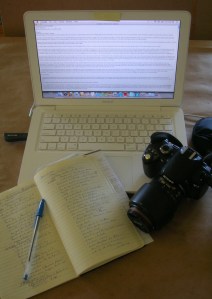
Welcome to a weekly series called “Tools of the Trade,” in which I invite creative professionals all over the world to share a little bit about what they do and where they do it. I encourage them to define “Tools of the Trade” however they like. ” Well, she said “however they like”, so I jumped in. My writing is based on notes on paper, composed in TextEdit (ala the PC’s Notepad), and only transferred to MS Word as necessary. My photography is based on a lower end Nikon, a D40, that has fewer pixels than some phone cameras. My teaching and consulting are almost technology free, but heating and lighting are appreciated. (Though I did just have two fine meetings outdoors today. But I digress.) Fancier technology may get me better gigs, be more impressive, but the extra costs can easily exceed the incremental benefits. I keep it simple.

And then there was my post about bicycling more and driving less, to the extent that the spiders were weaving the steering wheel to the rear view mirror. (Where would you place a front view mirror?) Using my car less decreases its pollution, cost of operation, and my anxiety over a high oil pressure anomaly. But Hannah Lee Jones made a comment about the underlying issue.  Here’s a snippet of her comment; “It seems that a lot of what we propose as solutions are dependent upon an infrastructure that is a lot more fragile than we could ever guess.

The world is a fragile place, at least in regards to supporting the human race. The biosphere is being challenged, and just like with the dinosaurs, it may evolve a solution that doesn’t involve the dominant species. Stay tuned. Very few things can disturb the planet. The human race, however, has lived a precarious life. A long while ago the population collapsed from millions until there were less than 20,000 of us on the planet. That’s the population of the southern half of my sparsely populated rural island stretched across the globe. Evidently agriculture saved us (though genetically my body hasn’t evolved to properly digest wheat, so the adaptation continues). Even after the rise of historical civilizations, life has been fragile. History has more examples of civilizations failing than it does of civilizations surviving. Now that the human race has gone global though we may have raised the sensitivities through numbers and technology. The majority of seven billion people do not have adequate power, water, food, education, health care, or security. Until we provide the basics to the vast majority, and do so sustainably, we as a species are fragile.

But I won’t say that I use simple solutions because I expect my solitary efforts to be a shining example. If some see it as a positive role model then great. Glad to be of service. I use simple solutions for two reasons.

One is what I described in my post on Angela’s blog. Pardon me as I steal from myself. “I am a minimalist, not through some grand plan, but probably because I was brought up in a family that had to be careful with money. That carefulness was handy during my aerospace career. If something is going to fly, every ounce counts and if something isn’t necessary it is left behind. Self-propelled tours of bits of the planet by hiking, skiing, and bicycling reinforced the notion. I’ve learned to live for days or weeks on what can fit into a backpack or panniers. Gear has to be simple, compact, rugged, and easily replaceable.

The other reason is that I must. My finances, my liquid net worth, are in such bad shape that I am applying for jobs and scrambling to make my efforts pay my bills. In general that means making money. I haven’t found any other way to pay the mortgage or the insurance. My situation is fragile. I am also an optimist. The odds of everything succeeding are very small. The odds of everything failing are also small. The most likely result is that something good enough will happen. Of course, I’ve been thinking that for months now. (Cheer up. Some good things are coming. Any day now. Really. Actually yes. Stay tuned. I look forward to blogging about good news, and in the meantime, go buy one of my books or photos or call for a consultation.) After my finances improve sufficiently I will get the car fixed, maybe get the sand out of the auto-focus mechanism in my favorite lens, probably add a travel computer for slideshows and such, and generally reduce the frailty in my life.

I am not alone. Many people are in tougher situations. I have specific reasons for hope. Most poor people have hope and whatever they can find at hand. Societies and governments built around them are built on fragile foundations. Governments and institutions work to maintain the status quo because we are in the blind habit of propping up dysfunctional processes. Our civilizations have rarely evolved out of that precarious situation. Something revolutionary might happen. That’s why I tend to invest in innovations and inventions that disrupt convention. To me, MicroVision‘s technology for fitting projectors into cell phones isn’t just a cute way to carry around a 100 inch monitor. It’s a way to abandon the habitual dysfunctional processes that go into digging up tons of sometimes toxic raw materials, to build enormous black boxes, that are shipped around the world in boxes in containers on ships, stored in warehouses, and then discarded after a few years. And the nice thing is that we can disrupt those wasteful practices and end up with the ability to show a wide-screen movie anywhere. Cool and positive. Okay, MicroVision (MVIS), do your stuff and do it soon so I can make my lifestyle much less fragile and help others too.

I am hopeful because the human race is adaptable. We’ve never had to turn around seven billion minds and lives before, but we will probably find a way. I suspect it will happen through innovations, inventions, and ingenuity. That is the basis behind my incubator. Others have similar and possibly better ideas. I’m glad to hear that. The more ideas the better. Now, as for the funding, well – anyone got a few million dimes?

Simple solutions will point us in the right direction. Respecting our frailty and working to reduce it is a necessary goal. And opening the channels for innovations, inventions, and ingenuity will make the effort easier, quicker, and our lives better.

I really should go clean the windshield in the car now. The cobwebs are cute, but more than a bit distracting. Maybe I’ll clean the camera lens too.

PS Even when I work from two of my previous posts, the words stretch out to over 1,300 words. So it goes. If I had more time I’d make it shorter. IIHMTIMIS

Posted in Uncategorized | Tagged , , , , , , , , , , , , , , , , , , | 1 Comment

Cobwebs In The Car

There are cobwebs in my car. Okay. It’s spring. Spiders are hatching everywhere, why not in my car? Evidently, they are using it more than me. Spring is partly to blame. So is $4.26 gas. I’m using a startling new technique for decreasing my gas costs. I drive less. It has its advantages, and I wonder if we’ll finally see a change in the way we live.

I like to start Saturday mornings by listening to Car Talk. Back when I hiked every weekend it was fun to listen to Car Talk on the way to the trailhead and A Prairie Home Companion on the way home. The hiking doesn’t happen as much anymore. Gas prices, ferry fees, and an aging car explain a lot of that. My house is shielded by a ridge, so my radio has a rough time pulling in a good signal. Fortunately, streaming happens and that’s good enough. I listen because Tom and Ray are entertaining and because I usually learn something. I might even call them this week if I can’t figure out an oil pressure issue. My ~150,000 mile Jeep has high oil pressure but isn’t burning any. Go figure.

With my current financial situation, ugh, I’m driving a lot less anyway. Much of what I do with writing and consulting can happen from home, so that’s handy. I can walk to Hammon’s Preserve where I am a Site Steward. And my neighborhood is on the water with marvelous views. Staying home is a treat. There are plenty of reasons to get out and drive: groceries, photographing Twelve Months at Double Bluff, managing exhibits, giving talks, socializing, etc. But now that spring has arrived and the days are longer it is easier to use my bicycle for some of the trips. If it wasn’t for one pesky hill and some skinny road shoulders I’d use my bike even more.

Some people shop for cars based on mpg and carbon footprint. I’m an engineer so I know data are good. But how something is used can be more important than how it compares to its competition. I know folks that custom design and hand build electric trucks. Amazing. They do it as a passion. Most folks though are likely to shop and buy instead of design and build. They need criteria and mpg and carbon are handy. But published criteria and data only make sense if the vehicle is driven the same way it was tested and measured. A commuter may benefit from a strict adherence to the numbers, but someone that only drives once a week won’t see the same benefit. They may spend a lot on something that looks like a good idea and is lauded by Al Gore, and yet have spent more money than necessary. It can take years to pay back such a seemingly good idea.

The easiest and cheapest way to decrease a car’s pollution and operating costs by 10% is to drive it 10% less. No new equipment required.

At last week’s conference, Collaborations for Cause, my team was tasked with coming up with a multi-media pitch for improving life in urban corridors. We focussed on commuters and came up with a slogan, My Commute Sucks, only to find that someone else already was using it. Oh well, at least that is proof that we were not alone. Ironically, most of the team members had given up the drive time commute by either using mass transit, moving within a walk or bike ride, or finding jobs that didn’t require commuting. We might represent a trend.

Trends can start from the fringe. I am familiar with frugality and bicycling. I’m Board Secretary of New Road Map Foundation (aka financialintegrity.org) and the author of Just Keep Pedaling, A Corner-to-Corner Bike Ride Across America. (By the way, I remembered there’s a slideshow online too.) Being conscious of how I spend my time and money, and being very aware of how far I can go on a bicycle mean I am comfortable with the notion of using a twenty year old bike instead of unnecessarily burning bubbling crude. Whidbey is hilly and the region is laughed at for being – moist. Yet, I am not as strong an advocate or as active a cyclist as others who are pedaling around our hills in the rain. Kurt Hoetling only used foot power for a year and chronicled it in The Circumference of Home. Hannah Lee Jones and Philip Renker Jones seem to use their bicycles for everything, including as fundraisers for their Ndoto Project (empowering youth in Africa).

Systemic changes do not require massive investments, revolutionary discoveries, or severe depravation. Changing the habits of a population require incentives, and I am not talking about tax breaks. Change happens quickest when people want to change. I watch trends and I am watching how news reports, facebook posts, and tweets are changing as gas prices increase. When the bulk of the text switches from complaining about the cost to proclaiming personal solutions, then change is being embraced.

Commuting costs, housing markets, trustworthy investments, health care options are all being challenged. Mass transit and people power can create more pleasant commutes. A sucky commute can become a lucky commute. Owning a small and comfortable house is winning out over buying a house so large that it owns the owner. Local and peer-to-peer lending is appealing to investors who trust their neighbors more than they trust the traditional markets. Businesses that advocate “alternative” healthcare are finding themselves busy as people distance themselves from western medicine – a trend which is entertaining because the “alternative” frequently is based on thousands of years of development, practice, and experience.

I watch such changes because I am an investor. I doubt that I’d invest in a car company. I don’t want to sell my house, but it might be a prudent financial decision (care to look, shop, and buy?); but as I dream of a better abode I envision something small and well-built in a very nice place. I’m still in the stock market because I am optimistic about and have invested in positively disruptive companies. (Unfortunately, the market see disruptive and thinks risky. Therein lies my financial situation.) And as for health care, I’ve been following friends’ advice and feel much better than any prescription ever managed.

Our world is changing. We know we can’t continue doing exactly what we’ve done before. We’re running out of planet. But some very powerful solutions are simple and pleasant. In my case, it means giving the spiders enough time to weave a cobweb from the visor to the steering wheel to the mirror, while I bicycle through spring days. The cobwebs are actually a good sign. The moss growing around the edge of the bumper – well, that’s just proof that I live in the Western Washington and that our local car wash shut down.

Posted in Uncategorized | Tagged , , , , , , , , , , , , , , , , , , , , , , , , | 3 Comments

My Nonsensical Realm

My world passed through ridiculous long ago. Now it is in a realm of nonsense. Companies do well, and their stocks drop. Do good hard work, and wonder if I’ll get paid. Apply diligently for jobs, and listen to the void. I admit to frustration, realize others are frustrated too, and yet I will persist.

It’s time to pay the mortgage again – within the grace period. I’ve been paying my bills by selling DNDN (Dendreon – a cancer vaccine company) at prices I consider to be a small fraction of the company’s worth. Each earnings announcement is an opportunity for good news, an increase in the share price, and a reason to delay my sale until the good news hits. Back in August they missed earnings by 20% and the stock dropped 80%. Since then they continue to increase earnings. The rest of the market is recovering. Surely DNDN’s valuation will return to the vicinity of those previous levels with each month’s good news. May 7th Dendreon reported results again. They hit their revenue numbers. They continue to grow. The treatments continue to work. The stock dropped 20% further. There are plenty of rationalizations, but to me, it doesn’t make any sense. It should eventually, maybe after I’ve sold all of my shares. Sigh.

Fortunately, I have skills and energy. I’ve been busy:

And then consulting showed up, and I’ve come to realize that I like it best. People and ideas are my passion and I am energized after each session. (Give me a call. We’ll probably have fun.)
Oh yeah, and each of us does charitable work too, right? So let’s remember being a site steward for Whidbey Camano Land Trust, and Board Secretary for New Road Map Foundation.
Okay, so maybe my energy level isn’t as high as it could be at the end of the week.
Unfortunately, all of that work has yet to pay the bills. Where’s the sense in that much effort producing so little reward? Many of those projects could pay the bills, and maybe someday they will, but the mortgage is already past due. (Thanks for grace periods.)

The good news is that there are jobs out there, so even if my entrepreneurial efforts don’t succeed perhaps a paycheck can make it all better. You can probably guess that my job search hasn’t been successful. (But if you want to help, here’s my resume.) A week or so ago I applied for another “rocket science” job, didn’t get it, and found out that there were 1,500 applicants. Even if I was more qualified than 1498 of them, and I don’t know if I was, coming in second is not good enough. It is a small comfort that I am not alone, but it can seem senseless to look for jobs every day with so little encouragement. I’m in my ninth month of daily looking and not yet finding.

At some point it seems to make more sense to do nothing. Sitting still for these months would have cost less, left me with more energy, been less stressful, and possibly had the same result.

The other evening I watched “My Man Godfrey“, a William Powell and Carole Lombard movie about wealth and poverty. It is a romantic comedy, but because it was filmed during the Great Depression (1936) it also acts as a societal commentary. Godfrey is homeless, except for a tin shack in the dump. He fell there from society’s heights, and then re-enters society by becoming a butler with style. They filmed it before they knew whether the Depression would ever end. I’ll paraphrase one quote; “They say prosperity is right around the corner. Which corner is that?” This was seven years after the crash and they still didn’t know where they were going. We know how it turned out, and hopefully the recovery doesn’t require a World War. I suspect the economy would’ve righted itself without the war. How close are we to turning the corner?

Picking good companies to invest in, doing good work which is nicely complimented, diligently applying for jobs at every level from secretary to director yet watching my net worth drastically dwindle is my recent frustrating history. It doesn’t make sense. And yet the optimist in me has not lost its voice.

The likelihood that everything will succeed is very small. The likelihood that everything will fail is very small. As I sell, my portfolio has a tougher time recovering, but the possibility exists. Come on MVIS and GIG. – you can do it and do it soon. The 10,000 Rule is working for me, I hope. My books and photos can sell themselves. If they do, then my work in the past pays me in the future. My classes are expanding. Consultations are becoming more common, especially as folks that have contacted me follow through. (Nudge.) Each of the other projects can surprise and there’s no way to know which to emphasize at the expense of the others. I’ll keep working on them all. The improving economy should be working for many folks eventually, including me. Young folks are getting job offers. Maybe my middle-aged friends and I will get such good news too. What’s most likely is that enough good things will happen, and that would be a sensible realm.

Posted in Uncategorized | Tagged , , , , , , , , , , , , , , , , , , , , , , , | 2 Comments