Help Find A Friend A Job – Spencer Webster

Welcome to the second installment in a new category within my blog: Help Find A Friend A Job (#FAFAJ). Jennifer Hooper was the first, and continues to look (but with some good prospects from other sources.)

I was probably the first, but unintentionally. Check back to the beginning of this blog and its predecessor and read the cautious optimism of a semi-retired investor. My job search continues, (My Jobs Report Month 9 – now past month 10), but I wanted to open the discussion to more than just me. I use myself as an example that gets past the statistics, but I am not alone. People are having tough times. Usually I say that in a general way for the sake of discretion, but I realized that some of my friends might welcome the opportunity to speak up and have their story told too. So, I decided to ask a few if they’d be willing to answer a few questions. People are more than their resumes. Maybe this is another way to get to know them, and help find a friend a job.

Welcome to Spencer Webster, a man I know as an artist and a writer. Here are my questions and his answers.

0. I take it you are under-employed. Is that a good way to introduce you?
I definitely would say I’m under-employed. For nearly six years, that has been the case. I’m ready for the next big step, whatever that looks like.

1. Who are you? Not the job titles, but who are you?
I am that creative person who has a wide-ranging skill set and interests to match. Perhaps too-wide. I am a content producer, from photography, to writing, from video to audio, from editor to page designer. If you need an updated newsletter, whether electronic or in print, I’m your man.
I’m a people person, capable of connecting in very meaningful ways, which comes through in my interview style. I don’t just see people I’ve interviewed as done once the interview is complete and the article is written. I count them as friends.

2. How do you want to live your life?
I want to be valued for my skills to a point of comfort, in turn to be able to pay my bills and have enough left over to do the things I enjoy, travel with my wife, explore, camp, fly radio controlled soaring gliders, shoot photos and ride a good motorcycle. Not too much to ask for.
In the end, I want to be able to live in the here and now, not just survive.
Oh and I want to continue to write fiction and tell people’s stories that get people’s attention.

3. How have you been getting by?
The thing that keeps me afloat is my military retirement pay. I have been working minimum wage jobs while getting a few interviews here and there for that elusive hand-up position that would change my life for the better, financially.

4. What title fits you that would never be picked up by a resume robot?
All-around writer. From newspaper articles, to human-interest pieces, from light technical writing to converting technical speak to layman’s terms, I’ve got the ability to distill language into readable type.

5. What job jazzed you the most?
My time on USS Enterprise as a public relations specialist – I got my hands on newsletter production, broadcast television, media relations, design and connecting with people experience.

6. Did you leave your last job or did it leave you?
I left it because I was moving from Southern Illinois back to the Pacific Northwest.

7. Besides the paychecks and benefits, what do you miss about having a job?
If I was completely unemployed, I’d miss the socializing, the networking with anyone I connect with. I don’t miss much about my time in the Navy except the meeting and making friends with new people.

8. Have you learned anything, either formally or informally, in the meantime?
I’ve learned there is some elusive thing I’m missing that companies are seeking. I interview well, become top three within a list of candidates, but something is just not present in my experience nor in my characteristics that keeps me shy of being hired. I’d love to find out what that is.

9. What projects have you gotten done in the meantime?
I’ve just completed a metaphysical thriller novel about a man who dives into his psyche, and meets a whole host of good and bad characters that help him to work on issues of love and forgiveness.

10. How else do you keep yourself busy?
I build model aircraft, shoot and edit videos, spend time with my wife and kids and explore Kirkland, WA.

11. How can folks find you?
People can find me at thewebby@gmail.com.

Spencer is always busy and trying new things. I wrote a few articles for an arts and lifestyle newsletter that he produced, edited, and published a few years ago (Inspiris). He certainly doesn’t sit still. He applies energy, talent, and enthusiasm to entrepreneurial projects. As he says, “Something’s got to break open.” He also has a YouTube channel and a Flickr feed.

Cloud Gate

Six years of looking. That’s impressive, and what’s more impressive is his positive attitude throughout. Role models exist. Here’s hoping that he finds the means to “live in the here and now, not just survive.”

A note to my friends: If you’re having a tough time finding a job and want to participate, send me an email. I don’t know how often I will post the responses. It has to fit in amongst the various projects that I’m pursuing. Stay tuned. Good luck.

A note to other bloggers: You’re welcome to pick up this idea too. Maybe using the same title, Help Find A Friend A Job (#FAFAJ), will help spread the idea. The more people hear the stories, the less likely they’ll see unemployment as a statistic or the unemployed as a stereotype. During the Great Depression people walked door-to-door asking for work. That is happening again, but maybe moving some electrons will be more effective. We might as well try. It would feel good to succeed.


Posted in Help Find A Friend A Job | Tagged , , , , , | Leave a comment

Sifting News For News

MicroVision (MVIS) is proof that investing doesn’t have to be dull, and just like in any news item digging deeper uncovers unexpected gems. Owning shares of MVIS is a cause of severe optimism, serious pessimism, prolonged patience, and considerable consternation. They may revolutionize the electronic display industry (go ahead, count how many displays you see in a day) or they may go broke. Finding out what’s happening is an exercise in parsing press releases (Deciphering News), attending stockholders meetings (Corporations Meet Owners MVIS 2012), trawling through discussion boards, driving past the company parking lot, or even going directly to the source and contacting the company’s Investor Relations official. Put it all together and I still may not come up with an answer, but I learn something every time.

A client (did I mention that I consult with creative people?) asked me how I research small companies. I prefer to value companies based on “Present Value of Future Revenues Discounted for Risk”. Which needs an acronym so how about PVFRDR? I use it because when I buy stock it is usually in a company that has yet to make any money. There’s less competition for the shares because there’s less certainty about what they are worth. I avoid the other end of the investing spectrum because there is great certainty about how much mega-corporations will make, and they are tracked and traded by legions of financial institutions. I invest where there is great opportunity and uncertainty. My risk tolerance is higher than most, which has been dramatically tested these last two years (coming up on the anniversary of the worst partly described in Triple Whammy).

We talked about my method from my book, Dream. Invest. Live., but basically, if I find a company that may be worth $1,000,000,000 five years from now and their current market cap is less than $500,000,000, then buying their stock now would return 15% a year. But it isn’t that easy. There’s always a finite chance they will fail, so the discount for risk is a guess. If they have a 50% chance (and here it helps to know something about the industry and its history) then I check against 0.50 x $500,000,000 = $250,000,000. If they have a 10% chance then I check against 0.10 x $500,000,000 = $50,000,000. Consider yourself perceptive if it seems like there is a lot of guesswork involved. The key for me is that future revenue. Few companies provide a number because they don’t want to go to trial for over-exaggerating the company’s prospects or be charged with attempting to manipulate the stock. We investors have to find the numbers ourselves despite the fact that the company must have a guess because otherwise they wouldn’t have formed the company.

So, lets go back to MicroVision. They have the potential to impact the multi-billion dollar electronic display industry. I’ve held the stock for over ten years and have always felt that this year or next they might finally begin their ascent. Delays have happened every year, but recently the news has become more immediate and the delays are shorter. Products should be available within six to nine months, for the last two or three years. It’s progress. (Hey, next week is within six months.) But wait, news has hit the wire, or the net. Lately the problem has been volume production and someone found some great news. The article uses the words MicroVision and pico-projector, and the numbers $19 and 2,000,000 units and 100,000,000 units, and the times of this year. If MicroVision sold 2,000,000 units at $19 their revenues would exceed their market cap. Play with that 100,000,000 number and Wow! maybe I’d be back to retired again.

Excellent. But the news was in Chinese and most of those words and numbers were surrounded by characters and guesses. Ah, but welcome to the world of automatic translators. Thank you Google! Now everything is in English words and recognizable units, but a string of words doesn’t necessarily become a sensible sentence. This was playing out on the discussion boards and folks dove in to parse the parlance and delve into the data. We may have just stumbled upon a leak, a highly profitable and public trading advantage, and the sort of news that optimists have anticipated for years. Calls for human translations went out through the community. The sparse and improved response confirmed much of what we thought, but weren’t complete professional translations because we were asking for alot and paying nothing.

There were some hints that we found the investor’s version of fool’s gold. The stock moved, so someone knew about the article, but it only went up 20% not 200%; and the volume was up, but not enough to convince me that institutions were jumping in. There wasn’t any press release from the company, but my expectations are so low that I accepted that. Google News didn’t pop up anything, not even the article. It was passed along by a link on a discussion board. The twitter and facebook feeds were quiet, only reporting on the departure of our preferred Investor Relations representative; but, maybe her departure explained the lack of news. Real life human events affect the supposedly automaton functioning of corporations. I even checked YouTube for official or unofficial videos in case someone uploaded some images of a new product. It all added up to nothing.

The news about the news came in. Evidently, the source was an Asian stock tabloid that has a reputation for publishing articles that would probably violate SEC rules. It was published months ago, and either republished or rediscovered. Some of my interpretations were confirmed. MicroVision wasn’t the only company mentioned, though it was prominent. The other players are bigger and may account for the majority of the 2,000,000 units to be shipped. The 100,000,000 units may be a total market number not a 2012 production quota.

So, there was no news, but it was suggestive; so, maybe the exercise was useful. The industry is developing. There are numerous suppliers and customers. If MicroVision was to achieve 10% of a 100,000,000 market and make $10 profit on each unit they’d make $100,000,000. Use a price/sales ratio of 10, a reasonable premium (in a normal market) for a disruptive technology and MicroVision gets a market cap of $1,000,000,000: a thirty-fold increase in stock price (assuming no dilution). OK. Can I have that now, please?

And there the argument/discussion/debate/consideration continues. Are any of the data trustworthy? What if they get more than 10%, or less? What if the market is larger, or smaller, or sooner, or later? How much profit can they make, and will that change with time, technology, competition? Will the markets return to higher premiums for price/sales and such, or are we in a new paradigm?

Yep. Even without any real news, we have a lot more to talk about. Imagine our conversations when we MVIS shareholders really do get good news. It should happen anytime now. Didn’t I hear that an announcement or three were due in the second half of 2012? Hey, look at the date! It’s July 7th! Sometime in the next 180 days or so there should be a really good press release. Aren’t we due? I’ll go check the news.

Posted in Uncategorized | Tagged , , , , , , , , , , , , , , , , , | 1 Comment

Independent Call To Action

It’s the Fourth of July, an excuse for me to remember my ancestor who signed the Declaration of Independence: Francis Hopkinson. Their fireworks meant something completely different. Flashes in the night sky followed by window-rattling booms were signs that the British were coming. They fought for freedom, and while I prefer the “pursuit of happiness” part, I also know that they had business in mind. I wonder what they would do in our situation and what we would do in theirs. I wonder what we will do with ours. Do we return to social safety nets and rational markets, or do we revolutionize the world again? If anyone in 1776 correctly predicted where the US would be in 2012 it was probably by luck or clairvoyance.

Their call to action came from white men, most of whom were in their thirties and forties, and who were positioned to have attained a position as Delegates to Congress. They weren’t all rich, but I suspect that if they were poor it was from the debts faced by all farmers and merchants. They fought tyranny to attain freedom. Citizens didn’t abolish monarchs; especially, monarchs that commanded the world’s pre-eminent army and navy. It was unheard of (but the Magna Carta should’ve been a good hint.) What Congress did was radical, and continues to be the role model for regime changes. Their courage was personal. If they failed they’d be executed. Well, maybe that part hasn’t changed.

The total population of the thirteen colonies was 2,400,000. Metropolitan Seattle encompasses over 3,000,000. Spread that out over the entire east coast. In 1776, simply showing up was a major event. It was easier to stand out because there were fewer who were available to attend anything besides their crops or businesses. The commute to Congress took weeks for some delegates. Dropping by or Skyping in wasn’t going to happen. Considering the small population, it is amazing how many of them were well-educated, wise, and like I said above, courageous.

Today’s call to action is more diverse and our situation is more complex. If nothing else, more people are involved.

Prepare for a list of somes.

  • Some people probably think that nothing needs to be done, that if everything will recover back to normal if we just give it time. Plenty of the traffic on facebook walls and twitter feeds suggests that many people are simply trying to get on with their lives, but that was true in 1776 (but walls and feeds meant something else).
  • Some people are moving the levers of power behind the scenes, using influence and intrigue to affect change. Benjamin Franklin was a proponent of secret societies, which he subsequently made public in his autobiography.
  • Some think that comedy or hyperbole is the way to address contentious issues, or at least to get the discussion moving past roadblocks. Jon Stewart and Stephen Colbert, meet Thomas Paine.

There are plenty of similarities, but there are also differences that make the outcome harder to predict.

  • Our conversation is no longer local. When the colonies broke away, they had the hope of being largely self-sustaining. The adage may be that all politics is local, but now the affects are more likely to be global. If one state or nation bans something, but another makes it legal, there will be migrations. When a disaster strikes Japan, businesses around the world feel the break in their supply lines and consumers can’t get certain products. Debris and pollution spread just as far as before, but the quantities and consequences are far greater. Fortunately, the support flows in from around the planet because we are much more aware of each other now.
  • More people are involved in the debates and notice the consequences. A population of over 300,000,000 Americans means over 300,000,000 opinions even if some of them are trying to use prescribed talking points. Consensus is tough enough in a two person relationship. No wonder we have a tough time getting to an agreement. No wonder compromise may be the only path to solutions. Unfortunately, compromise is out of fashion.
  • Debates – wait a minute, we don’t debate anymore – anyone trying to fully understand an issue today has to either devote an academic level of research to the task, accept a lot of the background on trust, or draw boundaries around the issue at the range of their familiarity. Legalizing marijuana is an issue of personal freedom, legal jurisdiction, health relief, health care, foreign drug wars, hemp fabric production, taxation, and economic. The definitions of life and death were simpler in 1776, but now we know more about what’s happening in the womb, how to fertilize eggs outside the body, and the nature of stem cells, can cure major illnesses, compensate for major traumas, and extend life to the point that it is hard to recognize. Who’s life is it when we haven’t agreed upon a definition of life? And if life is that precious, do we only consider human life?

Last week’s Money And Life conference at Whidbey Institute was more about the money side of the balance; but that is no less complicated. I’ll post more about that after some of the content becomes public, which at least means after Katie Teague’s movie, Money & Life, premieres (and by the way, she’d appreciate donations to finish producing the final cut.) It is apparent that economies, currencies, commodities, luxuries, and necessities are seriously out of balance; and that bringing them into balance involves species-wide consequences. No wonder the European Union is in such disarray. No wonder Kyoto, Rio, and Copenhagen haven’t created global solutions that are enthusiastically pursued and completed.

The Occupy Movement represents just as likely a path to solution. Alvin Toffler’s book, Powershift, suggested that governments would become anachronisms when information became more important than geographical borders. Some people, some individuals, are creating ways to find their own solutions. They are joining together to learn, and the dispersing to enact their independent variations on those solutions. Independence is a powerful tool, and now it can be applied with more awareness of our interdependencies.

As an optimist, I see many possible positive paths to appealing futures. As a realist and someone aware of the mathematics behind systems, I expect us to witness traumatic economic, environmental, and societal upheavals. As an investor, I keep in mind, that if publicly traded corporations continue to exist, that those with positively disruptive solutions are probably going to be in high demand – and so will their stocks. If only I didn’t have to sell stock in the meantime. (Got a job for an aerospace engineer that understands finance, trends, and how to write?)

As an islander, it is time to get out my bike and head over to the Maxwelton Fourth of July Parade. I’ll be part of the Occupy Your Bike troupe, squad, fleet, whatever. Registration is easy. Show up. Ride. Smile. Celebrate our independence and our community. Celebrate our solutions (we won’t be the only group with an idea) and have fun doing it. Happy Birthday America. And thank you, Francis Hopkinson. Did you know how this would turn out? Do any of us?

Posted in Uncategorized | Tagged , , , , , , , , , , , , , , , | Leave a comment

Semi Annual Exercise Mid 2012

Well, these last twelve months have certainly been a surprise and upsetting. Fortunately, by conducting these semi-annual portfolio exercises I can check back and know how the story changed. Trusting to imperfect memories can be delusional.  Unfortunately, replaying the disaster strike does not make the effects go away. Since my 2011 mid year review:

  • AMSC is down by about 50%
  • DNDN is down by about 80%
  • GAIA is completely sold
  • GERN is down by about 50%
  • GGOX.OB has become GIG and has doubledYeah!
  • MVIS is down almost 80%
  • RSOL is down almost 50%.

Why?

AMSC dropped but so did their revenues, though not through normal business problems. AMSC’s revenues dropped 75%, largely because their largest customer backed cancelled orders and is now suspected of stealing AMSC’s intellectual property. Then they tried to compete against AMSC. This one is a highly watched test case in the Chinese courts. Will China protect foreign IP or not? They say they will. This is when they can prove that they do. In any case, the resolution will take years during which AMSC has to recover.

DNDN dropped despite dramatically increasing revenues, but the increase wasn’t dramatic enough. A 20% shortfall resulted in an 80% stock decline. This one had the largest effect on my life. If the stock had only dropped 20% my search for a job and a house buyer wouldn’t be as important.

GAIA went away (Real World Trade GAIA) partly based on these exercises. I could see that they weren’t going where I wanted them to go, so I let them go. That’s investing.

GERN’s decline isn’t a surprise considering the news, but the news was a surprise. They discontinued their stem cell trials and research. I still haven’t heard that complete story yet.

GGOX.OB graduated from de-listed from NASDAQ to re-listed under GIG on AMEX. Congratulations. Their stock doubled even though their revenues were only up 20%, but some may have noticed that they have more than doubled revenues from two years earlier, and that they have new products coming out, and that they are still cheap. The stock buy-back and re-listing didn’t hurt. At least I have one success story with a lot of remaining upside.

MVIS is down, but that’s mostly because of massive dilution made necessary by supplier delays. It may be a simple statement, but it has an enormous effect. I have too many ideas of where it could go next based on more simple good or bad news.

RSOL is down, but they grew revenues by 40%. I think they have a Solyndra headache.

The market reactions to AMSC, DNDN, MVIS, and RSOL are unexpectedly, and I feel disproportionately, negative. Unfortunately, they were my largest holdings and to have two of them down 80%, and two of them down 50% has traumatized my finances, and frequently my emotions. Irrationality is hard to witness, especially when the impact is real and not abstract. Twelve months ago I thought I was on the cusp of seeing AMSC’s cables hit the market, DNDN reporting better revenues and expanding geographically and across the patient population, GERN possibly reporting that they’d helped a paralyzed person move again, and MVIS releasing a marvelous product that had been hidden by an NDA or maybe even releasing a product on schedule. What were the odds that they would all succeed? Small, of course small. What were the odds that they would all drop so much at the same time? Small, of course small; and yet, that is what happened.

The consequence is that since DNDN’s news and move in August 2011, I’ve been looking for a job. (My Jobs Report Month 9) No news yet, but I finally had an interview for an office position. My first in ten months of searching. It is part-time, but part-time is better than no-time. Besides, it is on the island; but, I’m also not the only applicant. And, someone else wants to hire me, if he can raise the money. Anyone want to fund an angel investor foundation or corporation working on innovative and positive solutions for the planet? And, someone else may have found a side door to a place where I keep knocking on the front. In the meantime though, I’ve spent almost everything outside of my IRA, and have had to sell over 75% of my depressed DNDN shares to pay the bills. At this rate, and without another source of income, my only other available asset to sell to generate money is my house; hence, my home is for sale.

My semi-annual exercise is useful. Without it, rewinding the memories could be an exercise in second-guessing and futility. It would be too easy to emotionally beat myself up. Knowing that my situation is a dramatic coincidence of bad luck doesn’t make it easier to pay the bills, but it does make it easier to understand and less personal.

Imagine the flip side. Imagine that equally small percentage possibility that all of the businesses and their stocks would’ve succeeded. It would be wonderful to look back and watch it happen. Me, my home, and many parts of my life would be much better, or at least I wouldn’t be delaying a lot of maintenance and repair (though I did finally splurge and bought glasses.)

What was more likely is what I suspected. Some of the businesses wouldn’t do well. Some would. I suspected that enough would. At least as I type this, I was wrong. The odds didn’t work out that way. Such is the nature of investing.

I’m going on a bit longer than usual here because if I don’t find the money from my business (check out my books, my photos, my consulting, etc.), or from a job (here’s a resume), or from selling my home (drop by for a virtual tour), or from some windfall (hello lottery), then this may be my last semi-annual exercise. The current value of my portfolio (pardon me as I double-check) is probably enough to make it through the rest of this year, but in some scenarios so little would be left that I wouldn’t worry about the exercise. Of course, in that time, enough of my stocks could soon enough rise to the values I think are appropriate, AMSC could clear its legal hurdle, DNDN and or GERN could announce surprisingly good clinical results, and maybe even MVIS could finally release some significantly good news. Google glasses with MVIS inside would be marvelous. So would an iPad with MVIS inside. A rapid rise in DNDN that allows time for the others to reach normal valuations could be enough for me to recover. The odds of enough of that happening are reasonable, but I’ve been living through unreasonable times for so long that I won’t make grand claims. Of course, if things became unreasonably good, well, I’d accept that. Let’s hope I get to continue posting these exercises for years and decades. Live long and prosper. And stay tuned.

Here’s the end of 2012 edition of my semi-annual stock portfolio exercise. It is a long list of links to Investor Village, The Motley Fool, and Silicon Investor because I think the discussion should happen in a broad forum. Feel free to comment here, but also feel free to post links out to other sites as well. One of the greatest resources individual investors have is other individual investors. Our shared voices can be more powerful than any official financial institution.

Investor Village
AMSC
DNDN
GERN
GIG
MVIS
RSOL

The Motley Fool
AMSC
DNDN
GERN
MVIS
RSOL
Economy and Markets

Silicon Investor
AMSC
DNDN
GERN
GIG
MVIS

Posted in Uncategorized | Tagged , , , , , , , , , , , , , , , , , , , , , | Leave a comment

Tactical Scrambling

Do something and get past the jumble in the head. I’ve got a lot on my mind. So do friends and clients. The world is changing. That’s always true, but today’s changes are systemic, redefining paradigms, and are probably permanent. I was overwhelmed before I got out of bed. I stayed under the covers until I sorted out what my first few steps would be. Others I know are entangled with too many choices throughout the day, yet they have to stumble through on someone else’s schedule. We seek stability and clear direction. We seek the next step, but the next step is a tactic, not a strategy. Whenever I can, I remind myself of the goal, the over-arcing strategy; but, in the midst of dodging colliding circumstances the path we follow is chaotic. It may not look refined, but scrambling works. Sometimes that’s the only way to climb the mountain.

A while back I posted about a bit of my scrambling. (excerpt from What Comes Next)
I dropped in on a friend’s shop the other day. The store is busy and business is picking up. They’re scrambling to keep up with demand. As a kind gesture I was sincerely asked what I was doing. Nothing came out of my mouth. Everything tried to spill out at once, and they all collided, creating a blockage in my throat. Eventually I shrugged my shoulders and said, “I’m scrambling.”, and left a while later. It was lunchtime, and in a rare event I went out to lunch. It was a business lunch. I’ll hang my photos in the restaurant for June and July and needed to see how the space was used, where the light fell, and look for anything I might have overlooked in my plan. As I sat there, all of those projects finally lined themselves up and I wrote them out as a list in my notebook. After lunch I went back to revisit my friend and hand over my answer. There were fifteen items on that list, each of which was on the order of writing a book or managing my consulting.

By the way, the photos are up. The Braeburn is a nice place to have them displayed, and yes they are for sale. Drop by if you are on the island.

My scrambling continues. The list is modified. Some items were dropped. Some items were added. Most of them continue, with a disproportionate number coming to fruition this fall. I wonder what will happen this winter. The scrambling remains. The scrambling remains because none of the items have managed to pay the bills. (And because I haven’t found a job or sold the house.) None of the tactics have made overwhelming progress towards my strategic goal of sustaining a thriving lifestyle. Of course, many of them won’t produce fruit until this autumn. So I take lots of steps this way and that in the meantime.

Friends and clients are in similar situations. The details vary dramatically. But changes in the economy, corporate life, the investing community, the environment, and our society are convincing many people to question almost every aspect of their lives. How should they invest their time and money? Should they set goals that are tied to conventional lives with thirty year mortgages, or should they find a new model of living? Most of the conversations are about finding a new way of life.

The greatest variation within the “new way of life” is the degree of disconnection from conventional society. Build a bunker and hide alone? Build an enclave and hide with friends? Go off the grid and find an independent source of income? Buy a piece of land big enough to sustainably feed a family, but stay within a reasonable commute and keep a well-paying job? OR, stay within the city and the system and try to change it from within? One entertaining option is to live aboard a boat. Find a job within a short bus ride of a marina, quite possible beside the Salish Sea, have the city and the short commute; and then cast off if society decides to implode. Most think about sustainably harvesting the land. Why not the sea? (These are the kinds of questions I’ll probably hear more about at the Money And Life conference this weekend.)

Tackling such considerations and choosing a dramatically different lifestyle is impressive. Until we get this immortality problem solved, each life is finite, and the sooner the decisions are made, the longer their benefits can be appreciated. I applaud those that take on the task early in life.

Yet, as impressive and as powerful as such strategic thinking and actions are, worrying it too much, considering too many possibilities, can produce too much stress and may actually get in the way of making progress; e.g. Paralysis by Analysis. It is good to have a sense of urgency, but if that feeling becomes overwhelming it can induce rash moves that aren’t tactical or strategic. I learned a saying in karate, “Do not move unless it is to your advantage.” Don’t move simply to move. That’s where you can lose your balance.

Investors and paycheck employees are in the forefront of change. Corporations have lost some of the public’s faith and expectation of stability. Why buy stock if you can’t trust the management to have similar ethics and morals? Why work towards a retirement plan if you don’t think the company, its industry, or the structure of corporations will continue much longer? Trying to plan a life is hard enough. Trying to plan a life while almost every major institution is changing is impossible. There are too many variables for one person to comprehend.

I have too many ifs in my life too. (Check my previous post.) Rather than try to optimize a path that encompasses every possibility, I’ve decided to take simpler steps because they are more manageable. Each day is a long list of disparate items that are leading to various near-term goals that can all be milestones along the way to my main strategic goal. Live long and prosper. (Thank you Mr. Spock.)

Taking the smaller steps can ease some of the stress because at least some progress is made, and if the steps are small, no one will go too far astray. Each step can be a lesson. If you want to buy stock, buying a little will show you what it’s like. If you want to try changing the system from within, start a conversation with management. If you want to step away from the conventional paycheck world, see if you can take an extended vacation, leave of absence, or a sabbatical. Yes, there is a nice waterfront off-the-grid house with acreage and a dock that I’d like to own, but in the meantime, I am going to take lots of little steps, sometimes in different directions until the fog clears enough to reveal a straighter path. Until then, I’ll continue scrambling, tactically.

Posted in Uncategorized | Tagged , , , , , , , , , | Leave a comment

Serendipity Aboard Adventuress

Well, that didn’t go according to plan, and that happens every time serendipity is involved. It was fun. Let’s do it again! Thursday evening I was on a tall ship under full sail, the boat heeled over to the gunwales, as a 133 foot long ship with almost as much sail area as my yard, plowed through the waves under excellent wind and a surprise visit by sunshine. The nature programs, my presentation, and every other plan except joy was left in the lee. It all worked out better than expected. I never planned to be there, but that’s the way the world works if I let it. I’ve been pondering that since I made it back to dry land, with wet pant legs and a soaked shoe.

Tall Ship Adventuress – Main sail

The Adventuress is a tall ship that sails out of Port Townsend because “We envision a future where everyone values Puget Sound and chooses to act as stewards of its treasured waters.” They (Sound Experience) are also excellent stewards of the boat. Frequently they take people out for evening or weekend cruises. The ship can handle it. It was designed to sail to Antarctica and back and did. Of course, it is almost 100 years old and they’d appreciate any help or donations you could provide. I was aboard to talk about the land, not the sea. I am a site steward for one of Whidbey Camano Land Trust’s properties (Hammon’s Preserve). They invited me aboard to talk about the Land Trust (the land feeds the sea), and Whidbey (which is across the sound from where we sailed. Serendipity got me there.

The short version of a slice of my life. Spend less than I made. Invested the rest ala Peter Lynch. Aligned my spending with my values ala the 9-Step program in Your Money Or Your Life by Joe Dominguez and Vicki Robin. Semi-retired early. Moved to Whidbey Island. Met my new neighbor who’d just moved to the island too, Vicki Robin. Our books come out together. The revised Your Money Or Your Life goes on to become a best-seller, and includes me as a case study. Dream. Invest. Live., by me with a back cover blurb from Vicki Robin, goes, well, nowhere because a book about investing ala Peter Lynch doesn’t do well as the market crashes. Despite that I end up on the board of New Road Map Foundation, an advocate of the 9-step financial integrity program. New Road Map gets interested in expanding the advocacy programs beyond text by going to video too, so because of my photography background I get sent to Collaborations for Cause, a workshop for advocacy via multi-media. There I meet the executive director of Sound Experience, the charity that tends the Adventuress and the vision of marine stewardship. I tell her about New Road Map and my photography, but when she hears about the Land Trust she invites me along for a cruise if I’ll give a talk. Thursday was the cruise and I was aboard. So was Vicki. And I made my talk a total of five sentences. We were on a tall ship with an able crew, an eager set of passengers, good wind, and sun. I wasn’t going to get in the way of that. Besides, I pay attention to big hints and don’t get in their way. I greet them as friends and see where they’ll take me.

Congratulations if you read that entire paragraph. I could graph it out, but the interconnections are more entwined than I listed. The key is that a wonderful part of life happened by following a path that could not be planned.

I was at the conference because of finance and photography. I’ve gotten to know Vicki by reading her book, luckily moving into the same neighborhood at the same time, working on books together, and dancing. I am a site steward for the land trust because I moved again and found myself near a vantage point for my photos of Cultus Bay. Whidbey Camano Land Trust had nothing to do with the conference, but they were the organization that ended up with the best chance for a benefit. None of that was planned. Maybe the cancelled talk is merely postponed to a time when there are fewer distractions and the presenter (me?) has a better idea of the speaking arrangements. The decks of tall ships are working spaces, not the rigid orthogonal architecture of most classrooms or lecture halls. There’s no way to know where it all leads.

Cultus Bay from Hammon’s Preserve

Plans work best when the world is orderly. Serendipity doesn’t care about order or chaos. It makes things happen regardless of the circumstances. We’ve just been through turmoil. My plans were scrambled, and now I am scrambling. I’m not alone. Even nations and global organizations are looking for stability to regain enough control to re-establish plans. We’ve become accustomed to life flowing in prescribed channels to agreed upon rules, but that is recent and not typical of our history. We travel around in cars down paved and bounded paths. We reside and work within rectangular boxes. We expect the same from financial plans, relationships, and institutions. People who spend time in nature know reality doesn’t work that way. Trails wind to accommodate contours. Sailors steer according to wind and waves, tides and currents. Perhaps my time in nature prepared me for this next adventurous phase of my life that follows after apparently suspended plans.

The crew of the Adventuress are excellent at sailing through uncertain seas. A part of me continues to be organized and attempts to be unobtrusive. Vicki and I took the ferry to get to Port Townsend. We drove for almost an hour, to ride across the sound on a ferry, to sail on a tall ship, to find out that we got the schedules wrong. We thought the Adventuress would return in time for us to catch the last ferry back. We were wrong. I just assumed we’d try another day when the schedules meshed. No worries. The crew took our situation as a challenge. They assured us that after a couple of hours on the water they’d find a convenient break, lower a boat, and have a member of the crew motor us to shore – that is, as long as we didn’t mind getting our feet wet. They were sweet, enthusiastic, and earnest. I’ve stayed in nice hotels where the staff is accommodating, but officious. The crew of Adventuress was sincerely eager. Then we went sailing, the nature programs were cancelled because we were having so much fun, and I was convinced that in the exuberance we’d been forgotten. Maybe that was an opportunity to visit a friend for the night (and maybe get some dancing in, but that’s another story.)

I was wrong. After a couple of excellent hours, after I did actually talk to a few folks about the land trust, the ship was pointed into the wind, a boat let over the side, they hung a ladder, and three of us climbed down into a high-speed rubber raft for a fast, choppy trip back to shore. Vicki sat up front and caught most of the waves, and laughed. I checked in with our skipper. This ride was nothing. He’s done the same thing often, at sea, in the open ocean, going to ship to ship. He ran the boat up to the beach, and it was only my clumsiness that splashed a foot in the water soaking one pant leg and one shoe.

His attitude, the entire crews’ character, is inspirational. As a nation, a society, and as a species we are trying to maneuver our way back to a thriving world. I see it playing out as people try to make sense of their finances. Vicki’s new book is about making sense of food, the simple idea of aligning eating with values, and the powerful idea of everyone eating local. It is also playing out in every aspect of policy and personal action. The concept of charting a new course is cliche, but sailing may be the best analogy for how we are going to get to where we want to be, and even accommodating a few special needs along the way.

Posted in Uncategorized | Tagged , , , , , , , , , , , , , , , , , , , , , , , , | Leave a comment

Apple Pixar Dendreon

I’m getting ready for more than enough things. Cleaning up and out because my house is for sale. Compiling my notes for my semi-annual stock review. Consulting with friends about life and money. Wondering about how my life has gone, why I made the choices I made, and what’s next. There’s a struggle within. Logically and spiritually I think everything will work out well. It’s been so long since I had substantial financial good news that my emotions are having a tougher time buying into the optimism. Then I decided to unpack some long unopened boxes, and memories of optimism returned. I pulled out rare shareholder only Pixar movie posters. They inspired a mental connection from Apple through Pixar with some hope for Dendreon. Yeah, it surprised me too. Look at what I am selling now.

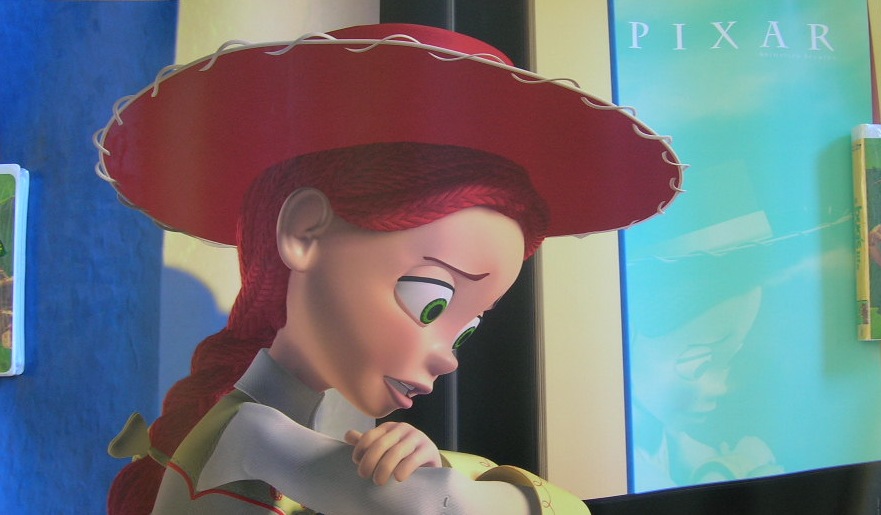
Pixar shareholder movie poster – Toy Story 2 Jessie

I bought stock in Pixar back around the time of Toy Story. Much of the art community dismissed them because the movies would be computer graphics, not hand-drawn images. Most of the investment community was making fun of them because it looked like a rich kid wasting his money. Back then, Steve Jobs didn’t have the highest credibility in the movie industry or the business world. I saw some of their early short movies and thought they were onto something disruptive. I go into that case study in greater depth in my book, Dream. Invest. Live. (which is a sales pitch, but also an expedient way to get on with this story.) For those early years Steve Jobs owned more than 50% of the company, so he could do anything he wanted. He had fun. Annual reports were colorful and were delivered with movie posters and videos. Investing doesn’t have to be dull.

Pixar shareholder movie poster – A Bug’s Life

The movies surpassed my expectations. The stock rose reasonably well. About the time it looked like the stock would finally reflect the value of the company, Disney bought them out. Steve Jobs became the largest DIS shareholder. The creative folks at Pixar got good jobs at Disney, basically taking over animation. The PIXR shareholders received a small premium, and could wait to become DIS shareholders. I don’t like owning complicated companies, so I sold and diversified. In the end, my profit was a very nice return, and a pile of movie posters. It was also a reminder that disruptive and successful companies can change the world – without necessarily having a similar financial impact for the majority of the shareholders. Buyouts interrupt investing success.

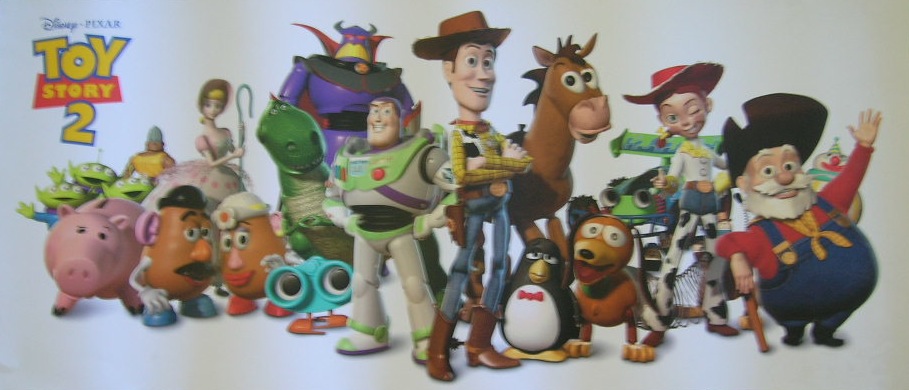
Pixar shareholder movie poster – The cast of Toy Story 2

Apple was never bought out. And as much as they use AAPL stock as an image of wealth in Forrest Gump, relative to other computer stocks, AAPL was a dull stock for its first decade or so. I remember. I owned it then. I bought AAPL because I’d seen, then used, then bought a Mac 512k. These folks were onto something. I debugged my friend’s IBM-ATs. I programmed PDP-11s and CRAYs at work. But I knew that Apple would succeed. Then they got rid of Steve Jobs, and in protest I got rid of my AAPL. I was glad to see them bring Steve Jobs back eventually, but I was comfortable with my move because I’d invested in other companies in the meantime. Apple spent two decades changing the way the world works, but within the public markets, the stockholders didn’t significantly benefit until the new millennium.

It is easy to look to the past and ignore a repeat happening in the present. Somehow DNDN came to mind. It was probably because I was compiling my notes for my semi-annual stock review.

Here’s a snippet from my first draft,
The first such treatment, Provenge, was approved for prostate cancer. Clinical trials suggest the treatment can be used over a wider patient population, and across more cancers (e.g. lung, breast, ovarian, colo-rectal, renal, bladder). The side effects are minimal in comparison to chemo and radiation. The overall cost is less too, though the individual treatments are expensive.
And yet, the industry and financial community focus on the shortfalls rather than the potential, so the stock languishes. Macs had trouble gaining market share too. Pixar lacked credibility, and even when they succeeded with Toy Story, it was discounted as luck. It wasn’t until the iMac, it wasn’t until the fifth movie that the companies were given credit for their accomplishments.

Dendreon’s technology is impressive. Maybe they haven’t found their dynamic leader yet. If the treatments continue to cover more of the patient population, geographically and across other cancers, then Dendreon will be truly disruptive, and eventually DNDN will reflect that value. There’s no guarantee of that success, but there wasn’t for Pixar or Apple either, which was one reason their stocks were undervalued for so long.

Selling DNDN to pay my bills is very demoralizing. It’s happening at a time when I’ve having to look for a job, and has led me to selling my home. It is demoralizing because I think DNDN may be following a similar path to AAPL or PIXR. I don’t know which. AAPL finally gained traction and the stock that traded around $15 for so long is now trading at $582. They maintained independence, vision, and execution, and have been rewarded. PIXR no longer exists. Pixar is known around the world and is an acclaimed success. The stock though was absorbed. If Dendreon maintains independence, vision, and execution, then the article Is Dendreon a $360 Stock – Or Is That Too Low? will be considered prescient. If Dendreon is bought out, hopefully just as many people will medically benefit, but the shareholders will miss the rewards. I’d like to hold DNDN, give it the time it deserves, and then use those rewards to fund a longer, more prosperous life. With that in mind, if I had discretionary cash, I’d probably buy more. (For the deeper, less optmistic story, read Corporations Meet Owners DNDN 2012)

Misfortunately, I don’t have discretionary cash. That’s why I am hunting for a job and selling the house. That’s also why I am taking those shareholder posters out of the back of the closet, flattening a few to photo, and then selling them. A quick look around the web shows that some have bought them for hundreds of dollars each.

Pixar shareholder movie poster – Toy Story 2? Woody and Buzz

Be first in line folks. I have a few extra that are in the original wrappers, and the original boxes. Maybe this PIXR dividend will help me hold onto my DNDN, or at least buy me some movie tickets and popcorn.

By the way, I also have copies of the uncommon copy of A Bug’s Life that has Hopper on the cover. Rumor has it the animators used Steve Jobs mannerisms in Hopper’s animation. Employees having fun with their dynamic leader. It happens.

VHS of A Bug’s Life with Hopper on the cover (original wrapping)

Posted in Uncategorized | Tagged , , , , , , , , , , , , , | 2 Comments

Money And Life On Whidbey

It’s happening. Economies are changing. People are changing. Change is happening. Even people with jobs and a bit of discretionary income are changing, or preparing to change. They know that assumptions about economies, currencies, and careers are very likely to change. That’s why something else is happening. At the end of this month there will be a “collaborative program”, “a convening of change agents working toward a new economic and social paradigm.” The first Money & Life event is being held at the Whidbey Institute. (A collaborative program of New Road Map and Whidbey Institute.) Even the concept of convention versus seminar versus workshop is changing. This is a new kind of event, and that’s appropriate because we are entering a new kind of world.

A Collaborative Program of New Road Map and Whidbey Institute

Have you noticed the change? It isn’t 1952 anymore.

Okay, allow me to back off a little bit. “A new kind of world” does not mean colonizing space (but sign me up for that discussion!). The new world we are entering is the new economic world. How can people change their lives to respond to the financial and social upsets we’ve encountered? If enough people change their lives, then society has changed. What’s that new society look like? This is a new kind of event because no one can stand before the rest and say that they’ve been there and have all the answers. We are building the answers together. And if we succeed we will create a new kind of world. We’ll definitely create a new society. And we’ll probably change our physical world. I doubt that we’ll change planets, but we’ll probably treat this one a lot better.

I’ll be there. I even get to co-host one of the talks about Individual Investor Advocacy, one arm of change that is like a tug throwing a rope over the bow of a container ship and trying to change its course. It works if done right. Others will talk about less corporate topics: Shifting Social Welfare Institutions, Tuning into Collective Wisdom, Indigenous Economics, etc. The key, as I understand it, is that those of us who show up are collaborators, equals, people who are actively engaged in change and who have something to give and something to gain. We are all expected to learn from each other. Podiums and pontifications happen elsewhere.

Regular readers know of my situation. I guess the post, Am I Financially Independent, is the quickest primer for those just recently finding this blog. My situation has made me acutely aware of the stable and unstable elements of the economy. Instead of listing them all I think of the changes in terms of thirty year mortgages.

Back in 1982 someone took out a mortgage and dutifully paid every month. How much has changed since then? Today my house is on the market for $291,000. Fifteen years ago it was about half that, $157,000. Seven years earlier it was closer to $100,000. In 1982 it was probably much cheaper. So housing prices are up. That’s not a surprise; but the world in 1982 was familiar with double digit inflation, double digit interest rates (a great time to buy bonds in retrospect), the threat of Mutually Assured Destruction, acid rain, ozone holes, the resurgence of America in space, and a young guy named Tom Trimbath heading back to college to get his masters in aerospace and ocean engineering. Personal computers were brand new. Arpanet, the predecessor to the Internet, was still alive. Reagan was President. Everyone remembered Watergate. Thirty years ago it was hard to buy stock without an expensive broker and research required visits to the library. Single digit interest and mortgage rates, the collapse of the Soviet Union, the retiring of the space shuttle without a replacement, and me becoming an artist and consultant were unimaginable.

None of us know where we will be in thirty years. Thirty year financial plans are extrapolations that quickly become academic. Currencies, shorelines, national identities, corporations may all change by 2042. What do we do if food or fuel become more scarce? Within thirty years technology will change enough to be unrecognizable. (If you really want to contemplate the extremes read The Singularity Is Near, by Ray Kurzweil.) I pity any sci-fi writer who is trying to write about 2042. If it takes them three years to write the book then we’ll be 10% of the way there. I don’t even want to have to guess what cell phones will be like in three years.

What we do know is that there is a general feeling that things will change because we’ve lived through change and have witnessed its acceleration.

Earlier this week I was talking with a client about security. Back when I was a millionaire I researched most of the financial instruments and how they’d survived through history. I learned that perfect security is an illusion. My recent life has helped prove that. Currencies can crash. Assets frozen. Every financial instrument had a moment when it failed. Bad luck happens. But of course it makes sense to strive for that security because doing something increases the odds of sustainability. But there are no guarantees.

I’m hearing a lot more from people who finally understand their basic needs are food, shelter, etc., not what they see in the ads. They are living within normal society, commuting to regular jobs, but they are more likely to eliminate their debt, live where they can grow some food, get off the grid within reason. Those are securities that are far less abstract.

This is the beginning, or the resurgence, of a trend; yet, it remains a minority. As the conventional economy recovers the majority have returned to their jobs, the malls, the couch, and their comfort zones. A significant minority sees that as yet another illusion. The Money & Life event at Whidbey Institute is for the people who see past that illusion and are interested in defining that new world. I’m glad to be included. (And happy it is just up the road within bicycling distance.)

The easy guess about the future is to say that the more things change the more they stay the same. In the last fifteen years or so I’ve watched the investment world bounce around as normal, but have also watched financial deregulation undermine the integrity of the markets while generating massive wealth for a narrowing segment of the population. The fundamentals of individual investing persist, but the growth in the excesses can’t persist for thirty more years. Maybe we’ll return to a more regulated market, but only after a more significant upset. I doubt that the total system will collapse from extreme dysfunction, but if it does, something familiar will remain. The global guesses are tough, but personal answers exist, and if they don’t, we’ll create them. Some say that currencies will fail, that money won’t exist; but, life will persist and thinking and acting now can help make a better society happen then. Step one: Ask a lot of questions. Step two: listen for answers. Come to Money and Life on Whidbey and do both.

Disclosure: I’m Board Secretary for The New Road Map Foundation, aka FinancialIntegrity.org.

Posted in Uncategorized | Tagged , , , , , , , , , , , , , , , | 1 Comment

Corporations Meet Owners DNDN 2012

Today, Dendreon had its annual shareholders meeting (what I shorten to ASM out of habit, but the real title is Annual Meeting of Stockholders.) Despite images of corporate America, no trumpets blared, no champagne flowed, very little gold was on display. At least that was the case for the public meeting. Considering how much management is paid it wouldn’t be surprising to learn that caviar was involved after the public left. Corporate America is caricatured, and a caricature is an abstraction. I like to walk in and check on reality. Sometimes the caricature isn’t too far off.

The meeting was held at Seattle’s Art Museum, affectionately known as SAM. The ASM was held at SAM. Nice place. If I wasn’t rushing around catching ferries and buses, and being driven by the desire to write, I might have hung around to look at Art. But, evidently I am a writer and an investor to the point that I attended without breakfast (gotta catch the right ferry to catch the right bus) and without lunch (when do the buses head from downtown America back to my island so I can write?). Two hours each way, I sympathize with the commuters who do that every day.

The total trip took six hours. The meeting took one. For those that want the details about the meeting, head out to the DNDN boards on The Motley Fool, Investor Village, and Silicon Investor. I post the full notes there so comments and replies can benefit broader audiences. For those that want a bit of the emotion and culture shock, stay tuned.

I’ve blogged before about the culture shock of traveling to Merika. Island life is stereotypically slow, quiet, and casual. Thirty years ago, Seattle was slow, quiet, and casual. Now, it is frantic, noisy, and populated with fashionistas. People from NYC and LA may disagree. Imagine the shock I’d undergo if I went to the big cities. It wasn’t always that way. Very few wanted to move to Seattle in 1980. I did because I’d landed a nice job at Boeing Commercial Airplanes. I was a young aerospace engineer and learned the trade on 747s. Suits weren’t required, or at least it didn’t appear that way. I dealt with computers. They didn’t care how I dressed. Microsoft, Starbucks, and Frazier may have changed Seattle.

About 100 people showed up for today’s Dendreon meeting. Only about a third weren’t in suits and such. In general, the casually dressed sat in the back, and were the individual investors, not the officers, directors, or financiers. Young companies tend to have small meetings. A hundred is typical until some spike in popularity that swells the crowd into the thousands. That was fun watching happen at Microsoft and Starbucks.

I attend the meetings to see the people. Are the officers happy to see individuals show up, or are they a nuisance? Does management mingle or cluster? Are employees attending, and what’s their mood? I want data about the company. That is the purpose of the meeting. The owners get to hear how their company is being managed; but, I also know that corporate speak can conceal instead of reveal. I show up anyway. They might actually say something, and even if they don’t, the crowd reaction can be very educational.

This meeting was more caricature and stereotype than usual, even moreso than MicroVision‘s from last week. The suits talked amongst themselves. I saw very little interaction. There was even a roped off section, a security guard (possibly Seattle Police), a photo ID check at check-in, and specified rules for expulsion. They weren’t called “rules for expulsion” on the sheet, but someone described them to me that way.

The business presentation was clinically clean. Previous meetings threw up disclaimers, and then tried to educate the audience. This meeting had the necessarily identical disclaimer, but then said far less. The change felt similar to the transfer within ICOS as it passed from the passionate founder’s era, to the detailed data development phase, and then to the corporate buyout phase. The passion and personal connection faded at each phase. I felt uneasy at that time too.

The unscripted parts are the most revealing, and that’s why the question and answer period is so intriguing. Go to the boards for the longer list. Allow me to highlight one item that exemplified cultural collisions.

In response to a question about the stock price, the CEO noted that no one else in the room wanted the price to go higher than he did. I almost said something out loud, but then remembered the rules for expulsion. In large part because of DNDN’s collapse I have been looking for a job (see My Jobs Report Month 9), am having to sell my house (see Home For Sale Alas), and have never had more uncertainty in my life (see Too Many IFs). I contend that he is not having to sell his house to find money for living expenses, is not looking for a job, and has not had to sell off 66% of his shares and most of an IRA in the interim. I strongly suspect that returning DNDN to $60 would have a much greater affect on my life than it would on his.

There is a disconnect within some companies, where the upper management seem disconnected from other economic realities. In one edit of my book (Dream. Invest. Live. – the basis of this blog) I recount the story of another company’s board bemoaning his water bill. He had a house in the southwest. Irrigating the lawn was costing him too much. He complained about the water rates. He didn’t question watering the desert. He didn’t recognize that his water bill was more than some people’s living expenses. He acted as if everyone has such issues. The other folks sitting with me in the back row raised eyebrows too.

I think one of America’s strengths is that individuals can participate in investing. Yet, there are too many examples of excessive corporate compensation and a disconnect with the folks in the back row. I think part of the problem is that the compensation doesn’t seem excessive from within that class that is caricatured, yet the more they receive, the larger the gap becomes. At times like that I wish corporate voting was based on one vote per shareholder instead of one vote per share. But I don’t expect that to happen.

This has been a long day, and while I spent this time to learn about the clinical and financial aspects of Dendreon, I think I learned more about how segmented America has become: rich and poor, urban and rural. Shareholders own corporations, which is one lever that can make the necessary changes. Citizens control a country, and our votes are one way we can affect change. I wonder how this will turn out.

Posted in Uncategorized | Tagged , , , , , , , , , , , , , , , | Leave a comment

Help Find A Friend A Job – Jennifer Hooper

Welcome to a new category within my blog. It’s not just about me. Recently I’ve blogged about my situation, selling my home, the unlikely simultaneous (hopefully temporary) lack of sufficient success in my stock portfolio, my business revenues, and my job search. I use myself as an example that gets past the statistics. There is great uncertainty in my life.  People are having tough times. Usually I say that in a general way for the sake of discretion, but I realized that some of my friends might welcome the opportunity to speak up and have their story told too. So, I decided to ask a few if they’d be willing to answer a few questions. People are more than their resumes. Maybe this is another way to get to know them, and help find a friend a job.

Jennifer Hooper, a friend who lives on Whidbey, is brave enough to be the first to answer the questions. Bravery, right there is a characteristic that wouldn’t show up on a resume.

1. Who are you? No, really, not the job titles, but who are you?
I am an artist and mentor.

2. What are your dreams?
My dream is to make a good living writing for children, from online posts to picture books to young adult novels, and use that as a vehicle through which I connect with and mentor young people.

3. How have you been getting by?
Pet-sitting, house-sitting, and helping take care of horses along with some other odd jobs. Squeek squeek squeek.

4. What title fits you that would never be picked up by a resume robot?
Writer for Children and Teenagers
Quirky Mentor

5. What job jazzed you the most?
The one-on-one mentoring I got to do while I was an Assistant Professor at a university in Los Angeles

6. Did you leave your last job or did it leave you?
It left me and everyone else on the campus. The university was slowly closed over the course of two years due to financial issues.

7. Have you learned anything, either formally or informally, in the meantime?
I’ve learned how to write. And I continue to learn how not to write.

8. What projects have you gotten done in the meantime?
I have written (but not illustrated) four children’s picture books and am about halfway finished with a novel for young readers. I haven’t submitted anything to a publisher yet.

9. How else do you keep yourself busy?
I have spent much more time with my family, some of whom live in the area.
I have spent a good deal of time focusing on, integrating, and upleveling (if you will — though that sounds rather lame) my spirit and ideas of spirituality. Reading, study, meditation, and connecting with the land by walking and being in it are all important components of that.
I have developed a method of working with watercolors and ink that I really enjoy.

10. How can folks find you?
Through you and this blog!

I also know that she is intelligent and wise, and succeeds at remaining positive. She is passionate about her art and is pragmatic, insightful, and articulate about the process. I’ve learned a lot by listening to her stories about her acting career and the differences between movies and the stage. If you want those details, maybe you should talk to her. If is also obvious that she understands frugality, the appreciation of the precious resources of time, money, and personal energy.

That is only an introduction to Jennifer. Like she said, you’re welcome to contact her through me or through the blog comments.

A note to my friends: If you’re having a tough time finding a job and want to participate, send me an email. I have no idea if this category will grow, or if this is a one-time experiment. I don’t know how often I will post the responses. It has to fit in amongst the various projects that I’m pursuing. Stay tuned. Good luck.

A note to bloggers: You’re welcome to pick up this idea too. Maybe using the same title, Help Find A Friend A Job, will help spread the idea. The more people hear the stories, the less likely they’ll see unemployment as a statistic or the unemployed as a stereotype. During the Great Depression people walked door-to-door asking for work. That is happening again, but maybe moving some electrons will be more effective. We might as well try. It would feel good to succeed.

Serendipity note: After getting this idea and working through it with Jen, I heard a news report on the radio. One of the local public radio stations (either KUOW or KPLU) did a follow-up interview from a piece about the unemployed. The person they checked in on found that his backup food business flourished, he got lots of interest in his engineering skills, and he got his old job back. Evidently story does matter.

Posted in Help Find A Friend A Job | Tagged , , , , , , , , , , , , | 2 Comments