I thought I was going on a bike ride organized by some local authorities to tour affordable housing issues and possibilities. Well, yes; but, no. It was a ride of the historical features of the area that must be kept in mind while creating housing solutions. I was confused, but it was a bike ride, so I didn’t care. Two hours of riding around my new neighborhoods? Sure. Whatever they wanted me to get out of it, the theme that stayed with me is impermanence. Things don’t stay the same.
I moved to Port Townsend about two months ago. But, I didn’t move to Port Townsend proper. I moved to the outskirts that simply use Port Townsend as a mailing address. Port Hadlock-Irondale holds about 4,000 people. Port Townsend has about 10,000, making it The Big City. I live between them. They’re planning on making Irondale bigger. Bigger happens. The surprise came when I learned that about a hundred years ago, Irondale’s plans were to grow to 20,000. They had Plans!
Something happened.
The history of the Quimper Peninsula (I think I got that right) is an interesting story about a region that was poised for dramatic growth suddenly was looked over as steamships sailed to Seattle instead of harboring in the tall ship friendly port of Port Townsend. The region had iron ore and coal, which was a combination that made Pittsburgh famous, but the railroads decided to stop on the other side of the Sound. Plans abandoned and stranded.
We rode to the site of the old mill. Now, it is used as a beach. It is easy to overlook the ruins of the kilns and docks, bricks and concrete either washed by the surf or used as canvas for graffiti. Where did the slag go? Where did the coal come from?
Now, the area is growing again thanks to being near Seattle. The people gotta go somewhere.
But my mind went back to when I lived in a Seattle suburb which has massively grown, Bellevue. (Sold a house for ~$340K circa 2001. Last time I checked, it was priced at ~$1.2M.) Ah, but Bellevue was suburban enough to be near trails in hills and forests with wildlife. The place was called Cougar Mountain. In some places in the world, it would be a mountain, but in Western Washington it is really only a large hill when compared to the local snowy peaks and occasional volcano. The cougar part is appropriate. Residents should mind their pets.
Before Seattle was big, before Bellevue was big, Red Town was big. Whatever their relative sizes, Red Town’s future was encouraging because they found coal. Coal on the West Coast? Excellent! Find some iron ore and the area could be the other Pittsburgh.
Now, it is even easier to overlook the ruins as the edges of a temperate rainforest cover the town’s remains. For me, the largest evidence of the past was the gated, fenced, and blocked entrance to the abandoned coal mile.
For years, the area has been growing again thanks to being near Seattle. The people gotta go somewhere.
I caught myself before I asked too many self-referential questions, but my family home was just outside Pittsburgh, near a few mills and an abandoned mine. I was bicycling past echoes of my past.
I was raised in West Mifflin. Never heard of it? Why would you? It is a suburb of Pittsburgh. Contrary to popular perception, Pittsburgh didn’t have the most mills. The messy, nasty, smelly, and amazingly productive mills were outside The Big City. Our house was within a short bike ride (even for a teenage me) of a few mills. Beneath much of it was an abandoned coal mine. As kids, we played in the remnants of mine subsidences. Friends toured the flooded shafts on air mattresses.
We rode around a slag dump, a slag dump that was supposedly the largest man-made mountain. Steel mills make steel, but between iron ore and pure steel there’s a lot of byproducts. Slag is like molten lava. The mills had a railroad that carried it to the dump, then dumped the ore down the self-made mountain in a splash of lava and a shower of sparks. Evidently, my parents would have date nights when they went there to watch the cheap light show.
About the time I was in high school, developers decided to use the defunct part of the slag dump as a site for a massive shopping mall and more. Being kids, we rode around the construction site when we could. Mostly, I rode around the raw slag. To break it up, the construction crews had to use a bulldozer pulling a grader sometimes being pushed by another bulldozer. Not dirt. Lava. Solidified lava. The tale of Century III Mall actually warrants some YouTube videos and a wikipedia page. According to wikipedia, it was the world’s third-largest mall for a while. Pittsburgh was growing. People were moving to the suburbs and shopping. Soon, that wikipedia page and those videos may be all that is left. They’re tearing down the mall.
Impermanence
OMG. Things are changing! Should I simply write the word: Duh?
Massive buildings can vanish within a lifetime. I’m guessing that grand plans usually don’t succeed. Some do, but even they aren’t likely to be permanent.
Currently there are dramatic changes in climate, politics, technology, and society. That’s the norm. Preparing for a change to a New Normal may not be as important as preparing for change followed by change, ad infinitum. Conventional wisdom may have been wise, but conventions are changing. I’m more interested in plans that are built around adaptation rather that some new convention.
It is romantic and nostalgic to remember simpler times. Spam would have a tough time if we only used rotary phones. But, if I dial 9-1-1, they have a better chance of knowing where I am and can contact me at the scene of wherever. How many lives has that saved?
As usual, I bring this back to personal finance (and I’ll spare you my thoughts on shopping malls and such – for now).
I continue to hear conventional wisdom based on the boom times after World War II. These times aren’t those times. Work hard, yes. Spend less than you make, yes. Invest the rest, yes. But work has changed; so much for life-time employment and benefits. Spending has changed; as minimum wage isn’t survivable, and affordable has less to do with prices than with employment (IMO). Investing is no longer expensive commissions, but its internal competition is already people versus algorithm. And the changes are accelerating.
One of the reasons I sold my house was because I wanted to be better prepared for change, even without knowing what that change will be. My most immediate worry was any possibility that my Social Security would effectively or totally vanish. I got out of debt in case inflation gets truly out of control. I moved off a beautiful island because basic infrastructure, like ferries, isn’t being managed responsibly. I continue to stay in a place that is temperate and with local resources like water. (I might even get solar on my house, pending management’s proposed sale of my leased property. Another topic.)
I live alone, but in terms of lifestyle, I am not alone. Several friends are becoming increasingly nomadic. Sell the house. Buy a van, or a boat, or a lot of airline tickets, or tour the world through epic house-sitting adventures.) Why only live in one place? I could even imagine moving, and I only got here two months ago.
The only constant is change. Even the pyramids will crumble. If the conventional wisdom isn’t changing, maybe you’re the one to challenge and change the convention.
Ah, the weather has changed. I mowed the yard in a light mist that turned into a dull overcast, which has now become clear blue sky. It is about time for me to change into clothes to dance in. There’s a dance late this afternoon. It’s down on the waterfront, by the old pier. You can even see the abandoned dock that is stuck in the mud but not connected to anything else.
That caught me by surprise. I forgot how to play my lottery game. For years, I’ve played this game with myself. What would I do if I won the lottery? I’d imagine a range of answers from winning $1 to winning $1B. This week, I realized I’d been so busy moving into my tiny house (MyTinyExperiment.com) that I hadn’t played the game in a while. Instead of mentally rattling off a list of possibilities, my answer was a blank. How’d that happen? What did that mean? Cool. Being debt-free had deeper effects than I expected. Unintended consequences can be quiet – and significant.
Here’s one example of how the game, or rather the exercise, went just a few months ago. Win $1. Thank you. Can I have another ticket? Win $10. OK. I’d like a ticket for the next ten drawings. (In WA you can pre-buy tickets 25 drawings in advance. Handy for lazy gambling.) Win $100. Give me the money! And the money will go into my wallet, merely delaying my next trip to the ATM. Win $1,000. Give me the money, or better, give my bank the money – with maybe a $100 splurge. (Which is less than some folks spend in dinner without noticing it.) Win $10,000. Nice. Not much more of a splurge. If I had any debt, pay off a chunk. Invest the rest. Win $100,000. Pay down debt. Fix up the house. Take care of some medical bills. Splurge a bit, which might be a trip to visit family the next time the weather discourages hiking, but I want a break. Hello, Amtrak. Win $1,000,000. Hello, doctor. Hello, realtor. Something nice near the Salish Sea. Win $10,000,000. Hello, philanthropy. And all the rest. Win $100,000,000 or more. Take lessons from the people I’ve met for whom excess wealth damaged their perspective. Philanthropy, for sure. Keep it simple, but with the ability to do so Very Comfortably.
So, I saw the lottery board flashing at the local convenience store which kicked off the return to that exercise – and realized nothing came to mind. What? Where’d those ideas go?
It took me about three days of occasional and casual introspection to finally realize that my lifestyle is now so much less driven by debt (e.g. effectively none) that many more of my needs are being met. Prior to selling my house on Whidbey, I was living with a mortgage, a home equity loan, and credit card debt. Every day, deferred responsibilities nagged me to get something done; but I couldn’t because I would have to go deeper into debt. Ah, but if I won the lottery, those nags could be silenced.
I sold my house. The debts are gone. My view is gone, too. (But the world literally looks better, which may be the topic of a subsequent post.)
Frequently, I hear criticisms of poor people who shouldn’t be playing the lottery. For me, the lottery played two major roles and a few minor ones. 1) Desperation. If working hard isn’t getting rid of personal poverty, then why not try an occasional $1 bet? The odds are very small, but not buying a ticket means the odds are zero. It could happen to you! So they say, and evidently, it does happen to random people. 2) Mental health. I’m not going to dig for Sun Tzu’s quote but basically, there’s a tremendous difference between being trapped versus knowing there’s at least one way out of a bad situation. Knowing I had a ticket in my wallet meant that there was a possibility of a way out. It might be highly improbable, but improbable is not impossible. A $1 ticket was an economical way to alleviate at least some anxieties – and was a lot cheaper than the preferred but expensive professional counseling. There’s a third approach presented by some economist. There’s an entertainment value to the ticket. Compare the cost and benefit of a $1 and the dreams it enables to the cost and benefit of a movie ticket. A movie lasts 2 hours and costs $10-$15. The movie’s cost is $5-$7.50/hour. $1 worth of a movie is roughly 1/5 of an hour. If buying a lottery ticket lets someone dream for more than that amount of time, it was a better deal than the movie, and cheaper.
And my brain’s recent response wasn’t working from desperation, a mental health break, or the need for escapism.
Imagine a pause in there because I paused at that realization.
Being in debt with more money going out than coming in was more than a financial shift. For years, I’d been in a haze of desperation, mental health issues, and wanting an escape. That consumed more than a small amount of my mind.
That much more of me is now free. (Had to go for the rhyme as I typed that.)
I pause as I type as I think about the millions of people who feel the need for an escape. They can feel trapped and desperate, especially because conventional wisdom no longer is reliable. As usual, the folks who may need counseling are the ones least likely to afford it. Maybe this is a source of the tons of anguish we’re seeing played out in our world.
Sigh.
And I continue to buy lottery tickets, one per drawing, generally. I feel like I’ve gone from floundering and trying to tread water to having found a large piece of driftwood or a small raft. I’m still floating down where the sharks live. Forget bootstraps. I’m not aiming for a yacht, either. (Though I am intrigued by the next generation of electric boats.) But sustainably safe is still out of reach, but getting closer. I continue to write, invest, and generally do what I can to improve my life. Wish me good luck, and I wish it for you, too.
What is the value of time? Gawd. Is there ever so ridiculously obvious and simply complex question? Time is all we have. We trade it for so little, and also for so many vital things. Allow me to try to be practical and pragmatic about it, at least as applies to my reality.
Track every penny. That’s advice I’ve heard from many. I also tracked it before I was told to. Being a student can do that. In the long lost era of cash and checks it was hard to not know how much money was going into and out of the bank. Being oblivious was in fashion then, too, but then it took skill. Now, subscriptions, fees, autopay, direct deposit, and only online reporting make it easy to ignore the process of income and expense. Running over? That’s what credit is for. Isn’t it?
Track every minute. I’ve never heard that one. Being aware of every minute is more daunting despite the philosophical insights and worldview it can provide. What wonder is a flower, or the leaves and stem that enable it, or the seed at its source, or the previous flower that created it? My yard has thousands of flowers and I don’t, I can’t, dwell on every one.
It makes sense to follow the money. Money, or at least assets and worth, are required in our society and civilization. If you have more than enough money you can spend your time more freely. If you have more time but not enough money the pressure is on to spend more time on making more money.
How long does it take to account for every penny? That depends on the person, but that act requires an expense of a life being lived for something artificial.
I think it makes sense to track every penny – for a while. Gain that awareness, but don’t be enslaved to it, unless your necessities necessitate it.
I no longer track every penny. Every week or so I track my account balances to see if anything significant up or down has gone one. Usually, nothing dramatic happens.
I can’t find the quote but it goes something like this. “If you’re going to be poor, be realy poor.” Why wallow on that border between poor and not poor if you’re not making progress? I do Not recommend that, but I understand it. Being on that borderline becomes a moment by moment awareness of not having enough, guarding what you’ve got, and vainly working on and wondering about getting more, or at least enough.
A couple of months ago I sold my house. My net worth dropped by about the amount of the commissions, the other expenses of moving, and un-deferring many deferred expenses. Next week begins another round of dealing with deferred issues as I finally have appointments with doctors and dentists. I can afford that because of the equity I had in my house and the relief I got from only buying a tiny house. The cash in the account has already improved my health. My apologies to my previous doctor. My new one should thank the old one for getting me this far.
Tracking every penny seems silly compared to the arm-waving that is done with negotiating prices and commissions. One contractor’s bill was probably inflated by ~50% according to some folks familiar with the work. That’s a contractor who won’t get anymore work from me. It would have made more sense to spend the time negotiating with the contractor than counting every penny. (Regardless, I consider the work worth it because it limited the likelihood of much larger damages from a threat to the house.)
Just playing with numbers. If you have a $100,000 portfolio, maybe your IRA, a 1% change is $1,000. That’s a lot of pennies. How long would it take to track those hundred thousand pennies? How long did it take to decide on that investment in that IRA?
How long do some people spend planning a vacation?
I am not a minimalist’s minimalist, but compared to many I get by with very little. I’ve been in my tiny house (MyTinyExperiment.com) for about two months and have yet to fill every cupboard and closet. There are a lot of things in storage, but that’s getting winnowed at my own pace in my own time. The storage unit costs ~$200/month. The value of some of the items is substantial, but not needed yet. Some items are required to be stored by law. A lot is irreplaceable. Heirlooms happen. So do certain books.
The time I spend there won’t decrease the monthly rent until I lose about a third of it. That will be awhile. It is a box of assets with various doubtful values.
Two hundred dollars a month is about seven dollars a day. (Let me check the math: $7×30=$210.) Some people will see the difference in $7 at the end of a day. They may not have much more. How many people don’t know if their grocery bill was accurate to $7? How much did dinner out cost? How much did that shower cost in terms of water and heating it for a shower?
The biggest savings I’ve seen were the things I’ve decided not to buy. A simpler car saved thousands, and fewer anxieties. An electric bike might happen, but my thirty-year-old pedal bike has moved me across countries and over mountains. Dining in rather than dining out may not be socially fashionable, but tonight’s fish and veggie rice bowl from scratch tasted better than a $35 chef’s made dinner from a restaurant, at least for me. The drink was cheaper too.
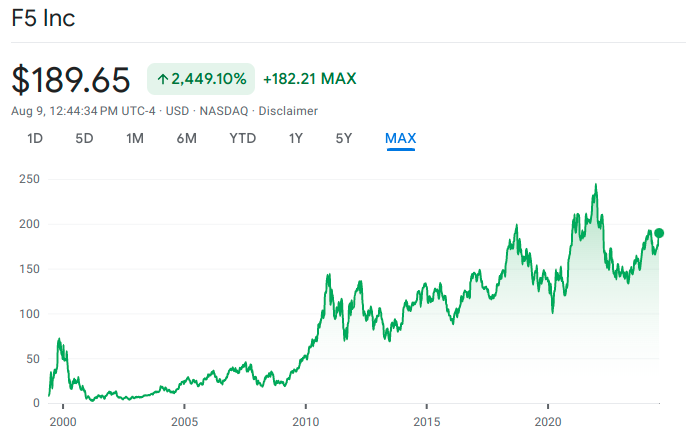
Once upon a time in an online stock market discussion I was asked to lament about my largest losses. Many of us had just lost most of our holdings in a crash. My biggest mistakes weren’t stocks that went down 99.99%. My biggest mistakes were from not trusting myself and talking myself out of buying Bitcoin at $220, SBUX when it was young, the same with PIXR, AOL/AMER; or selling FFIV, etc. Pennies are important, but I spent too little time applying what I know. I allowed myself to be stymied from selling at peaks, and not buying at troughs. It hasn’t been absolute. Look a few sentences back; I’ve frequently lost >99% but I sold FFIV at $44 and it went to over $240. Gains, if they happen, can cover lots of losses. That is a big IF.
There are jokes and memes about how much a minute is worth to Elon Musk. (A quick search comes up with $6,887/minute. – wionews.com)
How much is your time worth? If a minute spent with finances save you a penny was it worth it? If a minute spent with a friend strengthens that friendship was it worth it?
Go ahead. If you’ve never tracked every penny for one month (~one billing cycle), then it can be an education. But, at some point, decide if time is more important. Are people more important? Is life more important? And if you are on the knife edge I am lucky enough to have gotten off of, trust yourself to know if the penny or the second is more important. None of us can know that as well as you can.
Well, at least it has been an eventful half-year. Good news, a lack of news, new news outlets, and life improved even without the effects of stocks.
I turned 65! Yay! Or on some mornings, ugh. Hey, they’re right. Growing older isn’t for sissies. I also sold my small cottage in the touristy part of Whidbey Island and moved to a tinier house near the touristy city of Port Townsend. The list of reasons is long. It has been bittersweet because it was hard to leave the island and the only house that has felt like home, but that sale meant I am now debt-free. I’m also view-free, relatively, but a one-mile walk changes that. 65 also means Medicare, which I have yet to figure out, and signing up for new doctors and dentists and all that stuff. That task is taking longer.
Ah, but the tasks have proved to me the value of not being poor. Having cash in the bank has improved my mood. The world actually looks better. There are hints that I will have a future to look forward to rather than a drudgery of feeding the debt payments. Ideologues make that sound academic, but it is real and definitely impacts health. Being poor is expensive. The poor are more likely to feel stress. Stress is likely to impact their health. And they may not be able to afford the care, which makes them less healthy, more stressed, and the cycle repeats. I broke that cycle. We’ll see if that improvement manifests itself soon.
But let’s talk stocks. Much of the money from my house sale went into the stock market. I bolstered positions in GERN and LCTX. Skipped MVIS because MVIS is acting like MVIS and not acting like the promised MVIS. And I diversified by buying stock in LUNR (space!), QBTS (quantum!), and SLDP (better batteries!). Of course, recently, I bought stock in WNDW (solar! but management issues) and SOLO (/XOS, EVs!, but the startup didn’t.)
It is 2024, so as much as I avoid commenting on politics, politics played a role in selling my house, getting out of debt, moving off an island, and generally planning for the future. Hey! And I’m now closer to Canada! Just in case. My bigger worry is Social Security. My expenses exceeded my income when I lived on Whidbey. I took an early Social Security because I had to. The same with my Boeing pension. Those two, combined with occasional jobs, meant I occasionally had a surplus, but that was temporary. If Social Security went away, it was easy to imagine many people having to sell their homes, which would make it harder to sell mine. It would also impact the job market as many people would desperately take whatever job was available. That would cascade into unintentional consequences. Intentional or not, cash will make it easier to ride around and through those issues. Being in debt at the same time might work if there was something like a debt jubilee, but I figured the odds of that are slim.
Ideally, I’d own a nice house and the land, but in the meantime, I own the house and rent the land. And I invest. As usual, my stocks are in companies that can significantly, quantifiably, and positively disrupt their industries. A 10% rise in my portfolio will be nice, but inconsequential. A 100% rise would be a great easing, and enough in a stretch to buy land and move me and my house to it. A 1000% rise, well, that’s what dreams are made of.
Google Finance
Below are my synopses of my stocks. GERN (Geron) received FDA approval for their blood cancer treatment. In the most recent six months, the stock is up 97%, and it has yet to begin the main treatment campaign. LCTX may only be a year or two behind. And, of course, MVIS will succeed ‘any day/week/month/quarter/year/decade’.
And another, of course, AI can disrupt everything.
And, I still buy lottery tickets.
Read on. And good luck.
INTRO Here’s my semi-annual exercise to see if I remember why I own the stocks I own, and so I can check back and see if their stories have changed. I post in case it helps others too.
D-Wave Quantum
QBTS (market cap is $0.183B)
Pardon me as I steal from myself (via my YouTube channel’s description of D-Wave).
For simplicity, I’ll refer to D-Wave Quantum Inc. by its trading symbol, QBTS.
QBTS deserves an explanation. Quantum computing is a revolutionary computer architecture and business approach. Traditional computers use bits. Quantum computers use quantum bits, q-bits, (QBTS, get it?) devices that trap and use quantum particles and concepts. Quantum computing operates on probabilities and the reality that quantum computers can consider two truths are once; something can temporarily both Yes and No, effectively.
As problems become more complex digital models can be forced to consider all possibilities and their combinations one at a time. Model something complex like the planet’s weather and massive computers with millions, billions, (trillions?) of transistors are required. Quantum computers can resolve the possibilities with much fewer processors (a couple of thousand instead of billions), and the work faster, and do the work without requiring another era of mainframes.
Ideally, such machines should be much more efficient at modeling messy things like climates and stock markets.
As a result, IF QBTS succeeds, THEN it may be overlooked temporarily as investors try to understand such a complicated and esoteric technology and business model. At least within the human part of the investment world, it is understandable why an analyst is more likely to research coffee rather than high-tech.
Is ignorance keeping QBTS’s stock price down? I only see data from August 2022, despite the company being founded in 1999. That’s a long time starting up to get to be a start up. Alone, quantum computer could become an old overnight success; and, ironically, could possibly fade as nothing more than a technological curiosity.
Coincidences happen. Welcome artificial intelligence timely entrance. I am sure researchers in both fields are aware of each other. Each involves revolutionary implications and consequences. Each is basically struggling with finding sustainable and profitable business models. Together their capabilities could be mutually amplified in ways we can’t imagine. And ‘can’t imagine’ is one of those things that are scaring some people.
Unknowns are risks. Rewards are not guaranteed. The adage about risk versus reward is heightened. Companies like D-Wave (QBTS) intrigue me because of the technical challenge, the unknowable potential, and the celebration of decades of work from persistent humans.
DISCLOSURE LTBH since 2024, i.e. bought recently and intending to hold as the technology advances, hopefully to profitability because this could enable greater sustainability in my estimation.
INTRO Here’s my semi-annual exercise to see if I remember why I own the stocks I own, and so I can check back and see if their stories have changed. I post in case it helps others too.
Intuitive Machines
LUNR (market cap is $0.404B)
Pardon me as I steal from myself (via my YouTube channel’s description of Intuitive Machines).
Intuitive Machines which sounds more an AI or robotics company, but may be hinted at better by its trading symbol, LUNR (LUNaR, get it?) They’re doing moon stuff, and more. They are offering many of the services necessary for lunar exploration: transportation (after launch), Earth-based space communications, Moon-centered communications, a hopping rover, and more.
According to NASA;
“The Intuitive Machines 1 (IM-1, TO2-IM) mission objective is to place a lander, called Nova-C, on the crater rim of Malapert A near the south pole of the Moon. The commercially built lander will carry five NASA payloads and commercial cargo. Launch is currently scheduled for June 2023.” – NASA
It landed on February 29, 2024; then, tipped over. In the world of aerospace, that’s a success. In the land of everyday expectations, that could be considered a failure, or at least comical.
This is a good example of the early commercialization of space. It is starting with NASA contracts; which is more civil than commercial. I will be hoping for true commercialization which will be business-to-business.
They are attempting something complex and impressive. But then, Space-X’s idea of recovering and reusing rocket stages seemed audacious.
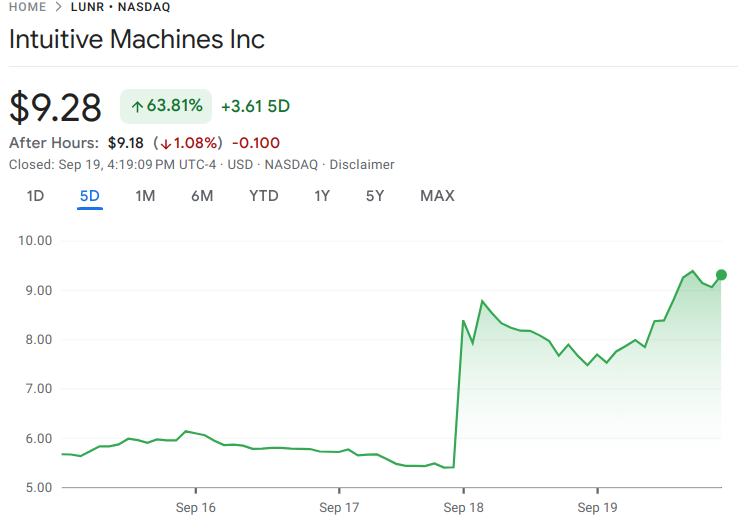
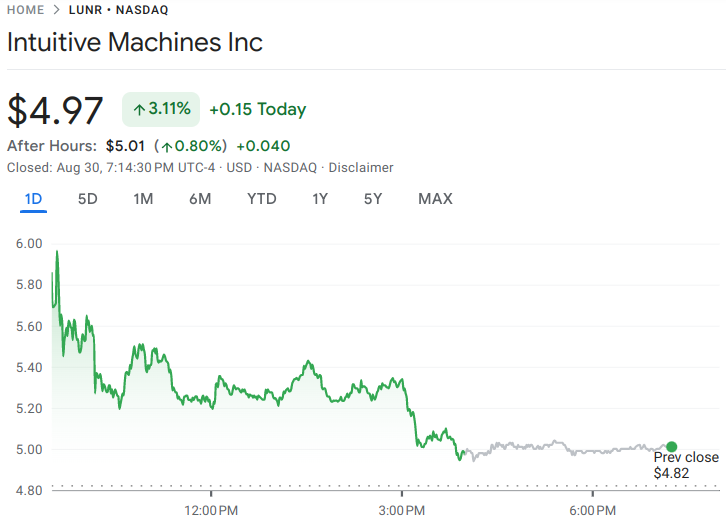
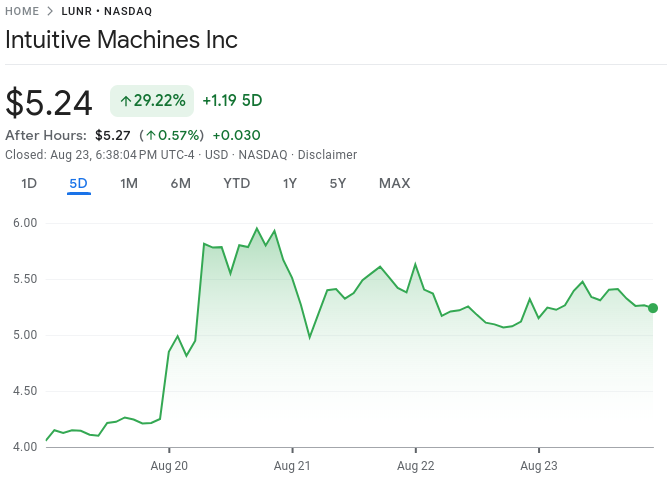
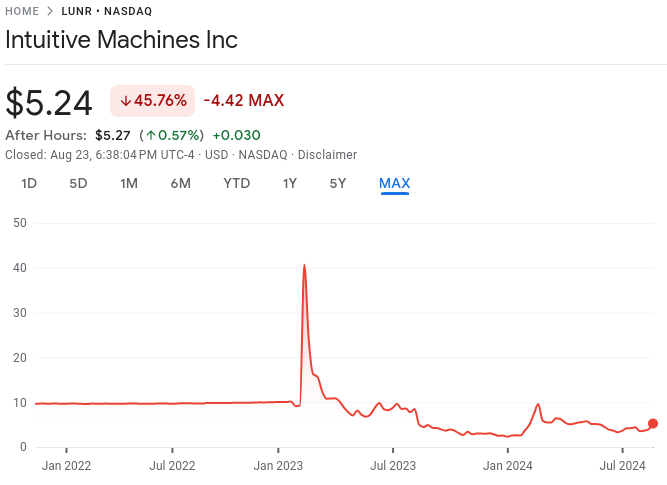
The stock’s ride has been wild. Within the recent few months the range has been from almost $2 to over $13. Rocket analogies are allowed in both directions.
DISCLOSURE LTBH since 2024, i.e. bought recently and intending to hold as the industry advances.
INTRO Here’s my semi-annual exercise to see if I remember why I own the stocks I own, and so I can check back and see if their stories have changed. I post in case it helps others too.
Solid Power
SLDP (market cap is $0.292B)
Pardon me as I steal from myself (via my YouTube channel’s description of Solid Power).
Hello, solid power batteries. In Solid Power’s case, they are using sulfide-based electrolytes. They are solid, which is safer than lithium-ion. Evidently, they should provide higher energy, and cost less than li-ion. ‘Should’ is the key term because new technologies always have a phase during their initial introduction when theory and ‘should’ meet practicality and reality. Witness some of the stumbles that autonomous vehicles are encountering as they ‘should’ not be causing video-worthy traffic jams, et al.
Solid Power is making product and making money. Sulfide-based technologies are less sensitive to geopolitical tensions over precious metals. As or if they prove their technology, their work should become better known. They are not the only alternative battery technology. (How about graphene batteries, which are based on carbon, which is an element that is also incredibly more available?)
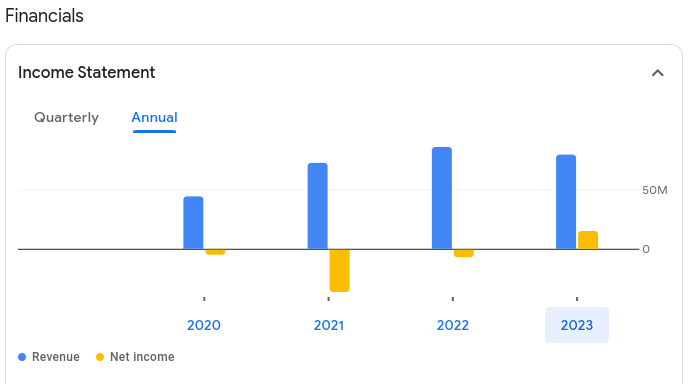
SLDP has been trending up in the recent six months, but it is far below it’s 2021 peaks of over $12. Revenues are up, but net income is dramatically negative. Hopefully, (not an appealing strategy) that’s the build-out prior to the build-up.
DISCLOSURE LTBH since 2024, i.e. bought recently and intending to hold as the technology advances, hopefully to profitability because this could enable greater sustainability in my estimation.
INTRO Here’s my semi-annual exercise to see if I remember why I own the stocks I own, and so I can check back and see if their stories have changed. I post in case it helps others too.
Geron
GERN (market cap is $2.52B was $1.15B)
Geron (GERN) has been working on highly innovative biotech for decades. Decades! Finally, the FDA has officially approved Geron’s blood cancer treatment. They will probably start trying to treat other types of cancer, too. One estimate is that the treatment will cost over $100,000 which is large compared to many drugs, but is meeting an unmet need, and it may be a lower overall cost. One bit of specifity is that patients may now experience “24 weeks of freedom from the burden of red blood cell transfusions”. (https://trimbathcreative.net/2024/06/07/geron-approved/)
Years, decades ago, Geron had a diversified portfolio of innovative and somewhat controversial treatments that could fight cancer by convincing certain cells to die, and fight auto-immune disorders by allowing certain cells to live. From that broad range of possibilities they’ve narrowed down to blood cancer.
The good news for stockholders is that within the previous six months the stock has risen from ~$2 to ~$5. Such news can generate greater premiums, but dilution has so reduced the value of the shares that the premuim may already be built in.
If the treatment can be applied to other ailments, then a multiplier may be appropriate, but the investing market may wait to see if the medical industry accepts and encourages its use.
This is also the era of hyperbolic claims of price appreciation. If there is irrational exuberance, I may sell at least some shares.
My experience with the first occurrence of Dendreon (DNDN, https://trimbathcreative.net/?s=dndn) dampens my enthusiasm. They had an FDA-approved cancer vaccine, were actively undermined, the bad guys were found guilty, but the shareholders lost their money, or at least I did. Hopefully, that won’t happen this time.
DISCLOSURE LTBH since 1999 and continuing to hold. I bought more after selling my house. I could buy more, but I expect I’ll wait until I hear about Geron’s plans for expansion. (From my One Company One Story series on YouTube https://youtu.be/su1AMjPEkLI )
INTRO Here’s my semi-annual exercise to see if I remember why I own the stocks I own, and so I can check back and see if their stories have changed. I post in case it helps others too.
Lineage Cell Therapeutics
LCTX (market cap is $0.165B was $0.191B)
Lineage Cell Therapeutics is a leading edge biotech company developing a variety of treatments, particularly (from my investing perspective) macular degeneration and repairing damaged nerves. Their use of stem cells was considered radical a couple of decades ago. Now, they have treatments that have progressed to modified Phase 2 trials.
Phase 2 is usually years from FDA approval, but in my opinion, their treatments are significant enough and the unmet need is large enough that there may be pressure for the FDA to approve at least some earilier use. But, I am an optimist and a dreamer (and I’ve felt this way for years, but ‘feeling’ is subjective, not objective.)
(Mostly a copy&paste for my biotech investments with the names changed)
One hurdle with biotechs is making sure the treatment is reliable, effective, safe, and commercially viable. Another hurdle with innovative treatments is gaining FDA approval in a reasonable time. Treatments for unmet needs have pressure for early approval. Innovative treatments have pressures encouraging the FDA to be cautious. We may soon see how the technical, political, medical, and societal pressures affect LCTX’s treatment and LCTX’s viability and LCTX”s performance.
Typical of innovative treatments of such critical conditions, very few patients have been treated. This can lower confidence in the results, but I have been encouraged by what I’ve seen, heard, and read. I am also Not a medical professional, so my assessments rely on larger perspectives (e.g. market, competition, etc.)
I don’t expect LCTX’s stock to steadily appreciate, but when it does it may happen so quickly that it might be too late to buy in.
DISCLOSURE LTBH by habit, but having to remember that my LCTX/BTX holdings came from AST (2014) which was spun off from GERN (which I’ve held since 1999). I hear patience pays, but it is easy to have doubts after twenty years of waiting. I recently purchased additional shares.
INTRO Here’s my semi-annual exercise to see if I remember why I own the stocks I own, and so I can check back and see if their stories have changed. I post in case it helps others too.
MicroVision
MVIS (market cap is $0.213B was $0.505B)
Another era of MVIS doldrums. Very little new news relative to the previous years/decades.
It is tempting to simply copy what I wrote at the end of 2022, so I will; then, I’ll add more (but very little because so little has changed.).
“Oh, MicroVision; will it be yet again another 6-9 months, or 9-18 months, or longer?” Well, it hasn’t been any of the previous hoped-for periods for the last twenty years – though there was that time of flirting with hope…” (circa 2021).
MicroVision is a electronics component manufacturer developing, and to some extent selling, elecro-optical units based on a chip-sized oscillating mirror. It is a simple and ingenious design defended by a long list of patents. Currently the greatest public hope for the company are the LiDAR sensors targeted at the autonomous vehicle market. MicroVision’s advantage is based on the chip’s scalability, the lack of pixel-sized constraints (as compared to LEDs), lower power requirements, and small package.
Before LiDAR, the company targeted short-throw projectors, projectors embedded in smartphones, augmented reality eyewear (see Hololens and more), as well as game controllers, bar code scanners, and orthoscopes. And probably more. The company has always operated under constraints from NDAs, the need to protect competition sensitive product developments, and some exclusive contracts that were ill-suited for the company, in retrospect.
It is easy to imagine that the company wasn’t persistent enough in pursuing some of those products as they were first movers in those fields. Now, competition has caught up. Also, corporate hopes pinned on singular products languished if the product or customer failed to deliver. Each CEO also resteers the company to distinguish their era from the previous one. The effect has been for the company to be seen as a tech test bench play shop that is dependent on demos and customers rather than faith in the company’s products to lead to financial success.
Forward Looking Statements suggested at least some profits in 2023, but those weren’t expected to reach cash-flow positive – yet. (Comment from mid-2024 = Ha!)
As stated above; “Oh, MicroVision; will it be yet again another 6-9 months, or 9-18 months, or longer?”
If it succeeds, its rise may be magnificent, which is one reason to own shares now. My shares are now old enough to have graduated college, worked for a few years, then gone back for a Masters, started a family, had kids, and watch them enter school. How much longer will it take for something positive, significant, and quantifiable to finally happen?
DISCLOSURE LTBH since 1999 (though the very first shares are gone). Dilution means that I no longer have more than enough if the company finally succeeds and the stock reaches the heights I think are possible. I doubt I’ll buy more because of the rest of my financial situation, and intend to hold until much higher price targets are reached.
(From my One Company One Story series on YouTube https://youtu.be/NJRgHJBW3M8 )
INTRO Here’s my semi-annual exercise to see if I remember why I own the stocks I own, and so I can check back and see if their stories have changed. I post in case it helps others too.
SolarWindow
WNDW (market cap is $0.012B was $0.021B)
SolarWindow has an attractive idea: turn windows into solar panels. Solar panels don’t have to be opaque slabs stuck on a roof. Modern houses and office buildings can be more window than wall; so, grab that power! Being able to use such panels for greenhouses also enriches nurseries, gardens, and farms. Farms particularly benefit because they are more likely to be off the grid.
Alas, some management mishaps meant the company had trouble reporting its finances. That cratered the market’s confidence. Supposedly at least some of those issues have been resolved. Now, the company seems to be returning to its previous operations that involved hopes and promises but insufficient sales. Losses are shrinking, but that could also be from reducing operations.
The stock price is so depressed that there isn’t much to be gained by selling, except maybe as a tax loss, but I have too few gains for the losses to balance against. Daily volume is so low that even small purchases can shift the share price, which discourages open buying. SolarWindow isn’t the only company working on transparent panels, which may mean that they lose to competition while the regain their progress. Staying tuned.
Down to two employees (according to Google Finance). Ugh.
DISCLOSURE
Usually LTBH but only bought in because another of my stocks was bought out (just as they were becoming profitable). I bought in to redistribute the funds and increase my diversification.
(From my One Company One Story series on YouTube https://youtu.be/OHjlrqVDztI )
INTRO Here’s my semi-annual exercise to see if I remember why I own the stocks I own, and so I can check back and see if their stories have changed. I post in case it helps others too.
Electrameccanica – now XOS
XOS (market cap is $0.054B as XOS was $0.040B as SOLO)
SOLO dropped. XOS bought them. I visited XOS’ web site and get the impression that they are providing both goods and services, particularly for the step-van market. In particular, their writing suggests they help businesses that are intimidated by the EV tech, or are busy enough with normal operations that they’d prefer some help.
I am a fan of EVs, but I haven’t found a significant aspect to XOS’ business model that makes they unique. I’m still trying to understand why a customer would choose XOS over the competition. Research happens.
My shares are worth less than I spent at the farmer’s grocery. I’ll hold the shares because miracles happen. So can selling for the loss.
DISCLOSURE
Usually LTBH but only bought in because another of my stocks was bought out (just as they were becoming profitable). I bought in to redistribute the funds and increase my diversification.
(From my One Company One Story series on YouTube https://youtu.be/DFLvNCV3zAE )
For more details about the stocks, here are links to various discussion boards where you can find my synopses, as well as others’ points of view. For more details about how I do what I do, there’s a book that I wrote at the request of several friends: Dream. Invest. Live. Maybe you can help my personal finances by buying a copy – though the frugal part of me recommends checking one out from a library.
The following links are to various discussion boards I follow. Many of the independent investors who contribute to the discussions provide in-depth analyses that either aren’t available elsewhere, or would cost too much to buy. The other advantage is the diversity of perspectives. Unfortunately, I don’t engage as much as I did before. Some discussions have degraded due to lack of moderators, or overly zealous moderators (oxymoron), or have too many immoderate voices. Some boards are effectively ghost towns, or feel like cavernous empty warehouses.
“Gold mines produce far more rubble than gold. It is easy to complain about the rubble. Ignore the rubble. Pay attention to the gold.”
Gold mines produce far more rubble than gold. Ignore the rubble. Pay attention to the gold. Regardless, here are the sites I continue to visit, even if it is only to lurk and listen.
I encourage you to tune in, because more voices (as long as they’re mature) make for a better conversation. Maybe I’ll read you there.
Reddit (Many will cringe, but there’s impressive quality within the impressive quantity of posts and voices. I do not post directly on Reddit because it is Reddit, as in, I read it. But in this case, I wrote it. So, I defer unless specifically requested.)
Does this seem tedious? Another long list of stocks? Well, this blog is about personal finance, and my personal finances are heavily skewed to dealing with two things: deciding what to do with the proceeds from my house sale, and prepping for my semi-annual portfolio exercise. And my thanks to those who are already asking for the update. I typed ‘two,’ but three is more appropriate. I also am maintaining my One Company One Story series on YouTube. Let’s start with that.
The YouTube channel has been building out, one video per month. That was true until last month when my change of address upset my schedule and the computer’s technology. (MyTinyExperiment.com) Connected! But two things are getting in the way of getting a video out this month. 1) The software I pay for no longer records my videos. It tells me that After I finish the episode. Grr. 2) The list of candidates to study shrunk to almost nothing. Years of episodes will do that, but so will the traumas that small companies experience. Startups don’t always do much more than start up. Sometimes, they’re stopped up. (Imagine the size of that plunger.)
For those who are new to reading my main blog, every six months, I write short (ha!) synopses to remind myself why I own what I own, and whether anything has significantly changed. I’ve been doing it for years, so some companies like MVIS and GERN had lineages. Product lines shift. Expectations shift, too. I’ve owned shares in both through the Internet Bubble, the bursting of that bubble, the Great Recession (which I think is the Second Great Depression, but only for folks who aren’t rich), and Covid, and now politics and wars and oy. Here we are nearing the end of June, so I’ve been drafting the synopses, adding as I’ve added holdings, and generally doing my regular exercise. My apologies this year as the move has encouraged me to rely on copy and paste for some stocks where nothing much changed. Still got about a week to go, more like a week and a weekend. There’s work to do.
There’s also work to do that is also part of my regular exercises, or maybe more correctly, my irregular exercises. For the videos and for my regular research I’ve waded into some stock screening sessions. (For folks who are unfamiliar with stock screeners, stock screeners are websites that allow you to apply criteria to stocks, reducing the list of thousands of publicly traded stocks down to one good one (ha!) or at least a much smaller list. It rarely provides a definitive answer, but it is a nice invitation to potential candidates. If you like, consider it like dating; lots of profiles, some look too good to be true, some may only have one mark against them, some – well, you probably get at least an idea, depending on your dating history.)
So, because this blog is public, I used a free public stock screener: Yahoo’s. In my opinion, there is no one master stock screener. They’re all just software packages and different providers package the criteria, the stocks, and the results different ways.
I am most interested in companies I can understand, typically tech. I am most interested in small companies with large potential that may be overlooked and, therefore, underpriced. I am also more interested in stocks that are traded often enough that my buying or selling won’t affect the price much.
Here’s my list.
Yahoo / Google
You may have noticed that, while the stock screener was Yahoo’s, I loaded up those stocks into Google. Different companies. Different approaches. One size does not fit all.
My next step, which I’ve already begun is to take a list of about 200-300 stocks and break it down to about two or three dozen. This can be subjective then objective. Or, objective then subjective. I’ve done this for so many years that I recognize several stocks. “Hey, there! How are you doing? What are you still doing down here? Still trying to start up?”
The step that will follow working within Google switches from free and public to more private. When the list is down to less than a dozen, if necessary, I’ll switch the Schwab, which I’ve been using for decades. They aren’t perfect either, but they are more detailed, more reliable, and more secure – and I can buy directly from their screens, or compare candidates to my official holdings.
Isn’t this how everyone spends a Friday night? Actually, I usually working on words as I write my books (my Amazon Author page), or going dancing (fun is more important than technique, for me.) But, as I said at the start, there’s a lot to do, so I do.
Unless something dramatic and positive happens, I do not expect to buy or sell in what remains of this month. I’m just too busy. (There’s a podcast to record, too. IntriguingCreativity.com .) And there’s life maintenance. I do intend to shrink the long list, but just enough to provide candidates for the videos. As my household finances adjust to my new old big tiny house, which needs work, then I may look at that list for new holdings, or maybe I’ll bolster existing holdings.
So much of personal finance media and offerings make the process seem only for professionals, or mathematically mechanical, or simply fancy gambling, or whatever. This may sound strange to some, but the world fascinates me, and I see no reason to act as if there isn’t drama and story because money is involved. Personal finance doesn’t have to be drudgery, and the way a person spends their time doesn’t have to be an expense. My book is Dream. Invest. Live. This isn’t a sales pitch for it, but the title is a reminder that investing is one way to possibly connect dreams to living. And that chance sounds pretty good to me.
Stay tuned. There’s a lot going on. Hopes, drama, struggles, successes, etc. Why be a spectator?
I didn’t time this to be one month from the post that inspired it, but welcome to the sequel to last month’s post: Time To Buy But What. Has it already been a month? That means I’ve been in my new old big tiny house for at least a twelfth of a year. (MyTinyExperiment.com Stay tuned for updates on tiny house life, like the fact that they announced the sale of the property just as I moved in.) In this sprint of a time, I managed to buy stocks based on the research I described in that earlier post. My portfolio has grown and is more diversified. My checking account has shrunk, but not as much as some expected/worried about. And I’m not done yet.
I regularly track companies, looking for ones that are publicly traded, can positively disrupt their industries, and might be overlooked. Overlooked can mean underpriced. Positively disrupt their industries usually means they’re in industries that should change but haven’t. Publicly traded means I can buy stock in them rather than simply be a cheerleader.
Months ago, I started producing my One Company One Story series on YouTube to pass along the little I’ve learned. That stopped about a month ago because I was moving from a small cottage with a view on an island to a new (to me), old (2006), big (360 square feet), tiny house (where the convention can be for 124 square feet.) Pardon the interruption, but one of the consequences of selling my home (which was more than a house) was turning the equity into cash, and my strategy of turning passive capital into active capital. Life is busy enough. Rather than re-research companies, I decided to pick from the companies I already profiled.
Let the buying begin.
Simply enough, I bought some of what I already have, and diversified by buying in more diverse industries.
GERN – They were close to the FDA decision on a cancer drug. I bought some more. The FDA approved the treatment. Good news.
LCTX – They aren’t as close to an FDA decision, so their price was much lower, and I bought much more. Staying tuned.
MVIS, SOLO/XOS, WNDW – If they have anything in common it is poor execution. I’ll hold and watch, but don’t see any reason besides price and theoretical potential to buy more.
Newbies
SLDP – I believe battery technology is ready for a technological shift from liquid Li-ion batteries to something more reliable, safer, cheaper, more productive, and less sensitive to geo-politics. There are many to pick from. Solid Power hit many of my criteria. Let’s try that one.
QBTS – I think quantum computing is as mature as artificial intelligence was a few years ago, a familiar term that no one really knew what to do with, until they really, really, really did.
LUNR – Space. Gotta love it, or at least respect that I have a masters in aerospace (and ocean) engineering, and was an aerospace engineer at Boeing for 18 years. I worked in space-related projects for years, which made it easy to appreciate the people who worked in it for decades and are now benefiting from those efforts – or about to. I don’t expect LUNR to be like SpaceX, but guessing the eventual victors in the lunar industry – well, LUNR has a head start.
Biotech, electrical components, energy storage, quantum computing, and lunar commercialization. Yeah. That’s diversified – in its own way.
But how did I do it?
How much to buy?
At a time like this, I strive for a somewhat balanced portfolio. I’m restarting from not much, so I picked an arbitrary value to target for initial purchases, or to leverage up existing positions. If there was no news, I’d apply that dollar amount to all. GERN had the potential for near-term news, so I elevated that one a bit. Note: I am not giving details because I do have some privacy. The main thing to notice may be that I set a common goal, and employed a simple too. I created a spreadsheet and played with the stock quantities until I had relatively equal dollar amounts. X shares of this. Y shares of that. Z shares for the other, etc.
Cool. I had a plan. Note: I also made life easy on myself by rounding off to quantities that ended in a few zeroes. I have some holdings that are 9 shares of this and 14 shares of that, but it is hard to track how a day went without doing math. A few years ago they all had similar (sad) share prices and held exactly the same number of shares of each stock. Handy, but also a bit silly.
When to buy?
I use Schwab. They aren’t perfect, but they’re pretty good. (Scroll through the years of this blog to find their few missteps – unless those old ones are now dead links.) If I had a full-service broker, I could just say, “Go buy X shares of this. Y shares of that. Z shares for the other, etc.”, but I don’t like having to explain myself repeatedly. (Years ago, one full-service broker wouldn’t let me buy SBUX, and had to be talked into AMER/AOL. Forget stock losses. I lost more because I wanted to buy more but couldn’t.)
I use Schwab, but I hate paperwork. Except I like paperwork for keeping records. Trust me. This matters. The only records I have for some of my shares (MVIS) are in the paper version of the transaction records, the settlement statements. So, silly happens again. I space out my purchases so I can handle each purchase separately. I do one per day. It takes days for USPS, but that’s okay. And I drop them into a folder after making sure the data is in my database.
I add one complication. I’ve learned from when I’ve had to sell shares that it is handy to sell in the same quantities that were on the settlement statement. It makes filling out taxes clearer, and I don’t underestimate how important it is to Not Confuse The IRS. So, if I buy enough shares, I might buy them in equal quantities over several days. Yes, it is more paperwork, but maybe not as much when I sell. Silly? Compare that to the anxiety of trying to report a sale on the tax forms when the records are lost. Been there. Don’t want to do that again.
Consequence? Take a look at the edited conclusion to last month’s post. It took thirteen trading days to complete that set of purchases. I’d modify that if a stock started moving quickly, but that wasn’t the case.
The bigger picture
These monies came from selling my house. I didn’t spend it all in one place. I didn’t spend it all on one stock. (Though I did playfully fantasize putting it all on MVIS and hoping. Stock market roulette. Nah.) Instead, I notionally split the funds into three general categories: re-invest, hold in reserve, live.
You’ve made it past the re-invest part. The hold in reserve part is static, though I may hunt for a no-load mutual fund, or not. The rest is for living expenses, and to reflect that changing addresses can be expensive.
I bought the house, but it is going to take thousands of dollars to fix various things. I’m willing to spend that (saying ouch anyway) because it was originally listed at over $110K and I bought it for $76.5K. Stingy would be hoarding that difference. A major trimming of the tree cost thousands. A compact washer/dryer may, too. The list is long enough that I posted it on the bathroom door. There are lots of checkmarks to go. Anyone in the Port Townsend area willing to bid on building two decks? Know a plumber? An electrician?
Buying and selling stocks can seem to be purely for buying and selling stocks. For those of us who live lives, it is necessary to responsibly know what else to do with the money, how to handle it, and know when having a new pair of work pants is more important than a few more shares of stock.
I plan to take a hiatus from buying stocks while I research healthcare providers, contractors, and chase down bureaucratic gremlins. I also plan to restart the video series. There are always new companies or new situations for existing companies. It never ends, but for me, it is important to visit that world but live in the broader one.
The following is the culmination of several months of notes and observations about life on the south part of Whidbey Island, a place now known more for being a tourist town. They are my personal observations and not affiliated with any organization. I am just a guy who liked a place so much he decided to live there, then realized he had to leave.
(Posted one month after getting the keys to my new old big tiny house on the outskirts of Port Townsend.)
Alas, some will lament that there is nothing illegal to expose. It is almost as if that breaks a rule of writing. But, there is suspense, drama, and a description of need.
There are realities of policies and procedures to expose. Who is a tourist town (but really the entire area) for, and how should it be run?
There may not even be a need to change any laws, just strategically enforce the ones that exist for the full-time residents.
Loving A Tourist Town
Tourism
It’s a tourist town! Want more reasons than that to live there? There are plenty to pick from. I’ve lived in two. If you need to see why it is so sweet, check with their Tourism Board, the Chamber of Commerce, every advertiser, and all the social media influencers who either live there or visit long enough for a viral post or video.
There are more reasons that aren’t as publicized. Everyone who moved in when it was quaint or were the ones who made it appealing are a self-reinforcing community of “people who are happy to be here!” Their efforts were quiet at the start, uplifting, and enabling of the rest – unintentionally and intentionally.
Here are a few examples of how I’ve liked one place, Whidbey Island.
And there were the times with the Land Trust, the dancers, the writers, et al. And the game I designed but never distributed. (Couldn’t find an easy way to include the dice.)
But this introductory section isn’t here for that. That’s why there are many more words following.
Living In A Tourist Town
Not Disney
Heard in ‘downtown’ as a group of four stylish young-ish visitors were walking down the sidewalk. “Do you realize people actually live here?” As if the town was built just for them.
Heard as a family exited a thrift store. “Well, it’s 10:30 in the morning. What else is there to do here?” They looked perplexed, as if there should be daily parades and shows. Where’s the entertainment? Head to Disney. There will be constant entertainment, costumed mascots, and plenty of parking! Something must appeal because tourist towns exist because of tourists.
The locals know to avoid the touristy areas, maybe even shop at a mini-strip mall on the outskirts to actually get something useful. Such shopping doesn’t fit the image, it is downright scandalous to some because people are in-and-out shopping for necessities, not just browsing for luxuries or trinkets with a latte in hand.
The more likely there are tourists, the more likely the parking is limited. Two-hour limit. Loading zone only. Come shop, but don’t come to work unless you can do it in two-hour chunks, or you can get here before the tourists, or you’re lucky enough to live along a bus route and your workday ends before the buses stop running. Yes, you’re a local, but don’t stay here long. But, if it isn’t tourist season, please shop local to keep the local shops in business. Please sustain us despite the loyalty you developed to year-round businesses outside the tourist core.
A tourist town is a business town. It is not a town dedicated to the people who live there. When a great majority of a town is employed by folks who have to commute to it, the town isn’t for the people who work there. That sounds and feels like working locals are subservient to people who live elsewhere.
The locals are, however, asked to fund improvements to the look and feel of the place, and maybe to its operations. Is it more important that the infrastructure looks good or that it operates well? Given the choice of nicer sidewalks or more reliable power, which will be funded? Shall we pave the rutted alleys that run through some of the neighborhoods, or should we have prettier storm catchment basins?
What is the charter and purpose of the municipality? State it. Govern to it. Don’t hide it, whatever you choose.
Grandkids And Yachties
The boats are back! So are the grandkids! Whether it is summer or a holiday, doors and docks, pools and playgrounds are opened as the kids and their parents’ boats are back. For a few months the amenities are at full operations – before being stowed away again in a few months.
Don’t have kids or a yacht? Spend months being reminded that you are not worthy. Restrooms are closed. Docks may be pulled up. Gates locked. Go ahead, maneuver around them as you creatively recreate. You get a lot less to work with. It’s not as if an island’s shores and lakes and playgrounds are moved off-island. They’re still here. But you’re only allowed to use them if the kids are around or if it is boating season.
Pools may be closed, but the ocean is open and the lakes are too. But showers are shuttered just when warm water may be more than just appreciated. A healthy swim in the winter can be in water that’s warmer than the air, but be prepared to bundle up as you get out of the water. Hypothermia awaits until you can finally change into dry clothes, take a shower, or both.
If you are a year-round resident be prepared to fantasize that for a few months those doors will be open, that services you are paying for will again be made available because the visitors re-arrive. In the meantime, make sure you go to your bathroom before you leave the house. The public facilities are likely to be unavailable.
Not everyone needs warm air and blue skies. There are people who don’t run away because the skies are grey and they might need a sweater. They don’t think of themselves as more rugged, because this is just the way things are. As the saying goes, the issue isn’t about whether the weather is bad; it has more to do with the clothing you wear, even if that is for underwater or while hanging from a kite.
Does it really cost that much more to provide year-round service for year-round residents? If the services are for people who are only here for part of the year, who is funding their fun? Evidently, locals are a magnanimous lot, paying for services year-round, but only getting to enjoy them when they must share them – if the lines aren’t too long.
Can full-time residents get full-time benefits, or are the benefits only available when visitors arrive? Maybe the trick is to live somewhere else, then come back with the crowds.
Vacant Houses
What? The power is out? Well, that’s why it is nice to have friends, wine, books, a fire, lots of blankets, candles – and maybe a generator if you are modern enough to need your electronics.
Ah, but listen. Walk through the neighborhood and hear the automatic generators kick in to automatically generate power to furnaces, water heaters, and appliances in empty houses. Cheers and applause to those who rely on quiet house batteries. But, after living in a neighborhood for a while, it becomes obvious which houses haven’t had an occupant for months, years, or decades. There’s nothing illegal about making that much noise, especially for vital services. Besides, if the owners aren’t there, the noise won’t bother them; it will only bother their neighbors.
During power outages during the off-season (from the perspective of the tourism economy), be surrounded by the noise of spare power being generated for the idle hardware, including security systems that are primed to make even more noise if they get confused and think there’s a reason to sound an alarm. Dark and cold occupied households can be mere feet away from a bit more comfort that only requires an electrical cord. Applause for some folks that share their excess simply by at least adding an extension cord that they run to their property line in case someone needs to charge a device’s battery.
An outage is an emergency, but it can also be an opportunity to remember what quiet sounds like. Introspection is valuable. People pay for quiet retreats. An opportunity to slow down that much more in contrast to our powered frantic modern pace. But have no fear. Crank up the noise and any house can be like a little piece of Bellevue or Bothell, protected pockets of abandoned suburbia amidst rural countryside.
What benefit could an owner of a vacant house provide if they fed their excess power back into a local grid, or even just share an extension cord? What other incentives can be offered to those who don’t make news? What disincentives can be imposed on those who make noise, even when there’s no one to benefit from that wasted power?
Unpaid Concierges And Custodians
Neighbors make a community. It is hard to be a community of one. My neighbor is going on a trip; sure, I’ll take care of the cats and the mail. And if the power goes out, I’ll reset the thermostat. I’ll do that because they’ll do that for me. Small towns make that easier. Cities enforce anonymity. Some people are altruistic enough to help anyone, anywhere, anytime. Saintly behaviour exists.
Oops. Looks like your water pipe busted after that cold snap. Time to knock on your door. Thanks for helping steady the ladder as I worked on my roof. That looks too heavy. Would you like some help? Good neighbors create a habit of help that becomes natural and innocuous to the point that people truly mean it when they say, “Don’t mention it.”
One famous incident was the response to a tragedy. A windstorm meant more than a trip to the hospital for a family driving home from an event. The details will be spared out of respect for those who survived. The story to emphasize is the community’s response. By the time some of them got home that night, the community had already built a support network. Food, childcare, and maybe even a crowdfunding campaign. The community did that. The family didn’t have to. The government didn’t have to. People helping people without needing paperwork or credentials.
People who own multiple houses may act that way, but they can’t keep track of every neighborhood they visit. They also can’t keep track of every one of their houses all the time. They may rely on the full-time neighbors to tell them something isn’t working right or something needs to be fixed. Septic alarms can go off in empty houses. A tree branch can puncture a roof in ways that no automatic security system is going to notice. It would be more than rude for a neighbor not to mention it – if they have contact information.
As a neighbor, make that call. During a disaster, turning off the water, or the propane, or the electricity can be a safety issue for the neighborhood. Who has a key and the security code? But don’t be surprised if an absent homeowner asks you to do something about it for free. Trivial things? Sure. Septic systems can have mute buttons for alarms, but those are temporary. Propane may be accessible outside, but anyone helping makes themselves open to liability if something else goes wrong. The same with electricity. One absentee neighbor asked a full-time resident to break in, find the electrical panel, and turn off the power – and was surprised when they wouldn’t trip the security system or break the law to do it.
Small-town people can be polite. Visitors witnessing neighbors helping neighbors sometimes assume they are going to get the same treatment despite never reciprocating. Maybe they’re practiced at having a concierge when they travel. Custodians come with the property, don’t they?
As tourist towns increase their percentage of vacant houses, a greater burden is placed on fewer full-time residents. Expecting vacant owners to voluntarily hire property managers may require more than good graces. Actually, mandating that someone responsible must constructively respond as rapidly as necessary seems reasonable, requiring living up to being able to respond. One unattended house puts the rest of the neighborhood at risk. In an off-season disaster, as many as a third of the houses may be vacant. In some neighborhoods, that can be greater. The risk to everyone grows.
Homeowners will need to respond to their home. Who responds if they are not there? Where’s the sign outside with contact information? What are the penalties for putting the rest of the neighborhood at risk? If the residents are going to become concierges and custodians, who compensates them?
Permitting Homes Instead Of Houses
If people can’t afford homes, we should permit affordable housing.
Sounds simple. Here begins many more words. There are policies for this and that. Programs for aiding this populace or that area. And yet, gaps exist. It sounds intractable and is definitely pervasive. Yet, there I sat, my home bracketed by new houses. They are affordable to some because otherwise, they wouldn’t be getting built. But they are not affordable to the people who need a house, any house, a shelter, a place they can afford on a typical income. Talk to local workers and find that they frequently have solutions, but they are literally not permitted to build them. They are not permitted to build what they consider affordable housing.
Where to start? I could describe my amateur understanding of the policies and procedures that are being debated. There are others who are better at politics and referendums. I’ll leave those discussions to them.
(Disclosure: I’ve written professionally about real estate and have also been a realtor. Currently, I am a homeowner and a writer.)
How about starting at a more personal level? Talk, no, listen to people who can’t afford housing. Most of the ones I know have solutions. They’re not whining about what to do. They frequently have answers that would work for them. Those answers aren’t panaceas, but case-by-case, people being able to live the way they want to makes the size of the problem necessarily shrink.
People who are struggling to find housing are frugal by necessity, yet they meet hurdles. Their solutions can be physically enacted. Sometimes those solutions become stylish by people who are frugal by choice, by fashion. They are more likely to have the resources to employ the people who will enable their applications and variances and their permits. Vacation houses become easier to permit than someone’s frugal home.
Tiny houses, cobb houses, strawbale, single-wides, houseboats, trailers, mixed-use buildings like barns. People in need don’t discuss such things as abstractions. Such alternatives meet their needs. One person might be fine with a converted barn. Someone else might be fine with a trailer. Their solution may be a temporary first step, but that may not be permitted. Innovative and frequently very old-style materials and construction techniques can even be more environmentally sound.
But, there’s that need for a permit.
The very nice houses being built are permitted. They are conventional, may require variances, and employ lots of contractors. Great. That drives an industry and an economy.
Unconventional houses may not drive an industry, but they may house that soon-to-be homeowner.
How many conventional houses were permitted in the area this year? Insert your municipality here. How many people need affordable housing? How many of their solutions were permitted? Which permits were given the higher priority?
Tourist towns can be proud of a quaint rural character. Rural character shows up in missions and goals, marketing materials, general descriptions of what the locals want the place to be. Rural character can be fashionable. The odd part is that permitting a modern farmhouse-style house may entail hundreds of thousands of dollars and thousands of square feet.
Traditional farmhouses had humbler beginnings. Imagine a farmer homesteading (and all the history that goes with that). They had land. No house. No crops. Possibly no income. What did they did first? Look back in history. They may have started in a tent, or a log house, or a sod house. Houses were small because large houses were expensive in money and time. They needed something to live in while devoting time to farming, or working livestock, or felling trees for lumber. That first house might have been temporary. It was probably small. Farmhouses did eventually grow, but that would take years, if at all.
Modernity provides options. Manufactured homes simplify the choices. But permitting them, especially the more affordable single-wides, is difficult – or may be banned. Container houses and tiny houses have their own shows, but building something small may violate building codes – that are there to preserve rural character. We pride our country on innovation, but we don’t readily permit it.
I liked my house, the only place I’ve emotionally called home. I can barely afford it and frequently have almost sold it. It is more beach cottage (though more than a quarter mile from the water) than farmhouse. It was built in 1964, was probably smaller, and expanded to its current size at still under a thousand square feet. It was all the original owners needed. Why build bigger? (Update: I sold it to move into a tiny house in a neighboring community.)
It couldn’t be built now. A correction. That home could be built now because the laws of physics have not changed. However, years ago, one member of the homeowners association (something else that wasn’t part of rural character) said my house was in violation of the bylaws because it is less than a thousand square feet. My house predates those rules. Many of the older houses in the area are this small or smaller. I was not going to artificially grow my house. Such money needs to go to more practical uses.
I’ve stayed in a 128-square-foot tiny house. I could see how it could work for me. The sub-micro-mini tinies are like 96 square feet. I prefer my friend’s tiny house, which is about 220 square feet. That plus a storage building, maybe a container, and enough land for a yard and garden, and I’d be in luxury compared to much of the world. I might also be out of debt. Unfortunately, if I sold this house and bought some land with the proceeds, I probably wouldn’t be permitted to live on the land while building an affordable house. (Update: I am now debt-free because I sold my house and moved into a tiny house.)
It is even tougher for many people I know.
But what about appearances? The conversation can leap to negative images of bad trailer parks, hobo communities, RVs, and a trashy lifestyle. Who wants that? I doubt anyone wants a trashy lifestyle, but someone who is paying so much for rent that they can’t afford healthy food, or someone who can’t afford any food, or someone who is illegally hiding in the forest has more basic needs. Function is more important than style.
Is rural character, or fashion, or style more important than housing those who are struggling? Can we enable someone who has a solution in mind but that they are not permitted to employ?
I mentioned that there are no panaceas. Water and sanitation are health issues to provide and protect. Power is less likely to require tying into the grid thanks to solar, wind, and LEDs. But people usually live near people, and that means sharing water sources and safely handling waste. Of course, there are options like water catchment, grey water systems, and even delivered water. As for sewage, septic is common, but can be required to exceed a minimum house size measured in more bedrooms than they need. Humanure systems exist (and I’ve seen them being hidden because they probably couldn’t get a permit.) Incinerating toilets are novel. I don’t want one, but if it works for someone else, it is not my job to say they can’t use it. (For me, I cringe at the irrational image of something that could put a fire up my butt.)
Of course, I’m only one person with some opinions.
The people who need a house have other answers. Go out and ask them on a dark and stormy night. Bring a flashlight and boots. Wear a hat and maybe a rain jacket. Expect them to be suspicious of your intent. Better yet, talk, no, listen to them some where and some time they feel safe and don’t have to skip work.
If housing is unaffordable, use less materials by reducing the size. If conventional construction of tinier houses has too few available contractors, make it easier for owner-built houses, maybe use alternative materials. If land is too expensive, allow smaller lots, or let people live on the water. By the numbers it is easier to be driven to physically feasible options – that aren’t permitted.
The bulk of the mainstream housing market works for the mainstream. That shouldn’t be a surprise. Outside the mainstream, people are diminishing their dreams to fit their reality. Frequently, that becomes a dream of a small house on a lot big enough for a garden. Simple. Almost farm-like. But, they couldn’t get permits for that single-wide, or that container house, or that houseboat, or, or, or…
In the meantime, many of the houses being built in a tourist area are second, third, fourth houses. They aren’t homes. Some are more like hotel rooms, waiting months or years for their owner-guests to visit for a while. They aren’t breaking laws by doing so. They are enjoying the fruits of their wealth, and they are permitted to do so. About a decade ago, the south end of Whidbey Island, where I lived, was about 27% vacant, according to the US Census. The last time they reported, that had risen to 38%. That’s a lot of permitted houses that are affordable to their owners, but evidently not affordable to those who need housing most. How many frugal houses do we need?
From the financial perspective of people who can’t afford housing, that’s a lot of unaffordable housing being permitted.
What are we really permitting?
Existing housing doesn’t have to change. The mainstream doesn’t have to change. The industry doesn’t have to change. But, there is a housing crisis. Evidently, something has to change. We could permit truly affordable housing.
What kind of housing are we really permitting? What are the area’s real priorities?
Bidding For Contractors
And the bidding begins at… That’s what you’re supposed to hear at an auction. What priceless trinket is on the block for a bunch of bucks? A signed first edition of 2001? An antique handmade quilt? A chimney?
When times are tough, contractors might work on anything. They might also work anywhere and may have to move to make that happen. When a region has lost contractors because so many moved or retired, and then the market recovers, it becomes a contractors’ market. They’re running a business. Charge what the market will bear.
Charge what the market will bear, and know that there are limits to how much a human can do. If there’s more work than time, then pick the priciest jobs and make those boat payments. It is the American Way.
It becomes more lucrative to help build the biggest houses, the nicest houses, the houses owned by people who can afford to bid up the price.
It becomes easier for less-wealthy homeowners to hear, “Sure, I can fix that, but I have to be able to make $x to do it.” In old houses in particular, a chimney that needs tucking and pointing for loose gravel won’t get worked on unless a contractor can make a few thousand rebuilding, not repairing, and swapping out the fireplace for a new woodstove. A window needs to be fixed? Only if they’re all replaced. A roof patched? Only if the entire roof is reroofed.
Homeowners can find themselves in structures that are deteriorating around them that are requiring the skills of licensed, bonded, insured professionals. Meanwhile, new houses can be built and left empty for the few times the owner needs a very large hotel room. A homeowner can find themselves having to move out of a house that contractors can’t spend the time fixing, which is then bought by someone who can afford the house price and the contractor’s rates – and again, may leave it empty. In the meantime, another full-time resident becomes somewhere else’s full-time resident.
Historically, home repairs were do-it-yourself. That remains one of our work ethics to be proud of, but insurance and regulations now mean a homeowner needs to find the time to hunt for a contractor, and failing that, learn how to apply for permits, and become skilled enough to do the work that will satisfy an inspector. It becomes easier to wait until a critical failure, which then sparks action, frequently at higher costs. Maintain is cheapest, then comes repair, then comes replace, and somewhere along the line it makes sense to respect a life and not subordinate it to a building.
Ideally, contractors play by the rules and laws, and also respect the needs of their businesses. But, what are they licensed to do? Government issues the regulations and permits. Government issues the licenses. Realistically, requiring contractors to not discriminate on wealth would create a nationwide news outcry. Realistically, doing nothing makes it harder to afford to live.
Parade Of The Pleasant Peasantry
Smile! Keep smiling. Put on that Disney face. There’s actually a good reason to do that. Small towns can be more pleasant. The lack of anonymity means residents are more likely to know the other residents. Anonymous honking fails fast when later you’re both in the same line at the grocery store. There’s a natural incentive to be nice to the other members of your community. Life isn’t a utopia, but compared to some suburbs, friends are easier to find and keep.
But what about that Disney face? Well-meaning visiting customers can say amazingly insensitive things. But don’t say anything back except thank you. Visitors can launch insults at barely no social cost because they’re quickly gone. Workers have always had to deal with class structure, but in a tourist town, rude people may be your greatest source of income from tips or sales. Absentee owners can come in, feeling beneficient, and have no clue about how people are coping to live in a town that is beyond their means.
A barista was stylish enough to get a compliment from some customers because she had a nice scarf. Obviously, she is doing okay, right? The barista said, “Thank you,” of course. It was a custom-designed scarf donated to a local thrift shop. Evidently, the barista was lucky because someone just got tired of the wearable art that was worth hundreds of dollars. The barista got a deal. All she needed was a scarf. As the customers left, the barista turned and said, “I wonder what they’d think if they knew I hang this on a tree branch in the woods when I get off work. It’s not like I have a house or anything.”
Some more philanthropic folks were concerned about housing. In public (same coffeeshop), they proclaimed that it only made sense to build houses with more than 1,500 square feet because “obviously no one would consider living in anything smaller.” They scoffed when a local customer pointed out that: 1) a homeless person appreciates a roof, walls, windows, a door, heat, etc. regardless of size because they understand the difference between necessities and luxuries, and 2) tiny houses, houses as small as 128 square feet appeal to people regardless of wealth because big houses can be wastes of materials, space, energy, and maintenance.
But there are public debates. Unfortunately, full-time workers working to a fixed schedule can’t decide to arbitrarily take an hour or two for an event, or to volunteer. Folks without much can seem to be unengaged because they’re not donating money, goods, or time. Feelings get hurt because the event or whatever sounds good or fun or noble, yet gets turned down by a busy, overwhelmed local. That recipient may not be able to store or use whatever was offered. They may not have the time to spare. If it was only a matter of feelings, that may not be so bad, but the recipient may feel forced to smile because the people to please are in control of jobs, sales, and tips. The lesson: Learn to smile. Don’t be real.
Working locals can find that their culture bifurcates into the parade of pleasant peasantry for one crowd and a life based on reality when not in public. Hide that grumble until after work. Ignore the insensitive dismissive comments from folks who’ve never experienced want. Be glad to have a release with friends afterwards, and don’t be surprised if they have to be contacted by phone or Facebook because they can no longer live here.
None of this is illegal. Some is driven by nobility and philanthropy. But to live in a tourist town requires cultural and psychological shifts that aren’t good for the mental health of the local community. There may be no answer for this one, except to wait for a dramatic shift in economic systems that alleviate income and wealth inequalities. Of course, change has to start somewhere. Why not in a tourist town?
Utilities Are Necessities
Ferries are romantic. They’re a great draw to an island or a remote peninsula. Most tourist towns have some geographical feature that sets them apart from the rest of the world. Islands can have ferries. Other towns have bridges. Mountain towns have scenic winding roads, that also experience the adventure of storms and slides and floods that can close roads. The impediments do not create the attraction; they are usually the necessary gateways. A ski area with a washed-out bridge is collecting snow but without skiers. A bridge being out means no traffic in or out. An island without a ferry needs either lots of boats, an airport, or a lot of stored supplies.
The good news for ferries is that they can be a great ride. They cross the moat that keeps the mainland available, but also limits its influence.
The bad news for ocean ferries is corrosive saltwater, waves that challenge larger ships, a need for proper ports, marine traffic, marine life, and the long list of issues sailors have dealt with for thousands of years.
Mainland resort towns are limited by the number of roads that lead to them. Ferry routes are limited by the number of ferries available to run those routes. Ghost towns are created when access is denied through disaster or neglect. Damaged roads and bridges are easier to see, point at, witness. A lack of ferries simply means water without a boat on it. The damage is docked in a shipyard, waiting to be resolved. A ghost town can be created, and ignored because no one can get to it to recognize it and its need.
Ideals for better transportation systems are wonderful. They’re ideal. In the meantime, locals see what’s real. Self-imposed limitations. Reduced business. A need for commuters to consider moving close to The Big City. Residents with medical needs need to move to more reliable options. Individual households leave individually. There’s rarely an exodus, a parade of refugees. A continual drain is not a dramatic news item. Ghost towns happen one home, one business at a time. Even if that ideal infrastructure is resurrected, the people who left can need a great incentive to return; and if they return, they return to a place that wasn’t the one they left.
It is fun to dream of a better transportation system not powered by politics, maybe a private sector solution, but one with enough capacity to maintain a population is impractical or is effectively privatizing the place. We wait, but many will leave, and those who remain may envy those who had a Mosquito Fleet or autonomous aerial taxis.
Creatives Exit
Congratulations to tourist towns for getting acknowledged as Creative Districts. It can also be a sign that it is time for the artists to leave. Artists move to a town that isn’t known for art, the town gets known for its art, the town gets popular enough that people want to move there, demand for housing exceeds the supply, the artists get priced out of the town, the town keeps its Creative District status, and the artists have moved somewhere affordable enough for an artist to make art. The image remains. The galleries may, too. The most successful artists can afford to stay, but we haven’t developed immortality, so like all humans, their stay is temporary.
Art is rarely profitable. Artists have the balancing act of living somewhere affordable while also remaining close to their customers/patrons. Artists are drawn to the edges by necessity. Edgy urban neighborhoods full of empty lofts, temporarily. Rural towns with just enough services to avoid the freneticism of suburban life while not being so far out as to spend all of their time sustaining a subsistence lifestyle.
Art also attracts artists. If one artist finds a solution, others benefit from their choices by moving and living within that new choice.
The economics of art also necessitate hard choices. Decisions to move are necessities, not casual luxuries. But, their decisions are quiet. As they decide to move, the focus becomes who is going to take their place. An old house sold for how much over list? Great! Congratulations! But they may have sold because they had to, not because they wanted to. Schedule in a multi-month interruption to their production schedule, and hence their income, which makes them poorer. They may receive the compensation if they owned the house, but if they were renters, well, wish them luck, good luck.
Artists are moving. It is not a hypothetical thing. They’re moving from where art developed a reputation to places that have reputations for fires, floods, or fights.
Imagine, a Creative District that supported the creatives as much as it supported the district.
Leaving A Tourist Town
Towns and cultures change slowly. Every day seems similar to the previous one, but the realities can’t be ignored over the course of years. A place can go from wilderness, to tribes, to explorers, to fisherfolk and lumberjacks, followed by farmers, a cheap place for artists to work, to bedroom community, to picturesque tourist town.
Each era existed for years, and lingers to some extent. Enough of each era remains to make it easy to say that nothing changes, but it did and does.
But each era fades as the next arises. Individuals move, or die. There may never be a reason to complain, but there may be reasons to move and not stay. After a while, it can be harder to find an artist, a commuter, a farmer, a fishing boat, or a tree wrangler. More houses are empty. Fewer houses are homes.
Those who leave sometimes return, at least for a visit. During economic hard times, how many contractors re-established their businesses, and now have no incentive to return? Some leave alone. A few move to ad-hoc communities within other communities. Selective amnesia makes it easier to look back at a warm culture, great neighbors, incredible nature, and all the rest that the tourism brochures offer. The amnesia part may dwell less on why they left, but those stories aren’t as grand.
As a place goes from 1-in-4 houses vacant, to 1-in-3, to 1-in-2, to… At what point does a community’s viability and sustainability become academic?
Or.
Decide that being a tourist town is an honor and an achievement, but that it is equally honorable and celebratory to support the people who built the place and the culture that makes it more than just another place on the map.
Good luck finding that balance, if balance is even desired. I’m selling my house and moving.
A Personal Experience
Soon after I moved to Whidbey Island, I was getting my hair cut. In true small-town fashion the barber was also the mayor. He asked the innocuous question, “So, how are you doing?” I pointed out that I was fine, but that I just moved from being in the downtown part of the tourist town to just outside it. He was disappointed because I just moved out of ‘his’ town. I said I moved because of the grown-up version of high school cliques and the gossipy fish bowl. He started apologizing and described how, as mayor, he saw one of his roles was to manage the culture, not just the finances. I stopped him. Yes. I moved, but just enough to get a bit more privacy. People were making up stories about me (possibly because I was in my 40s, single and retired), but they made up stories because they cared about me. If I didn’t tell them what was happening, they made something up, not for entertainment (well, maybe a little) but because they wanted me to be included and cared for. To some, that would be intrusive; but, I’d just spent over two decades in big city suburbia where neighbors rarely knew each other. It was a world of dull anonymity amongst an overwhelming supply of services and distractions. In his town, the stores actually closed. None were 24-hour except some service stations. Gossipy, authentic community versus overwhelming distractions? I’ll take authentic community over 24/7 service. Businesses closed aren’t open every day because some people understood life/work balance before they had a name for it. Balance, thank you.
Balance isn’t easy. I don’t think it is ever achieved; it is simply an impossible thing to strive for. It is hard for an individual. It is harder for a community. With this little bit of citizen literature, I hope I have at least collected several overlapping consequences that I hope also have overlapping and reinforcing solutions.
In the meantime, as I mentioned above, I sold my small cottage with a view and bought a tiny house and am debt-free though view-free. From so much debt that I needed a good and healthy job just to stay in place, to being debt-free and getting naturally healthier. The irony: My new address is also in a tourist town, though in the rural unincorporated part. And I’m hearing the same worries, concerns, and laments – as some of my neighbors are moving to more affordable regions.
GERN Achieves FDA Approval Ah, investing in biotech. Welcome to a mostly-incomprehensible title for a major announcement.
“Geron Announces FDA Approval of RYTELO™ (imetelstat), a First-in-Class Telomerase Inhibitor, for the Treatment of Adult Patients with Lower-Risk MDS with Transfusion-Dependent Anemia” – Business Wire
Silly me. That’s one media outlet’s version. Let’s see what’s on the company’s web site.
One has too much information. One has too little. Come on, folks. Geron (GERN) has been working on highly innovative biotech for decades. Decades! They can now start treating certain type of blood cancer, with the possibility of treating other things, too. Congratulations. In my case, it is also an example of LTBH (Long Term Buy and Hold) and a rare case of me buying stock from a hot tip. Yes, I own a miniscule portion of GERN. Up ~18%? That’s a good day. Waiting for it since December 1999? Well, LTBH can have its drawbacks.
First, for the technical bits. So far, Business Wire has been my source of information (thanks to a tweet and the person who tweeted it.) You’ve already seen the title. Here is a link and some snippets.
Lower-risk MDS is a progressive blood cancer with high unmet need, where many patients with anemia become dependent on red blood cell transfusions
24 weeks of freedom from the burden of red blood cell transfusions
RYTELO™ (imetelstat)
I’d like to say that the link is self-explanatory. Within itself it is. Within the community of retail investors I suspect it isn’t.
commercial-stage biopharmaceutical
Change one word, and the company’s futures change. ‘Commercial”. For years, Geron has been variously called ‘clinical trial’, ‘leading edge’, ‘bleeding-edge’ (by less sensitive writers), ‘innovative’, etc. Commercial means people can now expect to see data that includes dollar signs. It has been a decades-long journey.
Lower-risk MDS is a progressive blood cancer with high unmet need, where many patients with anemia become dependent on red blood cell transfusions
Finally, something tangible. They can now treat a cancer, and like many cancers, it has a ‘high unmet need’. Good for the patients. Good for the company. Also good for the company is an allusion to the possibility that this technology can treat other cancers, too. Precedence has now been set, which should accelerate any subsequent submissions to the FDA – I hope.
24 weeks of freedom from the burden of red blood cell transfusions
This is even more tangible. Patients have required regular transfusions, not a simple process. Much more cumbersome than taking a pill or getting an injection. But, it also means weeks of freedom, but not indefinitely.
RYTELO™ (imetelstat)
And, as usual, now that I finally have gotten better at spelling imetelstat, they change the name to some scrambled Scrabble assortment of letters, with a TM, too.
But what about me and GERN?
August 22, 2022 I recorded a video in my One Company One Story video series.
I’ll have to rewatch it to see how far removed my guesstimate was from today’s reality.
As I’ve mentioned before, I chronicled my investing strategy in my boo about frugal personal finance, Dream. Invest. Live. (https://www.amazon.com/stores/T.-E.-Trimbath/author/B0035XVXAA), an ill-timed book that came out as the Great Recession (which I think should be called the Second Great Depression) started. Bad timing.
Buy stock in small, overlooked, hopefully temporarily underappreciated companies. Wait for their stock to rise sufficiently. Sell. Dream. Invest. Live. Not Buy. Hoard. Be greedy.
It has worked. And then it didn’t. And now it might be working again. (Details through 1998 are in the book. A sequel might happen, but I’ve got a scifi sequel to finish, as a tall ship screenplay, too.)
I retired at 38 in 1998. A younger friend retired then, too. “Buy GERN.” Our conversation was much longer and wider. The last time I checked, he’d sold. LTBH has its limits. I bought more.
One commentor today posted about the effects of dilution.
Here's why biotech investors need to keep an eye on share dilution. Geron Corp's market cap has exploded now that it's first drug finally earned approval. But, investors who have held since the IPO are still down about 26% over the past 30 years. $GERN#biotechstockspic.twitter.com/1wUVQBNEPN
Dilution keeps startup companies out of debt, but it also means that, even without selling, a 0.1% share of a company becomes 0.01%, 0.001%, etc. What’s so big about 0.1%? If the company becomes worth $1B, then the shares are worth $1M. Humbler, but more than sufficient.
So, how should I tell this story, from old to new, or new to old? I’ll start new because any new reader is likely to only see this from the perspective of the recent news.
GERN was up 17.99% today. Nice. It bobbled about a bit, but for about the last four hours of the trading day it settled down to ~18%. Makes me glad I bought some near the end of May.
Within the last month the stock is up 18.6% (Google Finance). So much for a steady climb before the news.
Over the last year, up 28.93%. Even better, especially when compared to historical market averages that are in single digits.
For the last five years, 225.53%. ! It really didn’t start moving until mid-2022, which could match with Geron entering a new phase within the clinical trials.
Looking at GERN’s history back to 1996, and – ugh – down 36.25%. There was a peak to over $50 in 2000, which made my 1999 purchase look awesome. But then it fell as clinical trials took longer, asset sales kept the company afloat, but also reduced its internal diversification. (I bought into some of those acquiring companies.)
Let’s go back to a theoretical 1999 with a theoretical $1,000 purchase. Theoretically, assume achieving a goal of doubling an investment every 5 years. High risk, high reward. Right?
Realistically, not with GERN. GERN has a long way to go to reach those levels, and dilution was effectively shrinking the shares simultaneously.
But, I bought more about six more times. Once in 2021, and also last month. A financial storm meant I sold those first shares, so calculating my total return is more work than I want to do today. And today is only a snapshot.
It is the weekend. Some analysts are probably working the weekend estimating things like the current industry revenues for the treatments, how much demand there will be for Geron’s treatment, who will pay what, how long it will take to generate revenues, how long it will take to train providers, etc; and compare that to Geron’s market cap. Do they buy or sell on Monday? I know I’ll hold.
I paused typing as my brain went off into an internal list of analyses and estimates I’d conduct if it was my job. I won’t. My book was titled Dream. Invest. Live. on purpose. Have a dream. Invest to get there. Then live. Don’t get stuck in the dream phase. Don’t get trapped by the investment world. Remember to live.
I am hopeful because the treatment works. People will be better. The treatment may work for more, too. Geron may finally make money. Investors may want shares so they can share in the good news/asset growth. I’m finally debt-free, again, but my new old big tiny house has an overhanging shade tree that has split in five places. There goes a couple of thousand. Life. Gotta pay for these things. And it looks as if I will be able to.
Social Security and a pension from Boeing’s happier days mean I don’t have to sell stock to pay bills. I’m frugal anyway. Whew. It is sunny. The lawn is mowed. This is typed. The tree trimmer is scheduled for next week. – As the fridge whines to life. It’s always something.
This post is about this day, June 7, 2024. The next several months will modify the percentages and the totals. Thanks to the bittersweet sale of my island home, I now have a tiny house outside a tourist town, and a more diversified portfolio. I wonder if the stocks I’ve bought will help me live in my new dream. Thanks, to the people at Geron.
The following is largely a link to my blog about life in a tiny house. Because this issue and event deals with personal finance risks I post it here, too.
“Housing isn’t simply difficult to afford. It is also uncertain. Renters know this. People trying to rent can see it all as academic as they search for another room, or couch, or car. Home owners also know that houses can experience disasters, regardless of insurance. Of course one solution is to have more than one house. Few can do that, however.”
To me the message is less about tiny houses and risks, and more about housing in general and its risks – especially if you can only afford one house whether renting or owning. My situation is that I own the house but rent the land. It was the most affordable of the solutions available. It had one particular risk, which surfaced and did so with incredible timing.
Welcome to another weird chapter in my less-than-normal life.
Want a real-life lesson in basic needs? Academics can point to Maslow’s Hierarchy Of Needs. My parents would have a more peer-reviewed, or really peer-pressured list. I’ve been moving from Whidbey Island to Port Townsend by taking lots of ferry rides. One particular trip took longer than usual and threw me right into an urgent assessment of basic needs. When I got home I really needed to… dispose of some bodily fluids. Forget academia and forget what everyone else cared about. What I needed was what I needed. No debate. And yet, an insight.
Why would a ferry ride make a difference? They have toilets and a trip that takes more than half an hour. They provided the right place and more than enough time. Deal with it, dude. Ah, but ferries can be late. Three-boat waits are common – but I don’t need to use the terminal’s facilities. I’m a big boy (#massiveunderstatement and a punchline, too). I can hold it. Well, yes, and there are limits. A bit of a missed timing, a bit of a wait, and finally onboard. Whew. But. The cars were parked, or more appropriately packed. Opening a door was possible, but not easy. And then the rolling happened. Winds, tides, currents, and wakes can make the ride bouncy enough that walking between the cars means navigating between thousands of pounds of metal rocking on their springs and tires. Squishing usually doesn’t happen. Usually. My arrival at home was a bit more urgent than normal.
Walk in the door. Be glad it wasn’t locked because – well, you know, at such a time, time is precious. Get inside and realize that things must happen first. I was safely indoors. Good. Now, empty pockets of things that might fall out at the wrong time in the wrong place. Shed a suddenly inconvenient layer or two. Debate whether to dump the rest on the floor or actually dump them onto a table. Then, quickly do what needs to be done.
Doing what needs to be done created that insight. I had one urgent need, but several other needs had to be dealt with first. Housing, already taken care of. Responsibly taking care of some, but not all, of my stuff came next. Then, basic biology got its due. Lights? Not yet. Music or television or the computer? Ha! No. Heat was automatic, otherwise it would’ve been higher on the list. Socializing, whether through email, messages, or whatever, could come later. Art, commerce, politics, community all were delegated to not yet, if at all.
An alien watching our media may be excused for seeing it in the opposite order. Medicare ads, conspiracy theories, politics, luxuries, and celebrities dominate the stream. Maslow can be seen as: – physiological (bathroom), – safety (got into the house), – belonging and love (ah, not as much in today’s society), – esteem (self-generated is the most available), – cognitive (learning? Isn’t that happening when I’m awake?), – aesthetic (art – yeah, got and make that), – self-actualization (one of my counselors has commented on that), – and transcendence (that’s a topic for an entire shelf of books to read and write, or to share over the proper beverages).
As many readers know, I’ve recently moved into a tiny house (MyTinyExperiment.net). Moving is an opportunity to visit everything you own, as long as you pack it. Moving into a tiny house magnifies that because every item gets scrutinized before it is granted the honor of becoming part of the household. Otherwise, it is off to the storage unit, or to the donation site, or to recycle, or to the dump.
The only books that are assured of being in my house are my books that I’ve produced. Boxes of the rest are in storage, including the rarer ones that are first-edition science fiction classics. Clothes get season allowances. While I’ve reduced most things to a much smaller inventory, I’ve made shelves and such for the kitchen, because I like to cook and eat, and the office, which is really my one main seat and the site for every meal and almost everything else. Art is sneaking back in, a piece at a time. Most tools and things that can live outside will wait until I get a shed built.
Weirdly, there are great debates about whether people are being allowed to self-actualize, and active resistance to basic physiological needs. Housing, sanitation, food, health somehow have managed to gain powerful opponents. Drive into a big city and see how hard it can be to access those things – unless you are rich enough to rent a room, pay for a meal, and have access to a doctor. One of the ways owning a house is healthy is that many of the true basics are covered and provided, or at least enabled.
As I mentioned over on my tiny house blog, I mentioned my gig, Island Roots Housing, and another non-profit in my new county, Jefferson’s Housing Solutions Network (I hope I got their name right.) Both are working at providing real solutions for real people, practicality and pragmatism over academic arguments. And yet, I’ve witnessed that the people with the need are too busy working to engage in the public debate while their opponents might have the time and resources to speak at meetings, in public, in the press, and in the courts. Finding housing for a dozen or so households can mean engaging in conversations amongst hundreds or thousands across the ideological spectrum. I’m much more impressed now with those who have more than enough who recognize the humanity of those with not enough.
I’m glad I have a house. I’m disappointed at how many don’t even have a place to rent, not even a room. And frequently, those are the people we applauded as essential workers.
Hmm. Didn’t expect this blog post to take this turn, but as a friend and I said earlier today,
“If I Had More Time I Could Have Made It Shorter” – Mark Twain? or #IIHMTICHMIS – modern literary progress
Two weeks into this move, I’ve learned several things, but I won’t bore you with the list; but here are a few examples. I finally found the rest of the towels, but one set works well enough if washed enough. Knowing that all of my USB drive and SD cards are in this one particular box, but I can’t remember which box the box is in. (And I just found it, sitting within two feet of where I was when I realized I needed it – hours ago.) Nice soaps aren’t as important as hot water. An empty fridge is an opportunity to restock it. The same for the pantry. Curtains and blinds will be nice, but in the meantime, a few pieces of art hung in the window helps privacy both ways. (Fortunately, the art is purposely translucent, so it can be window art.) And I’ll just have to apologize to the car and the bicycle for having to sit in the rain – and I may have just found a way to get the bike into covered storage.
A tiny house is not the magic. Money changes things, but it doesn’t have to. Intentional living taken to the level of individual items makes it possible to see what really matters. Or, you can go on a long road (or ferry) trip without rest stops and experience what really matters to you.