What Comes Next

Planning a life can seem like a silly venture. My passion is people and ideas. My degrees are in Aerospace and Ocean Engineering. Many know me because I’ve written six books and produced five more. My photography receives more compliments than I ever expected. I find it very gratifying to help people plan and implement their projects, or life choices. When I was 15 there was no way to know that I’d be doing all of this 40 years later. If I live another 40 years, I should expect to laugh at any plan I make today. And yet, I continue to work on what comes next.

A cubicle job has a series of seductions. There’s a regularity of the space, the paychecks, the benefits, the work, the people, the commute, the topics, and even the lunch choices. The rest of a life can hang on such a structure. Work hours define which hours are left for sleeping and living. To some, such a routine is dull and drudgery. To others, such routine frees up the mind by marking off the pieces where thought is required from where emotions can be expressed. Regardless, any suggestion of regularity in this era is an illusion based on a world that never existed.

Life after The Great Recession returned to normal for many people. If it hadn’t, the protests in the streets would be louder or the exodus from the mainstream would be greater. In quiet conversations, off to the side, and rarely amongst more than two or three, people are asking me about what I think comes next. I shrug my shoulders a lot, listen a lot, pass along my optimisms and pessimisms – and then ponder at the incongruity I hear when they close the conversation describing actions based in the 70’s: IRAs, pension plans, retirement relocations, hobbies that will be resumed, etc. Even amongst people that see today’s norm as a fragile and temporary shell, there’s talk of how long they have until they’ve paid off the mortgage. If you think the economy is going to implode and the country is going to become insolvent within the next ten years, why assume that the mortgage will even exist in eleven years?

The reason to assume nothing will change is because, even after great changes, many things stay the same. Prior to the American Revolution and after the American Revolution crops had to be tended, bills had to be paid, and taxes had to be collected.

The reason to realize that things will change is because they always do.

I got a degree in Aerospace and Ocean Engineering at just the right time for the United States to accelerate into space and radically change the course of human civilization. The Space Shuttle had just been launched. We knew it wasn’t the best design, but it was a marvelous improvement over the Apollo Program, and that made it to the Moon. Surely America wouldn’t give up its lead. Commercialized space, and the vast wealth of resources available off-planet should have been enticements enough to take the next steps. If we did it right, the planet’s resources would have a far better chance of staying in the ground. Self-sustaining orbital habitats would be an impetus to develop processes that would allow life on Earth to happen in the ultimate recycling loops.

That didn’t happen. I suspect you’ve noticed. We abandoned space and dreams, for a while.

I enjoyed that job, and was saddened to realize that my effort came at the wrong time. We, as a civilization, thought we needed to pull back and devote more effort to the Cold War and disco. (But I did get to work on a fascinating project that challenged many of my assumptions and taught me a lot about the power of ideas.)

Ah, I knew you so well.

Today, I updated my Events page. I have a series of talks and classes coming up (and room for more, call me). The topics are Modern Self-Publishing, Social Media, and Personal Finance after the Great Recession. None of those seem to have much to do with a Masters’ degree in Aerospace and Ocean Engineering. If I expected them to, I’d be having a difficult time every day of my life. Fortunately, I know how all of it ties into my passion, and that knowledge is valuable.

My passion is for people and ideas. As far as we can prove, people don’t exist without ideas, and the only ideas I can effectively pursue exist within people. I’m a fan of the human race, which is why I want us to explore and colonize space; which has the happy consequence of leaving the Earth in better shape. Why tear down a life-covered mountain for a bunch of rocks when there are bunches of life-less rocks flying by our planet? That idea inspired me to get my two degrees.

Other people’s ideas inspire them. Knowing that I can help them inspires me. Self-publishing, social media, project planning, consulting, writing, and even photography are all ways for me to connect people with ideas to people with other ideas. If I had only seen my professional career as my only possibility, I would’ve been lost when I retired early (a temporary condition, evidently.) If I’d thought that the change would require a total redefinition of my self, I would’ve balked at the task. With a bit of introspection, and a great deal of retrospection, I was able to find the underlying passion that was also unrelenting.

Understand the fundamentals of why you do what you do. Then, when change inevitably happens, you’ll be readier to say good bye to the shell and illusions and find the strength in the structure beneath.

What’s coming next? I don’t know, but in the meantime I have these classes and talks, some intriguing projects, and some fascinating people with marvelous ideas to keep me busy.

Posted in Uncategorized | Tagged , , , , , , , , , , , , , , , , | Leave a comment

Getting Real With Tiny Stocks

Let’s get real. Put the emotions aside. Let the data talk for a while. I think emotions belong in personal finance, because otherwise persons won’t care about finance. I also know that math belongs in finance because finance is driven by arithmetic and math. Our emotions, however, don’t like to be usurped. Here’s an exercise I conduct that introduces each to the other when I analyze stocks.

Microsoft, Apple, and most of the S&P 500  companies grab headlines anytime they choose. They gain that power by what the companies do, but also by the consequences for their stocks: MSFT, AAPL, INX. Their stocks rise, the market rises. The number that typifies their power in the investing community is their market capitalization. Market cap can be as simple as the price of the stock multiplied by the number of shares of the stock. That’s arithmetic, not even fancy mathematics.

Investors draw lines in the investment environment declaring stocks to be small, medium, and large based on their market caps. Depending on who you are talking to, those borders change. Depending on how picky they are, they may even add micro and mega.

Let’s put market cap in perspective. According to Google, over 6,500 corporations have market caps of over one billion dollars; that’s $1,000,000,000. Currently there are about 7.125 billion people. Currently there are about 2,217 corporations with market caps over $7.125 billion. That many rich companies mean most investors, especially the professionals, only look at large companies. That also means many of them look down on small companies. I’m glad they do.

As an individual investor in a competitive marketplace inhabited by very powerful and ruthless competitors, I’m glad to find a niche that they avoid and dismiss. Thank you for laughing at small companies. Thank you for ignoring that the largest companies started out as the smallest companies. Even a multi-billion dollar corporation probably has a historian who can track it all back to one or two people who came up with an idea.

That rise from almost nothing to unimaginable wealth is an element of our society. It exists without judgment until we act upon it. I’ll leave that debate aside for this post.

Individual investors with high risk tolerances can’t readily invest in the “almost nothing” unless they start the business themselves or know the people involved. There are rules about angel investing and venture capital that encourage people to be “accredited investors“, which generally means someone with over a million dollars in liquid assets. The idea is that such a distinction is proof that you’re a prudent investor. Pardon me as I pause and reflect on how that definition totally ignores the role of luck in our lives.

For the individual investors with high risk tolerances but poorer finances, one option is to invest in small companies before they are popular, profitable, or proven. Warning bells ring whenever such investments are considered, and the label of “speculation” is appropriately applied. Some elements of the financial system aim to protect such investors from themselves. Many individual investors take that as a challenge.

A good characteristic of any investor is the willingness to analyze the investments they are considering. Small companies have less data, which is another reason for large investors to concentrate on large companies. While many investors have many opinions about their investments, I am most impressed with those who conduct an analysis, and even more impressed with those that publicly share them as part of an open discussion.

When dealing with small companies that have little data, it is necessary to extrapolate. Extrapolation, as most people familiar with math know, is easily misleading. Whenever extrapolation and estimates drive an analysis, I find myself checking the results against outside limits and benchmarks.

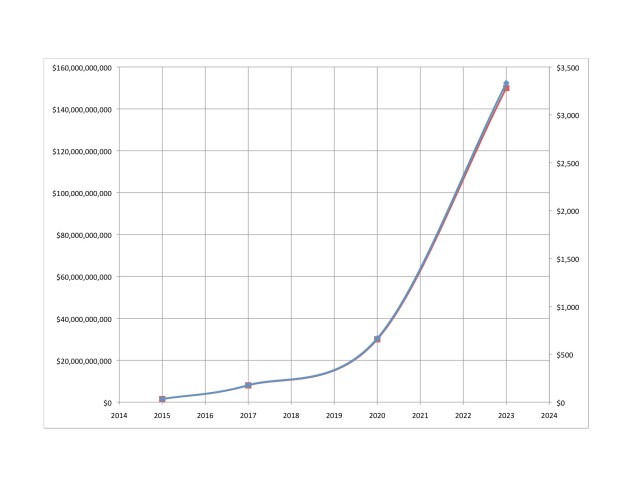
After MicroVision’s Annual Shareholder meeting I did a quick analysis of the share price possibilities based on comments made by the Chairman of the Board. I liked the answers, but I knew they had to be given some perspective. Based on the components that go into digital cameras, it is possible that MicroVision could see similar growth. Given that growth in the company, I calculated the growth in the stock.
2015            $33
2017           $178
2020         $667
2023      $3,333
It should be obvious that if I can hold the stock until 2023 that I’d be a multi-millionaire just from my MVIS shares. Have no fear, I’d diversify and have a bit of fun long before then. But how big is a company with a price of $3,333? Would it be bigger than the biggest company that exists now?

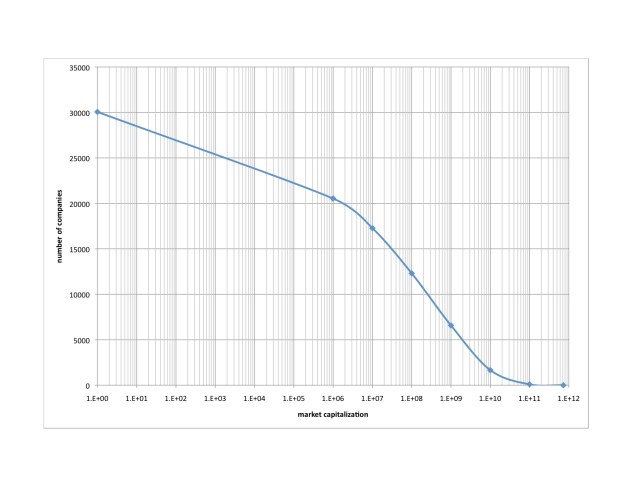
Currently, according to Google there are 30,059 companies to invest in. I suspect that includes mutual funds and such, but I work with the data I can get. 20,532 are worth more than a million; but there are a lot of houses worth that much. Even at one hundred million, there are 12,309 investment opportunities to pick from. At ten billion we’re down to 1,666; a number small enough that many people would recognize many of the companies. Only 96 are larger than one hundred billion; not all of which are recognizable, but most are. That top rarefied niche is the home of the drivers of the market indices, the holders of immense wealth, and also probably partly owned by most pension plans. None have made it to a trillion, yet.
Market cap    # of companies
1.00E+06        20,532    32% percentile
1.00E+07         17,272    43%
1.00E+08        12,309    59%
1.00E+09          6,578    78%
1.00E+10           1,666    94%
1.00E+11                96    100%

max cap 100814 market cap

So, where does my estimate place MVIS? Assuming about 45,000,000 shares for MVIS
2015               $33         $1,485,000,000
2017              $178        $8,010,000,000
2020            $667      $30,015,000,000
2023          $3333    $149,985,000,000

max cap 100814 MVIS

MVIS market cap and share price

That last number is definitely high, but at least it isn’t higher than what’s proven possible in 2014. It suggests that MVIS would be a major player in the S&P 500, even as the index climbs. That’s where conventional wisdom wags a finger and says it won’t be so. Maybe so. I don’t need it to get that high. I need sooner rather than 2023. But, that company with the largest market cap, the one that most people laughed at for decades was started by two guys who had an novel and simple idea. Thank you Steve and Steve, Jobs and Wozniak.

PS
If big price numbers create an emotional positive or negative response, remember, they’re just numbers. BRK, with a market cap lower than AAPL’s, closed today at over $200,000 per share, directly because there are less than two million shares available. MVIS has less than fifty million shares.

Posted in Uncategorized | Tagged , , , , , , , , , | Leave a comment

Reasons For Optimism October 2014

Overall, I’m optimistic. Got problems? Same here. I need to find additional work. My house, car, and self are requesting repairs. Yet, I’m optimistic. One friend calls it the Trimbath Sanguinity. I also like the term apocaloptimist. There’s a crisis amongst us, and I think what comes next might be alright. Here are some trends that I listed from just one day of casual web browsing.

Electric transportation
Mass produced electric cars have been tried before, and famously squelched. A good idea resurges, and does so with broad appeal and without trying to mimic old solutions. Electric cars are becoming common enough that there’s no reason to comment on them as they drive by. I’ve ridden in a few, and a few hybrids, and after the first few minutes the novelty is replaced with a normal drive. The range may be an issue, but that is only going to improve, not degrade.

Electric bicycles sound like they should just be toys considering the weight involved in batteries for electric cars. They do weigh more than a normal bicycle, but the extra weight doesn’t slow them down much. On my bicycle commute route is a one or two hundred foot hill. An electric bicycle climbed past me without hesitation. Its range may be limited, but just clearing that hill from my commute would save me ten minutes. People in flatter terrain are seeing the advantage.

Microelectronics
LEDs aren’t just light bulbs. It is easy to forget that they are Light Emitting Diodes, little bits of electronics. Their efficiency is impressive. Their lifespan is impressive. The rapidity of the price drop is becoming impressive. My local grocery sells subsidized ones for $4. Any extra cost is worth the extra life, and mine don’t have the annoying buzz of the CFLs I tried.

Someone did remember that LEDs are electronics and decided to try using them for more than just light. US electricity cycles on and off 60 times a second. That’s fast enough that our eyes can’t detect the 50% of the time they are off, but that is slow compared to computer speeds. But, LEDs can be cycled at high enough speeds that they can send data. Instead of using radio waves to create wi-fi (and creating some health concerns), LED lights can be designed to act as a local internet called li-fi. The bad news is that the light is stopped by obvious things like walls. The good news is that the signal is much more secure. Hackers can’t get the signals from inside closed rooms. Hospital rooms don’t have interference from other hospital rooms. And, those wi-fi health concerns are avoided. Someone will find something wrong with li-fi too, but maybe all they need is to leave the room rather than live in the wilderness or in a faraday cage.

LEDs are also showing up in monitors, not like in the flat panel displays on our laptops, but as pico projectors. Whether or not MicroVision succeeds with its MEMS mirror oscillating red, green, and blue laser diodes, computers, televisions, monitors, and an immense array of fragile flat glass electronics that require immense quantities of resources, transportation, and disposal costs will be replaced with projectors the size of postage stamps that necessarily take far fewer resources and leave far less waste.

3-D printing
Being able to print documents at home was a dramatic change for every household. The ability to print color and photographs continued the trend. Those impacts are small compared to the advent of 3-D printing. It might seem like a toy that can print toys; but the implications are far greater. Even if the price of the part doesn’t change, being able to buy something and print it rather than ship it dramatically reduces the cost of time, shipping, packaging, warehousing, and the waste of discarding unsold inventory. Just like print-on-demand means authors no longer have to store books and ship them to buyers, individuals will be able to design parts, sell the designs, and enjoy the royalties. Passive income is a nice thing. Decreasing waste in resources and time is even better.

Tiny Houses
If you haven’t seen them, you probably will. Tiny houses

For Sale

For Sale

are a growing answer to a population that either can’t make enough for normal mortgages, or don’t want normal mortgages, or have realized that they’d rather own a house than have a house that’s so big that it owns them. Everyone’s answer is different, but a bit of self-examination of basic needs means a house below 1,000 square feet usually suffices. I live in 860 square feet, and could just as easily live in 600 square feet. Others push a bit more, happily declutter, and get down to 120 square feet, some even less. Rather than being spartan, tiny houses tend to have high-end everything because the total cost of the house is so low because it is so small. Total impact on the environment is lower, especially when it comes to heating. Total impact on the owner is less in terms of upfront costs, recurring costs, while allowing more free time because there’s less house to take care of. If you have to move, put it on some wheels or load it on a truck and relocate.

Solar power
Solar cell efficiency is increasing. The cost is reducing. The subsidies help, but oil, gas, nuclear, every other energy source is subsidized, and sometimes more that solar. Residential solar is becoming popular enough that it is impacting conventional power generation. A destructive economic cycle is developing around conventional power because of solar and wind. As more people use alternative energy, fewer people are using conventional. Fewer people maintaining the old system means the cost per capita for conventional power goes up. That provides and incentive to use solar and wind, which feeds the cycles. Many environmentalists have pushed for energy policy changes, but basic economics and the acts of individuals may have a stronger effect.

Walk Away movement
I am witnessing what I am calling the Walk Away Movement. Some of the advances I’ve mentioned above, as well as others, are enabling people to become more self-sufficient. Transportation, energy efficiency, power generation, sustainable housing, and self-manufacturing, are joining an increasing population of people growing their own food, making their own clothes, repairing rather than replacing things, building communities, and learning skills that extend beyond sitting on the couch with a remote. The power structures are providing disincentives to participate in politics, and public advocacy; so why try to change a Senator’s mind when it is easier to stay home and be a role model.

Social media
Go ahead and groan, but we groan about social media via social media because it is far more effective at connecting with personal networks that anything that came before; except when villages were small enough that everyone could fit in the pub. Good ideas travel faster and farther because we shout it out and people listen. Phone calls, snail mail, and public meetings can’t reach as large of an engaged audience as an idea that goes viral.

Legalized marijuana
Whether you inhale or not, legalized marijuana is one example of how ideas are spreading. Despite our concerns about control, social media is far less controlled than anything coming through the official channels or conventional news media. it is now much easier to check data, listen to debate, and make up our own minds. We won’t all agree, but we’re at least working at an amazing array of issues far more effectively than the US Congress.

Graphene
Much of what I’ve just described is the consequence of the Age of Silicon. Even a bit of both sides of the political dysfunction and the WalkAway Movement are enabled by the information that flows through silicon chips. Graphene is almost magical in how much better it is. Graphene isn’t just a replacement for silicon’s conductivity. Graphene is also a building material so strong that an elephant standing on a pencil point isn’t enough force to break through a sheet of graphene the thickness of clingwrap. The difference between the strength of chemical bonds and molecular bonds creates astonishing characteristics. Graphene is nothing more than sheets of carbon. The holes between the atoms are smaller than water. That means a material that is strong and waterproof that also conducts electricity and heat. How about a roof and walls that are only one atom thick? The resources required to hold them up would be minimal, and fewer resources are used.

Consciousness, The Universe
The most powerful positives may be the progress we’re making in understanding consciousness and our place in the Universe. The insights are simultaneously humbling and inspiring. We reaching beyond compassion based on “Because I told you to.” and fundamentally learning about our similarities and interconnections. We may finally reach the point where people treat other people as if they were people, no labels applied.

Ironically, most of these ideas don’t affect my daily life. My financial situation is improved, which some take to mean resolved, but which I know is insufficient and fragile. While one of my major clients is closing their project, and I continue to look for an improvement, I’ve also had fun, actual fun, working for a new client. An article I wrote for Curbed Seattle, went to #1 regionally, then #3 nationally, and then was picked up by a news outlet. It had more views than there are seats in the Tacoma Dome. Now, that’s encouragement! Especially, because I did something similar the month before.

I may be hitting my niche, explaining things as diverse as real estate, aerospace, and financeDream. Invest. Live. in conversational and entertaining terms. Exercise that, and couple it with my joy in simplifying complex program plans, and my financial situation may get back to repair-the-house money, or more. We may be hitting our niche, in areas that we’ve all become aware of, but in ways that are creating a new mainstream that is hopefully pointed in a much better direction for everyone. Okay, I feel optimistic again. (I’ll look at the bills later.)

Posted in Uncategorized | Tagged , , , , , , , , , , , , , , , | 1 Comment

Twiddling Thumbs

What broke loose in the world? Everything seems to be in flux; but, maybe it’s always been that way and we’re just aware of it now thanks to the Internet. Nah. This time is different, as every time is. Almost all of the change is out of my control. I could try to track every detail, understand every nuance, and anticipate every possibility. And I’m old enough to know better. Sometimes the best approach is to keep doing what I’ve been doing – as long as it seems like a good idea. And sometimes, it just makes sense for the mental equivalent of twiddling my thumbs to keep my mind occupied while the world resolves itself.

I know, I’ll run a civilization! Gamers know what I am talking about. There’s a game called CivilizationScreen shot 2014-10-01 at 7.29.07 PM, aka Civ, also known as an addiction. A successful run at the game can take ten or twenty hours to play. This is not a shoot-em-up, unless you consider the seemingly inevitable global conflicts. Civ is a strategy game where the player starts with a wandering band of settlers who haven’t even developed writing. The player has to build up their country’s size, technology, culture, military, and relationships. The first country to launch a spaceship to Alpha Centauri wins. Finally a game that doesn’t require shooting and subjugation for success; except that is an option too. And success is possible by being the best diplomat, or most advanced culturally, or merely being the biggest in 2050. It takes strategic planning, big and small picture perspectives, and a lot of brain cells. I can dive into a game of Civ and have nothing left over for worries, anxiety attacks, or useless anticipations.

The planet is changing rapidly, and isn’t waiting for us to resolve a debate over the cause. People are implementing solutions are quickly as they can, and trying to make more of the population aware of the situation. Governments are realigning themselves in Scotland, the Ukraine, Syria, and probably a couple dozen other places. The US elections are only weeks away, and while there will be votes, it is hard to tell if there will be change; unfortunately, the lack of change is initiating change in the form of consequences. The economy is improving, at least in sectors; and maybe that’s enough, as I’ve seen many businesses gain traction and earn their owners a living. My business is losing a major client as they conclude their project; yet I hear hints of enticing possibilities that could replace or even improve that revenue stream. Aside from all of that, I’m hearing good news from many of the stocks in my portfolio; particularly, Peter Jungmann’s positivity regarding MVIS. Passive income again? That would be a welcome return.

It is tempting at such times to try to do something for each of the issues, and I do. But, it is also possible to do too much, even though it will have no other effect than to spend time. I live a life with little waste. I use my bicycle more than most. I compost. I won’t list the rest because no one needs to read anyone’s list of what they think they’re doing right. A good rule is that, when in doubt, people are making and acting on their best guess. That’s all any of us do every day.

But sometimes, I must remind myself, there is nothing to be done beyond what I’m already doing. I try to live “right”, at least according to my values and abilities. The forces in play in the world have incredible momentum, and are usually only affected by opposing levels of incredible momentum – though I do enjoy that fact that chaos theory suggests that a small random cause can have an immense effect. The forces in play in my personal finances have far less momentum, and yet are probably equally resilient and sensitive on any given day or night.

So tonight, while I wonder what’s happening with the ice caps, the protests in Hong Kong, the election fodder the politicians will provide for Stewart and Colbert, whether the economy’s recovery is temporarily superficial or permanently superficial, whether my newer clients will ramp up as they’ve suggested, or whether MicroVision and MVIS will finally be proven successes within weeks or days, I guess I’ll have dinner, let the world settle itself without my active interference, and play a game where I try to take over the world – peacefully.

twiddling thumbs

Posted in Uncategorized | Tagged , , , , , , , , , , | Leave a comment

Sustainable Versus Survivable

Watch the watchwords and catchphrases used by movements and causes. They shift, as language does, and also as people’s reactions are recognized. Sustainable was the word for several years. It was replaced by thriving. The real topic is how many people will be surviving. On a personal level, that’s the basis that we all work from, and how aware you are of the fact is a measure of where you’ve been in this life. At the level of survival, needs versus wants are not academic concepts. Necessities become starkly apparent, and valuable lessons that are hard to ignore or forget. Knowing your true needs makes sustainability, and then thriving more realistic. Self knowledge is one of the most precious lessons learned from the hardships encountered when survivability is challenged.

Several years ago I had a conversation with a noted new economy pundit who will remain nameless. The topic of poverty came up, and my paraphrasing of their response is that “while the poor may be in poverty, their culture sustains them.” I had one of those jaw dropping moments when trying to respond to a concept so disconnected from reality. The assumption was that even though the poor don’t have enough to eat, or a place to sleep, or healthy conditions, a song will carry them through. Nope. The human body needs sufficient calories, vitamins, and minerals to survive. Every climate requires some protection from the elements. No place on Earth is safe from disease because a person without enough food, or under too much stress will not survive long.

A simple fact is that, the generally accepted scientific observation is that humans are mortal. A wonderful source of science fiction, fantasy, and conspiracy theories suggest immortality is an option; and they may be right, but let’s assume that most of us are going to die. The fact should not be a shock, even if stating it is shocking. I’m over 55. As the saying goes, old age is not for sissies. That’s become obvious. Mortality also means that survivability for an individual is a limited time option, at least until the immortals or the digital singularity decide to change things.

My life for the last few years has been a journey through economic turmoil. One bit of evidence: I’m only going to conferences if someone else pays my way. I’ve been pleased, and several folks have applauded me, for being able to survive losing 98% of my net worth, avoiding foreclosure, and building up a business because for some reason I wasn’t able to get a job after trying for years. I accept the applause because I’m still here. Many folks assume that the result is obvious. As with anyone who’s been through a similar situation, we know different. We know the people who didn’t survive. The harsh reality is that lives are shortened either through stress or from more active means. This gets into a dark place, but the suicide rate dramatically increased after the economic downturn that became the Great Recession.

It is time to step up past survivability to sustainability. Sustainability was too dire for some early media campaigns, but it is a step up from bare survivability because it extends the concept of surviving out to a more typical lifespan. There is an ease to sustainability because the systems in place are reliable and replicable. Do this that way with these kinds of systems and life will get its chance to run a natural course. The stress and anxiety of survival are eliminated, leaving a great relief and an opportunity to enjoy the song that is culture.

Sustainability wasn’t enough, at least within ambitious America, and I am not surprised. As a species we can do amazing and good things. To do that we must do more than survive or sustain; we must thrive. By thriving and by remaining aware of our needs from our experiences surviving, we can realize our collective dreams whether that is improving everyone’s lives, expanding into the universe, deeper into our selves, or all of that.

Our civilization can thrive, but first it must become sustainable, and we must find a way for all people to survive. If thriving is only for a few, it is less likely to survive.

Like a lot of people I know, I am in survival mode. By working seven days a week, usually from about 8am to about 8pm, I can make enough to pay my bills; though I have yet to figure out how I am also going to pay the self-employment tax. Like I said above, I join the applause that I’ve reached this level, as have so many others. Survivable, however, is not necessarily sustainable. I’m only taking a day off every two months. My body has symptoms of carrying too much stress, a weakened immune system, and days when my diplomatic reserves are at a minimum. I strive for sustainability. I believe I can reach it because an extra client or two, or a windfall can dramatically improve my situation. I’m enough of an optimist that I know that eventually I’ll find the right combination of what I can supply to an existing unmet demand and that I’ll be compensated enough to thrive. I look forward to that day; and it could happen any day.

We find it convenient to classify people into lower class, middle class, and upper class. We are a class-based society, but at least we don’t require folks to stay in the class they were born to. One definition of lower, middle, and upper that comes to mind is housing:

  • lower = must rent,
  • middle = able to buy,
  • upper = able to buy more than one.

Roughly speaking, lower, middle, and upper could also be: surviving, sustaining, thriving. Sadly, there’s a fourth distinction that we treat as statistics and don’t talk about much and that is the not surviving. I’m glad I’m not there, but I can see it from here.

As we try to develop a society and civilization that will thrive, it may be best to look to the people who’ve learned how to make things sustainable, and even more to the people who are intimately aware of what it takes to survive. They’re the people who learned best about what matters most. Our modern irony is that the people with the most precious life knowledge have the least monetary wealth. Maybe it is time that what they can supply meets the demand to thrive in a way that helps them do much more than survive.

Posted in Uncategorized | Tagged , , , , | Leave a comment

An Irrational MVIS Market

Cause and effect are logical cousins. We expect them to be quite familiar with each other. The stock market doesn’t work that way – at least in the short term. MicroVision had a rare event, a press release that included data and dollar signs. They made money because they made something. This is good news! The stock popped; and as of today is right back where it was before the announcement. As an investor I have a simple model and expectation of how much a stock may be worth. The market and I disagree; and the market is what sets the price and the worth, regardless of my logic – at least in the short term. The news, however, suggests that the long term may not be too far away.

Ta Da!
MicroVision Receives Nearly $1.9 Million in Component Orders for Fortune Global 100 Customer
Development on display module complete; MicroVision expects to begin component shipments in Q4 2014

There are investors, or at least traders, who see a press release and buy or sell before they’ve read the news. In this case, I think they got as far as $ and bought. MVIS popped up 10% in the first hour. Then the stock started sliding back. Maybe they finally got past $1 and noticed that the next character was a decimal point. MicroVision made $1.9 Million, nearly; so, really probably a bit more than $1.85 Million. That’s a lot more money than I have, but there are houses in MicroVision’s neighborhood that cost more. It was good news, but it wasn’t great news. It wasn’t the sort of news that meant the company was profitable. And the stock settled back down, the energy spent. Evidently, the investing community is expecting bigger news and isn’t willing to hold the shares in the meantime.

My favorite valuation model is Present Value of Future Revenues, Discounted for Risk. Assume that someday they’ll make money, regress to today using some interest rate like 10%, and then take that number and reduce it by some percentage based on how likely they are to make that money. Peter Jungmann posted his estimate of the future share price based on future revenues. I appreciate his model, have my own values for some of the ratios, and am impressed that he has the courage to publicly post his answer. So many talk but don’t post. I’ve posted mine before as well, but it is late and my link is harder to find (here’s a piece of that story); so, let’s just use his. “Microvision @ $1,786 /share?

Share prices over a thousand look incredible, but he is not the only one to come up with such high numbers. I came up with something similar. Others have quietly emailed me theirs. Assume it takes seven years for MicroVision to become that successful. Regress the revenues back at 10% and find the price has dropped by about half; $854. Today the price is $1.93. The discount for the risk = 99.95%. (1.93/854~.0005) If I found that kind of discount on anything and could afford it and expected to be able to sell it, I’d buy it. Which I have in the case of MVIS.

My logic, however, is not popular enough to be reflected in the market.

Okay, I like such a high estimate for the stock; but I’m not surprised the market isn’t matching it. I am surprised that the market is effectively discounting it 99.95%. Even just based on luck the odds should be better than that. A 90% discount would be $85.40; which I think is reasonable. One of the reasons investors balk at that idea is that they are considering the share price without considering the number of shares. MVIS went through a reverse split a few years ago 8:1. Based on that share count, today’s 90% discounted price would be $8.54. Market psychology trumps market mathematics.

When I saw the news I saw the decimal point. $1.9 Million is nice, but it doesn’t affect my model. The parts of the headline that would affect my model, or at least how someone else may use it, are “component orders” and “shipments in Q4 2014“. As usual, there were few other data in the rest of the release, which is also why the stock may have come down, and also why the discussion boards are parsing the news a week after its release. Component orders, though, are an important step for a company that has been relying on development contracts. Hardware is being manufactured and shipped. Shipments in Q4 2014, mean things are happening now, not in some far off projected date. For me, the probability of success has just increased and the discount for risk has decreased. That’s enough reason for the stock to move.

Evidently, the stock does not agree.

I, like many of the MVIS investors who’ve owned the stock for years or decades, am anxious and eager for the company’s progress. So often they’ve made announcements, we’ve been exhilarated by the promise, and disappointed by the delivery. Now, we seem to be entering a phase where the events are more substantial, the far off anticipated events aren’t as far off, and we can base our discussions more on data than conjecture – though we have a long way to go there.

Eventually, eventually, if, if MicroVision succeeds, then I think it is likely that this market that has marked MVIS down by an irrational 99.95% may counter their history by marking it up with an irrational premium. And, no, I don’t expect a multiplied premium of 2000 (99.95% = 0.9995 = 5/10,000 inverted would be 10,000/5 = 2,000); but hey, there’s evidence enough that the markets are irrational. They didn’t listen to my logic before. They probably wouldn’t listen then, either.

Okay, MVIS, sooner is better than later. I’ve got bills to pay.

Posted in Uncategorized | Tagged , , , , , , , , | Leave a comment

My Money And My Life – Breakout

We whacked weeds, pulled old fencing out of bushes, posted some signs, and generally played around in our grubbies in the name of charitable land preservation. It is how I decided to spend a morning, and I didn’t even get paid. I’m one of the site stewards for a land trust property. It is something I do that makes my life a bit better by making my neighborhood a bit better, so I guess I was or will be paid. Sometimes it is the little events that don’t take much time, but that affect your life, that make it worth a temporary shuffling of a schedule. I did that in blackberry bushes on Friday. I also followed my own advice from the previous post and spent some time in the neighborhood of my personal finances. A bit of life spent as time taught me something about wealth and money.

Allow me to disabuse any grandiose notion of my role as site steward. The other steward does a lot more work and lives almost an hour away. I think they gave me the role because I can walk there in twenty minutes, and have to drive past the property to get out of my neighborhood. He’s useful and constructive, planting trees, getting a bridge built, organizing fence parties. I’m more convenient, will work on the constructive side, but I’m more likely to lead the charge against invasive plants. Destroy! Exterminate! (Maybe we should hire a Dalek.)

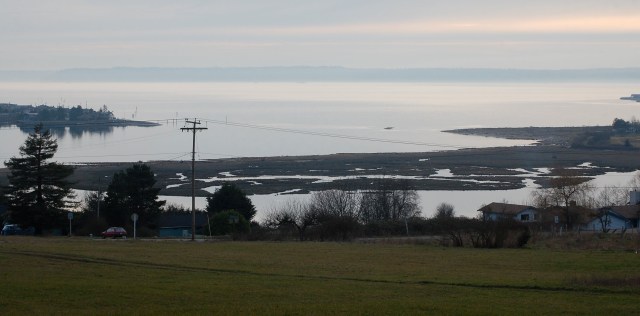
Hammons Preserve is a small farm that was passed on to the Whidbey Camano Land Trust so people can sit and find a bit of peace. It is also one of the few places to see Cultus Bay, an fertile and active tidal bay with a view of the Olympics and that has shores that shift by at least a kilometer between high and low tide. By putting the property in trust the land was saved from probably becoming a housing development or a MacMansion estate. Farms are fertile. That also means invasive plants are happy to move in and take over. Our work parties alternate between destruction (tearing out the invasives) and construction (planting native species) and then more defense against the invasives until the natives are healthy enough to take over.

Trust me, the Olympics are right there, behind the clouds.

Trust me, the Olympics are right there, behind the clouds.

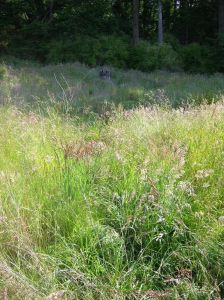
At the start, there were truckloads of old farm garbage. After that was carted away we covered the fresh dirt with mulch and weed barriers and started planting cedars, willows, grasses, and more types than I can recall. I spend more time with the weeds, remember? Those invasives are blackberry, english ivy, holly, canadian thistle, and scotch broom. We’re there about once a month. They work every day, but so do the natives. We are making progress.

Hammons Feb 2008

February 2008 – dirt and weeds

Hammons Jun 2011

June 2011 – our grasses arise

Hammons Sept 2014

September 2014 – shrubs begins to rule

Motivations differ, but at the last work party a thought came to mind. Aside from the long term goal of preserving the land, volunteers find personal short term reasons to help. The things we do for charity are the things farmers would do out of necessity. A Friday morning in grubbies is worth a celebration, but a farmer spends decades viewing much of it as just more work. If the farmer worked the land for decades, then the farmer found a sustainable lifestyle. Volunteers measure time and effort differently. A sense of gratification comes from knowing your work has helped at least in some way.

It is also gratifying to get dirty, do something good, and know you can get clean. It is gratifying to know that you’ve got the clothes for the job. It is gratifying to build up an appetite and know you’ll be able to eat enough to replenish yourself. It is gratifying to build up a thirst, know that water is available, and possibly have an excuse for an indulgence like a beer. The tools, though, are what impressed me. It is gratifying to have the tools for the job; and in our consumer culture, most of us have more tools than we need, and rarely use the ones we have. I know this because I had fun tackling a task by driving back home and grabbing an assortment of gadgets that meant a job got done rather than postponed. And I got to use my tools!

I felt rich – and anyone who’s been stalwart enough to read my financial story knows that I have far less money than even a few years ago.

That’s when the flash of insight hit. There are people who are working hard every day who, at the end of the day, can’t get clean, damaged their clothes, won’t have enough to eat or drink, and have to let vital tasks go undone because they don’t have the resources or equipment.

There’s a poverty line defined by the government based on income. I found a new line, while doing work for free even though I had to make up the money and time somehow.

In my previous post I exhorted folks to celebrate taking any small step in advancing their personal finances. Doing something is better than just talking about it. So, before I went to bed (actually couch), I opened up the Nine Step Program Guide and tasked myself with reading at least a page. Well, the first few pages are titles and copyrights; so I skipped to page 4 and ran into a list of questions. Mostly they were about money, and reminded me of how I’ve had enough and now do not. I was about to answer them as quickly as possible rather than dwell on my misfortune but I came across this one;
If you were to die in the next few years, would you be comfortable with your legacy or contribution to your family, your community, the world?
Yes. The answer came so quickly that I hit rewind in my brain and asked myself the question again. Yes. Despite my current situation, I am comfortable with what I’ve done and how I’ve acted – for the most part. I am human, so inevitably, mistakes were made. I beg your pardon. Accept my apologies. But the balance remains. And, no, I don’t feel like replaying my entire life within a blog; but I do appreciate the question and the answer and the level of confidence I have with it. (Want to know more of the story? I have over a million words published in books, articles, and posts. Check my bio. Read on.) Whether anyone agrees with me or not, the question is in the Guide because it is a question we should each ask ourselves. What’s your answer?

My new appreciation of poverty and wealth, and my new appreciation of my self arrived unexpectedly. The revelations continue to percolate and permeate through me. One thing is obvious – I’ve received some of the most valuable insights by spending just a little bit of time, for free. They broke me out of a mindset and gave me revelations. Thanks.

Posted in Uncategorized | Tagged , , , , , , | Leave a comment

My Money And My Life – Intentions

I have great intentions! Ah, I’ll get to them eventually. When life comes by in a rush it is easy to keep old habits and hard to develop new ones. I intend to step through the Nine Step Program

New Road Map Foundation

New Road Map Foundation

developed and popularized by Joe Dominguez and Vicki Robin. Back in the late 90s, the program helped me gain confidence in the way I managed my finances. As I’ve said before, it is time to do it again. Progress since the first time I mentioned it on August 6th equals zero. If you find that managing your finances is easy to procrastinate around, know that even from someone who knows its value, getting started is the hardest part.

Distill most personal finance texts down to the basics and they become, “Spend less than you make. Invest the rest.” Eight words, yet bookshelves are filled with variations on that theme, including my book, Dream. Invest. Live.Dream. Invest. Live. The variety exists because there is variety within humans.

How you spend is determined by your values and your necessities. Some people would never buy a gun. Some people would never be without one. Some people live alone. Some people have dependents that extend beyond family and acquaintances. Some people learn to be so frugal that they can meet their needs for less than some are compelled to spend on appearances and dining out. Some people have to pay for bad luck through medical bills.

How much you make is determined by your skills, talents, opportunities, and luck. Even Warren Buffet acknowledges that he has become one of the richest people on the planet because of luck.
I’ve worked in an economy that rewards someone who saves the lives of others on a battlefield with a medal, rewards a great teacher with thank-you notes from parents, but rewards those who can detect the mispricing of securities with sums reaching into the billions.” – Warren Buffet

Invest the rest are three simple words, yet the range of investment possibilities extends far beyond More Than Stocks; and each possibility is worthy of volumes of books and years of study. Be lucky enough to live in America, and many opportunities are available – if you’re making more than you spend. Tens of millions can’t afford both food and housing, and may be in debt. They aren’t investing. Yet, get on the other side of that balance and compound interest proves Warren right.

I intend to step through the Program because it helps systematize each of those steps, and adds 6 more. Mentally I am preparing for them again, looking ahead to the various exercises, and knowing that none are onerous though a couple are tedious while being instructive. And yet, I have yet to begin.

Life is nothing but time. Life is real. Time, at least for now, is non-negotiable. Money is abstract. I can make more of it, predominantly through spending time. The trade of time for money is improving, but the balance is fragile enough that any relaxation in effort is met with a shortage of resources. The notion of taking time off to better enjoy time puts too much pressure on my future time. Spending money to make more money is a fact of American life, but when there is no extra money to spend the extra money can’t be made. The US Government defines poverty by a yearly income, but a truer dividing line is that point where there is no extra money and no extra time.

Our lives are never totally out of our control. I can decide to risk bankruptcy by only working the hours I want; but, that is a risk that entails much more trust in serendipity than is prudent in a society that bases food, shelter, clothing, and health on wealth. Even as I type this post I am making a choice. I post twice a week, which takes about 3-4 hours each week. An extra 3-4 hours would help me get a lot done with at least a few of the tasks on my long list, including the Nine Step Program. I’m willing to make that trade because I know that I’m already on the right track to regaining financial independence. The Program will merely help me better estimate how long it will take. This blog, however, is evidently useful to a widely scattered international audience because so few people are able to articulate what it is like to live through such financial turmoils.

If you are on a similar path, congratulations. Even if you’ve only made as much progress as me, that is to set the intention, congratulate yourself on being far ahead of the millions who avoid, ignore, or live in fear of managing their personal finances. Every step may seem onerous, tedious, or innocuous; but, whichever path you take, deciding to place yourself at the start is the necessary first step. And then step. And celebrate. And step. And repeat, and realize that you’re heading to a goal that you defined. Get there and celebrate again. And don’t be surprised if you find more steps after that, but that’s another story.

Considering what I just suggested you consider, I am going to close this post now, a bit short, so I can take the few extra minutes saved to take at least the tiniest of steps: getting a copy of the program and reading page one.

For those of you who want to help me along with that balancing of time and money, keep in mind that I am happy to consult (for a reasonable fee) about such things (few have seen the swings through America’s economic classes as I have), or help me with that passive income that comes from sales of work I’ve already conducted (buy my book(s)!). History suggests that we’ll both benefit.

Posted in Uncategorized | Tagged , , , , , , , , , , , , , , , , , | Leave a comment

Retreat Run Away To Valhalla

Retreat! Retreat! Run away! Run Away – at least for a day. I, gasp!, took another day off. In the balancing of life and money, bare necessities necessitate working seven days a week. I’m known for my endurance (marathons, cross-continent bicycle rides, etc.) but I am also human. Logic dictates working every day until my finances have recovered sufficiently to take regular days off. I’m not there yet, but the realities of being human mean eventually needing to step back, even to the point of running away. I ran away to my mountains for a day and a night. And learned a lot about my fears, anxieties, and joys. Thank you, Valhalla.

Like many people I know, I work every day. It isn’t through choice. Working every day is required to pay every bill, even for someone with fewer and smaller bills as my frugal self. This year is far better than the last two years. I have just enough work to pay all of my regular bills thanks to four main clients, several short-term projects, and my regular classes, books, and photos. Add them all up and they just make enough to pay for the essentials, except taxes. Got to find a way to pay the government too.

The irony is that I am a strong proponent of balancing work and lifeDream. Invest. Live.. The universe presents us with lessons, sometimes rather forcefully, that expose our assumptions. Balancing work and life in today’s society is something that we’re only beginning to accept within social circles. Many people are working hard to keep the right job and the right car and the right house while doing the right things, except that they weren’t the ones that defined what was right. Tackle that, identify your personal values, live to them, and challenge convention with a life much better lived.

The reality for many people in situations like mine exposes the limits of that assumption. Implicit within the idea of balancing work with life is the assumption that work is producing more money than necessary. With 1/6th of Americans in poverty, there is sufficient proof that many people’s jobs aren’t producing more than enough money. Working every day isn’t a choice made to afford luxuries. Working every day is a necessity measured in balancing necessities.

As much as some think they’ve heard my litany of bodily aches, I can assure you that no one has heard the complete list. I only dare myself to list it to myself every few months. One reason I don’t concentrate on my aches is that I know that most of them are stress-related. The pain in my neck will be relieved when I relieve the ache in my assets.

Three days ago the aches ganged up. Sleep went away. My ability to concentrate pulled back from hours to dozens of minutes. I needed a break. With a little warning, but not much, I told all of my current clients that I was taking a day off. Nice folks all, they were encouraging.

The weather was right. My deck and fence were finally fixed. I had a slight backlog in hours. I committed myself to going on an overnight hike.

Taking a day off to go hiking sounds frugal, but it is expensive. As us work-everyday people know, a day off is not like what regular employees experience. A day off is a day without pay. The hike would cost me a day or more that must be made up with more work some other time. A hike also costs gas (~$40), food (~$20), ferry tickets for us islanders (~$20), trail pass (~$10), and the inevitable gear replacement (~$15 for a lost lens cap + ~ $15 in replacing snacks that became rodent chow). Even if I wasn’t losing a day’s pay, the hike would cost more than a day’s wages. And yet I knew I must go.

The cost and my anxieties were on my mind from the start. The price of gas, the age of my truck and its shocks and tires, encouraged me to drive slowly and carefully; ignoring the rest of mainland frenetic traffic. The trailhead is up a logging road, that was in the worst shape I’ve ever seen it. I know it well because I used it frequently when I was writing Twelve Months at Lake Valhalla.valhalla cover As I pointed out in the book, when stresses and anxieties arise, familiarity soothes. I was heading back to a familiar place.

Everything was fine. No breakdowns. As I got out of the truck I prepared myself for the inevitable climb with the sweating and heavy breathing. Yes, I love Nature. But, I was worried. I spend so much time in front of the computer that I was sure I was out of shape. My heart hasn’t felt happy on the days with contentious negotiations. If I didn’t keep my concentration up, my body might fall down. The wilderness is a bad place for bad things to happen. I know; I’ve had to assist in a few search and rescues just because I was in the vicinity.

Skip ahead to the top of the climb and meet my surprise. I wasn’t even sweating. My breathing was better than usual. My chest felt relaxed. My hips and back weren’t complaining. My headache was gone. I felt light, happy, and content.

DSC_4994I was in wilderness. I was in the wild, where even the trail crews can’t use powertools. I was in the wild where there are lions and tigers and bears, oh my. Or, at least there are bears (probably black), cougar (which have stalked me), and the most dangerous of all – rodents who pester and eat camp food. I was in the wild where there are rockslides, forest fires, falling trees, and hazards enough to limit human expansion until the last few thousand years. I was in wilderness and felt better than I’d felt in years, since the last time I went on a hike.
DSC_4969
I carried my basics: shelter, clothing, food, medical supplies, and assorted gadgets; all of which fit in a pack I carried on my back. DSC_4972 The anxieties were gone. The aches and pains and anxieties that fatigued me to the point of escape were the result of trying to meet society’s basics of a house, its systems, taxes, utilities, transportation, and the list of bills most of us are familiar with. We’ve made an unbalanced trade some time ago. Originally, we left the wilderness and developed technologies to civilize our world and ease our lives, but which separated us from nature. Yet, we also developed expectations within that society, while reducing wilderness to pockets that must be legally preserved and only visited temporarily.

Fantasies of living in a cabin in the woods or on an isolated island remain fantasies because those lifestyles cost money for the land at least. Of course, maybe I’ll win the lottery.

Realties exist though, that I am reminded are healthy. I lived a life that had me backpacking three weekends out of every four, while maintaining a regular job, while maintaining a house. I know now that this retreat has run me back into something I want and need to do. I have a refreshed goal of finding that balance, financially, mentally, and emotionally. I’m glad I ran away.

DSC_4967

Posted in Uncategorized | Tagged , , , , , , , , , , , , , | Leave a comment

ASTY Refuses To Be Boring

Stocks only return 5%-10% per year. Investing is boring. Timing is everything. I’ll agree with that last one. I intended to not mention ASTY again until my semi-annual portfolio review at the end of the year. So much for those plans. ASTY took the pop that I talked about last time, which was on top of a pop I talked about previously, and popped the top off both of those. Evidently, the stock ASTY doesn’t know that the company it is based on, Asterias, hasn’t changed significantly in the last two weeks. At one point today ASTY was up 359% from its recent low. I almost sold. Timing got in the way. That’s probably okay.

Four days ago I wrote, “My position was up over 200%. I could sell half, take out my original investment, and let the profits be pure.” I wrote about deciding to hang in there for the long term as I usually do. Selling half would let me do that with half of my position; but that position was the smallest in my portfolio. I didn’t want to invest too much time or emotional energy into deciding whether to sell or not. But, I tasked myself as usual and asked what would be a high enough price to pull out my investments while leaving a large enough position. I settled on a roughly four-fold increase and set my expectations to act on that within a few years.

The universe laughs at our plans. Investors can design intricate stratagems, but reality trumps everything. The day I published my post, ASTY went up to 6. The trading day after that, it climbed to 7. This morning it started with a jump by gapping up, and climbed past 8 as I had breakfast. My silly thought experiment of a four-fold increase was no longer a far-off calculation. It was something to calculate now. Ah, but I am a rational human being and decided to ponder the exact number as I drove to work. If it exceeded that number when I got there, I’d put in a Stop Loss order for a quarter of my shares.

Ha! the universe said. When I got in the truck, ASTY was above 8. As I drove in, I realized that approximately $8.80 would meet my criteria. As I got to my office (a co-works space in downtown Langley), I fired up my laptop, saw a blip above 9, arranged the rest of my nomadic workspace, poured my cup of tea, and saw that the stock had dropped to $8.60. I trusted the number I’d estimated, and waited for a possible rebound. It came and went while I dealt with my first client. Through the rest of the day it dropped as if it was bouncing down stairs, then plunged to below 7 and dribbled around in the mid-sixes for the rest of the day.

Who says investing is dull?

It is a good thing that I understand my risk tolerance, know the folly of definite plans, and have confidence in my overall strategy of investingDream. Invest. Live. in the company more than the stock. The stock dribbled along above 6. I bought it below 3. A 10% return on a $3 purchase would take seven years to reach $6. The stock’s performance is exceeding my goal. I haven’t optimized my portfolio, but at least that stock is exceeding the market averages.

Investing in startups involves a lot of guesses masquerading as analyses. Startup biotechs can range from below $100,000,000 to almost a billion; yet no one knows the answer until the FDA approves the treatment and the company begins treating patients and getting paid. Hindsight is perfect, and it is too easy to beat yourself up over missed opportunities. If only I’d . . .

I intended to take the night off. I’ve been working seven days a week with one day off every two months for the last year or so. I’m about due. But I wanted to write this post and pass along this example of real life investing: the possibilities, the realities, the utility of engaging somewhat emotionally to maintain interest, but not equating performance with personal judgment. Investing is a tool within a personal finance kit. So are minimizing expenses, maximizing income, and appreciating time. Investing is important. If you are invested at all, congratulations. You’ve enabled opportunity. If you’re doing the work yourself, congratulations again. You’re developing the skills that are useful for a lifetime and applying them to goals you, not some stranger, define. If you are regularly tending your investments, commend yourself for responsible behaviour and the chance to do better than average. If, however, your investments become a reason to judge yourself; step back and remember that they are only a tool and can never be more important than your self.

I picked a number, the market met it, but the time wasn’t right. That’s does not mean I should stare at the screen watching every pixel change waiting for the prime moment. It means I had a good idea, and almost had good timing. Next time it might work out. If this is the only opportunity to sell ASTY at $8.80 then I should get out of the stock now; but there’s no way to know that. And, of course, I am holding the stock because I suspect that a company that can regrow spinal cords will probably have a stock worth much higher than $8.80.

These last few days of ASTY also remind me of the possibility and reality of stocks in small companies. They don’t tend to creep up. They tend to sit nearly dormant, treated with dismissal and derision, until they produce something that is recognized as impressive and profitable. The kind of action ASTY just went through may be mimicked several times as the company matures. The same is true of others that I hold: AMSC, GERN, GIG, and MVIS.

The ability of simple things being recognized for their true worth is enticing and exciting, whether that is in stocks, world-changing discoveries and inventions, or in relationships. It is one reason I know that life refuses to be boring.

Posted in Uncategorized | Tagged , , , , , , , , , , | 1 Comment