Little Things Matter More Now

I can flush again. It is amazing how big the little things are when you miss them for a while. A working toilet, quiet time, water from a faucet, heat and light with the flick of a switch. Many people spend a lot of money on big things, and without getting the satisfaction that comes from a return of a vital part of life. The law of diminishing returns detours many financial plans. The frugal life, the minimalist’s life, takes the seemingly silly step of celebrating the little things as they are, without asking for embellishment, and saving money in the process. For years I lived such a life by choice. Now I live it by necessity. As wages stagnate and benefits fade, large segments of the population are learning the same lessons.

There are grand houses with temples to water. Master baths take on the scale of their own wings of a house. Tens of thousands are spent on expensive materials like marble or etched glass. Fixtures run hundreds or thousands of dollars for the simple act of turning water on and off. Phenomenal remodels don’t change the fact that people are human. The food that came into the house via the kitchen, and was served in the dining room and breakfast nook, gets flushed out the bottom of the house via gallons of water. (I salute those of you with composting or incinerating toilets.)

I got a new toilet. This month I’ll celebrate my eighth year in this house, the only house that’s truly felt like my home.DSCN5593 It was built in 1964. I don’t know for sure, but a lot of the appliances and fixtures look original. Renovations were, and are, in my plans. But, I was waiting for sufficient funds. Oh well, the wait continues. The toilet always had a few quirks. It was old. The water was hard. Its life was possibly hard as well. Before I bought it, this house spent decades as a vacation cottage. Strange things happen on vacations. Every year the toilet flushed less efficiently. A few years ago, a couple of flushes for required for every visit. A few months ago, sometime during the day, the toilet would empty the bowl at least once. A few weeks ago, I was simply glad that at least nothing solid was left behind, usually. The trend was not good.

Those of you with septic systems understand the possible problems. Solutions can cost tens of thousands of dollars. The closer the problem was to the bathroom, the cheaper the fix. I was lucky. Something, sometime fell into the toilet and blocked a channel. A service call confirmed that whatever was in there was as hard as a rock, and could be one. I don’t go chucking rocks down the toilet, and I doubt my guests do, but there have been parties and who knows what was bumped and fell in. About a hundred dollars and a couple of hours later, flush. Whew.

Remodeling that bathroom would cost a few thousand dollars, and wouldn’t create the same level of relief as the installation of a hundred dollar toilet.

Travelers, adventurers, explorers appreciate coming home to faucets that produce clean water, electricity that is always available, and a house that is warm and dry regardless of the weather.

Those simple things cost a small fraction of what people spend on houses. Transportation doesn’t require the fanciest sound system. Communications don’t necessitate smartphones. Entertainment doesn’t require electricity.

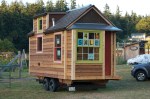
People are intrigued by tiny houses, even if they don’t plan to buy one. Cabin by AngelaMass transit, bicycles, and walking are gaining in popularity even with declining gas prices because people are recognizing the benefits of quiet time and exercise. (Though there probably will be a blip with this particular plunge in prices.) Flip phones are back in style, because smartphones do too much and cost too much, in both money and time. Distractions are intoxicating, but the wasted time is convincing people to kick the habit. Entertainment has never been more available, and yet, there’s probably nothing on (especially now that Ferguson and Colbert are off the air.)

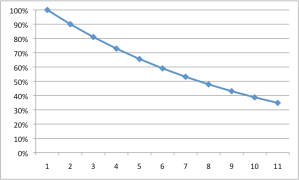
Living simply seemed monastic but our planet’s resource limits and our population growth means getting by with less is becoming a necessity, not a choice. Getting by with 10% less, then 10% less, then 10% less, will be painful. Do that ten times and you’re getting by on 65% less, not 100% (compound interest in reverse.) If, however, you lose 90%, and get back up to 35% (the same point as the ten 10% losses) there is a potential 350% increase. What a gift!
10 percent 10 times
As I am chronicling on my other blog, Pretending Not To Panic, there is good news too. Minimalism is becoming easier, and better. Projection screens that fit in your pocket (come on MicroVision.) Lights that last longer and use less energy (Yay, LEDs.) Electric autonomous cars that are so smart and efficient that you may not have to buy one; just call it up and it delivers itself like a taxi. Disconnecting from the complexities of the grid are becoming easier as power, water, and communications become decentralized. Even waste treatment is decentralizing. Septic systems have always been decentralized, but even those expensive and complex systems have alternatives like the composting and incineration options.

I continue to recover from my financial upset (understatement, oy), and am not comfortable yet; but along the way, each bit of recovery is celebrated more than it ever was when everything was simply assumed to work without a thought.

Our society is in various stages of denial and adaptation. Most of the hurts are of the 10% less kind. I don’t wish anyone to have to go through the 90% drop, but as we work through losses we may better appreciate the recoveries. Little things matter more now, and that’s good.

Now, pardon me as I want to use the toilet.

Posted in Uncategorized | Tagged , , , , , , , | 1 Comment

Mysterious MicroVision

It never happens the way you expect. MVIS shareholders have been waiting months for news from Sony. A Sony product with MicroVision Inside should be launched this year. We expected news by the end of 2014, and didn’t get any. January 2nd, the first trading day of 2015, and here we have it, an attractive, well-designed, pico-projector that unambiguously acknowledges using MicroVision technology, for a product launch by the end of January. It even has a price range because there are a range of options. But, it wasn’t Sony. A much smaller Korean company called Celluon announced their PicoPro – and, then they didn’t. The news vanished. The information, however, hasn’t.

For those of you who are unfamiliar with MVIS and who are surprisingly reading past the first paragraph, here’s a synopsis of a synopsis from My Semi Annual Exercise.
MicroVision is a promising small company with a technology that could dramatically change our electronic world. The company is based on a one key technology: an oscillating mirror built into a chip (MEMS, MicroElectroMechanicalSystems), that can acquire and display images very cheaply, at high resolution, at high frequency, for low power, in a very small space.
There’s a longer, but older, post Micro Vision, that explains more. The post’s age also tells a tale of patience.

Celluon’s press release vanished from the web. At least that was someone’s intent. Those aware of the workings of the Internet know that anything that is posted once was probably copied many times. Rummage around through the cache and the original can be found – and oops, that was deleted too. And again. The copies existed for a while, but now they too have vanished.

The video hasn’t.

Unfortunately, the video is of the device, doesn’t have time to mention details like suppliers, and is old.

The video age reveals something that is out of synch with the press release. According to the video, the AirPico was to be launched back in September, but it doesn’t seem to be for sale yet. CES, the big Consumer Electronics Show held in Las Vegas, starts Monday. The press release alluded to a launch then (as I recall).

There is where a possible conflict arises. Sony, which has already mentioned MicroVision as a possible supplier for a number of products, makes their big presentation at CES Monday at 5pm. Sony may not be happy being upstaged by an upstart. Maybe Sony convinced someone to retract the release. If so, then Sony cares about getting the right press with MicroVision, which is good for MicroVision and MVIS.

But, why would one competitor (Celluon) bow to another competitor (Sony)? Upstarts like to upset stalwarts. This would be a perfect David versus Goliath opportunity. Maybe something else is happening.

Rather than create a long list of speculations that will be moot either by the end of Monday, CES, or January, I’ll introduce one other possibility as caution. It is possible that the press release was faked, or at least generated by someone with great enthusiasm for the concept or the company without thinking through the implications. Investing in small companies also means investing in companies that have too few people to manage the corporate message across all media. Considering the hack against Sony, it is easy to imagine someone creating a wishful release, posting it, watching the reaction, possibly profiting from it, and then watching some authority like Celluon or Sony erase the effort. It is a scenario that fits the style of the various companies involved.

The press release was possibly legitimate. It may have been posted as intended and run into unintended reactions. It may have been released prematurely. It may have contained errors or revealed more than contracts allowed.

Regardless of the real reason, the reaction wasn’t mysterious. MVIS rose over 12% on reasonable volume. If nothing else, the news tested the market. An authentic looking press release from a relatively unknown company was sufficient to raise the price significantly. If a company of Sony’s size releases a similar or more significant product, the stock’s reaction will probably be much larger.

The mystery that continues to shroud MicroVision is similar to the mysteries that shroud many small companies. Information fog is one reason why investing in small stocks is considered speculating. Even when you think you know something, something tangible and quantitative, it can be deleted from at least the electronic memories.

As with any good mystery though, the hints along the path intrigue us and draw us to an eventual, yet unknown, conclusion.

Monday, January 6th, 5pm, Sony makes an announcement, and we’ll see if MicroVision’s story changes. I intent to tune in.

Posted in Uncategorized | Tagged , , , , , , , , , , , | 1 Comment

Semi Annual Exercise EOY 2014

Happy Invoice Day, EOY Stock Report Day, and Backup All Your Files Day. Oh yes, and evidently many people will use this time for celebrating the new year, or in many cases, having survived the old year. Pop that cork. Meanwhile, I’ll be sipping a cocktail as I end the year by sending out invoices, reconciling my business and personal finances, backuping up a few hundred gig of data – and, oh yes, posting the results of my semi-annual portfolio review.

I look at my stocks daily, as much for entertainment as anything; though lately it has been hard to tune in when my portfolio shrinks while the markets hit records. That is one of the consequences of investing in overlooked stocks, when the big money is running to the big companies, the little companies are left behind. Long-term investing, however, relies on patience, perseverance, and confidence in analyses and logic. That’s hard to do when downward trends run for years.

Emotionally, investing or speculating in small companies isn’t easy when the downturn is so severe that emergency funds are all that is left. Logically though, regular reminders of the basis of the decisions is valuable. While I may rationalize my holdings readily in conversation, or allude to it in posts on discussion boards, writing down the reasons is valuable and requires more logic. Writing down the logic behind positions and comparing it to the current situation is more valuable because an investor should always be willing to sell if the situation has dramatically shifted from the original intent.

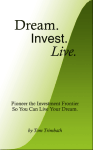
I’m very aware of the irony of writing a book about personal finance, frugality, and independent investing and then losing almost everything. While most people see the book and the subsequent performance, I see almost 40 years of data interrupted during the last most public episode. (The pre-2008 data is in the book, if you want to see my investing history.)Dream Invest Live cover

Ironies are entertaining in the media, but this irony created a massive scramble as I successfully struggled to keep my house, build my business, and pay the rest of my bills (which prominently involves health insurance). 2014 was better than 2013 which was better than 2012; and 2015 must be better than 2014 because certain bills will come due. Paying taxes in April is an obvious goal.

My portfolio has the potential to recover and ease those concerns, even within the April deadline. My portfolio has had that potential for years. Each of the companies represented by my stocks has made progress despite falling share prices. Each has also had issues, but if they had none I’d suspect them of hiding something. Long Term Buy and Hold (LTBH) investing, as I do it, requires patience and is usually eventually rewarded, though there are no guarantees. I don’t expect them all to recover in 2015, though that is probably more likely than having them all fall as they just did. So, 2015 has better future odds than the recent past performance.

I feel that my world, and the world in general, are in races between good news and bad news. Will my stocks recover sufficiently before I need to pull money from my IRA? Will we develop the attitudes and technologies that will help us adapt and change to the shifting environmental, financial, and societal shifts? If you haven’t visited it yet, I’ve launched a blog for “news for those of us who are eager and anxious about the future” called Pretending Not To Panic,

PNTP

PNTP

a phrase that nicely captures an attitude I and others find we must adapt. (Hip flasks now available.)

I post the semi-annual review of each of my stocks on various discussion boards. I could post the entire collection here, but: 1) it would be very long, 2) the more public the conversation, the more valuable it becomes, and 3) reading my posts on those boards introduces you to individuals who have different perspectives, strategies, and experiences. Collectively, those communities are more powerful than large financial institutions because the motivations and incentives are those of similar individual investors rather than that of profit-minded corporations.

Here are the links to the discussion boards I use. Feel free to comment here or there, and to pass along links to others. The bigger the discussion, the better the chance of valuable insights (as long as the trolls and flamers are moderated appropriately.) Congratulations to those who are using the same exercise. I hope it is working for you too.

Investor Village
AMSC
AST
GERN
GIG
MVIS
RSOL

The Motley Fool
AMSC
GERN
MVIS
RSOL
Economy and Markets

Silicon Investor
AMSC
GERN
GIG
MVIS

Posted in Uncategorized | Tagged , , , , , , , , , , , , , , , , , , , , , , , , , , | 1 Comment

Things To Look Forward To In 2015

2014 was better than 2013. 2015 has to be better than 2014. While that may be a personal wish, it is also a global one because some things continued to get worse in some topics while good news came in for others. Despite the cautions many send my way, I am an optimist. It is the only thing that makes it easy to go through life pretending not to panic.

Graphene
We are in the first years of the Age of Graphene. Graphene is simple, ingenious, and we’re only beginning to understand it. Wonder materials come along and are incorporated into our lives, but none of the recent discoveries match the potential of graphene. Graphene is simply a sheet of carbon. That simplicity obliterates the failings of almost every other material. A sheet of graphene is a single molecule. Almost every material we use relies on chemical bonds for strength. Molecular bonds are much stronger. To restate an old example, an elephant standing on a pencil couldn’t poke through a sheet of graphene the thickness of a sheet of plastic wrap. So, it’s strong. The gaps between the molecules are so small that they are the best barrier. So, it’s watertight, airtight, and maybe even hydrogen-tight. The sheets are made of carbon, which you’ve probably heard that we have an excess supply of. So, the basic material, the basic element is cheap and readily available.

The list of potential uses basically covers everything that requires strength, impermeability, at low weight. My favorites are incredibly light waterproof roofs, resilient roads, and structures strong enough for any impact, including bullets. Cheap desalination has been suggested. Emergency shelters become simple. Throw-away becomes more expensive than built to last.

Solar Energy
Solar energy has developed from a gimmick, to a way to power remote facilities, to an economic choice for ranches and farms, to an economical choice for sunny suburbs, to a direct competitor to conventional grid power. Feeding power back into the grid is becoming common. Disconnecting from the grid may be sparking a spiral in the decline of centralized power. As more houses create their own power, there are fewer using the central power plants. As fewer people use the central power plants, each person pays proportionally more. As each person’s costs rise, solar and other renewables become better economic choices, regardless of ideologies.

Economy and Markets
The stock markets are hitting new records. People are finding jobs. The number of homes at risk is declining. Obamacare is pulling more people into the insured ranks. The US dollar is strong. Interest rates and inflation are low. Each of those has caveats, but the picture would be far worse if the markets were down, unemployment was up, foreclosures were rising, and millions were left uninsured.

Societal Awareness
Ironically, the great exposure being given to racial and ethnic injustice is a positive sign. The debates aren’t just with words, but the words have been far stronger than the violence. Issues that weren’t being talked about are being debated, and leading to action. It won’t be easy to erase generations of suppressed emotions, but sooner is far better than later.

Peace
Just like with social awareness, there’s an irony. We are so much more aware of war that the total casualties are decreasing. We’ve always known war was bad, but it wasn’t until the US Civil War (aka the War Between The States), that the reality was visually revealed to the public. World War I proved the uselessness of treating people as pawns. World War II brought back movies within days. Vietnam brought back reality within hours. Now, atrocities are available on YouTube almost in real time. Our collective vote is No. Conflicts are smaller. Negotiated resolutions are more common. And we’re so appalled that we want even less. Good.

Frugality
Frugality is coming into fashion. For some, frugality is necessity, just like in the Great Depression. For others, frugality is a choice based on their understanding of the world, our economy, and each other. While many maintain the mainstream, increasing crowds are minimalizing, de-cluttering, re-using rather than recycling or discarding. Car usage is down. Tiny houses fascinate many. Local shopping has led to better business for small businesses, and lower transportation impacts on the planet.

The list goes on, but you’ve probably read enough. There are enough positive things happening that there are reasons for hope. There are enough negative things happening that there are reasons for worry. That balancing act, that race between good and bad, is why I find enough material to feed my other blog, Pretending Not To Panic.

PNTP

PNTP

We are an incredible species that is only now learning about itself and how to live as a species on a planet. We are quick learners. I look forward to seeing what we learn, and what we do, that will make 2015 and every subsequent year better than the ones that came before.

Posted in Uncategorized | Tagged , , , , , , , , , , , , , , , , , , , , , , , , , | Leave a comment

Thanks For Real Gifts 2014

Amidst the frenetic times in the days before Christmas I’ve received a few gifts that didn’t come with bows or ribbons but which I appreciate.

Work, and hopefully pay.
In addition to my work with the museum (HCLE), my new blog (Pretending Not To Panic), my books and photos, and my ever-shifting list of clients, I’ve also been sitting in as guest editor for Curbed Seattle where I also am a contributing writer. More succinctly, in addition to everything else I do, I’ve also taken on a full-time job so a friend can take a vacation. Considering the workload I’m witnessing from the inside, he deserves it. In financial situations like mine, work is a gift (as long as I get paid appropriately.) A bonus gift was posting one of my slightly flawed articles that hadn’t been published. It needed work, but I needed to post something quickly to meet a deadline; so, up it went. Within hours it increased the traffic to the site ten-fold. Thanks, I needed that.

Charlie Brown Tree

Thanks to artist and friend, Pat Brookes

Thanks to artist and friend, Pat Brookes

Working seven days a week, and then adding a full time job on top means things like cards, decorating, shopping for gifts, and socializing are only happening as bare reminders of normal years. I like tradition and ritual so there are some things that must be done! During a two hour forced gap in my schedule, I managed to harvest mega-rosemary from my yard and turn it into a wreath, and string the lights around the poor pine tree in the front yard. The deer use it for a scratching post during antler season. The tree is unhappy. The rosemary bushes are shorn. But, the wreath looks fine and the lights hung just right to make a postcard Christmas tree.

But, I still wanted a tree indoors. Half-jokingly I put out a call on Facebook for anyone who had too many trees on their property. I’d help by harvesting one. Pat Brooks was eager and generous. We found one that wasn’t getting full light, so it was only growing on one side. Great! My living room is small, and this way the tree would fit up against the wall. Just guessing at the height to cut for the length of the truck bed, and it fit just right. Bring it into the house, and again, it fit just right. I like it when a lack of a plan comes together. (PS You may notice that real trees are far more open an delicate than the groomed and trimmed ones from the lot. A bonus is that the ornaments hang free, as long as they don’t weigh too much.)

Food
The day draws near. So does the feast and so does the awareness that a lot of baking hasn’t happened. (My apologies to those who’ve requested my fruitcakes – yes, that happens – but this year I may only have time to make one, for me.) Shopping for dinner and dessert made me aware of the plenty that I live within. While I know my financial situation is temporarily unsustainable, I also know that I live within a civilization that distributes food around the world in variety and quantity never matched by royalty in history. Inequities exist, but I will celebrate the ability to choose and enjoy. There are few things as fundamental as food, and they are all appreciated.

MVIS
Surprise! I snuck in a stock. This isn’t some ploy to sell my book (but hey, while I’m at it – Dream. Invest. Live.

My book on frugality

My book on frugality

). A few days ago at bit of logic wandered into my brain. One of my storied investments is in a stock called MVIS, which is for a company called MicroVision. Many of us have been hoping for a Christmas surprise from the company, but nothing yet. During my disappointment, I thought about how long I’ve held the stock (since 2000) and its history (down, down, followed by down.) The company has made progress, but they haven’t made commercial profitability because they haven’t released a high-volume and successful product. Supposedly such news can happen any time; which has been the case for years. Well, the company is certainly in better technical shape than it was five years ago, so the stock should be in better shape. I knew it wasn’t, but my curiosity decided to look up that price from 2009. MVIS was over $20. Now, it is under $2. Many people bought it five years ago because logically it should be worth more than $20. If the company has made progress, and those earlier analyses were conducted with due diligence, then MVIS should be worth more than $20 today. There are a couple of “IF”s in there, but there was some cash in my self-directed IRA so I treated myself to a few extra shares for Christmas. If the Sony news hits by the end of 2014, great. If the CES show reveals some magnificent news, great. If not, I’ve provided myself an opportunity to dream a bit more, for less than some people will spend on shoes.

Thanks
A day or so ago an artist friend wanted to find a few minutes in my bizarre schedule to bounce an idea off me. Normally, I just say yes, but time is precious this week. Serendipity happens and a slot opened. They want to interview me. Sure. Why? They have some new equipment and a new idea for a series, and wanted to try it out with me. Ok. They got the new equipment because of a job they had for the last couple of years. They got the job because of something I’d helped them with years ago.

I had to interrupt.

The knowledge that somehow I’d helped someone get past a tough spot and into a place where they’re getting to do what they want and earn a living is a sweet gift. The interview is nice, and I appreciate it; especially, because it will be a promo video for my business. I’m honored. Knowing I helped, though, is worth far more.

We never fully know how we affect the world, and which side the balance tips, but at least in one case I’ve learned that at least one person’s life is better. That is truly a real gift I am thankful to have delivered and received – and it didn’t come with a ribbon or a bow.

Posted in Uncategorized | Tagged , , , , , , , , , , , , , , | Leave a comment

Insurance Maintenance And Repair

It costs less to live healthily than it does to pay for health insurance. Unfortunately, health insurance is required. Living a healthy lifestyle isn’t. A healthy lifestyle drops in priority because of financial pragmatism. Insurance, which can be a good idea, is becoming counter-productive on a personal and a national level.

If it wasn’t for the profits, insurance would be the embodiment of “We The People“. As much as I think my health insurance costs too much, I understand the bigger picture. Insurance is inherently simple. Accidents happen. Whether it is for healthcare, or cars, or houses accidents (and ailments at al) happen and frequently cost money. If the accidents didn’t cost much, there wouldn’t be a need for insurance. Each person saves a bit, and then has just what they need. Accidents can cost a lot. People have a tough time saving. Even for people who save, if the accident hits before the savings accumulate there is still a problem. Simple solution. Everyone puts in a bit, but we all put it in the same place, and whoever needs it draws from it. Ta da! We The People rule!

Put a lot of money into a pile and someone will volunteer to watch over it. Someone else will offer to watch over it and not take any. Someone will offer to watch it, not take any, and ask to be paid a fee for extra vigilance. Someone has to make sure that the money is coming in and going out appropriately. That costs more. Then someone points out that if they could invest the money they could make it grow, bring down the costs for everyone, and be able to pay themself from the profits. That isn’t how insurance was born. Communal protection has existed for millennia. But, it probably didn’t take long for the agents to think the steps.

There are plenty of hypotheses about the high cost of healthcare. The details of doctors, hospitals, pharmaceutical companies, insurance companies, lawyers, and patients make a simple collaboration into a very tangled situation.

I will set that debate aside because this blog is about personal finance.

Frugal people know that the best use of time and money is to properly maintain what you have. Repair costs more than maintenance. Replacement costs more than repair.

That’s true for healthcare as well because it is true for humans. Gain and maintain health by eating right, drinking plenty of fluids, get regular exercise, and enough sleep. Throw in some meditation and stretching, and some mental health activities like relaxing and having fun. The only item in that list that costs money is eating, at least in today’s society. Water is nearly free. Exercise, sleep, meditation, stretching, relaxing and having fun are free. Any costs associated with them come from our choices: joining a gym, buying a better mattress, paying for coaches or resorts, going to a movie.

My choices aren’t totally free. The exercise part is simple.

I like to: hike Walking Thinking Drinking Across Scotland, ski merritt cover, bike Just Keep Pedaling,

dance, practice karate, and an assortment for the sake of variety. The gear and lessons cost money, but all of it results in things I can do for free (except for food and gas). My preferred entertainments: conversations, some of that exercise for the fun of it, sharing meals (there’s that food again), reading, seeing shows (they cost), and an even wider variety – for the fun of it.

Staying healthy is important regardless of wealth. The good food part is fun because I also like to cook and eat; but, when money is tight the healthiest options have to be set aside. The good and fun exercise part is largely a case of time. When I have enough time it is easier to fit in a run, stretch, practice karate, and meditate; but, when money is tight in this society so is time.

Evidently the new health care system requires annual renewals. So I heard back in November. The process was thankfully simple. One half hour phone call and everything was arranged. It was also a half an hour when I wasn’t making money. It was also a surprise that, even though nothing had changed except getting less than 2% older, my monthly premium was going to up 17%. My health insurance was redirecting more money, and therefore time too, from insuring my health.

My monthly premiums are more than I spend on food. A bit of that premium devoted to organic, or fresher, or more nutritionally dense foods would improve my health. The time spent working to pay for insurance so far exceeds the recommended exercise requirements that I would be be in good enough shape to fend off a bad back, lose weight, and relieve stress. The power of that extra money and time is apparent because there is no extra money or time (My Rule of 7). If there were, I’d take days off more frequently than once every two months.

I’ll continue to pay the premiums, which are for healthcare that is 17% more distant than before. The distance is moot because, as I’ve written before, I could afford the insurance but insurance is not care.

There is a larger consequence that provided a new perspective. My monthly premiums are about what I should be saving to pay income tax (estimated). Premiums are paid to collect enough to cover recoveries. Collectively, that should be an impressive number. From my personal perspective, collectively the healthcare number is larger than what we collect to run the entire country. In 2012, healthcare costs in the US were about $2,800,000,000,000 ($2.8T). US GDP was $16,200,000,000,000 ($16T). It is not a surprise that the expenses and incomes of the US are not a scaled up copy of my finances. The comparison does, however, point out to me how much good could be done if money and time were being devoted to maintenance rather than repair; and how much healthier the nation would be.

Posted in Uncategorized | Tagged , , , , , , , , , | Leave a comment

Russian Ruble Proves Currencies Change

Feel sorry for the Russians, if not Russia. The Russian Ruble has collapsed as abruptly as it did just before the USSR collapsed. This time is different though. And it can only happen there. Or not. Personal finance can’t ignore global finance; but people can always control themselves by controlling how they live. It is our strength.

Fracking is a big issue. And yet, fracking is merely the fulcrum used by many for a variety of economic agendas. Fracking is worrisome to those near it because of the environmental hazards. The Russians are probably cursing it because fracking caused their crisis, at least partly.

Fracking isn’t something to do for the fun of it. It’s done to extract more oil and gas from wells that were losing their productivity. It’s like Red Bull for oil wells, but on a lot bigger scale. Neither is sustainable, but the short term rush is addictive. Fracking has produced so much oil in places like North Dakota that there’s an oil glut. Yay! say the fans of fracking who argue for American energy independence. Normally, OPEC, and particularly Saudi Arabia, would cut back on their production to keep the supply down and prices high. They like high prices. They don’t, however, like losing revenue.

Saudi Arabia decided to keep pumping oil. If they produced enough that the price dropped enough, then it might drive the frackers out of business. Yay! say the opponents of fracking. As long as Saudi Arabia has a lower cost of production, they’ll eventually win. In the meantime, the price of gasoline has dropped to mutli-year lows. Yay! say any cash-conscious American filling the tank – except maybe those whose jobs are at risk.

The battle may be between North Dakota et al and Saudi Arabia etc., but one of the casualties is Russia. Russia isn’t the only casualty. Every country that relies on oil revenue for a large part of its national revenue is hurt if their production costs are more than Saudi Arabia’s and North Dakota’s. That’s a lot of countries. Making a lot of money from something in demand is great, but not diversified. Russia, Venezuela, and Iran aren’t directly involved in the conflict, but they do rely on selling oil. Well, as long as they have stable economies they’ll be okay. Oops.

Russia is largely Putin. Just like oil, Russia has been relying on a singular strong central figure. The adventure into the Ukraine may have seemed like a good idea at the time, but the costs and sanctions that followed stifled Russia’s economy. Its reliance on a very few key figures meant Russia was a riskier investment. With the costs and sanctions, the expenses went up. With the oil war, the income went down. The Russian economy is now bad enough that the Russian Bank had to raise interest rates to 17% to convince Russians to keep their money in rubles. Yay! say people who have money to invest and who expect interest rates to exceed inflation. Maybe that will work. Maybe people will remember back about 100 years to another bond crisis in Russia.

“The Russian Ruble Is In Free Fall” – Slate

In less than a year, the Russian Ruble has fallen to 50% of its value in US Dollars. People with foreign debt effectively owe twice as much money. That sounds like a rich person’s problem, but if you’re an auto mechanic in Moscow working on Jeeps your parts prices just doubled. Borrowing from your local bank will be tough when you have to pay high interest rates. If your income growth is greater than the interest rate, great! If not, as is true for many, then individuals ride a downward spiral.

Back when I was an aerospace engineer for Boeing I spent ten days in the Ukraine soon after the Wall fell. We were there trying to find commercial uses for Soviet military rockets. (Ah, my days on Sea Launch, a real bit of seemingly sci-fi few know about.)

The days were busy, but a few times I had a chance to walk through the neighborhood. One walk alone would be sufficient for a book. Every time though, I encountered the same thing: a long line of sidewalk stores. Don’t think Parisian. Every store was a cardboard box about one foot wide, long, and tall. All were tended by someone sitting behind it. The typical fare was simple: one fish, one root vegetable, one loaf of bread. The river was near. There must have been gardens. I wondered if there was a flour allotment. The government had so little cash that they had to turn out the eternal flame honoring their war dead. The people who had so little cash, did whatever they could. They were resourceful. I don’t know if they were successful.

Russians are stocking up, probably trading old stories for insights rather than entertainment, and adapting. Russians are used to hard times, for good or bad.

We assume that only happens over there, somewhere else, to someone who hasn’t “figured it out.” As part of compiling the daily news feed for Pretending Not To Panic I’ve come across enough data to confirm that, we in the US are in a bubble.

Pretending Not To Panic news for those of us who are eager and anxious about the future

Pretending Not To Panic
news for those of us who are eager and anxious about the future

It may not be a financial bubble, though that’s possible too. The US Dollar seems steady, and it is, because no other currency is. The major currencies; the Euro, the Yen, the Yuan, all have uncertainties. The investment community doesn’t like uncertainties. The EU doesn’t seem stable, so why should their currency. The Yen has Japan’s aging demographic imbalance to worry about. The Yuan is tied to China’s impressive growth, but the growth may be ephemeral. The US looks good because everyone else looks far less good.

The US isn’t as reliant on one commodity, good, or service. Our debts are large, but so is our productivity. The fact that we have so many disparate voices also demonstrates that for any situation we have lots of potential solutions.

My worry is that too many Americans assume it can’t happen here. We assume the US Dollar will always be there, solid and sound. That is not normal. Personal finance is personal, and people respond differently to crisis. Even rocket scientists can find themselves sitting behind a foot-tall cardboard box selling a fish, a potato, and a biscuit. Some Russians may be doing the same thing in the Spring. It’s one reason I lived frugally before I had to, and will continue to do so after I no longer need to.

My book on frugality

My book on frugality

Our adaptability is our strength, especially when we watch what’s going on so we know how we might have to adapt.

Posted in Uncategorized | Tagged , , , , , , , , , , , , , , , | Leave a comment

Windy Whidbey Lemonade

Whidbey Island was hit by a wind storm last night. The entire West Coast was hit by storms. The storm that hit the Seattle area knocked out power to over 150,000 people. My power is still out, which is why I worked from Langley’s co-works office, which is why I got to hear lots of stories. Trees uprooted, roads blocked, roofs leaking, fences falling, and instead of complaining the common theme was that things worked out well. If coping involves turning lemons into lemonade, then we can write a cookbook of lemonade recipes.

We hear about gusts to 45 frequently, but the only areas that get that are out on the coast, along the Straits, in the Gorge, and in the mountains. The forecast was for gusts to 75 mph. That was storm 3 in three days. At one point the National Weather Service issued 14 bulletins for the area. First there was rain, then wind, then wind and rain coinciding with high tides, then ground saturated from the rain weakening the trees hold on soil, and soil’s hold on soil. The storms are past but the landslide danger continues. I even think I felt a rumble the other night, but won’t be able to check that slope until there’s a low tide in the daytime, probably in the spring.

On my pre-dawn drive into work today the branches on the road were so thick that I had a hard time seeing the pavement. I didn’t notice the road closed cones until after I’d driven over a powerline and was stopped by a tree that blocked the road from ditch to ditch. I lost track of the down trees that protruded onto the road, and was impressed with the work of the road crews who had chopped just enough to create a series of one lane gaps. (Someone get those people reflective gloves to go with the reflective vests. It was hard to tell whether they were waving me through or back.)

DSC_5268

Not the worst. Just the first place I could safely park.

The commute took two or three times as long as usual.

As I got to the office, I was happy for two reasons: 1) the power was on, 2) I could have any parking space I wanted. As I tidied up my first parking attempt after missing the white line, another pickup drove up. Out came the crew from The Braeburn, the restaurant downstairs. Of course a forest of trees on the road and a web of wires would be a great excuse to stay home, but it was also a good reason for a walk through the woods before dawn, to be picked up by another member of the crew, to meet another member of the crew. I had a breakfast with me, but had to order a side of bacon to celebrate our commuting accomplishments.

People deride Facebook, but as usual, it turned into a communal information exchange. Who has power? What are the road conditions? Does anyone need help? What stories do people have to tell?

  • Lemons: The chicken coop blew over. Lemonade: The coop was strong enough that it just needs to be tipped up. The chickens are fine. (Imagine that, things with feathers doing fine in the wind.)
  • Lemons: A tree smashed through a roof. Lemonade: The roof was the carport, not the house; and the car wasn’t in the carport; and the owner wasn’t in the car – but probably would’ve been if not delayed by a meeting.
  • Lemons: The power is out with no estimate of when it will be fixed. Lemonade: Finally an excuse to ignore the electronics and spend time with friends, wine, games, candles, books, and wine.http://www.youtube.com/watch?v=4iR8nso60cQ
  • Lemons: I lost about a third of my fence. Lemonade: It fell away from the propane tank and the fruit trees; and one section just needs to be tilted back up and cemented in place, and my other repair job from last season actually survived. (Lemonade for the deer: Easy access to Tom’s garden – for a while.)

Last night I was going to teach a class on Modern Self-Publishing. The winds were already rising, but wouldn’t hit their main strength until about two-thirds of the way through the class. As I got to the door, I found it locked. Miscommunications happen. I waited outside in case any students showed up. Island time is a notion that includes not committing to an event, and showing up hoping there will be enough room. I waited a while, but no one showed. As a result, I got home about three hours early. Today, circular apologies were made for miscommunications, and I just laughed. Yes, it would’ve been nice to teach to a packed room, but that didn’t happen. Considering the weather though, it all worked out for the best. If the class happened according to schedule, we would’ve had to quit because the power was out before the scheduled end. By getting home when I did, I had a clear drive home, was able to fill the gas tank, take a walk (very blustery down at the beach with salt spray coating my face), take a shower, make a drink, make some popcorn, and watch part of a show. When the power went out I reached for a book and a second cocktail, and then slid onto the futon to sleep. I was glad class hadn’t happened.

Someone was nice enough to ask about my situation and my skill set today. After a quick summary, I told them about the class. I teach because I am passionate about people and ideas, but also because I need the money. He took that aspect and my story about being glad class was cancelled and inspired this blog by saying I was good at making lemonade.

I am impressed with how well so many of us are at doing the same thing. The people who have less appreciate what they have that much more. You lose power, you’re grateful for candles. You lose a carport, you’re grateful you didn’t lose the car. You lose the coop, you’re grateful you didn’t lose the chickens.

The Great Recession means many people lost money. Climate change means many people are missing familiar environments. Social unrest means people are aware of what they could lose.

People are more likely to be frugal from respect. Fragile environments are recognized for their ephemeral nature. Compassion is appreciated.

Whidbey got windy and people made lemonade, but Whidbey is not the only place that happens. The world is full of lemonade stands. Drink up.

Lemons: wind storm Lemonade: calm waters the following day

Lemons: wind storm
Lemonade: calm waters the following day

Posted in Uncategorized | Tagged , , , , , , | 2 Comments

Wish List 2014

The more I understand my fundamental wants, the less sense my wish list makes. We should give gifts to each other every day, but buying that many things is impractical for anyone who has to spend time earning a living. That’s one reason Christmas and the holidays are popular. Even if you aren’t religious, you can enjoy getting and receiving gifts because it is such a rare event. When I was asked to put together a wish list I created a surprise. Almost everything I asked for didn’t require shopping as much as rummaging, and a lot of it couldn’t be wrapped in a bow or fit under the tree. Norman Rockwell couldn’t paint the goodies. The malls and big box stores won’t notice my lack of participation. Simple gifts given sincerely can be gifts that are remembered every day.

Before listing wishes, wants, and needs I want to reinforce the reality that gifts are always welcome, not because it is the thought that counts, but because it is the feeling that counts. If someone cared to give a gift, the response is always thank you, regardless. But, hey, this is my wish list, so here’s a bit of what I wish for.

There are plenty of things and stuff that I want. A new car would be a first. An ocean wherry, or even a sailboat would be firsts and fun. How about a new computer? This MacBook is old and my less-than-a-year-old Chromebook is acting aged. The next things that come to mind: a new roof, new windows, the fireplace replaced with a woodstove, the weathered south wall framing replaced with new wood, the broken kitchen appliances replaced with something from this century. My wishes quickly turn to the practical and pragmatic because, given my financial condition, even if I won the lottery I would find great relief from undeferred tens of thousands of dollars of deferred maintenance. The things I want are too expensive to be gifts for almost everyone I know.

My real wish list is much more realistic, but unconventional enough that I enjoy watching the reactions of people trying to adopt a new perspective.

An eternal favorite is food, and drink, and etc. I enjoy cooking. It is probably my prime entertainment. What I create wouldn’t show up on the Food Network, but I like my cooking. If you shopping for gifts for a foodie you know the appreciated things are more likely to come from a grocery store or herb shop than a gadget store. Wine is nice.; especially, if it came from Whidbey. Whiskey is nicer. Scotch is very nice. Homebrewed anything is best. (And those of you in the upper left hand corner of the map know that a gram can be a present too.) Cheese, more cheese please. Make Wallace and Grommit proud. Hey look, people are growing organic cheese on the island. Local salmon makes sense. Now, there’s even local beef.

There’s one of the problems. I like local, which isn’t much of a help to anyone on the mainland. Localvores may shift the old-style economy, but not as much during Christmas.

Having gone through decluttering voluntarily and by necessity, more stuff isn’t the answer. The fun part, however, comes from finding someone who is trying to declutter something that just happens to be something I want, and vice versa. Finding homes for a couple of floor cushions, a couple of healthy houseplants, an old Roomba that needs a battery, things that are worth something but that didn’t sell at the carport sale. I give something away and get space for a gift. Maybe it gets filled with something I want and need. (If you want to help an artist declutter, buy some of their older art. Photos and books available.)

Is it too early or too late to mention I have cards for sale?

Is it too early or too late to mention I have cards for sale?

I hate waste. It is one of the few times I use that four letter word. That’s all the more reason to pass along the leftovers. Leftovers can be anything. I’m still finishing soup made from Thanksgiving leftovers. (The turkey stock was a very tasty gift.) Too much firewood to store, too many apples to keep, too much soil to dump, too many seeds to plant. If you’re above the poverty level you probably have some excess, unless you are an ultra-minimalist, in which case I applaud you. It is a relief to know that there’s less going into the landfill.

Help is one of the finest gifts. Help someone fix something and that gift can be remembered every day. Help tackle some invasive weed like blackberries and the plants may thank you too.

Every time I mow my lawn I thank my neighbor who gave a lawnmower he found for free on craigslist. I was mowing the lawn with a push reel mower, the type powered by lunch. My lawn is small, but he didn’t like watching me fight the spring growth that gets ahead of us during the storms. He picked up and delivered the lawnmower, found the one piece that had to be replaced, gave me the mower for free, provided all the links to the manuals, and even suggested a fix that would probably be required in a year or so. He was right.  The gift didn’t come on Christmas, and I won’t be mowing the lawn for weeks, but the value of that gift is refreshed every time I make my lawn suburban proper.

The simple gifts are sincerely received, even when the giver doesn’t know they gave a gift. I thank you for your gift. You’re read this far into this post. You have given your time. I thank you for your time. Time is precious.

The only thing more precious than time is emotions. One of the downsides of writing is there is rarely an opportunity to see if a reader receives an emotion. This post is not overly emotional. If I crafted it better, and took hours, I might be able to dive into our common cores. My goal was to write about my wish list, not make you weep. We all carry a gift there, though. Emotions like love and caring, given as nouns and verbs, can’t be wrapped in bows, aren’t bought in the stores, and have few advertisements for them; but, they always have a place on my wish list for me, and my wish list for all of us.

Now, after this storms stops I’ll be able to get to making some wreaths from my property’s herbs and maybe I’ll make a few extra cookies (without the extra special herb for those cookies going out of state.)

Posted in Uncategorized | Tagged , , , , , , , , | 1 Comment

Scrooge V Cratchit

It’s the holiday season, the time for celebration, rituals, and traditions. On my list every year is a string of movies that wait for long nights and twinkly lights. The classic that was written in six weeks to pay some bills, wasn’t initially a financial success, then was  discovered, popularized, and now elevated to iconic is Dickens’ Christmas Carol. Scrooge and humbug resonate through the collective memories. As I’ve been working seven days a week, a comment was made about Scrooge’s lesson. Such a great emphasis is placed on Scrooge, the wealthy and greedy boss, that many seem to forget the other character working seven days a week, but for different reasons. Bob Cratchit worked because he had to. He worked to keep his job, his source of income, and take care of his household. Two stories in parallel, repeated several times every year, and yet the one is far more memorable than the other.

I usually only watch on incarnation of A Christmas Carol, but this year I’ll watch two. The Muppet Christmas Carol, because I finally have it on DVD. And, Scrooged, because Netflix added it to their streaming list this year. I’m already smiling.
Light the lamp, not the rat!” – Rizzo (not an original Dickens character)
Watch the birdie!” – The Ghost of Christmas Present (but Dickens’ character never whacked Scrooge with a toaster

The terms weren’t used then but, the tension in the story comes from wealth and its inequitable distribution. Wealth wasn’t bad. There are positive wealthy characters and negative wealthy characters. Charity and philanthropy are central to two men asking for donations. Scrooge and Marley sit on the opposite side, though Marley does it from the very far other side because he is dead, and Scrooge only represents greed for his most recent decades before his revelation.

A sign of a good story is being drawn to know more about the other characters’ back stories. If the three ghosts visited Bob Cractchit, what would he see in his past, present, and future? For every Scrooge there were dozens or hundreds of Cratchits. Dickens wrote about dark times for England. Eventually, the country reformed and took better care of more people. The country had its own Scrooge moment.

Scrooge is greed and selfishness. Cratchit is frugal and compassion. Remember the philanthropists. They prove that wealth does not equal greed, but can lead to it. Remember many of the characters in Dickens’ other novels. Poverty can create selfishness, but doesn’t have to.

Hard work, however, is common. The reason and goal of the hard work distinguishes the difference. Is the work barely enough to pay the bills? Is the work targeted at a well-defined, quantitative goal? Is the work itself the goal? In which case it could be a noble endeavour. Or, is the work solely for the accumulation of excess beyond all needs, wants, and uses?

It is harder to enjoy the holidays when every day is a work day. I’m already behind on my baking. The only decorations out so far are one mug and some kitchen towels. I’ve got great plans, but the bills must be paid.

Many of the traditions were paint in Victorian white are luxuries. To many they are unreasonable goals, and yet credit cards fill as people try to match the ideal.

I’m keeping in mind the Cratchit household. My life has never been as hard as theirs. My situation requires significant improvement, but to me that merely emphasizes how many millions in the US, and how many billions in the world, are struggling with far less while witnessing grandiose displays. And yet, almost everyone will find some way to celebrate. Eventually I’ll get the lights up. I hope to start making wreaths from my property’s herbs. The cards may be emails this year. (Of course, now that I think of it, maybe you and I should buy some of my cards. Winter Resilience - from Twelve Months at Lake Valhalla) I’ve already sung a few carols on a walk through town.

(Okay, now I’m thinking I should go out and dig into the storage boxes if lights after I post this. Ho. Ho.)

There’s plenty of time left in the season. As a Christmas Carol inevitably gets in front of you, take a look at the story that isn’t Scrooge. Take a look at the rest of the people. Regardless of their condition and situation, each would probably find at least some small way to celebrate; especially, as Scrooge eventually provided, the day off with pay.

At the beginning, it was Scrooge V Cratchit. After the revelation, it was Scrooge & Cratchit (or so the entrepreneurial romanticist in me likes to think.)

Posted in Uncategorized | Tagged , , , , , , | Leave a comment