Will Zillow Make Me Move

As of June 17, 2015, Zillow’s Zestimate® is only $162 from my Make Me Move® price. Sound like gibberish? Welcome to one possible future in real estate. My house, which isn’t listed, could get an offer. We’re about to see. A key element of personal finance shifts yet again.

If you haven’t heard, Seattle’s housing market is rather bubbly. The rule of thumb is that a normal market has about six month’s of inventory. Seattle has less than two months of inventory, ~ 1.8 months. Oops, ~1.2 months. Houses are selling in days instead of weeks or months, though that happens, too. The interesting thing is that, this bubble may continue. The Seattle job market is growing, with about 45% of the folks moving here making over $125,000 per year. People expected a housing rebound, so there was good upward movement from the recovery, but then a booming job market for computer types got layered on that. Then, Silicon Valley became so expensive that corporations began moving their operations, many of which came to Seattle. Now, you need to make at least $71,000 to get a house in the city, and good luck with that because folks with higher salaries are also getting outbid. I watch for bubbles to burst, but the trends feeding this one seem to have a lot of energy behind each of the drivers.

I don’t live in Seattle. Seattle is still a good label for folks from out of town, but I’m two counties away and on an island. Something happens in Seattle, and eventually the news hits here, too. Island County’s real estate has languished since the Great Recession. We have a higher percentage of vacation homes, so the demand has been low because people retreated to having fewer houses and greater financial stability. I didn’t have great financial stability, but with that market I wasn’t able to sell my house. I almost lost it. Fortunately, I was able to keep it.

Unfortunately, I might have to sell it. Yet again, I have to consider selling my home.

For those who have been watching my financial turmoil progress and improve, I salute you. You have immense patience. Every year has been better than the last since about 2012. My business is improving (thank you), but the business revenues stay just below my living expenses. The good news is that there are so many prospects providing near term optimism that I can look forward to undamming my plans. The bad news is that the bills are even nearer term, and yet again I find myself just on the wrong side of positive finances. The prudent response in such times is to consider all options, one of which is selling my house, my home.

I tried selling it before. Depending on who you asked, I probably would’ve broken even, or maybe made less than a few month’s living expenses. After I managed to negotiate a modified mortgage, I took the house off the market. With the new mortgage, my payments would be less than rent, and still are. Since then, Zillow estimated a low point for my house’s value at $236,000 in October 2014. Whether because the threat of foreclosure is removed, or because Seattle’s market is rising, or because of some fluke in their algorithm, Zillow now shows a Zestimate® of $323,838. If I sold now, I could make about two year’s frugal living expenses, and be completely out of debt – and homeless, but in a good way.

When I took my house off the market, I decided to leave the door open for the right buyer. Zillow’s Make Me Move feature lets home owners post prices that will make them move, under the right circumstances. There’s no commitment, but it is a simple way for buyers to know whether it is worth sending a message or knocking on the door of a house that isn’t for sale or on the market. Really though, almost any house is for sale and on the market, if the price is right. Some folks will never leave their house! But if someone offered them an extra million dollars, will they say the same thing? My thoughts weren’t that grand. I picked a number about a hundred thousand dollars over my mortgage. It wasn’t precise, it was just a way to open the door to possibilities. I didn’t expect the Zestimate to approach it so quickly. It is only $162 away. I wonder what will happen.

Take the numbers from above and then realize that my house’s value has been increasing by about $360/day. At that rate, the Zestimate should zip past by the time you read this. I know there are more people checking out the house online. They show you that data. But no one except agents looking for listings have called, so far. It would be good to relax my financial woes.

Take those numbers and look again. It is rare that my business makes that much in a day, and the real estate value requires far less work. Every day I stay here, my net worth increases a few hundred dollars. I need to continue working because that is asset growth, not income, but if the estimate is real, then I can start relaxing my work schedule according to my Rule of 7. For every hundred thousand my net worth increases, I give myself an extra day off each week; and then above $700,000 I can celebrate a re-retirement.

What’s going to happen? I don’t know. There is considerable debate about Zillow’s estimates. As a math geek, I know that the more they collect data, the better the accuracy can become. There are good reasons to doubt the estimate for my home because the house across the street is about the same size on about the same size lot and hasn’t been able to sell at $219,000. The view may not be as nice, but the disparity seems too large. Shrug. Who knows?

I do know, however, that a Make Me Move price is a new element in personal finance and residential real estate. My comfort zone is for someone to just give me more than enough money and take the house as-is; but my other comfort zone is to work with the same real estate agent I’ve used for several houses because selling real estate is far more complicated than selling stock and she’s better at it. She’s a professional. I’m not, at least not for selling real estate.

The optimum, as usual, is to correctly predict the future and act accordingly. Ha! The reality is that I’ll thank Zillow for the Zestimate. I’ll keep working as hard as I have been. If the business or the investments make me enough money, then I can always adjust the price of the house. In the meantime, I’ll see if Zillow helps make me move. Either way, I have more options, and better options than I had before.

Posted in Uncategorized | Tagged , , , , , , , , , , , , , , | Leave a comment

Digital Singularity Preparedness

The Digital Singularity is like an earthquake for someone living over a fault. It can feel silly thinking and preparing for it because, even though it can happen any day, it might not for years or decades. In both cases though, every day it doesn’t happen is one day closer to when it will. Building an earthquake kit is relatively easy (mine is just a garbage can stuffed with stuff), and probably a collection of the wrong things because there’s no way to predict what will be damaged. Building a singularity kit is supposedly impossible, but the event can fundamentally change every aspect of finance and economics, personal and global. The topic came up today, which emphasized that today’s as good a day as any to discuss it.

If you’ve never heard of the Digital Singularity, don’t be surprised. Even though it has the potential to completely redefine our world, few discuss it because the implications are incredible. It is one possible culmination of the Information Age.

Prior to the Industrial Revolution, people’s lives rarely changed throughout the Agricultural Revolution. Learn a trade when you’re fifteen and it will be the same when you’re fifty, if you lived that long. After the Industrial Revolution, people began to expect change, and expected it to be positive. Everything will be bigger, smaller, faster, cheaper, and replaceable. With the Atomic Age, we recognized that the future could be awesome in fascinating ways, but also in terrifying ways. We also expected greater leaps in technology; so, we began to rely more on industry than agriculture, and looked to space as an exciting and feasible venture. The Information Age sped up change because it relied less on improving things and more on improving data and the way we could handle it. Change is assumed, and we expect to be surprised with new advances. Even a phone is out of date within months (even though I continue to use my years-old flip phone.)Photo on 2013-12-04 at 20.37

Each new age meant new economies and personal finances: from cash being less important than food, to cash giving way to credit, to currencies existing mostly as numbers. Careers went from being born to the family farm, to becoming an basic laborer in a factory, to becoming an office worker for life, to advancing a career by retraining and advancing. How much you grew became less important than how much you made (and spent.)

So, what’s the next Age? At the start of each it was hard to predict the beginning of the next, though there were always someone who through insight or luck guessed right. Some are guessing that the Information Age will create its own ending, which makes it unique; and unique is what describes the Digital Singularity.

The Digital Singularity is the point at which the changes around us have accelerated to the point that humans can no longer adapt quick enough to keep up with the changes. We take it for granted that computers continue to get faster and more powerful, that automation and programming take on more tasks. We accept the probability of cars that drive themselves, phones that suggest how to run your life, and devices that check your health. The Singularity goes beyond that.

When a computer can reprogram itself in less time that it takes a human to reprogram it, then computers can evolve faster than humans. Instead of waiting for us to evolve, or even think up inventions, a computer can evolve at the speed of a computer. Computers are already smarter than humans in specialized tasks. More general computers are being developed that can do many tasks, though not all as well as a series of human experts. If technological change continues, eventually the computers can handle multiple tasks just like a human. Wait a while longer and the development means at least some computers will be able to do everything any human can do, and do it better. (Debates about subjective talents may now ensue, but they are necessarily subjective and not reconcilable.) Soon after that, computers can outperform any human, or at least convince us that they can because one of the skills will probably be persuasion.

The first Ages and Revolutions took centuries. The recent Ages have taken decades. I’m sure you’ve noticed that the world is redefining itself within years. Just compare life now to life in 2000. The Digital Singularity is called a singularity because it happens at a single point, or at least appears to from our perception. The change within the Singularity is more dramatic than any change previous and may happen within a few minutes. Take a break from your desk, come back, and find the world changed. That is not hyperbole. Hyperbole would be expecting the change to happen within a second – and there are those that think that is possible.

Why worry about the next Age, even if it is going to happen so abruptly? A median estimate for when this might happen is 2040. That’s before the planned final payment on my mortgage. So much for that amortization. A child born today will only be 25. So much for that college degree. Maybe it will happen later, but 90% of the experts believe it will happen before 2100. The kicker is that it could also happen sooner. Half of those experts think it will happen before 2040. There is more information about the Singularity than a person can read (though a computer could get through all of it relatively rapidly); but I suggest starting with this post by Wait But Why? If you want the sensationalized and subtle primer that happens in the space of a movie, I suggest watching Ex Machina, though it has to slow down the action to make it understandable it does add the critical element of artificial emotion. It is easy to understand a computer becoming intelligent; but what happens if it can mimic or feel or manipulate or manage some combination of human emotions?

The Digital Singularity would create an unimaginable super-human intelligence, which is why it is impossible to outguess the consequences for any of us, except by luck. Most of the movies that describe various scenarios make a fundamentally incorrect assumption; they assume the intelligence surpasses us, and then decides to deal with us. An intelligence that surpassed us in minutes would then surpass itself again within seconds. The unimaginable super-intelligence would not be able to comprehend the super-super-intelligence. One hour past the Singularity the new entity might consider us a footnote in its development as significant as some evolutionary branching that enabled us to detect the difference between dark and light, as no more relevant to its future. That’s why movies like the Matrix and Terminator are fundamentally flawed. They assume the machines or consciousness or whatever will care. Why?

The consequence for economies and finances is that any plan made today can have little expectation of being applicable after the Singularity. A retirement plan that includes inflation projections is a minor embellishment considering the possibility of anachronistic currencies and corporations. I want to write a subsequent post about the role of cornucopia machines and our society’s problems, but I’ll save that for later.

For now, my Digital Singularity Preparedness Kit is to focus on the essentials. Just like with an earthquake kit, I think in terms of water, food, sanitation, shelter, health care, and communications. There’s a great overlap between the earthquake and Singularity kits, but the quake kit is only meant to handle a short aberration. The Singularity kit may have to last an age, and – at least for me – means community, frugality, and an appreciation for the basics of life. True value takes an old, new meaning.

By the way, two of the possible scenarios make all of the planning moot. One, the Singularity already happened, it birthed a digital intelligence and consciousness, and that it evolved so quickly that it already departed for more interesting environments. Wave bye bye. Two, the Singularity happened, learned how to hide, and is hanging out, playing with or stewarding its toys, us; and we can’t tell. Wave hello to the entity that makes the NSA look like a single celled organism.

Photo on 2015-06-12 at 20.24

Posted in Uncategorized | Tagged , , , , , , , , , , , , , , , | Leave a comment

Messy Serendipity

Life is messy, and amazing. The messiness of the world is a source of my optimism. The grandest plans aren’t nearly as effective as serendipity, and serendipity can’t be planned. A friend had a dose of that this weekend, and it is a reminder of what can happen to anyone – even me.

As usual, discretion suggests I use pronouns rather than names, because the story is more important and because I don’t want to infringe on anyone’s privacy.

  • My friend had a meeting for which “her thanks know no bounds”. She met and talked with an inner circle of well connected, resourceful, and enthusiastic people. Just what a large, important, under-appreciated project needs.
  • The meeting happened because of a missed flight. These things happen, but it meant more time at an innovative conference during the most important time: the unstructured, informal conversations that happen outside the agenda.
  • She wasn’t on the original roster, but she was invited to be part of a panel. Most folks would moan at being part of the last panel of the conference, but it turned out to be a good thing because her story was fresh in the minds of the folks who hung around.
  • She found out about the conference because of a chance conversation I had.
  • A few months ago I met one of the organizers, heard about the conference, and made the connection.
  • I wasn’t trying to meet the organizers, and hadn’t known about the conference, but was working with the organizer’s partner on a different, ultimately failed project.
  • We started working on the project because a friend of his recommended his skills at audio and video production.
  • The friend that suggested him was part of the project, but not at the start. We needed a third, and invited her.
  • The audio project was the idea of someone else, the editor for a web site I write for.
  • I write for his site simply because he and I worked from the same coworks space. He needed some help, and I provided it.
  • I was in the coworks space because it was difficult to work from my house when it was threatened with foreclosure.

Because of the threat of foreclosure, I used the coworks, where I met the guy who started the project, that worked best with a third person, who I recommended, who recommended the producer guy, who is the partner of the conference organizer, who was receptive to the idea of my friend giving a talk, who gave the talk, but made a mistake in the departure itinerary, but ended up making some potentially vital connections for her project. Along the way, the coworks closed, the editor backed out of his project, the third person, backed out as well, and the project evaporated.

I enjoy program planning (really, I do), but I also appreciate that the world doesn’t follow a plan that we can see. Every outcome was preceded by a long string of failed plans, sincere intent for something else, and a long line of people saying yes to the next thing instead of just saying no at the first opportunity.

I have plans, most of which are dammed, and I realize that any eventual success may have nothing to do with my original direction, intent, or expectation. The potentials that surround my life are a massive mix of energetic initiatives combining in ways I can’t predict. Good. As one friend foretold, “You will succeed in ways you can’t imagine.” Considering that I’m a very imaginative guy, I try to imagine what I haven’t imagined. Then I shake my head and have a drink.

I have goals. Most of us do. Our society has goals, which are a massive mix of conflicting agendas, uneven resources, and bizarre circumstances. As long as we keep working at it, as long as we don’t try to control the mixing, we may yet produce a messy and amazing solution to our problems that none of us can imagine. I’m optimistic.

Posted in Uncategorized | Tagged , , , , , | Leave a comment

I Am Rich Relatively

I am rich, relatively. I can’t pay all of my bills, but relative to about half of America, I am rich. Relative to the other half of America, I am poor. I consider myself a moderate, but didn’t expect to be sitting the middle this way. And yet, this does not feel like middle class. The classic distinctions we’ve made in America are archaic. So, don’t be surprised if conventional financial wisdom doesn’t seem to work. Before you blame yourself, check whether it is working for other people like you. It may be for a society that only exists in the past. Ah, but perhaps there are riches in the future.

Thanks to pulling together news for Pretending Not To Panic (t-shirts and hip flasks available), I come across data about America’s and Americans’ economic conditions. Theories, ideologies, and assertions are set aside for data. Looking at the data the other day I realized how rich I am; and then I felt even sorrier for half the nation.

If you’re new to this blog, browse back through and see how I lost 98% of my net worth (Triple Whammy), couldn’t get a job (My Jobs Report), and managed to avoid foreclosure (Mortgage Chronology). There’s more, but that’s enough – unless you really want to deep dive into the story of my life. Have fun!

Because of my situation I’ve been working seven days a week (My Rule Of 7), which after a few years, I’ve had to modify because it has dragged on so long. I now take a day off every two months. Whether I need it or – oh, skip the not part, I always need it. Financially, life is much better now. Business has picked up (and I thank all of my clients whether their projects are large or quick). I’ve gone from wondering how I am going to have enough for food even while not paying the mortgage, to paying the mortgage and everything else except for one bill (sorry about that last one, but I’m working on it.) At this rate, I’ll get back to being able to pay the bills, repair what needs it, visit a doctor, and maybe even buy some clothes that fit.

Despite the positive future, I am very aware of the insufficiencies of the present. If nothing changes, and nothing breaks, all I have to do is be patient and pass along apologies when I finally pay my debts.

Where do I begin as I wade into the data?

The datum that caught my attention was the fact that 40% of Americans have negative net worth. Regardless of the level of wealth inequality, four out of ten Americans owe more than they own. Thanks to some recent shifts in my portfolio, and to the edge effects of the booming Seattle housing market, my net worth is probably positive – and probably positive by enough to put me at just about the middle between the richest and poorest Americans. The concept that America is rich may be true, but too many Americans aren’t.

The other datum was about income. I may not be making enough to pay my bills (and you can check on my frugal lifestyle throughout this blog) but I am making enough to barely be considered middle class. (I’m middle class again?) The upper end of middle class makes four times as much as me, but the poverty line makes about a third as much as me. About one-sixth of Americans are in poverty. I’m making more than three times their income. To them I could be considered rich. For a long time, middle class was a position of ease but without the luxury, but that’s not the case, anymore.

The third datum (and there are plenty more) is that there is no state in America where a person working a full-time job at minimum wage can afford a one-bedroom apartment. Working hard is no longer enough to get ahead, despite the traditional American Dream.

Forget about me (for a while). What is life like for the lower class? We like to think of America as class-less, but a lower class exists. Many of them are even following the conventional wisdom. Spend less than you earn, and invest the rest, and your dreams will come true. But, when you can’t earn enough, you can’t invest, and you can’t get closer to your dreams. I hear a lot of rationalization, as if so many people just see their circumstance as personal and partly their fault, but when the statistics start to accumulate then the system must be questioned and old wisdoms challenged.

There are avenues for escape, but they aren’t as successful as before. Education was one avenue, but the statistics show that a smart poor kid has a lower chance of graduating than an average rich kid. Inventions can create incredible wealth, but they have a high failure rate. Entrepreneurship is a self-empowered opportunity, but the early capital is harder to acquire since the Great Recession. Wage stagnation means the old style of comfort via career isn’t keeping up with inflation, which is still okay if your income exceeds expenses; but if it doesn’t, then a downward spiral occurs. Lotteries can seem appealing in such a situation. (I buy.)

To the many people I’ve met who rationalize their situation away as if it was their fault, I suggest they look around. Everyone makes occasional bad choices, but this many people in debt, this many people in poverty, this many people without adequate housing is probably not the result of this many people making the wrong choices. They may have merely been following advice that no longer works; which is why I cheer the people who are finding new ways to approach debt (e.g. peer-to-peer), new ways to handle money (e.g. Bitcoin and the sharing economy), and new ways to house themselves (e.g. tiny houses) A tiny house

I’ll close so I can enjoy a homemade infused herbal vodka martini, from the deck of my house with the modified mortgage, while a $2.29/pound pork chop marinated in home-grown sage and rosemary roasts in the oven with homemade baked beans, and I ponder what old movie I’ll be able to stream from Netflix on a beautiful Saturday night. That’s rich, and luxurious, and doesn’t cost much, relatively.

Posted in Uncategorized | Tagged , , , , , , , , , , , , , , , , , | 1 Comment

Corporations Meet Owners MVIS 2015

Another year another meeting of MicroVision’s stockholders. Another year of practiced patience for someone who uses an investing strategy like mine, long term buy and hold. It is also an exercise in trying to participate in investing in America, while witnessing wealth disparities, class differences, and gatekeepers along one of the few paths that leads into and through middle class America. It isn’t just MicroVision, but MicroVision is a nice microcosm of America entrepreneurship.

For those who aren’t familiar with MicroVision, check my recent post.

In many ways, MicroVision is a classic American startup. There are historic startups that go public, become incredibly profitable, and make it all seem easy. MicroVision is real. It went public over 15 years ago, has yet to become profitable, and definitely hasn’t had it easy – and yet, it may positively disrupt our technological world and positively profit those of use with patience (and amazingly profit one lucky investor who bought at the bottom.) Or not. Nothing is guaranteed. As of 2015, the company may have bit an inflection point (so says management) because products are coming to market and looking good.

So, one avenue to wealth, or at least personal financial health, is to invest in small companies and sell their stock when they’ve become large. The big financial institutions do so, we can too. The difference is that they can take on more risk, buy larger positions, and make more money – and then do it again. Left to market forces, the big investors will rule and make it harder on the smaller investors. That’s why there’s the SEC, to make sure the playing field is flat, or at least not as hilly. If there’s any information, then everyone gets it at the same time. Good.

Of course, it doesn’t work quite that way. The SEC is underfunded and can’t chase down many of the apparent injustices. The markets are driven by computerized actions that require such rapid transactions that institutions are moving their operations closer to critical hubs to reduce their transaction times by nanoseconds; an option individual investors don’t have. News is made public all at once, but institutions do get house calls, something that doesn’t happen for individual investors – which makes showing up at a stockholders meeting more important.

Spelling is important. Ask any grammarian. According to the notice for today’s event it was the Annual Meeting of Shareholders; an event where a bunch of shareholders meet. The typically used acronym, though, is ASM. Most shareholders I know call it an Annual Shareholders’ Meeting, a meeting owned by the shareholders. The ownership of the meeting shifts with an apostrophe. At today’s meeting, the paper said one thing, the slideshow said another. Evidently, there is some confusion.

In expectation, shareholders think they own the company and that the company has to tell them what’s happening. That’s the SEC rule as well. In operation, companies frequently act as if they own the meeting and they just happened to invite the shareholders. That can be taken to the extreme where the directors and managers are behind partitions and ropes, and that all questions are filtered. Class distinction made physical.

MicroVision’s meeting is somewhere in the middle. The directors and officers mingle with the shareholders, but several verbal barriers are kept handy to limit conversations. While they are protecting company secrets and not running it SEC issues, they can also overcorrect by saying so little that is substantive that trust diminishes. It is easy to witness the information filter and gateway as yet another distinction. They tell a great story, but release very little data or proper names.

Corporations are owned by their shareholders. In most US corporations, though, it is one vote per share; so the person with the most shares and the most wealth has the most power. It is possible to have a corporation that is one vote per person, but we’ve gotten into the first habit. Switching to the second style wouldn’t directly shift wealth, but it would shift power – which, through shifting votes on compensation, would shift wealth. Because few individual shareholders have as many votes as institutions, institutions and high-net-worth individuals attain and maintain power.

The consequence is not a call for shifts in corporate structures, except for mimicking shouting into a storm to turn it around. The consequence is for shareholders to work within the current system, where we’re allowed in the door, but must follow circuitous rules to get answers to questions, and to make better decisions about how to improve our financial positions. I think it is worth the effort.

In a recent article, 90.9% of US stocks are held by 10% of Americans. 40% of Americans have negative net worth. There is a strong correlation between investing and wealth; especially lately, because wages are no longer an avenue for improving wealth for most. It pays to invest. With my small holding in MVIS, there is enough potential to carry me from just above that 40% to just under the 10%. Between those two are a region where I can’t pay all my bills for a frugal lifestyle to a region where I have ‘enough’, not luxury in a marketer’s sense, but luxury in that that I could afford to relax, heal, and enjoy.

I came away from the MVIS meeting having experienced the annual frustration of trying to phrase questions such that I can get substantive answers without infringing on insider issues or even just running into the corporate communication immune response. Conversations should be easier, but an us versus them, a suits versus shorts, a power versus powerless divide doesn’t help.

Within writing, the strong declarative statement is preferred. Make it clear and simple. I don’t because the world isn’t clear and simple. That doesn’t, however, mean I don’t participate. My book is called Dream. Invest. Live.Dream Invest Live cover because investing isn’t the beginning or the end, but it is one way to get from dreams to living.

After the meeting, and after a fair amount of enthusiasm and commiseration, one friend (or me) put it succinctly; if they succeed and we make lots of money they’ll be considered heroes and all faults absolved. Such is the nature of American entrepreneurship, innovation, and investing.
PS My notes about the specifics of the meeting are available on various discussion boards: (Motley Fool, Investor Village, Silicon Investor). I encourage you to engage there, at least as a way to understand how others viewed the same event. We’re stronger together.

Posted in Uncategorized | Tagged , , , , , , , , , , | 1 Comment

Small Powerful Things

A cough and a sneeze collided, got lost, and now I have the hiccups. This is so distracting. It’s a little thing, but somewhere in my body is a bubble or a tiny twitching muscle that is making itself noisily known. Sniff. It’s pollen season and, even if my house wasn’t surrounded by vacant lots, I’d probably still be sneezing because every breeze carries a new batch from miles around. Pollen grains are small things, and are teaching me again that small things can have a powerful effect.

“If you think you are too small to make a difference, try sleeping with a mosquito.” – Dalai Lama

As a society, we like to speak of grand actions, sweeping initiatives and projects, and loud declarations. They have their effect, but dive into the histories and you’ll usually find one incident that began a cascade: refusing to give up a seat on a bus, a dare that a computer can be built on one circuit board, the realization that the Earth is a planet that orbits the Sun.

A common topic lately has been what’s coming next. Whether it’s because I’ve always been intrigued by the world and its forces and influences, or because I moved to an island community that considers grand things regularly, or because I created Pretending Not To Panic (news for those eager and anxious about the future), global topics come up in conversation more now. Society, economics, technology, environment, spirituality are all in the midst of accelerated change, or at least change that is easier to witness as the Internet has expanded.

For most, these issues are secondary to shopping, sports, and socializing for good reason; most days the bigger issues don’t matter. You may kayak out to stop an oil rigDSC_5518 that’s destined for the Arctic, but when you get home you still have to cook dinner, pay the bills, and do the laundry.

You could treat the big issues for the big issues that they are. Buy a Titan Missile Silo and be safe from even a zombie apocalypse, at least for a while. Buy a boat and live in international waters, just like in Waterworld. Become so self-sufficient that you can grow your own food, make medicines, build housing, and even make shoes regardless of the rest of the world; but you could also be very lonely, and a tempting target if everything else has collapsed.

A frugal response is to find the balance between preparedness and the cost of being prepared; being aware of the issues, while also being aware of how likely they are to change or happen. How much time and money can you afford to spend on getting ready for an earthquake, or a storm, or an economic collapse, or whatever you think is most likely and threatening. Everyone’s answer will be different, which is why diversity means at least someone will be adequately prepared. They become the guru, but only after the event.

One response is simple. Learn from those who’ve thought it through. The Red Cross, FEMA, the Coast Guard, and groups like the Mountaineers have established lists of essentials. Where you live and how you live determine what you need, but these are good places to start. The lists can look intimidating, but buying each item alone, the kits can be accumulated in a few weeks or months – or in a day as a package if you’re in a hurry. Boaters and hikers have a distinct advantage. They’re practiced at being self-sufficient and prepared for emergencies. Well-stocked backpacksThe Tourist and boats already have first aid kits, extra food and clothes, and a few repair tools and materials. It’s amazing how vital a couple inches of duct tape can become.

I am a hiker who bikes and occasionally boats, and lives above a tsunami zone over an earthquake fault within a short drive to view three volcanoes. The geological threats are real, so it makes sense to keep supplies in the truck just in case I need to replace an ash-clogged air filter (oops, I just realized the filter is for the previous vehicle), or have to walk home wearing a filter for me. Everyone is supposed to have a kit in the car, and another kit at home. The stuff I’ve done for fun means all I had to do was toss an old backpack into the bed of the truck. At home, I created an earthquake kit by buying a plastic garbage can and filling it with those essentials and more, enough to do some repairs, and even build a small shelter. Tarps and ropes are handy. I considered it done when I had a hard time closing the lid.

Foodies also have an advantage. I’m always surprised when I hear that many people only have a couple of days of food in the house. Hurricanes Katrina and Sandy proved that three days supply is not enough, but most folks I know who like to cook have such well-stocked pantries that they’re probably supplied for weeks. All they need is water and some way to cook. I keep a rain barrel full and have a spare canister of propane available.

It doesn’t take much to be prepared.

It also doesn’t take much to require those preparations: a slipped rock along the fault, a tweeted video of an injustice, a few lines of code that hack major systems, a small mutation in a small virus, a tiny shift in the orbit of an asteroid.

Knowing the risks has less to do with generating fear and more to do with understanding how simple precautions can mitigate great risks. For, as great as the risks may seem, the reason we are still here and having to deal with them is because we have survived. Generations of ancestors took just enough simple precautions to navigate just enough of the risks to position us to potentially benefit from a great future; and all it may take will be a few simple, powerful things.

Now, I have to go make sure I have an adequate supply of antihistamine pills. They’re tiny, but their effect is impressive. Until then, Achoo! Dang pollen.

Hey, the hiccups are gone. Maybe that little bit of pepper in the vodka made a difference.

Posted in Uncategorized | Tagged , , , , , , , , | Leave a comment

Such A Deal

Such a deal! A representative of one of my publishers called today with a deal. It was so nice of them to remember me. We talked for about ten minutes and I had to turn down their offer. I could see what they’d get out of the deal, but my side of the bargain was a lot murkier. Stories have been told of the Rise of the Creative Class. The rise is real. So are the opportunities – and the cautions. Our new economy will need new rules.

A bit of background. I’ve written six books so far. I’ve also produced five more. The six were narratives, lots of words. The five were art books, lots of photos. All have been self-published. I’ve been busy. Because of changes in the book industry, I’ve used four publishers for my books (iUniverse, CreateSpace, Blurb, Kindle). I’ve also used a few others for clients (I help creative people with their projects), so I’ve seen at least a slice of the industry.

Print-on-demand and e-books are the literary enablers for writers and artists who want to create physical or electronic versions of their work. The technology was new when I started to write back in 2000. Now, the new technology is replacing the old, and quickly.

A decade ago, the publisher I was working with had a supportive approach. If I made money by selling books, they made money. They had the potential to make quite a bit because each sale meant 10%-20% to me and 90%-80% to them. We both had costs, but they had four to ten times the revenue. Okay. That’s a bit lopsided, but they had to buy and operate the equipment, and manage the sales and delivery. Granted, they existed because all of those costs were lowered by technology, but I was willing to work within those constraints.

I can’t recall exactly when, but there was a management change, a merger, and a relocation that coincided with a new business model. They didn’t emphasize the change, but with my publishing experience from before and after the shift, it was obvious. They’d still make money from book sales, but few books ever make a profit. The last data I heard suggested that 80% never covered their costs. In an industry like that, it made more sense to make money from selling services to the author rather than from selling books to readers. Readership was stagnant. The number of self-acknowledged creatives was increasing; they sold to the rising market. The phone calls came with dollar signs, buy this service to make your book sell better.

I got such a call today.

For the low price of $2,600, they would produce an ad that included seven other books. The ad would be placed in a prominent publication, prominent within the publishing and bookselling industry, not prominent with readers.

The first sign that something was amiss, or at least scripted, was that she offered me this deal for my book. I paused. Remembered which publisher was calling, counted how many books I’d published with them, then asked, “Which book?”. She paused. “Well, your most recent one – Dream. Invest. Live.Dream. Invest. Live. Oh, that should do well because books about money do well.” She obviously had not been looking at the sales numbers. She also hadn’t been looking at any other numbers because my questions kept coming back to data and she didn’t have any answers.

How many books would I have to sell to cover my costs? She didn’t know. I suggested that, to make things easy, if I made $2.60 per book, I would have to sell 1,000 copies just to break even. That’s a lot of books. She pointed out that the royalties would probably be different. The more I asked, the worse the answer became. The royalties would be lower rather than higher; discounts happen, but she didn’t know how much, just lower.

Her appeals were all emotional or subjective. My responses were business-oriented and objective. Her appeals were based on the script she was given. I’m glad she has a job. I’m glad I don’t have her job. The episode highlighted the caution that artists should carry. We never got to the rest of the math because they didn’t expect her to have to go there and I wasn’t going to drag her through it. You, kind reader, get to read the rest of the story.

If I paid $2,600 and sold 1,000 books and made $2.60 on each book, I’d break even. The publisher’s revenues could have been as high was 90%, $23,400. Some of that would be costs; but I suspect the ad didn’t cost $23,400. Remember that they were putting together an ad what would include 7 other books. Without knowing the data for the other books, let’s just use mine and multiply by eight. The publisher would potentially make 8 x $23,4000 = $187,200 if all the authors just made back their initial investment. Even if no one sold anything, the publisher would receive $20,800 to make an ad. Maybe that’s what ads cost, but as a proprietor I’d shop around for other ad venues before I spent that much.

The Rise of the Creative Class is welcome. For some, it is an avenue that is open after other avenues are closed. For some, it is an avenue they’ve waited their lives for. The Rise has also inspired another Rise, that of the support industry, some of which is supportive of the artist, some of which is deriving support from the artist. I, and many others, strive to be supportive of the artist. But there are cautions and caveats for the new Creative Class. If you’re going to make a deal, make sure it’s a good deal for you. If it isn’t, ask yourself if it’s a good deal for them, and probably only them.

Irony #1 When she mentioned my most recent book I had to remember quickly that I switched to a new publisher, CreateSpace, that is working more from the old model. My royalties on Walking Thinking Drinking Across ScotlandWalking Thinking Drinking Across Scotland are more like 70%, and no sales calls.

Irony #2 When she introduced herself as a representative of iUniverse I was glad because I was thinking about ordering some more books. You see, my first book (Just Keep PedalingJust Keep Pedaling) continues to sell so well that I sold out of all my copies. I need more. But, we didn’t get around to talking about that. Of course, if she’d started the conversation by asking me what they could do for me, well… They probably would’ve had at least one sale.

PS A friend has a blog dedicated to inventors and innovators. Creatives may find it useful because he goes into much greater depth. ideaworth.wordpress.com by Alan Beckley

Posted in Uncategorized | Tagged , , , , , , , , , , , , , , , | Leave a comment

Retelling The Tale Of MicroVision Memorial Day 2015

Of course this has happened. You’re in a conversation with someone who knows the entire story, except for the recent news, when someone new walks up, gets intrigued, and wants to hear the entire story. Pity the person who only wanted the latest tidbit. Don’t, however, ignore the person for whom it is all news. I’ve mentioned MicroVision for so many years that many roll their eyes, send mental daggers my way, or escape as soon as possible. And yet, there’s a new batch of people interested in the company, fresh with enthusiasm, who want to know more. It is for them that I write this long synopsis of MicroVision, a company with a technology that has intrigued, frustrated, and infuriated me for years – while continuing to be one of the most captivating investments I’ve ever held. My apologies to those who’ve heard this before (and who may know it better than I do). My welcome to any who are interested. My admission that, even with my semi-annual exercise, it makes sense for me to tell this story to myself, again.

The Basics:
MicroVision is a company founded on a basic technology, an ingenious innovation. If you take a mirror, shrink it to the size of a micro-chip, oscillate it back and forth and up and down, the chip can send and receive photons. Light can be captured and displayed. That is obvious but the implementation is not. By making the mirror so small it can move at high speeds. Shine red, green, and blue light on it; find ways to switch them on and off quickly; move the mirror quickly; and project an image. Reserve the process. Move the mirror quickly; have the reflected image shine on a series of sensors; and capture an image. Because the mirror is so small, the projector and the camera can fit into very small spaces, use very little power, and be potentially cheap and easy to use and manufacture.

The Applications?
They’re too numerous to list. For a guess, though, look around your world at all the ways images are displayed and captured. The technology can’t replace all of the existing solutions, but even a small slice of such a large market can create a very profitable company. The resulting products are quieter, lighter, and use far less resources than conventional solutions. MicroVision technology can be an upgrade that also improves the technology’s impact on the planet.

The Reality?
It hasn’t happened yet; despite over 15 years of effort. Some significant hurdles were crossed with the introduction of a new CEO a few years ago, and with the technical shift from LED light sources to lasers. Shifting to lasers required the crossing of another significant hurdle, the invention of an acceptable green laser, but laser projections are always in focus and exhibit high contrast. Lasers don’t have to fake black. They just turn off and save power. The image resolution is about that of HD, and getting better and brighter. The ingenuity also enables unexpected applications that could come to market at any time. One demonstrated capability is the ability to notice and react to a person’s hand, enabling them to interact with the image. These have been true for years, and the market and the shareholders wait.

Some Specifics:
Skipping the generalities, here are some specifics. MicroVision could enable:

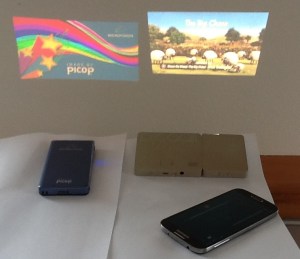
  • Projectors that fit in your pocket that can display images that are one foot bigger for every foot the projection travels. (Done, and available as a ShowWXIMG_0417, PicoAir, and PicoPro.)
  • Projectors that fit in a cell phone that do the same. (Prototypes have been spotted.)
  • Projectors built to act as TVs anywhere, speakers included. (Prototypes exhibited by Sony at CES.)
  • Projectors that project dashboard information. (Prototypes exhibited by MicroVision, and supposedly in development by car companies, kitchen appliance manufacturers, and UPS.)
  • Projectors that fit into eyewear. (Prototypes like Nomad and Spectrum exhibited by MicroVision years ago.)
  • Cameras that can fit into medical equipment like endoscopes. (A prototype exhibited by MicroVision years ago.)
  • Cameras that can read bar codes at very high rates. (Products like the Flic/ROV discontinued by MicroVision years ago.)

Just like with computers, however, the best applications will probably only be obvious after the products have hit the market.

The Reality, Revisited.
Unfortunately, the company’s finances forced the company to rely on others to develop the products. While MicroVision might want to create enormous billboards about their accomplishments and potential, any company considering using MicroVision’s technology is working in a competitive industry that forces them to keep as quiet as possible as long as possible. The result is that MicroVision says little, the investors know little, and the stock languishes.

Fortunately, after years of hearing about next year, next year, there has been significant news. Here I will direct you back to a previous post for details, but I’ll include the graphic here. MVIS CatalystsInstead of a few possibilities and very little revenue, 2015 has seen several possibilities, record setting production revenue, and actual product launches. Celluon already launched the PicoPro and PicoAir, and is so pleased with the response that they are considering additional products. Sony has committed to payments of $8M and $14.5M prior to expected product launches later this year. The company has mentioned additional potential products from UPS, Ford, another car part supplier, a Fortune 500 smartphone, and several others.

The Oh, Too Familiar Situation
Any day now, really, any day now, a product or products can be announced that will be produced in the volumes in the millions, and eventually tens of millions. The concept is simple, as ingenious concepts are. The manufacturing and distribution are far more complex, yet solvable. The product manufacturers are in control, which means MicroVision is not. MicroVision’s fate and future are uncertain enough that many avoid the stock (MVIS), yet the potential is so great that those of us blogging about it find increased traffic that probably exceeds the actual number of shareholders.

Sources Outside MicroVision
First, I must point to the official company site, even though I find it provides little, for the reasons I’ve already mentioned. I blog about the company occasionally because it is one of the most potentially profitable holdings in my portfolio. Estimates range from the ever-present zero, to a few multiples over the recent $3, to as high as $3,333 – which I admit is incredible, yet mathematically plausible. Peter devotes his blog to far more aspects of news, analysis, and speculation. I also suggest joining the discussions on Investor Village, Silicon Investor, and The Motley Fool, so you can hear from more than just me.

My Short Version of the Long Synopsis
For me logically, the potential far outweighs the risks. For me, MicroVision has the potential to do to tablets what they did to laptops what they did to desktops what they did to mainframes. It is easy to imagine a smartphone with a projector out the front for a keyboard (see Celluon) and projector out the back for a display. It is easy to imagine eyewear that allows a person to watch whatever they want, wherever they want, and to have their iris scanned as a password replacement. Riding on the bus will look different. The potential is so large that estimates may only look credible in retrospect.

For me emotionally, so far the company could be an archetypical case study in over-promise and under-deliver. I expected profitability about a decade ago. My enthusiasm has never been met by the reality. While I am able to write this synopsis, my emotions include those of not wanting to lead anyone on, and not wanting to repeat what I’ve seen before – people buying without research, simply because I bought and mention my enthusiasm. I mention my cautions as well, but that has been too easy for others to discount.

My preferred method of investing is to buy small companies and wait for them to get big, then sell. (See my book, Dream. Invest. Live.Dream Invest Live cover for details and historical data.) I buy based on comparing the present value of future revenues discounted for risk. I’ve always picked a risk discount that wasn’t as severe as the markets, which is why it thinks the stock is worth about $3, while I think it is worth about $33. Make your own analysis. Check in with your logic and emotions, and don’t let either carry you too far without the other. The story continues, and changes every day, and any day could see the story dramatically improve. The only evidence that it might not is years of history.

Past performance is no guarantee of future results.

Posted in Uncategorized | Tagged , , , , , , , , , , , , , , | Leave a comment

People Supply And Demand

How many people does it take to make a difference? Is it possible to have too much of a good thing? As much as it is handy to invoke Margaret Mead’s quote; “Never doubt that a small group of thoughtful, committed citizens can change the world. Indeed, it is the only thing that ever has.“, there’s a good chance she never said it. But it is such a good quote, let’s work with it. As for having too much of a good thing, anyone who makes desserts knows there are limits, and anyone who has sat on committees of brilliant people knows that too many happens too easily. Finding a place in the world is a gratifying achievement, especially for frugal folk who aren’t attracted to the roles of consumer or spectator. The opportunities exist, but there may be reasons why it is harder to find gratification and compensation – and yet, the effort is worth the potential reward.

Folks who are frugal by choice tend to appreciate achievements instead of acquisitions. (Ferengis shudder at the thought.) The more you understand your own values, the more apparent the advertising pressures become. Stuff becomes less appealing and experiences rise in importance. Frugal folk volunteer a lot, and also spend more time sitting in wonder at the natural world. Causes become things to work on. Sailboats could’ve ringed Shell’s oil rig,DSC_5518 but it was a crowd of (mostly plastic) kayaks that rowed out to corral the platform. Kayakers aren’t necessarily frugal folk, but in order of expense boats typically go from power down to sail down to water you have to row. Whether they made a difference is too early to tell. They did make a statement. (And the colorful kayaks made for some pretty pictures.)

In May 1776, a few dozen men gathered and argued about the future of the British colonies in America. We know how it turned out: revolutionary and good, and yet far from perfect. Their collective wisdom, insights, and audacity are so well celebrated that we tend to mythologize them. The Founding Fathers is capitalized. Good. They changed the world. Not only did they do something remarkable, but the fact that the colonies had such talent is incredible. The colonies were barely not wilderness. The colonists were people who left convention to pursue opportunity, freedom, or both. The population was about 2,600,000. The United States was born from a group of people about the present population of Chicago. That’s more than the population that Seattle, but less than the population of the surrounding counties, which undoubtedly were all represented. A few dozen people revolutionized government. A few hundred people made a statement about an oil rig, and what it represented. A few hundred thousand can march on the capital, and find that they made a great noise but weren’t heard. I don’t doubt the wisdom, insights, and audacity of people today. I think they’re up against something much more difficult.

In 1776, the population of the planet was about 800,000,000. The British American colonies were a small, seemingly insignificant portion, less than 1%. Now, the population of the species is nine times greater. In 1776, a few dozen men held a lot of influence because half the population was excluded by gender, another large percentage was excluded by slavery, another large percentage was excluded by access to information, especially those in the real wilderness or illiterate or both. The few remaining had few to convince. In 2015, the same amount of energy by the same number of people, and possibly the same percentage, can meet an equal and opposing force, and another, and another. The American Revolution was tough enough. Changing minds now is much tougher.

People who aren’t as actively engaged, people who just want to get on with their lives are finding troubles, too. I rarely meet someone who is spending most of their time lounging. Recent poll data reveals that the percentage of Americans who think hard work is fruitless has grown from 23% in 2009 to over 40% in 2014. They’re working harder, but they aren’t getting ahead. Getting ahead isn’t a euphemism for surpassing the Joneses. Getting ahead is increasingly simply getting ahead of the bills and achieving some financial stability. It has become common that people holding down two jobs can’t afford rent and food, especially if they are raising a family.

A possible explanation may have less to do with work ethic and more to do with demographics. How many people does it take to take care of all the people? One person can take care of one person, but there’s no margin for error. One disaster is disastrous. A couple or a family brings support and stability, hopefully enough to allow some time for critical times, like raising an infant or caring for the elderly. A village allows enough excess to enable crafts. A town can create marketable specialties. A city can support multiple industries, universities, hospitals, – go open the Yellow Pages (if you remember what that is, or was.) And then a nation can handle the really big issues like defense and – who can marry who, or who can smoke what, or whether pieces of cloth can be burnt or not. Okay, so there are some flaws in the system.

All of those tasks, projects, and services are becoming more necessary because of the increasing population. The increased necessity has increased the appeal of technology. We’ve seen an increase in productivity that makes it easier to do far more with far less. Our efficiency has increased, and may have become too much of a good thing. Our improved efficiency means that it takes fewer people to provide all of our necessities.

the increase in agricultural labor efficiency over the past century – from 27.5 acres/worker in 1890 to 740 acres/worker in 1990 – Environmental Protection Agency

This may be why, even as productivity increases and GDP increases, wages stagnate. Increased efficiency through better information, automation, and robotics, means fewer people are required to do the work. Increased supply (population) and decreased demand (productivity) mean fewer jobs in terms of percent. This may also be adding to wealth and income inequalities. More money is flowing around, but there’s less need for it to go to wages, which means more go to the people running the companies. They may have no intent to accumulate great wealth, but it has to go somewhere, so it ends up with them. No conspiracy required.

So, what’s frugal person to do? A major goal to start with is basic survival. Enough folks are having trouble with that. We need solutions. Ironically, technology and small communities may be the key. Decentralized power, distributed information, and an increased awareness of sustainability mean that many who can afford solar cells, a good internet connection, and some basic household and gardening skills can take care of themselves, those around them, and if necessary walk away from a dysfunctional, conventional society – at least until some ingenuity reveals a way to enact positive change.

It was easier to be noticed for wisdom when there were fewer wise people with extra time. Making a difference or a dollar may be more difficult now, especially if conventional approaches are taken, even if they were revolutionary once. If you feel discouraged, remember; the rewards are as great as ever, but the methods must change, and are.

Posted in Uncategorized | Tagged , , , , , , , , , , , , , | 1 Comment

Keep It All In Mind

It is tough, trying to keep all of it in my head. There’s a lot of news out there, and it is increasingly apparent that it is all connected because we are all connected. My news blog, Pretending Not To Panic

PNTP

PNTP

, is “news for people who are eager and anxious about the future” because there is good and bad news out there, and trying to keep it all in mind can cause headaches. If that was all a person had to do, it would be a tough enough task. Real lives, however, have to also keep in mind the practicalities and responsibilities involved in living. Take those two tough tasks and add a third by realizing how much of the news out there connects with the lives we lead – and then deciding what to do with things like our time and money. That’s a lot to keep in mind. There must be a way.

With seven billion people on the planet human perspectives become statistical quickly. There are some who believe that everything is going to continue to improve. Whether they are relying on inertia, faith, or analyses, they may see less of a reason to worry and more of a reason to prepare for a celebration. There are some at the other extreme who believe that everything is collapsing and that it’s too late to do anything about it. They may rely on similar sources and come to opposite conclusions. Are we approaching utopia and rapture, or dystopia and armegeddon? The great mix in the middle is infinitely diverse. Pick a general category: economy, society, justice, technology, environment, politics, … It is easy to hear from folks that think some categories are getting better while others are getting worse. Except on a biological level, we are not a homogeneous species. We get a great diversity of insights, and a lot of trouble reaching consensus.

I’m in that great mix. I’m in that great middle ground to the point that people who rely on labels have a tough time understanding my perspective. I am an extreme, independent, moderate – I am convinced that many of our best solutions are in the middle, and that none of the parties are there. The solutions may not be the ultimate, but the middle is where we can make the moves that matter, and that give us the inertia to get to the next step. The middle is where we have the best change of deciding what to do with our society.

My real life is equally complicated, with great potentials and great worries and a great uncertainty in where I am. I attempt to keep in my head the same things most of us must deal with. You don’t need my list. Look inside for yours. The two main categories are incredibly general and basic: time and money.

Because of my unfortunate financial situation and my dedication to improving it through my Rule of Seven, I’m working seven days a week, with a day off every month or two. Every day I think about how to allot my time. I’m an entrepreneur and sole proprietor, which means I’m working with several clients, which means I’m working to several schedules and compensation packages. Before I get out of bed (really just my futon sofa), I already have a plan for the day. That was true when I had a paycheck, but the schedule is far more chaotic, and each day is unique. Having several clients means that, except for my two biggest clients, an interruption in their schedule is easier to accommodate. Having several clients also means an inefficient way to work. As I shift from task to task I have to shift urgency, discretion, client implicit and explicit expectations, computers, and the way I account for my efforts.

My unfortunate financial situation also means that every expense is noted. Some are non-negotiable: mortgage, insurance, utilities, food. One measure of my situation is that the negotiable expenses are almost down to zero; but repairs

And another section fell.

And another section fell.

sneak in or are delayed, occasional luxuries arise and are ignored or approximated, and most plans are dammed awaiting that rising tide. Because bills come in on varying schedules, each month means a different maneuvering of funds, sometimes with delays in payment. Debt versus delay becomes a balancing act.

Here it is, 7pm on a Saturday night, and I just finished working an hour or so ago. It is a good thing that I enjoy writing because it is one of the cheapest ways to spend an evening.

The global view is overwhelming. My personal situation is stressful and anxious. In both cases, there are positives that can dramatically improve both, and that’s where I find hope.

The trickiest part, however, is the recognition that the world and I am not separated. I am part of the world, and the world affects me. Take the web of conditions affecting the globe. Take the intricacies of a necessarily frugal life. Then, realize that they are intertwined. As the environment goes, so goes my food, water, and air supply. As the economy goes, so goes my income and expenses. As politics go, so go my obligations and support. I’m glad I live by the Salish Sea, which moderates some of the environmental impacts; and I only use about a tankful of gas per month. That wouldn’t change much if my finances were better (though my hiking expenses would go up.) My business relies on other people and businesses, so as they have the resources to do more, I can do more – and I pay attention because the businesses are in industries that are changing. I vote, which at its basic level takes little time, but politics reaches in and affects my taxes, health care, mortgage – and reaches out and affects social injustice, support for others, and hopefully the common good. The most likely outcome is that both good and bad will happen, because they always have.

So, what happens when I keep all three levels in mind: global, personal, connections? I don’t know. The closest I got involved some precious time sitting on the deck (because I was tired and a client slip created a gap), with a drink (a homemade infused vodka martini).Cultus Drive deck and drink I do know, however, that I tried; and that the snippets, trends, and connections that I find are fascinating and frustrating. The fascination comes from seeing how close we and I are to dramatic improvements. The frustration comes from seeing how close we and I are to significant failures. I’ve managed a few such sessions, and I’ve learned one comforting paired response: I’m not perfect, but am trying my best; and that after trying to keep it all in mind I should trust my self and let it all go, at least for a while.

Learn. Understand. Act. Trust. Let go.

Posted in Uncategorized | Tagged , , , , , , , , , , , , , | Leave a comment