Comfort Food

Comfort food, a fine response to a week that held great drama, bad news, good news, and a need to remind myself of my Litany of Optimism. Don’t worry. I’m not going to dive into all the messy details. I’d rather write about popcorn.

Here’s a quick skim of the downside: delayed payments, an 80% budget cut, a 20% investment loss (unrealized), unspecified delays in three opportunities, and a understandable neck ache. Oh yeah, and a profane propane bill.

Here’s a quick skim of the upside: a visit with a naturopath that was far better than any recent conventional doctor visit, a series of writing assignments finished and published, and some sweet support from friends who know how to listen.

A storm is washing the region tonight. I can hear the rain on the roof. The landslide hazard is probably up again. It is hypothermic outside, and it is March. Regardless, bulbs are coming up. Deer and rabbits are getting busy. It is time to plant, as soon as the ground dries out enough. It is a good night for a movie, a drink, and a snack.

Ah, the snack. One of my favorite foods is buttered popcorn, made at home, maybe with some parmesan sprinkled on top. Ah, my waistline. I’ve been working so hard that I haven’t been working out. Maybe it is time for a different snack. Nuts are great, but expensive. Peanuts are cheaper, but I hadn’t taken the time to compare. Should I snack on popped grains or roasted fake nuts? I needed a task that had nothing to do with work, so I did some research. Thank you, internet. Finally, something simple and easy and completed. In only a few minutes it was obvious that popcorn would win. The calorie count for a third of a cup of peanuts is about 270 calories (pardon, but I forgot to record the source). A third of a cup of unpopped popcorn kernels is about 170 calories. Excellent. Add a tablespoon of butter, which adds about 100 calories and end up back at 270 calories. Mathematically, they’re equivalent. I can take my pick.
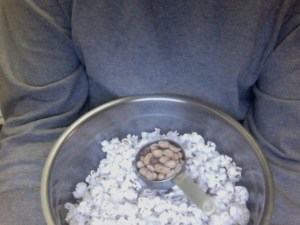
photo-on-2017-03-03-at-19-25

Take a look at taking that pick. A third of a cup of peanuts looks like a diet plan, not comfort food. A third of a cup of popcorn kernels becomes 10 cups. 10 cups! of popped corn. Give something the right opportunity and it can become far more than it was before. That looks like a celebration, not a restriction.

This is about more than peanuts and popcorn. Everyone needs comfort food; well, almost everyone. Monks exist. There’s a benefit to embracing simple comforts. I’ve been rich and I’ve been struggling and spent a lot of time between them. Regardless of my net worth there are times when a bit of edible comfort is appreciated. Throughout, I’ve found that foods I make taste better, are cheaper, create less waste, and are readily available. For someone, their comfort food is going to be caviar. Comfort foods that are cheap, easy, tasty, and relatively good are valuable and available. I’ve enjoyed popcorn all that time.

Comfort food doesn’t make the pain go away. It gives the hand and mouth something to do while watching a mindless movie (haven’t picked tonight’s, yet). But comfort food is a reminder that life can be enjoyed now. Most of my worries are about taxes and an upcoming employment gap. Popcorn is here and now, and very undemanding.

Next week can bring good news for some of my stocks (come on MVIS, NPTN, and AST), probably a new assignment or two, maybe even a payment for an invoice, better weather, a dancing to a live jazz band, and a bit of a breather. With several clients re-assessing their situation and with several assignments completed and submitted, I might just take a day off (I even hesitated as I typed that). With all of this talk of comfort food I’ll be happy to take some time for something else that’s simple and comforting, a nice long walk – after the storm has passed.

Posted in Uncategorized | Tagged , , , | Leave a comment

Bye To My GIG Buys

As a closure to my purchase of the various incarnations of GIG, I decided to analyze the many purchases and subsequent sale of the shares that became part of a final sale. Analyzing successes is easy. Being willing to analyze the ups and the downs is more difficult, but more enlightening. Here’s a quick review of the consequences of Long Term Buy and Hold of the stock of GigPeak, which had been GigOptix, which had been Lumera, which had been part of MicroVision.

Want to watch someone’s eyes roll back in boredom? Tell them you have a spreadsheet with over 30 years of trading history chronicled, ready to be sliced and sorted and studied. Hey, it’s what I do. If you tuned out, I’m not surprised. If you’re trying to learn about investing, here is a real world example of patience, a good idea, and someone else’s success.

I’ll skip most of the details, but here’s the quick story. I bought shares in MicroVision, MVIS, in 1999 because they had a great idea for wearable displays and embedding projectors in cell phones. Sounds inevitable, only a few years out, right? MicroVision had a secondary division called Lumera that had electro-optic technologies that would work well in the increasingly automated and connected world. I was impressed. MicroVision spun them off to raise money. I bought shares so I was invested in both. Lumera had amazing technology that could work in several industries, but had a tendency to be product-out rather than customer-in. The strategy of building something they hoped would sell itself didn’t succeed. GigOptix, however, was buying such small companies because it was expanding its electro-optical switch business. Lumera had two advantages: 1) it was already public, which made GigOptix publicly traded, and 2) Lumera’s technologies could hit very high communication speeds with no moving parts. Everything else from Lumera was cast aside and Lumera’s technology eventually proved itself and began generating more revenues than MicroVision. Just as GigOptix, now GigPeak, was about to become significantly profitable, the company sold out to a larger firm. Instead of a six-fold valuation increase which I thought was due, I received a 20% bump. Nice, but not nice enough.

If I wanted to only talk about the successes, I’d only mention the most recent purchase of GIG which netted a 50% gain in six months. But that’s only part of the story. Overall, I lost about 74%. If the stock had continued its recent climb I would’ve seen a nice profit. That was cut off by the buyout.

My investing strategy is Long Term Buy and Hold of Small Companies that I sell when they get Big. (LTBHSC? Nah, even that’s too long.) For details and data on the years up until about 2007, see my book, Dream. Invest. Live.Dream Invest Live cover Fans of irony may enjoy comparing the dates of the book’s publication and the start of the Great Recession. It wasn’t my fault!

Part of the advantage of long term investing is the greater exposure to buying opportunities. They’re the same for everyone, but when you own the stock the opportunities are clearer. Since Lumera’s spinoff from MicroVision I bought stock seven times: 2004, 2005, 2007, 2011, 2011, 2014, and 2016. I lost money on every purchase except the last two and basically broke even on the two before that. Effectively, all of my losses were from the first purchases which were large relative to my current net worth, but small relative to my net worth at the time.

gig-chart

By only looking at the total loss I could do a great job of beating myself up. That’s still the loss I must live with, but I’ve wondered if my strategy that worked for so many decades was failing. Not necessarily. A couple of bad trades from a time when it was easy to take risks overwhelm the story. The reality is that, while the performance wasn’t stellar, it was succeeding and was primarily truncated by an attractive package to a few shareholders. I’m still bummed about it, and the situation I’m in, but I will give myself a bit of credit.

Individual investing is personal finance. It gets personal. If it doesn’t, then why do it? The last ten years can skew any results in the small cap investing world. The mega-caps are doing very well, which is big money chasing big money about which I have other opinions, but I don’t see a need to step back on that soap box in this post.

The reason for this blog is to provide real world examples of what it can be like to make finances personal, to invest as an individual, and to do so long enough to benefit from the experience. Start early. Learn along the way. Adjust as necessary. And, I wish you good luck, or at least a successful investing history.

Over a decade of research heading to the recycle bin.

Over a decade of research heading to the recycle bin.

Posted in Uncategorized | Tagged , , , , , , , , , , | Leave a comment

Returning To Stock Screening

This blog is about the personal finance of one frugal folk, me. I write it so people can see one version of what it’s like to invest in stocks as an individual. Investing in particular stocks frightens some people, as if it is something only professionals should do. It is actually one of the ways to possibly make money from money. My style takes far less effort than active traders, but when it does take an effort I try to give it the time it deserves. Take a look through this blog and realize that very few of the posts have anything to do with buying and selling, because trading stocks takes up very little of my time. Thanks to GIG Goes Buy Buy, it was time to dive in and decide what to do with the proceeds of the unfortunate sale. No research is ever complete. At some point a decision must be made. I’ve developed my process over decades. If you are just starting to invest, your process will develop to match your style. Here’s a view of mine that closes with an irony.

If you want more details that are explained more clearly, read (and maybe even buy) my book. Dream. Invest. Live. I wrote it in response to folks who asked me to write about how I retired at 38. Unfortunately, it was published as the Great Recession (the Second Great Depression) started. Regardless of that, I was hit by a perfect storm of bad luck (as a few professionals have called it). I called it my Triple Whammy, which I continue to work at recovering from. Until that perfect storm, the strategy had worked for three decades. I’m continuing to buy and hold small companies for the long term (LTBH) so I can sell them when they are much bigger and much more valuable.

GIG had just hit one of my key success criteria – and then was bought by another company before the stock properly responded. Just as I was about to see my patience rewarded, I’m finding myself having to recover, again. Once more into the breach, dear friends.

The task is simple. I sold all of my GIG and now had to find new places for it. The money is there to make enough money so I don’t have to worry about making more money. It shouldn’t sit still for long.

The cheap response, at least in terms of time, would be to just buy more of what I already have. That doesn’t improve diversification, and whims are bad strategies. Despite that, I did take a small portion of the proceeds to buy more AST and MVIS to bolster their positions. Both are stocks that are in my portfolio. Both have the potential for near term dramatic news. Both of the purchases are in my IRA, so I could sell again and buy something else without penalty, as long as they didn’t lose too much. Hopefully they’d gain more than the few percent available in money market accounts.

Time to screen every stock available. Take a deep breath.

Stock screeners sound like a simple idea. Load up the database of stocks, sort on criteria, pick the winner. Unfortunately, every screener tries to work a different way. I ended up using three to do one task.

Yahoo!’s screener took a while to load. My first criterion is market cap. They offered “Small”. I wanted to enter a range with specific numbers.

Google’s screener has the finest details for specific limits. Here it’s interpretation of my critieria.

  • Initial list of stocks = 33,327
  • Market cap = $50M – $2B. (I could enter the limits, but couldn’t figure out how to make it update, which it did when I did something innocuous like click on something else.)
  • List of stocks = 9,782 (That’s a bit much. Retry with tighter limits.)
  • Market cap = $50M – $1B.
  • No change? Try adding the next criterion.
  • Total Debt/Equity (Assets) < 10%
  • List of stocks = 6516
  • Positive book value
  • List of stocks = 6302
  • Still too broad to be useful, which is quite like some Google searches

Search for other, familiar screeners. Looks like sites have either taken down my favorites or renamed them.

Well, I’ve used Schwab for decades. Let’s see what they have.

  • Success! It starts with a smaller list, but that’s okay. I only need a few.
  • Market Cap 50M-2B = 2760 stocks
  • Debt/Equity < .1 = 961 stocks
  • Price/Book > 0 = 947 stocks
  • Revenue growth (next year) > 0.1 = 482 stocks
  • That’s small enough that I can begin clicking through.
  • Remove sectors I don’t understand or don’t want to invest in. (The reasons would take a few thousand words. Maybe later.) Take out: Banks, energy, mining, fashion, holding companies.
  • List of stocks ~ 270
  • Schwab includes a nice, quick research glimpse with a mouseover of the name. Reduce, reduce, reduce, usually based on sudden stock drops.
  • Call Chat to find out how to download the results so I can sort in Excel – and learn that my work has to stay within Schwab.
  • Sigh.

It’s a good thing Monday was a holiday because it gave me one more day (part of an evening because I worked the rest of the day) to work on it.

Retreat to Yahoo!

  • One way I research stocks is to keep a list of interesting companies from news items. I maintain one portfolio on Yahoo! that I call Curious.
  • Check Curious against the criteria and come up with:
    CRAY, RRGB, BLDP, BREW, GAIA, ULBI, BSQR, NNVC
  • Check another portfolio, an out of date version of the 100 top stocks based in the Seattle area. (The benefit being I can research them by attending their meetings.)
    HOME, CRAY, LSCC, SCHN, RENT, CACB, PCBK, NLS, BLT, NILE, BBSI, NSTG, POPE, DMRC, ESIO, CSTR, RNWK, NWPX, TSBK, CTIC, MCHX, MVIS, PXLW, KTEC, KTCC, BSQR,
  • Realize that I can hand copy the “short” list from Schwab.
    XXII, AHC, ACTA, HIVE, AVAV, AGYS, AIRG, AOSL, AMSWA, APPF, APTI, AFI, AUDC, AXTI, BW, BLDP, BZUN, BRFH, BNED, BSET, BWEN, PRSS, CRCM, ECOM, CAAS, DL, CHUY, CTRN, CLFD, CLRO, CTRL, CRAI, CRAY, CROX, CFI, CYBE, CYRN, DAKT, DZSI, DWCH, DFRG, DNN, DGII, DMRC, DVD, ESTE, EDGW, ESIO, EMAN, EMKR, NDRO, WATT, EFOI, ERII, PLUS, ESCA, ETH, EVBG, EPM, EXA, EXAR, EXFO, XONE, EXPR, FARM, FARO, FINL, FRAN, FRPT, GAIA, GNK, GEOS, GPX, GHM, HABT, HSII, HIBB, HDSN, IDSY, ICD, IIIN, INST, IVAC, SNAK, ITI, ITRN, JIVE, JOUT, JMEI, LRN, KTEC, KIRK, KRNT, LAKE, LFGR, LEJU, LITB, LPTH, LLNW, LQDT, LYTS, LL, MGIC, CALL, HZO, MRTN, MED, MEET, MIND, MITK, MIXT, MOBL, MODN, MPAA, MOV, MRVC, MTSC, NSCC, NCIT, NPTN, UEPS, NTWK, NMBL, NWPX, NVMI, NVEE, NVEC, OOMA, OESX, ROYT, PCTI, PDVW, PRFT, PETS, FENG, PLAB, PCOM, POWL, PRGX, QIWI, QTNA, QUIK, QNST, RNWK, REIS, RVLT, REX, REI, RRTS, RTEC, RUTH, SANW, SPNS, SALT, SEAC, SCWX, SCVL, SHOR, SIAF, SODA, SORL, SPAR, STRL, SPCB, SUP, STS, SYX, TNGO, TEDU, TNAV, TESO, TLYS, TACT, TGA, TRMR, TUES, TWIN, UNXL, USAT, UTSI, VRNS, VRA, VIRC, VJET, VUZI, WMAR, WEYS, WYY, WLDN, WKHS, WPT, XCRA, XOXO, YUME, ZPIN, ZUMZ
  • Create a new Yahoo portfolio called Shopping that has all three lists.
    Argh! Yahoo! limits copy and paste to 200 stocks.
  • Edit duplicates and obvious non-candidates.
    RRGB, BREW, ULBI, NNVC, HOME, LSCC, SCHN, RENT, CACB, PCBK, NLS, BLT, BBSI, NSTG, POPE, DMRC, ESIO, CSTR, NWPX, TSBK, CTIC, MCHX, MVIS, PXLW, KTEC, KTCC, BSQR, XXII, AHC, ACTA, HIVE, AVAV, AGYS, AIRG, AOSL, AMSWA, APPF, APTI, AFI, AUDC, AXTI, BW, BLDP, BZUN, BRFH, BNED, BSET, BWEN, PRSS, CRCM, ECOM, CAAS, DL, CHUY, CTRN, CLFD, CLRO, CTRL, CRAI, CRAY, CROX, CFI, CYBE, CYRN, DAKT, DZSI, DWCH, DFRG, DNN, DGII, DMRC, DVD, ESTE, EDGW, ESIO, EMAN, EMKR, NDRO, WATT, EFOI, ERII, PLUS, ESCA, ETH, EVBG, EPM, EXA, EXAR, EXFO, XONE, EXPR, FARM, FARO, FINL, FRAN, FRPT, GAIA, GNK, GEOS, GPX, GHM, HABT, HSII, HIBB, HDSN, IDSY, ICD, IIIN, INST, IVAC, SNAK, ITI, ITRN, JIVE, JOUT, JMEI, LRN, KTEC, KIRK, KRNT, LAKE, LFGR, LEJU, LITB, LPTH, LLNW, LQDT, LYTS, LL, MGIC, CALL, HZO, MRTN, MED, MEET, MIND, MITK, MIXT, MOBL, MODN, MPAA, MOV, MRVC, MTSC, NSCC, NCIT, NPTN, UEPS, NTWK, NMBL, NWPX, NVMI, NVEE, NVEC, OOMA, OESX, ROYT, PCTI, PDVW, PRFT, PETS, FENG, PLAB, PCOM, POWL, PRGX, QIWI, QTNA, QUIK, QNST, RNWK, REIS, RVLT, REX, REI, RRTS, RTEC, RUTH, SANW, SPNS, SALT, SEAC, SCWX, SCVL, SHOR, SIAF, SODA, SORL, SPAR, STRL, SPCB, SUP, STS, SYX, TNGO, TEDU, TNAV, TESO, TLYS, TACT, TGA, TRMR, TUES, TWIN, UNXL, USAT, UTSI, VRNS, VRA, VIRC, VJET, VUZI, WMAR, WEYS, WYY, WLDN, WKHS, WPT, XCRA, YUME, ZPIN, ZUMZ
  • Delete non-candidates, again. (finance, mining, education, furniture, fossil fuels, apparel, cars)
  • Wow, that took some time.
  • Check the Detailed view (handy) to remove sudden stock drops.
    Remove BLT, CRAY, EFOI, EXFO, FRAN, HABT, KRNT, LEJU, LQDT, NDRO, NLS, RENT, SIAF, SORL, TRMR, ULBI, ZPIN
  • Review company profiles at a glance:
    ACTA, AGYS, AHC, AIRG, AMSWA, AOSL, APPF, APTI, AUDC, AVAV, AXTI, BLDP, BREW, BRFH, BSQR, BWEN, BZUN, CALL, CFI, CHUY, CLFD, CLRO, CRAI, CRCM, CTIC, CTRL, CTRN, CYBE, CYRN, DAKT, DFRG, DGII, DMRC, DWCH, DZSI, ECOM, EDGW, EMAN, EMKR, ERII, ESCA, ESIO, ESTE, EVBG, EXA, EXPR, FARM, FARO, FENG, FINL, FRPT, GAIA, GEOS, GHM, GPX, HDSN, HIBB, HIVE, HOME, HSII, HZO, IDSY, IIIN, INST, ITI, ITRN, IVAC, JIVE, JOUT, KIRK, KTCC, KTEC, LAKE, LFGR, LLNW, LPTH, LSCC, LYTS, MCHX, MED, MEET, MGIC, MIND, MITK, MIXT, NOBL, MODN, MOV, MPAA, MRTN, MRVC, MTSC, MVIS, NCIT, NMBL, NNVC, NPTN, HSTG, NTWK, NVEC, NVEE, NVMI, NWPX, OESX, OOMA, PCOM, PCTI, PDVW, PETS, PLAB, PLUS, POPE, POWL, PRFT, PRGX, PRSS, PXLW, QIWI, QTNA, QUIK, RRGB, SCHN, SCVL, SCWX, SEAC, SHOR, SNAK, SODA, SPAR, SPCB, STRL, STS, SUP, SYX, TACT, TEDU, TESO, TGA, TYLS, TNAV, TNGO, TSBK, TUES, TWIN, UEPS, UNXL, USAT, UTSI, VIRC, VJET, VRA, VRNS, VUZI, WATT ,WYES, WKHS, WLDN, WPT, WYY, XCRA, XONE, XXII, YUME
  • Feeling a time crunch, so I decided to leverage past research, at least for now. I can come back later when I have time. It was interesting to see how many I recognized.
    • Eliminate ACTA. I owned it when it was ICGE, a decade ago, but it has declining revenues.
    • Consider BLDP. A nice alternative fuel source investment with a promising profit margin.
    • Consider BREW. I owned it when it was HOOK, as in Red Hook Brewery. They have mildly increasing revenues, but I don’t buy it anymore. I’ve always wanted to attend the annual meeting, though.
    • Eliminate BSQR. I lived up the hill from their office and watched them grow, but declining revenues.
    • Eliminate CTIC. A Seattle biotech that I’ve considered frequently but its stock just fell off a cliff.
    • Eliminate DMRC. Declining revenues.
    • Eliminate ESIO. Flattish revenues
    • Eliminate GAIA. Sold them a few years ago because I doubted their strategy which has produced flattish revenues. Maybe I was right.
    • Consider KTCC. But, flattish profit margins
    • Consider LSCC. Recovering is good.
    • Oh no, not again! MVIS. Repeat, Oh no, not again!
    • Eliminate NNVC. Nice or not it’s a too early biotech for my goals.
    • Consider NPTN. Surprise! It’s GIG’s competitor and it too is newly profitable.
    • Consider RRGB. I owned them near the IPO, but steered away during the Recession. Slight and stable revenue increase.
  • That brings the list down to:
    AST, BLDP, BREW, KTCC, LSCC, MVIS, NPTN, RRGB
  • I prefer disruptive business models.
    BLDP, KTCC, LSCC, NPTN
  • A quick check of the final four (including a quick tour of their discussion boards) finds NPTN the key candidate. Back where I started with GIG, just shifted one company over.

After considering the cash available, the stocks I’ve reviewed, and my existing portfolio I decided to buy a bit more AST, which is already in my portfolio and promising, but too small of a position; and NPTN at a level that is smaller than GIG, but something to keep in mind for further purchases. I’ll learn more about them as I own them.

All of that happened within my IRA. There were a few shares outside my IRA, but I’ll hold onto that cash until I figure out how much I have to pay in income taxes. There isn’t enough there, but if it makes the difference between paying in cash or paying on credit, then investing in cash will have a secondary benefit.

That process took a few hours. Typically, I do that once or twice a year. That hasn’t happened for the last few years because I’ve really do buy and hold for the long term. That means I’ve saved that much time and more over other more active strategies. Whether they would have done better, whether I missed better investments above, I have no doubt. There is always something better, and best can only be determined from the moot safety of the future. I hope that I’ve done well enough, which is all any decision in the real world can be measured against.

My congratulations to everyone who got this far, even if you skipped over the boring bits.

Posted in Uncategorized | Tagged , , , , , , , , , , , , , , | 1 Comment

My Economy On Marketplace

And people ask me why I use Twitter (@tetrimbath). And now for something completely different, which is remarkably the same. Those who listen to public radio may already be familiar with the business show called Marketplace. They’re part of my Twitter feed so I can hear their succinct summaries of the economy, markets, and the world in money world in general. I think it was one of their tweets that asked for stories about the Gig Economy. Did I have a story to share? Sure. I filled in their form, can’t remember what I wrote, and got an email shortly after. Would I mind being interviewed? Sign me up! The piece was broadcast at 3pm East Coast time today. For people who wonder how to get a message out, there’s a lucky example. For people who think the job market in 2017 is the same as in 1987, tune in for mine and other stories. This is a new world.

I’ll skip the suspense for folks who just want to listen to the piece. Here’s the link.  It’s less than 2.5 minutes.

Regular readers are welcome to enjoy the coincidence that my previous post was also about GIG, but that was the stock, not the modern workplace.

The Gig Economy is also called the 1099 Economy. Forty hour work weeks, paid vacations, and benefits sound so sweet. Many people continue to have such jobs, but they are fading. The economy has recovered nicely since the Great Recession, but 97% of the job growth has been in alternative jobs. W-2s aren’t growing much. Their part-time equivalent, the 1099, is where almost all of the growth is happening. If it feels fruitless to try to find full-time conventional employment that’s possibly because almost all of the new jobs are part-time, temporary gigs.

My Gig Economy is improving. Within the last few years I’ve gone from selling things around the house to pay bills and almost losing my house, to working seven days a week (see my Rule of 7), usually from 8 to 8 and having enough to pay almost all the bills except income tax or health insurance. Those aren’t bills that are improvements. It has only been within the last few months that I’ve made enough to pay for a few DIY repair projects, and they’ve felt like luxuries. I continue to internally recite my Litany of Optimism, and parts of it may finally succeed (except for GIG.)

I mention my situation for the same reason I wrote Dream. Invest. Live. and started this blog. Money is a taboo even as it is central to our lifestyles. When I wrote the book I knew there were few who would openly talk about their money management. Besides, a book has to be general so it is applicable years later. A blog provides current reports. To those who think I only talk about the downside of money, go back and read the early parts where it looked like I’d be a millionaire again, and soon. Then I was criticized for being too positive. Aiming for honesty generates interesting reactions from the same people at different times. As I recall, that line from Fiddler on the Roof is, “When you’re rich they think you really know.” It is amazing and sad to see how people measure intellect using wealth, even though they have little in common. Think about it. Do you know any poor people who are smart or wise? Do you know any rich people who could use a bit more education and maturity? If not, go look at the news again.

The Gig Economy can be sold as a wonderfully freeing alternative to the conventional workplace. And it is, when it is entered by choice. When necessity means there is no choice, then the Gig Economy can be a constant source of anxiety, stress, and uncertainty. Companies are using Gig employees because the companies save money on benefits and can be more responsive with adding and subtracting people. Have you noticed corporate profits rising but wages stagnating? That’s one reason why. I think it works against the long term viability of the company because they lose expertise and rarely gain loyalty, but at least their near-term finances look better. The burden of benefits sits on the employee’s – oops – contractor’s to do list. People lose the economy of scale when negotiating for health care, lose the ability to recuperate mentally physically without losing a day’s wages for every day in recovery, and contractors must always be preparing to swap jobs because the notice can be short and the gap between the next paycheck may be longer than on billing cycle.

We are building a new economy and if we don’t pay attention to its inefficiencies and inadequacies the new economy won’t become sustainably efficient and hopefully more than adequate. That’s why I was willing and eager to pass along my story. Getting interviewed for it was just a very special treat. It is also an opportunity for me to expand upon < 2.5 minutes of me speaking (with some nice music interspersed.)

Some people march in parades. Some people create advocacy groups. Others get into politics. Many back away, and too many don’t even vote (and yet they complain.) I tell my story, and hope others find resonances with theirs.

With 15 minutes of interview edited to fit inside 2.5 minutes, much had to be set aside. Some of that I’ve covered above. One piece I want to pass along. Robert Garrova, the interviewer and reporter who I could learn a lot from about interviewing, asked why I didn’t go back to engineering. Didn’t I like it? Yes. I did, and do. I’ve knocked on that door for years. The only job interview I had for a full-time position was one where they knew they weren’t going to give me the job, but they didn’t believe anyone could truly live up to a resume like mine. They told me they were pleasantly surprised, but that of the 24 criteria for the job, I only met 22 of them. Getting a full-time job isn’t as easy as it was thirty or forty years ago. I got my first engineering job because I was above average and was the only applicant who had taken two normally disparate classes in college. They liked that combination and accepted the rest knowing I could be trained. Welcome to 2017.

It has already been fun and interesting to hear the feedback from friends. There’s no way to know if my story will change anything in the world or in my life, but it’s just like reading the news on Twitter. Doors can open in unexpected ways and lead to unexpected places. Now, it is time to close this post, add links, publish it, share it on social media – and then get back to work. It’s 8pm, but I have more work to do. Some of it is even billable.

Posted in Uncategorized | Tagged , , , , , , , , , , , , , , , , , | Leave a comment

GIG Goes Buy Buy

And there goes another great idea. I’ve heard that every good thing must come to an end. GIG, the stock for the company called GigPeak which was GigOptix which I owned because it merged with Lumera which was spun off from MicroVision, GIG will soon be part of a much larger company. Integrated Device Technology and I agree, buying GIG was a good deal. They’re buying one of my most promising stocks just as the company delivered and just before the stock had a chance to be fully appreciated. This is the risk in buying small companies that are tightly held. Any deal only has to make sense for the people who hold the most shares, not to the most shareholders. The deal meant about a 22% rise in the stock which I estimated could’ve risen far more in the next few months. Instead, I followed my investing strategy and sold; and now must go buy something else.

Two of the main elements of my investing strategy are Long Term Buy and Hold, and Buy Small Companies and Sell Them When They’re Big. I’ve held various manifestations of GIG since 2004, and even 2000 if you count its time as a division within MicroVision. I like to buy small companies before they are profitable, and therefore potentially cheap, hold them through profitability, and then sell when their growth commands a premium. It has worked with companies like Pixar, Starbucks, America Online, and others. It has also failed when upper management is offered attractive buyouts that benefit them and few others like in Go2Net, Eagle Hardware, QFC, and now GigPeak. Details on some of the case studies are in my book Dream. Invest. Live.Dream. Invest. Live.

GigPeak was bought for the very reason I invested in it. They have a technological advantage in the highly technical industry of high-speed internet infrastructure. Their revenues were up 45% over last year. Grow a $200M company by $10M and swing to a much higher Price/Earnings ratio. Put that same $10M inside a $2B company and barely see the stock budge. The great potential of GigPeak will continue, but it will happen in a crowd of products that can go down as much as it goes up. That’s why I sold Pixar when it was bought by Disney, Eagle Hardware when it was bought by some bigger big box store, QFC when it was bought by Fred Meyer (as I recall), and GigPeak when it is being bought by Integrated Device Technology.

GigPeak’s future is now moot to me. I have to focus on my future by shifting my portfolio. The first step was selling all of my shares of GIG. The question for me becomes, where does the money go next?

Look back through this blog and find several times when I’ve had to make similar investing moves. The process is simple, but can take a lot of time. One of the other benefits of Long Term Buy and Hold is that research invested in understanding a stock and a company happens in a large initial effort with updates a few times a year. Check my semi-annual portfolio exercises for years of examples. It saves time in the meantime, but requires significant efforts at a time like this.

I’ll pass along the updates as I work through the process, but here’s the general outline as it comes back to mind.

  • Create a list of all the stocks with market caps below $2B. (They’re already too big for me. Besides, this is the region where individual investors are trying to out-compete major financial institutions. Dancing with the elephants is dangerous.)
  • Remove all stocks with market caps below $50M. (They may be cute, but they can be so small that they can be manipulated.)
  • If that’s too many stocks, remove all stocks with market caps above $1B.
  • Remove all stocks with Debt/Equity > 0.10 (I skipped this step with Iridium, which went bankrupt from too much debt – and then succeeded after shedding its shareholders.)
  • Remove stocks for companies that are either in industries I don’t understand or display values I don’t want to support. (This is a very subjective step, but a necessary one for me. For me, it makes personal finance personal.)

That will take the list of available stocks from several thousand down to several hundred. It is a long list, but most of the steps are mechanical.

My next step will be to review the list and watch for companies and stocks that I’ve been tracking from news items. I’ll also review my portfolio to rebalance it if I see an opportunity. In this case, I am likely to buy more AST (Asterias) because I am impressed with their clinical trial progress in helping paralyzed people regain some use of their bodies, and MVIS (MicroVision – and yes, I can hear the groans) because this year will be different (right? please?). I’m willing to devote some of the funds to those two stocks because their companies have histories of sudden positive stock movements on surprise news announcements. Neither has held onto those gains, but they both have a large, latent demand and a limited supply of shares (even with dilution.)

When I was acting retired, I’d devote a few days to the process. With working seven days a week, news may hit while I stretch the process out over weeks. I’ll move some of the money soon, hold some in reserve possibly through tax season, and eventually reinvest most of the rest because interest rates are too low.

screen-shot-2017-02-15-at-7-52-39-pm
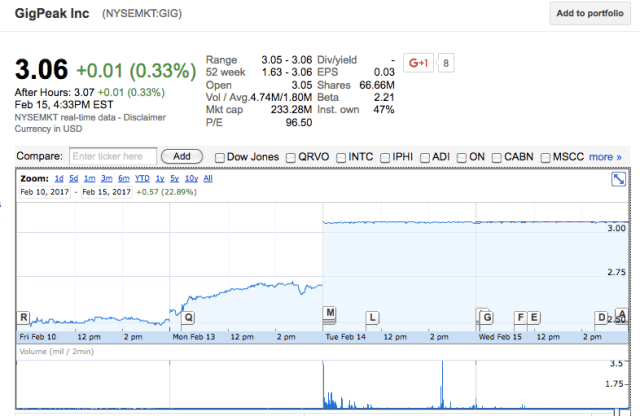
Before I leave GIG behind, I want to pass along the chart of the last few days. While the government is supposed to regulate the stock markets, they can’t be everywhere at once. I include this picture of the stock action that happened around the news release. The pattern is too familiar. Days or hours before official news is officially released, the stock moves. It has now become the norm that such moves are watched by other investors as if they were news, too. Possibly felonious actions are now part of the indicators in the stock market. That’s a sad statement. I can’t prove if the stock movement was illegal, but I can point out that it is common enough that few investors expect any action to be taken. It, too, is one of the risks of investing in any stock, particularly small ones that could experience big news. Be careful out there. As I said above, dancing with the elephants has its risks.

In the meantime, it is time for me to say bye bye to GIG and then decide what I am going to buy and buy.

Posted in Uncategorized | Tagged , , , , , , , , , , , , , , , , , | 1 Comment

See Politics Post Art

See politics, post art. Make sure that comma is in there because otherwise it sounds like an invitation to watch politics create art. The phrase came to mind one day when I realized that my artist friends were more likely to make political posts than artistic posts. I don’t post about politics much, though I do read some every day. These are historic times. Imagine not reading the papers in 1775. Surprise, 1776 happens. I did hit a limit though when I realized I was seeing less beauty and art; so, rather than complain about the lack I decided to post art when I’d seen enough politics for the day. Some days that happens right after breakfast. Other days, dinner. Living frugally means respecting resources like time, not just money. As historic as these times are, I also want to make sure I see other parts of today’s world. One way to do that is pay an equal attention to art.

Fiery July Fronds
Insert self-centered plug here. Want some art? I’ve produced plenty. Whether it is pretty or beautiful or not is subjective. Here are some links so you can make your own assessment, and maybe find your own inspiration. My books via my Amazon Author Page. My Whidbey Island photos via the Gratitude Gallery. My Washington Cascades photos via Fine Art America.

But enough about me. What about you?

These are stressful times. Everyone seems to be going through a balancing act between knowing enough and seeing too much. That’s true for both sides (and the fact that there only seem to be two is a temporary illusion.) My and my family’s health history have proved to me the value and the difficulty in reducing stress. The good news is that it can be done without spending money. The bad news is that it may require spending time. The best news is that after you’ve mastered it, it takes no time at all; but of course then you are a monk of some sort.

For the last several weeks, since the day after Christmas, I’ve been working every day. Partly that is my Rule of 7. Partly it is because of an aspect of the Gig Economy; when work shows up, work, because it may not be there later. Something usually turns up, but until it does, anxiety can fill the void. Even my body is telling me that I’ve been sitting, typing, and squinting for too long. Within the last week, several projects have come to completion, which means some day soon I’ll be able to return to my de-stressing exercises, as soon as I can spend the time without having to worry about the money.

It would be entrepreneurial of me to say that art is the best way for me to reduce stress, and that it helps others do so, too. I’ll get to that.

For me, there are four times a day when a few minutes diffuse the tension.
1) When I wake up I stay under the covers and steer my brain back to thinking about how warm and comfortable I feel. My muscles are the most relaxed. I try to memorize that moment so I can remind myself of it later in the day.
2) It may sound like kindergarden, but I take a ten minute nap after lunch. It may not be long, and it may not be as effective as eight hours of sleep, but for ten minutes my body unscrunches and gets a chance to concentrate on digestion.
3) I thank Steve Smolinsky for putting a name to my late afternoon pause. He calls it a Clarity Break. Schedules mean I don’t manage to do it every day, but at about 4pm I find a seat with a good view, and sit there for the time it takes to drink a cup or a glass of something. Tea is good. Martinis happen, too. Lately, I’ve had to pull back from whiskey, even though that seems appropriate. Besides, I usually have two or three more hours of work to do. When there’s enough time, I try to include a few minutes of meditation.
4) I’ve edicted an arbitrary line at 9pm. I’ll only work past then if a deadline is approaching too quickly.
At each of those moments I remember the insight from The Way of the Peaceful Warrior. There is only here and now. Most of my anxieties come from thoughts about things that could, might, are possible, in the future; or, they are thoughts about what’s happening in other places. Things to truly worry about here and now can exist, but adding all the possibilities from the past, the future, and the rest of the planet will always be more than a person can handle. Those other issues can benefit from our energies, but for a few times a day it is good to return to taking care of the person that is in this place and time.

Art helps me do that, particularly photography. Writing helps me express myself, but it is always about what was or what will be. No one can write about the present because writing always takes a finite amount of time. Photography, however, does the opposite. It usually records a finite, yet much smaller period of time, usually less than a hundredth of a second. An image is as close to a moment as we can get, as close to a now, or at least a remembrance of a now.

It’s after 7pm on a Saturday evening. I’ve been so busy that I haven’t posted any art today because I haven’t had much time to check my Facebook page. It isn’t avoidance, simply an overwhelming schedule (and I’m glad for the work, and the pay.)

I’ll draw this to a close with and image or two. One is from Twelve Months at Admiralty Head, an image that just happened to be sent in as a candidate for display at the local hospital.

dsc_6496The other provides another point of view on art and politics. It is a painting by Brian Kern, a long-time friend and artist who is using politics as inspiration for his art, and as a way to vent. It took longer to make than one of my photographs, but evidently didn’t take long. I think that may be why I can feel the energy in it.

distressTake your pick. Find your balance, and don’t be surprised if you find that it feels best to have a bit of both. But, if you see too much politics, maybe just post some art. (Or even buy some. My artist friends would greatly appreciate that.)

#SeePoliticsPostArt

Posted in Uncategorized | Tagged , , , , , , , , , , | 2 Comments

Super Bowl Ads 2017 Sell Success Carefully

The game is over. As usual, I skipped the game and watched the ads. I’ll assume some team won the game and some team lost the game. Congratulations. Sorry to hear that. The ads are entertaining, but I watch them to catch the themes. The advertisers don’t coordinate their messages, but common threads appear that tell me something about trends and emotions, which affect how people buy, spend, and deal with each other. This year they did it again, without trying. Despite the event being a spectator sport, most of the ads celebrated getting active, physical or otherwise.

After writing up my notes I realize the underlying theme was rarely stated. Make fun of our political situation, carefully. Encourage commonality, carefully. Encourage activism, carefully. This year’s situation is too fresh and fragile. Next year’s ads will tell a different story; another reason for me to record my notes.

Athletics

  • Michelob – Exercise, get in shape, and then have a beer. Ah, check your calorie balance.
  • Pistachios – Exercise, and eat nuts for their protein. Remember to clean up after yourself in the gym. Don’t eat and run.

Perseverance

  • Honda CR-V – Move forward despite failure. Believe you can make it. Dreams are within reach and worth chasing.
  • Ford – Exercise any way you can, even if you don’t succeed, because eventually you’ll break through.
  • Audi – Forget what everyone else says. Ignore conventional wisdom and old stereotypes. Work hard and succeed.
  • Kia – Nature needs your help, and you must help if you are going to be a hero. Don’t be surprised if it hurts.
  • Budweiser – Pursue your dream, and if you need a role model, look to immigrants and refugees.

Community

  • Mercedes, AMG – Even bikers band together when they find a common enemy, and then find he’s one of their heroes.
  • Budweiser – Don’t drink alone, or you’ll be visited by the ghost of a dog.
  • Febreze – Want to see something we all have in common? No you don’t, because it is the bathroom break.

And then there were the indulgences – The Greatest, None Better, You Deserve This

  • Tiffany – Somehow Tiffany is a rebel. Yeah.
  • T-Mobile – You deserve everything, all the time, no limits.
  • WeatherTech – Even your car’s floor mats should be the best.
  • Nintendo Switch – You should be able to play your game anywhere on anything.
  • Battle of Evony – You should be a king, empress, general in a great battle. Ignore diplomacy.
  • King’s Hawaiian Bread – Bread so great you should hide it from the rest of your family, who then steal it from you.
  • Wendy’s – Don’t settle for frozen beef, as if fast food is an exercise in luxury.
  • TurboTax – Just because you can, you can, even if it is stupid and someone else has to pick up the pieces.

And Also The Apocalypse

  • Ghost in the Shell – A movie about a stolen life that must be saved, thanks to a naked robot that isn’t a naked woman, really.
  • Transformers – A movie that shows the world is dying, and that we must seek redemption, with lots of explosions.

When In Doubt – Nature

  • Fiji Water – A gift from nature. Untouched by man because man is messy.
  • LIFEWTR – Art makes life, and life requires water.
  • BUSCHHHH – A mountain stream, an eagle, USA, and a noisy beer.

Simply Fun

  • Skittles – Everyone gets some, skittles, that is.
  • Avocados from Mexico – Conspiracies, leaks, and plenty of missed opportunities about fruits coming over the border.
  • Yellow Tail wine – Pet your ‘roo, but only if it says yes.

Ads That Made Me Shrug

  • KFC – Not the real Colonel.  Kind of get it.
  • Tide – Socks and sleeves were king of cute.
  • Wix – A great series of ads that were impressive and expensive, but that didn’t engage me.
  • Buick – At least it reminded me that Buick hasn’t gone out of business.
  • Sprint – Anti-Verizon, which is supposed to be enough.
  • Lexus – Great dance routine, inspired by a car?
  • GoDaddy – Making up for years of outlandishly sexist ads?
  • Mr. Clean – Sex sells, anything.
Posted in Uncategorized | Tagged , , | 3 Comments

Presidents Of Countries And Companies

Okay. I give in. I’ll write about the President, and I’ll try to bring it back around to personal finance because that’s the purpose of this blog. So much weird stuff has happened since Inauguration Day that it takes a special effort to not mention the President. So, let’s get this out of the way. Now that there’s a week of evidence accumulated I think I understand where a lot of misunderstandings are coming from. This President is acting like a lot of other Presidents; not political ones, but Presidents of companies. Seen from that perspective, The President of the United States is still acting eccentric, but within the vast realm of corporate officers that run the non-governmental side of the country. He’s not acting like a politician because he’s not a politician. He’s someone who has almost accidentally found himself promoted to a yet another higher position, and probably thinks he’s not done yet. I think our country is now being run by a “bungie boss.”

Refresh your memory of dysfunctional companies. It is easy to find anecdotes of people who are promoted for reasons that have nothing to do with the job or their performance. The right connections, being in the right place at the right time, a dose of strong definitive statements, and someone can rise from the bottom to the top of a company. Gain some momentum, make a strong impression, initiate bold maneuvers, then move up before the flaws are exposed. Get out before the bad news hits and the next person catches the blame. It isn’t a universal model, but it is familiar enough to make it into Dilbert, also the Peter Principle.

Previous Presidents of the United States have accomplished impressive feats. Except for a few, they’ve all risen through political ranks. Several achieved the position because of successful military careers, which makes some sense considering the position is also Commander in Chief. Combat generals also have a tendency to want to avoid war. Regardless, their collected ranks created traditions and conventions that worked towards diplomacy and compromise, at least until recently. They were never completely diplomatic or prone to compromise, but the systems around them buffered undiplomatic and uncompromising positions.

Presidents of companies can be promoted for the opposite reasons. They may make names for themselves for boldness, for challenging convention, for taking dramatic actions, and for being confident in their positions – even to the point of delusion. Because such managers and leaders exist, it is important to evaluate a company’s management team when researching a company.

When I worked at Boeing, it was amazing and sad to see quiet, well-liked, efficient, honest, and very capable people be over-looked for opportunities because they were too diplomatic. They were too likely to share credit, admit faults, truly accept responsibility, and not complain. Too frequently, someone cunning enough would market themselves well, associate themselves with accomplishments, vie for a position, attain it, and repeat. While that may seem like a strategy limited to the levels of management within a company, it isn’t. Rise high enough and the next move may be to a better job in a different company. Do it fast enough and your mistakes don’t have your name on them and can’t catch up to you. Someone stuck with the mess can point at such great risers, but people will dismiss the criticism because there’s a perception that someone who’s risen so far so fast obviously does things right, even when that’s the opposite of what they did.

To me, the President of the United States of America is acting like the President of USA, Incorporated. He thinks we work for him, without realizing that in his new position he works for us. And most Americans are not acting like a bunch of employees. It’s almost as if it is our country.

The tactic of move up and out before finishing the job has political models as well. An ex-governor of Alaska did something similar. Get the job. Make a few bold moves. Leave before the term is up. Get promotions and opportunities based on stories rather than reality.

I worry about our country. People with delusions don’t act rationally. The greater the disconnect between their delusion and reality, the more extreme their reaction. No one on the planet can be act more dramatically and cataclysmically than a leader of a major nuclear power. So, yes, I worry about that, and many other things.

I’ve spent some time thinking about those presidents, managers, and high-powered people I’ve experienced in the corporate world as an employee or as an investor. In none of those cases was I able to change what they did or what they thought. Their identity is built on supreme confidence. If they admit a flaw, admit to being human, the challenge to their internal identity can be painful for them. Impressive defenses clang into place. Denial of their flaws and accusations of flaws in others is a common response.

Revelations happen. That’s a hope I hold for any lofty person who has been lofted too high too fast. It is, however, wonderful to witness when they receive that marvelous gift of a fresh perspective.

The two tactics that come to mind are simple enough. Patience is the easier to employ. It isn’t easy, just easier. When I saw a bungie boss pop up in an organization chart above me, I knew that it was temporary. A year was usually too soon for them to leave. They had to stay around long enough to get something started and get themselves associated with the title. Three years was too long for them to stay. In that time, bad ideas could become very bad, very obvious, and damage their internal and external identity. The other tactic is to feed their self-image to convince them that they are ready to move on. It is sad, but it can be effective.

I wasn’t surprised that citizens of the United States would vote for someone practiced in bombast. Bombast persists because it is effective. Many sales people rely on it, and pay their bills because of it. I was surprised that such a person would be elected to the Presidency. That’s our new reality.

There will be personal finance implications: interest rates, GDP growth, asset bubbles, income and wealth inequality, diminished benefits to the poor while the rich receive their own version of welfare, etc. It will be a long list. I also expect an extraordinary level of dysfunction as a person tries to run a government as if it was a company. As I said, citizens aren’t employees. The president of a country reports to the citizens. Employees report to a president. Proclamations work in one case, not in the other. When employees protest, officials can find an excuse to fire them and hire others. When citizens protest sufficiently well, they can fire the officials.

If my scenario comes to fruition, the current President of the United States could launch initiatives, declare victory in about a year and a half, move into an amazingly profitable string of commercial ventures, and leave the country to our Vice President, the person who would become President Pence. One thing at a time.

Posted in Uncategorized | Tagged , , , , , , , , | Leave a comment

Pay Bills Do Laundry

Allow me to pour a glass of wine, again. So, how’s your world? Seen any changes lately, like, oh, since Friday? The world has changed. The world has stayed the same. Take any period and that’s been true, though the rate of change has definitely accelerated in the last century, last few decades, since the new millennium, and in the last few days. It’s probably changed in the last hour. I’ll check on Twitter after I post this. Throughout the change, some things, usually critical things, remain the same. I’ve been watching for a major societal upset for a while now, wondering I was just humoring my inner pessimist, and realizing some of those scenarios may be happening now. Travel and a study of history come in handy at times like this. Stick to the basics, including ethics, and adapt as necessary – and maybe recognize new opportunities.

My world got busy in 2017, mostly in good ways, somewhat in uncertain ways, but at least there’s more money coming into my business now than there was a year ago. No politician can claim any of that accomplishment. I thank my network. I’ll skip most of the details because so much in life is shifting and changing that it is healthiest to concentrate on the steady, healthy core. Some of the shifts are nicely positive, but I won’t celebrate them until there’s a positive commitment. A quick summary is this, my Rule of 7 continues to apply as I work seven days a week, and usually ten to twelve hours a day, but the number of billable hours are up, and so are the rates. Whew.

I’ve been so busy that I’ve put on weight because I’ve had less time to exercise. I continue to get out for walks, but not runs; my bike is collecting cobwebs as I wait for coworks to open; and the weather has curtailed energetic martial arts exercises outdoors because it is embarrassing to find that I slipped and hit myself. Yes, that happens.

In about 1996 I was fortunate enough to work in the Ukraine for a week and a half as part of a team launching American satellites on Russian upper stages on Ukrainian lower stages that launched from a cruise ship and mobile oil platform that were modified by Norwegians. I like jobs like that. Throw in a culture clash between commercial and military and never be bored. I miss those days as a mission planner and customer liaison.

My main benefit from the trip to Dnepropetrovsk (a fine word to have to repeat to border agents who don’t quite speak English or Ukrainian), was meeting Ukrainians. The Berlin Wall was down. The USSR was dissolved. Their economy was in such bad shape that they turned off the gas to the eternal flame that honored their World War II dead. And yet, they had impressive technology, brilliant engineers, and resourceful people. Their engineers were calculating rocket trajectories by hand that I could only do on a computer. And they excelled.

The people outside the factory impressed me more. On one of the few walks through town, we saw rows of people creating small, personal markets. Don’t think of quaint farmer’s markets. Think smaller. A long line of people, each with a cardboard box, each selling less than a half dozen things: a fish, some bread, maybe some fruit. It was a sad sight. It was also a sign of adaptation. The ones on the sidewalk hadn’t given up. I wonder how their lives have changed in the last twenty years.

The norm in America is far from that norm. I keep in mind, however, that such things are possible anywhere.

I squeezed in a walk this evening. I wanted to get some exercise in before dinner and before sunset. A man walked by with two dogs, which are really just conversation starters on leashes. He and I chatted for long enough that the energetic dogs sat down in the road. (There’s a mark of a rural road, take a seat and don’t worry about traffic.) It turns out that we’re both frugal. The difference is that he is older and already on Social Security. His philosophy was simple. Take it easy. Live simply. Ignore the fluff. Walk the dogs. That’s something that doesn’t change – as long as Social Security doesn’t change.

A similar quote comes to mind for people on spiritual journeys; “Chop wood. Carry water. Gain wisdom. Chop wood. Carry water.” I think the modern equivalent is; “Pay bills. Do the laundry. Gain understanding. Pay bills. Do the laundry.”

Usually, I post one article per day to PretendingNotToPanic.com, news for people who are eager and anxious about the future. Too many places only report the good or the bad, but not both. I do what I can. I tend to leave politics out of it unless it is a generalizable trend measured over years. Since Election Day, it’s been more difficult finding apolitical content. The good news is that I’ve forced myself to focus on issues that will be pertinent in five years that were also pertinent five years ago. A span of ten years can encompass dramatic change that is less random than political whims. Climate change, economic instabilities, technological advancements, scientific discoveries, are all progressing. They may be impacted by politicians; but now that we’re a global community, a dip in one place inspires action in another.

Frugality has its benefits. One is an understanding of fundamental values and resources that are highly personal. Just like the guy walking his dogs, being frugal by choice and then by necessity has taught me the value of my values, my efforts, my friends, my community, my faith in people, and my general faith.

We are in weird times. If I solely concentrate on the weirdness, I’ll miss these times in my life. I’ll continue to watch the news, be aware of the political winds and whims; but the main thing I have to keep in mind is pay bills, do laundry. Good thing I have a washer/dryer.

Posted in Uncategorized | Tagged , , , , , , , , , , , , , | Leave a comment

Light One Candle More

Whether it is because of climate change, politics, social injustice, or personal problems that no one else appreciates,

It is better to light one candle than curse the darkness.

dsc_7209

And

It is even better if you can light fifty and really get some energy flowing.

dsc_7211

Be careful around the smoke detector, though.

Posted in Uncategorized | Leave a comment