 Not long ago, this twisted, melted piece of plastic was a pulley. A simple, little thing; just a pulley. A simple, little thing broke. In the vast possibilities of bad luck, it broke in one of the best ways, though only after causing a struggle. That was true of my truck. It may be true of other pieces of my life. It’s true for everyone, because every life depends on many simple, little things not failing. This one seems to resonate as a mirror, the other end of an era of troubled times.

The view from Mount Townsend, oh so many years ago…
Finally, I’m taking a day off every week. Friends and clients tell me I look more relaxed. I can believe it. It’s prime hiking season. The snows melted out of the sub-alpine country. Wildflowers (and bugs) are enjoying their short growing season. I long for the high mountains. One night isn’t enough. I decided to splice two weeks together to get two nights off more than a mile above the record breaking heat. The goal: Mount Townsend, site of one of the best panoramas in the Puget Sound region. From the ridge it’s possible to see out to the Pacific, and around 270 degrees of Vancouver, Everett, my house, Seattle; including a string of volcanoes: Mt. Baker, Glacier Peak, Mt. Rainier, Mt. St. Helens, and Mt Adams, as I recall.Load up the pack, remember to take the camera and tripod, load up the truck – and forget the abandoned attempt to hike into Anderson Lake where the truck acted like something was wrong, but was actually fine. A Low Fuel light came on even though there was ten gallons of gas left.
Drive up the island, ride across to the Olympic peninsula on the ferry, drive down to the Quilcene Ranger Station, take their thoughtfully prepared map, and start the drive up one of the nicest approach roads (paved!, mostly) for a 14 mile climb to a trailhead that would lead to a few thousand feet of climbing to wildflowers and cool air. (Smoke from Canadian forest fires would probably have blocked the view, alas.) Even paved approach roads are bumpy and noisy, but eventually one noise seemed determined to be heard. Grump. Stop the truck in the middle of a one lane road, but keep it running in case it didn’t want to restart, look under the hood and find – an engine that seemed to be working fine without being smelly or smoky. And yet, Chuck the Truck is 17 years old. Things break. I executed an 8-point turn which included dropping into 4WD to get back out of the ditch, and headed back down to the highway. The responsible side of me was trying to convince the over-worked side of me that it was the prudent choice. But, just a week or two earlier had been that trip that I shouldn’t have abandoned.
Here’s where the good bad luck started to happen.
Roll about seven miles back to the highway and resign myself to driving home. Nope. A quarter mile along US 101 the noise came back; then I heard, felt, and saw a series of somethings that convinced me to get off the road. Evidently, the engine was still running but power steering was gone. The best place to park took a U-turn and left the truck straddling a shallow, grassy ditch. Maneuvering a 4,800 pound truck without power steering in a tight space without knowing what’s wrong meant quitting before I started falling behind. On go the flashing emergency lights. Up goes the hood. A quick look showed the serpentine belt had tried to serpentine itself around the engine block. Grrr. Out comes the phone, and thank you AAA.

The friendly neighbor came out to keep me company. He didn’t have to stay long because the tow truck just happened to be finishing up a call about five minutes away, much better than the possible two hour wait I first heard about. I’d picked a repair shop at random (Gary’s Auto Service, on Martin Road), and he knew the guy. A call to the shop held the good news that he’d have the replacement part by the time we got there, about an hour to get hooked up and driven to the shop. That’s where we found the melted pulley. So much for a quick fix. Belts must be tight. The belt has a tensioner. The tensioner has a pulley. Something in there decided to stop turning, melting a bit of the belt, melting the pulley, and then throwing the belt off the other pulleys. It was late afternoon. I was already trying to figure out which combination of buses, ferries, and bicycle rides would get me home and back to the shop again. He decided to make another call. It was late, but they could get him that part, too. Probably less than an hour later, the truck was running again. When I asked for the price, he quoted something so low that it was obvious he wasn’t the sort to take advantage of the situation. I knew the truck needed a new battery, and I was happy to suggest he get that business, too. I was one of the last vehicles to squeeze onto a ferry (after a one boat wait) and got home at sunset.

Imagine the difference if the truck broke down at the trailhead, 14 miles in, more than thousands of feet up, and at the end of the day.
This happened near the sixth anniversary of my Triple Whammy, the summer when several simple and unrelated things broke in my financial engine. Each was unexpected. Diversity in my portfolio wasn’t enough to protect against a cascade of little things suddenly stopping big engines. The repair hasn’t been as quick as the good fortune that I had with my truck. And yet, I am hopeful.
The last time something similar happened was with my Jeep Cherokee Classic on the way down from Johnson Ridge in 2009. The Great Recession was in full worry mode. My portfolio was hit, but was recovering nicely, potentially. One the drive back from the trailhead, a rock somehow managed to wedge itself into the brakes. I couldn’t tell until I hit the highway, but there it was obvious something was terrible. The Jeep wobbled and bucked if I drove more than 15 mph, not good on a 55 mph two lane highway with few shoulders. The brake fluid boiled in the lines. A complete brake job went onto my credit card, reluctantly. Until then, I almost always paid off my balance every month. It and the problem with the dishwasher (see earlier post) were milestones that signified the beginning of an era. I’ve carried a balance ever since.
Getting the dishwasher fixed (though I am chasing a couple of leaks) felt like a mirroring of the failure of the first one, as if there was a symmetry at the beginning and end of an era. The similarities with the Jeep and the truck seem like a mirror as well because, while they were both bad, I have greater confidence that I’ll be able to pay down this repair (and the rest of the balance, too.)
Simple, little things break. Bad luck happens.
Simple, little things can be gifts. Good luck happens.
Luck plays a larger role than most people and organizations will publicly admit. My problem with my Jeep would cost me two full weeks of business revenue (not profit), and the recurring interest charges escalate that. My problem with my truck will cost me about four days of business revenue. The difference is significant for anyone who has to be careful with their bills. The same sort of things can happen to businesses, organizations, and governments. Realizing that makes me feel less alone, and makes me less likely to judge someone or some group. Maybe they just had some bad luck that tangled their engine, temporarily. Maybe they just need some good luck, and the opportunity to take advantage of it.
I think I’ll skip hiking for a while, though – unless someone else wants to drive.
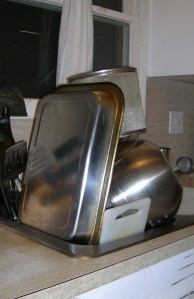
 The frugal and resourceful part of me would like to say I’d installed it myself. I tried. Unfortunately, the two dishwashers had completely different electrical and plumbing attachments. Listening to the old dishwasher throw sparks as I pulled it out didn’t help my confidence. Helping at a








 Trimbathcreative's Blog (Tom Trimbath)