Maxwelton Fourth Of July Parade 2018

That title is longer than necessary, at least for anyone familiar with Maxwelton on Whidbey Island. There’s only one major parade, it’s on the fourth of July, has been held for over a hundred years, and merely has to be described as “The Parade” for any of the neighbors to know what you mean. For one day every year, the neighborhood gives up its one street and park to welcome in enough people to fill several small towns. And then, it’s gone, leaving enough snacks to keep the gulls, crows, squirrels, and chipmunks busy and wired for weeks.

The Smithsonian is collecting small town America stories, so maybe Maxwelton doesn’t qualify. Maxwelton was one of the largest towns on the island about a hundred years ago. There was even a regular Chautauqua hosted in a 3,000 seat amphitheater; but the switch from sailboats and steamships that landed on the shore, to cars on ferries at deepwater docks drew attention to other parts of the island. Today, Maxwelton is an interesting slice of American lifestyles: marvelous beachfront homes with gorgeous views on one side of the two-lane road, with farms and funkier homes on the inland side. Thanks to the county park, visitors can still access the beach, enjoy the playground, and maybe even play some baseball. It’s a mix.

The public park is the focus of the parade. There’s where the temporary plywood bandstand sits, just beside the backstop for the ball field. The parade is as ephemeral as the bandstand, pulled together just in time, and swept away to let the neighborhood get back to the business of living and relaxing by the water.

A team of volunteers organizes the event throughout the year, but it is the day of the parade that is obviously organic, casual, energetic, and fun.

Want to be in the parade? Show up. That’s about it. Show up about an hour or two before it starts. Hang out in the appropriate lot (which may have been cropped and mowed by livestock, but more likely by a John Deere). Tell the organizers why you’re there. Get a number. Get in line. Get ready to march, and stop, and march, and stop, and eventually probably get a round of applause as you pass the grandstand. Don’t be surprised if they don’t get your name right. They don’t know who will be there until everyone lines up.

If that sounds too simple, you’re right and wrong.

36613355_10216510093404023_3635103321099862016_n - Edited

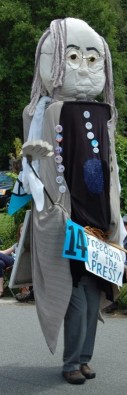
Obviously, someone is going to spend as much time creating their display as the organizers do raising money, arranging for the permits, and getting a basic idea of how the day will flow. Oh yeah. Someone must be out there getting the outhouses ready. Some of the displays are phenomenal. Super-tall puppets, gardens on bicycles, tiny artistic sheds on wheels, and the inevitable politicians on floats or in convertibles or in antique cars. (I felt like an antique because I’m now older than some of the cars. Ouch.) One display was a mini-parade of paintings of winners of the Nobel Peace Prize. 36657925_10216510082763757_1441357205965111296_n - Edited

Those displays make the best photographs, and get the greatest oohs, and ahs; but it is the spontaneous displays I enjoy the most.

Got a family reunion? Get everyone in line, and have fun with it. One family cut six holes in a table cloth, draped that over the heads of a half dozen of them, and marched as a picnic table. Another group had everyone wear oven mitts shaped like crab claws. One year, a group of us bicyclists wore capes quickly made just in time for us to ride (very slowly) and chant “Occupy Your Bike!”. The cutest were, as always, the kids, pets, and kids with pets dressed in red, white, and blue with sparkles and glitter.

10492405_652357298172690_1683113942703449245_n

As the parade marches by, many in the parade throw candy to or at the folks on the side of the road. Thanks for the thought. Ouch! An appreciated counterpoint was the local school’s garden that passed out fresh peas (or was it beans?).

As stately as a parade can seem, Maxwelton’s is far more relaxed and playful. The people in the street parade know the people beside the street, so there’s lots of authentic waving, hand-shaking, and hugging. Exuberant kids dash out to grab the candy, say hello to friends, and sometimes try to join in while parents pull them back out of the traffic.

The parade starts with a proper honor guard and ends with the inevitable fire truck with lights blazing. After the last vehicle has driven by, they all park in the park, the national anthem is played, and then the games begin.

36589914_10216510094164042_8211449403722956800_n - Edited 36616269_10216510071963487_2353922350593867776_n - Edited

Within a few hours, the neighborhood will retreat to the seasonally busy level, which seems quiet in comparison. Within a few weeks, the neighborhood will return to its much quieter and less crowded year-round population. The livestock can go back to feeding undisturbed by noise. The scattered remains of candy and fireworks will be swept into the trash, or swept out to the sea by the tides.

Describing the details of every entrant and display would be worthy of a book, but in sad commentary on modern society, there are too many cautions about publicly mentioning the specifics of children doing innocent things, too many controversies if a political opinion feels it wasn’t given equal coverage, and too many opportunities to violate people’s privacy thanks to facial recognition.

Yet, for a few hours, with the help of caring people, a community can spring up, have fun, and carry away memories – whether they happened in a small town, or not.

Posted in Uncategorized | Tagged , , , | Leave a comment

Semi Annual Exercise Mid 2018

Silly habits that we get ourselves into. They can be so hard to give up. Decades ago (was it really that long?), I started following Peter Lynch’s example by regularly seeing if I could describe each of my investments simply. The idea was that, if an investor can’t explain what and why they hold an investment, they should consider investing in something they understand. I set myself a schedule: every six months, write a synopsis of each company and include a simple assessment of their prospects. I was silly enough to do it on either June 30th or December 31st (I’d have to check my old files to establish the date). Now, my businesses and commitments layer that exercise on top of the end of the month, the end of the quarter, and the end of either the first or second half of the year. This time, it also included the end of the week. Silly, but I’ll continue to do so because the exercise benefits my financial fitness, even when it is somewhat painful.

Through all the ups and downs of the first half of 2018, the total portfolio value hasn’t changed much. That’s a sad accomplishment considering the record setting stock markets. But, that’s partly the plan. Missing the gains isn’t part of the plan, but not being tied to the “markets” is definitely part of the plan.

The markets are defined by the indicies, like the Dow, the S&P, and the NASDAQ. They are dominated by the mega-corporations, which are dominated by the major financiers and institutions. I don’t expect to compete against them as they shuffle between MSFT, CSCO, SBUX, and whatever at nanosecond speeds. I invest in small companies that have the potential to become big companies, diversify because some won’t make it, and sell the successes when they are in high demand and short supply as reflected in a high share price. Allow me to introduce you to three where that worked: MSFT, CSCO, and SBUX as well as several others.

The strategy worked so well, and I described it well enough, that several of my friends encouraged me to write a book about it; Dream. Invest. Live., which I did.

That strategy worked for decades until, as a few financial professionals have described it, I was hit by a perfect storm of bad luck; what I call My Triple Whammy.

Since then, my portfolio has languished with no indication of whether the lack of performance is from a fundamental change in the investment world, my perspective, or simply bad luck following good luck. Being the optimist, I look forward to the return of good luck. Being the realist, I realize something systemic like computerized trading, or mega-corporations hoarding profits in tax havens could have changed the way things work to the detriment of small businesses. Luck may also be playing a role.

My portfolio hasn’t recovered, yet I remain optimistic, though not as optimistic as previously. Small companies with small revenues frequently survive by diluting their stock. A decade or two ago, my holdings were sufficient for me to step up to a significant level. If I owned 0.1% of a company, one-thousandth of the company, and the company became worth a billion dollars, my holding would be worth a million dollars. Score! Retire. Dilution has erased that potential in all of my long term holdings. As of last year, my MVIS shares were worth 1/40th of their original ownership value. The same is true in other companies. The market cap potential persists, and may even be greater, but the number of shares is so much higher that the benefit to the individual shareholder is much lower.

I may not be as likely to retire on one phenomenal success, but if a few succeed, I can at least rest more easily and take more days off. There are mountains to climb!

(The following are synopses of the synopses. The longer synopses, a funny writing concept, are reached by links below.)

AMSC, which was called American Superconductor, hoped to do for electricity what fiber optics did for information. Their superconducting cables are finally available, but the sales haven’t arrived. The potential persists, but I can’t tell if the issue is the adoption of innovations in a conservative industry, or a management team that lacks the proper sales skills.

Asterias (AST) and Geron (GERN) have similar biotech stories. They’re both in mid-phase clinical trials, far enough along to be encouraging, but far from traditional FDA approval, and hence profits. They also both have that same issue of trying to spread the news without violating SEC and FDA rules, resulting in indecipherable press releases.

MicroVision (MVIS) has a technology that has the possibility of disrupting the technology industry the way smartphones did to laptops, which disrupted desktops, which disrupted mainframes. As I wrote in its synopsis, “The current projection is that profitability is possible in 2019, but for years the recurring theme has been that “really good news” will arrive in about six to nine months.” And, then there’s the continual dilution and a management team that has lost its credibility, at least for me.

Neophotonics (NPTN) sits in the critical industry that enables high, and higher speed internet speeds, something in high demand. I haven’t figured out how they can manage to languish as poorly as my portfolio, but maybe that’s a temporary situation for both.

The first half of 2018 has been weird enough that I don’t expect to correctly predict my portfolio’s performance in the second half of 2018. The markets don’t like turmoil, but they might like a more efficient energy infrastructure, treatments for cancers and damaged nerves, dramatically improved electronics, and appreciation for higher internet speeds. I can hope, which isn’t a strategy, but it is what I have to work with.

Here are the links to the discussion boards I use. Feel free to comment here or there, and to pass along links to others. The bigger the discussion, the better the chance of valuable insights (as long as the trolls and flamers are moderated appropriately.)

Investor Village

AMSC

AST

GERN

MVIS

NPTN

The Motley Fool

AMSC

GERN

MVIS

NPTN

Silicon Investor

AMSC

GERN

MVIS

Reddit

MVIS


Posted in Uncategorized | Tagged , , , , , , , , , | Leave a comment

Karate Again And Still

Ouch. I hurt myself. No one is better at knowing my weak spots than me. I did something silly and serious. I knelt down to meditate. Creak. Groan. Grr. Since 1984, I’ve been training in the martial arts. Since I moved to the island, and especially since My Triple Whammy, I’ve missed working out in one of my style’s dojos. A few weeks ago, a local, internationally known sensei agreed to let me rent time in his dojo so I could train somewhere besides my living room or carport. Step one. Kneel down to meditate. And listen to old joints complain. It’s good to be back for many obvious and un-obvious reasons.

Remember the original Karate Kid movie? My style, Shobayashi Shorinryu Karatedo, is very much like the old guy’s style (Mr. Miyagi.) Karate is about not fighting. Karate is about defense. The biggest fight is with the self, not the other.

Most folks react as if karate is all about punching, kicking, and shouting – like the villain in that movie. One of the lessons I’ve learned is that whoever attacks exposes their vulnerabilities, and not just physically. That’s an interesting lesson to reflect on during today’s politics.

The main benefits are less obvious. They influence my approach to personal finance, entrepreneurship, and how to deal with people.

Do not move unless it is to your advantage. Also, do not block the punch that will miss. It is too easy to react when there’s nothing to react to, to start defending when someone is merely posturing. Address real threats (of which there are enough to keep my PretendingNotToPanic.com blog busy), but pause and notice how many times people read between the lines when there are no lines, when nothing was said. Moving for the sake of moving can feel like getting something done, but it is wasted energy that may be needed later. Of course, when there is a threat, act. For me, for a while, that meant working seven days a week. Now, I’ve been able to keep my house, have built some equity in it, and can start taking days off.

Tight no-tight, and breathe. People see Bruce Lee’s phenomenal physique and think martial artists are iron-solid sculptures in muscle and bone. He wasn’t tight all the time. To be tight all the time is another waste of energy. Tight is also slow. To conserve energy, be relaxed and fluid; then, to act, tighten everything at once or in such rapid succession that a punch isn’t a fist, but coming from an entire body. I kept that in mind during that seven-day-a-week work schedule because I knew I couldn’t do it forever, and that the longer I did it, the more counter-productive I’d be. Throughout, find time to breathe. Without breath, energy gets depleted. Breathe, and be able to continue.

The biggest fight is with the self, so don’t fight it, befriend it. In business, there’s an exercise that’s meant to get to the core of a situation. Keep asking “why?”. Be like an annoying little kid and keep asking yourself “Why?”. Why are we acting and feeling this way? Why are we in this situation? Why do we care? Why? Why? Why? I even ask myself that when I write a post. Know yourself and know half the battle. Karate takes that further by asking about the other half of the battle, when there is one. If there’s an opponent, why do they feel and act that way, why are they in this situation, why do they care, why, why, why. Understand them, know both sides of the battle, and find there may not be a battle. Hard to do, but karate is not known for being easy.

I’ve been training for decades, and know that I’ve only begun. My drastic retreat as I defended my essentials for life meant my training has suffered. So, it’s no surprise that I have a bit of self-imposed suffering to do.

At least in my style, a typical class starts and ends with meditation. Kneel, or sit in lotus, or at least sit, and breathe. Just breathe. Work and chores and everything else is outside the body. Just concentrate on breathing.

But, about those creaky joints. Oriental and Asian martial arts history is mostly folklore because many of the documents and institutions were destroyed in various wars and societal calamities. One story leads back to the early Shaolin temples that predate karate. Supposedly, in China, a master of mediation and defense came across a temple that housed threatened monks. The monks regularly were assaulted and robbed. They prayed, but they didn’t meditate, it was that long ago. The visitor realized they should learn how to meditate first, to calm themselves. Unfortunately, the monks were so out of shape that they couldn’t sit or kneel for long enough for proper meditation. So, the visitor decided to train them for self-defense in the meantime, with the side benefit that they’d be able to meditate better. And so began at least one martial arts tradition.

I sympathize with those folkloric monks. Even though I’ve been maintaining my practice through the various formal exercises, I’ve neglected the basics of stretching and strength training. Those basics have less to do with fighting techniques and more to do with being able to sit in meditation for very long (something I have also lacked the time to do.) One of the ironies of martial arts, at least for me, is that the speed and strength of youth are gone, but my understanding of the techniques means my young self and body would have a tough time sparring with my old self and body.

Trust intuition, because in a fight the subconscious can be a great ally.

The less baggage or weight or whatever we carry around, the easier it is to be flexible and mobile.

The person who wants to fight might just beat themself up if you give them enough time; and don’t be that person, and be prepared, just in case.

There are too many opportunities to fight at every level from the global to the societal, to the national, to neighborhood, to the internal and philosophical. Lately, I’ve focused on the personal, particularly the personal financial because food, health, and housing are basic needs for survival. It is nice to have reasons for optimism that I can loosen up from that battle, to breathe, and to move to advance.

Now, if only I could kneel without having to pop a pill.

NSKA logo

Acknowledgments

I thank Kyoshi Warren Berto of Shorin Ryu Seibukan Karatedo for the use of his dojo. In typical Whidbey fashion, an international master in a style similar to mine just happens to have a dojo within walking distance of my real estate office

I thank my sensei, Kyoshi Jerry Gould (retired), of Shobayasi Shorinryu Karatedo for teaching me for decades. In typical Pacific Northwest style, I walked into his dojo without knowing until several years later that he was the chief instructor in North America for our style. 


Posted in Uncategorized | Tagged , , , , , , , | Leave a comment

Appreciating Fresh Water

Flush. Oh, how I look forward to that sound in my house, again. My neighborhood is on Day 5 of “Mandatory Water Conservation”. Our neighborhood of a few hundred homes gets its water from a local well. Over the holiday weekend (I don’t know exactly when), the pump broke. Since then, we’ve been waiting for the water to come back on. Since then, we’ve been involuntarily practicing the emergency preparedness we’re told to have in place, and getting a small but intimate lesson in what life was like for people affected by Katrina, for Puerto Rico for the last year, and for millions around the planet forever.

We’re lucky. The power goes out on the island often enough that people joke about it, bands sing songs about it, and plenty of people have generators or at least a proper attitude – as well as a good supply of wine, books, and lanterns. But, that’s only losing one main utility at a time (except for those who need power for their pumps.) Losing power starts as an interruption, rises to an inconvenience, and can reach worrisome levels; especially, if the power is out when it’s cold outside. Freezing nights without power can be bad, but there are simple fixes like letting the water run to keep the pipes from freezing, not opening the fridge or freezer unless necessary, and then bundling up while hunkering down.

Losing water happens less frequently. It’s hard enough for some to get motivated enough to gather earthquake kits, go-bags, and food caches; and that’s for emergencies that are either frequent or so well-documented that everyone gets a chance to hear about and prepare for them. Electricity is fundamental to our society and civilization. Water is fundamental to life. We got by without electricity until a bit over a century ago. We came from water, are bags of water, and can’t survive more than a few days without water. And yet, notice how few households have backup water when news media is covering disasters. Entire populations can turn from residents to refugees within days because of wars or damaged dams.

Our situation is far simpler, and yet, also an insight into how complicated something as simple as well water can be.

If you want the full description, visit the neighborhood’s web site.

Here’s another description. We live on an island, so our water has to come from here, not from some massive mountain reservoir. We don’t have a sewage system, so every house uses septic systems that are close to the surface. It’s a bad idea to get water from the vicinity of where toilets get flushed, so there’s separation between the two. Our water comes from a aquifer filled with rainwater, an aquifer that is over 300 feet down. That puts the bottom of the well below sea level. The pump lives in the well, and the well lives at the bottom of the hill. One way to simplify a water system is to put the water at the top of a hill or by using a tower; hence the iconic water towers in middle America that announce every town that sits beneath them. Getting enough water for a few hundred homes, to rise up a few hundred feet of well, then climb the hill, then fill two 50 foot tall tanks requires a big, expensive pump sunk into a very deep hole.

Fully filled, those two tanks seem like they could keep the neighborhood watered for days, especially if people aren’t watering and washing. Unfortunately, the tanks were drawing down rapidly during a heat wave over a holiday weekend.

inside air temp with windows closed, shades and curtains drawn, and awning deployed

Some time in there, the pump failed. When the emergency was announced, the necessary response was drastic. I don’t know about my neighbors, but I haven’t flushed for days thanks to friends in other neighborhoods. It also helps to work from the office rather than from home.

As I type, the pump repairs were scheduled to be completed. I’m definitely staying tuned to the news.

I’m one of the lucky ones. I live frugally. I have an earthquake kit, two rain barrels, a backpacker’s sensibilities, and a real estate business that’s busy enough to keep calling me back to the office. I’m lucky enough that I felt I have to hide the fact that I can water my garden (with some very icky and organic rain barrel water that is somewhat alive.) Honest, folks. I’ve only accidentally used the faucet once or twice out of habit, and quickly turned them off.

They didn’t know, or at least didn’t tell us, the prognosis the first day; but I remember the last time the pump failed (which also makes me wonder about warranties and alternative water sources.) I already had a few gallons of drinkable water stashed in cupboards. After work that day, I bought a couple more gallons. I also bought a big bag of ice cubes. No need to feel guilty about having a cocktail if the ice came from somewhere else. By luck, I’d also just refilled all of my hiking, bicycling, and commuter water bottles. Serendipity happens.

Events like this are reasons to be upset, but they are also lessons about what we take for granted. When I lose power, or electricity, or water, or the ability to flush, I better appreciate them when they return. That’s one of the side benefits of backpacking: come back home and marvel at clean water flowing on demand, and not having to dig a pit to poop into.

Cheers to the neighbors who delivered free gallons of water to each household. Special cheers to the neighborhing neighborhood that let us tap into some of their supply – though that seems to be consumed as quickly as it’s delivered because the tanks aren’t filling.

One neighbor’s comment about the free water pointed out how much better off we are than the people in Flint who, even though they get water, they take risks by drinking it. If all goes well (hard to avoid that pun), we’ll be able to get by with a few gallons of water from bottles before being able to have so much fresh, clean water that we can use it to flush slightly less clean water.

Pardon me as I check email, and the neighborhood’s web site and Facebook page for a status update.

As of 20:47 June 21, 2018 there’s no news since 23:31 June 20, 2018. I can tell from the power company’s map that the power has been restored, but no news. As I close this post, I don’t know if I have to continue my nomadic life and work schedule for another day or more. It is a very good thing that I have generous friends who aren’t picky about protocols when reality arrives.

I get my answer soon enough. Puerto Ricans continue to wait. Syrians are no longer Syrians, or aren’t as tied to a national identity as they are to a basic human need. Look back up a few paragraphs. I’m one of the lucky ones.

PS
1) Life hack to lighten the mood: Beer from a bottle doesn’t use up any of the water, doesn’t have to be washed, and the end product can be disposed of by watering a patch of lawn, discreetly.
2) A bit of more expansive optimism, American fresh water consumption is down even as the population rises. It’s down to “only” 82 gallons per person per day. A number which continues to startle me; but at least is heading in the right direction.

PPS – YAY!
“As of 7pm this evening, power has been restored to the Sandy Hook Community. The well is now pumping and our tanks are being refilled. However, we do ask you to conserve water until 5pm on Friday, June 22nd, providing the tanks some time to replenish.
The pool will reopen tomorrow (Friday, June 22nd) at 12pm.”

Posted in Uncategorized | Tagged , , , , , , | 1 Comment

Donald Leroy Trimbath Senior

In honor of Father’s Day, my memorial for my father. I thought of him today as I spent my day off volunteering for Whidbey Camano Land Trust by clearing invasive weeds on their property where I’m a Site Steward. The last thing I remember him saying to me was; “Do good work.” I do what I can. – Tom Trimbath, son of Donald Leroy Trimbath, Sr.

Tom Trimbath's avatarTrimbathcreative's Blog (Tom Trimbath)

Photo: Glasgow, Scotland, April 1945, about the time a young sailor was introduced to Guinness Photo: Glasgow, Scotland, April 1945, about the time a young sailor was introduced to Guinness

There were whitecaps on the bay today. They were nothing like the waters of the North Atlantic, or typhoon in the Pacific that my Dad survived aboard ship as a Merchant Marine in World War II. He died, Saturday, September 19, 2015 after a long life of hard work mixed with enough play. He helped raise three sons, including me, and will remain an example of a frugal life and an internal honesty.

He lived a version of the American dream. Born in coal mining country in southwestern Pennsylvania, got out as soon as possible by joining the Merchant Marines because he was too young for the other services, survived (except for a broken nose from a softball game in Marseilles), came home, became a trucker to avoid being a miner (which was wise considering…

View original post 939 more words

Posted in Uncategorized | Leave a comment

Fighting Depression

At various times, I’ve been cautioned not to write about this, but a string of news stories, fresh data, and conversations with friends came together for this post. It is not easy to write. Challenging taboos isn’t easy. Exposing vulnerabilities threatens facades. I may not do the subject justice, but I decided to join others in trying to talk about depression, depression that I’m hearing about in society and amongst friends and occasionally inside my own head. As one writer friend tweeted;

Even as I write this and paste that, I know I’ll already turn away from two inspirations for this post.

One : Yet another celebrity who seemed to have everything committed suicide.
Two : In the US, 25 states have seen a 30% increase in suicides in the last twenty years.

Depression has been tied to too many of these stories. In particular for this personal finance blog, many of the less public suicides have been tied to personal finance. The Great Recession wasn’t just an economic blip. It hurt. It didn’t just hurt bank accounts and retirement plans. It hurt people. I experienced the emotional assault unleashed by collection agencies. Their attacks left me physically shaking for days. They practice it. They’re good at it. I’m still surprised that I didn’t have a heart attack from people who so expertly knew how to reveal unsettling publicly available information, identify my emotional hot buttons, and hit those buttons with rapid-fire hammer strikes. I’m not surprised that many people decided that the only way out was – well – I guess I will mention suicide after all. One of the things that saved me was the organization that saved my house. Few find them or others like them (Parkview Services), unfortunately. I’m glad I did. (Details: My Mortgage Modification Chronology)

I live on a tourist island where there’s obvious income and wealth inequality. There’s a facade of “welcome to the cheery and pretty place.” And it is a cheery and pretty place. That’s part of why I am here. That facade, however, is propped up by what I call the Pageant of the Pleasant Peasantry. Hotels, restaurants, and shops cater to a clientele that appreciates the natural beauty, art, and culture of the island. The service is high-end, polite, and good at finding a balanced casual quality. Come here to relax and enjoy. It works. I didn’t truly begin learning to relax until I relocated here. Enjoy the service, but it wasn’t until I lost ~98% of my net worth, almost lost my house, and had to work about a half a dozen jobs, seven days a week, for up to twelve hours a day before I began to see behind the facade. The pageant is that polished and powerful.

Too many of the hotel staff, waiters, and baristas live in the woods or in cars. Drive through some of the parking lots farther from the center of the various attractions and see cars that the owners can’t afford to properly fix. Head to the middle of the island, back from the water and the views, and find households that are trying anything and everything to get by.

It isn’t just the people in the public view. On a recent rainy day, I gave a ride to a hitchhiker who was happy to finally get $1,000. He’s a carpenter who will finally be able to buy a cheap car so he no longer has to limit himself to the job sites within walking distance. Browse craigslist, or even better, drewslist, and see proud people selling essentials so they can buy things that are even more essential.

Many people who are smiling are slapping on their version of that facade. Recently, one friend interviewed me as a case study for a class on leadership. Honored to be included. One of his questions was, “How often are you happy?” My answer, about 10% of the time. He was surprised. He expected something more like 80%. I’m not surprised. We frequently base our impression of people from what we experience. I like people. When I’m with people, I smile. When I dance, I smile. But, that’s only part of my life. He also was caught by a data quirk. Ask a geek a question with a number in it and you may get too specific of an answer. About 33% of the time I’m trying to sleep, which I’m quite terrible at. Most of my time is spent working. I enjoy doing good things and getting things done, but the Gig Economy is too chaotic to encourage the flow that I’ve experienced when working with only words, only data, or only playing with ideas. The logistics of switching between the various roles gets in the way. It’s easy to get down to only 10%.

Some readers have cautioned me to not mention such things because it is too real, too much information for clients who want to work with the illusion behind Confidence and the Strong Declarative Statement. I understand that. Go look to 1600 Pennsylvania Avenue or Mar a Lago for proof that reality isn’t as important as a strong and confident facade. Facts and logic aren’t in style, at least for a while.

We’re seeing the price of listening to those cautions.

I have another blog for “people who are eager and anxious about the future”, PretendingNotToPanic.com. The name gets more of a response than the posts. Pretending Not To Panic resonates. I say it, and people smile or laugh or nod their head or some mix of those reactions. They’ll talk about it privately, one-to-one; but won’t publicly admit that they’re pretending not to panic. It cracks the facade, which may mean smaller tips, fewer patrons, more rejections, a shorter list of clients. That’s the fear.

It isn’t just poor people. Anthony Bourdain wasn’t poor. Neither was Robin Williams. Both worked in an industry that paid them very well and provided creative outlets. Yet, behind the facades we placed on them, there were severe troubles.

Depression doesn’t have to reach suicidal levels before it should be addressed. Some countries measure their happiness index. That may sound silly in modern American culture, but wouldn’t it be better to working to that ideal rather than one of “if you struggle hard enough you’ll be allowed to survive?”

Depression isn’t something simple, and certainly not something that can adequately be collected into one blog post. There are many causes. I’m continuing to learn more about mine. I self-diagnose as depressive, because I know good news doesn’t lift me as easily as it did, and because my experience with avoiding foreclosure trained me to flinch at mortgage company emails and any hint of late bills. I also am feeling better. During that phase I flinched at phone calls. At least I don’t do that anymore. Thanks to some amazing support, my situation is improving. Appreciative consulting clients, shared real estate sales, and a financial “buffer” are getting me through some tough times. I’m smiling more. Bodily aches and pains are diminishing. I even had a party the other night and was pleasantly surprised by the joy I felt seeing friends for the fun of it. It’s been a long time.

There are shelves of books about the topic, each with a perspective that matches someone’s needs. Another will be added soon by one of my clients who is working from a pseudonym because they’ve been through a long and successful recovery, have insights, research, and a perspective to share – and yet need to use a pen name because their professional career must be protected by a strong and confident facade. Look for their longer story, soon.

In 2004-2005 I went to counseling for stress-related issues. My counselor pointed out that I had a very thin support network, even though I had a lot of friends. I asked him the blunt question, “Am I crazy?” No. I delved a bit and we got into a conversation about modern psychology and sociology. As dysfunctional as the society was fifty years ago, and before, society and communities and friends were more internally supportive. Pardon the stereotypes, but this was part of his perspective. Fifty years ago, a man would come home from work, then hit the bar. At the bar, he might complain about work, his wife, his life, his kids; but he also may want to share good news with other men who had jobs, wives, and kids. Fifty years ago, a housewife, after taking care of the kids and the house, could get together with other wives and some wine, and similarly complain and celebrate with people who understood her situation. People had emotional outlets. As a society, we’ve worked hard at breaking down gender roles and barriers, reducing drunk driving, and emphasizing openness and diversity – but he pointed out that we also lost those support networks. Our society is in the process of redefining them through “tribes” and bizarre things like social media; but until we replace that network, one of his main jobs is to listen, as much as a barkeep or hairdresser or simply a friend, as a psychologist.

One of the most powerful things he said to me was; “You look like you are in so much pain.” My muscles relaxed so much at hearing those words that my sternum actually cracked. A very freaky moment. A freaky realization that no one else had said those few simple words. My issue at the time wasn’t depression, but stress; but he proved to me the power of listening. Others showed me the same power amplified by holding a hand, or providing a hug. Advice can have the opposite effect. Advice can come across as “Here’s what you are doing wrong”, “It’s all your fault”, “How can you be so stupid as to do…?” A defense must be raised and responded to before getting to the true listening. Try listening first. “I’m sorry to hear you’re in such a situation”, “How does that feel”, “I can’t imagine.” It is also one reason I am training myself to greet people with “It’s good to see you.” Ironically, asking someone “Hey, how are you doing?” in a public place can startle and scare. The same question in private, asked sincerely, however, maybe the best medicine.

I don’t feel that I’ve lived up to Richard’s challenge, “go deep into raw pain, to unleash the fury, the blood”, especially not in a first draft, which is basically what I post. But my eloquence or lack doesn’t matter as much as hopefully helping others know that they are not alone, and hopefully helping others consider other ways to help. We’re all in this together.

Posted in Uncategorized | Tagged , , , , , , , , , , , , , , , , , , , , | 2 Comments

Corporations Meet Owners MVIS 2018

Photo on 2016-06-01 at 16.08

Another year, another stockholders meeting. Another exercise in that dissonance between being able to own a piece of a corporation in America, while being treated as an inconvenience, and dismissed – unless a question is innocuous and positive. One key to wealth generation with the US has been investing in publicly traded corporations. That continues to be possible, but as wealth inequality grows, as companies hide their finances, and as “they who has the gold makes the rules”, it becomes harder to see that the same benefits apply. I just attended the Annual Stockholders’ Meeting for MicroVision (MVIS) and continue to find myself equally fascinated by the possibilities while cautioned by several realities. (I congratulate their graphic designer. This year the poster had proper punctuation, though the presentation did not.)

My book, Dream Invest Live coverDream. Invest. Live. was published so long ago that it is easy to forget that this blog is based on that book. Books are static. Personal finance is dynamic, hence this blog. As I prepare to write the sequel (something this blog is enabling), I wonder if that dynamic has shifted too much.

Paradoxically, even though information flows more freely because of the internet, the Internet Bubble, Enron, and the Great Recession (the Second Great Depression) inspired reforms that throttled information flow. If something is made public, it is readily available around the world. Unfortunately, in an attempt to level the “playing field” (as if this was a game) full disclosure requirements and forward looking statement caveats have provided management tools and excuses/reasons to conceal a company’s plans, operational information, and financial expectations from its owners – seemingly unless those owners are officers or managers. In a very well executed presentation of MicroVision’s prospects there were few quantitative facts, not even of publicly released financial data. If the company had proved the value of such secrecy by becoming profitable, it would be easier to believe the reticence was worthy. Competition sensitivity is real, but that reticence can be hard to distinguish from deciding not to mention mistakes.

Personal finance benefits from a person being interested in their finances. Prudent investing benefits from personal research. As research becomes more difficult for an individual, successful investing becomes more difficult. The simpler, more conservative alternatives continue to exist, e.g. no-load index funds; but the more aggressive alternatives become less attractive. If individual investing is only practical to those who have large net worth, then it becomes less possible for people with low net worth to significantly increase their net worth. Wealth inequality expands.

I’ve experienced the ability to grow a portfolio from a few hundred dollars to a over a million through prudent investing, a diversified portfolio, a modicum of research, and frugal living. Hence, my first retirement at 38 years old. Hence, friends encouraging me to write my book on personal finance for frugal folk. It may be possible to do that again, but I’m not so sure, anymore.

Companies seem to be more reticent, and more likely to use tax havens, and to use cash for financial investments rather than investing in research and development. Within the last two decades, automated trading has expanded from a few programs deciding what to trade, to advantages measured in nano-seconds and an emphasis on prices, hedging, and momentum instead of company fundamentals, strategies, and managerial effectiveness. Historically, shorts could be caught in a short-squeeze, an opportunity for longs to benefit from people who bet a stock would go down but instead went up. I hear echoes of investors looking forward to one, but shorting has become more popular and automated that effectively pessimism becomes more profitable.

I have yet to see the data, and it may not exist, but I wonder how much of the increase in market value is transferring to the majority. If the economic recovery feels uneven, is that one reason?

And yet, I continue to invest in the stock market. As my finances recover, I look forward to following my investing strategy: investing in small companies in disruptive technologies, and selling them after they’ve grown substantially. I continue to think that is possibly profitable for stocks like MVIS, AST, GERN, AMSC, and NPTN. (More about those in my Semi-Annual Portfolio Exercise, with a new one due at the end of this month.) Obfuscation, shorts, and computerized trading “should” not contain significant success. There remains the possibility that years of irrational pessimism about a stock can be followed by years of irrational optimism. I look forward to re-retiring.

I continue my journey from Middle Class to Millionaire to Muddling By, and appreciate you following my progress. There is enough uncertainty in the economy that any of my concerns can be negated by good news for my companies, positive financial reforms, or sadly another Great Recession. Considering history, the most likely future is one we can’t predict. Stay tuned.

For more about the specifics of the 2018 MicroVision stockholders’ meeting, go to Motley Fool, Investor Village, Silicon Investor, Reddit, or some combination. There, you’re likely to find other views and voices. Together we provide more than one perspective, and some do an excellent job at peering behind through the fog of obfuscation.

Posted in Uncategorized | Tagged , , , , , , , , , , , , , , | Leave a comment

Small Towns Rejoice

Small towns rejoice! The data are in. Living in a small town correlates well with happiness. The farther someone is from a city, the happier they tend to be.
Cities rejoice! The data are in. Living in a city makes it easier to make money. The closer someone is to a city center, the easier it is to find a good job at good wages.
Suburbs can rejoice because they have a bit of the best of both, and can mourn because they have a bit of the worst of both.
If you want data, you’re welcome to start with my post on PretendingNotToPanic.com and follow the links. (Which some have done and reached their own conclusions.)
This post is here to skip the data. I gripe about my economic life being tough, but I can pass along an anecdote or two that make me glad I moved to a small town.

Everything is relative.
I live on Whidbey Island, a long island with its southern tip a little less than a 30 mile crow-flight, plane ride, or boat ride from Seattle. That’s close. But, it is also far enough away and un-urban enough that some Seattle-ites couldn’t find it on a map. I know people in Seattle who are proud that they’ve never traveled to the other cities in their county. Whidbey? That’s the wilderness to them.
I live on the south part of Whidbey Island, a place known world-wide for its tourist destination town of Langley, a place that considers itself a city when it comes to naming their building city hall, but brands itself as the Village by the Sea for the tourists.
I live in Clinton, a place that is unincorporated, is a census-designated place, that is best known for the ferry terminal that leads to the mainland. Clinton is known for being a drive-through, a place along the “highway” (really a state route), the connects the southern ferry to the rest of the island. (Check out the Rural Characters having fun with Clinton.)
I may have a Clinton address, but I live so far south on the island that people who’ve lived here for decades don’t drive here on purpose. We aren’t on the way to anything, anything except peace and quiet for most of the year. Summer is a different story. My house is part of a small neighborhood that looks suburban, but it is a bit of suburbia with shoreline, views of the Olympic Mountains, easy access to the Puget Sound and the rest of the world’s oceans (for those intrepid souls), and even a marina. We may be closer to Seattle than the rest of the island, but we’re part of another world.

Scatchet Sunset – from Twelve Months at Cultus Bay

For over 20 years I lived in various urban and suburban parts of Seattle’s metropolis. Each had its virtues. Each made fun of some other part of the area. There were more than enough people, more than enough things to do, enough jobs that meant I frequently had to move, and more than I could see, visit, or do in a lifetime. Seattle is not a dull place. (Flashback irony: One reason Boeing said that hired me was because they had a tough time attracting young people in 1980. The city was seen as too quiet, too dull, and too wet. So much for that image.)

It was only after I moved off the mainland that I learned what my life and world lacked: community.

It isn’t that I didn’t have community. I did. I had a wide range of friends, people that Facebook helps me keep track of. We did a lot together. I didn’t realize, however, how much anonymity I had.

Within a year of moving to the island I ran into the fish bowl effect that small towns are known for. I moved to the center of the fish bowl, Langley. Yes, Langley is a tourist town, but it has residents, otherwise it wouldn’t be a town, or city, or village, or whatever. I was newly single. A single guy in his forties who was retired, active, had parties, liked to dance and cook, and was a writer – well, word got around. Word got around so much that if someone parked a car somewhere near my house overnight, I’d hear stories the next day about who I was with – even if it was just a parked car owned by a stranger visiting someone else. The rumor mill was active, and that’s an understatement.

The gossip was also common enough that it was a worry for the mayor. He sat me down to talk about it. Okay. He sat me down to cut my hair because he was my barber, but he was also the mayor. He asked me what I thought he should do about it. The city’s culture mattered to him and he saw it as detrimental. I agreed, and told him to leave it be. I’d just been through a divorce and retired early because of stress-related health issues (and because I had enough money). While living on the mainland, my immediate circle of friends and family knew some of what was going on, but most of it was hidden. We lived in different neighborhoods, worked and shopped in different places, and had other friends who weren’t part of the circle, the network. When it came to emotional support I had what my counselor (the mental health kind) called “a very thin support network.” They were people who cared, but they also had to care about a lot of other things, too. Within my neighborhood only one neighbor took the time to listen.

On the island, it isn’t true that everyone knows everyone, but if they don’t know you they know someone who does. They gossiped because they cared. If they knew what was going on, they’d cheer or sympathize as appropriate. Gossip happened when they cared but hadn’t heard enough of what was really happening. It was the other end of the spectrum, and could benefit from some moderation (especially those folks who purposely spread hurtful rumors because they thought it was fun). Its benefit, though, far outweighed its cost, usually. I’ve never seen so many instances of spontaneous generosity for people in trouble. They don’t help everyone, no person and no community can, but they don’t wait for the mayor or the preacher to gather and point them towards helping someone. In the best cases (usually in the worst circumstances) help can arrive before someone gets home from an accident or the hospital.

In the city, anonymity is the norm. Want to be rude? You’ll probably never see that person again. Go on a never-ending series of overnight stands? Same thing. Be polite? That’s great, but what goes around takes a lot longer to come around.

In a small town, everyone knows your name, or maybe your face, or they’ve heard of you, or at least you have something in common. Want to be rude? People do, but those are the people who have to avoid people. Want to date around? That’s natural, but there are few secrets. Be polite? Be polite. Be helpful. The local paper regularly runs their Hometown Hero section where someone is profiled for decades of simply being themself in extraordinary ways. Will there be massively inaccurate gossip? Of course. And that’s true for everyone, and everyone knows it. Just don’t expect juicy and wrong gossip to die quickly. There’s not as much to do as in the big city, and a good story can be worth a lot of social capital.

It is an interesting environment to live in. Imagine getting stopped in the grocery store (yes, they weren’t all replaced by supermarkets) by someone with congratulations or condolences. They heard the story, recognized a face, and may have offer a handshake or a hug.

I moved to this neighborhood in Clinton to enjoy the view and the quiet, but also to distance myself from the fish bowl of Langley. Enough can be enough, eh? I make fun of Langley. It’s a tourist town that is proud of itself; but it also may have the best example of community. From Langley Library to Good Cheer Thrift is about a 4 minute walk, according to Google. It can take two hours in reality. Traffic is not the issue, except that it is. Traffic in terms of meeting friends, dropping into shops, enjoying the gardens, and generally moving at an islander’s pace. Within a block or two, nothing may happen; or, folks may want to know about a dance, or have an idea for a business, of have a cause that needs support, or generally are just being friendly. Want a reason to rejoice? There’s one.

Now, excuse me as I skip editing this post. It has been a long day (real estate gets busy this time of year, evidently) and I have a party to prepare. It will be my first in years, and I’m looking forward to celebrating a bit of financial relief thanks to friends, clients, and my perpetually extended exercise in frugality. Step one, clear some room in the fridge. Party fixings are coming in. Oh well, I guess someone has to finish this box of wine. Can’t have my friends drinking the dregs. Cheers!

Posted in Uncategorized | Tagged , , , , , , , , , , , , , | 5 Comments

A Day In The Gig Economy – 2018

I thought it was silly when I first heard a futurist predict that the next generation would have seven careers in their life. Retirement would take on a new meaning. Allow me to take this opportunity to count whether I did something similar in one day in the Gig Economy.

Two or three career choices was easy enough to imagine while working my way through an engineering job that looked like it was good for a lifetime. Few were as fortunate as me. Within my years with Boeing, I steered myself to the job I aimed for while in college: working on the next generation space shuttle. From the grumblings I heard, it sounded like most people worked in jobs, not careers, that had little to do with their dreams, intentions, and education. My Dad’s generation raised the expectation of one job for life, but then, life didn’t last as long then. A trend that went from a lifetime job, to a couple of jobs in a lifetime, to seven careers seemed unreasonable. The futurist may have been conservative with his estimate.

When I retired at 38 – (pardon the pause as I reflect on that decision made over twenty years ago) – I expected to create a new career. Conventional wisdom for such an unconventional situation was to channel a bit of Monty Python; “And now for something completely different.” Stepping right back into the role of an engineer or manager could unfortunately reinforce a personal identity based on a job title. The answer to “who are you” is not limited to a job description. Who am I? Instead of limiting that to “engineer” I can tell you I am a person who is fascinated by people and ideas – and who enjoys personal powered play time like hiking, skiing, bicycling, dancing, and such. Following that advice, I followed the advice by embarking on something completely different: putting my black belt to use by teaching a very old style of karate.

Skip forward 14 years. The karate business was shelved because of martial arts politics and logistics. Unrelated, I requested and received a divorce (dissolution in Washington State). Independent of that, my portfolio was hit by a Triple Whammy as the nation was struggling with the Great Recession (the Great Depression Part II). When I could no longer pay my bills, I stopped paying my mortgage, and I implemented My Backup Plans. In those years, I accidentally became a writer by bicycling across AmericaJust Keep Pedaling, began teaching about modern self-publishing and social media before they were popular, initiated my management consulting business, and basically fielded invitations to entrepreneurial situations that would begin as soon as they found the right money.

Skip forward about 6 more years and notice that the total of all of that work, effort, networking, and patience was less than enough to pay my bills. At least I was able to negotiate a modified mortgage and keep my house. I needed something else, and became a real estate broker. Stay tuned on that venture, and be encouraged because it turns out that real estate benefits from someone who understands how to run a business, write, speak, take photographs, negotiate contracts, network, treat people and paperwork responsibly and with respect, and communicate that through social media.

At least for today, none of my ventures have been an all-or-nothing success. For today, they mean a full day built from a string of gigs that involve a mind-numbing array of business styles, tax laws, contracts, responsibilities, and discretions.

A Day In The Gig Economy

  • Wake up after a fitful night’s sleep.
  • Before getting out of bed (er, futon couch because the bed was sold years ago) check stocks (because I maintain some hope for my portfolio), news (because the world has gone weird in ways that affect me), and emails (because one email can change my entire day.) By the time I stood up, I’d checked on book publishing and real estate clients. Three aspects of my recovery already reviewed.
  • Turn on the radio until I hear serious news about politics, then switch to online replays of the late night talk shows making serious humor from the same news items.
  • Shower, shave, and make a lunch to go.
  • Today, a special treat, eating out for breakfast as a way to get to know more people on the island that I normally wouldn’t meet.
  • Back to the real estate office for my shift. We make sure there’s always one broker on duty for people who walk in.
  • Switch hats, but not seats, to dive into more non-real estate business details. Decide what to do with a possible class in Modern Self-Publishing. Contact a fellow presenter for a duet of a talk at the local library this fall. Check in with a book publishing client about their paperback and ebook that will follow the recently produced hardback.
  • Settle into managing an online museum for an hour or so, just to make sure the communications are flowing smoothly.
  • Realize my next real estate shift has to be shifted because a real estate client wants to meet at the same time. Be thankful for a supportive group of brokers in our office.
  • Skim then scan news sources for PretendingNotToPanic.com, a side venture that I maintain for people who are eager and anxious about the future, and who prefer news that is apolitical, factual, based on data, and consequential. That task was a lot easier until November 2016. Very little is apolitical anymore; and facts and logic are no longer in style. Consequential, ironically, has never been more consequential.
  • Jump back into real estate by pulling together the paperwork for a hoped-for deal.
  • Lunch! But eat quick because there’s a real estate errand at another office that has to be squeezed in before a meeting with another book publishing client.
  • Sneak in a few minutes with my eyes closed to reset my brain into editor/publisher/consultant mode. Then, meet with an fascinating client to polish and submit their book for publication. Oh Microsoft Word, quit trying to be so helpful. A simple task takes twice as long as we spend as much time making changes as we do undoing the changes the programs makes while trying to help. Success! And, a very happy writer/author. Now, about that next book…
  • Swing back into the real estate office to check emails, hoping to finish early enough for a bicycle ride and writing this blog (without knowing what the topic will be.) Get an email, then a phone call from a client who wants to look at a house in under two hours. Happy to help – and grab a can of soup from the local grocery for a quick, light dinner.
  • Find that I’ve been invited to be part of a panel discussion about the island and security issues.
  • Tour a recently listed house that, in typical Whidbey fashion, was lived in – creatively. Listen to what they want, find something possibly a lot better for less tha 10% more, then head home.
  • On the drive home, decide whether to detour to the site of my next Twelve Month photo seriesDSC_0126, or head directly home to work on this blog. A little later, and the colors would be richer, but too early is too dull, so drive home.
  • Get home. Sigh.
  • Boot the home computer. Check emails. Send out a few to real estate clients based on what I’d just toured, including more details on the nicer properties (that are also a better fit and cheaper to live in, and realize that the blog has to be simple.
  • Decide that the simplest, yet most illuminating and useful blog for one of my next books, is to chronicle most, but not all of the day’s events.
  • Count the gigs.
    • 1) Investing – something to continue because passive wealth generation is powerful, and is something I’m known for as a writer, speaker, and investor.
    • 2) Book Publishing – something I do as a management and project consultant, which I’m well-enough known for that I’m currently working with five clients, none of which are working on similar projects.
    • 3) Real Estate – and its many facets that are known for overwhelming and upsetting schedules
    • 4) Teaching – one of the most powerful ways for me to connect people and ideas.
    • 5) Public Speaking – ditto
    • 6) Museum Management – which can sound out of place, but it is an extension of my consultancy where, according to the executive director, I’ve helped them get more done in a year than they did in a decade
    • 7) News and Merchandising – an odd pairing combined in Pretending Not To Panic, but with the potential of the folks that creating “Life Is Good”
    • 8) Strategic and Community Planning – because evidently someone with a variety of perspectives is appreciated (though uncompensated financially)
    • 9) Photographer – even when deciding not to take a photograph, the decision making process is part of the job.

So, seven careers in a lifetime? How about nine gigs in a day?

The Gig Economy is portrayed as a panacea for those who decide to skip the corporate path. The truth is that most of the job creation since the Great Recession has been in the Gig Economy. They are unsettled jobs with chaotic income streams that require vigilance rarely experienced in large companies (and probably never by politicians – oh yeah, and I planned to run instead of simply making commentaries, but look at what I just wrote and understand why I missed the deadline. That would’ve been gig #10.)

I plan to write a sequel to Dream. Invest. Live. The working title is From Middle Class to Millionaire to Muddling By23697 Middle Class to Millionaire. If I waited to chronicle days like this, I’d forget too much. It is hard to keep track while in the midst of the muddling. I suspect this it temporary, but this temporary situation has been happening for over six years, there are no guarantees it isn’t permanent, and I consider myself one of the lucky ones because I have so many opportunities.

By the way, that “lifetime” engineering career probably wasn’t a lifetime option. Almost all of my engineering friends have been laid off or encouraged to spend more time with their families.

It is after a late springtime sunset by the Salish Sea, as is astronomically predictable at this latitude. My literary friends would encourage a more literary ending and conclusion. Accept my apologies that I don’t spend more time editing and polishing before taking what remains of my drink and enjoying it on the deck in the fading light. Tomorrow is another day in the Gig Economy. I wonder what it will bring.

(Doh! I forgot to mention the writing assignment I was arranging today. Oh well, it’s all good – and someday, somehow, good enough.)

Finale

Posted in Uncategorized | Tagged , , , , , , , , , , , , , , , , , | Leave a comment

Little Time But Good Food

Hello, clients. Pardon me as I take a break to type during a busy work day in the Gig Economy. There’s plenty of work to do, but the Sun and the horizon are closing on each other, it has been a long day, and somehow dinner is going to happen. Frozen pizzas or nachos are answers, but I like to cook from scratch. Making a pizza crust is going to take too long. Making chips from tortillas would take longer. Decades of experimentation (and a tolerance for culinary excursions) has brought me back around to basics done simply and well – or at least well enough. It is an approach frugal folks recognize; respect time, money, priorities, and basic necessities and pleasures. The approach applies to tonight’s dinner, but it also applies to the work that led to it.

I am not a chef. I was brought up on truck stop food because my Dad drove trucks (and eventually managed the operation), and packaged foods because my Mom was the daughter of immigrants and it seemed that labels and brands were American. In their quick defense, my Dad was also a fan of fresh fruit farm stands before they were popular, and my Mom innovated with cheap cuts of meat in ways I thought were sophisticated. Still, I can be more comfortable around a buffet than ordering from waiters with their priceless menus.

I am a cook, and I enjoy it. My Mom started me with simple recipes, steered me towards cookbooks that relied on Cream of Mushroom soup, and showed me how far she could go with Rice Krispies, Heinz ketchup (and it had to Heinz because we lived just outside Pittsburgh), and bacon grease – not all together. Now, my meals are far from what she cooked (fresh veggies!) and more likely to fit my lifestyle. She had to make our breakfast, prepare jello molds for bridge club and the women’s club, then come home to cook for the two of them, plus three boys, feed us all, then watch my Dad head off to his second job. My dinner table requires far fewer seats, and only has to accommodate one set of tastes (but probably with more dietary restrictions than my entire family.)

I am surprised that more college students don’t learn to cook when they leave home. It is understandable that life in the dorms can also mean prepared meals in the dining hall; but eventually, moving off campus (or getting kicked off, but that’s another story) on a limited budget meant the steepest learning curve of my collegiate career. The first meal couldn’t wait days or weeks. Maybe it was a pizza delivered by another student. I can’t recall. But, I do remember that, of the three of us, the one who labeled himself a gourmet chef only liked to cook one meal a week, my other roommate had a mother who supplied us with groceries which were appreciated and fulfilled his obligation, which left me standing in the kitchen trying to decipher the Betty Crocker Cookbook. Yes. Smoke alarms are exercised by bachelor cooks.

After college, the Joy of Cooking began educating me. Cooking was cheap entertainment, and I entertained myself enough to gain twenty or thirty pounds. More sophisticated cookbooks were distractions that didn’t lead to how I wanted to live. Then, the Food Network came through the cable and I began to learn from Alton Brown. His show, Good Eats, focused on the basics. Why stock makes food taste richer, and how to make stock at home. Why the same energy delivered slow and low cooks differently than fast and hot, and when to use each. One of his themes resonated with my Mom’s cooking and my Dad’s appreciation of it. Recipes that others have turned into sophisticated procedures and elegant presentations frequently started as ways to use cheap ingredients to feed exhausted workers. Roasts, casseroles, and stews didn’t rely on the best ingredients. They relied on slow and low to break down tough tissues and to blend flavors. Fast and hot had their place with quick meals that were enabled by slicing ingredients into smaller or thinner pieces. Hello, stir fry and minute steaks.

Those meals were built around the Industrial Revolution, the nuclear family, and the Baby Boom. My meals are built around the Gig Economy, cooking for myself, and saving the inevitable leftovers. Maybe my college grades would’ve been better if I was able to spend more time studying and less time cooking.

Then, there was one extra lesson I learned that made my life easier, and just as tasty. Make the recipes match my life, rather than making time in my life for recipes.

Photo from an earlier dinner

Read most recipes and they do what they are supposed to do: tell the cook how to gather ingredients, measure, season, prepare, cook, tend as necessary, wait for the timer, portion, plate, present, and eat. It looks like clockwork, and can intimidate those who believe perfectly following the recipe is the only way to succeed at making a meal.

Thanks for the suggestions. Welcome to reality.

Cooking frozen foods. I’m not talking about frozen dinners. I’m talking about ice-hard chunks of meats and vegetables. Sure, thawing them properly is preferred. But, many meals work out fine if cooked a lot slower and a little cooler. Tonight’s dinner is a frozen chunk of chuck steak surrounded by frozen veggies with a huge carrot broken into thirds. Drop it all into a roasting pan, season with whatever seems reasonable, cover, set in the oven at something over 250F and under 300F, and let it cook as I type. The aroma will tell me when it is done. One extra hour is usually enough. No need for a timer (though I set one anyway, just in case.)

Cooking beans and grains. Ah, they are supposed to be soaked. Yeah. But again, I give them more time, keep them moist, and create chilis and casseroles that I enjoy. I even take time with oatmeal. Rather than pay attention to it as it cooks or nukes, I cook it earlier than I need it, set it aside, and let the rehydration commence. Need some heat? Mr. Microwave can add some energy at the end. I had a tough time timing rice because it would burn while simmering. Now, I cook it for a minute, lid it, and take it off the heat. I don’t try to start it fifteen minutes before I need it. Perfection and perfect timing is tiring. I make it up to an hour earlier and let it set.

When I want something fast, sandwiches suffice. If I want something fast and hot, I’ll splurge on a steak – and keep the cost down by keeping the size of the steak down. Eggs cook quick. And, of course, leftovers reheat well enough for a busy worker.

There’s probably a cookbook that already covers all of this; but experience has steered me away from recipes and directed me to techniques.

The same lesson applies to work. In the work world, the recipes are the checklists and procedures that must be followed, frequently because of tradition. Much of the urgency and drama is created by “we’ve always done it that way” and “because they said so.” Preparing tasks early when time allows, then setting them aside, lets some things simmer. Sometimes, while things sit, better ideas and alterations arrive. Rushing to a boil can create messes and occasional alarms. If a diner is paying for a gourmet meal, then give them one; but they may only be hunting for quick something. Don’t make them Eggs Benedict when all they want is a hard-boiled egg and a piece of cheese.

Posted in Uncategorized | Tagged , , , , , , | 3 Comments