Twelve Months At Possession Beach

A dead whale. A dead grey whale. Then, bones. Eventually, nothing. And some people wonder why I continue to produce twelve month essays and studies. Twelve Months At Possession Beach is the latest of my twelve month series. Fortunately, the majority of visits smell better than a dead whale, but there’s always something interesting – even if it takes twelve months to realize it.

Possession Beach cover - draft

(Full the fuller set of links and description of Twelve Months at Possession Beach, check out one of my other blogs: AboutWhidbey.com.)

OK. A dead whale is smelly and gross, but I was there to take pictures. Why include it? There are vistas, flowers, wildlife, tides, storms; and for Possession Beach and Possession Point there are beaches, salt marshes, bluffs, forests, and trails.

0322_Autumn Suspended

Many people travel by checklist. Saw this site, check it off, move to the next, repeat. They get to see everything, but each becomes a snapshot, one glimpse of a place from one moment. It’s like speed dating, but they never call back.

My approach to travel isn’t exactly getting married to a spot, but by accidentally starting my twelve month studies I’ve found myself looking at, experiencing, and on occasion smelling a variety of places in the Pacific Northwest. 41hreqcqdkl.sr160240_bg243243243(Read Twelve Months At Barclay Lake for how the whole thing got started.) It may not be marriage, but I find myself developing a relationship to a place that isn’t based on one good or bad day, but on how a place feels throughout the seasons. Weather changes. Crowds change. Nature changes.

Travel is more difficult, now. People who would’ve casually planned a trip to another continent might wonder where to go, instead. That doesn’t have to be difficult. Everywhere you go, someone thinks that’s the place to be – and someone else wants to leave as soon as possible.

Whenever I hear about someone wanting to fly to another country to experience another culture, I wonder if they’ve traveled within their own city, county, state, nation, or continent first. Washington’s culture isn’t the same as Washington D.C.’s culture. Is this something we’re missing, when people in a country are more interested in other countries without knowing more about their own? Imagine the food! You want decadent? Try anything deep-fried from the Southeast. Want experimental? How about some Asian fusion from the Northwest? Want to understand “them”? A visit to “their” neighborhood may only take a few hours, but it may provide insight into discussions that are already taking days of some people’s lives. On one visit to the southeast, I had one halting conversation with an elderly black man, and another with white folks who boldly celebrated “kicking the Yankees’ butts at Vicksburg during the War Between the States. 51fqu8xbkxl.sr160240_bg243243243(Chronicled in Just Keep Pedaling.) We’re not all alike.

Picking someplace new every time costs time, a precious resource. There is effectively an infinity of destinations. Checking them off, and then deciding yet again which to visit next also means spending time reinventing travel arrangements, what to pack, and who to have along.

Returning to one place several times throughout a year simplifies the escape. Clothing changes, and weather may get in the way of travel, but that’s part of life. Visiting several times means not having to squeeze every experience into one trip. By taking pictures and notes, I spend more time noticing changes. A lonely and wet Wednesday in March will be dramatically different from a crowded and sunny Saturday in August. Looking back at those photos and notes makes it easier to see the changes. In some places, it confirms that Nature is resilient. In other places, it becomes obvious that there is no “preserving the land as it has always been.” The mammoth bone I found on one beach certainly wasn’t from a herd that’s still here.

The whale, though. Whoa. The whale. How many different stories are there? Whales in the water are magnificent. They’re one of the reasons I enjoy living by the Salish Sea, particularly on Whidbey Island. But standing on the shore and seeing a whale in the water is at least somewhat remote and ephemeral. They’re always at least some distance, they rarely stay in an area very long, and only part of them is visible. That’s way more than enough compared to my childhood wandering through the Pennsylvania woods (which included creeks with a whiff of sewage, depressions that turned out to be the collapsed roofs of abandoned coal mines, and houses never far away.) But seeing a dead one taught me new things.

When I first saw the whale I thought it was another rock on the beach. I knew better. The bluffs shed sand frequently, and boulders occasionally; but the boulders are easy to spot. I’ve tracked one from being barely noticeable, to jutting out from the bluff, to where it fell onto the beach, to the growing gap between it and the hillside. This was too big to be such a boulder. But, it didn’t smell and I thought I was downwind. (Later I would find the smell had permeated my clothes. Laundry!)

The rational mind can carry too perspectives. Dead whales are so rare that there could be a different explanation. That ain’t no boulder.

It is bittersweet finding a dead whale. It is a rare event, which can be a thrill; but it is also a sad event. Too many of the dead whales in the Salish Sea die of starvation. I can also take a hint. Whether Nature intended it or not, I wasn’t going to ignore the opportunity to watch what happened. By the way, I also called Orca Network to report a dead marine mammal, as anyone should. They knew about it, which explained why parts of it were anchored and tagged for research or to be displayed or both.

Each visit added to an experience that is more than I want to shove into one blog post. Personal experience is richer than reading about someone else’s. That’s why I am a fan of travel.

The first visit was after the whale was dead for a while. The skin was turning from grey to a surprising mix of colors.

9722_Whale Abstracted

By the time of the second visit, most of the flesh was gone, revealing a cathedral of bones draped in remains and seaweed.

9813_Whale Cathedral

Within several weeks, what was left was mostly a curve of spine that was slow to break up.

0114_Whale Backbone

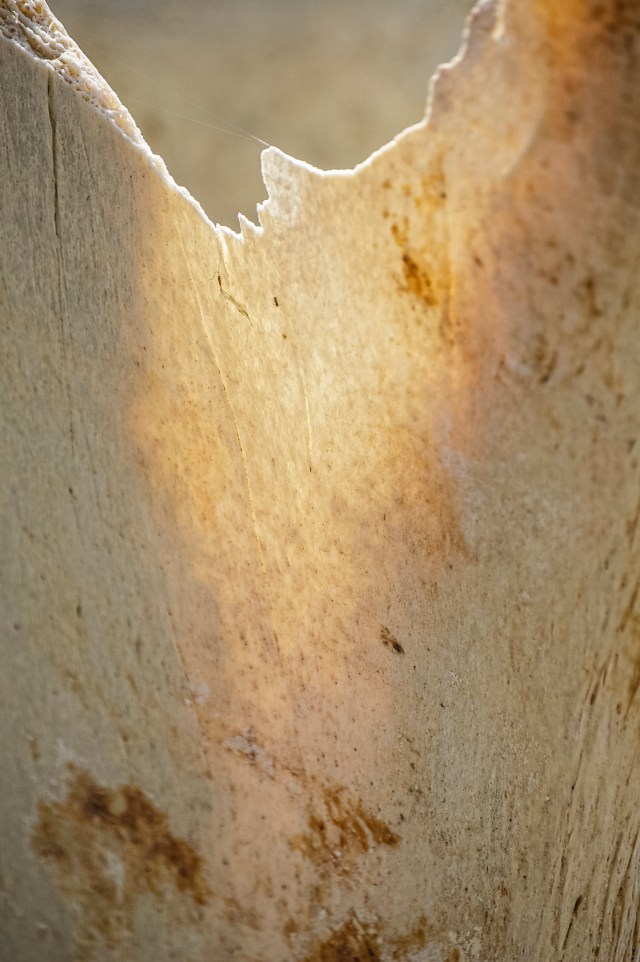
A few larger bones, either from the head or the hip, stood apart, weathering  to translucence.
0462_Whale Translucence

And then, it was all gone, or at least distributed to the bellies of birds and crabs, with some pieces heading to labs and displays.

And then, and then… The changes in flowers and migratory flocks of birds and people were enough for a year of stories. That is always the case, at least for me.

I am working on the twelfth in the series. The first was in the Teanaway Valley, but I didn’t record it. The next three were in the Cascades: Barclay Lake, Lake Valhalla, and Merritt Lake, bracketing three climates across the range. After I moved to Whidbey I started the photo series (as photos to print and as photo books): Cultus Bay, Deception Pass, Admiralty Head, Penn Cove, Double Bluff, Maxwelton Beach. And now Possession Beach. And now the next one, which is in month six of twelve.

Visiting a place over twelve months isn’t traveling as broadly, but it is traveling more deeply. In these pandemic and economic upset times, it is also nice to have a way to cheaply and easily get out into the world, to get out into Nature. Nature was here first. Nature will be here for millions or billions of years. The rest of the news is about layers we drape over a reality that has a lot to teach us. It is reassuring to look beneath those layers for lessons that are more eternal, even cyclical.
Posted in Uncategorized | Tagged , , , , , , , | Leave a comment

Thankless Kindness

I’m going to start with thanks. If you are dutifully wearing your mask when appropriate, washing your hands frequently, and maintaining social distancing, I thank you. I say it here because if I say it when we meet it might just sound like mumbles muffled by fabric and social distancing. Seeing herds of tourists walking around without masks, or distancing (and I’m not going to ask if they wash) made me wonder about how much society relies on layers of thankless kindnesses – and whether this time next year kindness or arrogance will rule. And, because this is a personal finance blog, I wonder what that means for jobs, investing, and life in general.

I live on a touristy island which has a few touristy towns. It’s June. It’s the season for tourists to arrive.

Langley from calmer days

Coupeville from calmer days

Real estate has been busy during the crisis. People want to escape the density of concrete canyons, or condos, or at least move to some place with more space. I get to work with the people making a commitment to live such a life.

Tourists are escaping the same things, but temporarily. They’re escaping tight restrictions and looking for a way and a place to relax. Evidently, they forget that many of the rules they’re trying to escape and in force, here, too.

There was a rare break in my day, today. Generally, I like the tourist towns – from September through May. Otherwise, I shop in other parts of the island. Believe it or not, there are shops that are selling more than gifts and souvenirs. But, there are some special items that are only available in the midst of the crowds. Some of them are health-related. Some of the items support my work as an artist. (Stay tuned for my next book which is in the mail. I’ll announce that when it arrives.) So, I parked on the outskirts, put on my mask because I do anyway and because the town has edicted that masks are required, and set out to say hello to friends and do my chores.

And there goes a maskless team of eight, packed together, no distancing, and roaming along the sidewalk aimlessly. I suspect they didn’t notice me standing back from them by about eight feet until they passed. Just a part of the scenery to ignore. In the next hour I would guess that about half of the people in town were maskless. None were people I knew. All of the people I knew were wearing masks. All of the people I visited were working there, sustaining the town, all running essential businesses. My friends were making the tourist town attractive enough to draw people to the island (and make it better for the locals throughout the year), and yet were probably not going to be thanked by the very people whose health they were defending. From what I see in the news, the maskless are more likely to get upset than to say thank you if asked them to wear a mask, too.

Somehow, (gasp, how?) the last few years people have been encouraged to be more selfish, less considerate, and less compassionate. The majority of the protests seem to be trying to counter that trend. I don’t know what will return us to common courtesy, manners, politeness, and community. (If my mother was alive and we let her run the country, well, this would get turned around real quick.)

Do you see where this is going? Human cultures continue to mature, but it looks like we’re still in an adolescent phase where we’re obviously growing up. We’re also obviously dealing with acne, greasy skin, hair that won’t behave, impulses that seem like a good idea at the time, and occasionally saying deeply embarrassing things that we may regret later, too late. Jobs, investing, and life in general are things driven by logical advice, mature advice. Human culture is also a mix, like a high school. Some are trying to act responsibly. Some 14 year olds act like they’re 41. Others act like they’re 4.

We’ve progressed because enough mature people and enough resourceful people have lived constructively and in community. We’ve also progressed because of inventors and revolutionaries who also live constructively. Even their disruptions are intended to be positive. At least in the US, inventors can become wealthy. They at least get that for thanks. The dutiful employees, however, may get a paycheck and a rousing speech if their company does well. Considering how much has been accomplished to get us here and now, that’s little thanks.

We’re also witnessing the result and the value of those centuries of efforts as we suddenly find ourselves missing things we took for granted. (My hair, oh my hair. I’m starting to look like a cross between Santa Claus, Alfred E. Neuman, and Albert Einstein. And, no; I am not including a bio photo.) Some become more appreciative of what they must give up temporarily. Others cry like 4 year olds who’ve been told to go to bed on time.

Jobs, investing, life.

We’ve seen it. Most jobs are thankless, even if they are essential. Maybe this is the precipitating event that changes that.

As currently designed, investing favors the wealthy, but allows anyone to play. (And yes, at some level it is play. Think about how often you hear about winning and losing when it comes to stocks.) The investors in small companies, the individuals who tell others about the company and its goods or services may be thanked with a rising share price, but they probably don’t get their fair share of the credit. They may become thousandaires or maybe millionaires, but if my shares become worth ten thousand dollars, someone with a hundred more shares will become worth more than a million dollars regardless of anything either of us did beside accumulate enough money to buy the shares. That’s true, except for the people who benefit from executive compensation packages that can escalate even as a company flounders. They may put in fewer hours than some investors, do less to market the company, yet be paid richly.

Life is largely thankless. I never thanked my parents enough. When I’m driving, I’m more likely to notice someone doing something dangerous than someone who obeys all the rules, guidelines, and laws. I do notice them, however. 51fqu8xbkxl.sr160240_bg243243243When I bicycled across America (Just Keep Pedaling), many people would ask about how I dealt with the drivers who would blast their horns at me, maybe swerve towards me, or shout insults as they sped past. Standing by the side of the road during a break I realized how many thousands of cars and trucks passed me every day, dutifully, maturely staying their lanes. After a while I realized there was usually only one bozo per day (except in Kansas and maybe Arkansas, shudder, where it was one per hour). I had to respect the threat a bozo could be, but also look at how many tolerated me. A thousand to one? And there was no way to thank them.

I’ve watched people put up their guard when I deliver an unexpected thank you. It is as if they are expecting a sales pitch to follow. Too often when we get some news the sweeter the coating the more bitter what’s inside. Maybe that’s something else that can change in this culture.

How does this affect my personal finance? I look for the positive in my job(s). (Which can be REALLY tough some days.) I also concentrate on investing in companies that are positively disruptive. Sadly, I also don’t act surprised if essential workers aren’t treated well enough for them to afford the essentials.

I am not a parent, but I can recognize thankless kindness in what they do. Just as all of us move society by our actions, parents move along children. Almost all of that is thankless, but at least we recognize it in parents and others with a simpler word. Love. Thanks to all who love.

Screenshot 2020-06-17 at 19.04.34

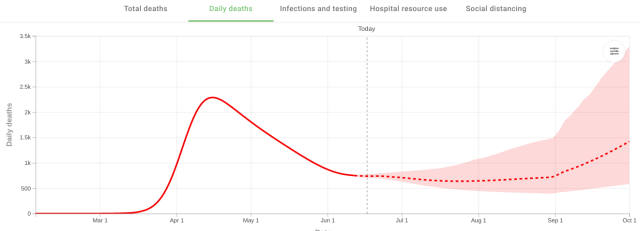
PS While Island County (the home of me and the tourist towns described above) is possibly entering Phase Three, the United States of America is no longer projected to reach zero deaths per day through October. Currently, over 700 people are dying per day and the total deaths projected by the start of October exceeds 200,000. People. 200,000 people. At that rate, our hard-fought Phase Three progress may be lost. Thank you for wearing your mask, washing your hands, and maintaining appropriate distancing.

Posted in Uncategorized | Tagged , , , , , , , | 1 Comment

After Covid – June 2020 Guesses

It has been happening for the last month, articles about what will be different after Covid-19/coronavirus is done. Most know we won’t go back to the old normal. But no one can accurately predict the future except by chance. Regardless of the articles I’ve been pondering the possibilities, too. I think about such things to begin adapting now, and to consider possible investments. Welcome to some of my notes, thoughts, and observations. Besides, writing them down here makes them easier to find if I ever want to check back. This will NOT be comprehensive, guaranteed, or authoritative; just one person’s perspective.

Deliveries

Have you developed the habit of getting more things delivered to your house? My local postal carrier says the Post Office’s workload feels like Christmas, not the celebration part, the frenzied delivery part. Delivery was popular before the pandemic, became a necessity during the lockdown, and will probably not retreat because it really is an affordable luxury. Sometimes it is even cheaper than shopping. The gas for driving to the store to replace a burnt-out light bulb can be more expensive than the bulb. Sure, waiting until the list is long enough to make the trip, but why wait? USPS, UPS, and FedEx drive by the house every day. No extra gas spent. No extra wear on the car (or truck.) No time spent driving, parking, and remembering the parking spot. Besides, someone is undoubtedly buying things they wouldn’t want to pick up in person.

Robots

Businesses are advertising touch-free service. Humans = ick. Shrink wrapped packages, industrially-processed things, including food, can alleviate some anxieties when there was no one who could sneeze on what you’re buying. The same is true of the deliveries mentioned above. Robots, whether on wheels on the sidewalk or as drones flying in from wherever reduce the number of people touching each package. Also, robots can do things humans can’t, like be immune to contagious diseases. It is also easier to sterilize a robot. Humans are human and can forget to wash their hands. Autonomous taxis may not be as efficient as a fully-loaded bus, but which are you more likely to feel comfortable in?

Artificial Intelligence

AI has much in common with robots, but AI also lives in algorithms. We humans have created so many dividing lines within our societies, that some will prefer a mindless artificial intelligence instead of a person who may care more for their agenda or ideology or prejudices. AI isn’t perfect, either. At its core is the work of human programmers, so biases may be built in; but the appearance of impartiality can be appealing. We may have balked at the idea of robotic cops, but how many communities trust their police forces even less? We may create and welcome our artificial authority figures.

Necessities

The recent months tested and proved who is really essential and who is simply celebrated.

“Something I’m looking forward to, a political party built from postal workers, police, firefighters, EMTs, nurses, doctors, drivers, delivery workers, grocery clerks, farmers, ranchers, teachers, people making less than a living wage, people who need community – and others for easily overlooked. Imagine a party that represented that power, instead of the party or simply opposing the other party. (Disclosure: Independent)”

This pandemic may be the prime example of who is truly essential and who deserves more than they have been receiving. Actors, professional athletes, can be fine people and I’m not surprised they can command large paychecks. But, I’d rather hear that the majority of the flamboyant salaries were spent on everyday arts. Some movies now make a billion dollars in a weekend. How many art classes and schools could be sustained with one movie’s revenues? Billions are spent on stadiums for billionaire owners of teams filled with multi-millionaire athletes. If a city spent half of a stadium’s cost on parks and amateur sports, the public’s health would be improved, and better able to counter viruses. If the national leagues can’t afford the stadiums, maybe they should reconsider their priorities rather than make us set aside ours. Maybe unions will return, hopefully without going too far the other way. Power can corrupt. We’re spending more than enough, but the people who need it aren’t getting as much as they deserve.

Health Care

It will be amazing and sad if this pandemic doesn’t change and improve global healthcare. We’re connected. Keeping people healthy in one country can keep other countries from being infected. Enough examples of good systems have been proven and tested that other countries have to actively decide to ignore better ways of doing things.

Reduced Inequality

Trillions of dollars are involved, which may make it more difficult to reform; but the wealthiest people demonstrated how vastly different their lives are from everyone else’s. Billionaires’ wealth has increased during the pandemic at the same time that tens of millions are getting token assistance. The money may be on the side of the wealthy, but the votes should be on the side of the crowd. If more money flows through taxes or better wages to those who don’t have enough, the economy could see increased consumer spending, improved health, and less unrest. It is a battle that has begun, with the main event in the US being November’s election.

Possibly Obsolete

Cruise ships. They may still have fans, but fewer. They may difficulty finding crew, especially considering how many of them have been stranded at sea for months in terrible conditions.

Airplanes. There will be a demand because, unlike cruise ships, air travel remains a necessity; but tourism and family visits may be less. Though there may be a short term spike as restrictions are relaxed and some pent-up demand is alleviated. That will take a while, though.

Restaurants. Are you still looking forward to dining out? Sure. But many people are now better cooks than before, and more aware of how much comfortable it can be to dine at home. Even if they don’t cook, home delivery is convenient. If only there was someone who could come by and do the dishes.

Opportunities

Home entertainment. We know the pandemic can come back. Anyone who was bored during the lockdown may decide to stock up on books, games, and better electronics.

Home office. Being able to shut the door, have more than enough bandwidth, and have a professional looking office may encourage folks to buy houses with the right rooms, on a good internet trunk, and maybe spend a bit more on office furnishings.

Rural Distancing. Urbanization has been a trend, just like globalization. Being trapped in a city, densely packed, far from food, and with little personal space is already creating a systemic demand for having a least a bit more land, maybe some place where it is possible to grow your own food or buying from a real farmer’s market. Even a small garden on a small lot allows some relief and supplies when compared to an apartment on the sixteenth floor. The acoustic barrier alone could be valuable.


During disruptive crises, the best opportunities can be in ways people can’t imagine – except for the people who create, invent, and innovate new solutions for the new world rather than trying to accommodate lifestyles that are quickly becoming archaic. Bicycling is becoming popular, and cities are adapting. Hopefully bicycle manufacturers will emphasize practicality over mimicking competitive cycling. Online working, visiting, and learning are in the midst of a rush of traffic; but that’s largely been through existing solutions. Would this be a good entry for augmented or virtual reality, or both? And of course, fashion. Someone is going to design a mask that is stylish, can be worn as necessary, and dropped and carried while looking like a tie or scarf.

Just from these notes I’ve picked up some ideas for my investments. 1) Make enough money to pay my bills plus enough to invest. 2) I’ll skip the big deliver companies because they’re already too big for my investing style; but I will watch for innovators using drones to deliver to places like islands. (A personal bias) 3) Increased robotics, improved consumer electronics, reinforce my interest in companies like MicroVision (I can hear the groans, at least internally) because they can enable such innovations. 4) As for health care, wealth and income inequality, and the dismantling of obsolete organizations, I hope for governmental change. 5) I’ll skip the travel industry, though see an opportunity for foreign travel to shift to local travel, just not part of my investment style. 6) As for rural distancing, I’m witnessing that as a real estate broker on Whidbey Island. Urban to rural is appealing to more, now. Islands come with a bonus: a moat. That’s also why I am having 1Gig internet service installed in my home office, and with the next commission check I’ll probably make the place nicer – or at least find better ways to hide the clutter.

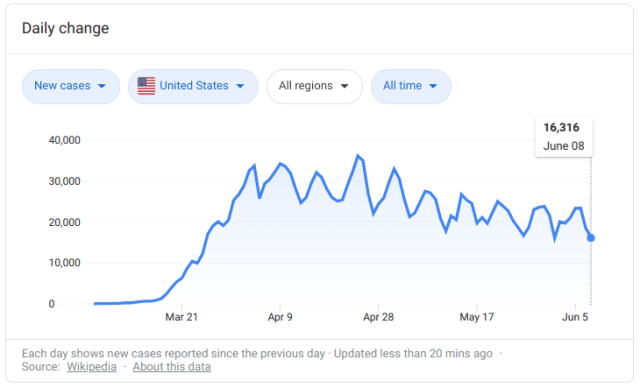
There’s more. The discussions of what comes next (see Practice Pandemic) will continue until the results are so obvious that they aren’t worth mentioning. In the meantime, I’ll continue to wonder about the world, and wear my mask. The number of Covid-19 cases on my island is down. Washington State is making impressive progress. Beyond that, however, the number cases globally is increasing, not decreasing. Over 400,000 have died and estimates suggest months before the curve is contained, partly because so many places with ineffective controls are already rising again. We’re all part of the same species on the same planet. We’re witnessing changes that will reach across borders and boundaries. I wonder what’s on the other side.

Screenshot 2020-06-05 at 14.33.46

Island County

Screenshot 2020-06-05 at 15.06.43

Washington State deaths

US

Screenshot 2020-06-09 at 18.59.20

US new cases

Screenshot 2020-06-09 at 18.58.55

Worldwide new cases

Posted in Uncategorized | Tagged , , , , , , , , , , , , , , , , , , | 2 Comments

Book Value Incentives People

Life in the weird zone continues. It’s 2020. There’s also a full moon, but full moons don’t last 365 days (unless you get into some tricky lunar orbital mechanics, but I digress.) Understanding people is so difficult that religious leaders, trained psychologists, and anthropologists have work, never-ending work. The rest of us just get to shake our heads (and sometimes fists.) A recent example is playing out in one of my investments. That may be the safest environment to comment on, currently. You can draw parallels (or squiggly lines, if you prefer.)

(The following is a heavily paraphrased discussion.)

“But, it is obvious. Take the value of these assets, and even if you ignore income and expenses, the company is worth x and the stock is worth x/(number of shares). Right?” 

“Yes. No. But reality is different.”

Finance and investing seem like they should be logical, based on data, constrained by legalities, and independent of luck and chance. Yes. No. But.

There are many ways to estimate a value for a company. Some investors invest that way. That’s a separate discussion.

Investors are people. Even the institutions that allow algorithms to dictate actions, people are still involved in choosing the algorithm and deciding whether to implement or countermand its suggestions. Investors and institutions do not have infinite resources. They may have far more than enough, but they can’t do everything. They can’t chase every opportunity.

Individual investors have more freedom but fewer resources. Active investors must decide which stocks to own. Individuals have different values, capabilities, and opportunities. It is understandable that it can be difficult to understand an individual’s actions. We’re all just people, humans, silly creatures that are trying to figure our way through the world.

Institutions seem like they can be more logical because they aren’t as affected by the seemingly trivial disruptions that happen in every life. They should be able to analyze all of the public corporation data, rank the results, and distribute funds accordingly. Find companies with cheap stocks relative to a variety of criteria, track those criteria, and adjust accordingly. Logical. Methodical. Probably true, sometimes.

An analyst published an article, probably more than a decade ago, that described the reality of their job. Sure; the computer produced a stack of stocks to consider. Supporting documentation, error bands, competitive analyses, etc. gave the analyst more than enough information to make a decision. But that’s not what really made the decision.

The analyst had to decide which of the prospective stocks met the computer’s criteria, the firm’s criteria, the analyst’s criteria, and their boss’ criteria. It was those last two that made the process human, and sometimes seemingly illogical.

The analyst was part of a team that competed against outside and inside competitors. Once a week the analyst had to attend a meeting to present their recommendations. It wasn’t just about the numbers. It was also about the people in the room. What was best for their job? Recommending something someone else recommended wouldn’t get them more attention, or a raise. Recommending something too obscure was too bad, too. If there’s no demand for the stock, maybe there never would be and the investment would never become profitable. In that environment, quicker profits were preferred over long term profits. It was necessary to find that balance between too little and too much risk. Anything proposed also had to meet the criteria of whoever was making the decision. Do they have a preference? Do they avoid certain industries? Is there a grudge or a fan reaction? The best investments could be ignored because of the wrong image, timing, or because they’re too complex to describe in a short intense meeting where dozens of simpler stocks were being mentioned.

My friend’s analysis was logically and mathematically valid, but it was for a stock for a company with an un-trusted management culture, a technology that is too innovative and risky for some, and a history of poor finances. It might be valued at less than its assets, and may eventually become a phenomenal success, but for now it might be too much trouble for an analyst to recommend.

The analyst’s job is supposedly to find good investments, but their incentives are to keep their job, advance their career, and get paid along the way. That doesn’t mean finding the most profitable long-term stock, but finding a series of stocks that are profitable enough and appealing enough to prove the analyst’s worth soon enough.

The analyst’s meeting was more important than the computer’s results.

I saw something similar happen when I was struggling to avoid foreclosure (which was successful thanks to some excellent help. See My Mortgage Modification.) I heard many people talking about the bank hoping to benefit from taking ownership of my house, or that the mortgage servicer would appreciate any money I could send them. The calls I received from the mortgage servicer were traumatizing. I’d shake for days after some of them.

A friend who worked in the field for a short while pointed out that the banks and the foreclosure had little to do with the people I talked with. The people I talked with were paid to be part of the foreclosure process. If there were no foreclosures, they would lose their jobs. Their incentive was be part of the process. The longer the process, the longer they had a job. Whether the banks wanted the properties or not was secondary. There were no obvious incentives for them to make the process more efficient or fair or compassionate. My friend also pointed out that one incentive for some of the employees was the opportunity to be nasty over the phone in ways they never could in person.

As a real estate broker (with Coldwell Banker 360 Team on Whidbey Island – a state-required disclosure that interrupts this narrative), as a broker I’ve watched a similar dissonance. As someone said; “It’s obvious that everyone’s goal is to make as much money as possible.” Yes. No. But reality is different.

Aside from money, there’s also time. “Get me out of this place! Now!” or its corollary “Get me into the place! Now!”. There’s complexity. Sometimes great deals get too complex, or simple deals fall apart because the property’s details are too complex. Too much of a good thing is too common. And then there are human elements like neighbors, the distance to family and friends, and what the other generations in the household might think.

And then there’s the rest of the world. As I watch advocates and deniers, marchers and enforcers, and the general voting public I also know that logic isn’t as fashionable as feelings. Wearing a mask or not is rarely a choice made after analyzing infection rates; many trust the authority figures, others trust conspiracy theories. By the way, people who believe conspiracy theories don’t see them as conspiracy theories. They trust and believe a different set of authority figures. I ask, what is everyone’s incentive? Fitting in with a particular crowd? Being on the “right” side?

This post is being published later than usual because I spent too much time trying to track down a specific quote. It might be from a sci-fi author. It basically said, everyone does what they think is right, even if they don’t like it. Even if someone does something purposely wrong, there may be a fundamental value in doing that is effectively “right” to them. There’s that human need to belong to a community, or maybe try to prove to a community that they should be included. And, of course, one person’s “right” is another person’s “wrong”.

We humans have only had a global civilization for a few decades. Our psyches and bodies take longer to evolve. It was easier to understand each other when villages were small, and everyone knew your name. We’re clashing as we’re mixing. But I keep in mind that “we” and “they” are stereotypes and labels. Crowds and causes are a mix of individuals and their individual incentives. As I watch the news I wonder about each person in each crowd and wonder if we’re getting closer to similar incentives or further from them.

As for my friend’s analysis of the stock we both own, yes, the analysis looks valid; but I suspect the analysts won’t look at the stock until the company proves there’s sufficient incentive for other investors to invest there, too. We and they are only human.

Posted in Uncategorized | Tagged , , , | Leave a comment

Contrarian Rebellion

This will not be a shock for folks who know me, but once upon a time I went dancing. In the midst of a crowd where I didn’t fit in, I realized an entertaining way to rebel legally is to ignore the crowd. It may seem odd, but that helped me pick my investment strategy. But first, let me reminisce about dancing, because, why not?

Set the way back machine to the late 80s. I hadn’t danced in a decade, but when a friend asked me out, I said yes. (This was back when women asking men out was scandalous, almost. Actually somewhat rebellious, upon reflection.) Life in the suburbs was not for her, so she suggested we head into the heart of Seattle’s avant garde scene. It was a goth club. The walls were black. The clothes were black. Much of the make-up was black or bright red. Practiced scowls were more common than smiles. She wore something a bit more fitting for the place. I was an engineer; so of course, I wore a polo shirt and chinos. I stood out.

A few years earlier in my early twenties I would’ve felt the peer pressure as a bunch of strangers peered at me. Instead, after a few minutes I began to smile, then enjoy the evening. I was rebelling.

The others in the club were rebelling, too. Goth was new. They were serious about it. They were doing something different. They were so determined to do something different that they were all doing the same thing. They’d accidentally turned unconventional into something conventional, at least within their environment. By being conventional I was unconventional in their space.

Rebelling, or being contrarian, does not have to mean breaking the law, or regulations, or even guidelines. There is an infinity of possibilities within society’s borders that can startle most people. Treat the speed limit as a limit, not as a minimum, average, median, or a goal. Try driving one or two miles an hour below the legal limit, and get comments and gestures. Become a minimalist and a millionaire during the Me Decade and make people wonder what’s wrong. Be honest, and people may not trust you because why would anyone tell the truth, at least in some circles. Imagine an honest politician. Some can’t even though they must exist.

Investing in stocks is risky. Many individual investors invest by following the crowd. Everyone else is buying MSFT? OK. Buy MSFT. Everyone’s doing it so it must be good. I bought stock in AOL. (I’m realizing some people no longer get the reference. Oh, how the mighty have fallen, or at least faded.) People and pundits laughed at it. How can an online business make money? SBUX. Who will pay over $3 for a cup of coffee when 7-11, Denny’s, and Dunkin Doughnuts has it for far less? PIXR. Movies made on computers? That can never compete with Disney’s hand-drawn art on every frame. Want details? They’re in my book, Dream. Invest. Live. I also have examples where that approach didn’t work. Dream Invest Live cover

(Late addition: Imagine using social media as something social instead of as advertising, and being grateful for what it provides for free because it is free.)

Maybe I am on to some radical, rebellious strategy. Nope. Charles Schwab advocated buying overlooked companies that are therefore temporarily cheap. Warren Buffet is known for buying unexpected companies.

Those who invest only when commentators are upbeat end up paying a heavy price for meaningless reassurance.” – Warren Buffet on Motley Fool

With an attitude like that, bad times can be good times.

The stock market reports in the evening news are about the crowd, the companies and stocks that were also in last night’s news, stories that can be told in fewer than ten sentences. Listen for the “moo” as the herd heads this way or that based on the movement of the herd. The herd may not know where it is going or who decided to go that way, but that’s the norm.

The stock market swings from irrational optimism to irrational pessimism. In both cases people respond as if whatever is happening will continue happening forever. Has anything ever happened forever? Even the universe has phases. Why pretend anything is eternal?

Unfortunately for me, I don’t have any recent success stories to celebrate. Yet, I continue to invest and write about the experience. Within personal finance, money is used as the measure of intelligence and wisdom, even though luck and chance can be just as important. Rich investors who are also writers pontificate as if they are infallible. Investors who are writers who lost their money fade away. I rebel by continuing to write about both sides of the experience. A couple of my strengths, or at least characteristics, are persistence and perseverance. As a friend pointed out, if you want good relationship advice find someone who has been in more than one relationship, both good and bad.

Currently, my portfolio is very contrarian. I purposely invest by buying stock in companies that are based on positively disruptive technologies and products: energy efficiency, advanced biotech, and innovative electronics and optics. The topics are popular, but most investors are drawn to incremental business strategies, ideas that nudge the boundaries. After my experience, I favor companies that are erasing and redefining the boundaries, at least.

Stay tuned. Even my patience is being tested.

Normal and conventional are currently being redefined. As we pass through this crisis, someone is going to create a new business model that revolutionizes their industry, or creates a new one we didn’t know we needed and wanted. (Drones and robots allowing touch-free delivery solve a lot of hygiene problems. Automation may take over a large swath of low-income jobs. See CGP Grey’s popular video from a few years ago; “Humans Need Not Apply.“)

Reaching back a post or two is the reminder to challenge fundamental assumptions. I expect either significant improvements in tax policy, or an entrenchment of our current dysfunctional economic model. Ideas that were overlooked are probably being looked at. That will benefit some companies, but which ones? Changes favor companies that can adapt, regardless of size. Entrenchment favors companies that are already in that trench.

I don’t know how things are going to go. The pandemic is bad news. Subsequent waves in pandemics can be worse news. So many people are doing so much to avoid or mitigate the subsequent waves that they may be creating good news. Ironically, they may be chided rather than cheered for it if it doesn’t arrive, even if it doesn’t arrive because we stayed and worked and learned from home, wore masks and gloves, and washed our hands.

I don’t know how things are going to go, but this feels like that moment in one of the original Star Wars movies where Han Solo sits and waits for the fleet to break up and fly off in one direction before flying the Millenium Falcon on a path he prefers. As I was taught in karate, “Do not move until it is to your advantage to do so.” Then do so.

I do know how one thing went. Soon after trying to dance at that goth club, she fell in love with a guy who was just right for her. I was the maid of honor. (Unconventional! at least for that era.) A few years later, I decided to actually take dance lessons from an instructor who was a fan of being unconventional, but within guidelines. There’s a lot of fun to be had playing inside the bounds but in the places few play. Have you ever cha-cha’d through a waltz? Try it sometimes – after social distancing is appropriately relaxed, of course.

Posted in Uncategorized | Tagged , , , , , , , , | 1 Comment

Quarantines Vaccines And Generations

So see that word ‘Generations’ in the title? That’s the hint that this will be a bit of a throwback post to contrast with today’s situation. Astrologers know that when you are born makes a difference, but here I’m reflecting on different generations are born and bred into different assumptions. Behind any plan and most actions there are assumptions that change how valid those plans and actions are for others – including personal finance, but I’ll get there, later.

I am over sixty and younger than seventy. That means I don’t remember the polio scare, but I remember my parents being very glad I was given the vaccine. Sure. Whatever. I was a kid. Take the sugar pill. Put up with the new invention of a needle gun. Do what I’m told because the topics were too complicated to explain to someone who barely understands the basics of the 3 Rs. It was a time when people trusted scientists and doctors, and were practiced at following orders because a few wars had just gone by, and the threat of nuclear attack wasn’t abstract. I didn’t understand bio-chemistry, but I knew what a Fallout Shelter was for.

It was normal for kids to be quarantined. Besides polio there was mumps, measles, chicken pox, etc. that made kids stay at home, and have a sign in the window warning us not to visit. Of course someone contagious would stay home. Why would we infect anyone else in the neighborhood?

Flash forward to 2020 and I begin to realize that we followed directions so well that entire generations aren’t aware of the value of data, logic, science, and community. Deny vaccines? Sure. What good did they do in a young person’s life? Challenge authority? Sure. There is a value there, but to do so over wearing something that protects everyone? How strange these humans are. But, I see them as strange because my experiences bred in a different set of assumptions.

My Dad could never understand climate change, sustainability, equality, … He was born just before the Great Depression and was raised during it. His family was so poor they really didn’t notice it. But, he was raised in a company mining town, back when that was the stuff that inspired strikes and unions. He understood unions and solidarity (at least within that community.) When he was born there were just about two billion people. Many people still worked on farms. Fresh local food was the norm. Supermarkets didn’t exist. To him, the American lifestyle was sustainable. As for social justice, being a union steward was a major effort. He picked that battle and let others pick theirs.

The advice graduates are receiving from commencement addresses may be moot. They are graduating into a world where connectivity is assumed, sustainability isn’t, governments aren’t to be trusted, good and bad information is readily available, gigs and jobs are more common than careers, and various inequalities seem firmly entrenched. The world’s a mess and why did the previous generations let this happen? Throw in the invulnerability of youth and don’t be surprised if social distancing doesn’t make sense (especially as hormones are at their peak). They don’t realize the power of their collective votes. And too much of conventional wisdom sounds archaic.

Did you notice the sweeping generalizations? I’ve found insights while thinking about this, but I also keep the cautions in mind. Generations are built from individuals, and individuals are individuals. There are people from 1926 who understand all of this. The same is true of folks who haven’t graduated high school. It is one reason why I tune out when I hear things like; “Americans are upset about…” No. Americans aren’t 100% in agreement on anything. “Men are…” “Women are…” “Kids are…” “Boomers are…” Nope.

Too much advice is delivered to a generalization. One message doesn’t sell to every person. If it was possible for one person to always be able to convince everyone they met to agree to some idea, then everyone who met the Pope would become Catholic, and everyone who met the Dalai Lama would become Buddhist. And, I’d be curious what would happen if the two of them met privately (which I suspect they have.)

Obviously, there are messages here for advocacy, sales, or simply understanding each other. But, I want to steer this back to something less abstract and more direct. (This is ostensibly a personal finance blog.)

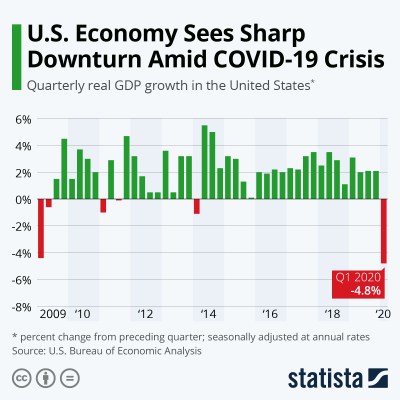
We’re probably entering another recession. We’ve had the Great Depression. Then the Great Recession, which I thought we should call the Second Depression. This pandemic has affected more people and more of the globe than the previous economic crises. System studies suggest that, even without a pandemic, our economic system is unstable. We should expect higher highs (just had those) and lower lows (which might be coming sooner than expected.)

The advice my Dad had about lifetime careers didn’t last. I followed advice about the Space Race and the Space Age, and became an aerospace engineer. That advice was either too late, as America backed off as I graduated college; or too early, as commercial companies are doing much of what I hoped to work on. If a new graduate asked me for advice I’d probably have something in mind, but I hope I’d hesitate and ask them about their goals, values, expectations, and situation. We may be alive at the same time, but we’re each living in a different world.

There are some basics that I will keep in mind as this crisis proceeds. Spend less than I make. Invest the rest. The caveat: As Long As You Can Pay Your Bills. #ALAYCPYB Currently, many can’t pay their bills. That’s a different world from those who can invest the rest. I am relieved that I sit closer to that balance point than most, and have reasons for optimism. (I suspect Whidbey Island is about to become more popular.)

With record unemployment, trillions of dollars being thrown at the moment, a pandemic that hasn’t been contained, and that long list of troubles from climate to politics to justice, last year’s assumptions are already due to be reviewed.

18839

Life in the 1930s wasn’t life in the 1960s isn’t life as we are swept into the 2020s. I am encouraged to see people who aren’t assuming we’ll return to a normal (that never existed), and who are finding ways to live that reflect ‘now’ not some irretrievable ‘then.’

People respecting quarantine (or simply staying and working from home), a coronavirus vaccine, reforms in government and economics, and more sustainable lifestyles, imagine how much better things could be. Imagine what this generation will tell their generations, and whether advice from 1930 will persist into 2130.

Hmm. I wonder what some of my astrologer friends have to say about the 2020s. Some may not consider that ‘normal’, but normal isn’t what we need, right now.

Stay tuned.

Posted in Uncategorized | Tagged , , , , , , , | 1 Comment

Masks Facades And Probes

I’ve been probed. Yep. That was weird. It tickled. And, no, it wasn’t aliens. (Or were they?) Yet another surprise from 2020 that I hope never has to be repeated. Probes and masks are something unexpected. I’m also seeing a lot of new facades and fallen ones, too.

On the official side of things, Island County Department of Health was finally able to begin testing people who don’t have symptoms of corona virus aka Covid 19 aka SARS-CoV-2, also known as one of the few things to make us reassess every aspect of life and lifestyle. From what I heard at the drive-through testing, they wanted to test about 3,000 Island County residents to get a diverse demographic sample. Because the pandemic can also be asymptomatic (a word many of us never typed before), they have to test as many people as possible to find out who has it, who carries it, who had it, and who doesn’t have it. That’s a tough test to set up. I’m glad I was selected.

On the practical side of things, here’s what it was like for me. To start with, it isn’t drive-through testing. I had to actually stop the truck at three stations. Drive-through would be cool, but really difficult to take the test at speed. Drive by has a different connotation. Drive up? Closer. Station 1) Lowered the driver’s window to get instructions, which was basically a name check and the instruction to drive to the next station. Station 2) Name and age checked again, and they prepared a little packet that they placed on the hood. That’s one way to keep the speed down. Station 3) They asked me to lower my mask so they could stick the probe up both nostrils. Sure, but how long does that probe have to be? It looked like it could clean out my ear wax by going in through my nose. One nostril, innocuous. Something in the other nostril took a wrong turn and hit something that tickled. Imagine being tickled from the inside while there’s a stick sticking out of your face. Don’t laugh. Seriously, don’t laugh. After she pulled it out, I tried to imagine what would happen if it broke off in there. Needle-nosed pliers for real noses? It was actually fine; weird, but fine. I started to wonder if that was a way to clear out mental cobwebs. Station 4) I think they handed me some paperwork. The cab of my truck was messy thanks to running errands and taking care of one of my real estate listings so I may have lost it. I was more interested in what the attendant(?) had to say. Test results can be ready within 72 hours, frequently within 24 hours; but the testee may not hear back for days. Positive results, meaning the test indicates the person has the virus (which the test can get wrong), get the results first. That makes sense. People who need treatment need to hear it about quickly. Negative results (which is positive in normal language) take longer to report because there’s less urgency and more people to call because they expect most people are clear. That may also be why they’re not calling back the folks that weren’t selected for the test. The testers are busy. In a county with only 80,000 people, they only needed about 3,000 to test but had 6,000 sign up. That’s a lot of phone calls and a larger fraction of the population than I expected to volunteer. By the way, I asked what demographic was under-represented. The young woman said they needed more young men. I got out of there before I played with that straight line in too many inappropriate ways.

I’ll probably post my results in the Comments section eventually. Stay tuned (but why would you?)

Screenshot 2020-05-14 at 17.41.26

Within the last few weeks the good news has been that the rates of infections in the county are down from the peak. At the same time, businesses and even municipalities are becoming stricter about mask usage. At the same time, some people are protesting masks, social distancing, and the shutdown in general because they think their rights are being violated.

I’m fine with wearing a mask. It’s a mask. It’s a bit of cloth. I’ve studied enough science and history to know that what we’re being asked to do is very little compared to previous crises. Besides, I’m finding side effects that I like. My hay fever is more in control. Wearing a mask while bicycling is like resistance training my lungs, something like runners carrying weights during a jog. Diplomacy is easier and harder. It is easier to hide an accidental (or not so accidental) grimace. One person talked about practicing laughing eyes, conveying a smile however possible. It is also a sign of respect of others. And, of course, it is at least some barrier to the virus; possibly more than enough.

Once a week I shop. It’s usually the day I check on my real estate listings. Today included a stop at a grocery store. Outside the exit were three people, none wearing masks, all rather close to each other, and bracketing the exit. Everyone leaving the store had to walk through the cloud of their conversation. I doubt they stood there intentionally. Perhaps they weren’t aware they were putting others at risk. Perhaps they simply didn’t care.

They aren’t alone. There are more of ‘them’ than I think most suspected. Within the last few years America’s mask and facade has been stripped away. Truth, Justice, and the American Way were a fine (and somewhat ambiguous) motto. But, we’ve seen truth dismissed in favor of feelings and emotions. Justice is more obviously based on discrimination not equality. And the American Way, ambiguous as it sounds, is no longer as valued here and in the rest of the world. Americans are impressive, generally. Witness the mass mask production that was mostly done without thought of profit or applause. Witness the work of the essential workers who frequently aren’t paid what they’re worth, yet they continue to work even under threat from the virus, finances, and local armed intimidation. America as a governing body, however, is governing – well – I’m glad I live in Washington State and Cascadia where people’s lives matter. The other Washington is making itself moot.

Life, school, work, and even worship have been upset. By necessity we must reassess what we value, what’s essential, and how we will manage our lives during and after this crisis. I’m a minimalist. A friend called me Mr. Frugal. Some of that is by necessity, but most of it is by choice (which has turned into necessity after my Triple Whammy.) Dream Invest Live coverWriting a book about personal finance forced me to think about my values, my finances, and my choices. Wearing a mask during a pandemic? Working from home? Limiting my trips and shopping? I would do that regardless of governmental declarations. How better to respect my community, my friends, and my self?

As for the test and the crisis, I’m glad they didn’t use a pipe cleaner, that this was nasal and not one of the less accessible orifices, and that it didn’t cost anything. I do miss dancing though. Some day. Some day.

Posted in Uncategorized | Tagged , , , , , , , , , , , | 1 Comment

Wither Or Whether MVIS

There are far more important things happening in the world this week, but for a few thousand people, the future of MicroVision and its stock (MVIS) was massively distracting. Rumors were flowing of great things, some terrific and some terrible. The fates of many companies are being tested. This was happening with MicroVision as well, but the possible outcomes were amplified, partly from the pandemic, partly from expectations. This one stock is one of the many stories that are lost in the crowd of content we’re currently experiencing. By the end of the week, neither the doom and gloomers were right, nor the cheerleaders. Welcome to the swings of fortune in personal investing.

My investing strategy that had worked so well for decades is commonly called Long Term Buy and Hold. (For details, look in my book: Dream. Invest. Live.) Dream Invest Live coverFind stocks I think are undervalued, hold them until their value is recognized, and maybe even sell them when they are over-valued. It isn’t a guarantee, but one friend called it a Get Rich Slow technique. I’ve owned shares in MicroVision for about twenty years. Is that slow enough? A bit more patience may be required.

If you’re interested in the company and why I am enthused about it, browse this blog’s posts that are tagged with MicroVision or MVIS. Basically, if the company succeeds with its technology, I can envision MicroVision’s tech doing to laptops and other such displays what laptops did to old CRTs. That’s a rather large market. (Massive understatement at no extra charge.)

Small companies with big ideas generate lots of stories. For years, I described MicroVision as a company that will either make headlines or go out of business. Disruptive ideas can be too radical. A few years ago they were finally getting into products which were actually being sold by major corporations like Sony. I thought the odds of going out of business were finally almost zero. Oops.

After that surge of products there was silence. No new products had been announced since September 2018. Evidently some contracts fell through, large corporations can shift product lines without warning their small suppliers, and competition was catching up. The CEO was replaced with another CEO. The company is typically reticent, and only broke that silence to suggest they might be cash flow positive or profitable by the end of 2019. That didn’t happen. The CEO was replaced with another CEO. Even less was being said.

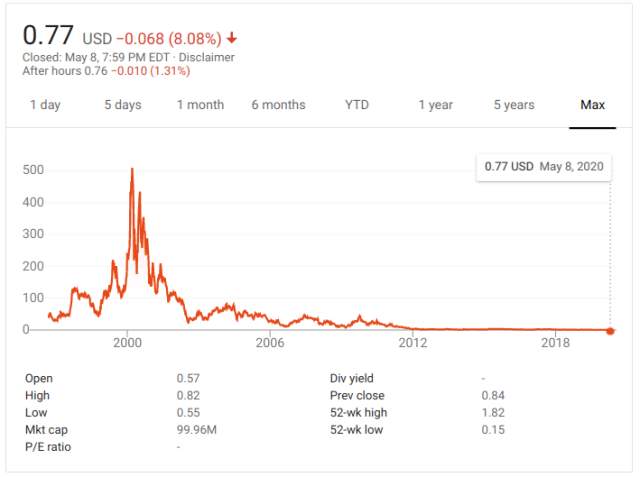
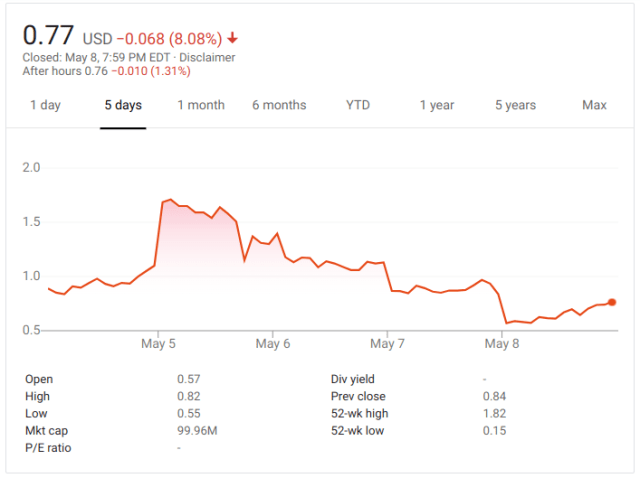
Screenshot 2020-05-08 at 19.35.37

Google Finance

The stock dropped below $1 for too long, which threatened to have the stock delisted. Some see that as traumatic. I’ve seen other companies weather that without reverse splits or fancy financing.

Unfortunately, recently MicroVision announced “strategic” considerations, which was interpreted as being bought out. That’s seen as good and bad. Good in terms of getting something rather than nothing out of the stock. Bad in terms of a sign that revenues won’t arrive in time to pay expenses.

screenshot-2019-02-25-at-13.58.38Ah, but there were rumors about Microsoft’s next big product, Hololens 2. MicroVision components were in the prototypes. Great! But Microsoft moves slowly. Bad – for MicroVision. Neither company mentioned the other in anything official, but as long as the product was a success and the revenues arrived, that’s fine. The rumors had been around for over a year, hence my post from 2019: HoloLens2 And MicroVision. I didn’t pay much attention to the discussions on the discussion boards because most of it was speculation. Something was different this time. More people were on the stock boards. The stock started to move.

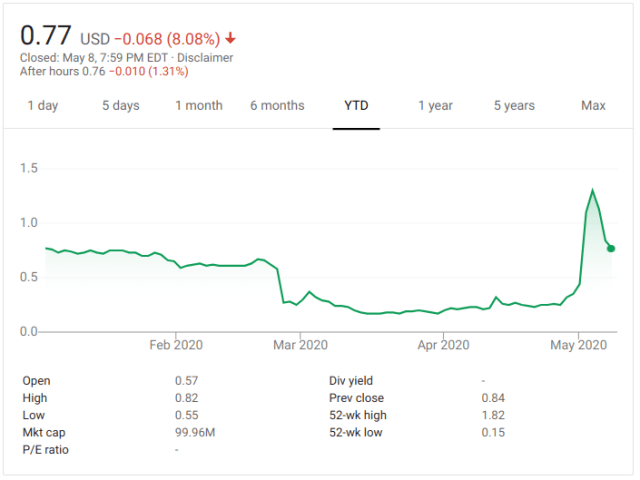
One commentor advised me to “load up now” because I’d waited so long. They were right. Maybe I should’ve. Within a month the stock went from a low of ~$0.15 (yes, fifteen cents, less than a quarter, only one dime and one nickel) to about twice that. By the beginning of May, it was ~$0.44. (Almost two quarters!) A few days later MVIS was over $1.70, and I was thinking that for once a stock tip was right, and I missed it.

Screenshot 2020-05-08 at 19.40.30

Google Finance

I stood by my reply, though. Buying on rumor is gambling or speculating. I’d done enough of that with MVIS. I was waiting for significant, positive, quantifiable news. Earnings were going to be released on Thursday. I might miss a jump by not acting, but I already had a position and decided to hold. (But, really, from $0.15 to $1.70 in under two months. And I watched it happen. But hey, no news, just rumors. Therefore, no action.)

Other folks were interested, too. Traffic to that year-old post I mentioned above, Hololens2 And MicroVision, spiked this blog’s traffic by a factor of twenty. Hence, I knew I’d be writing about MVIS this week.

In an ideal world, people would wait to hear the news before acting. In an ideal world, no one would be trading based on having heard the news early. (That can be illegal, but legalities are considered selective, by some.)

Days before the meeting, the price began to fall. Just before the meeting, the price was back down to under a dollar.

Screenshot 2020-05-08 at 19.42.02

Google Finance

The meeting did not have “significant, positive, quantifiable news”. There were lots of waffle words, no Q&A, and too little in general. The next morning the stock was under sixty cents. Today, Friday, it began to climb back up, finishing at $0.77.

The speculations begin again.

MicroVision has had similar swings in simpler years. Basically, the company has been in a series of startup modes, sometimes several within the same CEO’s tenure. I wonder if they’d stood still with their original strategy if the world would’ve come to them. Yet again, we are left with the mantra of “things will be better within the next six to nine months.” And maybe it will, this time. We’re also left with the realization that the cash available may only last fewer than six to nine months, or not in time to realize revenues.

These aren’t simple times.

There’s bad news. The pandemic has been disrupting supply lines, maybe including MicroVision’s. The company’s customers may delay product launches until the economy re-launches.

There’s good news. The devices MicroVision’s technology enables are potentially in demand. Hololens2 helps people work remotely. MicroVision’s tech may be enabling that display. Instead of touching an electronic display screen, MicroVision’s tech allows people to gesture in mid-air as if they were using an iPad. Robotic deliveries need sensors for the robots, and MicroVision has an innovative LiDAR solution.

No one knows which way it will go. That’s typical for startups. There’s even more uncertainty in the world, now; and even more for MicroVision.

This is a story I’ve been following for decades that I have always thought would be resolved in less than a couple of years. I’ve watched irrational exuberance about the technology, the company, and the stock. I’ve watched irrational pessimism in the investing market because of failed expectations, poor management communications, and a lack of demonstrated success. In my opinion (opinion, as in my guess), the present value of the company’s future revenues is far greater than the current stock valuation except for the risk that those revenues may never happen. The company and the stock probably won’t be properly valued until they receive and release news about significant, positive, quantifiable news – or until it is bought out as that is another way to define what the market will pay.

Do I think it should be resolved soon? Of course, I hope. The downside scenarios are so dull that I’ll simply shrug and hold until something happens. The upside scenarios are so exciting that I’ll enjoy them. Either can happen any day, or week, or month, but probably not any year. This is the time for something significant to happen. I’d like to be able to say I know which way it will go; but whether MicroVision withers or succeeds is too unpredictable. That makes MVIS a speculation at best, a gamble in many minds; but could yet be a phenomenal investment.

One thing is for sure, owning shares of a company like MicroVision isn’t dull. Hopefully, years of risk will result in decades of rewards. Stay tuned.

Posted in Uncategorized | Tagged , , , , , , | 4 Comments

Challenging A Fundamental Assumption

A common response many have in retrospect;

The Soviet Union will live forever. Of course it didn’t. Africa shattered into even more nations after the colonizers left. Naturally. The European Union may no longer be a union. Well, it never looked sustainable, did it?

I can’t find the TED Talk video that talked about the tendency for nations to breakup rather than come together. In the meantime, here’s a more entertaining video that includes the rise and fall of empires as well as the Big Bang and a bunch of science.

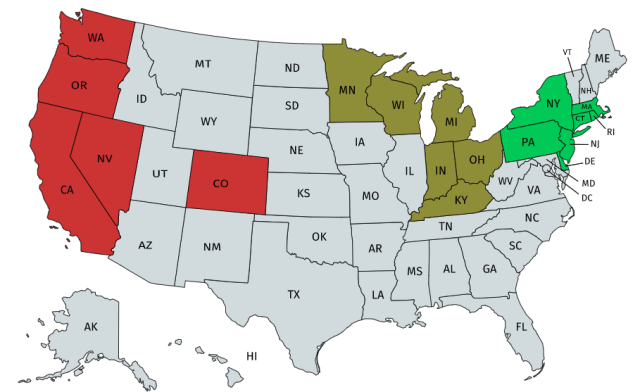
The Western States Pact (as well as the Upper Midwest Pact and the Northeast Pact) brought me back around to considering the fundamental assumption behind the United States. How united are the United States, and does it matter?

Screenshot 2020-04-27 at 11.33.46

Because of the corona crisis, various states in the United States are uniting because the United States government is treating the states as part of them not us. (See States Uniting And Not over on one of my other blogs, PretendingNotToPanic.com) As of late morning, April 27, 2020, 19 states are in the pacts listed above. Their goals are to coordinate their responses to the crisis. The fact that there are three pacts points out that each sees their region as having separate circumstances and cultures.

It does not necessarily follow that the pacts will remain after this crisis has passed; but it does exemplify the reality that pragmatism can become more important than ideology when needs aren’t academic. People are dying. At least some governments are proving they can govern responsibly.

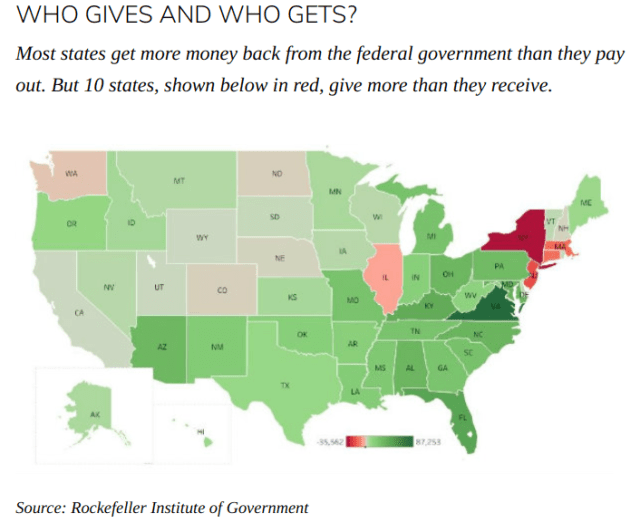
Various state’s responses have also highlighted which ones have been funding more than benefiting from the federal budget. At least in a rough sense, states joining the pacts are aggressively responding to the crisis, are being deterred by the federal government, and are more likely to send more money to the federal government than they receive. States that aren’t aggressively responding to the crisis are more likely to receive more than they send. Not surprisingly, friction and resentment can result.

Screenshot 2020-04-27 at 17.39.49

While many say a dissolution of the United States won’t happen because we don’t want another Civil War / War Between The States, keep in mind that peaceful changes happen, too. The Louisiana Purchase and the Alaska Purchase are two examples of governments getting out of debt or simplifying their administration by selling off land. I don’t know of a similar situation has happened in modern times with industrialized regions.

As I wrote above, this is something I’m considering, a fundamental assumption I am challenging. The world’s been weird enough, lately. Could this happen, too?

If. If. If. If, it happened I wonder how life and governance and personal finance might, might, might, might change. What else is there to do while during StayHome and WorkFromHome? I’ve poured a mug of tea (a cup’s too tiny for this), and decided to break down the response by one representation of the US Government: the Cabinet, etc. This is not a detailed and long-researched analysis. I’m just sitting, typing, and will see what insights come up. In no particular order but with my Western Washington perspective, here I go.

Environmental Protection Agency – Clean air, clean water, wildlife protection, lots of those green things that people make fun of treehuggers about; expect them to return and possibly be expanded.

Health and Human Services – Particularly during a pandemic, especially while sitting on the Pacific Rim and the travel that is required, expect a greater response. This is the front line, and the local agencies know it. Maybe improved health care, including mental health.

Agriculture – If Eastern Washington comes along, then the area’s economy benefits greatly from plenty of farm and ranch products and ports from which to ship them. Otherwise, a lot will have to be shipped in, driving up costs. Many nations are in such a precarious situation. Whether the area can be self-sustaining depends largely on how large an area is included.

Labor – Many of those essential services live here. Think Amazon’s shipping network. Seattle’s minimum wage advocacy could extend to farm workers and other overlooked occupations. There may be fights between unionization and the mega-corporations that also exist here. Would the corporations leave if they didn’t win?

Commerce – Washington State has a strong economy. Boeing may move production lines for smaller airplanes, but the jumbos are tougher to shift. The Puget Sound’s standard of living draws high-paying professions. The ports are important. Proximity to Canada and the Pacific Rim is powerful. Could be a significant income source, as it has been.

Treasury – Here’s a big one. How to establish a credible currency and banking system from nothing. Going to cryptocurrency sounds appealing, but I’d check how long and hard it was to establish the Euro. The region is not seen as a finance center, though there is certainly significant wealth in the area – at least for now. Keep it here and maybe it can happen. One possible big benefit, disassociating the region from the current US Federal debt and deficits. Those would be intense negotiations, but they could make all the rest work by providing sufficient funds and stability.

State – In general, the region has a favorable international reputation. Reinforcing trade partners is high leverage. Increased foreign aid? A new Peace Corps?

Interior – Hello, preserving national parks! Hello, managing forests, too. That may be less of a battle here because the parks tend to be too steep or dangerous for commercial activities. Between the two, well, finding the balance is what governments do. The debate will be significant because the local interior is rich in many ways.

Housing and Urban Development – Homelessness has been a major issue on the west coast. Urban development has also been active as planners try to fit more people into geographically constrained land. The efforts seem to be independent of the federal agencies except for grants and loans, but as discussed above, grants may be balanced against current federal taxes. Possibly no significant change.

Transportation – The region is a transportation hub, as well as being a producer of airplanes, trucks, and some ships. Geography will continue to funnel traffic through the area. After a crisis-induced decline, producing transport vehicles may recover, possibly with the loss of the Boeing Renton plant. Boeing has been one of the largest contributors to US durable goods exports. Even a small portion of that would be even more significant in a much smaller region.

Energy – I suspect the Department of Energy might live up to its name. Instead of being only about nuclear power, energy, and weapons, it could include the already impressive renewable energy infrastructure. Emphasize the renewable energy markets and the total budget may significantly decrease. Hanford might not be happy about it, but would possibly get more emphasis on cleaning up the site.

Education – That’s a tough one. I’d assume no change until some innovation is accepted.

Intelligence – CIA, FBI, NSA, NRO, some semblance of them would be necessary, but again, it would probably be proportionally smaller; and possibly more focused on industrial rather than military needs.

Defense and Veterans Affairs (and I’ll include the various security services) – This may be the only one trickier than Treasury. It would be difficult to imagine a new region spending the same proportion of the budget on the military. That would be a significant budget improvement. It would also be difficult to negotiate the status and operation of the US military bases. Because of the region’s location, they can’t be readily moved. But, that’s a situation the current Department of Defense negotiates in dozens of countries. There are precedents. As for border security and such, if the region is no longer identified as The United States of America, would it be as much of a target? Perhaps the only targets would be those military bases. That is worrisome considering the nuclear arsenals. Very strong benefits and difficulties. Hopefully, the Coast Guard would be as important as ever.

A new region would probably create new bureaus and bureaucracies. Washington is already known for a mix of liberalism, libertarian values, and conservatism. Despite being known for diversity, there’s more than enough internal conflicts to keep such an event from occurring.

To me, the biggest swingers would be a monetary system and the military presence. To my personal finances, there’s the potential for little change and a possible improvement because the federal taxes and benefits already almost balance but on the side of more taxes out than benefits in.

That’s a long way to go to get back to effectively no difference, but that’s on a governmental level. On a personal level, my income may improve if people are drawn to move here, and also to move away. (Real estate brokers get involved in both.) My tax expenses may not change, but I suspect eventually there’d be better social services. Social services are valuable. Interest rates would probably be much higher until financial institutions gained confidence in the new government and region.

Being on an island also provides a buffer. Islanders tend to be more independent from necessity. Being on an island that includes a Naval Air Station (which must be capitalized) means also having a front row seat to one of the major contentious points.

Over 1,500 words for something that probably won’t happen. And yet, now is a good time to consider such possibilities. Considering them after they become realities can be too late.

Posted in Uncategorized | Tagged , , , , , | 2 Comments

Negative Oil Prices And More

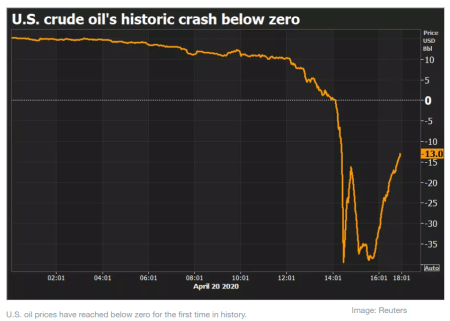
screenshot-2020-04-21-at-10.21.05Economists do not like negative numbers, at least not ones that make the economy diverge from some norm. A new one showed up in the last few days (mid-April 2020), negative oil prices. Yep. Want to buy some oil? You probably won’t be able to take advantage of what is probably a very temporary event, but at least for a few hours, producers were producing so much oil that they were paying people to take it away. Surprised? Sure. But the economy has been getting weirder for the last few years. Check your assumptions because they aren’t academic; they’re part of any plan you have behind your personal finances.

Look back to a post from earlier this year, Oh Know 2020. At that time, I’d been watching China’s coronavirus crisis, but not saying much because it was over there. That ‘there’ is now everyone’s ‘here’. At the start of the year it was relatively easy to see hurdles in politics and elections, social unrest, climate crises, natural disasters, financial instabilities, and unknowns. Let’s put the corona crisis under the Unknown category. It was known, but mostly in retrospect. Now, it is affecting almost all of those categories. The response to the virus has definitely been political. Social unrest is apparent as we realize our essential personnel are not treated as valued people, and being poor is costing more than most realize. The natural disasters aren’t as affected, but climate has actually improved simply because we aren’t in nature much, lately. The financial instabilities were bad enough: inequality, increasing debt at all levels, and a general mismatch between needs and budgets. Now, record unemployment, an unavoidable recession, and an uncertain schedule for, well, living in general are going to keep the economy uncertain for months, probably years.

So, how are your assumptions doing so far? Mine? If they were written in chalk, there’d be a lot of dust around as erasers are cleaned after clearing blackboards.

The negative oil prices are weird enough, but they make sense. Fossil fuels are under pressure from competitive renewable energy sources, and from an expanding attitude of switching from consumption to sustainability. As renewable energy gains more users, their demand for fossil fuels falls. Fossil fuel providers, however, have high fixed costs. Fewer customers, same costs, so their prices should go up; but that drives away customers. Profits fall. Profits fall enough that some low-cost producers with cash reserves attempt to drive high-cost competitors out of the market by temporarily producing more oil, increasing supply, driving down prices, and making marginal producers get out of the market. Increased supply, low prices, good news for filling the tank, right? And then governments finally realized how bad the corona crisis was and told billions to Stay Home, maybe Work From Home. Less driving. Less demand for fuel. As long as enough of us used the fuel they produced, they could continue to produce it. But. Our consumption dropped so far that the industry’s tanks weren’t being emptied. Storage tanks on land are almost full. A significant amount of oil is being stored in tankers because there’s no where else to store it. Turning off wells isn’t easy, evidently. Prices fell from $100/barrel a few years ago, to $60/barrel, then $40/barrel, then the price wars drove it down to $20/barrel, then for a few hours less than negative thirty (<-$30/barrel.) Take my oil, please; they said. At the close of business April 21, oil was back up to $9/barrel. Not $9/gallon, but $9/barrel. That may be cheaper than water in some regions. Some aspects of this are discretionary, but such an event can change an industry.

Alone, that is weird enough. But, at the same time much of the world’s finances are experiencing very low and sometimes negative interest rates. Contemplating Negative Interest Rates was a post from August 2019. Money is accumulating in so many havens that countries are trying to encourage people to spend it by discouraging saving. The more money in the havens, the less there is in the economy, the greater the inequalities, and the less stable the entire economy. The US was one of the few countries avoiding negative interest rates, but corona crisis convinced the Fed to drop the rates to zero. Ironically, that convinced some mortgage rates to rise as mortgagors saw it as a sign of greater financial risk. The fact that so many countries were already experiencing negative rates is an indication that the economy wasn’t as healthy as it could be, and now is even worse.

Assumptions are being erased, regardless of whether we recognize it.

Since the Internet Bubble and the Great Recession we’ve become familiar with very low savings interest rates for individuals, and countries have witnessed very low rates of savings from individuals. Many people were only one or two paychecks from insolvency or losing housing. That’s being tested.

Conventional wisdom about investing is being challenged as algorithms out-compete people, at least in the short term. Companies that are accumulating cash aren’t reinvesting in research and development as much as before. Stock buybacks are popular, but do nothing for creating a future for the company, the economy, or society. Then, a virus hits and the markets drop faster and farther than most folks knew was possible.

Common plans work to goals of retirement that can be years or decades away (or decades in the past for some like me), or mortgages that are frequently measured in thirty year blocks. For the next year, interest rates, income, expenses, market returns, and even taxes will be in flux. The details may change every day. The essentials are more reliable.

Crises are painful and opportunities. For those with higher risk tolerances (like me) and sufficient resources (not like me) this can be a time to invest in depressed assets, or in assets that are expected to rise. I’ve been invited to participate in several conversations about what comes next and what can we do about it now. Happy to have the conversation. Wish I could act on what we learn. For those who are near the edge, it is a scary view. Providing goods and services that are immediately needed or wanted may be the start of a new business. (Several clients are hoping to provide help to people trapped in their houses.) For those who can stand back from the edge and gain a different perspective, there are opportunities (maybe in those new businesses); but I know my caution and partly the inspiration for this post is to challenge the assumptions behind those opportunities. Is an intriguing possibility a good idea based on the way the world was, the way the world is, or the way I think the world will be? Something I’m thinking about every day.

Posted in Uncategorized | Tagged , , , , , , , , , , , , , , | Leave a comment