Semi Annual Exercise EOY 2021

As I note at the start of my stock synopses that are posted on the discussion boards listed below;

INTRO Here’s my semi-annual exercise to see if I remember why I own the stocks I own, and so I can check back and see if their stories have changed. I post in case it helps others too.

Portfolio analyses can be made overly complex. Single portfolios are tough enough if money flows in and out. Multiple portfolios are tougher, especially if money flows from one to another, like when I had to sell some stock in my IRA to add cash to my regular account from which I pay bills. And then, there are years when one stock can act as a summary of the complexity. Frequent readers won’t be surprised that MVIS fits that description. 

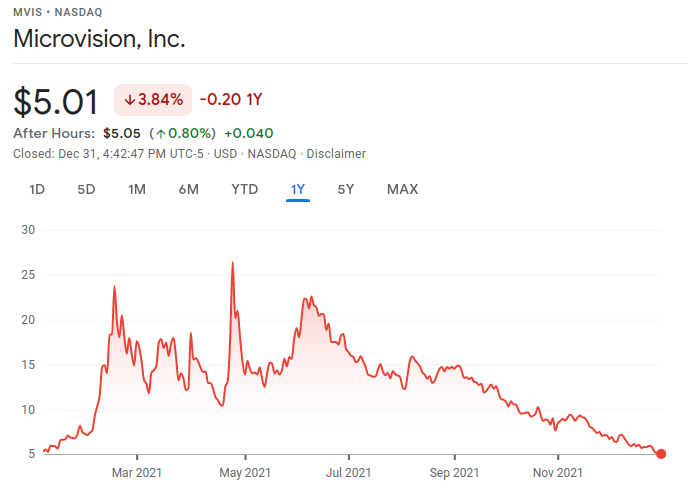
In April 2020, MVIS was priced at $0.15. Dismal times for my portfolio. By the end of 2020 it had climbed to just about $5. Hope! The percentage rise was great, but a large percentage increase of a small number can still be a small number. But that hope, that was valuable. Within the first quarter of 2021, MVIS rose to $28, with some interesting intra-day spikes. Investor sentiment carried my sentiments higher, with the potential of easing lots of monetary and personal anxieties. By mid-year it was back to just over $16. Now, it is back to about where it was 12 months ago; ~$5. 

Google Finance

That’s old news that can be tracked through my previous posts. (follow the tags for MicroVision & MVIS)

The part that is less obvious is the emotional ride. Hope rose as the stock became a good source of story. The hope took a while to settle in, and when it did my mood began to improve as years of patience and struggles looked to be over. Then the slips, and the slips, and the rationalization that “Well, at least it is better than two years ago.” As the stock dropped 50% from its peak and personal expenses rose the numbers looked less optimistic, but the optimism that remained superficially continued while an unease crept in beneath it. In the midst of a complex year, it took a while to recognize the emotional ride of seeing heights then having to accept a retreat to overly-practiced coping mechanisms. It is a good thing I was frugal by choice years before it became a necessity. 

The stock charts are easier to draw. The emotional charts are more important. The two are as tied as the words ‘personal’ and ‘finance’. 

There are many ways to measure a portfolio. My broker, Schwab, and others provide a variety of ways that also provide a variety of answers depending on what is measured: individual stocks, IRA vs regular portfolios, cash flows, deposits, withdrawals, performance relative to cost basis, or yearly, or the rest of the market, etc. Take your pick for your portfolio and your personal perspective. 

One basic measure captures the personal and the financial: how much do I have to work? Without assets, income heads straight to expenses, and hopefully there’s something left over. Many aren’t fortunate enough to have excess. Work is a necessity. At the other end of the spectrum, assets are sufficient to sustainable retire. Work becomes discretionary. Work because I want to (but am I taking away someone else’s opportunity to have a job to they can meet their basic needs?). The middle is most common; a bit of excess, or at best more than enough to live but not enough to retire. I am in the first of those three parts of the continuum (#ALAYCPYB).

Within these last two years I’ve been able to see the entire spectrum, though my re-retirement was only glimpsed at the time. At that time, however, projections of my stocks suggested I could (not guaranteed but could) have enough assets by the end of the year to cover the majority of my money-related anxieties, and maybe even re-retire. My physiological and emotional health looked forward to that. Sigh. I’ll check my lottery tickets soon, maybe after the New Year begins. (The roads are a bit icy here, now.)

And yet, I feel confident about 2022. 

LTCX and GERN, my two biotechs, both announced (forward looking statement alert) expectations of commercial availability of their respective treatments within the next few years. News about treating people beyond trials is encouraging. Twelve months from now those stocks may be much more in demand.

MVIS has been a rocket ship roller coaster, and 21st century rocket ships can fly again. At least one product has launched. Another seems imminent. Others are advancing. The company is better known and respected. And management was smart enough to raise enough funds to skip a buyout and possibly remain independent. 

NPTN announced that it would be bought out, so I redeployed those funds to SOLO (electric vehicles for sale now with more models to come) and WNDW (solar energy windows which have uses that opaque panels can’t match – e.g. greenhouses.) Those holdings are new, small, and encouraging; but largely moot unless I can find funds to bolster those positions. But, that’s the way investing works.

My personal finances outside of my portfolios also elicit encouragement, but those are outside the scope of my semi-annual portfolio review. That story will be chronicled, as usual, in the rest of this blog. For more details about the stocks, here are links to various discussion boards where you can find my synopses, as well as others’ points of view. For more details about how I do what I do, there’s a book that I wrote at the request of several friends: Dream. Invest. Live. Maybe you can help my personal finances by buying a copy – though the frugal part of me recommends checking one out from a library.

The following links are to  various discussion boards I follow. Many of the independent investors who contribute to the discussions provide in-depth analyses that either aren’t available elsewhere, or would cost too much to buy. The other advantage is the diversity of perspectives. Unfortunately, I don’t engage as much as I did before. Some discussions have degraded due to lack of moderators, or have too many immoderate voices. Some boards are effectively ghost towns, or feel like cavernous empty warehouses. Regardless, here are the sites I continue to visit, even if it is only to lurk and listen. 

I encourage you to tune in, because more voices (as long as they’re mature) make for a better conversation. Maybe I’ll read you there.  

Investor Village

LCTX

GERN

MVIS

SOLO

WNDW

Motley Fool

GERN

MVIS

Silicon Investor

GERN

MVIS

Reddit

LCTX

MVIS

SOLO

Posted in Uncategorized | Tagged , , , , , , , , , , , , , , , , , , , , , , , | 1 Comment

White Christmas-ish 2021

Snow days, an excuse, a hint, time to take it easy. Happy, Merry, Joyous ___fill__in__the__blank.

Tom Trimbath's avatarAbout Whidbey

It’s 2021, when every present has a chance of being delivered just in time or maybe a little late. For Whidbey, snow for a White Christmas arrived on the day in some places, and a day later in others. Down near the water, less snow. Along the ridges, much more. The island is so geographically and meteorologically diverse that there is no one number to pin on the island, as in “Whidbey got four inches of snow.” Considering road conditions and the weekend, there’s more reason for many to not drive, stay home, and enjoy the gift that will eventually clean up after itself. 

Mentioning the time for gifts, a personal one is keeping this somewhat delayed post very short post so there’s more time to relax and play.

Ho. Ho.

(And if you do have to drive, may you be gifted with safe travels.)

View original post

Posted in Uncategorized | Leave a comment

My MVIS Dream as of December 15 2021

To sleep, perchance to dream. But sleeping is a bad investing strategy. With a stock like MVIS it is possible to be completely awake and watch emotions run from fear to greed, wonder and hope, with a very large helping of what the…? Dreams come and go, which may be the history for many MVIS speculators this year. Reality has been going on for decades, and isn’t over, yet.

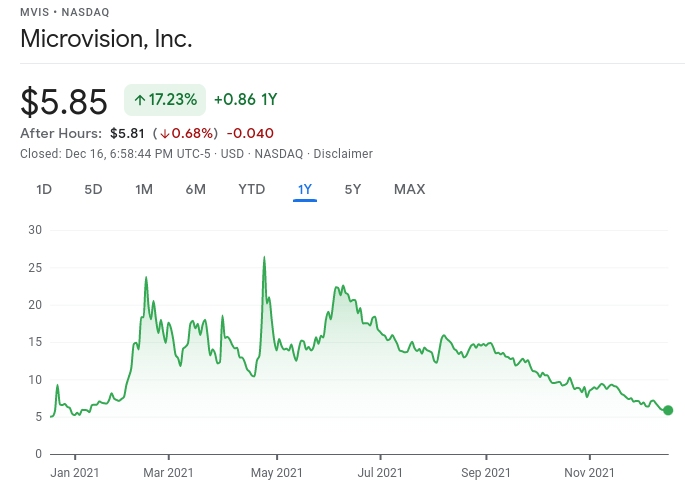
How many companies have stories like Google asking to be bought out for a fraction of today’s value, or Netflix offering itself to Blockbuster? MicroVision may have seen something similar happen within the last two years. How many companies were being courted to buy MicroVision when MVIS was under $1? Two years ago, before MVIS hit bottom at $0.15, the company was valued at $0.085B, or $85.0M, or slightly more than the price of the most expensive house for sale in the US in 2021. As I type, the company’s market cap is $960M, up more than ten-fold from the end of 2019, and down from ~$29 in the middle of 2021 to a whimpering price of $5.85. Eep. Or is it, yay!?

For over a decade, maybe two, I conduct an exercise of reviewing the stocks that I own, and why I own them. Simply because life is hectic, I tend to begin writing a synopsis for each stock sometime in mid-December. Limiting MVIS to a synopsis has become more of a struggle than any other company I own stock in. Considering the ride the stock and its shareholders have been on for the last two years, I decided to dedicate a post to MicroVision and its stock, MVIS. Check back again on New Years Eve to see if the synopsis is any shorter or is simply a pointer back to this post with some updated prices.

2020 and 2021 were the era when MVIS became a meme stock. I’ve always thought of MicroVision as a story stock, a company with a story about an impressive potential, and hence a stock that was attractive to me. Their struggle has been grueling to long term shareholders who held but didn’t trade. Suddenly, a new force entered the investing environment that cared more about the stock, the shorts that were influencing it, and whether a concerted community effort could deliver their version of justice by buying up the stock, trapping the shorts, and benefiting from costing the shorts lots of money while holding on long enough to sell at overly optimistic prices. Concerted community efforts are difficult to sustain, while professional shorts have the resources and organizations to hopefully survive the siege, at least this time. Hence, the stock rose from $0.15 to ~$29.

At the same time, a new CEO saw the company as drastically undervalued, and worked hard at simultaneously developing products while shopping some or all of the company to various possible buyers. $85M for a potentially industry changing technology? That’s a cheap acquisition when measured against the time and money necessary to defend against the tech. Playing catchup can put an entrenched or developing product line at risk. As months progressed, encouraging words suggested (forward looking statements, etc.) that many significant buyers were seriously interested. Expectations of a full or partial buyout within a few more months were high. That didn’t happen. 

My speculation (Speculation! Guessing! Just me thinking about my investments! I’m not a investing professional, just an independent shareholder attempting to understand my investments!) I digress. My speculation was that if things went well, the anti-shorts could help drive the potential buyout buyers into an auction as various competing mega-corps kept their competitors from gaining an advantage. 

Note: If, Could, Expectations, Encouraging, = nothing definite. But nothing is completely knowable, there are always risks, and MicroVision has certainly been risky – and hence, possibly rewarding. Or not.

Another of my speculations. Prudent companies interested in buying the company necessarily take time and work with caution before making a decision and acting on it. They have shareholders to answer to and careers to guard. While MVIS may have seemed like a bargain at the beginning, at some price point it would no longer be a bargain, at a higher price point it might only make sense on a strategic level, and eventually become too expensive to make sense for them – especially if none of the other bidders were committing to a purchase. The stock loses some support, the price drops. As the anti-shorts don’t drive the shorts into a squeeze, their support weakens, the shorts strengthen, and the price drops more. 

Again, this is one of many possible scenarios. I doubt even the CEO knows the entire story because looking inside a mega-corp could be considered illegal, trying to track the shorts seems fruitless to other CEOs I know, and the anti-shorts community it so fractured that only pieces can be seen.

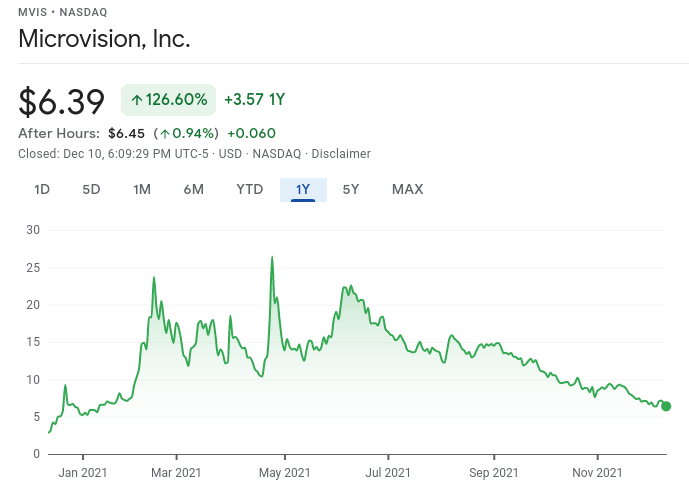
So, time for one set of perspectives. MVIS is at under $6, started the year at a similar level, wandered through some exciting spikes, all of which looked phenomenally fine after the April 2019 low of $0.15. Which perspective is yours? Whether you own the stock or not, is there a level that you identify with: irrational optimism, irrational pessimism, or your perfectly rational perspective? 

So, time for a different set of perspectives. (See why this doesn’t fit into a synopsis?)

My perspective

I invest in companies by buying their stock. 

I bought my first shares of MVIS when I saw a TV news broadcast that included one of the anchors putting on a pair of glasses that had a miniature TV display superimposed on his vision. The broadcaster couldn’t replicate his experience, and it looked somewhat uncomfortably staged, but I could see (no pun intended) the potential. That was during the irrational exuberance (the Fed chairman’s phrase) of the Internet Bubble when valuations were testing new territories. (Another hint about the era was that I was actually watching broadcast TV for news.)

But, I’d seen the technology advances from punch cards to keyboards, from mainframes to mini-computers to PCs to laptops, from reading printers to CRTs to LCDs/LEDs and saw the natural progression from fragile flat panels to virtual imaging. Why mine massive materials to ship to massive factories to build ever bigger screens that include large warehouses filled with enormous boxes that would require bigger trucks to deliver big boxes to stores where customers would drive to them to buy then load those boxes into their cars to get them into their houses and then hook up the device while the packing material heads to the landfill? The MicroVision display unit might only be as large as a pair of ski goggles, and would inevitably get smaller. 

By the time I started attending stockholders meetings the company was also developing a cell phone (not a smartphone, yet) that projected a video call’s content directly onto a user’s retina. Not even any need for the glasses. Daylight readable. A short while later they were developing a Head Up Display unit for mechanics and construction workers. (Hello, Hololens fifteen years early.) Then, HUDs for cars. Then, miniature medical cameras, high-speed barcode scanners for industrial applications, and maybe even miniature display projectors.

The miniature display projectors progressed from the size of two smartphones (because it was now that era) down to projectors that fit inside the phone. Along the way, the projectors actually hit the market, including one in a robot. (That’s a story, too.) 

Bored by all the side stories? They are the stories that didn’t promise but were massively encouraging to shareholders who were watching profitability advance from 2-3 years from now, to 1.5-2 years, to 9-18 months, to 6-9 months. Do the math. Those original profitability dates were off by a factor of ten. The progress has not been gradually improving; there have been many ebbs and flows, but progress.

For investors with patience, and an appreciation of the potential, it was easier to hold on. 

Within the last two years the company has been helping develop consumer displays, interactive touchless displays, home sensors, augmented reality devices, and laser imaging devices for autonomous vehicles. That’s a much broader product line. Surely something will succeed.

And something did, sort of. Hololens. Microsoft’s augmented reality display includes MicroVision projectors. (By the way, keeping track of which ‘Micro’ to keep track of isn’t easy for some. Don’t be surprised if you get confused.) Hope rose significantly, particularly because that news hit about the same time as the buyout prospects and the anti-shorts crowd arrived. Layer all three into a composite structure and the future looked fun and profitable. 

And then the shrinkage began as described above. Other product lines didn’t gain commitments, or experienced postponements. The company seems to be relying on Hololens and whatever will happen with LiDAR, the sensors for autonomous vehicles and more.

Throughout, the company has survived by diluting the stock. They aren’t in debt, but without significant revenues, the company was always having to deal with potential bankruptcy (from my perspective). The current management team was wise enough that during the price spike, they sold stock and raised so much cash that any buyout can be considered optional, for a while. Not being bought out means they are more in control. Instead of the profits being absorbed into a mega-corp, those profits can create significant wealth for the company and its shareholders – but it may take a year or two. 

MicroVision’s story is not just about memes. It isn’t just about MVIS. The story is deep enough to warrant a book, which I might write, but I’m writing two or three others currently. Others know the story better. All of us are hampered by the company’s reliance or restrictions or both on Non-Disclosure Agreements which have limited what the management can or want to tell us. (To the extent that news about Holoens may have only been revealed because a shareholder bought one of the multi-thousand dollar units and dismantled it so see if there was MicroVision Inside.)

I continue to hold because I return to the fundamentals of the technology. Whether MicroVision develops it or not, I have literally seen what I think is the next generation in human-computer interfaces, and how that is extending into automation industries. If MicroVision gains even a small market share and remains independent, I might be able to re-retire. I hoped, expected, and actually began to plan for that as MVIS rose through $20. MVIS has now fallen through $6. I will not ignore that emotional price. I hold, however, because MicroVision, the company, the employees, the technology, the markets, and the industry continue to impress me with the positive, disruptive, innovative potential that I am invested in. 

While I wait I dream about what will happen next.

Posted in Uncategorized | Tagged , , , , , , | 3 Comments

Google MegaMillions Story Stocks In 2021

Thank you, Google. (And thanks, Vox.com for reporting on it.) One of my pet peeves is end of year compilations that are compiled before the end of the year. Google listed the top searches in 2021, already. Hey, what would happen if the aliens dropped by for a visit, huh? Back on track, Tom. Vox mentioned items that were I’ve been watching too. I just didn’t know anyone else cared. Two of them touched on personal finances: the lottery and meme stocks.

Meme stocks like AMC and GameStop were also newly popular searches in 2021. They were also, incomprehensibly, well-performing on the stock market this year.

Trending searches for Mega Millions lottery and stimulus checks suggest regular revenue streams weren’t quite panning out.” – Vox

And, no, I did not win the Mega Millions lottery jackpot – but that doesn’t mean I’ll quit trying!

And, what they call ‘meme’ stocks I call ‘story’ stocks; something I’ve been writing about for over a decade. (Lottery Ticket Stocks)

Cue conventional wisdom, cliches, knee-jerk reactions. Or, know there’s a different perspective on such things. 

Lotteries are a voluntary tax on the poor.

Risky stocks are where fools throw away their money.

Or, as Vox also reported;

Perhaps undergirding this newfound interest in the stock market — and alternative assets as a way to get rich quick — is the persistent economic uncertainty in the US.

They use nicer words. I call it desperation strategies. 

When a person has more than enough money to pay the bills, a lottery ticket can be solely entertainment, a ticket to dream of luxuries – with a slight chance of seeing it happen. The cost of a ticket doesn’t impact a budget or a retirement plan.

When a person doesn’t have enough money to pay the bills, or is only paying some bills while ignoring other necessities, a lottery ticket is a ticket to dream of covering all of the necessities, and maybe more. Instead of buying a new Mercedes, they may envision finally scheduling a surgery, or fixing a foundation, or paying for school or day care or insurance. And it can only cost a dollar for a ‘normal’ jackpot, or a few dollars to reach that over-the-top dream money. The budget impact might be (barely) noticeable, but minimal compared to the price of a gallon of gas or even a bus ticket. (Though one thing nice about Whidbey Island is that the bus rides are free; which is a story in wisdom, insight, and practicality mixed with compassion.) As for retirement plans…ha! 

A few years ago I heard an economist put lottery ticket prices in a different perspective. A lottery ticket costs a dollar or so, and provides an entertainment benefit while the purchaser exercises their imagination with a phenomenal upside potential. A movie costs much more, is over in under two or three hours, and has an upside limited to a few memories – and maybe a few more calories from the butter on the popcorn. (Another thing going for Whidbey where The Clyde is a bargain in both over the mainland theaters.)

I have an additional perspective. Eventually every lottery is won by someone. For that someone, it could life-changing, even life-saving. For a few dollars I contribute to someone’s very good day – with a chance that it will be me. Why wouldn’t I do that?

Ah, but for bigger budget items: stocks.

The big news that Google and Vox described was about AMC (the mega-plex movie theater company) and GAME (for Game Stop, the video game company). (Gamestop And Moving Smaller Stocks) Their stories were where I first heard the term ‘meme stocks’. The ‘meme’ made the companies sound like Internet Bubble companies, companies that had vaporware instead of real products and services. Popups that will vanish within years, maybe months. I used the term ‘story stocks’ to describe the startups that I invest in which have stories but no products or services, yet. Every company starts that way. Buy in early when the company is being laughed at or ignored, sell when the company becomes the must-have stock. (Details in my approach and my history are in my book, Dream. Invest. Live.) Some consider them get-rich-quick stocks. The irony is that AMC was founded in 1920, GAME in 1984, and MVIS in 1993 (the one I’ve owned since 2000). Quick? Meme? These companies existed far before the term became so popular.

All three stocks have been laughed at. All three were heavily shorted by investors who thought the stocks would become worthless (or could be manipulated to become worthless according to those who know more than I do.) Some bought the stocks because they like the companies. Some bought the stocks because they liked the stock. Some bought the stocks because the companies could be bought out. Some bought the stocks because they hoped to attack manipulative shorts by driving up the prices while tying up the shares to create a short squeeze. Every stock has an community of investors with a variety of motivations, but this year has been ridiculous as new players learned the old rules and tested new tactics and strategies. 

It made for a wild year, even for me and my shares of MVIS. For reasons complex enough to inspire several other posts, MVIS surged, my expectations were elevated, and my dreams of becoming financially secure again were re-awakened. And, the surge passed, and dreams delayed, again. 

The sad? news is that MVIS is ‘only’ up over 120% this year, and ‘only’ up 4260% since Spring 2020. Why am I disillusioned? At one point MVIS was up over 18,000%. Double that stock price, and debts could be gone, or necessities so taken care of that a few upgrades would be possible, or both. I even joined in the speculation that could see the almost-lottery-style odds that would re-retire me. OK, but up 120%. So, maybe I wait another year or two or whatever. 

AMC and GAME? AMC up 600%. GAME up 1,094%. [sarcasm on] “Those silly meme stocks. Those people are stupid for investing in them.” [sarcasm off] There were some who bought at the high and watched the fall, but there were also others like the few who emailed me directly to tell me that they are now multi-millionaires. Silly? If it works, it works. 

Repeating what Vox reported and commented; “persistent economic uncertainty”. Or my version, desperation strategies. 

One reason I’d like to write a sequel to Dream. Invest. Live. is because I’ve been on a roller-coaster through America’s wealth classes. So much of what I hear as conventional wisdom comes from a position of ease that thinks any un-ease or even dis-ease is merely a matter of perception. ‘If poor people only thought right they’d have all the money they needed, and more.’ It is also common to say that it takes money to make money. That’s a wonderful statement, but is rarely extended to the reality that the poor are defined by not having money. No money, no money to be made, and the poor remain poor. But, for the price of a lottery ticket or a cheap stock, there’s at least the dream, the slight hope, and the slim chance that maybe it will be possible to do more than struggle to survive and to actually live.

As for end-of-year summaries, compilations, and reports, I generate several about stocks, as well as for each of my blogs. If you’re interested, check back in early 2022. I always hold out the possibility that Santa will deliver a jackpot to me, or that the aliens might drop by, or both. Stay tuned – but wait a few weeks.

Posted in Uncategorized | Tagged , , , , , , , , , , , , , , | Leave a comment

Introducing WNDW and SOLO

That title looks a line from a Star Wars sequel. Nope. Today I acted on the informal and personal stock research I’ve been conducting since learning that one of the companies I was invested in is being bought out. Neophotonics (NTPN) was being bought out. I sold my shares then bought Solarwindow (WNDW) and Electrameccanica (SOLO). As I said last time, rather than buy only one, I bought a bit of both.

Hmm. It’s come down to two, and maybe both: SolarWindows, and ElectraMeccanica. Interesting enough, imagine an office building producing power that charges employees’ trikes.

Why mention it? Because at its core, this blog is about personal finance and is based on my book Dream. Invest. Live. I wrote the book at the request of friends and with the recommendation of a world known best-selling author. People liked it, and told me I was able to simply describe a topic many consider to be complicated or at best boring. Thanks. Then the Great Recession hit, and my strategy continued to work; but too few wanted to read about investing when the market was crashing. Then I had my perfect storm of bad luck, which happened at a time when job and real estate markets were terrible. But.

Rather than quietly hide that reality, I decided to continue writing about the realities about my personal personal finances. One of the taboos I’ve been willing to break is to describe the good news and the bad, as compared to many pundits who make everything sound like a success without any hint of failures. It’s been a wild and difficult ride, and may become the basis of a sequel. So, why mention it? Because personal finance isn’t only about successes, failures will happen and shouldn’t be a source of shame, and the mundane steps between those two extremes should be shown in case others want to see at least one example of how investing can be done. And, of course, I am looking forward to celebrating successes, eventually. Let me check those lottery tickets.

For me, researching stocks isn’t drudgery. Each company is a story about dozens, hundreds, maybe thousands of people who also have stories. Someone had an idea for a company and decided to do something about it. Congratulations. The research helps distinguish each company from the others, one story from the other stories.

Those stories can be marvelous narratives, something that’s been apparent since Gates and Jobs and the thousands around them revolutionized our society and culture. Not dull.

As I do it, the research also involves data. Some only focus on the data. Some only focus on the stock price, regardless of the company. I prefer to look at the official data as required to be reported by the SEC. That’s looking back, and is proof of how they’ve managed. I also look ahead at the unofficial “forward looking statements” where people inside and outside the company project the company’s growth, the industry’s growth, and the technology’s growth. Why would any manager make that sound dull?

Solarwindow’s story builds off solar power’s long struggle to gain acceptance, and could lead into a new approach. Solar power systems are becoming so common that getting a system installed on your house isn’t as much of a novelty as a decade ago. Everyone I know who has a system likes it, especially on Whidbey Island where power outages are common. Even in winter, or during a late autumn storm like the one passing by as I type, it is possible to generate power. But all of those systems rely on opaque panels usually mounted on a roof or out in a field.

Solarwindow uses a technology that uses transparent materials called windows (radical innovation, windows are), to capture the sunlight. Instead of shiny (and possibly glaring) panels mounted on trusswork, a Solarwindow building might not look much different because they just look like windows. That’s appealing aesthetically, but also can keep land open and roofs clear of wind-catching obstructions. Besides, snow has to be brushed off panels but is less likely to stick to every window. While I am more interested in the story side about powering houses, the bigger economic benefit to the company could be office buildings which have much more surface area in glass than in roofing material.

Now, pardon me as I yet again copy and past the name of the other company. Ah. Electrameccanica. I think I’ll use their trading symbol, SOLO. Much easier to remember and spell.

Oh well, while the name is in the copy and paste buffer I’ll use it.

Electrameccanica is building and selling electric vehicles. This is a risky and adventurous time for any startup, that brief period when their products finally hit the market and reality measures whether enough people want what they are offering. Electrameccanica isn’t the only electric vehicle manufacturer, but the others have much higher market caps. I buy smaller companies so I can enjoy the ride as they reach those heights. Most are producing cars and trucks that are innovative, frequently with some tie to conventional chassis designs. Electrameccanica (still in the buffer) is willing to offer trikes, as well as sedans and work trucks. I find that encouraging because we’re experiencing a time when people by necessity are exploring new ways of living.

The surge in interest in electric bikes proves to me that people are already challenging old norms. The old convention involved using the family sedan that holds six as a way for one person to commute most days of the week. That will remain popular for many reasons, but the company may be profitable from those who to decide to swap out one car or replace it entirely with something more enclosed than a bicycle. The fact that the company is based on Vancouver BC is a great demonstration of using such a vehicle in a climate known for – well – messy weather making a mess of a person’s hair and clothes.

I encourage you to read the previous posts about the process that got me here. In it you can see how the decision could’ve resulted in picking other choices. Today was one of those that started with me slapping myself, but staying my course. I’d already sold NPTN and was going to buy WNDW and SOLO, but I caught a glimpse of some of the other candidates rising and falling – and teasing me and raising doubts about my decision.

There’s a central aspect of investing in stocks that I keep in mind, even if I rarely exercise it. Stocks are bought and sold every day. I bought something from Amazon the other day that I need to return. I can do so, but it is a hassle. If I decide to not own WNDW or SOLO, I can sell it much more readily. The price will have changed, but my ownership is easily shifted. There may be tax implications, but that’s a detail, not a lifetime commitment. I recall selling one stock that way and accidentally made a profit. Stock ownership is as much of a commitment as you want to make it. The stock doesn’t care.

A comment on one of the previous posts asked a good question about whether I’d researched this or that aspect of the companies. I hadn’t. There’s a middle ground between total guesswork and researching every employee, building, competitor, customer, et al. I do enough research to differentiate between the various stocks, buy, and not stop learning. Owning shares of a company makes it much easier to find the motivation to answer those deeper questions as press releases are released, discussions are held on discussion boards, and tweets go flying by. I look forward to attending stockholders meetings again because I’ve learned a lot by sitting in the back of the room and watching the finance types, the other board members, employees, and particularly the other shareholders as they react to the CEO’s and BOD’s comments. I can try to do so before buying, but trying to do that with a dozen companies can be a full-time job. My style of investing tries to do enough without doing too much.

The title of my book is Dream. Invest. Live. That was a purposeful choice. Dream – and not just about stocks. Live – because that’s how we know we’re alive. Investing just happens to be in the middle providing one, but not the only, bridge to get from dream dreams to living them.

December is only hours away. At the end of the year I will compile my semi-annual portfolio review. This year will have one less entry and two new ones. I don’t expect to do much more than watch the news on my stocks in the meantime. There’s a life to live, and that is more valuable than any portfolio.

Of course in this society values are a bit askew, which is why I invest, and work, and encourage you to buy my books! (Pardon the shameless self-promotion, but I do it so rarely that I hope you don’t mind.)

Now, to post this then rescue my three-foot tall Christmas tree that is sitting in its stand outside in the wind.

Posted in Uncategorized | Tagged , , , , , , , , , , , | Leave a comment

Soup Stock Versus Company Stock

It’s the Friday after Thanksgiving as I type this. (Apologies to those reading from the future.) Many things are on my mind, but on such a day two things dominate – besides the occasional burp. The bird is cooked, so it is time to enjoy the stock and the leftovers. I have a decision to make about my NPTN stock, which I want to act on early next week. Rather that write two posts, I’ve decided to write one and see how much those topics have in common. 


Let’s start with the culinary side because foodies might not want to wade through financial stuff, while I don’t mind making the financial types deal with having patience. 

As I write that I already see a similarity. One tool for good cooking is patience. The key to my investing strategy is the long term, as in Long Term Buy and Hold. Time doesn’t guarantee success in either case, but used wisely time can enable tasty benefits.

More apologies, this time to the foodies. Despite enjoying cooking a feast, I prefer to concentrate on the food, not the photos. I guess that ruins my chances of a YouTube cooking channel – unless someone else wants to hold the camera. 

There’s a turkey shortage? Fine. I bought a capon. Basically it is a chicken, but it is a castrated rooster, so the distinction was probably significant to that bird. I was only cooking for one, so didn’t want a full-sized turkey. It was just the right size to not overwhelm me with leftovers, but also distinct enough in size and taste that it felt more special than just cooking a chicken. Ironically, in a ‘normal’ (Ha! at the concept of normal, anymore), in a normal year the big turkey would’ve been cheaper. 

I spatchcocked it, which is such a fun word that I won’t describe it fully so interested readers can research the term themselves. But, it is somewhat odd and unintended wordplay to spatchcock a castrated chicken. 

I put the bird on a cooking rack over a roasting pan which held the giblets, various herbs, some water, spices, and the peelings from the veggies. This way the chicken juices were already seasoning the ingredients that would end up in the stock. (See, I’m getting to the stock.)

Stuffing and spatchcock (I wonder what will happen to my search results from using that word so much.) those two don’t go together, but I made a wild rice dressing with mushrooms, walnuts, and a slice of orange left over from breakfast.

Veggie dish number one was asparagus with slivered carrots and almonds, sliced onions, garlic, and herbs I picked in the garden. All of that was booked in a cast iron skillet with oil to start and butter to finish.

Veggie-ish dish number two was an experiment in mashed potatoes, but with a yam that had been grated instead of cubed. Which turned into a soup because I added too much milk, so I added cheese and an egg and hoped something would thicken it up. 

Cook. Clean. Wait. Serve. Burp. Clean some more.

Then, 

Take the roasted drippings, add the carcass, more water, and put back into the oven at low temperature for several hours. Because I cooked for a noon meal, partly from tradition, partly from a desire to cook before a storm took out the power, that meant I had fresh stock just in time to make several servings of a lentil soup with some of the leftovers for dinner. I also froze three batches of stock for future soups and sauces, and seven (7) seven! servings of the soup. 

Is Thanksgiving pricey? Maybe, but count the meals: 1) the main dinner, 2) supper that night, 3) seven servings of soup (sounds like a verse in a Christmas song), 4) and three batches of stock each of which typically makes five more servings of whatever it eventually becomes. 

As I said above, burp.

Also, welcome to a packed freezer, which might also be likely to stay frozen when the power goes out because that’s a lot of thermal mass working in my favor.

Spend just enough, be creative, use it well, and the benefits greatly exceed the cost – at least for me.

Allow me to shift topics but repeat that line.

Spend just enough, be creative, use it well, and the benefits greatly exceed the cost – at least for me.

I’ve been chronicling my response to one of my stocks being bought out: NPTN, NeoPhotonics. Check the two previous posts for that story. Usually when a large company buys out one of my stocks, which tend to be from small companies, I sell, shop around, and buy something that fits my portfolio. 

In the world of investing, while some are looking for big turkeys (MSFT, AAPL), I am looking for overlooked offerings that may be more valuable than many suspect (a capon).

It’s ‘Black Friday’, a day which deserves to be renamed. While tens of millions are shopping in the mall or online (my stores: books on amazon, photo essays on blurb, photos on FineArtAmerica, and merch on Zazzle) I am spending time researching companies that I may want to spend money on. 

The short list:

  • WNDW – SolarWindow Technologies Inc
  • AMSC – American Superconductor Corp
  • FTCI – FTC Solar Inc
  • HTOO – Fusion Fuel Green PLC
  • KULR – KULR Technology Group Inc
  • SUNW – Sunworks Inc
  • SOLO – ElectraMeccanica

Let’s meet the competitors.

Solar Window Technologies

What I like about them: 

Solar cells built into windows? Cool. Many solar panels are installed on the roof. For multi-story buildings, though, there’s more square footage on the sunny windows than on the roof. Even if the efficiency isn’t as great, a solar cell that is a window can be multiplied across the sunny side of the building. Solar panels are frequently built as a structure on top of the structure. They advertise potential applications for vehicles, too. The one I like that could be profitable for farmers is solar panels on greenhouses, an extra source of income for farmers.

What I wonder about them:

They have a MVIS/GERN style history, been around for decades, looks like the market has caught up with them, but where and when are the profits?

As for the investment community, the only traffic on reddit was during that spike, which is also MVIS-esque.

Google Finance

American Superconductor

Hey, I know this one. I had it for many years. Check out my blog’s tag for that history.

What I like about them: 

They hit many of my key criteria: 

Innovative superconductor technology, 

Could disrupt an entrenched and archaic industry

Positive product that enhances the efficiency of our aging electricity infrastructure 

I don’t know if they continue to use their catchphrase, but at one time they claimed to ‘do for electricity transmission what fiber optics did for information communications’ (paraphrased). Cool.

I also like(d) the project they were working on that would’ve connected all three US power grids, which is what was intended to help in situations like Texas’ problems last winter; but that fell to the side.

What I wonder about them:

They got knocked down by intellectual property theft that wasn’t their fault, from what I can tell; but they haven’t seemed to recover. In the meantime, I wonder if other technologies like graphene will overtake them without the need for cryogenic systems.

FTC Solar

Hmm. Couldn’t find out what FTC stood for, and doing searches on it can lead to Federal Trade Commission.

What I like about them: 

They intend to improve solar tracking systems, evidently for the large solar farms where even a small improvement in efficiency had have large positive effects.

They are international.

They are making money, well, revenue; but are close to breakeven at a glance.

What I wonder about them:

What does FTC stand for? Why not spell that out? Do they think it doesn’t matter, is answered somewhere else, or have they not noticed what their public presence looks like?

Their market is a niche, but it may be a very large niche. But, is there a battle between consumers installing solar on-site versus tapping into a grid-enabled solution? #NotRhetorical, but I haven’t researched that industry.

I couldn’t find any independent coverage, and wonder if that’s because, well, I just wonder about that. Could be a positive or a negative or null.

Fusion Fuel Green

Name looks like someone had a bunch of words on cards and matched them up until it sounded eco- enough.

What I like about them: 

Hydrogen is a great energy source, but has been hard to handle and has required a lot of energy to produce. If they’ve found a way to economically and environmentally use solar power to power hydrolysis to extract hydrogen – wow! Ah, they’re using solar photovoltaics plus the thermal by-product for extra energy and efficiency.

Hydrogen is also an energy storage potential, and energy storage is lagging renewable energy production. Nice bonus.

What I wonder about them:

They’re based in Ireland, which is fine and an island I want to walk around (see my book Walking Thinking Drinking Across Scotland), but I am hesitant to work with non-US companies because politics, taxes, and currency fluctuations can make it more difficult to track the finances.

They use the word ‘Fusion’, yet no fusion is involved, from what I can tell. Just a catchy word, or purposely misleading, or do they have some really-stellar ideas in mind?

KULR Technology Group

KULR, cooler? or just a coincidence?

What I like about them: 

Mars! Evidently they are associated with the rovers. Nicely done.

They are a cooler company, or at least a cooler technology. High-end batteries can only deliver the power if they don’t overheat. KULR helps with heat management. That has potential to be an overlooked company that provides enabling materials and systems to the backend. They might not be noticed because they aren’t sold to consumers directly, but pervasive if they are accepted as necessary to the industry.

What I wonder about them:

They are aiming at extraordinarily large markets measured in trillions of dollars, but I didn’t find a mention of their slice of the sub-market that will deal with.

Not bad, but more research is required for me.

Sunworks

What I like about them: 

Total solar system installation. Simple idea. Someone has to install the big and the little systems. Looks like the markets Real Goods Solar was aimed at back when I had that stock – right until they left the stock market on a sad note.

What I wonder about them:

Someone Really Liked them, then didn’t. Why?

Thanks to subsidies, solar systems are being readily adopted. Subsidies, however, vary from state to state, which must make it difficult to manage a business that is in several states, but not necessarily everywhere. I’m glad I don’t have that job.

Google Finance

ElectraMeccanica

What I like about them: 

Electric vehicles, great!

Innovative trikes, like.

Smart enough to also have four wheeled variants.

Hitting a range of price targets. Good.

Only in business for a while (2017) yet starting deliveries.

What I wonder about them:

They’re based in BC, which I almost moved to and should’ve when I had the chance. Alas. But see my comments about holding non-US stocks from inside the US. Of course, if BC and WA state combine = score!

Trikes are innovative, and I could see having one if I had to commute within suburbia or the city. Will they finally be accepted? Will they be challenged by e-bikes or win out because the driver isn’t exposed to the elements but also not constrained by narrow streets and parking spaces?


Whew. I need a drink. And that took long enough that it is time to reheat leftovers for dinner. A pause while I pour, heat, and return.

OK. Food in the oven, slowly warming. Beer from the local brewpub poured and beside me. Sip.


Allow me to summarize the company stock stuff, because I need to at some level.

The short list:

  • WNDW – SolarWindow Technologies Inc
    • I like the idea, especially if it is a way to incorporate energy production into architecture reliably. Vehicles are a bonus.
  • AMSC – American Superconductor Corp
    • Been there. Nice to see them surviving. But even without the IP theft, I expected them to recover stronger. 
  • FTCI – FTC Solar Inc
    • Tracking systems may not have a barrier to entry that will distance them from competition.
  • HTOO – Fusion Fuel Green PLC
    • Worth watching because of energy storage. I will admit to some reluctance because of the safety issues I encountered when designing and participating n rocket launches. Hydrogen is powerful – and requires caution. Can it be handled by so many in so many situations and be safe? 
  • KULR – KULR Technology Group Inc
    • For me they are too arcane and too reliant on existing battery technology, I think.
  • SUNW – Sunworks Inc
    • Been there with Real Goods Solar. Maybe they’ll make it work. But again, where’s the barrier to entry?
  • SOLO – ElectraMeccanica
    • Cute. That alone may sell it. There are so many electric vehicle innovators being tested in the market that some will surprise the mainstream. Tesla’s already done that, and they may have already won; but the electric bicycle market is also proving that other solutions are being adopted. 

Hmm. It’s come down to two, and maybe both: SolarWindows, and ElectraMeccanica. Interesting enough, imagine an office building producing power that charges employees’ trikes.


Stock shouldn’t be cooked too long. the pot or the brain can take too much scrubbing to clean afterwards. 

To some, either is too much effort. For me, each took less time than watching a football game, and has the potential to create something appealing and lasting that can improve my life. I can’t say the same about spectator sports. My freezer is full. I’ll let my financial stock ingredients simmer for the weekend, and serve up something after the market opens. One advantage of a portfolio over a freeze, there’s always room for more in a portfolio – no burping required.

Posted in Uncategorized | Tagged , , , , , , , , , , , , , , , , , , , , | 3 Comments

NPTN Buyout Aftermath – Checking My Running List

How does that phrase go? “Last time on this show…” It is time for me to find a new investment because NPTN is selling, er, has been bought out. My previous post chronicled how I went from considering the entire market (~8,000 stocks) down to about two dozen using largely objective criteria. (NPTN Buyout Aftermath – Stock Screening Begins) This week I took the next step. By the way, a step a week is about the right pace for me. I can do it more quickly, but life’s frantic enough – especially for a relatively small position. This week’s task was to review my running or rolling or ever-evolving list of intriguing companies based on more subjective criteria. This step was more fun.

Last week’s process dealt with things like market cap, stock price, debt/equity, etc. Very objective criteria.

This week’s process was to review a list of companies based on subjective criteria. That subjective criteria is basically, “Hey, gee, that’s neat.” The longer description is also basic but may sound more mature. As I read articles, talk to friends, see what people are buying, and generally do some amateur projections I create a list. That list is companies, industries, technologies, and trends without regard to whether they are specific stocks.

The best example was Pixar. (For details see my book, Dream. Invest. Live.) I saw one of their first animations, back when Steve Jobs had been kicked out of Apple and started following his passions for hardware (NEXT) and software (the company that became Pixar.) I knew they weren’t public, but I waited and watched because it seemed inevitable and something I didn’t want to miss. I bought the stock, held while people scoffed and laughed, and sold when Disney bought them out. And yes, I do imagine how much more profitable my investment would’ve been if the company had remained independent.

(Aside: I’m selling off much of my Pixar memorabilia, so contact me if you’re interested, or watch for me on eBay.)

Here’s my list that I finally organized.

nanomaterials/nanotech
quantum computing
high capacity battery/capacitor
superconductor
RadPowerBikes
Fisker
LTA Research and Exploration
Aptera
Skydio
Beyond Meat
Rocket Lab
e-bikes
drone delivery manufacturer, operator, dispatcher, port
Leafly
decentralized/off-grid
Arrival (private EV company)
Canoo
IKON – printed houses
NFT
crypto for marijuana
OTCMKTS: TGCB
Einride
ElectraMeccanica
https://www.nimbus.green/
Electric aviation startup BETA Technologies
Fate Therapeutics
Vertical Aerospace

Do you see any order? If there is one, it is accidental. I just keep a file open and dump notes into it as ideas come to mind.

The next step was to sort them into companies with publicly-listed stocks, companies that might have issue stock publicly, hints of companies, general industries, and simply ideas.

Arrival (private EV company)
Rocket Lab
Fisker
Beyond Meat
Fate Therapeutics
Canoo
ElectraMeccanica
OTCMKTS: TGCB

RadPowerBikes
LTA Research and Exploration
Aptera
Skydio
Leafly
ICON – printed houses
NFT
Einride
https://www.nimbus.green/
Electric aviation startup BETA Technologies
Vertical Aerospace

nanomaterials/nanotech
quantum computing
high capacity battery/capacitor
superconductor
crypto for marijuana
e-bikes
drone delivery manufacturer, operator, dispatcher, port
decentralized/off-grid

Simply being able to organize them was entertaining because I had to research each well enough to remind myself about their stories. Some I crossed off because they’re in industries I’m not interested in. I might have heard about a subsidiary that was intriguing, but if their main business is something like defense or fossil fuel production, then they were removed.

Seven of them are actively traded:
Arrival (ARVL)
Rocket Lab (RKLB)
Fisker (FSR)
Beyond Meat (BYND)
Fate Therapeutics (FATE)
Canoo (GOEV)
Electra Meccanica (SOLO)

Again, I had a long list and shrunk it relatively quickly. If it took any time it was because I enjoyed reading their stories. It was interesting to see that many of them were working on electric vehicles or aerospace or both, with one that is for meat-less meat. I only need one stock, so I concentrated on those, trimmed the rest of the list, and set it aside for later.

Because they are publicly traded I was able to apply last week’s objective criteria. The simplest one was market cap, how big is the company? As I stated in the previous post, I prefer to find small companies that are overlooked, wait until they and their stock become popular, then sell if I think they’ve risen too high. Another way of looking at it is, how much larger can they grow? A $1T company has a rough time making it to $2T. There’s room for a company to go from $100B to $200B, but few do so well. For a company to go from $10B to $20B is newsworthy; but I’d prefer to buy when a company is valued at $1B because the jump to $2B is relatively easy, and a $1T company probably was worth about $1B at one point.

None of the companies on this list were on the previous post’s list. That made me go, hmm.

Ah, almost all of them are valued at over $2B, one is valued at under $0.1B, and only one fell into my criteria of over $0.1B and under $1B. All of them have compelling stories, but if they are already valued at $6B, how much could my investment grow?

Missing on that one criteria does not mean they are no longer candidates, but if I feel compelled to include one with a market cap of $5B, then I return to the previous list and expand it to $5B, as well.

There’s room in my investing to balance objective criteria and subjective criteria. Finance and passion. Math and story. Reasons to benefit my portfolio and reasons to meet my other criteria of being innovative and positive solutions that can benefit my portfolio, society, and the planet; especially if they disrupt archaic industries. Pixar wasn’t trying to heal the planet, but witness the changes they made to the technological and the narrative aspects of animation. Someone has an idea that can dramatically and positively change the transportation industry? Yes, I am interested.

The one stock that meets my existing criteria (pardon me as I have to dig into my research again, because I don’t memorize this stuff unless I’m about to buy) is Electra Meccanica (SOLO). They’re an electric vehicle designer and manufacturer concentrating including three-wheeled vehicles for cities – and with some retro-styled ideas – and vehicles for people and companies – and… I have to learn more about them. One of my secondary criteria is to buy local. They’re a Canadian company, and I live in Washington State; so they’re not exactly local, but they’re also only about 100 miles, oops, 160 kilometers from my house. (And if BC decided to annex western WA, well, cool.)

Another criteria is to check on how popular the company’s stock is with the investment community. If I’d checked this list last year the number of candidates would’ve been higher, but some of these companies already saw a swell of interest. One of them rose more than 600%. It may already be ‘found’. Folks who have been following the story of one of my other holdings (MVIS) can appreciate the similarities.

The next step will be to do more research into SOLO, reassess the criteria, revise the previous analysis, then revise the list.

For me, personal finance isn’t just about finances, it is also about personal values. Finance without values is easy to fall into pursuing money for money. All values without respecting finances is more fun, but more like playing the lottery. And for me, personal finance is that middle, that bridge in the title of my book; Dream. Invest. Live. Investing is powerful, but it is incomplete without having a dream and living a life. So, I’ll put this aside because there are friends to talk to, chores around the house, and an appreciation of the value of relaxing now and not just hoping to later.

Posted in Uncategorized | Tagged , , , , , , | Leave a comment

NPTN Buyout Aftermath – Stock Screening Begins

It’s been a long time, but it is time for me to decide which stock to buy. Deciding which stocks to consider is so daunting that many give up and let someone else pick the stock, or the mutual fund or the index, or which way to splurge. I’m not doing much splurging. One of my stocks, NPTN, is being bought out; which means I’ll be reinvesting that money somewhere. The process may look daunting, but after a few decades, my process has sped up, at least somewhat. This post chronicles some of the steps and progress I made in an hour or two, today. 

Every person is different. Everyone’s financial situation is unique. Personal finance is personal. That includes me. What I do may not work for you, but sharing might help someone who wants to know at least a bit more about how this stuff can work.

By the way, I didn’t use a stopwatch, but I know it only took about an hour or two because I only drank a cup or two of tea. Hey, we all have our ways of tracking our progress through errands and chores.

Alright. NPTN is being sold. Rats. That’s OK. Check the previous post (NPTN Buyout – An MVIS-ish Legacy Ends) for that backstory. Buyouts sound profitable, but that seems to be more the case for management than for individual stockholders. A 45% premium is welcome, but I tend to own stocks that the potential to make that jump much several times, not just once and then over. Compounding 45% is powerful, but the buyer buys that potential.

So, what am I going to buy? I’m not sure, yet. When I had a more diversified portfolio (~ a dozen stocks) I’d use the money to rebalance the portfolio. During the Great Recession I had to sell off all but a few, so I’d like to take the money from NPTN and shift it to another stock. But which one?

Here’s the place where many are intimidated. They imagine the number of stocks to pick from to be in the millions. It’s not. Checking with various databases today I found ~8,000. Broaden the criteria to include less easily traded stocks and then the numbers get ridiculously large, but sticking to the normal markets like the New York Stock Exchange, the American Exchange, and the NASDAQ brings it to that ~8,000 number. That’s still enough to scare some away.

There are ways to make it more manageable. One way is to use a stock screener. A stock screener is a way to winnow the list down by many criteria. Each stock screener has a unique collection of criteria and how they operate, but basically you can pick by things like size, industry, performance, etc. 

My style of investing is Long Term Buy and Hold, and Buy them when they are small and Sell them when they succeed – ideally. Details, successes, failures and other insights are in my book, Dream. Invest. Live. 

I steer away from large companies because the large financial institutions are the main competitors in that market. I steer towards small companies because the large institutions become less efficient the smaller the company is. So, my first criteria is to ignore companies that are larger than $1B market cap. (Market cap is the stock price multiplied by the number of shares, basically.) There’s an insight into US industry; $1,000,000,000 is considered a small company. Go figure. Here’s a quick breakdown:

6 companies over $1T (according to the stock screener on 11/11/2021)

> 99% are under $1T

~ 98% are under $100B

~83% are under $10B

~53% are under $1B

~20% are under $0.1B

~5% are under $0.01B (So here’s another perspective, there are hundreds of publicly traded companies that are valued at less than the priciest houses.)

It is arbitrary, but I start with companies that are between $1.0B and $0.1B. That’s about a third of the market. That’s a lot, but it’s also a lot less to consider – and it took longer for me to describe the process than it did to actually do it.

Still, that’s thousands of companies and their stocks. Some investors treat all stocks equally, as mathematical artifacts to evaluate and compare. My personal approach is to apply some of my personal values. Within a stock screener that can be reflected in either eliminating or concentrating on specific industries and sectors. The categories don’t exactly match my definitions, but it was easy to cut out companies that I don’t feel comfortable buying because I don’t understand the business models or don’t agree with their approach. For me, that meant no hotels, fossil fuels, banks, military suppliers, fashion houses (ha!, as if I understand fashion), and other personal choices. I made sure to include the alternative energy industry, telecom, commercial space enablers – basically companies working on my other strategy “companies developing and selling positive, innovative, and disruptive technologies that make the world better.” Being interested in what the company does makes it much easier to stay engaged in my investments.

That brought the list down from about a couple of thousand to about five hundred; smaller, but still large. That would be a lot of web sites to check. Slice it down some more.

Before I exited the screener I also narrowed the list by only considering stocks with between no and 10% debt/equity, a price between $1 and $30? (forgot that note), and a positive net worth. Basically I want ones without a lot of debt and in a price range that means I can buy a few hundreds or thousands of shares; that’s something I’ve found handy when selling to pay bills. It may not be a sophisticated reason, but it works for me. Hey, like I said, this is personal finance.

The list came down to ~250.

Looking at the list of hundreds of companies it became easy for me to see which entire groups I should avoid simply because I already own stock there. In this case, biotech.

Stock screeners sometimes allow users to download the data. It removes it from the tools inside the stock screener, but at some point the details start to matter.

The next step was tedious, but simple. It was relatively easy (note the ‘relatively’) to browse through the list deleting companies that I recognized and don’t want for a variety of reasons, companies with names that were misleading, and companies that are based in countries whose markets and business laws I don’t want to have to understand. Without biotech, media companies, holding companies, and a few other industries my list dropped to about a quarter, ~75.

Here’s where the real tedium begins, but the list is much shorter. Many financial sites provide quick overviews of a company based on the stock symbol. Of those 75, several I didn’t need to investigate further because I was already familiar with them. That’s an advantage of doing this for years. It’s also a measure of the company that their stock is still available. 

These are companies, corporations, worth at least $100,000,000. And yet it is dismaying how many of their web sites either don’t load, or look great but are so laden with buzzword bingo that I couldn’t tell what they did. Forget return-on-equity and other financial criteria, if the web site’s that bad I wonder how well their marketing and customer service is.

Working away at those sites (and here my eyes did blur a bit) brought the list down to just over two dozen. In less than two hours I was able to take a list of thousands and reduce it more than 99%. That doesn’t mean I am done, I’m still only going to buy one stock, but the task has become much more manageable. 

One encouraging and discouraging insight was seeing how many of those 27 companies had stocks that were up over 10% in the last week, and one what was up over 600% in the last year (and no, it wasn’t MVIS. Those kinds of performance do exist; they’re uncommon, but they exist.)

I already started taking my next step. I keep a running list of interesting companies, companies that I’ve heard or read about that look like they are innovative and may positively disrupt their industry. Nothing on the two lists matched, but it was worth checking. Next I will take the running list and check whether those companies have stock, and if so, how that compares to the other list.

But that’s for another day. This doesn’t have to be done to a deadline, or ever. Make each step small enough and the burden probably won’t be intimidating.

Now, time for another cup of tea (and making sure I make time to work on that book about tea – but that’s another story.)

Posted in Uncategorized | Tagged , , , , , , , , , | Leave a comment

NPTN Buyout – An MVIS-ish Legacy Ends

Yep. It’s another stock post. Something happened that I actually have to do something about. My style of investing is called Long Term Buy and Hold (LTBH). Circa 2000 I bought a stock, that spun off a stock, that was acquired, renamed, bought out, sold out, so I bought some of their competitor, which just announced today that they are also being bought out. Buy, wait two decades, then sell, which will lead to another buy – and hopefully not having to wait twenty years, again. NeoPhotonics is being bought out, which means I’ll sell, shop, then buy something else. It is time for me to get a bit busier with my portfolio.

For those whose ears perk up or whose stomach twists into knots at the mention of the company, this involves MicroVision (MVIS). Yes, that one. It also involves the University of Washington, inventions that were decades ahead of their times, and a lot of patience. 

Those who want the fuller story can read my post from May 2012, UW MVIS LMRA GGOX GIG. I’ll summarize and use lots of acronyms and symbols. A prof at UW came up with ideas that helped create MVIS. MVIS held onto the display technology – which will be ready any day, week, month, year, decade – for the last twenty-so years. Eventually MVIS needed money so they spun off Lumera (LMRA), which worked on bioarray chips for rapid analysis of medical samples, solid state steerable antennas for telecommunications and collision avoidance systems for cars, a few other things I can’t recall, and solid state electro-optical switches that could operate at very-high speeds with very few moving parts. 

It seems that those bio chips could’ve been handy during our recent pandemic. Steerable antenna for telecom? I think telecom has grown at least somewhat since then. (understatement on purpose) Collision avoidance for cars? Yep, that became a thing. But the acquiring company get rid of all of them in favor of the electro-optical switches. It fed well into their product line. Eventually the company became profitable. Just as I hoped the stock would reflect that, the company sold out to a private firm. I sold and received a small premium, but not enough to provide a significant return on investment. 

Rats. I couldn’t own stock in the tech, so I bought stock in the industry by buying stock in their competitor: NeoPhotonics. 

Here’s a minor irony. Basically I had stock in Lumera (LMRA) and have stock being bought out by Lumentum (LITE). That’s a long way to go to come back around from Lumera to Lumentum. 

This buyout, too, will reflect a premium of ~45%; not bad, but not a champagne-popping ROI, and certainly not the kind of premium so many hope for companies like MicroVision (MVIS). 

Right ideas, a little too early, but just right for someone who could buy the entire company. 

Another aspect of my investing strategy is to buy small companies, hold them until they become begin to succeed, at which time the stock tends to appreciate as the investment community switches from pessimism to optimism, then sell at a premium. It is a risky strategy, but the rewards can significant. IF the company succeeds. I’ve experienced it enough times that I continue to use the strategy. For details of personal successes and failures, see my book “Dream. Invest. Live.” For years of irony read this blog which is much bigger than the book.

So, LITE is buying NPTN so I plan to sell my NPTN then buy something else. Some sell immediately. Some buy into the acquirer. I hold for a little while longer in case a second buyer appears, driving up the price. 

What will follow for the next few weeks will be my research into what to buy next. I plan to blog about it as it goes, because that process is at the core of what I describe in the book. The somewhat short version is to find:

  • small companies (<$2B market cap, because many analysts overlook small companies)
  • developing innovative, positive technologies that have the potential to positively disrupt their industry, or make a new one (which plays to my strength of understanding new tech)
  • soon to be profitable (I tend to get in too early, if you hadn’t noticed)

Then I get picky. 

The list of thousands of stocks will winnow down to one. My NPTN position wasn’t large enough to spread around. Diversification is a great enabler, but, well, a “perfect storm of bad luck” damaged that. The process can take weeks depending on whether I find any candidates and whether the rest of my life has sufficient time available. Gotta keep working, eh?

The recent experience of MicroVision (MVIS) (meme opportunity: has anyone made a ‘micro’ version of the character ‘Vision’ from the MCU?) was fascinating to watch as people recently finding the company scrambled for adequate comprehensive descriptions of the company. As I investigate companies I might write up some descriptions as appropriate. There might even be an entertaining market for that as I stumble to understand possibilities. YouTube lives!

The strategies I follow are old. They work more from the viability of the company rather than the daily variations in the stock. The strategies may be having difficulty with day trading, programmed trading, hedging, and hyper-speed access to the trading environment. I’ll stick with the basics because of things like the anecdotes I described in Trust Your Self (currently my most popular post of the last twelve months and the third most popular post overall).

Stay tuned for one of the more significant and current examples of my approach to my personal finances. I wonder what I will find. I wonder.

Posted in Uncategorized | Tagged , , , , , , , , , , , , , , , , | 3 Comments

Five Years Later 2016-2021

I missed my cue! Five years and one month ago I wrote a post about what life could be like five years later, September 2021. Let’s have fun tearing apart my own predictions. (Allow me to remind you and me that this was before the pandemic, the insurrection, the #GreatResignation, and lots of rockets. No aliens, yet; but UFOs are now a thing.) Begin!

2016

The following post will be the straight line of a joke where we get to hear the punch line five years later. I’ve been lucky enough to be part of a conversation and series of meetings about the economic sustainability of Whidbey Island. Speculating about the future can rarely be anything more than educated guessing; and yet, that’s what we all have to do. So, here is a rather extemporaneous extrapolation of the environment for small towns, particularly like those on south Whidbey, about five years from now. Let’s see how frugal the world will be. I can already hear my future self laughing at me.

2021

Who’s laughing now? Not very many. The meetings about economic sustainability stalled or evaporated. Maybe they’re continuing, but I’m not a part of it. In the meantime median sales prices for homes went up 50%-100% depending on the area. (Wow, this is a throwback. I wasn’t a realtor then, just a writer writing about real estate. Now I have to add a required disclosure. “I am a licensed real estate broker with Dalton Realty, Inc. on Whidbey Island. Kind of interrupts the narrative, eh? http://whidbeyrealtor.com/ Hasn’t affected my income, and lately even diminished it; the consequence of deciding to concentrate on working with buyers. Long description that I’ll skip.) Anyway, because median incomes probably haven’t risen as much the affordability and sustainability probably haven’t improved. The upside, asset growth has changed, particularly for homeowners who become home sellers – and then probably move off the island.

2016

Let’s look five years back. (my note: 2011) This incarnation of this blog goes back that far. I didn’t realize that. The world was in the Great Recession (the Second Great Depression) and I was in the depths of my Triple Whammy. Hopefully, optimism would see us through. Housing prices were terrible, and I was about the enter the struggle to keep my house. People were avoiding the stock market even while Quantitative Easing was supporting economy but also the creation of wealth derived from wealth. Aside from the economic issues, most things would feel the same; right?

2021

Hello, optimism. How are you doing? Some actually are doing better now. Many are not. We’ve gone from the Great Recession to the Great Resignation. People voluntarily quitting jobs may be more effective at social change than Occupy Wall Street managed. We’re probably still years from that resolving.

2016 

Things we take for granted, now. It is hard to see what has changed in the mainstream because each change is so gradual. Film, tape, mail, landlines, tv, newspapers are fading. People go into withdrawal if they can’t connect to the Internet (which is now so ubiquitous that we aren’t supposed to capitalize it anymore.) Shopping malls are no longer growing. Urbanization is claimed as a solution to many environmental and societal ills. Staycations have become common and don’t need to be justified. Who wants to deal with TSA?

2021

Landlines are fading. Streaming rules. E-books are so busy that someone reading a book is assumed to be using something battery operated. Newspapers? My gig as a real estate journalist vanished as they decided to report on Seattle’s market using writers in New York City. I’m curious about whether those jobs are now remote. Irony. Malls are being turned into schools and apartments. Urbanization ran into Rural Distancing. Whidbey benefits. Staycations have shifted from uncommon and voluntary to the norm and almost a necessity. 

2016

Looking forward (and an ominous typo just went by – looming forward), requires many assumptions, which is why futurism is rarely accurate. I’ll assume there are no great economic, environmental, societal, or existential calamities. One asteroid can ruin your day, eh? I’ll also assume that we won’t be dealing with fifth forces of nature, aliens, digital singularities, or breakthroughs in consciousness. The last five years haven’t had them; let’s assume the next five don’t. (Part of me says, Ha!, but go ahead and continue.)

2021

Looming. Hmm. That seemed prescient. So much for “no great…calamities. 4.97 million dead. I didn’t round up to 5 million because I don’t want to be accused of making it sound worse than it is, and that kind of communication nuance is a sign of that other calamity, our degraded mutual trust. No aliens, but UFOs. 

Wow, and that was just the 2016 prelude. I went into details? Hmm. I guess that shouldn’t be a surprise.

2016  

Five years from now

2016 Housing

Urbanization has helped create a phenomenal real estate market in Seattle. I should know; I get to write about it. (Curbed Seattle) Seattle’s economy is growing faster than most because technologies are being advanced and accepted, established companies like Amazon are growing spectacularly (just check out the spectacle of their domed offices), and Silicon Valley has become so expensive that businesses and jobs have been moving here. Hiring has drawn so many people that Seattle can’t hold them all, nor can King County. Neighboring counties are now seeing median house price increases of over 20% annually. Unless Silicon Valley gets cheaper, or the Internet breaks, the trend is likely to continue. Right now, Whidbey’s real estate prices are relatively low; but if even a small fraction of new residents or displaced mainlanders decide to shop for houses on Whidbey, the prices could rise dramatically. Small supply, relatively easy access to the city, and non-negotiable growth limits like water and septic could drive prices into unsustainable territory. One response is to allow unconventional housing options to become more conventional. Tiny houses drop the price by lowering the square footage. House sharing divides the expenses, effectively turning some homes into boarding houses. Whidbey is an island, one that has surprisingly few, if any, houseboats. Rafts of neighborhoods could provide housing for the folks who can’t afford the land that would fit under a tiny house. At the same time, waterfront and view properties would head in the opposite direction, mimicking the wealthier islands. One EPA study reinforces the notion that the density won’t change, which suggests the housing will diverge between those who maintain the island and those who can afford luxurious homes. Island wealth and real estate tax revenue will probably increase.

2021 Housing

Not only #WorkFromHome, but also #LearnFromHome is rising (as is the use of hashtags); but solar power and satellite internet are enabling neighborhoods based on decentralized services and infrastructure. People are getting out of town, and not just to Whidbey. I saw it happening in North Central Washington where houses are going up that are relying on solar systems, Starlink Internet, and smartphones. Low prices for real estate? Let’s repeat that Ha! The need for innovative housing continues, but the regulatory and lending institutions have barely budged while the construction techniques and consumer acceptance have surged.  

2016 Employment

Currently, tourism is a big business; which is necessarily very seasonal. There are plenty of service jobs in the summer, and a dearth for the other nine months. Great paychecks and tips for three months don’t look as rich when divided by four. There are a few other businesses on the south half of the island, but boat builders and the phone company can’t employ everyone. A large portion of the island commutes to the mainland because that’s where the jobs and the money are. That may change. Ten gigabit internet service is already being installed, far ahead of the rest of the nation. I know several people who work remotely from the island. For them, good upload and download speeds are vital. As the adoption and awareness of the high speed internet expands, some Seattle-ites may decide to relocate; and some commuters may realize it’s easier to work from home rather than the office – and they may be able to make the case because island speeds are higher than mainland office speeds. Switching commuters back to island workers means they spend less on commuting, they spend more on the island, and time wasted in traffic is traded for time invested in family and community. Coworks become important, as do businesses that provide the goods and services offices need. Talent gets concentrated rather than diffused. Whidbey can become a destination for clients who get to meet in more pleasant surroundings. I’ve seen that happen within my business. Come to Whidbey, relax, get some work done.

2021 Employment

This one actually seems reasonable, considering the other upsets we’ve experienced. Coworks weren’t helped by the pandemic, but the rest of it seems to be moving along. While many make fun of those who take chances, it is a good thing that the local telecom took that risk of installing fiber when they did. Imagine if islanders were only now seeing the cable get connected to the island. The island is only partly connected, but this post is being written thanks to that work. So, thanks. (Now about those advertised speeds and DSL’s better reliability during an outage… Good thing my smartphone can also act as a Internet hub.)

2016 Shopping

Buy local. That’s worth repeating. Buy local. Thanks to some advocates who kept out brand names and big box stores, Whidbey has an almost complete collection of stores, most of which are owned and run by locals. But, there’s a price to pay for shipping things to the island. Check prices on-island versus off-island and see a premium. Things that are built here, however, aren’t as likely to deal with that. As technology develops, 3-D printing has matured to the point that a few thousand dollars is enough to build a device that can create custom items within a few hours. It may take less time and money to download and print something than it does to take the ferry and drive to the mall. At the same time, things printed here can be shipped anywhere. One entrepreneur is doing this in 2016. By 2021 the capability may be so common that a printer is a natural part of a home, just as ink-jet printers were. More money flowing within island businesses makes the island more affordable and sustainable. The Organic Farm School has just started, and within five years will have added at least some inspired farmers and ranchers to the area.

2021 Shopping 

Let me start with an updated reminder about #ShopLocal using a post on one of my other blogs, AboutWhidbey.com – Shop Whidbey Shop Local In 2021. The names have changed, but the diversity remains. 3-D printing hasn’t become common, and may not be as anticipated as drone deliveries both within the island, and from the mainland to here which avoids ferries and bridge traffic. Imagine deliveries that don’t have to worry about icy roads or downed trees; but that’s for 2026, perhaps. The local food production continues. Personal note: My old truck is now part of the Organic Farm School’s equipment. Maybe I should see if they deliver. Ah, that’s something that has changed. #SocialDistancing encouraged restaurants to begin deliver services, even if only temporary. Of course, we expect the pandemic to be temporary, but enough folks are avoiding the vaccine (which wasn’t anticipated, of course) that delivery and #DiningAtHome may shift the island lifestyle that clustered around town cores. 

2016 Infrastructure

Whidbey Island relies on ferries. Hopefully, the new terminal will be open by 2021, making it easier to get on and off the island, as well as into and back from the city. That change may not be as significant as the introduction of driverless vehicles. A taxi fleet is already being launched in Pittsburgh. A fleet of taxis picking up islanders and taking them to the ferry would free up a lot of parking lot space, reduce the number of cars on the road and in the waiting line (waiting for the ferry can stretch to three hours), and dramatically change an already supportive mass transit system. Bad news for taxi and bus drivers, though. With more virtual work going on, people may be more concerned with power and Internet outages than potholes. If the income bifurcates as the wealth may, more people may be relying on bicycles and whatever mass transit exists.

2021 Infrastructure

The new terminal is open! I miss watching the diners in Ivars as we drove to and from the ferry. At least now I am less likely to groan when a neophyte in front of me in line decides to “just run up to the take-out window before we load” even as the ferry workers are directing traffic for the next sailing. The ferry workers are part of the system, and the Great Resignation has definitely had an impact. I’ve already canceled a few trips because too few crew had managed to avoid contamination. Will any new workers be more successful at being able to get to work reliably? I like the idea of driverless taxis and mass transit. It may happen, but the technology sits at a crux as it tries to prove that the sensors and algorithms can be so much safer than human drivers that governments and insurance companies add to the adoption. Electric vehicles, however, are so common that they aren’t worth commenting on. That’s a good thing.

2016 People

The fancy name is demographics, but the issue is people. Without people, the island gets to revert to nature; but that’s probably not going to happen in five years. Whidbey’s population is old. The last time I checked, I was the median age – and I’m collecting a pension. Granted, it is an early accelerated pension, but you can read those details throughout this blog. People define culture. Islands tend to create intentional communities. On the mainland, a person’s neighborhood may be decided by their job and commute. On islands and in small towns, people decide to live there and then figure out how to make it work. Retirees have an easier choice. Artists are passionate about picking their places. For decades, Whidbey has been a community that is a mix of retirees, commuters, artists, and others who found a place to lead an alternative lifestyle. Whidbey is going through a generational change, just like many small towns. Families who lived there for generations begin seeing the next generation look elsewhere. Older folks stay. Younger folks leave. Schools empty and hospitals get busy. As the older generation departs, taking a support network with it, younger people eventually move in. But in Whidbey’s case, the next generation may be less likely to be artists and such. They will be faced with affordability issues that if not resolved will require them to be more entrepreneurial, more concerned with income and expense than meditation and expression. The character of the community may change simply because choices that were available fifty years ago won’t be available in five years.

2021 People

So much for an aging population. The new census won’t capture the new arrivals that are working and learning remotely, but many aren’t retired. The Navy has added thousands of service personnel. Ironically, places like Langley can now be designated something like “Creativity Zones”. Langley was a center for art, but its median house price can be as much as $100,000 higher than its surrounding neighborhoods. Anecdotes point to artists that are leaving for more affordable places. Personally I’ve seen friends move to Oregon, the Southwest, and the other side of the Cascades. Road trip! The wealth increase has been obvious as houses are more likely to sell for cash and then only be lived in part of the time, the prevalence of Maseratis is barely worth a mention, and restaurants are more likely to be closed to the public because they are hosting private parties. Fortunately for me I like to cook at home.

2016

As I said, this is an extemporaneous list. The conversations we’ve been having about the introduction of 10 Gigabit Internet service prompted me to write this post today; but the topic is always on my mind. Technology is changing. My community is changing. Houses, schools, jobs, are all going to change as well. The changes in the next five years have the potential to be much larger than the changes from the last five years. High speed Internet may enable significant moves to affordability through jobs and shopping. Other, less technological initiatives can have large influences, too. New tax codes for farmers, new zoning regulations that allow tiny houses or houseboats, common meeting areas for nomadic workers can strengthen community and the economy simply by deciding to accept that the world is changing and peoples’ needs are changing. The personal choices for non-retirees, however, may be very similar to the same frugality that defines rural lifestyles. Don’t assume needs are taken care of. Respect them. Then, as resources allow, enjoy luxuries.

2021 

Today’s changes larger than yesteryear’s changes? We’re in health, political, social justice, climate upset, and infrastructure crises that may be perceived as temporary, but are initiating long-term changes through our civilization and environment. While governments, institutions, and corporations have the greatest leverage, many of the changes are being driven by individuals who are redefining their lifestyle by choice or necessity. Frugality never changes, though its tools evolve.

2016 

I enjoy playing with such ideas. As one friend put it; “How do you keep all that in your head?” It’s easy because I enjoy it. I’m also enough of a student of history to know that something else completely different will happen. I hope I’m right that in September of 2021 I’ll be laughing at my guesses because life turned out to be better than I could’ve imagined. Stay tuned.

2021

Ha! and not in a good way; but maybe that’s temporary and 2026 will be much better. Stay tuned.

Posted in Uncategorized | Tagged , , , , , , , , , , , , , , , , , , , , , , , | Leave a comment