Encouraging Work And Play

Sunday night, my weekend begins. Oops. No, this isn’t a whine, a rant, or a lament. It simply is. It is not, however, news to most entrepreneurs or small business owners. Balancing work and play, money and time, means challenging conventional notions of workdays versus weekends. Old ways of working and living are changing. New definitions are necessary, and much more useful.

So far in 2014 I’ve taken two, maybe three days off. One of those was a sick day. That’s as much time off as most people get in a week. I look forward to my business doing so well that I can take that much time away from it. We’re not there – yet.

The US government tracks the unemployed (as we hear about so frequently), the employed (which is easy to assume is everyone else), and the “not in the labor force” (which is not talked about much.) As of the May 2014 report, there are about 730,000 discouraged workers, people who aren’t counted as unemployed because they couldn’t find employment. That’s the type of definition that I hope wouldn’t make it into the Oxford English Dictionary. They aren’t counted as unemployed because they’ve been unemployed for too long. If they are not being counted does that mean, as far as the US government is concerned, that they don’t count? Does a population larger than Seattle not count?

From what I can gather, at least some time in the last few years the US government considered me discouraged and not in the labor force even while I’ve been applying for jobs and working seven days a week. Maybe I should be more discouraged; but, I’m not.

I’d be more discouraged if I expected to live the same old life by working the same old job that is part of the fading American Dream.

I know a brave man. To slightly alter Horace Greeley, my friend said to himself, “Go East young man”, and he did – with some prompted and encouragement from his friends. “East” wasn’t as important as “urban”. He took a trip away from this rural rock (or pile of gravel) that is Whidbey Island to see what life, and work, might be like in New York City, though any city may have sufficed. He came back, which surprised me; but he came back with different ideas of work and his worth. See what a bit of bravery gets you?

Thirty years ago if a person wanted a change they retyped their resume (with a fresh typewriter ribbon on very nice paper) and started using real knuckles to knock on real doors. The resume era is behind us, mostly. Now it is LinkedIn profiles with purpose-produced videos, and considerable electronic and social networking. He and I passed each other in the grocery store (not even a supermarket) and quickly passed a few business-related possibilities. He smiles a lot anyway. He’s smiling more now. He has an idea that doesn’t fit into conventional models, but it gives him more options in his life – including building up one job while he keeps and possibly improves another.

It is necessary to keep life and play within a day. Work should not take over every moment. I knew he wouldn’t be trapped in just thinking about work. Impressive that he balanced both.

The conventional American Dream rigidly drew limits and boundaries: 5 eight hour days per week, Saturday and Sunday off (to cover two of the common Sabbaths), and a few sick and vacation days sprinkled around. Don’t forget your lunch hour even if it is only forty minutes long. Everyone works the same way, so no explanations required and scheduling parties is much easier.

A new variation is coalescing that differs for everyone, which means it confuses many others. Work as much as you have to, when you need to, but not necessarily all at once. A work day may stretch from some other time zone’s morning into your own evening, but as ease allows there is also time to visit with a friend, tend a garden, watch a sunset,

a short walk from my house

a short walk from my house

and maybe even dance for a song or two.

The transition from the old to the new isn’t instantaneous. Personal values must be pulled out from societal conventions and habits. What matters to the person becomes more important than a possibly anachronistic routine. I continue to make the transition. During my two years of applying for jobs I envisioned getting a job and conforming to their schedule. I’d do that today, for the right situation. But in the meantime I am changing. Change was driven by necessity and because: 1) I was possibly labeled a “discouraged worker” because I possibly fit into “Employers think they are too young or too old, or they face some other type of discrimination.“, 2) my simultaneous efforts to build a business were beginning to produce results, and 3) even when I had a conventional job I was willing to challenge convention.

My quiet Sunday evening is quiet, and I still have about two more hours of work to do as the sun sets. Of course, I’d like to have every evening off; and while we’re dreaming, how about every morning, afternoon, and night off too. While I am typing this post I’ve been sipping a fine beverage that involves ice but no soft drinks, I can hear the birds outside, and I can smell a roast that is in its second hour of slowly cooking.

Roasting while I type. Done by the time you read this.

Roasting while I type. Done by the time you read this.

I actually had to commute today, but I was able to do so in a comfortable work shirt which I’d worn while helping a dear friend restock a wood pile for next winter. Here at the end I am looking forward to comfortable clean clothes, comfort food, and getting comfortable – even with the classic comforts seen in the ads.

I work seven days a week, mostly; as per my Rule of 7. As my net worth increases I’ll take more time off; but like so many other middle-aged people I’m having to quickly recover from a major financial setback while mortality make me simultaneously much more aware of the preciousness of every moment. I work. And I definitely appreciate play, or even the satisfaction of finding some time to help a friend.

With that in mind, don’t be surprised if I don’t wordsmith this post to a high polish. I rarely even pass through a second draft. Life is too precious to spend too much time trying to conform to old habits, others’ expectations, or society’s conventions. Living my life the way I want to live it is the most encouraging way to live I can imagine. As the unemployed become the discouraged, then become entrepreneurs and sole-proprietors by necessity, we may also become one of the most encouraging examples of a new American Dream, of living a new definition of a life.

Posted in Uncategorized | Tagged , , , , , , , , , | Leave a comment

MVIS Before The 2014 ASM

Welcome to the world of investing in small companies. MicroVision’s Annual Meeting of Shareholders approaches yet again. That’s a good sign. That means they hadn’t gone out of business in the meantime. Seriously, the way I describe MicroVision is that the company has great potential and is usually on the verge of collapse (a synopsis). Investing in their stock, MVIS, has not been easy; yet seems to make sense based on the technology, the market, the business model, and their network. Tiny companies inspire enthusiasm, rely on high risk tolerances, and could dramatically benefit from actionable good news. Or they can go broke. Welcome to the world of investing in small companies.

Investing in small companies is properly called speculating, unless the company has years of solid and steady financial growth. Startups don’t have that. They have story. Story is a way to build without a foundation, or to at least draw the plans in the air. Interestingly, MicroVision’s technology may allow such images to be created; but not in something we can buy, yet. (What a holograhic iPhone might look like.) While owning MVIS is speculation, I’ll call it investing. The English language has enough trouble with the word speculating and its variants: spectacle, spectacular, speculation, and spectacles. There’s too much opportunity for mis-communication, especially with my non-English-speaking audience.

I’ve held MVIS stock for over a decade, and for over a decade the promise of success has been interpreted as being within a year or two, to the more recent six to nine months. I say interpreted because MicroVision has rarely communicated in a way where the communiques matched the shareholders’ inferences and the eventual reality. The company may have never violated any SEC rule, and has probably always worked within the Forward-Looking Statements disclaimer yet a quick read of any of the discussion boards suggests that more than enough shareholders feel that the promises were under-delivered.

Last year’s ASM seemed to be the turn-around year (check my notes) because certainly before the 2014 meeting there would be marvelous news. Technology and supply issues were resolved. The prime OEMs were lined up. Announcements were due. Finally, MicroVision’s life that’s been concealed by competitive pressures and restrictive NDAs would begin to be revealed.

A part of me felt that the 2014 ASM (of the 2013 year) must be far away because the only news had been of corporate collaborations instead of product launches, of press releases that mentioned MicroVision in the footnotes instead of the headlines. And then the Annual Report and proxy arrived in the mail. In about a month, MicroVision will host yet another Annual Meeting of Stockholders (which most shareholders replace with a previous acronym of ASM). This is the first year in many that won’t be held at a regional convention center, but at a hotel near the company. I suspect that this year will also dispense with the early opening for the demonstration room where shareholders could spend an hour with the technology, technical staff, and management to better understand the company they partly own.

Before this annual report joined my bulging box of previous annual reports, DSCN5162 I read through it hunting for quantifiable and actionable information. Aside from the SEC required financial reports and the industry expectations I found little from which to evaluate the company. There are plenty of qualitative descriptives of the company, its technology, its partners, and its progress; but little of use in quantitative analyses. There was, however, a disappointment that was effectively a zero; which is quantifiable in a sense. “We also see potential for PicoP display technology in other areas, although we are not currently working with customers. PicoP display technology could be combined with other components and systems to be incorporated into a pair of glasses …” So ends any speculation on whether MicroVision was being considered for Google Glass, or any of the competitors to Google Glass, which is sad considering the large lead MicroVision had years ago in wearable displays.
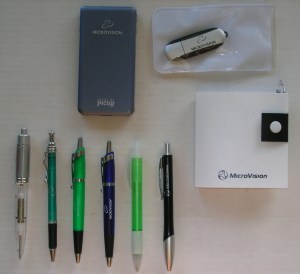
While rummaging around with my stockpile of annual reports, I also pulled out the tangible results from previous ASMs. Pens, mostly. DSCN5160 A USB drive that’s probably never been out of its sleeve. A notepad or two. One of the pens is actually one of my favorites. I wish I could buy more. It has a red LED near the tip for writing in the dark. Very handy for jotting notes that come to mind during movies or plays. (It’s a writer thing.) That’s the only pen that has more than MicroVision stamped on it. It was the commemorative pen for MicroVision’s first see-through wearable display, NOMAD. At least the pen still works. NOMAD, well, I wouldn’t be surprised to find that many don’t know about it, or Flic, or ROV; and that think MicroVision has yet to announce a product. Except maybe they know about the ShowWX (the grey rectangle), of which I have two. Maybe they’ll be collectables some day.
With the ASM less than a month away there is less than a month for the company to release news that not only satisfies management’s idea of impressive news but also the shareholders’ evidently higher standards. Within the last year there has been good news, but announcements that help the company succeed another year are a lower bar than announcements that the company has arrived technically, financially, and publicly.

A few friends owned shares of MVIS before I became a shareholder. They impress me with their foresight and patience. Too many friends bought MVIS after me and have seen their investments drastically diminish. There is a strong desire amongst a large portion of the US populace to find a way out of their financial situation. Working seven days a week isn’t creating enough income. Living frugally to the point of foregoing healthcare isn’t lowering expenses enough. Lottery tickets have odds of millions to one, and yet they are bought because they are a possibility of more than enough income at a very small expense. Investing in small disruptive companies like MicroVision provide the possibility of less than a jackpot for less of a risk for an intermediate price – and are especially attractive when the disruption if positive.

Optimists know that every day is a new opportunity. MicroVision’s management has described a production capability of hundreds of thousands of units in the second half of 2014. That’s probably millions of dollars of revenue, which is short of the tens of millions that are necessary for profitability. Sony’s products commonly are produced at the tens of millions of units level, and they’ve included MicroVision as a footnote; so maybe a successful Sony product will produce success for MicroVision and MVIS. There are other customers, and maybe MicroVision’s capacity can ramp up to support them all. One success can cascade nicely, especially with MicroVision’s business model. In 2015.

I’ll put the documents aside for a few weeks. Then I’ll try to find a bus route that takes me to the meeting. The gas and other commute fees are bad enough. At least the previous meetings were held by a transit center. Every morning I’ll check the news because despite the company’s reticence, and because of their temporary NDAs, I might wake up to news that exceeds management’s and shareholders’ expectations; and then the ASM will be more party than meeting. Just as I hoped for last year.

Posted in Uncategorized | Tagged , , , , , , , , , , , , | Leave a comment

We Listen To Stories

Let me tell you a story. What else do writers do? Actually quite a bit within non-fiction. But stories are what we listen to in the news, to inspire change, and even in how we handle money. Objectively we know that data may be more important, but as humans we want to hear what is happening to other humans.

On March 22nd a part of a mountain fell on a neighborhood in Oso, WA. At least 41 people were buried. On May 2nd a part of a mountain in Afghanistan fell on Aab Bareek possibly killing 500 to 2,700 people. These are important stories, and I must remain unapologetic for pointing out the dangerous realities of living on this planet. Over 371,000 people are born every day. I am happily unapologetic for pointing out that many celebrations. (And yes, some of them aren’t happy about it; but come on, most of those parents were smiling.)

Statistics can use data to paint whatever picture we want to present. It is difficult to completely encompass every aspect and perspective of any issue. Individual realities reside within the details.

To the vast majority of the population of the planet news stories are statistics flavored with human interest stories, at best. To those involved they were life changing events. Some media outlets skip the statistics and amplify the stories until the anecdotes define the issue. Something that affects 300 Americans every year only affects less than one in a million people. Is that a big effect or a small effect?

Sharks are dangerous, right? Elephants kill ten times for often. Crocodiles ten times for often than elephants. Tsetse flies ten times more often than elephants. Humans kill humans almost fifty times more often than elephants kill humans. And mosquitoes beat them all because they infect people with malaria. But, a shark story is much more interesting than mosquito story, even though the mosquito story is more important.

On the positive side, a royal gives birth, or even just a daughter of a possible US Presidential candidate announces a pregnancy, and the news outlets create employment for hundreds of writers and photographers. Pardon me as I copy and paste with an addition. “Over 371,000 people are born every day.” + “We hold these truths to be self-evident, that all men are created equal,” Wolfram Alpha meets the US Declaration of Independence. Evidently the reporters missed out on at least 371,000 news stories.

We seek brighter futures. We create stories of better lives based on our ideologies. Dystopic visions persist, but despite any diminishment of the old American Dream, in general the majority of the world’s population looks forward to a higher standard of living. Even some dystopic visionaries look forward to outwitting their version of our anticipated collapse by properly preparing according to their prognostications.

Whenever I am overwhelmed with story I search for the foundation beneath the story that is the data. Currently, there are some of the strongest yet most diverse forces at work within the data that describes our world. On the pessimistic side there is enough data out there to bolster stories about environmental, financial, and societal collapses. On the optimistic side there are encouraging numbers behind the technological (so many to list that it may be its own post), spiritual, and reformatory advances. A lot is going to happen within the next seven years or so, and the outcome is not obvious.

It should be obvious that I enjoy Big Picture topics, but I always try to bring them back to the influence on a personal level.

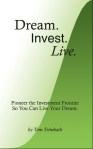
The two main resources I have for managing my life are my time and my money. Time isn’t money if you have nothing but time. Money means nothing if you have no time. Despite my recent difficulties, I continue to work towards the balance of money and time, or as I put it into the title of my book (and the basis of this blog) Dream. Invest. Live. Dream. Invest. Live. Investing is only a tool for getting from your dreams to the way you want to live.

Investing continues to be one of my possible avenues that can bridge my dreams to a simple, financially independent, sustainable lifestyle based on my values – one of which is to have fun. As such, I listen to story by buying story stocks, stocks that at least temporarily define themselves by stories of possible futures. I only do so though, when I think the data supports them. AMSC building into the massive infrastructure that is the world’s power grid. Geron with its possible effective treatments for many of mankind’s ills. MicroVision with its possibility for disrupting the electronics industry in ways we can’t imagine except that we’ve already witnessed as PCs, iPhones, and the Internet have changed our lives. (That may be a reach, but if it succeeds that well I would be silly to have avoided the potential.)

We listen to story, and we should also listen to more than just the anecdotes, promises, and worries. Data alone may be truth, but it can be so dry that no one tastes it. We know that asteroids orbit past the Earth at, by definition, astronomical speeds; but, as a populace we don’t pay attention until one blows up over a city. Why were so many people injured? They saw a flash of light, went to the window to see what was happening, then as the much slower than light shock wave hit the glass they were cut. They wanted to see what was going on. They didn’t want to miss the story. Now we know that an asteroid or meteorite hits the Earth with the force of a nuclear bomb about every six months. We probably won’t do anything about it until the next story.

I do the same thing when I feel a building shake. Was it a truck going by or did we just have an earthquake? Silly me. Get away from the window.

A story without the data may not have much of a foundation. Data without a story is so grounded that only those who can trip over it will notice it. Whether we seek change in the world around us, our society, or even just our own lives and money it is good to keep the story and the data in mind.

Posted in Uncategorized | Tagged , , , , , , , , , , , , , | 1 Comment

You Make Me Feel So Young

I sat down to lunch at a local restaurant, felt a bit annoyed, and then realized it was a symptom of youth. I was reminded that you’re only as old as your thoughts, regardless of what my joints are telling me as I type.

The world changed dramatically in the last thirty years. Russia was part of the Soviet Republic. Anyone talking about the environment was considered a hippy. Gas cost $1.21 per gallon. Computers were something that had to be explained. HCLE We knew we were going back to the Moon any year now. Financial crises revolved around double digit interest and inflation rates, but almost every transaction was still handled by certified professional humans.

Now, some are surprised that Russia is trying to rebuild the Republic. Almost all scientists are worried about not just environmental crisis but actual calamity. Gas costs over $4 at my local station. Computers are so ubiquitous that they are doing the explaining. We’re still going back the Moon, any decade now. Financial crises are taken as a norm, even though interest and inflation rates are near historic lows, and every crisis intimately includes computers. Individuals have more information than ever; but low cost services sometimes reflect getting what we pay for.

Two men sat at the next table. It was early, so no one else was in the place. They saw no reason to be quiet, so the volume went up on their rants about the conspiracy behind climate change, the poor work ethic of today’s employees, and a stream of commentary that I was happy to edit out as my business lunch partner arrived. I am very glad I know people with manners.

As easy as it would be to make even more fun of the two at the next table, I am also a fan of Freedom of Speech. They have a right to their opinions. And Comedy Central would’ve had a wonderful time exercising the Freedom of Speech and The Press by interviewing them.

What I kept in mind is something that I keep in mind with any conventional wisdom. Maybe what is said or claimed is valid if measured against its assumptions and era.

My favorite meteorologist is Prof. Cliff Mass from the University of Washington. He has a very popular blog that extends beyond the local weather. A while back he made the point that Western Civilization was much more sustainable, not because of technology but because of population. Back when there were only 2,000,000,000 people on the planet we had a much smaller effect. The year? 1930. As much as it is a Duh moment for many to realize that fewer people on the planet makes their civilization more sustainable, it also points out that for many people born in that era it is natural to assume that today’s claims of unsustainability are hyperbole. The system worked when they were young. If it doesn’t work now, it must be because the new generation isn’t as smart, resourceful, or hardworking.

A lot of financial advice is handed out based on conventional wisdom developed before 1980, in some cases before we dropped the Gold Standard. Get a degree whatever it takes. Work hard and you’ll get ahead. Devote yourself to a job and it will become a dependable career. Fit in. Buy the biggest house you can afford and grow into it, and then move up every few years. Look forward to a retirement with good benefits and no worries.

A millennial reading that last paragraph might think it is a parody. Student loan debt exceeds mortgage debt, frequently costs more than the career can repay, and can’t even be forgiven by bankruptcy. Working hard is a given, but getting ahead seems to be more about luck. Devoting yourself to a job implies the company won’t get bought out, you won’t get laid off, or some new technology won’t invalidate your schooling. Fit in? Fit into what? Nothing is static. Buying the biggest house you can afford may mean 128 square feet and on wheels (which, if you do it right is actually quite nice.) Cabin by Angela Move every few years? That’s what the wheels are for. As for retirement and benefits, what are they? Worries, well, they’re eternal.

I won’t say that I feel young. My back, hips, knees, eyes, et al cast their votes every day. But I was heartened to hear that I have some of the symptoms of youth, not that I am living a young person’s lifestyle; but I am glad that I am not as trapped by wisdom that only made sense when we, as a species, could be more foolish. Foolish is fun, but when it comes to the essentials of life it is wiser to be aware of current reality. And current reality is considerably different than 1984’s reality.

I offer my point of view and opinion as a point of departure for others who are redefining conventional wisdom.

  • The climate is changing. I’ve seen more than enough of the data and witnessed too many of the effects to deny it. The systems analyses are scarier still which is why I’m not surprised when I hear that the change is accelerating faster than predicted.
  • Energy is changing. I know more people with electric vehicles or hybrids than people with pickup trucks. The list of bicyclists is too long to write down.  Solar, wind, and efficiency are becoming the norm.
  • I don’t know anyone under the age of 60 who wants a bigger house. Tiny houses are appealing for many reasons, and I even have friends who not only live in them, but also help others build them.
  • Space is commercializing, yeah. But too late for my career or me, evidently.
  • A resume is an anachronism. Lists of job experiences on LinkedIn replace the carefully typeset prose on perfect paper presented professionally. Resume bots have blanks that must be filled in. Remember your username and password. We’ll get back to you. Oh yeah, and word-of-mouth still works best. (Some things don’t change.)
  • Investing is so driven by financial institutions and large cap stocks that individual investors like me have withdrawn to what were considered penny stocks. And in many cases, I understand why people are investing peer-to-peer despite the risks.
  • Even currency is coming into question. The last time it was questioned was when we gave up the Gold Standard, but now alternative currencies are arising because the dollar and Euro are no longer considered as standard as they were as recently as 2007. Even paper and coins are being replaced by cryptography.

Put all those effects together and personal finance plans require new analyses and options.

A sign of youth is the willingness to challenge authority and assumptions. It was heartening to hear the contrast between what those men said and what I know. Whether they were right or wrong, their conversation seemed more of a desire to reinforce an image that existed when they were younger and “righter”. I may do the same thing eventually, if I haven’t already started.

So, celebrate any dissonance you have with conventional wisdom. Conventional wisdom is being redefined by those that challenge authority and assumptions, and if that’s you too, then celebrate your symptoms of youth. And don’t be surprised if that retirement calculator asks questions that are laughably inappropriate.

Posted in Uncategorized | Tagged , , , , , , , , , , , , , , , , | 2 Comments

Off The Market

See anything different? DSCN5128 The For Sale sign is gone. My house, my home, is off the market – for at least a while. Welcome to yet another episode in “Maybe I Get To Keep My House”. After two years of trying to sell it, I decided to take my house off the market just as a possible mortgage modification is coming through, and as the local real estate market makes agents busier than they’ve been for years. Things change. Things stay the same. What’s news about that?

  • In the summer of 2011 my finances were hit with a Triple Whammy. But hey, I’m an optimist. They’ll come back.
  • By spring of 2012 my finances hadn’t come back, despite my optimism. If things didn’t improve quickly and significantly, I wouldn’t be able to pay the mortgage. Evidently, it was time to sell my house, my favorite home. I put it on the market at the same price I’d bought it for five years earlier.
  • In the fall of 2012 my finances hadn’t recovered. None of my Backup Plans were working at full force. I was paying the mortgage from my IRA, and my IRA was almost empty. I stopped paying my mortgage. The emotional pain was surprisingly intense. The Mortgage Company Tactics didn’t help.
  • In the spring of 2013 the mortgage company finally posted a Notice of Default on my door. The next step would be the all-too-common foreclosure notice. Ah, but there was a phone number on the notice. I’d had such bad experiences in previous communications, but this one promised to be with an independent third party, Parkview Services. Their advice steered me into a beneficial delay, and then mediation based on an intimate and experienced knowledge of the foreclosure and mortgage modification process that few homeowners could attain.
  • During the summer of 2013 a trusted friend and real estate agent who has seen me through several deals agreed to take over from the previous agent. Kath has seen me in the midst of intense stress before, and knows how to communicate with this somewhat-stubborn ex-engineer.
  • Through the summer and fall of mis-scheduled meetings we (the mortgager, Fannie Mae; the mortgage servicer; the mediator, my counselors at Parkview, and me) finally came up with a schedule for a possible mortgage modification.
  • Thank my two biggest clients (HCLE and NRM) who readily agreed to double my hours and give me a raise in the fall of 2013. My business income increased enough to at least pay rent, and maybe qualify for a modified mortgage.
  • Good news arrived in the late winter of 2014. I was offered an trial payment plan that would possibly qualify me for a modified mortgage. The payments are about the same as rent. Good.
  • Here we sit, spring of 2014. The real estate market boom finally crosses the moat from the mainland to the island. My agent friends are busy. The mortgage modification may be offered within the next few weeks. These are dynamic times.

To those of you who skipped past the bullets, I don’t blame you. The details of this history do not make for a simple story. We are comfortable with the simple and the quick. As this situation flows around me I’ve come to realize why less is said about the personal stories behind foreclosure. Take a look at that lineage. That is the simple version, and its latest episode includes a twist.

I took the house off the market because the amount I owe has risen every month that I haven’t paid the mortgage. Even the trial payments I am making do not necessarily keep the penalties from accumulating. As of April the amount that I owe probably couldn’t be covered by a full-price offer. A full price offer a couple of months ago may have left me with some money for the first, last, and deposit for a rental; but the market wasn’t active then. The market is so active now that I’ve had more showings in the last few weeks than I had in the previous year and a half; but selling now would possibly cost me thousands of dollars.

Such stories don’t play well in the press. They don’t fit into a 30 second sound bite. If you skipped the details you can appreciate the time constraints of a reporter trying to compile the best story in the shortest time. And as I said above, my story is simpler than most. A relatively healthy single guy with no dependents, only one mortgage, who lives frugally and responsibly, with advanced education in a key field, whose mortgage wasn’t underwater at the start because he put 20% down. Imagine how complicated such stories get with health issues, divorces, kids, second mortgages, and poor employment prospects. When the news gets complicated the press tends to report the stats rather than the stories.

It is good to get my home off the market. Of course I hope the mortgage modification comes in as suggested by the trial payments. There’s a lot I want to do with the house that only makes sense to tackle if I am going to be here for years. I still haven’t planted this year’s vegetable garden because I don’t know if I’ll be here to tend it.

But the sage and rosemary are doing well.

The sage and rosemary are doing well.

My house has only marginally been “staged” to appeal to potential buyers; but now I can pull the coat rack out of the closet, put the messier bits of a real kitchen back onto the counters, not worry about strangers having access to my personal stuff, only make the bed (er, futon) when I want, and maybe finally move the standing desk out to where there’s a good view (which happens to be beside the kitchen).

A few conversations with neighbors marked the difference between perception and reality. They both saw me as doing “really well now”, based on – what? I don’t know. We work from illusions. Graciously, each listened to my story, and I appreciate their listening. One couple shared their story too. They too were on the edge, but no one could tell from the way they act, the appearance of their home, or from what they’ve made known. The simple story that all is fine is a fine one to leave their neighbors with, except I guess for neighbors like me who sincerely and honestly answer questions that are usually avoided. Proprieties aside, people appreciate truth.

A dear friend asked where I thought I’d be in thirty years. That is the easy question to answer. I am an optimist. I expect to be in a much better place. I even hope to be somewhere better within the next three years. But the next three months, weeks, or days are less certain – which I guess is no change for any long-term optimist and short-term realist as myself. And possibly also the case for the quiet crowd living through similar circumstances. May you experience the change you wish to see. Now, that would be news.

Posted in Uncategorized | Tagged , , , , , , , , , , , | Leave a comment

You Are Not Your Job

A friend lost a job. How often have you heard that one? How often has it been their fault? Lately, losing a job means a corporation downsized, outsourced, or randomly re-organized. Decades ago losing a job probably meant doing something wrong. Now it means being in the wrong box on the organizational chart, or being on the wrong side of a line in some spreadsheet. Unfortunately, a lot of attitudes and perceptions are based on a society from decades ago. Now, young people are the wise ones because they know that careers are an illusion, every job is temporary, but who you are prevails. The trick is to make that nice sentiment mesh with commitments like thirty year mortgages. And yes, it can be done.

I can think of two or three people who have lost their jobs for personal reasons. Nothing that a bit of maturity won’t change. Learning to play well with others is tricky. Almost everyone else I know who has passed or is passing through unemployment was launched into that financial space because a company either ran out of money, or wanted to make a lot more regardless of the cost. The quick list includes vice-presidents of marketing, technical experts in artificial intelligence, programmers with multiple degrees, engineers from every field except petrochemical, linguists, healthcare professionals, information specialists, and at least a few ex-professionals so upset that they’ve become reclusive at the very time they have to step into uncomfortable change.

Corporations lobby Congress to allow more foreign workers to fill critical skill gaps at the same time that I can run into folks with such resumes just by walking into the local coffee shop. I sense a dysfunction that I can’t solve.

The ex-professionals who rebounded the quickest emphasized their expertise and re-created themselves as consultants. Their jobs may have been taken away, but their skills stayed with them. Self-employment requires a new set of skills, but it comes with a large dose of freedom. Take a severance package, if you’re lucky. Take a month or two off because the last few months or years were probably in a stressful position, and then fix up the resume (and the LinkedIn profile) and get in touch with the network that was developed over years.

The ex-professionals who have the most fun are the ones that, with the time to look at their finances, realize that they could retire. It is easy to get so wrapped up in work that a house and a portfolio have quietly grown to more than enough. Yes, you can take money out of your IRA while you are young. The best way to find out is to try, and be willing to change back if necessary.

The ex-professionals who grow the most are the ones who, through choice or necessity, find within their self more skills and talents than their job ever let them develop. Either through entrepreneurship or non-profit participation, there are plenty of ways to grow that have nothing to do with corporate America, and they can pay nicely in both money and satisfaction.

I was an Aerodynamics Stability & Control engineer (don’t worry about what that means), but I was also good at a lot of things that weren’t included in the title: program management, strategic planning, team facilitation, presentations, cross-team coordination, etc. (Check my bio for a long list.) Each was enjoyable for different reasons. And yes, I actually enjoy program management and the rest. Go figure. But then I also learned that I was reasonably good at writing, photography, teaching, and public speaking. I was more than my job title. I am more than any label slapped on me, though I do rather like the title of Renaissance Man.

As people live longer we are redefining retirement. Even assuming a career that lasts until Social Security kicks in, an idea that is foreign to many, when retirement arrives it is necessary to redefine your role. The money is important, but personal values eclipse finance. That can seem like a blithe statement, but losing the identity associated with a job is the best time to concentrate on what should never be lost, a person’s morals and ethics.

Let’s not oversimplify things though. As much as personal finance should be about the person, finances happen. I’m very aware of how money flows can direct a life. I’m also aware of how hard it can be to find a corporate job. (My Jobs Report) That’s the reason for action and backup plans.

As I’ve said before, I’m asked how I’ve managed to stay positive throughout my turmoil.

  • One, I haven’t done a video of my head-banging sessions.
  • Two, I know that a bit of complaining is necessary, but that things will get better quicker if I concentrate on the better parts of my life.
  • Three, I’ve recognized that much of what I am going through has less to do with me than it is does with dysfunctions in the system. And
  • Four, I have learned better and deeper than ever what my true values are, old attitudes that really didn’t matter, and what I won’t compromise regardless of money.

The world of my first mortgage was very different. I’d be within four years of paying it off. ARPAnet was being replaced with the Internet, but hardly anyone knew it. The fears of climate change were being debated but they were overshadowed by the threat of Mutually Assured Destruction. Stocks were still traded between people instead of computers. And careers were what people aspired to. Retirement plans were simply assumed.

A lot has changed. Personal values haven’t. For anyone working at that time, decades of training and experience have developed impressive skills, talents, and wisdom. The world still needs such people. Corporations may dismiss them in batches; but ventures, philanthropies, charities, and personal passions can benefit from incredible people. Redefine yourself and give them the chance to benefit from you, and you from them.

PS It looks like another round of job shuffling is in action. If you another outlet for your story I can include you in my Find A Friend A Job posts (#FAFAJ). Another valuable thing no one can take away is the support we give each other.

Posted in Help Find A Friend A Job, Uncategorized | Tagged , , , , , , , , , , , , , , , , , , , , | Leave a comment

Ruts Routines Revolutions

April 20th, a fine day for a party. A fine day to celebrate the break from tradition that was the beginning of the Revolutionary War. Most folks thought April 20th, 2014 was Easter. Well, yes; but someone had to spend time “paying homage to this nation’s radical dissident forebears”. Friends held a party. I had to go. One of my ancestors signed the Declaration of Independence, that radical. Breaking from traditions has been a recurring theme, recently. That’s okay. As Thomas Jefferson said, “I hold it, that a little rebellion, now and then, is a good thing, and as necessary in the political world as storms in the physical.” Occasionally stepping into and then breaking out from traditions, ruts, and routines is healthy.

Thursday night I gave a talk at a local library. The Friends of Langley Library hosted my talk about my most recent book Walking Thinking Drinking Across ScotlandWalking Thinking Drinking Across Scotland. They’re a brave bunch because I rarely know what I am going to say. To me, what the audience wants to hear is more important than what I want to say, though I make sure I slip that in too. Evidently I do it well enough because they’ve asked me back for next month too. (I’ll talk about the year-round wilderness that is the Washington Cascade Mountains.)merritt cover

Usually I start before the introductions by chatting with the early folks about their stories. No need to repeat things they know. Good to know the hooks that allow me to spin off from their comfort zones. This time we broke with tradition by including traditional music. Bagpiper Don started the evening by playing the small pipes (and who is also entrepreneurially embarking on non-traditional ways of making income, like making and selling biscotti.)DSCN5097 His playing took me out of my comfort zone, but entertained the audience which was more important. The change in routine fit in nicely with the opening passage that I read from the book, and was a reminder that I should be willing to change.

We build ruts. We build them out of habits and for a purpose, even if we don’t realize it. Our ruts keep us in the vicinity of what we think we need and aim us towards a goal we expect to reach. A rut is a person’s self-built one-dimensional maze that includes walls and a picture of cheese. If it is a deep enough rut the horizon becomes the top of the trench that we can’t see over. The world shrinks to something that seems controllable where everything except the end is within reach. We humans are very good at putting ourselves into silly situations.” – Tom Trimbath

Lately I’ve been in a rut that I’ve consciously built to make enough money to keep my house and pay my bills. Stay tuned. The next few weeks will tell whether I’ve satisfied the mortgage servicer. In the process of working within that very productive rut I’ve witnessed the distancing that happens with everything outside of it. Personal traditions of how I rested and recreated are obviously removed. I’m willing to stay within this rut because I am aware that it is temporary and also because I have no other obvious rut to switch to. The goal nears and then change will happen.

In the last row at the talk was a woman who left early. I didn’t take it personally. Free talks carry no commitment and with so much to do on Whidbey I expect about 20% of the audience will arrive late and 20% will leave early. It turns out that she is challenging her lifestyle as well. What I call ruts she calls routines. While I’ve broken out of mine by bicycling across America or walking across Scotland, she’s breaking out by traveling the world one place and month at a time. Every month will be a mix of old traditions that tag along, new ones from the place she’s moved to, and an inevitable blend that will help redefine her life. Her story is just beginning, and she’s chronicling it. Tune in.

There are a lot of people who feel that they are in ruts that they didn’t choose, ruts imposed on them. Or maybe they chose that rut, but it was a choice from a selection of one, all others being illegal, immoral, or improbable. While many people are cheering a recovering economy, I know too many people who wonder how their job or business will ever lead to anything better than what they know now. Quite a few conversations end with jokes about the lottery, MVIS (which may be the same thing), or apocalypses that are personally positive. If the currency markets crash a struggling farmer or excellent is suddenly the richest person in the neighborhood – and if you know how to brew beer, congratulations.

Local unconventionally traditional eggs - not sorted by size or color

Local unconventionally traditional eggs – not sorted by size or color

It can get dark in those ruts and a friend asked me how I manage to pump sunshine into mine. Looks can be deceiving, and yet, maybe my attitude means my rut is better lit than most. Pardon me as I reach for the light switch.

In America we underplay the role of luck. If you are successful, you get all the credit; and the few that are wise humbly acknowledge the contributions of others. The sad part is that policy and perceptions are driven by the corollary. If you aren’t successful, then it must also be your fault.

Effort and luck both contribute to a person’s life path. Where and when you were born matters. Hard work improves your chances generally, unless you’re working on the “wrong” thing. Jobs openings aren’t filled by every hardworking applicant; but are filled by one applicant who is probably hardworking and who possibly stood out from some lucky connection they made with the employer. The rest of the hardworking applicants have to work hard at applying again, and possibly eventually turning to entrepreneurship (check out Ideaworth’s blog).

The extremes are easy to talk about because their lives make good stories, and we enjoy good stories even if they are dramas instead of comedies. Some people seem to sail through life trusting merely to luck, or to mentally manifesting their future. Others work every day and struggle to the end. But there are also those who mentally manifest a fantastic future – right up to an unfulfilled end. While others may work hard, and find they picked just the right job at the right time despite bad luck.

My optimism reaches in by reminding me that, even while my life feels like an extreme, almost every life includes a mix of effort and luck. Persistence is the great enabler. As long as I persist, and as long as I remain aware of other possible routines, I know that in general that combination of effort and luck will prevail.

Look at the American Revolution. A baker’s dozen of colonies that were much too young, small, and poor stepped out of ruts established over centuries. Despite a string of defeats that should have led to unconditional surrender and retributions, they persisted through effort and luck – (and the French, but it isn’t fashionable to point that out.)

Look around at your ruts and routines. They may serve you well, but it may also be time for a little revolution.

Posted in Uncategorized | Tagged , , , , , , , , , , , , , , , , , , , , , , , , , | Leave a comment

Utopia Yourtopia Mytopia

I am glad to see that utopia is still more commonly used than dystopia. (Check Google Ngrams and Google Trends for data.) That alone means there’s hope for the human race. But, except for magazines like Yes! and Intelligent Optimist, there’s also a lot more discussion about financial, environmental, and societal disasters. It seems that we are far from utopia. That’s also nothing new. One thing that is always new and unique is every individual’s image of utopia, their mytopia or yourtupia. No matter what the world is going through, understanding mytopia is one of my best guides to living.

The desire for utopia has always existed. We want to be and do our best, and we want a world that lets that happen. Many now see utopia as eco-friendly, peaceful, and thriving with clean cities, ample resources, and a sustainable civilization. I suspect the cavemen utopia was a clean cave, easy food, a happy clan, and not being eaten by some fanged beast. Same thing, but it looked very different.

We do seem to emphasize the downside. While there are extreme positivists, much of human communication is about what bothers us. The media feeds on our tendency. I know that I am guilty of it as well as I give a personal voice to troubles that are usually reported in generalities and statistics. I’m known for being positive and optimistic, but I’m also known for pointing out dysfunctions and incongruities. That’s reality.

Human nature plays out a bit in this blog’s traffic. The most popular post is about one man’s contribution to community, A Bow To Drewslist; but followup posts languish. Solid traffic comes to my less-than-positive posts about health care, mortgages, and financial turmoil; some people stop following, but those that follow follow methodically and gather audiences of compatriots. (They are also the first to hear the good news and appreciate the contrast.) The greatest volume of reliable traffic is for any post about stocks and investing; which, I guess, is because so many bloggers write about investing merely as a sales pitch for their services. (I’m happy to help clients and sell books,Dream. Invest. Live. but the numbers prove that I write this blog largely without financial compensation.)

The classics prove the appeal of the dismal. What’s more dismal than Hell? Yet, Dante’s Inferno is recognized by many who’ve never read any of the classics. The story is terrible and rich. Most people aren’t aware that Inferno is the first book in a trilogy (oddly named the Divine Comedy, so there are definitions that were broader back then.) The second and third books are Purgatorio and Paradiso. Dante’s journey didn’t end with an escape from Hell. He went through Purgatory and Paradise. If we were so in love with utopia, Paradiso would be the best seller, not Inferno. But in each subsequent step away from Hell, the verbiage becomes less vivid and less engaging.

Society and individuals progress regardless of our apparent concentration on destruction. We talk about how bad the weather is, and we build stout buildings – though they aren’t as stout as a cave. We complain about finances, and generations continue to work hard hoping to get ahead. We shout about injustices that never seem to fade, and yet progress is made over decades.

Regular readers are very aware of my turmoil of the last few years. Readers from the beginning can see the contrast to the days of dreams that were almost realized. (Until the dreaded Triple Whammy.) Through it all I have aimed at a dream, a mytopia, that has changed little except for the necessary change in scope and timing based on finances. Mytopia may be further away than ever, yet it draws me more strongly because each setback required me to reevaluate my values and expectations. The biggest jump was realizing that the standard American dream wasn’t just a bad fit, it was counter to what I wanted and valued. Everything after that has been an intensely personal refinement.

Mytopia is a small house; on sufficient land for comfortable autonomy; in a sustainable region, environment, and community; with enough resources to live with ease. There are plenty of other details, some of which are so personal I won’t share here; but, most of them can be summarized as Live Long and Prosper, Relax and Enjoy, Be Excellent to Each Other, with a good chance to practice DFTBA (the catchphrase of vlogbrothers, Don’t Forget To Be Awesome.) It is not a small life. It is a life that is just the right size to meet my abilities, needs, wants, and resources. – and help others.

What I have to keep in mind is that utopia is an abstraction, and becomes an easy way to say no to possible solutions. My current house is my favorite home, and yet it is obvious that it is a little too big (even though it is only 840 square feet), on a lot that is a little too small (because 7,000 square feet aren’t enough for a proper garden plus outbuildings plus workout space plus etc.), in a neighborhood that doesn’t encourage decentralized utilities (except for the house-by-house septic systems, which I want to replace with a proper composting toilet.) Mytopia is for something else, which would make it easy to give up what I have, but what I have may be good enough. Most people on the planet would consider my house, its yard, and the utilities to be luxurious. And they are right. And I am right to acknowledge that something a little different could be a lot better.

The only true judge of such decisions is the person involved. Knowing that you are the only person that can truly judge you and your choices is powerful in housing, finance, and generally in how you want to live your life. Go ahead and complain because that emphasizes the contrast between where you are and where you want to be, but don’t let a search for utopia or yourtopia or mytopia pull you away from what is already good enough.

Relax and Enjoy

Relax and Enjoy

Posted in Uncategorized | Tagged , , , , , , , , , , , , , , , | Leave a comment

Personal Trust Diversification

Here’s my plan. It’s Saturday, the day I tend (with several long lapses in recent years) to post about investing and the markets. Here’s reality. It’s Saturday and the more cyber-astute are reacting to and recovering from Heartbleed, a phenomenal security hole in the Internet. Finding such a hole in the Internet is like finding out that a business couldn’t trust the electricity, water, and sewers to keep working; and that for the last two years sparks from the wires were scorching the walls, drips were rotting the foundation, and messes were piling up in hidden corners. Maybe everything is fixed, but someone’s going to have to go down into that basement and make sure – and be prepared for anything, (like Heartbleed’s cousin?). This can lead to a bit of insecurity, and investors don’t like insecurities.

The Internet created modern commerce, but not intentionally and not alone. The Internet existed for years doing what it was designed to do, connecting up various organizations so they could send data around without having to create a tape and drop it in the mail. As more people began to play with it outside of work, it blossomed while being derided as trivial. There were plenty of guesses about what it could be used for, but most of the non-work activity was discussions and hobbyists. (Serious historians can slice this gross-simplification to shreds, but stick with me here.) Then came the web, and the traffic went from text to graphics. The Internet become prettier. In addition to everything else, businesses began creating pages as digital storefronts; but really nothing more than just brochures, because they were trying to get people into the malls or catalogs. Add a bit of security though and something serious like payments could happen, and did. Hello, Amazon.

Regardless of the distrust in the investment community, my investments did well in that era, and even afterwards because I trusted in the acceptance and growth in the Internet.

Aside from stock bubbles and revolutions within industries, the Internet has grown because it has become more secure. We rely on online transactions for shopping, but also for paying bills, investing, signing contracts, talking privately, and now for storing our files in the cloud. Heartbleed proved the immaturity of the system that we’ve come to depend on and take for granted. If you can’t trust password protected accounts what can you trust? And, if you can’t trust the Internet are you prepared to retreat to paper, pen, envelopes, stamps – or even driving to the store and being limited to what they have in stock?

Despite any damage to trust in Internet transactions, businesses based on online commerce will continue. There may be a sudden spike in the demand for digital security specialists, but we’ve reached a new norm. We’re as likely to abandon the Internet as abandon electricity.

The trend I am watching is the general acceptance of diminished trust. Financial institutions lost their veneer when we saw the risks they took in the financial markets. Government shutdowns primed us to consider the possibility of losing our central authority. The Vatican continues to deal with its scandalous priests. Current economies clashing with political wills are challenging the primacy of various currencies. Tens of millions of shoppers found that their credit cards were compromised by people expending very little effort. And now, Heartbleed. I’m looking for the trend that will reinforce trust, but I haven’t found it. (The effect of writing on the writer. Having written this paragraph I noticed that the paper covering my computer’s camera had fallen. A few months ago I saw the camera light go green for no reason. Pardon me as I put the paper back in place.)

It is very easy to get scared by staring at the imperfections in the system. I definitely have concerns, but I know that my best plan is to assume everything will return to normal because we rely on this new way of living to the point that we can’t go back without trauma.

I believe it is also wise to be very aware of the imperfections in the system, and because trauma can happen. People taking on the challenge of actively managing their personal finances are to be commended. Our society is based on a currency economy. It certainly isn’t barter. But, assuming that everything will stay the same and always work ignores one of the most powerful tools available to everyone, diversification. What if online transactions couldn’t be trusted, even if for a while? What if online communications weren’t secure? What if the predominant currencies lost their dominance? Only the wealthiest have sufficient resources to cover every contingency, but at least the rest of us can take some steps to cover the contingencies we consider most likely.

Here are some of my Personal Diversifications: (in addition to diversifications within my portfolio, of course.)

  • One of the benefits of living simply is that I am less tied to the various aspects of societal infrastructure. I can do a lot with just a bicycleJust Keep Pedaling.
  • I live in a rural area where plenty of folks are happy to grow and sell food. I’d like to live even more simply by living in a house that could go off-grid. We lose power here often enough that secondary power and heat are normal parts of conversation.
  • As much as possible, I buy things that can do more than one job; and if something only does one thing I better need that frequently or in an emergency.
  • Through necessity I am generating income by relying on various skills: project management, strategic planning, social media, speaking, teaching, writing, etc. Much better than only having one skill.
  • I’ve even shopping around for crypto-currencies as a diversification against the US dollar. Why not?

Trust is under assault. If the NSA didn’t know about Heartbleed, then the NSA is not living up to their reputation – and maybe not even their mission, goals, or budget. If the NSA did know about Heartbleed, then by no saying or doing anything publicly then we may doubt their intent. Did Heartbleed reveal the NSA as incompetent or as immoral? In either case, there’s less reason to trust the NSA. Or maybe, trust was always under such suspicion but it wasn’t until we had an instantaneous and ubiquitous communication medium that we could hear each other’s doubts.

In the meantime, my stocks await a positive catalyst that I trust will arrive and I’ll continue to investigate the best way and time to diversify into a crypto-currency – ironically trusting to the very Internet that is a little less trust-worthy now.

Posted in Uncategorized | Tagged , , , , , , , , , , , , , , , , | 1 Comment

Tax Inequity Increase

I paid lower taxes when I was rich.” I said that last year. This year proves it out even more. Income was down about 40%. Income tax was up about 40%. I was traumatized by the numbers. Surely our system isn’t that dysfunctional; especially when approaching the poverty level. Surely I was wrong – and I have plenty of friends in similar situations to prove it, at least to me. There is a bit of good news but it only became apparent after downing a stiff drink and then venting with a dear friend who understands the situation too well. Maybe things will get better.

Was the first governmental conversation about income tax overly simplistic (the more a person makes the more they’re taxed because they’re more likely to afford it), or did they imagine the loopholes and byzantine paperwork to appease a draconian authority (fill out this form but attach this schedule if the worksheet produces a number in excess of the value on the appropriate table)? It must’ve seemed simple at the start. Maybe it was.

Really, I can understand the appeal of an income tax, but the reality of it has bizarre consequences.
I make a mistake in the govt’s favor I’m a chump and they’ll happily take my extra money. If I make any little mistake in the other direction, I’m a criminal.“*
A math mistake, putting a number in the wrong box, or misinterpreting arcane language across reams of instructions carries the fear of being charged with a federal offense.

When I had far more than enough income and net worth, I trusted my tax preparation to a professional. She was honest and properly pedantic, and worked through W-2s, real estate rentals, stocks, options, and miscellaneous. During my temporary, early semi-retirement my taxes were so simple that I could do them because I had no income. Make some money by making one or two stock trades per year was easy in many ways, including the paperwork. After I bought my house, and then decided to sell books and photos I used software (TurboTax) to work me through the details. Then the Triple Whammy hit. I have been working several backup plans simultaneously since. None of my efforts have succeeded comfortably, but all combine to maybe make enough to keep my house. Unfortunately, having such a diverse set of incomes means many more forms. I relinquish control to the software because properly understanding the requirements for services, retail, wholesale, royalties, etc. would require so many hours that I could probably qualify as a tax preparer.
filing taxes is a money losing proposition“*
just found out I’m making about $6.00 an hour and working my heinie off besides. Owning my own business is not all that it’s cracked up to be.“*

From what I hear, the job market is improving. What I see is many friends, unable to get hired (in many cases despite multiple degrees and phenomenal work ethics) turning instead to entrepreneurship. I submitted job applications for two years and only received one interview for a full time position – and they even admitted that they didn’t plan to hire me, but they wanted to meet the person with such an amazing resume. Trust in the conventional job market has faded, just as trust has faded in many of our institutions and conventions.

Here’s where trying to get ahead when you’ve fallen behind puts you further behind.

Welcome to something I’ve skimmed past in the past, but ran hard into this year: self-employment tax. I don’t understand how it operates but I know that, because my business’ profit margin dramatically improved I ended up paying more in self-employment tax than I paid in total for the previous year. As I said at the top, “Income was down about 40%. Income tax was up about 40%“. Part of the reason income was down was that much of the early income came from early withdrawals from my IRA, which is now seriously depleted.
According to another friend,
I’m better off earning $20K than $36K. at 36 I owe $4000 or more. Makes me sick.“*
The folks that considered themselves “lucky” were the ones who could claim large business losses.
only reason we lucked out this year is because of business losses“*
Though, it doesn’t always work out that way.
we are getting a little back, but the amount dropped significantly when I put in my little business loss…a loss…. I’m still trying to wrap my mind around that.“*
Making sense of a dysfunctional system is a waste of time, and most of these hard-workers don’t have that extra time.

One of the tenets of the American Dream is that good, hard work will be rewarded. We encourage people to work their way out of trouble. But it is while working hardest that taxes hit hardest. I worked hard enough at Boeing that my early retirement was largely encouraged for health reasons; yet, I work harder now. Corporate life also comes equipped with professionals responsible for properly accounting for withholdings and reporting. Tax season rarely held a negative surprise. When I worked the least was when I was comfortably living off my investments. (Though, for a while there I was doing nothing much for pay, but working 32 hours a week on charities. So much for lounging.) Living off investments can make life balance very easy. Trade once or twice a year, live off the proceedings, and match losses to gains. There were several years when I had two or three times my current income and paid less than a few hundred dollars in taxes. I’d like to get back there, but I wonder how the government can function under such a system.

Entrepreneurship is discouraged enough that a common chorus is a desire to return to the corporate world, just to simplify life.
When I complained about taxes I’m told to “get a better job”.“*
I got royally stung when I tried the non-S corp route. My taxes were over double previous years. You probably get that, right? I’d rather do the corp dance than see that situation again.“*
Of course, the entire issue started because better jobs weren’t available, despite the news reports and economic data.

If the system is flawed, change the system. It’s our country, right? We should be able to do that.
The waste of humanity that is our income tax system. We need a flat tax.“* – David Nelson (and with his talents I’m surprised he hasn’t single-handedly made that happen)
We need to repeal the 16th Amendment, make the states pay federal taxes… and start following the 10th amendment.“* – Peter Jungmann (and he has a plan to make it happen)

So, where’s the good news? At least for me, the good news is that last year I had to use my credit card to pay my taxes. This year, if I scrape around in various accounts and only pay the minimums on some bills, I might, might be able to pay in cash. Of course, some of the cash will come out of my skinny IRA which will kick off a tax penalty to be paid next year, but well, oh well. The taxes will get paid, then the health insurance (if I still have it), and then the trial payment for the mortgage – oh yeah, and incidentals like food and gas and . . . But hey, it is a step in the right direction. My business is growing (want to be part of the growth? hire me for some strategic planning or program management), and the increased revenues and increased profits will mean – increased taxes – and maybe enough left over to get ahead after falling so far behind.

* (Quotes courtesy of a very active social media response on Facebook with some comments on Twitter. Thanks to everyone who participated.)

Posted in Uncategorized | Tagged , , , , , , , , , , , , , , , , , , , , , , , | 1 Comment