A Good Week – October 2025

Good weeks can happen too. There were at least two pieces of good book news, three pieces of stock news, and a compliment or a few. Which to write about? We get enough weird news from the world lately. I’ll share each of these because good news deserves to be mentioned too.

Muddling By

A friend called to read a quote back to me. They’re reading my latest book, Muddling By, and wanted to thank me (or congratulate me?) for writing the following line.

“Visitors to the simple life have a different experience than those who live there involuntarily.”

We live in tourist towns. Tourist towns can be social centers wrapped with rural lands. People can be a mix of local farm folk, retirees, and people temporarily escaping their corporate and urban lives. Some visit the simple life. Some choose to live there. Some do not have a choice. They may all stay in a tiny house on a small acreage, but one is there for the weekend, one is there to relax and recover, and one is there because where else would they go?

And yet, we have to find one set of laws, regulations, and norms that can fit all. That isn’t easy.

And, thanks for the compliment about the quote. There are more like it in the book. (For sale online, but maybe your library can carry a copy.)

Podcast

Serendipity and synchronicity happen. I attended an HSN (Housing Solutions Network?) meeting this week about affordable housing in Jefferson County. I almost – almost – kept my mouth shut. Really, I have tried to scale back from my active life of volunteering and such, partly from doctors’ (note the plural) orders/suggestions, but the unofficial coordinator asked if anyone who hadn’t talked wanted to add an observation. OK. I spoke up.

I spoke up to reinforce the experiences mentioned by a minority at the event. The event was doing good work. The event was like others I’ve seen, people working hard at trying to navigate a way through funding, regulatory, and economic issues to make more housing available. Frequently, the discussion is about how to build more housing. Good. But I heard and emphasized a comment that pointed out the severity of the issue that is easy to overlook.

Some people can’t buy anything. Some people have jobs that don’t produce the income and documentation that lenders and landlords require. They can be the most exposed, and the least represented. Let’s not forget about the homeless, and don’t assume that they want to own or even need a traditional house.
Living in a camping trailer may be a step up, especially to someone living in the forest, yet they are overlooked. They probably have a housing solution in mind, yet they are not permitted, as in officially not granted a permit, to live.

I’ll skip some of the details for privacy reasons, but I realized that we may be able to give them a voice through a podcast. By attending without expecting to participate, serendipity and synchronicity may have enabled some of us to produce and provide such a voice. Stay tuned.

Back To Books
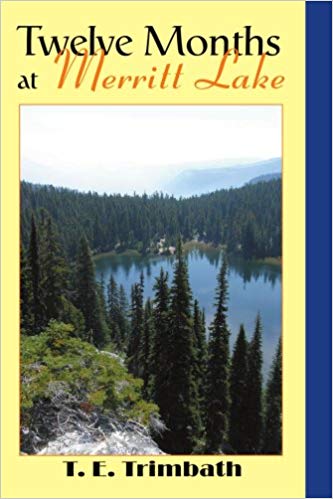
It is easy to remember to mention my latest book (Muddling By), but when I checked its status on Amazon, I noticed that a book I wrote over twenty years ago had a sale. Twelve Months at Merritt Lake was found by a customer. Cool. Some topics are timeless, but given enough time, they can be overlooked, too.


Twelve Months at Merritt Lake was the third in my trilogy of Twelve Month books in the Washington Cascades. Barclay Lake is on the wet side, basically in a temperate rain forest. Lake Valhalla is at the crest. Merritt Lake is in drier terrain where forest fires are more common. So are errant livestock. So are guns and hunters. So is wilderness area that overwhelms humanity in its scale.
Nature’s presence is the core of the book, and is why reading it twenty years later is still appropriate. Read on, and thanks.

Compliments
We can never share every compliment that we think of. We’re busy enough. Taking the time to thank everyone for everything would take all of our time. We’d all be more thankful, but we still need to do the laundry and pay the bills. Besides, a conversation of compliments can be dull, as if we need some simple small talk to smooth out each day’s bumps. And yet, this week has delivered more compliments than usual. I’ve been able to share some, too. I’ll pass along this one that was delivered to me via social media.
“Reading your words is like settling in for a cup of tea while sharing a window seat with a friend.”
See? Social media is good for something. Thanks.

Stocks
Amidst the rest of the week, three of my stocks delivered unexpected and good news.

SLDP makes solid batteries, basically. Most cars use lithium-ion batteries that use a fluid. They also use Lithium. So, getting the materials is troublesome. Fluids leak, and in particular, result in a battery that can catch fire. Lithium-ion batteries got us this far, but there is a lot of work going on for the next generation of batteries. SLDP announced that they are working with partners to make a prototype with BMW. That’s a major step past a lab bench, and good news.

LUNR is known for making lunar landers that land and then fall over. People laugh. People tend to ignore that, at least according to some objective criteria, LUNR has hit 85% of their work items. Add to those items the fact that LUNR will now be working on developing nuclear power sources for lunar orbit. That’s business.

QBTS (what’s its 1-year ROI? Oh. Ah. >3,300%) may be included in a US government plan that will involve the US owning a bit of the stock. I won’t say much more because politics is weird lately, but whether the company wants it or not, the stock responded positively. I don’t buy stock based on politics, but I also try to recognize political realities.


Was there more good news? Certainly. But, as I mentioned above, thanking everyone for everything would take longer than I want to type. Besides, there’s a dance to get ready for, and I just got my first hot-towel razor shave and trim. I might look respectable. I wonder if anyone will notice.

Posted in Uncategorized | Tagged , , , | Leave a comment

Bought A Bit Of LUNR Again – October 2025

Once upon a time, I’d post my stock trades on the Motley Fool. This forum, my blog, seems to be a more public and more trafficked place for such things lately. So, here’s a quick note. I bought some more LUNR. Let’s see if I ramble into a longer article.


Recently, I sold some of my QBTS. (QBTS At 40 So Soon) That was partly to realize some profits. It was also because I think the market is at least temporarily into Irrational Exuberance Again. Done.

Done, but not. The realized sale can also be called cash. A big checking account is very welcome after years of worry. A cash buffer is a good thing. But excess cash doesn’t grow, doesn’t do good work, and continually reminds me to do something with it. The taxes are covered. Good. I know about how much I want to reserve for living expenses and that cash cushion. I’ve already paid some personal debts. My kitchen may get an upgraded appliance or two. That leaves me with more than enough to reinvest. Any compounding in my portfolio is the result of sales being reinvested. I bought some more LUNR.

LUNR, which I consider to be poorly named as Intuitive Machines, is a company with a space-based business model. Cool. And risky. Twice they’ve landed craft on the Moon. Twice the craft have tipped over. Oops.

As an ex-aerospace engineer, I can understand why. Space is tricky. I’ll skip the details because YouTubers like Scott Manley explained LUNR’s situation better.

As an investor, I see a company that is overlooked because its main graphics are of fallen lunar landers – despite succeeding at many of their other lunar infrastructure projects. Tippy landers make the news, but successfully meeting 85% of their objectives – and getting paid for it – means there may be overlooked value. And, hopefully, third time is a charm and an entry into a more profitable and successful era. That’s why I buy companies, because they might do something good and make money doing it.

Eventually, I’ll return to researching other possibilities. Maybe more LUNR. But there are thousands of public companies to consider. I listen to my intuition and emotions, as well as considering logical and objective criteria. My thoughts kept returning to buying a bit more, so I did. I didn’t buy as much as I wanted, but at least I bought more. After I buy a range or a fridge or both or whatever, I’ll consider what else to consider.

In the meantime, it is time for me, the author of Muddling By, A Rollercoaster Ride Through America’s Wealth Classes, to do some authory stuff like telling people about the book, producing and publishing the ebook, submitting it to the Library of Congress, while also working on Twelve Months on Hurricane Ridge, and the third book in my sci-fi trilogy (the Exodus/Genesis series, Firewatcher and Fire Race). Oh yeah, and maybe take some time off and celebrate the season.

Five hundred words? Yeah, that’s enough typing for a Monday morning. Next up, trying to move my range so I can see what will be required to switch from propane to induction/convection. That story will get told on my tiny house blog, MyTinyExperiment.net.
(Oh, and if you’re curious about my writing, there’s a blog for that, too. (https://tomthewriter.net/)
Hmm. Maybe a nap, first.

Posted in Uncategorized | Tagged , , , | Leave a comment

Irrational Exuberance Again

Irrational exuberance again? The stock market is up again? But it sounds and looks like the world is in turmoil. Isn’t it? Not-exactly-a-news-flash = the market is not the world, and a crowd of supposedly intelligent investors can act like a mob of wannabes. We humans are so silly. Or, maybe this time is different.

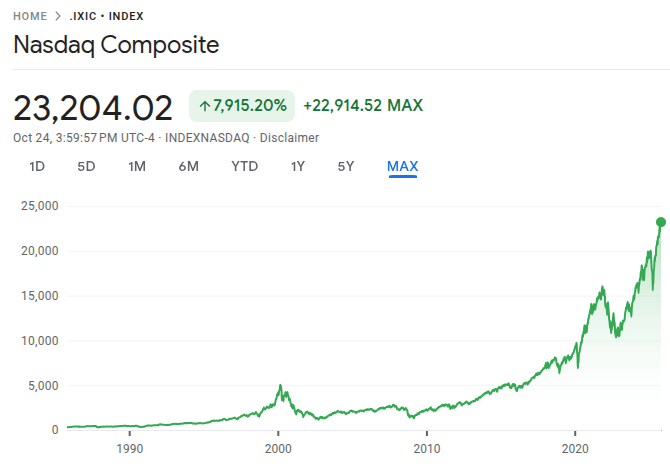
Was it really back in 1996, almost thirty years ago, when the Fed chairman, Alan Greenspan, warned about a market that was possibly irrationally exuberant? Note that ‘possibly’ because the comment was made in public and Fed chairmen are rarely emphatic. They use wiggle words to allow a way out of conversational traps.

Google Finance

He was right. The dotcom bubble burst. The markets tumbled. People lost money. 

And, the general economy recovered. Many dotcoms became today’s monopolies. The markets rose, again. People made money.

And then there was the Great Recession (the Second Great Depression in my opinion). And then there was the … a continuing string of booms and busts. 

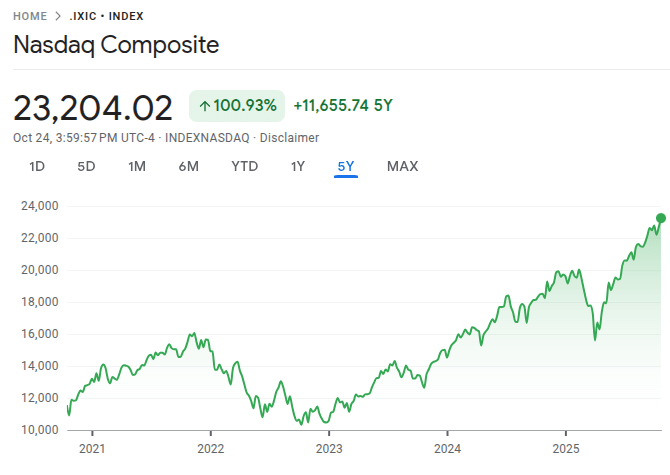
The markets are booming again. In the most recent five years, the NASDAQ index has doubled. That’s roughly a 15% increase every year, which is about double the historical average. Look at the data in more detail and see a much more turbulent ride. That’s normal. Wars, elections, crises create swings in the markets. 

Google Finance

Currently, the AI possibilities are creating a lot of enthusiasm and worry. If AI is effective, economies, businesses, and most lives will change. If so, now is the time to reposition portfolios (and careers) to take best advantage of the situation.

The problem now is like the problem then. The enthusiasts knew, or at least strongly guessed, that great things were coming. When the bubble burst, they might have been hurt. Many guesses at investments faded even as the technology advanced. Some, however, guessed right. And I contend that ‘guess’ is the proper word for what felt like intelligent declarations.

I do not own any AI stocks. I suspect the same technological trends will repeat, but the benefits may be indirect as existing companies improve their companies. There will be profitable and pure AI investments, but I’m not guessing which they will be.

I am invested in quantum computers (QBTS). AI is catching a lot of the news, but quantum computers are also positively disruptive and hard to guess. At least for now, I’ve guessed right by buying QBTS. Even with a drop from ~$46 to ~$32, the stock has risen >2,700% in the most recent twelve months. Fine. I sold a bit. As I type, it is an ~$11B market cap based on – let me check again – ~$9M revenue. Note that is revenue, not profit. The company lost ~$144M in that time.

Google Finance

What? Why would someone invest in such a company? History.

Quantum computing potentially – potentially – is a greater positive technological improvement than the PC, in my opinion. I see it as more like the introduction of the transistor. That was 1947. There were decades of disruption to come. There were decades of progress to benefit from.

The problem with such disruptive technologies is – pardon – ‘a’ problem with such disruptive technologies (and there are always more problems) is that there is no industry to compare them to. How big will AI or the quantum computing industry become? Probably not nothing, because they’ve already made a non-zero impact. Probably not everything, because there’s still an economy of people doing things only people can do. The likelihood is probably something. As an investor, guessing at the ‘something’ without the aid of history can mean estimating growth based on the progress of transistors. Investing in MSFT, AAPL, AMZN were very good investments. This could be bigger than those. Or not.

Big ideas can start in businesses that don’t make much money – yet. Good. That makes those stocks cheaper to buy. 

As the technologies make progress, and as their companies project their potential impact, risky investors, really speculators, can bid up the price based on little data. Hey, if it works, why worry the details?
The problem is that a lot of money is spent on enthusiasm. At an extreme, an irrational exuberance. 
What is it that is said about heroes and fools only being different based on someone’s definition of success? 

As I type, QBTS is up >2,800% for the last twelve months. (Note that number changed since I started typing this post.) By conventional wisdom, it is irrational to buy stock in an $11B company that had revenues of less than a few million. By history, such a paradigm-shifting company could potentially be worth hundreds of billions, if not trillions of dollars – eventually. Could.

QBTS and other stocks are into teetering territory. Prices have risen high enough that stockholders rush in and out like waves, not like tides. A random comment from a CEO or politician can swing a stock without any fact-checking. Within the most recent month, QBTS hit a low of ~$24 and a high of ~$47, almost a 100% gain. Then the crowd went away, and then a spurious news item drove it back up to – let me check – ~$33.

The precise price movement is not as important as the fact that, without much rationality, the prices can move that much that quickly.

Irrational exuberance is not rational. Duh. I also call it irrational optimism because humans can also experience irrational pessimism. 

I’m not saying this is a time to invest or not invest. I am not a certified financial person. As an individual, though, I am reflecting on history, psychology, and technology to help me decide what to invest in, and how much to invest. Turmoil is uncomfortable, but I’m old enough to have witnessed and experienced booms and busts, profits and losses, missed and captured opportunities. (I coulda and shoulda bought COST, AMZN, yada, yada.)

Throw in the extra-market turmoil that is politics and this is a time to pay more attention to factual news. 
Irrational exuberance. We’ve seen this before. This time will be different, as every time is; which also means a lot of it will be the same. Hang on for the ride. Remember where the emergency exits are. Remember your goals. And, if you don’t have goals or exits, this is a good time to find them. It already is a bumpy ride.

Posted in Uncategorized | Tagged , , , , | Leave a comment

Sitting On Decisions

A few days ago, I Sold A Bit Of QBTS (QBTS At 40 So Soon). Listen to a lot of pundits, and it would sound like the money would already be allocated, spent, redistributed. Nope. I’m sitting on those decisions. Conventional wisdom can make it seem that cause and effect have no gap between them. Got the money, do something with it. Eventually. The world is acting quickly enough. I don’t need to accelerate it, and I don’t see the need for it to accelerate me.


Sell some stock. The money ‘settles’ eventually. Sometimes money flows, even digital ones, run into physical or procedural limitations. After I sell a stock, I prefer to wait a few days to make sure I get the cash. I’ve never had cash from a stock sale get lost, but scroll back to when the banks (including the SEC) lost the money from my house sale. (My Money (And Almost My House) Lost In The Wire
I’ve taken a week to think. That’s a luxury I don’t want to waste.


The cash should be enough to pay for a few years’ living expenses, but that’s not hard considering that I am getting Social Security (a tenuous proposition), my pension from Boeing (which is about as much as the rent on my storage unit), and my frugal lifestyle (which is a great enabler.) 
I bought the ability to take my time.


And I can dream and scheme.


Scheme? Nothing Machiavellian. Ah. I’ll more appropriately call it planning. What will I do with what I’ve got, and when will I do it?


The long list starts to collect in my thoughts: where to reinvest, pay taxes, begin to repay a personal loan, what to buy, what to keep in reserve, what to use for those living expenses, and treats and how to treat myself. 


Rearrange that.


Taxes first. I won’t need to pay them for a while, but long-term capital gains must eventually be paid. I probably won’t set up a savings account, but I will make sure there’s enough cash to pay the government’s bill. I probably also won’t sell again this year, just to keep the taxes simple – and be ready to change that because the only constant (especially in this current world) is change.


Loans. Friends provided a buffer when I had none, and should be recompensed. Hey, if they don’t need it, great, then they can pay it forward and continue the generosity. 


Reinvest. One way to keep me from spending… Nah. I wouldn’t just spend the money; I’m frugal, remember. But, maintaining my portfolio means tending to the existing positions, and maybe adding one or a few. I am sure some investors, and definitely some traders and speculators, would already redirect the funds into other investments. I’ll wait. I might miss an opportunity ( and LUNR and SLDP are rising as I type), but I might also find a new and therefore more diverse investment. Stay tuned. I may post my research to my One Company One Story video channel .

Buying stuff. Are kitchen appliances considered stuff? My life in my tiny house (MyTinyExperiment.net) has been proving to me how little I need. There’s always something to buy, but little that I actually need. So, I’ll buy a bit of the little I don’t have, but I’ll also shop for two new kitchen appliances: a refrigerator and a range. This house’s gear is almost twenty years old. The fridge makes noises. It also makes ice in ways that aren’t cubes, but as thick old frost. The range may go, too. Swapping propane out and bringing induction and convection in will be a nice upgrade, and may mean a few more square feet of living space. The details should show up in my tiny house blog if I do that.


Living Expenses. Hey, if Social Security continues, that anything I set aside for living expenses could be (frugal) luxury expenses. For me, that’s occasionally eating at a restaurant. Still, it is nice to not be living on the financial edge. Considering current politics, I’ll keep about a year’s expenses in cash, just in case.
Reserves. Gotta have reserves, and in my financial situation, there’s an overlap with those possibly under-spent living expenses. Yet another cash cushion to keep track of.


Treats and treating myself. I’ve lived in the land of necessity and in the land of choice. For over a decade, my frugality was by necessity. Fortunately, I lived frugally by choice for decades before that. Now, I am returning to frugality by choice, and comfort; but I feel a delayed deficit of treating myself well. I pause as I type, which shows me that even considering treating myself better will take an effort. My newest book, Muddling By, is about living in each of our wealth classes, middle-class, millionaire, and muddling by. A rich person who becomes poor must change their spending habits. A poor person who spends as if they are rich will never be rich, except by luck. What I witnessed was too many people who didn’t adapt to their changes. Yesterday, I treated myself to a visit to my doctor about a question. It wasn’t an emergency. I was curious. They had time. I bought some insights. Treat! But, I also know that I have lost the emotional freedom to treat myself to a vacation. Even my recent coast-to-coast road trip was organized as a long chore, essentially. I have to re-free my mind to be comfortable taking time for me without worrying about agendas and expectations. Let’s see if I manage to go somewhere and do nothing for more than a couple of days.

Don’t spend it all in one place. I’ve heard that phrase thrown my way whenever I’ve celebrated some financial success. Have I ever spent it all in one place? No. When you give someone advice, listen to it yourself because it may only be one part of you talking to another part of you and using someone else as an excuse to have that internal conversation. I wonder if they’ve ever spent it all in one place. Would they if they could? I know if there’s enough to worry about taxes, there’s probably a long list of possible places for the money to flow to. Getting the money and spending it the next is a necessity for some, but taking the time to consider treats time as the luxury it is. Time is precious. Life is fast enough. I’ll do what I must, but I’ll also treat myself to taking my time.

Posted in Uncategorized | Tagged , , , , | Leave a comment

QBTS At 40 So Soon

Again, “I’m not bragging. I’m not boasting.” That’s what I said in my recent post. (QBTS And Luck – October 10, 2025) I’m not even celebrating. The emotional news of selling a bit of my QBTS holdings hasn’t sunk into my hormones. The news is still having to settle in through my brain. That journey, that mental and emotional journey is what I intend to share because it is a bit of reality that might be useful to other people, other investors. My main quote from the morning, “Whew.”

For those who want to review my history with QBTS, click through this link

As I type, the stock is up over 3,600% in the most recent twelve months.

Google Finance

As I type, it is up over 13.5% so far today. It is a wild ride, and one that benefits from watching the daily news even though I rarely trade. Here I am in October, and this is my first trade of the year. I am not an active trader, but I do find the market more fascinating than most fiction.

Google Finance


As I mentioned in that previous post, “Knowing, or at least guessing well, about when to sell is an art that involves math.”

Despite my daily diligence, I missed a peak at $39.55. I slept in. It happens. I resigned myself to waiting and watching for the stock to recover investors’ enthusiasm, knowing it might take months. 

This morning, I didn’t sleep in as much. Evidently, it started up over $1, dropped, then rose. Here comes the emotional or at least the biomedical response. I calmed myself to leave that tab open because the stock just might meet my $40 goal, or at least my $38.50 acceptable target, while I made breakfast and dove through my normal morning routine. Regardless of the market and finances, a person’s got to eat, and brushing my teeth is a good idea.

But I couldn’t pretend to myself that it was an unemotional response. I wasn’t eager, like on a child’s Christmas morning. I wasn’t as worried as some are around a crisis. I was somewhat anxious and concerned and hopeful. And I kept reminding myself that I could miss this peak, too, and that it would be okay. I didn’t need to sell. I could benefit from a sale, and stocks are held to sell (sans dividends), so it was prudent that I watched. So, I watched.

That didn’t take long. As I ate breakfast, the stock climbed back up towards $38. I’ve missed out on gains on several occasions by waiting for that next dollar, but waiting for that next dollar is how my QBTS managed to go from ~$1 to ~$37. 

Here is the advantage of not selling everything.

I was ‘only’ going to sell about a quarter of what I held. When I bought the stock, I purposely bought it in a few blocks. I sold the first block when the stock rose enough for me to recover my initial investment. That was 20% of my holdings. I was planning on selling the next block, which would be 25% of my holdings. Each block was the same size, but each sale diminished the shares remaining in my account. Whatever I did, I’d still have those other shares.

And I watched. And I refreshed the screen. And I watched. And I noticed my feelings. 

Personal finance shouldn’t be a stress. I’ve lived through a portion of life that definitely was, but this sale would largely be a discretionary benefit. I didn’t have to do it. I wanted to do it.

My feelings of anxiety and concern could have a cost. Mental health is important. Why raise my blood pressure over a few extra pennies? Granted, those few extra pennies would be multiplied by how many shares I sold, and that reality was not to be ignored. More can be better. But despite the movie line, greed is not good. I asked myself was it good enough to sell at $37.50 instead of $38.50 or even waiting for $40? I’d miss out on the price of an appliance, but if the stock fell back I’d have most of the gain, and if the stock continued to rise my other shares would reflect that.

I sold at $37.955. Whew. Good enough.

I double-checked my account balance, updated my rarely opened investment spreadsheet, and slowly and calmly returned to the day’s chores.

I frequently reflect on a variation of an old adage.

Chop wood, carry water.
Reach enlightenment.
Chop wood, carry water.

Though I prefer my modern variation.

Pay bills. Do laundry.
Celebrate progress.
Pay bills. Do laundry.

Goals are great. Celebrate them as they are reached, but life will return to familiar chores.

BTW I type this while my washer/dryer is busy cleaning the weekend’s clothes. The bills are already paid.

BTW As I type this,  QBTS is up >17% and is above where I sold those shares, $38.71.

My approach to personal finance is not unemotional. I am human. I have emotions. I decide not to ignore them. Personal finance does require a personal choice about how to balance emotions versus practicality. Irrational pessimism and irrational optimism are extremes to avoid. But pessimism and optimism can benefit the process by encouraging and considering the possibilities. How bad can things get? How good can things be?

Now that I’ve sold the stock, my cash balance has blossomed. I will not spend it all in one place. The majority will be reinvested. That’s the way investing works. I’ll also set aside some for the inevitable taxes (long term capital gains). There’s a personal debt I want to repay. And I won’t ignore the small celebrations that this sale can enable. Maybe a new fridge. Maybe a short trip or two. The biggest emotional benefit I’ve experienced has been a cash cushion in my checking account. But that’s a story I’ve already touched on in this blog and in my recent book, Muddling By. Hmm. I wonder if I can afford a bit more advertising? First, go check the laundry.


OK. Maybe another look at the stock. Up 23%?! I missed some of that money, but not most, but I also saved my psyche a morning of anxiously asking myself, “Do I sell now? How about now? But what if?”


Additional thought:

Is this an assault on the shorts? Hmm. Maybe not directly. But, some news item says some bank says they might invest in quantum companies, which may also result in a short squeeze unintentionally. That’s a lot of action based on a lot of uncertainty. OK.

Interim results, up 4,000% in the most recent twelve months.

At market close, QBTS was $40.62, up 23% for the day, up 3,921% for the recent twelve months – and I’m going to take a nap. Whew.

Google Finance
Google Finance


Feels like a bubble, but I already got my initial investment out, just realized >700% profit, and still have 3/5 of my initial shares. I should feel more celebratory. Maybe a drink with dinner, eh?

Posted in Uncategorized | Tagged , , , , | Leave a comment

QBTS And Luck – October 10, 2025

I’m not bragging. I’m not boasting. I am also not ignoring my unrealized good fortune. D-Wave Quantum’s stock, QBTS, hit a new high this week, $39.55. I missed quantifying the peak, but the stock closed the week at $33.02 for a one-year gain of over 3,600%. Good things can happen, and I prefer not to ignore them. I also didn’t act on it. I slept in. So it goes, and maybe keeps going.

Google Finance


I do not advise anyone. I particularly do not advise anyone to invest in stocks the way I do. I do, however, point out that it is possible to see returns that far exceed the historical averages of ~7% to ~10%. Single-digit returns can make investing seem silly. Few expect to win the lottery. With a bit more than lottery luck and an acceptance of some risk, it is possible to see returns that are in that middle. Thanks to some good luck, my portfolio is up over 150% over the most recent twelve months.

Thanks to some good luck.

Bad luck happens, too.

I’ve written about some of my bad investing luck in this blog and also in my recently published book, Muddling By. Criminal acts against two of my stocks cost me ~80% of my net worth circa 2008. Not being able to get a job or sell my house meant drawing down my investments until I’d lost 98%. Hence, the beginning of My Triple Whammy. 


Those losses weren’t from a lack of investing logic. Both companies, DNDN and AMSC, were succeeding with their products (in my opinion), but both were targeted by criminals. That’s true of crime in general. 

(The third part of My Triple Whammy continues to play out as I wait for MVIS to do something besides simply survive.)

If I followed writing advice, I’d share this part last, but I prefer to disclose this part early. That 3,600% gain is unrealized. Unrealized means I haven’t sold the stock. I haven’t ‘made’ that money until I sell. But I also don’t want to wait until then because this is happening now. 

I also want to chronicle this stock’s performance. 

I almost realized some of the gains. Almost.

I watch my stocks, but I rarely trade. I haven’t sold anything this year. Maybe I will. Maybe I won’t. I do, however, watch the stocks daily because small companies can change quickly. As QBTS started to suddenly rise, I started to watch it more intently. I buy stocks to eventually sell them, hopefully for a profit. I’d already sold enough to clear my initial purchase. I was and am letting the profits run.
Knowing, or at least guessing well, about when to sell is an art that involves math. Guesswork is involved because the future is uncertain. Pick your preferred style.

Sell because you have to or because there’s something better.

Sell with a 10% profit, or 20%, or 30%, …, or 100%,… or 1,000%, or…

Selling with a profit is a success. The details describe the success’ extent.

I do Not have a fixed, rigid, sales philosophy. I sell when I feel it is the time to sell. There’s usually some math involved, but each situation is unique, so I remain adaptable.

I do Not sell at a fixed, rigid percentage because I’ve missed out on more gains than any 100% losses I’ve encountered. 

Roughly, I bought QBTS near $1. As a reminder, it closed today at $33.02. If I had sold at $2, I would’ve made 100% (ignoring taxes and commissions and such). Profit! But where else would I put the money? Simply buying something else is like finding a favorite fishing hole, then deciding to go elk hunting instead. QBTS was going up. D-Wave was improving. I’m staying.

And yet, I’ve also seen stellar stocks crash. So, I typically pick a portion to sell at some elevated price. I decided on ~25% of my QBTS to sell at $40. My amateur knowledge of market psychology suggested that others might have the same idea, so I’d probably sell at $38.50 unless it was rocketing up. It started the week at $31.85. Monday, it closed at ~$36. I joked with an acquaintance about the stock because I didn’t expect to see those prices until later 2025 or 2026, if ever. I relaxed. 

Tuesday, I slept in. I slept in for ~1 hour after the market opened In that brief window, QBTS hit $39.55. I missed it. OK. Maybe it will bounce back. Not so far. I am Not heartbroken. I bought the stock near $1. If the stock fell back to $2, I’d have a 100% gain. I’d be bummed, but financially ahead. 

It is hard to know how high a stock can go. Math may provide an answer, but the investment community’s psychology matters too. Is it unrealistic to imagine a $1 stock going to $2? A $2 stock going to $4? A $4 stock going to $8? An $8 stock going to $16? A $16 stock going to $32? How about a $32 stock going to $64? And on…

Each of those doublings may seem reasonable because they already happened. Why not $64, or $128, or more? There are reasons to limit corporate expectations. There are practical industrial limits. But stocks involve emotions which defy logic.

I slept in and missed out on selling at almost $40. My acquaintance grinned and said they thought the universe was playing with me. They might be right.

I do not know how big D-Wave and QBTS can be. The market is guessing too. Quantum computing is a new industry. We’re all just guessing.

I’d be more likely to sell if the proceeds could do more than buy a new car. A new house would need much more. The performance so far continues to mean I am much further from my recent world of worry. I won’t complain.

I will also take this as a reminder of the power of luck. I’ve seen good luck and had luck, and I’ve seen hard work. I can’t claim credit for hard work creating my current wealth. And I will thank and won’t ignore the benefits of good luck. 

Holding QBTS, and fascinated to have a front-row seat.

Posted in Uncategorized | Tagged , , , , | Leave a comment

Muddling By – A Rollercoaster Ride Through America’s Wealth Classes

A heady day. Hmm. Such a heady day, in a good way, that I think I’ll take some headache medication because adjusting to good news can be taxing, too – especially because the flurry of activity that surrounds publishing a book is a lot of activity. Rats. I already buried the lede. Welcome to the publication of Muddling By, A Rollercoaster Ride Through America’s Wealth Classes. It is one person’s view (me) of what it’s like to be middle class, a millionaire, and muddling by in America. Pardon any missteps, but I wanted to get it done and available while we still have an America, or at least a USA.

As the description on Amazon says;
Muddling By explores about two dozen topics seen from his roller coaster ride through middle class, millionaire, and muddling by.

Each topic looks different from each class, but all are valid.
Most of us are just trying to get by, living inside the implicit confines of our community.
Few are oligarchs. Few are criminals.

We made up money and wealth. We’ve decided to permit poverty.”

Here begins the next challenge for any writer, trying to concisely describe what they’ve written. 

(pardon the long introspective pause that readers don’t get to see)

Our culture in the US has devolved into an internal Us versus Them. It’s not a surprise. Our culture grew, particularly when the Them was external and a real threat. Regular readers know I’ve gone from middle class to millionaire to muddling by. From the media narrative, each of those has been a Them to someone else. For me, each was always just me. I’ve come to realize that there is no true Them until you get into the realms of the oligarchs who purposely distance themselves from Us. This story, this book, is about two dozen-ish topics seen from the various perspectives: middle class, millionaire, and muddling by. This book is about those generalities, which I contrast with my realities. 

Most people are simply trying to get by with what they have, where they are, within the community that accepts them. Each ‘wealth class’ is legal and valid, mostly. I have met people who break the law, and that’s been true in every community. The greater majority are people who live valid and legal lives without more than a normal amount of human compassion and occasional disgruntlement. 

The media, the pundits, and the politicians thrive off the disgruntlement. 

Conventional writing wisdom is to emphasize the disgruntlement. Writers are advised to find the conflict and the drama.

What I’ve witnessed is that everyone I know has some battle, regardless of wealth. Granted, one person’s wealth could resolve another person’s problem, but that distribution has its own problems, and simply redistributing all of the wealth instantaneously is impractical. We invented wealth and poverty, and I’m not surprised that we haven’t figured it out yet. We are a young civilization, and our growing pains are real, not abstractions.

Many books and articles I encounter treat wealth classes as Us versus Them, as if they are a rigid caste system. We’re messier than that. Articles and books are easier to write for one particular Us. The world isn’t that narrow.

In 2008, I published by request, Dream. Live. Invest., basically a book about personal finance for frugal folk. I’d retired at 38. People wanted to read that story. Ironies happen. The book became available just as the Great Recession (the Second Great Depression) began. My portfolio and I survived it. Then, I was hit by My Triple Whammy. Mostly because of two sets of white collar criminals, my portfolio fell 80% within a few months. I couldn’t get a job and couldn’t sell my house, so I gutted my investments while I scrounged for work. My net worth dropped 98%. Through lots of gigs and a few very generous benefactors, my house and I survived. Recently, I got rid of all of my debt by selling my home. Being debt-free has been a great benefit. I realized it was time to compile my various perspectives into a book that is almost but not really a sequel.

Muddling By is part of my attempts to show how we differ and how we’re similar. I include messy details of the Us versus Them dynamic because that is part of our reality. There are differences between the classes, but it’s become apparent to me that we invented wealth, and poverty, and the mess we’ve made as we try to make an economy work. The media, pundits, and politicians will emphasize the differences and disgruntlements as if there was some Them to blame, but that is a narrative based on short-term gains instead of long-term sustainability. 

Most people commenting on wealth in America comment from a singular perspective. Class mobility is not as common as it could be, so commentaries easily devolve into opinions about Us and Them. Entire media networks, careers, and political parties are based on the assumption of rigid boundaries that can be assaulted or defended. With mobility so low, it is easy to reinforce the notion of those borders.

It is counter to convention, but I decided to chronicle how various topics are not just perceived but actually lived with from a variety of wealth-based perspectives. As a writer of several books, I have no grand notion that Muddling By will be a best-seller, but as a person, I knew I wanted to express my perspective that has been based on personal experience and shared insights. It may not be as dramatic or as inflammatory, but I hope there’s an interest in recognizing our commonalities. Maybe we can turn a bit more to respecting and helping each other and our society, rather than dividing and shattering the things we have going for us. 

Did I bury the lede? Probably. A person can only develop a limited set of skills. Ledes, headlines, and online descriptions are elements of marketing. Marketing is a skill that, at least for me, is under development.

But, if you want to learn more about various perspectives of America’s wealth classes from someone who has crossed much of that landscape, well, here’s my book about that. I hope it helps.

Muddling By – A Rollercoaster Ride Through America’s Wealth Classes

Posted in Uncategorized | Tagged , , , , | 3 Comments

Another New Book – Hopefully Not TLDR

All the knowledge of the world available thanks to the Internet. Nah. Tl;dr. At the same time that readership is down, the number of published books is up. Supply and demand, heading in opposite directions. And yet, my next book should be published in October. Not every decision has to make business sense. Muddling By, a roller coaster ride through America’s wealth classes, should be ready to buy within weeks. Interesting timing.

Last year, there were a few million titles published in the US. When I wrote my first book in 2002, there were about a quarter million titles. I doubt that number, but without being an industry pundit or employee, I have to rely on what I heard at a conference. I also heard that there were about a tenth as many self-published titles. Here we are a quarter century later, and libraries do not lack for content. They may lack for budget and public support, but writers are creating more books to steward. Great! Great supply! People are making stories available as the public finds ways to get around the gatekeepers.

Less than half (48.5%) of Americans read a book last year. Ten years ago, it was more like 54.6%. 48% is nice, but fewer people are reading full books. 

At the same time, 
…the amount of time that Americans aged 15 and older spent reading anything “for personal interest” was roughly 15-16 minutes. 
…Americans spent between 2:40 and 2:51 hours watching TV on any given day.

Federal Data on Reading for Pleasure, National Endowment for the Arts

Look around and guess how much more time people are spending looking at their phones.

Tl;dr. Too long, didn’t read.

Information is power, some say. Information has never been easier to access. The breadth of information continues to expand, regardless of privacy concerns. We’re sharing lots. Posts and photos are shared largely without thoughts about security, but the videos, photos, and memes are welcomed. I give thanks for the Library of Congress, Wikipedia, and Internet Archive. They are a wealth that is largely overlooked, or at least underfunded.

Longer posts, articles, and publications are less likely to be read. Folks are too busy scrolling to get to the next cute video or inflammatory diatribe.

And yet, I wrote a book.

In 2008, I wrote Dream. Invest. Live. because my friends asked me to. Evidently, I could describe finance simply. They may also have been curious about how I retired at 38. The book was published, the Great Recession (The Second Great Depression) happened, totally unrelated I lost 80% of my net worth because of white collar criminals, then lost a total of 98% when I couldn’t sell my house or get a job. Many years of 10-12 hour work days later, I finally sold my house to get out of debt, and have been muddling by. Regular readers know this. Scroll back through years of previous posts for details.

As my finances have recovered, I realized I had lived through a rare set of situations. We talk in terms of ‘us’ and ‘them’, but I’d lived through middle class, a stint as a millionaire, and years of muddling by. I could relay one person’s perspective of all three wealth classes, pointing out what we have in common, and what is easy to overlook. Hence, my next book, Muddling By. The longer title was going to be From Middle Class to Millionaire to (Mostly) Muddling By, but in today’s digital world, a book cover is the size of a thumb, so keeping it short made it easier to be seen: Muddling By.

The book awaits my final review, and I await the delivery of its proof. Stay tuned. I hope its review goes well.

But I didn’t write this post to sell the book. (That comes later.) Regular readers know that I watch trends. 

As a society, we’ve delivered the greatest supply of information, and we continue to add to it. And yet, we read less – or at least we read less long-form writing less. I haven’t seen the data, but I wouldn’t be surprised to learn that the number of words we read in posts and memes exceeds the number of words we read in books. But posts and memes rarely develop ideas, directly connect them, and deliver a complete thought. Instead, most social media posts are flashes of emotion that ask for little or no thought.

I think the world is more complex than a sound bite, unless we get very philosophical and debate whether “Nothing is Everything, and Everything is Nothing.”

Muddling By is commentary on America’s wealth classes: the stereotypes, the generalities, and my personal experiences. Each topic gets a couple of thousand words, not enough for deep consideration, but hopefully within modern attention spans. Each topic is complex for a bookshelf of titles. Each topic is also something that has hit the news. Despite the media’s tendency to emphasize discord, as I lived through each class, I recognized that the great majority of experiences were simply people trying to live their lives, usually helping others as they can. The stereotypical opposite is easier to pull in views of posts, but it purposely misses the validity of almost all lives. 

We invented wealth. We’ve decided to allow poverty and hoarding. A hundred years ago, such concepts existed, but the variety was abstract. Now, we are a click away from social situations that were easily ignored. 

We have fewer reasons to ignore our differences. We have more opportunities to realize the validity of a wide variety of lifestyles. Many of our differences are based on abstract concepts that we invented. Muddling By is one offering to demonstrate commonalities that may build some bridges, encourage some actions, and inspire some possibilities. 

In the meantime, as I wait for my delivery, I think I’ll drink some tea, read a book, and maybe go dancing later. No screens required.

Posted in Uncategorized | Tagged , , , | Leave a comment

QBTS Still And Again – September 2025

How could I Not write about this? I’m sitting in the lounge at the Port Townsend Film Festival, which I attend because I have a screenplay (true-life tall-ship growing-up buddy story from 1876), while one of my investments, QBTS, goes up 11.9% today, 52.3% for the week, 75.5% for the last month, and 2,700.0% for the most recent twelve months. It might be obvious that I’m making more money on the market than in the movies – so far.

D-Wave’s business (QBTS) has had good news, but I suspect its growth has been more about irrational pessimism replacing irrational optimism. Of course, irrational optimism may also be the feeling that helps some relationships cross early hurdles in relationships. 

The stock is at $26.88. I bought most of mine around $1, with one batch down near $0.75 about a year ago. I’m pretty sure I’m doing better than the market average. 

So what?

I tend to buy stocks for the long term. I’ve held GERN and MVIS since 1999/2000. My patience has not been rewarded. Other patient holds did provide rewards (SBUX, PIXR, FFIV, etc.). It feels a bit odd to have such a great return within such a short time. I’m not complaining. I’m also down 20% from where my holdings could be because I sold off enough to cover my investment as it first went up a few hundred percent. I buy stocks for the long term because I don’t want to have to time the market. GERN/MVIS on one side. QBTS on the other. And GERN/MVIS both have reasons to finally revive my hopes, and ideally, my net worth.

For years, QBTS languished in the space that is easy to fall into, an idea that is radical enough and early enough that it is hard to value. Within the last twelve months, QBTS has had news that even investing behemoths can’t squelch or ignore.

QBTS has gone from being a hope based on unknowns to being a possibility propped up by obvious successes. Investors don’t want to miss out on the next Intel or Nvidia, even though there’s no widely accepted valuation. They’re a $9B market cap supported by a few millions of dollars of sales, and the hope and expectation of early ownership of The Next Big Thing. I suspect few can explain quantum computing and annealing methods. But, hey, lots of people are excited about what’s happening. Maybe they should get some.

I am old enough and been investing long enough to not be excited, but to be hopeful. Folks laughed at AOL, which I bought at ~$1, watched go up to ~$80, and sold when it fell back to ~$40. Oh dear. I ‘lost’ 50%. Or. Cool. I made $39/share on a $1 investment.

I bought QBTS at ~$1. It is easier for me than most to imagine it rising to $80. I’d probably sell a bit along the way, but not yet.

Whoever sold any stock after a 20% increase in a year can celebrate successful investing. 

I want to thank the person who intended to corner me about my investing failures by asking how much was the most I lost. That’s easy. I’ve held several stocks that fell 100%. That train of thought made me realize that those losses were small compared to the amounts I’ve missed out on. I misread FFIV, so I sold some at $44 after buying some around $4. FFIV closed at $328 today. For relationship reasons, I held back from buying ten times more AOL. There went a potential million. I almost bought two bitcoins at ~$200. It is now at $115,500. There’s more.

I do not advise anyone to invest the way I invest. However, I encourage people to look past the mystique and fear marketing and the fear of missing out marketing to better understand how they should invest. My style of investing is risky. I know people who are far riskier investors. They think I am overly conservative because I invest for decades instead of minutes.

Writers can be encouraged to write in simple declarative statements. Life is more complicated than that. 

Investors can be encouraged to invest in solid financial situations. Most companies don’t start that way. 

I’m willing to invest early in companies involved in innovative, positive technologies. They are risky. Most fail. The most they fail is 100% (for longs.) The most they can rise is far higher than that. 

QBTS is an early enabler of quantum computing, which is a more radical technological shift from conventional computing than now-conventional computing was from tubes and Victorian difference engines. How big can that become? No one knows, but enough folks are guessing that QBTS has risen 2,700% in twelve months. Fine by me. Let’s see if it rises enough for me to buy a house, or if it falls (but since my holdings are pure profit, I won’t have a loss), or does something unexpected, which is the only real reality to expect.

And now, back to the fantasy/fantastic world of the Port Townsend Film Festival.

Posted in Uncategorized | Tagged , , , , | 1 Comment

Thirty Year Mortgages

There’s that thought, but where’d it go? There’s that feeling, and it’s gone, too. There’s a thread of reality that is winding its way through modern reality. I can’t think or feel my way into being able to describe it, and then I take a nap, and there it is – until I wake up. The world is changing, and I suspect it is changing in ways that aren’t familiar to us. So, we live by habit, assuming old assumptions remain valid. Some day, the disconnect will require abandoning old habits; but what habits will we find we must give up, and which new habits must we learn? Just casual thoughts from a couple of naps, eh?

Regular readers know I frequently mention that a thirty-year mortgage assumes the world doesn’t change much in thirty years, though with an assumption that a person’s pay will be better and the burden of a mortgage will be less. I think that was somewhat valid for returning WWII soldiers in the late 40s looking at paying off a mortgage in the late 70s. Reasonable in hindsight.

I got my first mortgage in 1988. It lasted about three years as I sold the house to get married. That house was my address for almost a decade. Not the next one, it was a rental. Then, another for a few years. Finally, my home, which I just sold, was home from 2007 to 2024. That home was just right, but the mortgage was not. Now, I have a tiny house and no mortgage, which is just right for other reasons. (MyTinyExperiment.com)

But what about younger people trying to buy a house in the 2020s? I watch trends. I think the next five years will be turbulent enough to defy prognostication and guessing. 2055? I’d be amazed if USA has the same fifty states, extraterrestrial life may have been found, we may have had our Magna Carta moment. (Maybe A Magna Carta Moment) Climate change will be undeniable, and social injustices will probably grind themselves smooth, though through painful effort. And then there’s AI, which will not be waiting for us to catch up. 2055? Good luck guessing at that one.

And yet, guess we must.
Actually, guess they must. I intend to never have a mortgage again. (Be careful with ‘never.’) Amidst today’s turmoil, not having a mortgage means a major slice of instability and complexity has been removed from my life. Good. Stay tuned as love and money can change plans.

My investments, my personal finances, do not reflect my life. They reflect my expectations for subsequent generations. Older people don’t shop as much as younger people. Young people are having a harder time shopping and planning because their lives are much less certain and don’t show much sign of stabilizing, except into science fiction dystopias. Ugh.

But, of course, the thirty-year mortgage is not a commitment to thirty years of an unchanging life. Houses may only be held for a dozen years. Jobs change. Refinances happen. If inflation continues, a mortgage payment can shrink relatively and become a nuisance worth paying off. 

And yet, the thirty-year mortgage provides me with a perspective to measure world changes against.

And I reflect back on those nap dreams, those tenuous fragments of insight that are possibly no better than a guess.

Climate change will drive people to higher ground and more temperate zones. Technology changes are driving people to enforced mobility within their careers. Power is shifting from governments to corporations. Energy is more likely to be renewable and decentralized. 

Ebikes are gaining popularity. So are solar systems, as well as geothermal. Everything tech!, at least for careers and investments; though folks with farmable land may be the most stable. Handicrafts that benefit from human imperfections may gain popularity, but probably won’t be a major part of the economy. (Prove me wrong.) None of those are without struggles and hurdles. Investing involves risk.

And how will investing change as AI competes against humans?

My apologies that there is no clear resolution of these uncertainties. Predicting the future was difficult enough when change was measured in dynasties and generations. Change is accelerating to months, weeks, days, etc. A thirty-year mortgage? Maybe that’s one change worth predicting, the death of long-term debt instruments.

I think I need a nap.

Posted in Uncategorized | Tagged , , | Leave a comment