Buying Time

I got paid! Yay! I got paid twice this month! Yay! Yay! (One was actually from selling a house in June, but paychecks can take a while to arrive in the time of Covid.) So, what am I going to buy? A new car? Nope. A long vacation? Not traveling far this month. I’m buying time instead of things.

OK. There was one big bill. I paid my taxes. That was a luxurious necessity because I had to pay (necessity) and was able to pay on time, in full, without borrowing to do it (luxury). (Side note to helpful friends: Cash buffers from friends definitely have helped, but fortunately, I haven’t spent all of those funds and was actually able to pay from my earnings. Sweet.)

OK. And I have started crossing items off my Retire Anxiety list (see my post Furnace Bicycle Mower.)  About a decade of deferred maintenance means that’s a long list.

And yet, I’m not going to eliminate that list all at once. Call it risk management. If you haven’t noticed, 2020 has been a year of Mondays, or Friday the 13ths. What new crisis, today? Really? The federal government’s secret police force teargassed the mayor of a major city? Didn’t see that one coming.

My main income source lately has been real estate. (State required disclosure: I am a real estate broker with Coldwell Banker 360 Team on Whidbey Island.) Other industries are having trouble, but across the country there’s a demand for rural real estate. #RuralDistancing Urban living has its appeal, but people are finding it hard to grow more than a few veggies and herbs on an apartment balcony. Over 4,000,000 people in the Seattle metropolitan area. Fewer than 200 houses for sale on Whidbey Island. It doesn’t take much for one population to overwhelm one island. And Whidbey is known far beyond Seattle. But, I digress. (But, that’s also why I got paid.) (See Whidbey Real Estate During Covid19 – July 2020, over on one of my other blogs: AboutWhidbey.com.)

It is tempting to retire anxieties, and maybe buy a few luxuries. From what I can see, Jeep is offering so many new car incentives that new cars look like they can cost less than used cars. My doctor and I agree that trading in my long truck for something that’s better suited for maneuvering around mountain hairpin roads would ease some tension, as well as help me get back into the alpine zone – a place where I truly relax. But, just because I can, doesn’t mean I should – yet.

One advantage of living a frugal life is that a little money goes a long way. Real estate may be busy now, but folks who are watching the pandemic data can see the possibility of re-tightening restrictions. If we’d done that back in March, we probably wouldn’t be in this situation now, but we didn’t, so we are. Every bit of cash I can save translates into a cash cushion that can see me through between paydays. There are other anxieties to retire, but knowing I have enough saved up for six months of frugal living is relaxing (my goal is twelve months), or at least not enabling the fear so many rightly feel about how they are going to pay their bills if the economy retreats.

(By the way, there’s a stereotype about how much money real estate brokers make. The commissions are large, but usually that’s split between the buyer’s firm and the seller’s firm, then those slices are sliced again depending on the firm’s policies. That’s the broker’s gross revenue. Subtract the cost of doing business and many (if not most) brokers are making less than minimum wage. A tough business; but at least one that is currently in demand.)

Assuming no major disaster happens (in 2020? Ha!) I now may have enough to live frugally for several months. That’s not a brag. I’m pleased about it; but I mention it because I see other people making the same choices. Maybe this is why Jeep is offering such good deals.

There’s a myth that poor people are poor because they waste whatever money they get. Allow me to shift that. It isn’t poor people. It’s people. People tend to waste money. Frugality isn’t common. From what I’ve witnessed, poor people are less likely to waste money because their needs aren’t met and losing money hurts them harder. The amount that a poor person may waste on a six-pack is very small compared to the amount someone wastes on a fancier trim package for their car that can do 180 mph, but shouldn’t because there are speed limits. All that extra power is a waste, and a dangerous one.

And there’s where the debate about a universal basic income begins…which I’ll leave to others.

Today, I splurged. I find it fun to wander the grocery and hardware aisles and break out of my normal shopping pattern. What do I usually walk right past? What have I denied myself from habit? I’ve found satisfaction in a herbs and spices, kitchen gadgets, maybe a better outdoor grill (one that isn’t rusted), a cheap car-camping tent to retreat to on hot nights.

I can imagine the frustration those in government feel when stimulus packages don’t stimulate the economy enough. People have the pesky habit of paying their taxes, paying down their debt, maybe taking care of medical expenses, and even saving the money in case they need it later. {sarcasm on} It’s almost as if they are responsible adults (which mystifies those who rely too much on stereotypes.) {sarcasm off}

Granted, it is hard to celebrate without a receipt in modern America. It’s almost as if true celebrations can’t be found in concocted advertisements. No one runs ads for living responsibly or frugally. A celebration based on personal values may not make sense to anyone else, but it may be the most valuable thing a person can do for themself. And, if that means months of money, well, few celebrations last as long or can mean as much.


But, it is fun shopping…

Screenshot 2020-07-23 at 17.11.26

Posted in Uncategorized | Tagged , , , , , , , , , | Leave a comment

No News Big Smiles MVIS

Someone out there is having an epic; “I told you so” moment. I believe it was back in March when someone on the MVIS Reddit board told me to buy more MVIS stock because it was bound to go up, had to go up, couldn’t go down any further. (Paraphrased because the MVIS board is so busy I couldn’t find that post among the thousands of comments.) I bow to them, but I also have not changed my strategy or tactics. MVIS’ low price was $0.15. Friday it closed at $2.71. If I’d listened to them then, the $1,000 I had to invest would now be worth $18,000. I recognize the missed opportunity, but I also respect my approach to personal finance. Both things can be true.

Screenshot 2020-07-18 at 17.50.16

For more about MVIS, the stock for the company MicroVision, I suggest either drilling into My Semi-Annual Portfolio Exercise, or the MicroVision and MVIS tags in this blog, or both. The discussion boards are even better for a broader collection of perspectives. For the rest of this, I’ll assume you, reader, either already know about the stock or don’t need to know the specifics and are fine with the generalities of independent investing.

Turning $1,000 into $18,000 in less than half a year is frequently considered a good thing. Those discussion boards are suddenly populated by millionaires. I’m not one of them, alas. So it goes. And, congratulations to everyone who can celebrate that wealth.

My investment strategy is to buy stock in small, positively disruptive companies when they are overlooked, hold them for years (or decades in this case), and sell them when they become popular. (aka Long Term Buy and Hold, LTBH. Details in my book, Dream. Invest. Live.) Dream Invest Live coverIt is easy to dismiss startups because so many collapse. That’s why their values can be driven down by market unreasonable pessimism (there’s that $0.15). When there’s unreasonable optimism (aka irrational exuberance), the price can go the other way. I bought my original shares in 1999, lost that data, watched the price spike to something like $500, then bought more as it retreated during the Internet Bubble. That price was $38-ish X 8 (reverse split) ~$304. Optimism!

Over twenty years there have been several rises and falls, each as the highs weren’t as high and the lows were usually lower. Ah, but I was effectively dollar cost averaging, buying a bit more as I could. Because of that, I no longer have to wait for it to reach $304 to break even. My current break even is about a tenth of that. I’m not exactly sure because I’ve held the stock for so long that my brokerage lost some of the records. I have paper copies, but I don’t need to know the exact number – despite the curiosity of many others.

Screenshot 2020-07-18 at 16.46.21

For me, and especially for stocks in small companies, I use three familiar terms but give them my own definitions: gambling, speculating, investing. For me, investing means objectively evaluating a company and its stock based on quantifiable finances and market analyses; e.g. financial reports, etc. Speculating involves educated estimates of the numbers that aren’t available; e.g. realistic market capture, market size, market growth, company revenues, expenses, etc. Gambling is something I’ve done too often; e.g. it’s gotta go up because it can’t go down any further; e.g. about half of all my shares and trades.

Investing hopefully reduces risk. Speculating accepts a bit more risk. Gambling is risk. And gambling can pay off. Eventually someone wins are Roulette, someone wins the PowerBall lottery jackpot.

When I am estimating a value for a company or its stock or both, I use a method that needs a shorter name: Present Value based on Future Revenues Discounted for Risk. If there are no revenues today, there can still be a value in the company if they eventually make money. Amortize the future back to the present. Multiply that present value by the estimated (guessed) likelihood that it will succeed.

For a long time I’ve been convinced that MicroVision’s technology has great potential (future revenues), but have underestimated the risk (the fall from $304 to $0.15).

And yet, even with the timely advice to buy more at $0.15, I didn’t. While that person was epically correct, each of my other almost annual purchases seemed correct, too. Imagine the conversations around each of those purchases, and the people who encouraged me, the people who discouraged me, and the people who got tired of hearing about MVIS (especially the ones who so much that it ruined relationships.) The ones who discouraged me got to say “I told you so” far earlier than the recent ones.

For most small companies, I have a high enough risk tolerance (but no longer a rich enough portfolio) to invest a bit, gamble a bit, and concentrate on speculations. MicroVision, and particularly MicroVision’s management’s communication style, as inspired me to add yet another criteria before spending more money on the stock. There’s sufficient silence and ambiguity from the company that I am holding back until there is significant, positive, quantifiable news.

Recently there’s been significant positive news about the company. At least one consumer bought a Hololens (Microsoft’s main play in the augmented reality market), and took it apart to find a MicroVision subcomponent inside. That is certainly significant and positive. Unfortunately, the news isn’t quantifiable. How many units? Is MicroVision the only supplier? What’s the profit margin on the MicroVision product? When will those revenues be recognized?

Management alludes to several other possibilities. Over the decades they’ve talked about NDAs that keep them from mentioning the details about other HUDs, some for cars, some for people; display units; embedded projectors, LiDAR, sensors, etc. Those are potentially positive and significant too, and even less quantifiable.

But, by my criteria, there’s no news.

Obviously, there are also many smiles.

Despite my desire for significant, positive, quantifiable news, the stock has rapidly risen. Yes, someone found the component in Hololens. Yes, the company avoided delisting the stock. Yes, there have been management changes. Yes, there are rumors of buyouts. Yes, there are far more shares being traded and far more people visiting the discussion boards. If I was in a gambling mode with money I could afford to lose, I might be convinced to buy some. But, I already have enough shares that MVIS is my largest holding, even before the recent rise.

As I recall, at one point I had enough shares that, if the company became worth $1B, my holdings would be worth $1M. Time to retire! Dilution has dramatically decreased my leverage. Partly because of that dilution, I don’t expect the stock to regain $300. My hopes for re-retirement (see My Triple Whammy for details) probably require more than a rise in MVIS.

I find myself in an interesting position. As interest in MVIS has increased during a lack of news but great rumors, several people have told me that I’m not pessimistic enough because they see a house without a foundation, and several people have told me I’m not optimistic enough because I prefer to wait for significant, positive, quantifiable news. Maybe that means I’m in a reasonable position.

Envy is too strong a word. I sincerely am pleased that many people who have recently purchased the stock had profited so well. If I’d been able to take all the money I spent on the stock and purchase it at $0.15, I’d be re-retired. Dollar cost averaging, or accidental acquisition, diminished that possibility; but it also meant that I was in position to benefit any time. Wishes don’t matter. Reality does.

Many focus on the growth from $0.15 to $2.71, for good reason. I also recall lessons learned from four decades of stock ownership. Looking back isn’t as powerful as looking ahead. If I have good reason to suspect that the stock is worth more than $2.71, then I should consider buying it. Averaging more than 10% in a year is better than most investors’ performances. MVIS can meet that goal by being worth more than $3 this time next year.

That’s true for any stock. That’s why I am also evaluating the rest of my portfolio. One of the cheapest risk reduction strategies is diversification. After these recent weeks, MVIS is by far my dominant position. The lack of significant, positive, quantifiable news; and the realization that there are more stocks than just MVIS encourage me to consider alternatives.

The pandemic has upset many lives. (Duh. Massive understatement.) It has meant that my current occupation as a real estate broker on Whidbey Island is keeping me busy, and possibly providing me the funds to begin investing/speculating/gambling again. The race is on. Will MVIS rise faster than my discretionary funds accumulate; or, will either change course as restrictions and economics shift? Interesting times, for sure.

As the title says: No News, but maybe soon; Big Smiles, at least for now, and maybe bigger ones later; Wither and Whether MVIS?

Stay tuned.

Posted in Uncategorized | Tagged , , , , , , , , , , | 2 Comments

Retiring Anxieties – Furnace Bicycle Mower

Here’s a challenge, and a celebration. What do a furnace, a bicycle, and a lawn mower have in common? Each has been a source of anxiety that has become a reason for celebration for me. Odd? Sure. There isn’t a section in the greeting card aisle for “Happy new lawn mower. May all your clippings merrily mulch.” But being able to use my furnace, my bicycle, and a mower without worry is the sort of thing that usually doesn’t show up in personal finance shows, podcasts, or books (though I will as I write the sequel to Dream. Invest. Live.)Dream Invest Live cover For everyone who hasn’t had enough money to replace or repair basic necessities, regaining that ability can be better than anything wrapped up with a bow on top. Don’t worry; I’m not going to try to use all three at once.

Buy quality, when you can afford it. In the long run, quality lasts and saves money by requiring less maintenance, and may last a lifetime if taken care of. If you can’t afford quality, at least afford maintenance, or at least repair, or at least replace as necessary. Old and broken equipment can be hazardous, which can be even more expensive if someone gets hurt. But, people who have to decide whether to pay this bill or that bill can look at maintenance, repair, or replacement as major luxuries. That car with the broken headlight may not be a sign of neglect. They’re probably very aware of it whenever they drive. They just might not be able to afford it. Imagine their relief when they can replace a bulb without worry.

My little house is the only place I’ve called home. I’ve lived in many places, but this is the only one that gets the label of ‘home.’ One of its better features is radiant floor heating. It isn’t quick, but it’s quiet, and I don’t have to worry about the fire hazard from heaters, or losing spare change down a vent filled with dust bunnies. But. Radiant floor heat is complicated, requires regular maintenance, and isn’t something that’s east to repair simply by looking at the various parts. It’s a mess. Every year, the company that installed it sends me maintenance reminders that I ignore. I couldn’t afford the inspections, and certainly couldn’t afford to repair or replace anything. That’s a risk, because the system uses hot water for heat, and that can leak.

dsc_3189

Now that I’m working from home I notice things that may have been overlooked. A few mornings ago I heard a water hammer noise coming from the utility room. Bam. Bam. Bam. For a minute or so it sounded like the pipes were trying to pop themselves free. A boiler blowing up is bad. Duh. Even simply breaking would make a mess, leave me without heat (more of an issue in this island summer than you might expect), and without hot water. OK. The house has a long list of deferred maintenance items, and this one jumped to the top of the list. Grab the installer’s postcard that I’d saved. A friend’s repairs cost thousands. Despite a ridiculously busy schedule, the installer could come out and inspect and repair in a day or two instead of a week or three. Less than $300 later, two or three parts were cleaned, repaired, or replaced and I could take a hot shower without worry. If you think that means I’ve taken cold, or at least chilly, showers for years, yep. Welcome to part of my world I didn’t talk about.

It is a good thing hot showers are available again because I need to get more bicycling in. StayHome as a real estate broker has meant less exercise. I like to cook. I like to eat. My neighborhood is usually empty except in summer when visitors return to summer homes and vacation rentals. But. Those homes and rentals have been busy since the start of StayHome. Why stress out in the city when you can relax in the country? So they relax, and too many of them think that means they can relax their use of masks and distancing. Sorry, folks. The same rules apply. That means going for walks means navigating an invisible fog of careless behavior. My answer: get on the bicycle and go for a ride. Mask up, sprint through the fog, then relax while cruising country roads.

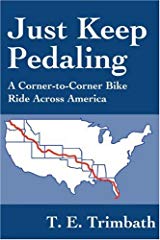
That sounds good, but the bicycle is the same venerable vehicle that carried me across the county twenty years ago. (See Just Keep Pedaling for details.)51fqu8xbkxl.sr160240_bg243243243 Even then, it was a ten year old bicycle. Now, when I took it to a shop to get one or two things fixed, they informed me that it was in such sad shape that they’d only sell me a new one (after I got on the months-long waiting list). So much for exercise. My storied bike was too dangerous to ride? I wanted a second opinion. Two weeks and $200 later, a bike shop at the other end of the island ($20 in gas for each trip) serviced, repaired, and replaced enough components to make it safe to ride again. (Looking forward to tomorrow’s test ride.) One consequence: I liked some of the new bicycles I saw in the second shop, and might buy one after I retire some other anxieties – after I help a few more people buy and sell some houses.)

And then there’s the mower. My lot is about 8,000 square feet. Part of that is house and carport (~1,500 square feet), part is driveway, part is garden, part is deck. The remainder that is grass doesn’t take long to mow. For my first few years here, I used a reel mower, a person-powered mower. That worked fine, except aesthetically; at least it kept the grass within neighborhood norms. Ah, but spring would come and there’d be a season of struggling to keep up, even on a small lawn. A neighbor got tired of watching me sweat, went onto craigslist, found a broken mower, fixed it, and gave it to me for free. A gift. A very welcome gift. Power!

Alas, it was old when he got it, and I’ve used it heavily for enough years that parts started falling off. The rubber flap that keeps the grass from flying out the back began to fray into nothing. The gate that turns it into a mulching mower blew open, so I had to wear a mask before it was popular just to keep from breathing grass clippings. I mowed through a green fog. The kicker though, was when I decided to get the blade professionally sharpened. It came back sharp, but also out of balance. The mower shook so much I was sure the shaft was weakening. The sound was terrible, louder than a gas mower. I know mowers can throw their blades and I worried. One remedy was to balance the blade with a grinder (which I don’t have), or to add weights. All it took was a double wrap of tape. Easy, cheap – and needed to be replaced about every twenty minutes.

The perceived threat of getting cut off at the ankles can create at least some anxiety. (Understatement.) For about $200 I took the leap and bought a brand new mower. (You’re allowed to gasp.) Quiet, smooth, clean, and worry-free. Worth the money.

20200714_171856

The money is the issue. Many of my anxieties, my stresses, and therefore my health issues come from having to hang onto whatever I can to get by. Keep in mind, that I’m making more income, have lower expenses, greater assets, and lower debts than tens of millions of Americans. Imagine what it is like for them. The three items above cost less than $1,000, which I didn’t feel comfortable spending until a recent house sale completed successfully. Before that sale and the ones that preceded it, $1,000 sounded exorbitant. After that sale, $1,000 sounds reasonable. For those with little, it doesn’t take much to make a big difference. One small improvement may mow a lawn, but relieve worry, and let someone move on to more important things.

One of the reasons I chronicled this here is for my own benefit. (And thanks for reading this far.) Within days of retiring these anxieties they become innocuous memories that are easily forgotten. I wanted to capture them to remind myself to celebrate them now, but more importantly later. It is also a reminder of those small things making big differences.

Next month is the anniversary of my Triple Whammy. About nine years ago I lost 98% of my net worth. My recovery from that isn’t over yet. These three items moved themselves up from the middle of a very long list of deferred maintenance of things, including my health. There are good reasons for me to be optimistic that I can retire those items and their anxieties. It may take months or even a few years, but as each is removed from the list, the recovery accelerates. One of optimisms for the future is precisely that phenomenon. So much worry, anger, anxiety, and despair can probably be retired for far less than most imagine. That would be something to celebrate.

As for trying to use the furnace, the bicycle, and the mower at the same time, well, I’m sure there’s a way. It might even make a good video. Repairing our collective sense of humor may be worth much more than we can measure.

Posted in Uncategorized | Tagged , , , , , , , , , , , , , , , , , , , | Leave a comment

Good Taxes During Bad Times

That delay made a big difference. The US government delayed the income tax deadline from April to July. That (and an able accountant) meant 2020 was the first year in years that I was able to pay my taxes on time in full without resorting to payment plans or credit cards. That’s a significant hurdle crossed in my journey through America’s wealth classes. I was able to pay my bills without worry. I feel like I finally have boots from which I can tug on bootstraps as I pull myself back towards a life that’s more sustainable.

The main trend continues. The more I make, the less I pay. Maybe that’s the influence of hiring an accountant, but it may also reflect the inverted nature of taxes in America. Income taxes are designed to demand higher taxes from higher incomes. All things staying the same, if I make more this year than last year, I expect to pay more taxes.

Check back through this blog and find a yearly progression that challenges that. Reach back far enough (though those posts may be abandoned by the host) and find a time when I was retired and paying almost nothing. As I recall, there was one year when I received a refund despite only having income from capital gains. Then, as I lost almost all of my assets, the amount I paid dramatically increased. Hence, credit cards or IRS payment plans. Money being spent to manage money that I owed while not making or spending much money.

Thanks to a friend’s amazing generosity, there was one year when I was able to pay, though I still had significant debt. (I didn’t expect them to provide the one gift, and certainly didn’t intend to ask them to clear everything.) Last year I was back to putting the taxes on my credit card, which has almost been paid off – again. There’s a good chance that debt will be gone shortly. Less money going out means more money to catch up on deferred repairs and maintenance of my business, my house, my truck, my stuff – and my health. Such seemingly simple hurdles can hinder too many, and I’ve seen it happen to me.

It’s hard to pull yourself up by your bootstraps when you can’t afford boots.

I can afford boots, now.

The two biggest differences have been generous friends and significant employment. I tried doing it alone, but years of hunting for jobs resulted in being turned down because I was too experienced (old), male (they specified they weren’t comfortable hiring men), knew the wrong people (even if I didn’t agree with them), and had the wrong address (really.) Of the few interviews for full time jobs (I can only recall two in ten years), one was particularly fascinating. They interviewed me because; “They didn’t believe anyone could have such an impressive resume.” (not verbatim but close) I met 22 of their 24 criteria, but they never intended to hire me. And they didn’t.

And now for something different. Welcome to real estate.

It only took about a year of urging from friends for me to try becoming a real estate broker. Fortunately, that’s a job that has one prime explicit criterion: passing the test. I did that. The prime implicit criterion is being able to survive long enough to begin earning enough money. The test and setting up the business may cost a couple of thousand dollars, but surviving long enough costs far more. This year, I expect to clear that hurdle, too.

If my taxes had been due in April, I would’ve been back in the same debt cycle. Despite coronavirus, I was able to earn enough money in the last three months to pay my taxes, as well as every outstanding bill in my in box.

For years I know I’ve been on the edge between poverty and a sustainable lifestyle. I could see both possibilities from where I stood. From there I could appreciate how tenuous my position was, and also feel dismay at the tens of millions of Americans who were on the wrong side, dismissed by rhetoric and ideology despite the reality that they were humans, hard-working citizens, who had the bad luck to be trapped in a system that didn’t, and sometimes couldn’t, care.

I made more this year than last year, and my taxes went down. I’ll assume that is due to the expertise of a professional tax preparer, and wonder if it is also because someone who identifies as a real estate developer has been given America’s most prominent position.

The pandemic has changed everything. While many places are shutdown, Whidbey Island, where I live, is in Phase 3 of 4 (for now.) The island is largely rural with only one large-ish city. Across the country, urbanites sequestered in condos and apartments are seeking escape to places where there’s more room. Sharing hallways, elevators, and laundromats is enough to convince some to consider a house with enough land to garden, and a large enough buffer to be able to wave at the neighbors without also worrying about their coughs and sneezes. I might be quite busy for quite a while.

The US tax system isn’t so broke that those with the least pay the most, but it is common to hear about those with the most paying the least, or nothing, or actually getting money (think subsidies and corporate welfare.)

Thanks again to those who are generous, those who are capable professionals, and whoever had the idea to postpone the tax deadline just a few months. You’ve helped me create a bootstrap I can tug on.

IMG_20200707_170941

It is a tiny bootstrap, and there’s only one per boot, but I’ll celebrate it anyway.

Posted in Uncategorized | Tagged , , , , , , , , , | 1 Comment

Semi Annual Exercise Mid 2020

Semi Annual Exercise Mid 2020

Six months ago, who thought the world would look like this? (Let me check my notes. Nope. I was reading about but didn’t start writing about the pandemic until February 2020.) Six months from now, who can predict how things will be. During the next six months there should be an election, an economy that’s stumbling to correct itself, protests, frustrations, and resistance to change that is being overwhelmed by circumstances and collective actions. So, sure, why not, let’s look ahead, behind, and in the mirror for a bit. This is my semi-annual exercise. The rest of the world may be in turmoil, and that may be the best reason to maintain some structure and continuity, while also trying to decide whether to change investments in stocks, time, and money. For this post, stocks.

Of my five remaining stocks (from what had been a diversified portfolio of about a dozen stocks about a dozen years ago) the price of three hasn’t changed much (AMSC, LCTX, NPTP) while two have more than doubled (MVIS, GERN). Of the five, all are Long Term Buy and Holds (LTBH): (AMSC 2003, GERN 1999, LTCX via GERN 1999, MVIS 1999, NPTN 2017 though that was in response to LMRA spun off from MVIS 1999). These are the remnants of that portfolio where many of those stocks were held for years then sold for significant profits (AOL, PIXR, SBUX, MSFT, CSCO, AMAT, FFIV, etc.). Are these the weeds that I shouldn’t be watering, or are they seeds that are about to sprout? 

AMSC may not be dying off, but it also seems to be growing like a low ground cover rather than the towering tree that was supposed to “do for electricity what fiber optics did for telecommunications.” Of the five, it is my most likely candidate to sell, despite the need for its technologies that improve the efficiency of the power grid.

GERN started with four prime technologies aimed at revolutionizing health (GERN – Geron – gerontology, get it?), but is down to one which, if proven, can be a cancer vaccine for more than the blood disorders it is currently targeted towards. That’s worth hanging onto, but also risky enough that I don’t count on it. 

LCTX includes one of those GERN prime technologies (stem cells) that is inspiring as it has the potential and has proven somewhat to repair damaged nerves in accident victims without the use of mechanical devices or implants. Yeah. I’ll hold onto that.

MVIS, ah MVIS. The more than doubled stock price reflects a cratering of credibility that drove the price from ~$0.75 down to $0.15 then the almost substantiated news that an MIVS component was spotted in a Microsoft Hololens unit. Add in the typical rumor mill of other contracts to be announced ‘real soon’, and the rise to a price of over $1.30 makes some sense. I may have missed the bottom, but with companies with communications as poor as MVIS’ I prefer to wait for significant, quantifiable, positive news. Risk and reward. Can’t ignore it.

NPTN replaced my shares of GIG that came from LMRA that came from MVIS. The need for high-speed electro-optical switches has increased through these years, which is why GIG finally became profitable (Yay!) and then was bought out (Boo.) for far less of a premium than a shareholder could’ve enjoyed if the company remained independent and public.

Which catch-phrase comes first in the list of many? Persistence pays. Address an unmet need. Buy low, sell high (buy small companies and sell them when they are large.) Embrace change. Don’t try to time the market Or. Don’t water the weeds (as I said above.) Cut and run. You can always come back later. Don’t try to catch a falling knife.

The pandemic, social unrest, climate change, and politics are having a massive impact on personal finances. As I mentioned in my book (Dream. Invest. Live.), Dream Invest Live coverone of the reasons I invest in small companies is to sell when they are large. Another reason is that small companies don’t necessarily trend with the market. The market, as reported, is not representative of every company or stock. The market is reported on as the Dow, the NASDAQ, and the S&P 500. Those indicies are dominated by fewer than a few dozen very large companies. 

The very large companies tend to defend the status quo. I wish I hadn’t sold my AAPL in protest back when they fired Jobs, but look at what and how Apple managed to disrupt several industries after spending years in dire situations. IBM stock has not done as well. 

I believe we need to use energy more efficiently, to introduce less traumatic and more effective treatments into medicine, to get past the era of the computer screen, and wider and deeper adoption of telecommunications. That’s what I felt at the end of 2019. It is also what I largely felt in 1999. The various crises we are experiencing don’t change that, and in some cases amplify the need. As the companies progress, they are also making larger positive contributions, which are hopefully reflected in the stock price.

The economy has been hit by the crises, but it has been fundamentally unstable for years. We continue to add poles to prop it up a bit longer, but I worry about the effects as some of the temporary props are removed, or fall part. Increased debt, fewer jobs, supply chain disruptions, and geo-political mismanagement will probably take longer to correct than the time it takes to develop a vaccine. 

In six months, hopefully the US election will be resolved peacefully and justly, hopefully the pandemic will be under control, and hopefully justice will be fairly and evenly applied to people’s concerns. Hope.

My main investment may be myself. I’ll watch and manage my stocks, of course. In uncertain times, stress arises from a feeling of a lack of control.  I can’t control the markets, but I can control whether I buy, hold, or sell. I can’t control the economy, but I can control many of my expenses, and I can try to improve my income. 

Here are the links to the discussion boards I use. Those discussions are less philosophical and hopefully more practical. Feel free to comment here or there, and to pass along links to others. The bigger the discussion, the better the chance of valuable insights (as long as the trolls and flamers are moderated appropriately.)

Investor Village

AMSC

LCTX

GERN

MVIS

NPTN

The Motley Fool

AMSC

GERN

MVIS

NPTN

Silicon Investor

AMSC

GERN

MVIS

Reddit

MVIS


Posted in Uncategorized | Tagged , , , , , , , , , , , , , , , , , | Leave a comment

Twelve Months At Possession Beach

A dead whale. A dead grey whale. Then, bones. Eventually, nothing. And some people wonder why I continue to produce twelve month essays and studies. Twelve Months At Possession Beach is the latest of my twelve month series. Fortunately, the majority of visits smell better than a dead whale, but there’s always something interesting – even if it takes twelve months to realize it.

Possession Beach cover - draft

(Full the fuller set of links and description of Twelve Months at Possession Beach, check out one of my other blogs: AboutWhidbey.com.)

OK. A dead whale is smelly and gross, but I was there to take pictures. Why include it? There are vistas, flowers, wildlife, tides, storms; and for Possession Beach and Possession Point there are beaches, salt marshes, bluffs, forests, and trails.

0322_Autumn Suspended

Many people travel by checklist. Saw this site, check it off, move to the next, repeat. They get to see everything, but each becomes a snapshot, one glimpse of a place from one moment. It’s like speed dating, but they never call back.

My approach to travel isn’t exactly getting married to a spot, but by accidentally starting my twelve month studies I’ve found myself looking at, experiencing, and on occasion smelling a variety of places in the Pacific Northwest. 41hreqcqdkl.sr160240_bg243243243(Read Twelve Months At Barclay Lake for how the whole thing got started.) It may not be marriage, but I find myself developing a relationship to a place that isn’t based on one good or bad day, but on how a place feels throughout the seasons. Weather changes. Crowds change. Nature changes.

Travel is more difficult, now. People who would’ve casually planned a trip to another continent might wonder where to go, instead. That doesn’t have to be difficult. Everywhere you go, someone thinks that’s the place to be – and someone else wants to leave as soon as possible.

Whenever I hear about someone wanting to fly to another country to experience another culture, I wonder if they’ve traveled within their own city, county, state, nation, or continent first. Washington’s culture isn’t the same as Washington D.C.’s culture. Is this something we’re missing, when people in a country are more interested in other countries without knowing more about their own? Imagine the food! You want decadent? Try anything deep-fried from the Southeast. Want experimental? How about some Asian fusion from the Northwest? Want to understand “them”? A visit to “their” neighborhood may only take a few hours, but it may provide insight into discussions that are already taking days of some people’s lives. On one visit to the southeast, I had one halting conversation with an elderly black man, and another with white folks who boldly celebrated “kicking the Yankees’ butts at Vicksburg during the War Between the States. 51fqu8xbkxl.sr160240_bg243243243(Chronicled in Just Keep Pedaling.) We’re not all alike.

Picking someplace new every time costs time, a precious resource. There is effectively an infinity of destinations. Checking them off, and then deciding yet again which to visit next also means spending time reinventing travel arrangements, what to pack, and who to have along.

Returning to one place several times throughout a year simplifies the escape. Clothing changes, and weather may get in the way of travel, but that’s part of life. Visiting several times means not having to squeeze every experience into one trip. By taking pictures and notes, I spend more time noticing changes. A lonely and wet Wednesday in March will be dramatically different from a crowded and sunny Saturday in August. Looking back at those photos and notes makes it easier to see the changes. In some places, it confirms that Nature is resilient. In other places, it becomes obvious that there is no “preserving the land as it has always been.” The mammoth bone I found on one beach certainly wasn’t from a herd that’s still here.

The whale, though. Whoa. The whale. How many different stories are there? Whales in the water are magnificent. They’re one of the reasons I enjoy living by the Salish Sea, particularly on Whidbey Island. But standing on the shore and seeing a whale in the water is at least somewhat remote and ephemeral. They’re always at least some distance, they rarely stay in an area very long, and only part of them is visible. That’s way more than enough compared to my childhood wandering through the Pennsylvania woods (which included creeks with a whiff of sewage, depressions that turned out to be the collapsed roofs of abandoned coal mines, and houses never far away.) But seeing a dead one taught me new things.

When I first saw the whale I thought it was another rock on the beach. I knew better. The bluffs shed sand frequently, and boulders occasionally; but the boulders are easy to spot. I’ve tracked one from being barely noticeable, to jutting out from the bluff, to where it fell onto the beach, to the growing gap between it and the hillside. This was too big to be such a boulder. But, it didn’t smell and I thought I was downwind. (Later I would find the smell had permeated my clothes. Laundry!)

The rational mind can carry too perspectives. Dead whales are so rare that there could be a different explanation. That ain’t no boulder.

It is bittersweet finding a dead whale. It is a rare event, which can be a thrill; but it is also a sad event. Too many of the dead whales in the Salish Sea die of starvation. I can also take a hint. Whether Nature intended it or not, I wasn’t going to ignore the opportunity to watch what happened. By the way, I also called Orca Network to report a dead marine mammal, as anyone should. They knew about it, which explained why parts of it were anchored and tagged for research or to be displayed or both.

Each visit added to an experience that is more than I want to shove into one blog post. Personal experience is richer than reading about someone else’s. That’s why I am a fan of travel.

The first visit was after the whale was dead for a while. The skin was turning from grey to a surprising mix of colors.

9722_Whale Abstracted

By the time of the second visit, most of the flesh was gone, revealing a cathedral of bones draped in remains and seaweed.

9813_Whale Cathedral

Within several weeks, what was left was mostly a curve of spine that was slow to break up.

0114_Whale Backbone

A few larger bones, either from the head or the hip, stood apart, weathering  to translucence.

0462_Whale Translucence

And then, it was all gone, or at least distributed to the bellies of birds and crabs, with some pieces heading to labs and displays.

And then, and then… The changes in flowers and migratory flocks of birds and people were enough for a year of stories. That is always the case, at least for me.

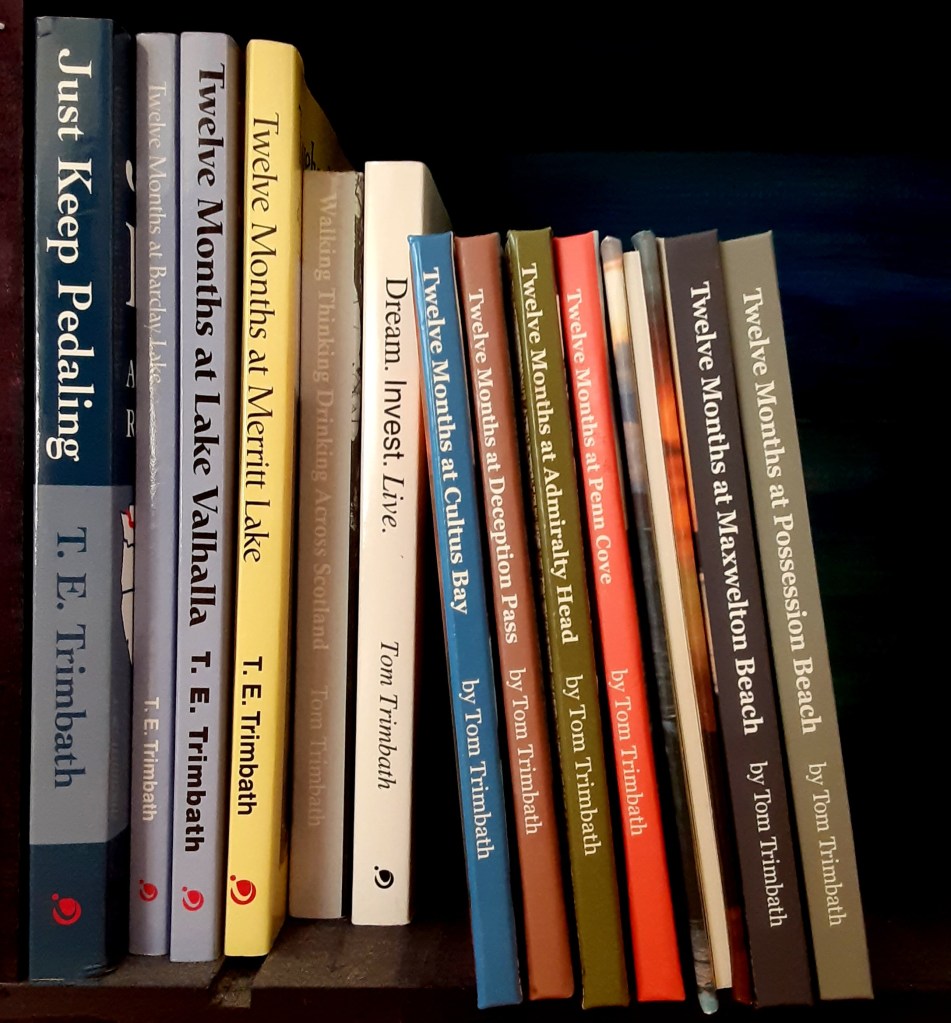
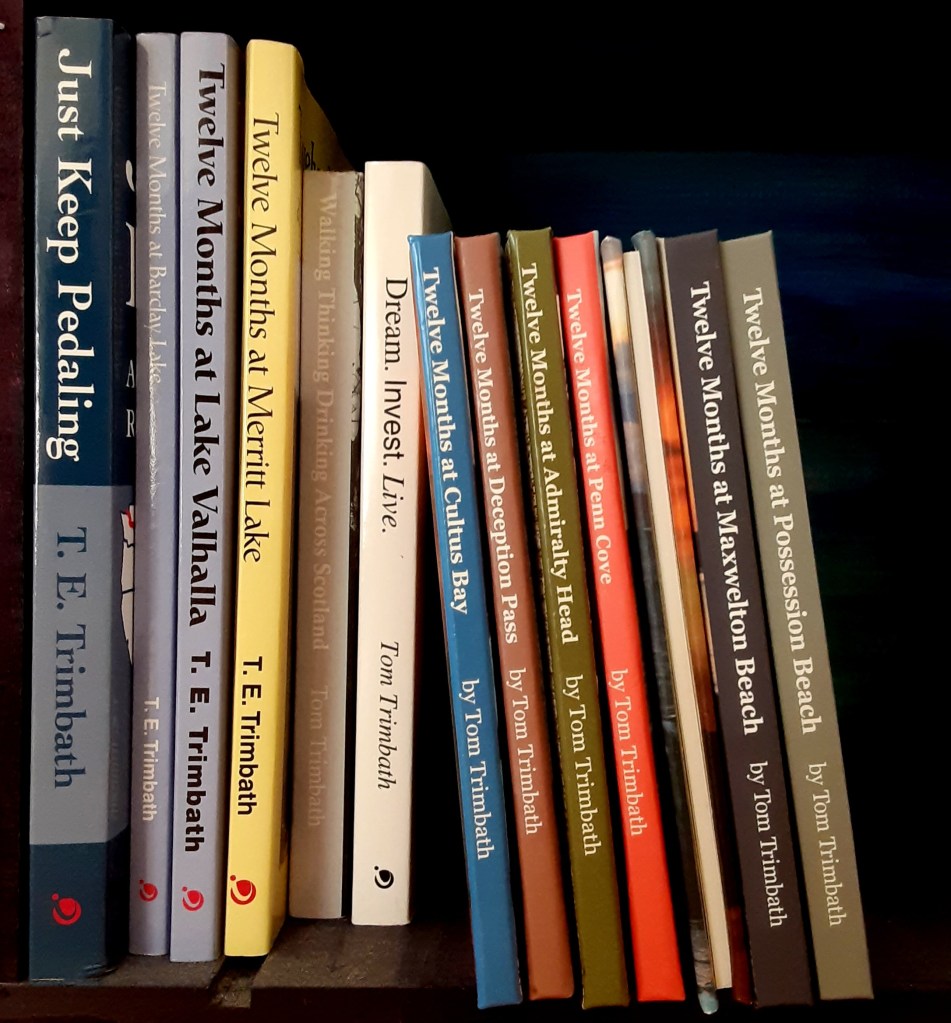
I am working on the twelfth in the series. The first was in the Teanaway Valley, but I didn’t record it. The next three were in the Cascades: Barclay Lake, Lake Valhalla, and Merritt Lake, bracketing three climates across the range. After I moved to Whidbey I started the photo series (as photos to print and as photo books): Cultus Bay, Deception Pass, Admiralty Head, Penn Cove, Double Bluff, Maxwelton Beach. And now Possession Beach. And now the next one, which is in month six of twelve.

Visiting a place over twelve months isn’t traveling as broadly, but it is traveling more deeply. In these pandemic and economic upset times, it is also nice to have a way to cheaply and easily get out into the world, to get out into Nature. Nature was here first. Nature will be here for millions or billions of years. The rest of the news is about layers we drape over a reality that has a lot to teach us. It is reassuring to look beneath those layers for lessons that are more eternal, even cyclical.

Posted in Uncategorized | Tagged , , , , , , , | Leave a comment

Thankless Kindness

I’m going to start with thanks. If you are dutifully wearing your mask when appropriate, washing your hands frequently, and maintaining social distancing, I thank you. I say it here because if I say it when we meet it might just sound like mumbles muffled by fabric and social distancing. Seeing herds of tourists walking around without masks, or distancing (and I’m not going to ask if they wash) made me wonder about how much society relies on layers of thankless kindnesses – and whether this time next year kindness or arrogance will rule. And, because this is a personal finance blog, I wonder what that means for jobs, investing, and life in general.

I live on a touristy island which has a few touristy towns. It’s June. It’s the season for tourists to arrive.

Langley from calmer days

Coupeville from calmer days

Real estate has been busy during the crisis. People want to escape the density of concrete canyons, or condos, or at least move to some place with more space. I get to work with the people making a commitment to live such a life.

Tourists are escaping the same things, but temporarily. They’re escaping tight restrictions and looking for a way and a place to relax. Evidently, they forget that many of the rules they’re trying to escape and in force, here, too.

There was a rare break in my day, today. Generally, I like the tourist towns – from September through May. Otherwise, I shop in other parts of the island. Believe it or not, there are shops that are selling more than gifts and souvenirs. But, there are some special items that are only available in the midst of the crowds. Some of them are health-related. Some of the items support my work as an artist. (Stay tuned for my next book which is in the mail. I’ll announce that when it arrives.) So, I parked on the outskirts, put on my mask because I do anyway and because the town has edicted that masks are required, and set out to say hello to friends and do my chores.

And there goes a maskless team of eight, packed together, no distancing, and roaming along the sidewalk aimlessly. I suspect they didn’t notice me standing back from them by about eight feet until they passed. Just a part of the scenery to ignore. In the next hour I would guess that about half of the people in town were maskless. None were people I knew. All of the people I knew were wearing masks. All of the people I visited were working there, sustaining the town, all running essential businesses. My friends were making the tourist town attractive enough to draw people to the island (and make it better for the locals throughout the year), and yet were probably not going to be thanked by the very people whose health they were defending. From what I see in the news, the maskless are more likely to get upset than to say thank you if asked them to wear a mask, too.

Somehow, (gasp, how?) the last few years people have been encouraged to be more selfish, less considerate, and less compassionate. The majority of the protests seem to be trying to counter that trend. I don’t know what will return us to common courtesy, manners, politeness, and community. (If my mother was alive and we let her run the country, well, this would get turned around real quick.)

Do you see where this is going? Human cultures continue to mature, but it looks like we’re still in an adolescent phase where we’re obviously growing up. We’re also obviously dealing with acne, greasy skin, hair that won’t behave, impulses that seem like a good idea at the time, and occasionally saying deeply embarrassing things that we may regret later, too late. Jobs, investing, and life in general are things driven by logical advice, mature advice. Human culture is also a mix, like a high school. Some are trying to act responsibly. Some 14 year olds act like they’re 41. Others act like they’re 4.

We’ve progressed because enough mature people and enough resourceful people have lived constructively and in community. We’ve also progressed because of inventors and revolutionaries who also live constructively. Even their disruptions are intended to be positive. At least in the US, inventors can become wealthy. They at least get that for thanks. The dutiful employees, however, may get a paycheck and a rousing speech if their company does well. Considering how much has been accomplished to get us here and now, that’s little thanks.

We’re also witnessing the result and the value of those centuries of efforts as we suddenly find ourselves missing things we took for granted. (My hair, oh my hair. I’m starting to look like a cross between Santa Claus, Alfred E. Neuman, and Albert Einstein. And, no; I am not including a bio photo.) Some become more appreciative of what they must give up temporarily. Others cry like 4 year olds who’ve been told to go to bed on time.

Jobs, investing, life.

We’ve seen it. Most jobs are thankless, even if they are essential. Maybe this is the precipitating event that changes that.

As currently designed, investing favors the wealthy, but allows anyone to play. (And yes, at some level it is play. Think about how often you hear about winning and losing when it comes to stocks.) The investors in small companies, the individuals who tell others about the company and its goods or services may be thanked with a rising share price, but they probably don’t get their fair share of the credit. They may become thousandaires or maybe millionaires, but if my shares become worth ten thousand dollars, someone with a hundred more shares will become worth more than a million dollars regardless of anything either of us did beside accumulate enough money to buy the shares. That’s true, except for the people who benefit from executive compensation packages that can escalate even as a company flounders. They may put in fewer hours than some investors, do less to market the company, yet be paid richly.

Life is largely thankless. I never thanked my parents enough. When I’m driving, I’m more likely to notice someone doing something dangerous than someone who obeys all the rules, guidelines, and laws. I do notice them, however. 51fqu8xbkxl.sr160240_bg243243243When I bicycled across America (Just Keep Pedaling), many people would ask about how I dealt with the drivers who would blast their horns at me, maybe swerve towards me, or shout insults as they sped past. Standing by the side of the road during a break I realized how many thousands of cars and trucks passed me every day, dutifully, maturely staying their lanes. After a while I realized there was usually only one bozo per day (except in Kansas and maybe Arkansas, shudder, where it was one per hour). I had to respect the threat a bozo could be, but also look at how many tolerated me. A thousand to one? And there was no way to thank them.

I’ve watched people put up their guard when I deliver an unexpected thank you. It is as if they are expecting a sales pitch to follow. Too often when we get some news the sweeter the coating the more bitter what’s inside. Maybe that’s something else that can change in this culture.

How does this affect my personal finance? I look for the positive in my job(s). (Which can be REALLY tough some days.) I also concentrate on investing in companies that are positively disruptive. Sadly, I also don’t act surprised if essential workers aren’t treated well enough for them to afford the essentials.

I am not a parent, but I can recognize thankless kindness in what they do. Just as all of us move society by our actions, parents move along children. Almost all of that is thankless, but at least we recognize it in parents and others with a simpler word. Love. Thanks to all who love.

Screenshot 2020-06-17 at 19.04.34

PS While Island County (the home of me and the tourist towns described above) is possibly entering Phase Three, the United States of America is no longer projected to reach zero deaths per day through October. Currently, over 700 people are dying per day and the total deaths projected by the start of October exceeds 200,000. People. 200,000 people. At that rate, our hard-fought Phase Three progress may be lost. Thank you for wearing your mask, washing your hands, and maintaining appropriate distancing.

Posted in Uncategorized | Tagged , , , , , , , | 1 Comment

After Covid – June 2020 Guesses

It has been happening for the last month, articles about what will be different after Covid-19/coronavirus is done. Most know we won’t go back to the old normal. But no one can accurately predict the future except by chance. Regardless of the articles I’ve been pondering the possibilities, too. I think about such things to begin adapting now, and to consider possible investments. Welcome to some of my notes, thoughts, and observations. Besides, writing them down here makes them easier to find if I ever want to check back. This will NOT be comprehensive, guaranteed, or authoritative; just one person’s perspective.

Deliveries

Have you developed the habit of getting more things delivered to your house? My local postal carrier says the Post Office’s workload feels like Christmas, not the celebration part, the frenzied delivery part. Delivery was popular before the pandemic, became a necessity during the lockdown, and will probably not retreat because it really is an affordable luxury. Sometimes it is even cheaper than shopping. The gas for driving to the store to replace a burnt-out light bulb can be more expensive than the bulb. Sure, waiting until the list is long enough to make the trip, but why wait? USPS, UPS, and FedEx drive by the house every day. No extra gas spent. No extra wear on the car (or truck.) No time spent driving, parking, and remembering the parking spot. Besides, someone is undoubtedly buying things they wouldn’t want to pick up in person.

Robots

Businesses are advertising touch-free service. Humans = ick. Shrink wrapped packages, industrially-processed things, including food, can alleviate some anxieties when there was no one who could sneeze on what you’re buying. The same is true of the deliveries mentioned above. Robots, whether on wheels on the sidewalk or as drones flying in from wherever reduce the number of people touching each package. Also, robots can do things humans can’t, like be immune to contagious diseases. It is also easier to sterilize a robot. Humans are human and can forget to wash their hands. Autonomous taxis may not be as efficient as a fully-loaded bus, but which are you more likely to feel comfortable in?

Artificial Intelligence

AI has much in common with robots, but AI also lives in algorithms. We humans have created so many dividing lines within our societies, that some will prefer a mindless artificial intelligence instead of a person who may care more for their agenda or ideology or prejudices. AI isn’t perfect, either. At its core is the work of human programmers, so biases may be built in; but the appearance of impartiality can be appealing. We may have balked at the idea of robotic cops, but how many communities trust their police forces even less? We may create and welcome our artificial authority figures.

Necessities

The recent months tested and proved who is really essential and who is simply celebrated.

“Something I’m looking forward to, a political party built from postal workers, police, firefighters, EMTs, nurses, doctors, drivers, delivery workers, grocery clerks, farmers, ranchers, teachers, people making less than a living wage, people who need community – and others for easily overlooked. Imagine a party that represented that power, instead of the party or simply opposing the other party. (Disclosure: Independent)”

This pandemic may be the prime example of who is truly essential and who deserves more than they have been receiving. Actors, professional athletes, can be fine people and I’m not surprised they can command large paychecks. But, I’d rather hear that the majority of the flamboyant salaries were spent on everyday arts. Some movies now make a billion dollars in a weekend. How many art classes and schools could be sustained with one movie’s revenues? Billions are spent on stadiums for billionaire owners of teams filled with multi-millionaire athletes. If a city spent half of a stadium’s cost on parks and amateur sports, the public’s health would be improved, and better able to counter viruses. If the national leagues can’t afford the stadiums, maybe they should reconsider their priorities rather than make us set aside ours. Maybe unions will return, hopefully without going too far the other way. Power can corrupt. We’re spending more than enough, but the people who need it aren’t getting as much as they deserve.

Health Care

It will be amazing and sad if this pandemic doesn’t change and improve global healthcare. We’re connected. Keeping people healthy in one country can keep other countries from being infected. Enough examples of good systems have been proven and tested that other countries have to actively decide to ignore better ways of doing things.

Reduced Inequality

Trillions of dollars are involved, which may make it more difficult to reform; but the wealthiest people demonstrated how vastly different their lives are from everyone else’s. Billionaires’ wealth has increased during the pandemic at the same time that tens of millions are getting token assistance. The money may be on the side of the wealthy, but the votes should be on the side of the crowd. If more money flows through taxes or better wages to those who don’t have enough, the economy could see increased consumer spending, improved health, and less unrest. It is a battle that has begun, with the main event in the US being November’s election.

Possibly Obsolete

Cruise ships. They may still have fans, but fewer. They may difficulty finding crew, especially considering how many of them have been stranded at sea for months in terrible conditions.

Airplanes. There will be a demand because, unlike cruise ships, air travel remains a necessity; but tourism and family visits may be less. Though there may be a short term spike as restrictions are relaxed and some pent-up demand is alleviated. That will take a while, though.

Restaurants. Are you still looking forward to dining out? Sure. But many people are now better cooks than before, and more aware of how much comfortable it can be to dine at home. Even if they don’t cook, home delivery is convenient. If only there was someone who could come by and do the dishes.

Opportunities

Home entertainment. We know the pandemic can come back. Anyone who was bored during the lockdown may decide to stock up on books, games, and better electronics.

Home office. Being able to shut the door, have more than enough bandwidth, and have a professional looking office may encourage folks to buy houses with the right rooms, on a good internet trunk, and maybe spend a bit more on office furnishings.

Rural Distancing. Urbanization has been a trend, just like globalization. Being trapped in a city, densely packed, far from food, and with little personal space is already creating a systemic demand for having a least a bit more land, maybe some place where it is possible to grow your own food or buying from a real farmer’s market. Even a small garden on a small lot allows some relief and supplies when compared to an apartment on the sixteenth floor. The acoustic barrier alone could be valuable.


During disruptive crises, the best opportunities can be in ways people can’t imagine – except for the people who create, invent, and innovate new solutions for the new world rather than trying to accommodate lifestyles that are quickly becoming archaic. Bicycling is becoming popular, and cities are adapting. Hopefully bicycle manufacturers will emphasize practicality over mimicking competitive cycling. Online working, visiting, and learning are in the midst of a rush of traffic; but that’s largely been through existing solutions. Would this be a good entry for augmented or virtual reality, or both? And of course, fashion. Someone is going to design a mask that is stylish, can be worn as necessary, and dropped and carried while looking like a tie or scarf.

Just from these notes I’ve picked up some ideas for my investments. 1) Make enough money to pay my bills plus enough to invest. 2) I’ll skip the big deliver companies because they’re already too big for my investing style; but I will watch for innovators using drones to deliver to places like islands. (A personal bias) 3) Increased robotics, improved consumer electronics, reinforce my interest in companies like MicroVision (I can hear the groans, at least internally) because they can enable such innovations. 4) As for health care, wealth and income inequality, and the dismantling of obsolete organizations, I hope for governmental change. 5) I’ll skip the travel industry, though see an opportunity for foreign travel to shift to local travel, just not part of my investment style. 6) As for rural distancing, I’m witnessing that as a real estate broker on Whidbey Island. Urban to rural is appealing to more, now. Islands come with a bonus: a moat. That’s also why I am having 1Gig internet service installed in my home office, and with the next commission check I’ll probably make the place nicer – or at least find better ways to hide the clutter.

There’s more. The discussions of what comes next (see Practice Pandemic) will continue until the results are so obvious that they aren’t worth mentioning. In the meantime, I’ll continue to wonder about the world, and wear my mask. The number of Covid-19 cases on my island is down. Washington State is making impressive progress. Beyond that, however, the number cases globally is increasing, not decreasing. Over 400,000 have died and estimates suggest months before the curve is contained, partly because so many places with ineffective controls are already rising again. We’re all part of the same species on the same planet. We’re witnessing changes that will reach across borders and boundaries. I wonder what’s on the other side.

Screenshot 2020-06-05 at 14.33.46

Island County

Screenshot 2020-06-05 at 15.06.43

Washington State deaths

US

Screenshot 2020-06-09 at 18.59.20

US new cases

Screenshot 2020-06-09 at 18.58.55

Worldwide new cases

Posted in Uncategorized | Tagged , , , , , , , , , , , , , , , , , , | 2 Comments

Book Value Incentives People

Life in the weird zone continues. It’s 2020. There’s also a full moon, but full moons don’t last 365 days (unless you get into some tricky lunar orbital mechanics, but I digress.) Understanding people is so difficult that religious leaders, trained psychologists, and anthropologists have work, never-ending work. The rest of us just get to shake our heads (and sometimes fists.) A recent example is playing out in one of my investments. That may be the safest environment to comment on, currently. You can draw parallels (or squiggly lines, if you prefer.)

(The following is a heavily paraphrased discussion.)

“But, it is obvious. Take the value of these assets, and even if you ignore income and expenses, the company is worth x and the stock is worth x/(number of shares). Right?” 

“Yes. No. But reality is different.”

Finance and investing seem like they should be logical, based on data, constrained by legalities, and independent of luck and chance. Yes. No. But.

There are many ways to estimate a value for a company. Some investors invest that way. That’s a separate discussion.

Investors are people. Even the institutions that allow algorithms to dictate actions, people are still involved in choosing the algorithm and deciding whether to implement or countermand its suggestions. Investors and institutions do not have infinite resources. They may have far more than enough, but they can’t do everything. They can’t chase every opportunity.

Individual investors have more freedom but fewer resources. Active investors must decide which stocks to own. Individuals have different values, capabilities, and opportunities. It is understandable that it can be difficult to understand an individual’s actions. We’re all just people, humans, silly creatures that are trying to figure our way through the world.

Institutions seem like they can be more logical because they aren’t as affected by the seemingly trivial disruptions that happen in every life. They should be able to analyze all of the public corporation data, rank the results, and distribute funds accordingly. Find companies with cheap stocks relative to a variety of criteria, track those criteria, and adjust accordingly. Logical. Methodical. Probably true, sometimes.

An analyst published an article, probably more than a decade ago, that described the reality of their job. Sure; the computer produced a stack of stocks to consider. Supporting documentation, error bands, competitive analyses, etc. gave the analyst more than enough information to make a decision. But that’s not what really made the decision.

The analyst had to decide which of the prospective stocks met the computer’s criteria, the firm’s criteria, the analyst’s criteria, and their boss’ criteria. It was those last two that made the process human, and sometimes seemingly illogical.

The analyst was part of a team that competed against outside and inside competitors. Once a week the analyst had to attend a meeting to present their recommendations. It wasn’t just about the numbers. It was also about the people in the room. What was best for their job? Recommending something someone else recommended wouldn’t get them more attention, or a raise. Recommending something too obscure was too bad, too. If there’s no demand for the stock, maybe there never would be and the investment would never become profitable. In that environment, quicker profits were preferred over long term profits. It was necessary to find that balance between too little and too much risk. Anything proposed also had to meet the criteria of whoever was making the decision. Do they have a preference? Do they avoid certain industries? Is there a grudge or a fan reaction? The best investments could be ignored because of the wrong image, timing, or because they’re too complex to describe in a short intense meeting where dozens of simpler stocks were being mentioned.

My friend’s analysis was logically and mathematically valid, but it was for a stock for a company with an un-trusted management culture, a technology that is too innovative and risky for some, and a history of poor finances. It might be valued at less than its assets, and may eventually become a phenomenal success, but for now it might be too much trouble for an analyst to recommend.

The analyst’s job is supposedly to find good investments, but their incentives are to keep their job, advance their career, and get paid along the way. That doesn’t mean finding the most profitable long-term stock, but finding a series of stocks that are profitable enough and appealing enough to prove the analyst’s worth soon enough.

The analyst’s meeting was more important than the computer’s results.

I saw something similar happen when I was struggling to avoid foreclosure (which was successful thanks to some excellent help. See My Mortgage Modification.) I heard many people talking about the bank hoping to benefit from taking ownership of my house, or that the mortgage servicer would appreciate any money I could send them. The calls I received from the mortgage servicer were traumatizing. I’d shake for days after some of them.

A friend who worked in the field for a short while pointed out that the banks and the foreclosure had little to do with the people I talked with. The people I talked with were paid to be part of the foreclosure process. If there were no foreclosures, they would lose their jobs. Their incentive was be part of the process. The longer the process, the longer they had a job. Whether the banks wanted the properties or not was secondary. There were no obvious incentives for them to make the process more efficient or fair or compassionate. My friend also pointed out that one incentive for some of the employees was the opportunity to be nasty over the phone in ways they never could in person.

As a real estate broker (with Coldwell Banker 360 Team on Whidbey Island – a state-required disclosure that interrupts this narrative), as a broker I’ve watched a similar dissonance. As someone said; “It’s obvious that everyone’s goal is to make as much money as possible.” Yes. No. But reality is different.

Aside from money, there’s also time. “Get me out of this place! Now!” or its corollary “Get me into the place! Now!”. There’s complexity. Sometimes great deals get too complex, or simple deals fall apart because the property’s details are too complex. Too much of a good thing is too common. And then there are human elements like neighbors, the distance to family and friends, and what the other generations in the household might think.

And then there’s the rest of the world. As I watch advocates and deniers, marchers and enforcers, and the general voting public I also know that logic isn’t as fashionable as feelings. Wearing a mask or not is rarely a choice made after analyzing infection rates; many trust the authority figures, others trust conspiracy theories. By the way, people who believe conspiracy theories don’t see them as conspiracy theories. They trust and believe a different set of authority figures. I ask, what is everyone’s incentive? Fitting in with a particular crowd? Being on the “right” side?

This post is being published later than usual because I spent too much time trying to track down a specific quote. It might be from a sci-fi author. It basically said, everyone does what they think is right, even if they don’t like it. Even if someone does something purposely wrong, there may be a fundamental value in doing that is effectively “right” to them. There’s that human need to belong to a community, or maybe try to prove to a community that they should be included. And, of course, one person’s “right” is another person’s “wrong”.

We humans have only had a global civilization for a few decades. Our psyches and bodies take longer to evolve. It was easier to understand each other when villages were small, and everyone knew your name. We’re clashing as we’re mixing. But I keep in mind that “we” and “they” are stereotypes and labels. Crowds and causes are a mix of individuals and their individual incentives. As I watch the news I wonder about each person in each crowd and wonder if we’re getting closer to similar incentives or further from them.

As for my friend’s analysis of the stock we both own, yes, the analysis looks valid; but I suspect the analysts won’t look at the stock until the company proves there’s sufficient incentive for other investors to invest there, too. We and they are only human.

Posted in Uncategorized | Tagged , , , | Leave a comment

Contrarian Rebellion

This will not be a shock for folks who know me, but once upon a time I went dancing. In the midst of a crowd where I didn’t fit in, I realized an entertaining way to rebel legally is to ignore the crowd. It may seem odd, but that helped me pick my investment strategy. But first, let me reminisce about dancing, because, why not?

Set the way back machine to the late 80s. I hadn’t danced in a decade, but when a friend asked me out, I said yes. (This was back when women asking men out was scandalous, almost. Actually somewhat rebellious, upon reflection.) Life in the suburbs was not for her, so she suggested we head into the heart of Seattle’s avant garde scene. It was a goth club. The walls were black. The clothes were black. Much of the make-up was black or bright red. Practiced scowls were more common than smiles. She wore something a bit more fitting for the place. I was an engineer; so of course, I wore a polo shirt and chinos. I stood out.

A few years earlier in my early twenties I would’ve felt the peer pressure as a bunch of strangers peered at me. Instead, after a few minutes I began to smile, then enjoy the evening. I was rebelling.

The others in the club were rebelling, too. Goth was new. They were serious about it. They were doing something different. They were so determined to do something different that they were all doing the same thing. They’d accidentally turned unconventional into something conventional, at least within their environment. By being conventional I was unconventional in their space.

Rebelling, or being contrarian, does not have to mean breaking the law, or regulations, or even guidelines. There is an infinity of possibilities within society’s borders that can startle most people. Treat the speed limit as a limit, not as a minimum, average, median, or a goal. Try driving one or two miles an hour below the legal limit, and get comments and gestures. Become a minimalist and a millionaire during the Me Decade and make people wonder what’s wrong. Be honest, and people may not trust you because why would anyone tell the truth, at least in some circles. Imagine an honest politician. Some can’t even though they must exist.

Investing in stocks is risky. Many individual investors invest by following the crowd. Everyone else is buying MSFT? OK. Buy MSFT. Everyone’s doing it so it must be good. I bought stock in AOL. (I’m realizing some people no longer get the reference. Oh, how the mighty have fallen, or at least faded.) People and pundits laughed at it. How can an online business make money? SBUX. Who will pay over $3 for a cup of coffee when 7-11, Denny’s, and Dunkin Doughnuts has it for far less? PIXR. Movies made on computers? That can never compete with Disney’s hand-drawn art on every frame. Want details? They’re in my book, Dream. Invest. Live. I also have examples where that approach didn’t work. Dream Invest Live cover

(Late addition: Imagine using social media as something social instead of as advertising, and being grateful for what it provides for free because it is free.)

Maybe I am on to some radical, rebellious strategy. Nope. Charles Schwab advocated buying overlooked companies that are therefore temporarily cheap. Warren Buffet is known for buying unexpected companies.

Those who invest only when commentators are upbeat end up paying a heavy price for meaningless reassurance.” – Warren Buffet on Motley Fool

With an attitude like that, bad times can be good times.

The stock market reports in the evening news are about the crowd, the companies and stocks that were also in last night’s news, stories that can be told in fewer than ten sentences. Listen for the “moo” as the herd heads this way or that based on the movement of the herd. The herd may not know where it is going or who decided to go that way, but that’s the norm.

The stock market swings from irrational optimism to irrational pessimism. In both cases people respond as if whatever is happening will continue happening forever. Has anything ever happened forever? Even the universe has phases. Why pretend anything is eternal?

Unfortunately for me, I don’t have any recent success stories to celebrate. Yet, I continue to invest and write about the experience. Within personal finance, money is used as the measure of intelligence and wisdom, even though luck and chance can be just as important. Rich investors who are also writers pontificate as if they are infallible. Investors who are writers who lost their money fade away. I rebel by continuing to write about both sides of the experience. A couple of my strengths, or at least characteristics, are persistence and perseverance. As a friend pointed out, if you want good relationship advice find someone who has been in more than one relationship, both good and bad.

Currently, my portfolio is very contrarian. I purposely invest by buying stock in companies that are based on positively disruptive technologies and products: energy efficiency, advanced biotech, and innovative electronics and optics. The topics are popular, but most investors are drawn to incremental business strategies, ideas that nudge the boundaries. After my experience, I favor companies that are erasing and redefining the boundaries, at least.

Stay tuned. Even my patience is being tested.

Normal and conventional are currently being redefined. As we pass through this crisis, someone is going to create a new business model that revolutionizes their industry, or creates a new one we didn’t know we needed and wanted. (Drones and robots allowing touch-free delivery solve a lot of hygiene problems. Automation may take over a large swath of low-income jobs. See CGP Grey’s popular video from a few years ago; “Humans Need Not Apply.“)

Reaching back a post or two is the reminder to challenge fundamental assumptions. I expect either significant improvements in tax policy, or an entrenchment of our current dysfunctional economic model. Ideas that were overlooked are probably being looked at. That will benefit some companies, but which ones? Changes favor companies that can adapt, regardless of size. Entrenchment favors companies that are already in that trench.

I don’t know how things are going to go. The pandemic is bad news. Subsequent waves in pandemics can be worse news. So many people are doing so much to avoid or mitigate the subsequent waves that they may be creating good news. Ironically, they may be chided rather than cheered for it if it doesn’t arrive, even if it doesn’t arrive because we stayed and worked and learned from home, wore masks and gloves, and washed our hands.

I don’t know how things are going to go, but this feels like that moment in one of the original Star Wars movies where Han Solo sits and waits for the fleet to break up and fly off in one direction before flying the Millenium Falcon on a path he prefers. As I was taught in karate, “Do not move until it is to your advantage to do so.” Then do so.

I do know how one thing went. Soon after trying to dance at that goth club, she fell in love with a guy who was just right for her. I was the maid of honor. (Unconventional! at least for that era.) A few years later, I decided to actually take dance lessons from an instructor who was a fan of being unconventional, but within guidelines. There’s a lot of fun to be had playing inside the bounds but in the places few play. Have you ever cha-cha’d through a waltz? Try it sometimes – after social distancing is appropriately relaxed, of course.

Posted in Uncategorized | Tagged , , , , , , , , | 1 Comment