Thinking ahead. Looking forward past current crises. We’ve missed out on a year of celebrations. Some day we’ll declare success over the pandemic. We know it won’t truly be over. Most contagions find ways to survive, but some day enough people will have masked up for long enough, enough people will have taken the vaccine, enough people will have found enough ways to cope. For that day I suggest a day of holidays.
Pardon the departure from my normal personal finance ponderings.
With slight alterations to their definitions:
Memorial Day
Because those who perished should be remembered
Sunrise service
Groundhog Day
Because every day has felt like the movie
Starts at 6:01AM
Christmas Day
Because getting past the pandemic is worthy of gifts, lights, and songs
Valentine’s Day
We’ve learned to know who knows how to love and live
Independence Day
Fireworks at noon, just because
Labor Day
Celebrating every essential worker
Free drinks for them (but I’m not sure who will serve them)
Arbor Day
Making sure Nature isn’t forgotten
An hour spent planting trees will only partly thank Nature, a refuge for many
Pick your own culture day (St. Patricks, Cinco de Mayo, – or art)
Many got through thanks to their heritage and culture
Many got through thanks to writers, musicians, artists
Thanksgiving
Reflect and give thanks, feast, and sure, maybe play football
New Year’s Day
A short fireworks show at midnight, a closing period as we begin a new time
I don’t know if we’ll get there within a few months, or even this year, but I do feel that if we’re willing to celebrate victories in wars, then the end of this struggle will definitely be worth reflection, ceremony, and celebration.
You are welcome and encouraged to edit because we’ve got plenty of time to get this right, and it deserves to be just right.
Burp (figuratively.) A while ago I celebrated finances that were good enough that I could take advantage of a sale on bulk meat – Thirty Steaks. You can probably imagine my doctor’s carefully tempered reaction. Polite and professional, but I could imagine the calm, caring demeanor covering someone rolling their eyes, grimacing, and generally not quite sharing in a red-meat bonanza. But hey, I know a deal when I see one. This evening I finished eating the last one. No burp required.
Go back and check the origin story, if you’re very curious. It basically comes down to a local grocery that is not part of a national mega-chain of supermarkets. It’s part of a more local group that seems to have criteria that are a bit more aligned with people than profits. That’s basically true of most of the groceries near my house. Maybe it’s a small town thing. Maybe it’s an island thing. Maybe it’s because this is a very charitable place. (See Feeling Charitable On Whidbey for the data – and applaud Greenbank for excelling at giving.)
On Whidbey it’s possible to find high-end, grass-fed, organic, locally-sourced, whatever-other-trendy-adjective-is-necessary food at prices that match. And, sales of more typical grades for far less money, if you time the sales right. One of my real estate clients runs restaurants on the mainland. As I told them the story to fill some time they politely and absent-mindedly nodded their head as we walked to a property; and then they stopped as it sank in. I was getting meat for less from a retail operation than they were paying for wholesale – they said. Island life is not the same as mainland life.
Frugality doesn’t have to be dull, stingy, or distasteful. Pardon me as I sip some box wine to finish the meal.
When I wrote about the steaks I didn’t expect much of a reaction. It was a sale they regularly hold. It was advertised in the papers and online. Where’s the surprise? Evidently, few folks actually take advantage of the opportunity.
Of course, many of my friends are vegetarians, vegans, or pescetarianism. And, no, that last one is not a Protestant sect, it means the only meat they eat is seafood, from what I’ve been told. My apologies to all, but I’ve tried the variations and my body rebels. Maybe I’m a throwback. So it goes. Biochemistry doesn’t make judgments, and I shouldn’t ignore what my body tells me.
So, tonight I finished the last of the steaks. It took me 156 days to eat them all. That’s about one steak every five days. They also weren’t very large, only about five ounces for each one, with a few that were about twice that for special occasions or really bad days. I guess bad days are special, too.
The reactions were interesting. Assumptions quickly went to extremes. To paraphrase entire conversations down to a few phrases: “Oh, no.”, “That’s not healthy”, “That’s gluttony”, “Don’t tell me you’re cooking them to well done. What a waste.”
It’s almost as if every topic is now taken to extremes. Moderation is not in style.
Frugal folk get to deal with such reactions from people more comfortable in the mainstream. A step to the side of the mainstream can be mis-interpreted as dancing along the top of a cliff. Advertisers emphasize artificial lifestyles because they have to fit their message into 15 second bites. There’s no room for nuance. It is assumed that everyone wants to live the same way. Frugal folk, however, get to make their own choices based on their own values and their own circumstances. Frequently that means explaining choices that may not make sense to others, or simply not mentioning how they manage to live a life that isn’t normal.
2020 proved ‘normal’ is bring redefined. Mainstream has turned from a smooth course into chaotic whitewater. People who may have been seen as extreme may find that they’re standing in the right place at the right time to become guides to people who are trying to find a new path.
The people I know who are best prepared for a new normal are also people who are not trying to grab the spotlight. They aren’t trying to be in the headlines or on the front page. They don’t have podcasts or blogs. They aren’t spending hours a day watching videos, movies, or shows. They don’t follow sports, but are more likely to be active outdoors, bicycling, gardening, or managing their projects. They’re living lives that make sense to them, and they don’t care if their choices make sense to anyone else.
I must not be one of them because I have a few blogs, a podcast, and end up in the news occasionally. (Though being part of the news in a small town community sometimes means simply showing up and smiling for the camera because you know the photographer, or providing a quote because you know the reporter.)
I’m also not going to list their names. I will, however, suggest that as we try to find new ways to live, we are lucky enough that we may already have guides nearby. Look around for the quiet people who had chickens before they became trendy, who bicycled because it made more sense than carrying around two tons of car just to get a pound of food, who enjoy and maybe even run thrift stores or recycle centers. Many of them in my community are some of the nicest and most generous people I know. You probably know a few, too. They might be the ones who can tell you how to make thirty steaks last five months at a price that others would spend on one meal.
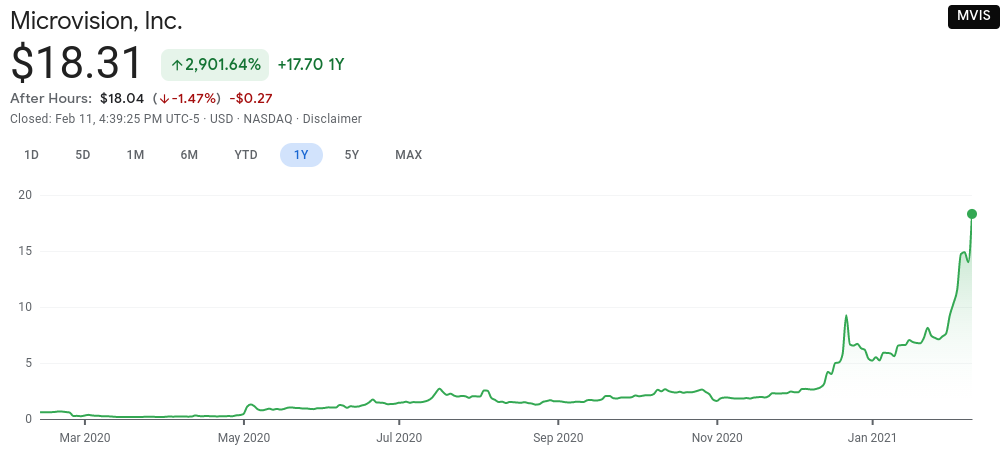
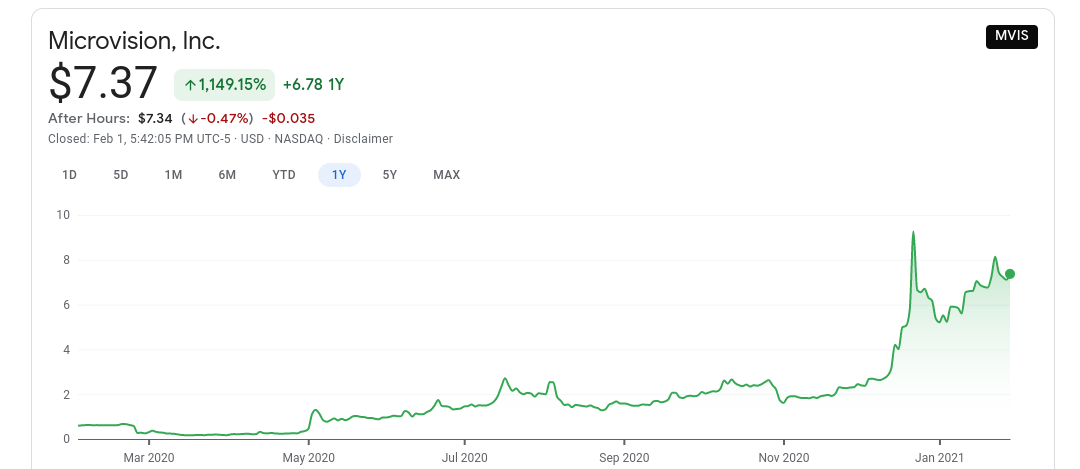
Whee!!! Whoa. Wha? MicroVision’s stock, MVIS, has been doing some crazy stuff, lately. MicroVision has always been a story stock, but usually there was only a small audience listening. Something changed.
A year ago it looked possible that a new pandemic interrupted their supply chain, dropping the stock to $0.15. (Coronavirus Implodes MicroVision)
I didn’t follow the tip to buy more, and a few months later the stock hit $1.70. (Wither Or Whether MVIS)
In July, $2.71, again without my sought-for “significant, positive, quantifiable” news. (No News Big Smiles MVIS)
Sure, there were announcements of strategic positioning and favorable customer responses, but no real financial news.
And then, Gamestop, or was it the anticipated delivery of a LiDAR component in April, or the anticipated buyout. And MVIS reached $7.37. (Gamestop And Moving Smaller Stocks)
Welcome to two weeks later. MVIS rose to over $15, and started sinking to $14 at the close of regular trading earlier this week. A few minutes, yes, minutes later the company released one of their first Press Releases in a long time. (MicroVision, Inc. Announces Progress on its Automotive Long Range Lidar A-Sample) The timing isn’t surprising. Most PRs are published after market close. But the After-Hours market was open, and followed by the Early Trading, today. MVIS jumped ~50%. Through today (Thursday, February 11, 2021) the stock has bounced between $17 and just under $22. All of that on news that the company; “…has received necessary components and equipment to meet its April milestone of completing A-Samples of its Long Range Lidar Sensor“. No sales, no projections, no commitments to analyze; and yet, good news because of the interest in autonomous vehicles and things like home security. Imagine what will happen when that news is announced, assuming it eventually happens.
Google Finance
From $0.15 to over $15 in less than a year. I lamented some of the failings of my preferred Long Term Buy and Hold strategy because my losses from those first shares were so large. I’m celebrating that same strategy now because I haven’t missed out by trying to time the market. As a group, all of my current MVIS holdings are now profitable, something I didn’t expect to see this time last year. Individually, some of those shares won’t be profitable until $155. But now I am hearing fresh voices calculating those same valuations other long term shareholders like me arrived at years ago for different reasons.
There’s a battle between logic and emotion.
Logically, IF MicroVision succeeds in the LiDAR industry, and in the Augmented/Virtual Reality industry, and in the display industry, THEN valuations in the billions become reasonable. One benchmark has been buyouts of similar companies for billions of dollars.
Emotionally, MicroVision and MVIS probably just experienced an extraordinarily long bout of irrational pessimism, which was understandable because they haven’t been profitable. Emotions can swing faster than fundamentals, which may mean MVIS’ rise MAY be at least partly irrational optimism.
Wasn’t it Warren Buffett who said something like; “Buy when folks are pessimistic so you can sell when they are optimistic.” Ah, here’s the quote; “We simply attempt to be fearful when others are greedy and to be greedy only when others are fearful.“
What to do? What to do?
I’ve lived through this before. A stock rises without regard to news or conventional expectations. I wish I’d chronicled it but, I can recall one of my stocks rising 240% in one day, and several rising 140% in a day. Historical annual averages of 7% are well-grounded, but the average does not describe all of reality. A lot can happen in a day, or a few hours.
When to sell?
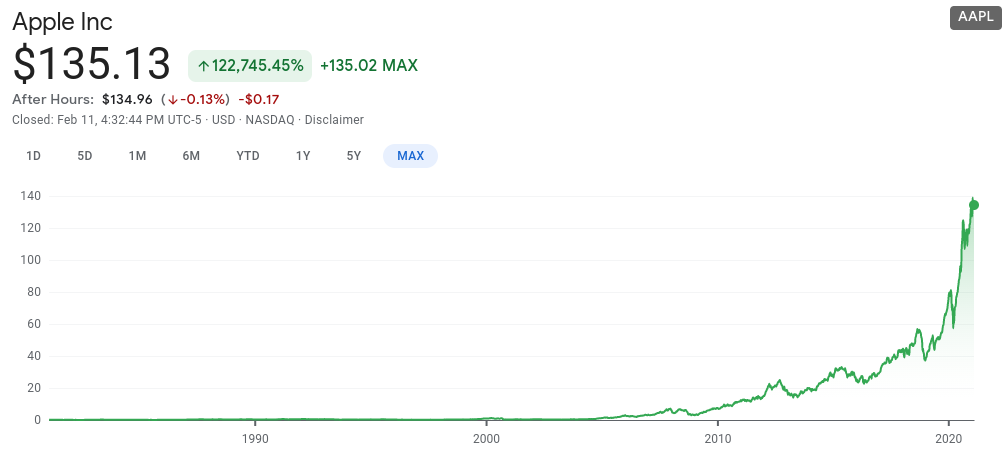
It took me a few years to realize that the largest losses in my investing career weren’t from selling for much less than I paid. The largest losses were from selling instead of holding. The simplest story is when I sold Apple stock (AAPL) in protest because they fired Steve Jobs. This is only approximate, but AAPL has risen about 120,000% since then. The most it is possible to lose is 100%. +120,000% versus -100%. Silly me.
Google Finance
When to sell?
Every situation is different. Apple was a leading-edge technology company developing innovative electronics for an unproven market and was about to encounter financial difficulties for several years. MicroVision is… Hello, a moment of honesty. I hadn’t intended to make this comparison as I started writing this post. That’s the nature of writing. I just gave myself something else to think about. Before I go much further, though; the investing decisions I made in my twenties are different than the ones I make in my sixties. There are forty fewer years of lifespan to work with. Hmm.
I’m not the only one trying to decide what to do with MVIS. I’m familiar enough with the long-term MVIS shareholder crowd that many of us know each other. The last twelve months have seen an influx of individual investors that seem to have quadrupled the number of voices on the most active board I track, reddit. Their enthusiasm is so energetic that I’m mostly holding back and letting them run the conversation. Besides, I don’t think they want to hear from an old guy who has seen the downs as well as the ups.
Much of the new crowd is emotional. Except for a few detractors, many are very optimistic. Almost all are just learning about the company, now. That’s natural. That’s how I started, too. (re: selling AAPL in the mid-80s as a protest)
Where will it go? Of course, none of us knows and all of us are guessing.
One fresh shareholder optimistically wrote about the stock going parabolic. Hear my sigh as the aerospace engineer kicks in. Yes, a parabola can point up, but the most frequent use of a parabolic trajectory is in ballistics; as in, something rises at high speed and then crashes back to create a crater. That is a possibility. The handy thing about investing is you don’t have to stay for the entire ride.
While in aerospace mode I thought about a curve I prefer, the hyperbola. Rise, rise, rise, and escape. That’s a model trajectory for satellites that escape Earth’s orbit.
Ah, but stocks can’t rise forever. They are limited by the wealth of the economy.
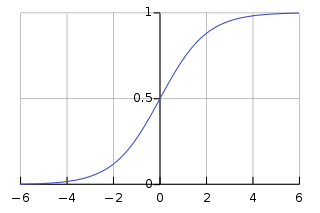
A more common curve sounds somewhat scatalogical for some: the Sigmoid Curve. A stock starts low, rises quickly, approaches a new and higher level, then levels off; possibly repeating.
wikipedia
All of the mathematics are fun for me to play with, but what are the numbers to attach to decision points? The mathematician in me says there are too many unknowns and I probably don’t know all of the equations. MVIS is in the midst of an emotional, subjective, speculative phase with the promise of near-term objective news.
One of the advantages of investing on the Internet is the availability of many voices. From various discussion boards, private messages, social media, and analysts’ videos it’s obvious that there is no agreement. Up, is popular. Whether that stops here, or at $33, or at $100, or higher is being debated. A few point at zero, or close to it. The market will tell us, but we have to wait, and we have to decide to act or not.
I could use some money. Balancing tax losses and gains makes that a bit more difficult. (Waiting for $155 would normally seem ridiculous or take too long, but in this market sentiment – shrug.) I also don’t need the money – right now. My style of investing doesn’t require checking on the stock every day. (see my book: Dream. Invest. Live.) I do so mostly for entertainment, but when it might be time to act, I check for real. I intend to hold because I endured decades of pessimism and am willing to endure a long spell of optimism. I will sell if I need to, especially because of the pandemic and its effect on the economy. Holding can be difficult as it rises from $18, just as it was somewhat difficult to believe it could rise to $18 from $0.15. I’ll be watching intently because until significant, positive, (financially) quantifiable news is released it will be difficult to tell the difference between a hyperbolic trajectory and hyperbole.
I feel sorry for the people who had to produce ads for the 2021 Super Bowl, and yet, maybe not too sorry. We’re in a pandemic that’s mutating. The US is so not-united that one of the ads was wise enough to mention the Re-United States. Social injustice, climate change, and wealth inequality are becoming more apparent (which is at least better than covering it up.) There are so many opportunities to upset someone, to be accidentally insensitive, and to have an ad backfire as a meme that writing a script can seem impossible. But then, that also means the bar is set so low that something innocuous can be good enough. Considering all of that, here’s my yearly review of the Super Bowl ads.
Some background. Once upon a time I watched football a lot. Then I found hiking and skiing and running and bicycling and – why would I stay inside watching millionaires playing a game for billionaires when I could be out there living my life. But, I watched the ads afterwards because they were fun. Then I realized the ads were an intense opportunity to check market sentiment. What do companies think will sell? Who are they targeting? Do the ads resonate? So, now I watch the ads for those reasons as well as to put some perspective on my investments. Are my investments in areas no one cares about? That can be good or bad, and it’s nice to know which is more likely. For a while my portfolio was diverse enough to include at least one company with an ad. Not so now. Biotechs don’t say much prior to FDA approval. High-tech electronic component manufacturers advertise to other corporations, not the public. And yet, those end products can be reflected.
I make life easier for me by waiting until the game is over, then watching the ads on YouTube. This year I got through most of them, hit the wrong key, lost track, and decided I’d seen enough. Now I hear I missed some good ones but I’m not starting over.
Wince. I know it would be odd to have every person in every ad wear a mask, but I was distracted when I saw maskless faces, hugs, and a lack of social distancing. I guess the advertisers are uncomfortable showing people who can’t show smiles. Hopefully this won’t be an issue next year.
Power! Vroom Vroom continues to rule. Lately I’m thinking more about cars that are more reliable, and would be interested in examples of which ones are best suited for someone working from the road rather than the office. That’s probably too narrow a market, or was. Even the truck ads that show trucks at work have to show them kicking up a lot of dust as they speed away from the job site. I’m a fan of Jeep, and one of their ads showed Jeeps busting through snow and racing around. When I really needed a Jeep’s abilities I was driving slowly, maneuvering around rocks and ruts, and striving to stay in control on snow and ice. So much for practicality and utility.
Electric Power. One of the most positive signs was the tendency to show electric vehicles. Yay! I look forward to owning one some day. Get the kinks worked out for me, please. Buying into that industry might be tough. I feel sorry for a friend who wanted to buy Tesla stock right after the IPO. Buying that now, ouch. Glad to see electric vehicles are so prominent.
Chips Dips and Drinks. Most years there’s a great explosion of ads for party food. Drink Responsibly (but buy and drink a lot, eh?). There was less of that, so maybe there was some restraint of showing people partying. Snacks may be more for comfort food than party food. Will that persist?
I liked the Budweiser ad explaining that they would donate the ad money to fighting the pandemic. I was then surprised to see so many of the other Anheuser-Busch drinks running ads anyways.
Movies. Spoilers! which is why I skipped those ads.
Money. Personal finance got some time on screen as various institutions offered early access to tax rebates, instantly improved credit scores, rocket mortgages, fast, fast, fast, and seemingly free. Now, about those fees. The ads looked like they were targeting the people who had enough to go shopping, but not enough to invest (except for Robinhood, which was interesting considering what’s going on with “Gamestop And Moving Smaller Stocks“. Considering what’s going on with stimulus packages, unemployment, and a bubbly stock market, next year’s ads might be back to those from the Great Recession.
Flowers. Short, sweet, in time for Valentine’s Day. They actually described what they do and how they do it, which is rare in comparison to the others that sell image, ego, and emotion.
Stars. I don’t have the data, but it seemed as if there were more stars and celebrities this year. Is that because they are less likely to be filming a movie or touring with their band? The ads showing them in their houses was distracting, too. You’re problem is that you have to hide in the closet in your mansion to eat your chips? Sad. Also sad was how many celebrities I couldn’t recognize. Getting old, I guess; or, more likely to be engaging on social media or writing my own stories.
Home Security. A sign of fear: the indoor drone that can be launched remotely because the security system sent the homeowner an alarm. That one and some of the others are up for security, but also making it easier for parents to spy on kids for hackers to see inside the house. At least pets and people with health issues can be checked on. Ironically, this is one place where one of my investments (MicroVision, MVIS) might be selling subcomponents. (And that’s a story I’ll be writing about in more depth Real Soon.)
Inspirational. Here was probably one of the toughest tasks. Find the balance between too sappy and sweet versus too real and serious. Jeep did a pretty good job. I think the ads from the Great Recession may have been stronger, but then we had the illusion that we were united, fair, and working towards common goals.
There were more, but I looked for and got a message. Very few ads really tripped up as much as they could have. Despite a few ads that actually choked me up (hey, it happens), the general feeling seemed to be caution with some optimism (maybe things will be better next year, maybe), less extravagance (unless you’re a celebrity), a concentration on home and lawn and security, and a tendency to hold back on the humor as if it is still too early for any of the topics in the news.
2020 made us question many of our societal norms and assumptions. Good. Challenging assumptions can be healthy, especially if those ideas haven’t been checked in years or decades. What we do in 2021 will be reflected in the 2022 Super Bowl ads, assuming there’s a Super Bowl in 2022. Maybe then we can celebrate what we’re doing now. Stay tuned.
Oh dear. Some financial institutions are upset that some individual stockholders figured out how to play the market taking advantage of the institutions’ techniques. The big players are upset that others have begun beating them at their old game. Simply by buying and selling in just a particular way the stock price of GME (Gamestop, the strip mall game store) rose dramatically, making money for the individuals and potentially making the institutions lose billions. As one comedian put it, the tiny violin factories are getting busy. Such is the changing nature of the US stock market which may be about to enter a revolutionary period. Or not.
Here’s my overly simplified (yet sadly long) interpretation of what happened to GME.
Believe it or not, it is legal and allowed to sell shares you don’t own. Why do that? Do that if you think the price will fall. Instead of the conventional ‘buy low sell high’ it is ‘sell high buy low’. How do you sell something you don’t own? Borrow shares from a shareholder (who probably thinks you are wrong), and buy them after the drop. There are a few problems with that. One) Selling short is betting on failure, and can be a self-fulfilling prophecy because as the price goes down, the company’s ability to borrow money for growth also goes down. Two) Some short sellers will promise to borrow shares – eventually. It becomes possible for too many promises to be kept, too many shares borrowed than can ever be found. Three) The most a long-term shareholder can lose is 100%, but short sellers can have unlimited losses as the price goes up.
Imagine being a shareholder in a company that you consider to be promising that someone else thinks will fail, or can be made to fail. You’re ready to wait for years but the shorts think they can make money now. A shorts’ attack can ruin innovations and growth, making billions for the shorts without regard for jobs, lives, or solutions. From what I’ve heard, the shorts were hoping to make money on GME because it relies on sales at their physical stores, and more gamers are buying and downloading rather than driving to the mall. As an investor and shareholder, you might be more than a little upset if you think the company has a profitable strategy.
Imagine being an upset shareholder thirty years ago. About all you could do would be to go outside and scream at the sky. Now, scream online and probably find others screaming, too. Rather than play the institutions’ game of short seller, however, a crowd of investors realized that one way to literally make the short selling institutions pay was to drive up the price. Buy. Buy. Buy. If the institutions could be forced to sell above the prices they bought at, the institutions would lose money. One report mentioned about $5B in losses. That probably exceeds most SEC sanctions from previous cases, didn’t require political lobbying, and maybe made money for some of the long term investors, too. If the shorts promised to borrow more shares than existed, then there can be a scramble to buy buy buy to limit losses, which ironically drives the prices up.
Trevor Noah (The Daily Show) produced an excellent interview of Doug Henwood better describing the macro-view that includes Fed funds, another bubble, and the need and futility of investing reform. They mentioned one thing in particular, if a crowd of individual investors lose billions, it is taken as a sign of their amateur status, but if institutions lose billions they ask for financial aid from the government – and might get it.
I’ve been watching with some interest because I’ve seen similar losses ignored. Even when the losses were manufactured by felonious manipulation of the stock price, all the individual shareholders can hope for justice, not recompense.
This is the nature of individual investing, or at least that was the situation.
The stock market is supposed to operate openly, fairly, honestly, legally, and without collusion. Sounds like a good idea. The market is really driven by greed, fear, privilege, bias, power, and greed. Did I mention greed? Greed. Markets were developed to allow company owners to sell bits of their companies (shares) to raise money for creating, growing, and maintaining the business. Technology shifted that. Computers made it easier to analyze every company, not just a selected few. Understanding one industry well was less profitable than finding the best leverage regardless of industry. The stock became more important than the company. Connect the computers via the Internet and the speed of trading accelerates to the point that there’s no need for traders to appear in person on a trading floor. Automate as much of the process as possible, and the computers can analyze, select, and execute trades faster than any human. Get more sophistication into the system and institutions can buy long and sell short at the same time for the same stock in ways that ‘hedge their bets’. Individual investors become increasingly disadvantaged.
(Personal note about my personal finances: That’s why I invest in companies that most of the market decides to ignore, at least for now. Even though institutions could analyze every stock, there are institutions that are restricted from buying or selling companies that are too small. That’s where I go shopping.)
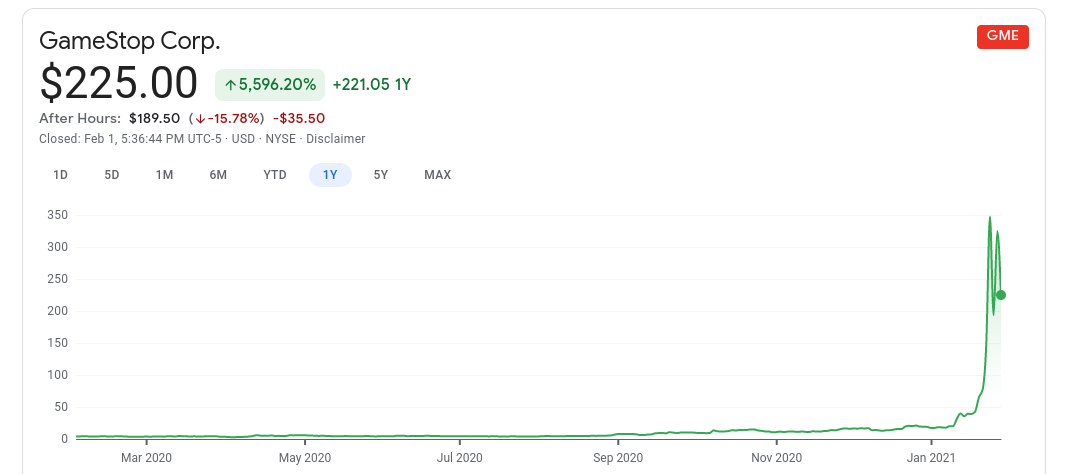
And now add discussion boards, places online where shareholders can share notes, analyses, insights, tactics and strategies, rants and raves. GME’s shareholders found allies on a reddit.com board. (Check my Semi Annual Exercise EOY 2020 for the boards I track.) Get enough disgruntled people together and they might just try something, as they did with GME. I don’t know the details of those conversations. I don’t need to. I do know, however, that the stock jumped over 1,200% in the last month, and over 5,500% in the last year – and that is down ~50% from the peak. Shorts got burned.
Google Finance
There’s an argument to be made that what just happened was collusion, which is something the SEC can investigate. There’s a counter-argument that the combined assets deployed by the individual investors was small compared to the assets deployed by even one institution. If ten individuals are working together does it matter if they are all on the same institution, across more than one, or are ten people with personal finance plans? Should the SEC investigate everyone? That might be necessary for reform on a scale similar to uncovering governmental corruption or domestic extremists. Should the SEC only investigate the individual investors? That would be more ammunition for the battle between the haves and the have-nots. Should the SEC hold back and implicitly allow an abuse of the system that was developed to invest in companies and the country’s future rather than simply being a money manipulation scheme? That question may be the fundamental perspective that underlies what happened with one stock within one year. Do the rules only get enforced for this one stock this one time, or is this a return to enforcing regulations systemically, or is this the opportunity for a reform that would challenge major sources of wealth and power in the US?
Back to the personal side of personal finance. As I mentioned in my Semi Annual Exercise EOY 2020 at the end of 2020; my portfolio is “up 170% in six months and 300% in a year”. Is that because all of those companies made that much progress, or because they were overlooked but aren’t now, or because (as mentioned in the video above) the Fed has put ~$5T into the financial markets, or now I wonder if something similar to GME is happening with MVIS and LCTX in particular? Is this yet another bubble like the others I’ve seen over the decades? We are about due.
Google Finance
The essence of investing is buying and selling. I appreciate the appreciation in my portfolio, but I am not planning to buy more or sell what I have. I don’t have any casual cash, and by my analyses my companies and their stocks are probably undervalued based on ‘Present Value of Future Revenues Discounted For Risk’. (Details in my book, Dream. Invest. Live.) I am watching, but I am not acting because I am an investor. The closest I come to speculating is in buying stocks in companies that aren’t profitable, yet. Without profits they are harder to analyze, and computers like having numbers to analyze, which gives me an opportunity to buy low and eventually hopefully sell high. (The book includes examples of when that worked and when that didn’t.)
The story behind GME is handy as an insight into the way things were done, can be done, and might be done. This could be the event that leads to a more equitable way to trade equities. Or not. Entrenched institutions have erected impressive battlements. But even without reforms, it looks like the country-folk might have found a way into the fortress.
“Miracle Max: Have fun stormin’ da castle. Valerie: Think it’ll work? Miracle Max: It would take a miracle.”
Use By Dates? Ha! In the midst of tackling yet another anxiety, I found a bottle of (probably haz-mat) stuff that was so old the bottle didn’t have a Use By Date, or a bar code, or (gasp!) even a web site! That’s today’s treasure from a retiring a plumbing chore, a day that also saw a medical concern alleviated, and – oh yeah, a more peaceful government come to power. Slowly, life gets better, but we (or at least my stresses) have a long way to go thanks to a pandemic, climate change, societal unrest, and other injustices. One thing at a time is good. Three at a time can be even better. All at once can be too much.
I mentioned government last, but will write about it first. I don’t want to create a false sense of suspense so let’s start there. I’m glad the nuclear codes are in mature and responsible control. I’m glad to hear science, facts, data, logic, reason, and compassion are coming back into style. I’m glad there is at least the intent to actually manage and govern the country while also defending and protecting the US Constitution. There is some relief, there.
There are also a long list of anxieties of which;
“Any one of these would be enough to challenge us in profound ways. But the fact is we face them all at once, presenting this nation with the gravest of responsibilities.” – President Joe Biden
I am glad for the relief. I am also too aware of the scope of those challenges, as well as being aware of an echo from one of the first posts to this blog (long lost to Apple orphaning the software that supported that post) from President Obama’s election. While many were cheering the man named Barack, I was glad, but also weighed down with the reality of the work required to recover from the Great Recession (The Second Great Depression). A familiar weight remains, but with the awareness of an undercurrent of people willing to attempt an armed insurrection.
So, some anxieties relieved; but not ignoring the rest, either.
I list these anxieties as I retire them because I’ve found selective amnesia is willing to forget the depths of the downs that can highlight the heights of the ups. I also list these because it is also easy to forget how long it takes for such transitions to happen.
One anxiety I’ve been quiet about was spawned by an off-hand comment by a newly-graduated eye doctor. They were probably still learning a bed-side or chair-side manner as they casually began to listing the various ways I could go blind. There was even a hint of how I could die. Not a cheery office visit. That was several years ago. Since then I’ve been too aware of those possibilities and the price of those surgeries and treatments. Finally, thanks to a gift from a friend, I was able to afford a second opinion and possibly a surgery. This time it was from a doctor closer to the end of their career. They were also closer to my age, very aware of the same issues, but much better practiced at putting things in perspective. Instead of comparing my aging eyes to the perfection of youth, he compared me to himself and others our age. Yes, my eyes aren’t perfect. Hey, that’s life. Yes, there are issues to keep in mind. No, no need for surgery; but a new prescription – and A Lot Less Stress – would clear up many issues. Oh yes, and if a massage helps, go get a massage. Weird as it may seem, after weeks of intense work, I’ve found an hour long massage improves my eye sight. (I’m sure there are straight lines in there, but the improvement is seriously good enough that I skip the jokes.)
The same topic from two different perspectives is more than doubly valuable. Of course, I’m reminded of the problem with old-style watches that didn’t keep the most accurate time. A person with one watch might be confident, even adamant, about the time, because they had one number and that’s all they needed. A person with two watches might be confident if the watches agreed, but they rarely did; so, the person with two watches knows at least one, and maybe both, are wrong. A person with three watches might have a better idea of the time, but they’re probably also giving their friends reasons to worry about them.
And then there was the plumbing problem. Since I bought this house fourteen years ago (hey! just realized this is the anniversary!) there’s been a sink with a slow drain. I don’t use it much, so didn’t worry about it; but I did wonder. Plumbing problems can easily mean four trips to the store and a bit of plumbing out of operation between the trips. I dreaded trying to pull it apart, hoped it wasn’t anything major, hoped I wouldn’t break anything, hoped it wouldn’t cost too much, and hoped I wouldn’t have to call a plumber.
Step one, clean out the area. And, hello, a bottle of some cleaning product that was so old that the company is probably gone, there were no instructions about what it did or how it did it or what to do if it got splashed around on skin. This is also the one that had no barcode or web site, which are now so ubiquitous, that finding something without that information seems like an archaeological find.
Step two, carefully start disconnecting pipes, celebrating the fact that none of them cracked or broke, and finding that the only problem was a hairball from the previous owner. No need for new parts or a drain snake.
Simple? Yes. But for years there were higher priorities for fixing and repairs like the roof, the gutters, windows, walls – and I’ll spare you the long list.
Our big problems are unlikely to go away that easily. If we could clear away our larger problems as if they were just caused by a big hairball that would be a hairball that I wouldn’t want to meet. Besides, a hairball that size might fight back.
Retiring anxieties are definitely worth celebrating. There’s a cascading effect that is also worth celebrating. The money I put aside to possibly repair the septic system wasn’t needed because the repairs were minor. Whew. That money has helped sustain me during this downturn. The money set aside to retire one anxiety can fix it if necessary, and if not necessary, can slide over to work on the next in line.
I’ll check my lottery tickets, but it is rare to be able to tackle every anxiety simultaneously. Most of us must manage cash flow. (As I write that it reminds me that the country can’t do everything instantaneously and simultaneously, either.) Look back at the previous Retiring Anxieties posts and notice that I tend to group mine into threes. Writing about each individually would get boring for readers. Ignoring progress could become disheartening as selective amnesia minimizes memories. Trying to do everything could hurt, and possibly require more cash than is available. Bit by bit, not doing nothing, not doing everything, and making progress because of it.
Stresses remain. As issues are put aside, the others step to the front of the line distracting from the successes. There will always be more issues. I’m human and trained as an engineer. I can always find something that needs improvements; but for today (really tonight) I will have a glass or two of wine, get out my old glasses so I can watch a movie, and also cheer the shards from shattered glass ceilings.
Power! People were offering me power! And I turned them down, with thanks. One way to experience off-the-grid living is to move to a rural area where storms are common. Up comes the wind, down come the trees, out goes the power. A hundred fifty years ago, not having electricity was the norm. In the last seventy years, having the power go out feels like an entitlement has been stolen. Twenty years ago, technology made it easier to disconnect from the grid, especially in remote places where the cost of connecting to the grid was ridiculously high. Now, there are so many options that when the power went out a few days ago, I had several offers of excess power being generated in various ways – and yet, I turned down almost all of them. Off grid living has come in from the wild.
Yes, Whidbey Island got hit by a storm, again. Northern Pacific Ocean storms don’t get names like they do in the sunnier latitudes. Storms in the US Southeast are basically troubled celebrities that attract a lot of press. Storms that hit Whidbey Island might get mentioned, then are easily forgotten, and people wonder why the power goes out so much, as if it was a surprise. We get hit by a recently identified phenomenon called an ‘atmospheric river.’ Imagine part of the tropical ocean evaporating in and around Hawaii, rising into great clouds, then storms, then those storms getting pulled and pushed by currents like the jet stream, then aimed to hit the west coast of North America somewhere in California, Oregon, Washington, British Columbia, or Alaska. Now we know that at least 30%-50% of the local rainfall is actually from such storms.
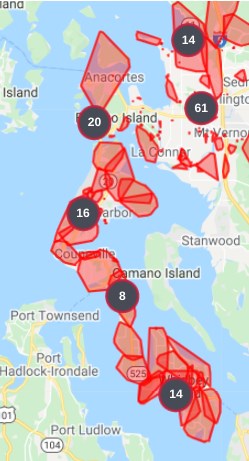
Record setting rain. Weakened soil. Strong winds. Trees fall and land slides. And the power goes out. At one point, almost the entire island was out of power. Over 350,000 people in the area were out of power. Whidbey was slated to get repaired later, after the main damage on the mainland was fixed or at least patched. The estimate was that it would take four days to fully restore power. Eep.
Islanders, however, are prepared. Fancy homes can be equipped with automatic generators that clatter to life, even if no one is home. Folks in occupied homes might have to drag our theirs, disconnect the grid, fill the fuel tank, start the generator, hope, and carefully turn on some subset of lights and appliances. Until recently, almost everyone else got by with fireplaces, woodstoves, camping equipment, and maybe frantically feasting on everything that might spoil. Personally, I have relied on an ice chest in the carport, a car camping stove, and maybe some cold meals. Don’t feel bad for me. Some of those meals were smoked salmon Caesar salads with organic veggies, and a very nice wine. An adventure – for a day or so.
As word spread that we’d be out for four days, my smartphone got a few calls. Do I need power? One friend recently had so many solar panels installed that about the only thing they couldn’t run was the big oven. They had an extension cord reaching to the driveway for any friend who wanted to recharge batteries. A neighbor recently bought a very nice RV, a diesel RV with a large fuel tank and a very capable generator. Initially I declined the offer to use their external outlet, but decided to test it – just in case. By the time another friend called I’d spent so much time considering the alternatives that I surprised them by saying “thanks but no” (despite also turning down a visit to their awesome garden – but, well, the pandemic discouraged the visit.)
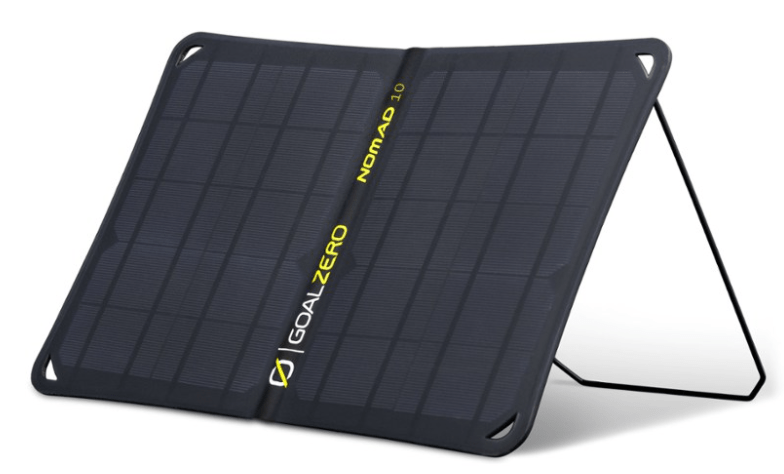
Within the last year I bought myself a couple of presents: a small solar panel, and a small battery pack. The solar panel only generates 10 watts. The battery pack only holds about two recharges (basically more than two days) for my smartphone. They only work for small devices, but that isn’t much of a hardship, anymore.
Up until a few months ago I had what I called my “big hurking battery”. It only could deliver 400 Watts for a couple of hours, but that was enough to keep batteries charged, and periodically power up the router so I could check on the internet. Nothing fancy. Actually basic brute force, frugally, of course. But, good enough for temporary outages.
The battery died, and I couldn’t find a direct replacement.
My internet connection changed. The old dsl line could work as long as I had power for the router, and the router didn’t demand much. Now, I have a fiberoptic connection, but when the power goes out, it goes out. Eep! again.
Thanks to the pandemic and just generally shifting to working more from home, there was less to count on at the office. Almost all of my new equipment is smaller, more efficient, and can be charged from a USB connector instead of a three-pin plug.
When I couldn’t find a direct replacement for the big hurking battery to power the router, and because the internet connection was no longer as robust, I did some research and learned that my smartphone’s Hot Spot meant I could still access the internet.
The smartphone could be charged from the solar panel or battery. Careful laptop management helped it last days. Even my various newer flashlights and lanterns either used very efficient LEDs or were rechargeable without plugging into anything except the Sun, indirectly.
I still appreciate big power sources for heat and cooking. But the reliance on those wall plugs is diminishing. The cost of hooking up solar panels is decreasing. The efficiency of our electronics is increasing. The difference between how much power a household can generate versus use is shrinking, and in some cases has flipped to the point that there’s so much power that they can call people and invite them over for electricity.
Going off-grid (or returning to an older more rural way of life) was a necessity for remote residences. Now, there are more reasons and it is easier to go off-grid even in suburbia. As these trends progress, connecting to the grid is becoming a mandated anachronism. Sure, there are advantages to being part of the grid, but it had been a necessity. Soon it may be something to do because the municipality requires it.
Climate change continues because pollution and consumption continues. But a small, local, temporary disaster proved to me that we’re making technological progress, progress that in another twenty years may mean fewer reasons to have power poles poking up along roads, fewer reasons to have power lines scratching across views, and fewer interruptions as power switches from centralized power plants to each house generating at least some of its own. This storm was also a reminder of the power of community and generosity, even during, or especially during chaotic times. A bit of lightness that shone more brightly because of the darkness.
Things are changing. Ha! That and other gross understatements are provided at no charge (so far). “Go west, young man.” was advice delivered to people (men) struggling to escape terrible conditions on the east coast of the US. Gold rushes helped. The advice wasn’t new. For most of human civilization there was always somewhere else to go, assuming you could escape kings, warlords, and slave owners. We may finally be reaching a limit to that advice, and its effects may only now becoming apparent. What happens when there’s no west to move to?
This came up during a phone call the other night. (The easiest way to maintain a safe distance.) And, yes, I know people who’d rather play with ideas than replay what happened in some spectator sport.
Our species started in Africa. (So, yes, everyone has an African ancestry, sort of.) For some reason, someone moved east through the Middle East, some moved north into Europe. Feeling crowded? East to the rest of Asia, and eventually south to Australia and Oceania. Wait a while and all of that feels crowded. Oh, goodie; the ice began to melt and someone decided to walk or sail to this other hemisphere. Wait several thousand years and some of those Europeans decide to leave Europe. Now the east coast of this new nation gets crowded and, well, go west young man, woman, whoever. Fast forward to about a hundred years ago. The Gold Rush is over. The Dust Bowl chased more people west. Now, there are almost eight billion people on the planet. Where do we go next? Movement stalls. It’s hard to be a pioneer when the last frontiers are in space or the depths of the ocean.
As recently as a few decades ago, the rule of thumb was that people moved about every six or seven years. Better prospects, bigger family, want a different climate? Save your money and move to a place you think is better. And don’t be surprised if someone is making the exact opposite move. Trading houses happens.
Then the Internet Bubble burst. There was a Great Recession (the second Great Depression?). And now, a pandemic. Moving isn’t as easy as it was before. As wealth and income inequality increased, it became harder to move from a poor place to a rich place. Sure, there are better jobs in the cities, but if you’re living in a place with low wages and low housing prices it becomes difficult to accumulate enough to move, whether that’s moving to the west, east, north, or south. Up and down are available, but start with billion dollar checkbooks.
From a typical six to seven year span between moves, it lengthened to about ten, and now to about thirteen. Thirteen years between moves means fewer houses on the market. Fewer houses on the market means less supply even if demand remains high. Less supply, high demand, higher prices. Higher prices are fine as long as incomes rise more quickly. Oops. Income hasn’t budged much in the last twenty (forty?) years. There goes affordability.
I’ve watched such trends for decades. Watching the way our society and ‘civilization’ change fascinates me. A few years ago I became a real estate broker on Whidbey Island (Dalton Realty, Inc.) and had a better reason to dive deeper into such data. One trend in particular is making me ponder.
At least on Whidbey Island, the current rate of decreasing inventory can’t be sustained. Extrapolate that curve (and extrapolation is bad and will be shown to be incorrect) and hit less than zero homes for sale within two years – which won’t happen. It is hard to have negative inventory.
So, inventory will probably run into some other limit because there is always someone who has to sell or wants to sell or can no longer use the house.
Within systems, when a trend runs into a limit things can either break, move off in a different direction, or surprise us, or some combination of all of that.
According to various economic reports, this isn’t only happening on Whidbey. The trend from six to ten to thirteen years between a house changing ownership is national.
And then the pandemic hit. Now, some people have an even greater interest in moving; while at the same time, many people are reluctant to move. Demand rises. Supply falls. Ah, oops?
I wonder how much discontent is based on feeling trapped in a bad situation. I wonder how much dissension is heightened because the great mixing pot that was the US isn’t getting stirred as much. And, I don’t see anything that is readily going to change that.
What happens when there is no equivalent of the west to go to? While I watch trends, the other main trend I am seeing is a retreat from the recent growth in urbanization. Social distancing is difficult when you have to share an elevator, a laundromat, or even just a hallway. Rural life is inherently distanced. Even suburban life has more room than a condo in an excellent downtown. Sometimes a garden in the backyard is more appealing than having a theater within walking distance. (And I know of a few places where it’s possible to have both.)
Much of personal finance is based on anecdotes, rules of thumb, conventional wisdom, traditions and habits. The world has changed, then the pandemic changed it again, and something else may make yet more changes. With that many changes it makes sense to check assumptions about personal finance plans. I have a 40 year mortgage with about 35 years to go. Life in 2055? My plan is highly unlikely to survive that long, partly because it is highly unlikely I’ll survive that long.
I don’t know what’s going to happen. My apologies if you thought I was going to provide perfect predictions of the future. The only constant is change. I’m in the process of challenging my assumptions about my plan. Will I be here in 35 years? Will the US? Will money? Will climate change change my choices? Will new frontiers like Mars, the Moon, orbital platforms, or living in the ocean become options?
I’ll try to share as I change my plans. In the meantime, especially during turmoil, I plan to continue to spend less than I make and invest the rest. Now, about the amount that I make, can I interest you in buying a house on Whidbey Island, or even more startling, selling one here? Stay tuned. It will be a long time before the world gets back to dull.
Some of the topics I wrote about where: Politics, a pandemic, wildfires, storms, floods, changes in a social structure (including social media), health care, health insurance, Social Security, tea, writing, science fiction, real estate, frugality, food, anxieties, recovery, rural life, community, taxes, kindness, sustainability, Gig Economy, work from home, shopping local.
Good traffic for much of it, but what did readers want to read the most?
Take away MicroVision (MVIS) posts and there’s my invention for tidal power, a guest post by Alan Beckley from 2014, and two posts about stocks (including MVIS.)
Hey, people, there’s more to life than MicroVision. Of course, the interest in MVIS might be explained by the stock hitting a record low price of $0.15, then rising to a peak of $9.74. Twenty years of waiting, almost got back to break-even, and all on only suggestions of catalysts.
To me, this was a year of enough financial recovery that I was able to retire some anxieties by a bit of repairs, some replacements, and an inspection or two. Like everyone, I was adapting to shifting pandemic instructions as the scientists learned what to do and not do, and as many people revealed their self-interests. Compassion, kindness, and community aren’t high priorities for many, too many. I made progress on three books (the sequel to Dream. Invest. Live., my first sci-fi novel, and a gift book about tea.) Real estate‘s been a surprise as supply went down because people didn’t want to move from safe places, while demand was up as urbanization was recognized as having a few issues with density during crises. Two accidentally positive things I’ve witnessed are people who are critically challenging which professions are truly essential, and people who took the time to practice frugality as they planted gardens and baked bread.
And people want to read about MicroVision (MVIS). Fine, but I will continue to post to the blog based on its original intent, to write about personal finance from a personal perspective. My roller-coaster ride through America’s wealth classes will be the basis for the sequel to Dream. Invest. Live., which inspired this blog. Reading this blog is one way to follow my notes and my journey from blue collar to professional middle class to millionaire to barely getting by to recovery. I’m not surprised at the lack of understanding across those classes. I hope to address those perspectives, but it may take a year or two more before I can consider my situation recovered (though lottery tickets could always accelerate the process.)
We can’t put 2020 behind us. Even if the pandemic disappeared today, we’ve now challenged the notions of work, school, support, essential services, and many archaic and anachronistic institutions. People have revealed how much or how little they care about other people. Stereotypes that were hidden are now far more public. I suspect the people of the United States are effectively going to be debating what unites the states.
I’d like to raise a shot glass to 2020 and a champagne flute to 2021. And I’ll definitely keep watching, learning, adapting, and hopefully recovering.
While the wide world and my private world were in turmoil, something unexpectedly positive happened in 2020. In the last six months since my mid-year semi-annual portfolio review and exercise my portfolio rose by a factor of 2.7. Since the beginning of 2020 it has risen by a factor of 4.0. What had been a few months of living expenses is now over a year’s worth. The irony, and a fine insight into the stock market, is that my good news from my stocks’ good news, had almost nothing to do with news of any sort from the companies. Yes, they had good news, but nothing as startling as a major product announcement, or a declaration of profitability. That’s the way the market works. That’s why I am glad but also cautious. There’s chaos under heaven and at least this aspect of this situation may be hinting at excellence.
Let me put this in perspective. Historically, a portfolio performance of about 10% is worth celebrating. Stocks rise and fall. Portfolios can be well or poorly positioned. How many stocks and portfolios were drastically surprised by Covid-19? My stocks didn’t rise because of Covid-19. But, up 170% in six months and 300% in a year? That’s news, and there are reasons for that.
As long-time readers know, my portfolio fell apart when I was hit by My Triple Whammy. At that time, about nine years ago, a few folks pointed out that I had a perfect storm of bad luck. Within about six months back then, my portfolio dropped 80%. The companies seemed to be doing fine with fundamentals and near-term catalysts, but three of the major ones were hit by news that sent conspiracies swirling through the message boards. It wasn’t until this year that I learned that it wasn’t bad luck. Two of the biggest holdings, stocks about to help me re-retire, were undermined by acts that have now been proven in court to be illegal, felonies, and not a matter of chance. Unfortunately, stockholders’ losses aren’t compensated. Something like justice happened, but it is doubtful anyone went to jail.
As long-term readers also know, I buy stocks for the long-term. My portfolio only has four stocks left, but all lead back to original purchases from about 2000. I’d like to say it is proof that I have excellent patience, but the reality was that the stocks fell so far that it wasn’t worth selling them. One purchase dropped so far that its worth as a tax loss would be enough for about six month’s living expenses. It only makes sense to sell that holding when I have similar profits. That seemed silly last year. It is less silly this year.
The stock market is not rational. Emotions, psychology, and whim are important, too. There’s a herd out there and it doesn’t always know why it is moving and where it is going. While a company and its stock can be valued by objective criteria, innovative companies can have so little financial data available that investors become speculators as projections are made from guesses. Irrational exuberance happens, as does irrational pessimism.
It is reasonable to surmise that these old startups have been living with irrational pessimism. They have been making progress in the last two decades, so their intrinsic value should have been rising even as the stock prices were falling. As they attract attention, even rising to a nominal valuation can require significant stock appreciation. That may be what is happening. My biotechs (GERN, LCTX) are proceeding through clinical trials. MVIS continues to juggle suggestive press releases about possible buyouts and possible technical advances. NPTN was impacted by impetuous trade wars, which may soon abate. Each have reasons to rise, though none have revenue projections I consider reliable. And yet the stocks rise and I don’t mind.
MVIS’ story has been the most dramatic. I wrote about it two weeks ago because the stock had risen from a low of $0.15 in March 2020 to $4.00. Then the stock kicked in to hit $9.74 just before Christmas (Santa Claus rally, but really Santa on a rocket). Now, it is all the way back down to ~$5. Check your perspective. Is it up a phenomenal amount, or has it dropped dramatically? The right answer may be Yes. I ran a poll on Twitter (hence very unscientific), and most votes were for the rise being speculation about a buyout rather than a product launch. If there is a buyout in negotiation, then we’ve just tested a wide range of price points. That story isn’t over.
The stories for the other stocks aren’t over, either. NPTN is grinding along as the only one with an established product line. The biotechs are making progress, but unless the FDA does something with a compassionate approval, they have years of trials to complete.
I certainly won’t complain if my portfolio rises a factor of 4 again in the next twelve months. I’m not planning on it. Considering the subjective nature of the news surrounding these companies, I also won’t be surprised if their prices retreat. But I also recognize that each of these companies is probably not valued properly as each has been either overlooked for years, or has stories attached to it that affect subjective sentiment rather than objective valuations.
As I said above; “There’s chaos under heaven and at least this aspect of this situation may be hinting at excellence.”
Stay tuned.
The following links are to the various discussion boards I follow. Many of the independent investors who contribute to the discussions provide in-depth analyses that either aren’t available elsewhere, or would cost too much to buy. The other advantage is the diversity of perspectives. Unfortunately, I don’t engage as much as I did before. Some discussions have degraded due to lack of moderators, or too many immoderate voices. Some boards are effectively ghost towns, or feel like cavernous empty warehouses. I suspect some of the tensions are associated with a stressful year, and the subsequent delay in product announcements, program developments, and general business conservatism that is waiting for better news about the pandemic. Regardless, here are the sites I continue to visit, even if it is only to lurk and listen.
I encourage you to tune in, because more voices (as long as they’re mature) make for a better conversation. Maybe I’ll read you there.






 Trimbathcreative's Blog (Tom Trimbath)