Scared By Medicare

Do you mean to tell me that is all there is to signing up for Medicare? I’ll take Classic, please.

Thanks, ads that interrupt my shows, thick brochures mixed in with my bills, barely overheard horror stories about the service. Even thinking about Medicare made me emotionally dance around the fringes of Medicare. I can see 65 from here, and I was powerfully procrastinating reading the materials. I was dreading having to sort through the options. Between daily finance issues, Social Security changes, and what sounded like a mandatory Medicare process – well, I wasn’t looking forward to the paperwork associated with reaching ‘retirement’ age. I feel better, now, thank you.

Signing up isn’t that scary, I think.

Ads leverage fear. The fear of missing out, the fear of doing it wrong, the fear of making a commitment in a morass of unintelligible complexity.

Friends can swing the emotions either way. Horror stories, or at least dramas, drive conversations. Making something sound simple isn’t as entertaining as emphasizing critical moments and the teller’s excellence at evading them or surviving them.

Two friends, one on social media and one I saw in a physically social event (was it a dance?) calmed me down. They said it was super easy, barely an inconvenience. (I’m curious who will get that reference.)

I’d saved a lot of the brochures; they sat on a corner of my desk. On my computer, emails and tabs for websites were open. Rather than prepare myself, I happened to be in my office doing cleaning chores and dove in. Get it done before I over-thought it. Besides, Jim said it was easy.

Trust Jim. Jim was right – so far, and that’s good enough for me, so far.

This post will probably be long enough because I write that way (how else do you think I manage to write so much?), so I’ll spare you the details of all the sources I researched. Go to the government’s site.
https://www.medicare.gov/


OK. Maybe not. The website is slow enough that my browser bonked on it. In classic form, they talk about and around it in so many ways trying to be helpful that it felt like they were purposely trying to find something. But they have to cover everything for everyone in every situation. Great, they cover it, but then they bury it.


Let’s try, again.
https://www.medicare.gov/publications/10050-Medicare-and-You.pdf
Page 10, maybe page 11, too. Your Medicare options. My options? Yes, my options, evidently.
On one page they mention Parts A, B, then D, and go back to describe C, and add two more choices. This is already simpler. I looked at the heading, and it simplified further into two choices: Original Medicare and Medicare Advantage. I show my age by getting a flashback to Classic Coke and whatever else was around. I read over Original, and thought it seemed fine for me. I double-checked with friends, a doctor, and an insurance agent. They agreed. It took longer to check that it really was as simple as choosing Classic than it did to sort through the ads and brochures. Your results may differ.

It turns out that most of the obfuscation comes from so many voices trying to clarify, and clarify, and clarify the system that the system seems like it must be incredibly complex. The government’s handout (or download) is 128 pages long. I needed one page, maybe two. The companies are trying to entice me into being their provider. The government is trying to please everyone by covering every possibility, most of which won’t apply to me.

I’m not surprised. The government gets massively criticized if anything they do can be misconstrued. Too many imperfect people (and we are all imperfect) expect perfection from the people who are trying to help. That’s true in health care, public policy, protective services, everyone and everything everywhere.

The corporations know how profitable the healthcare insurance industry can be. The government is charged over a thousand dollars a month for my subsidized health insurance. Give me a thousand dollars a month to spend on health care and I may not need the health insurance. Of course they want my business, and that’s more important.

We humans are so good at complicating things.

I may have over-simplified things.

I had a similar reaction to signing up for Obamacare. That chronicle is one of my most popular posts. I suspect something similar to happen here. The prelude is wrapped in a confusion of opinions and claims. Actually, signing up eventually becomes easy, especially in retrospect. Expect a few imperfections. When the benefits become available, the imperfections become real and manageable. Using the benefits is when the greatest confusion can happen because reality is messy and no system is perfect – and because everyone is different, including me. Histories matter, especially after living for a few decades.

I haven’t had to sign up yet. So far, it is simple but theoretical.

In a couple of weeks, I’ll meet with a local insurance broker whom I know and trust.

Early next year, I’ll turn 65 and the coverage should begin.

Soon after that, I’ll ask my doctor to help investigate various issues and treatments.

I have a plan, which is calming.

I also have a real life going on at the same time. I’m busy. I have to keep things simple. Time has always been more precious than money, and its value increases as my time available decreases.

And,

Within the next few months, I might have to sell my house and move. That’s another story. I only bring it up because turning 65 will have other implications. There will be lots of bureaucracy. I don’t want to have changes of address mixing up the various signups. They allude to that. I’ll deal with that separately. If I move, it will probably be to a place where the list of providers of anything is only one line long. Limited, but simple.

And, if I get it wrong, I can change it in a year. All of this noise and effort and it can be redone? Sweet.

I consider it ironic, or maybe just sad, that it became unhealthy to listen to health insurers, health care companies, drug companies, care facilities, and also people bashing the government. My screen’s Mute button gets hit a lot. That day when I finally dove into the paperwork included a step I didn’t mention above. When I have to deal with health insurance, I tend to take my anti-anxiety medicine first. The health system that is supposed to make us all healthier is so convoluted and confusing that I find it unhealthy. Glad I have something somewhere covering that. Tracking that down is too complicated.

Posted in Uncategorized | Tagged , , , , , | Leave a comment

Permitting Affordable Housing

Sometimes, a few words can encapsulate a deep and complex topic.

If people can’t afford homes, we should permit affordable housing.

Sounds simple. Here begins many more words. There are policies for this and that. Programs for aiding this piece or that piece. It sounds intractable and is definitely pervasive. Yet, here I sit, my home bracketed by new houses. They are affordable to some because otherwise they wouldn’t be getting built. But they are not affordable to the people who need a house, any house, a shelter, a place they can afford on a typical income. Talk to them and find that they frequently have solutions, but they are literally not permitted to build them. They are not permitted to build what they consider affordable housing.

Where to start? I could describe my amateur understanding of the policies and procedures that are being debated. There are others who are better at politics and referendums. I’ll leave those discussions to them.

(Disclosure: I’ve written professionally about real estate and have also been a realtor. Currently, I am a homeowner and a writer.)

How about starting at a more personal level? Talk, no, listen to people who can’t afford housing. Most of the ones I know have solutions. They’re not whining about what to do, what to do. They frequently have answers that would work for them. Those answers aren’t panaceas, but case-by-case, people being able to live the way they want to, the size of the problem necessarily shrinks.

People who are struggling to find housing are frugal by necessity, yet they meet hurdles. Their solutions can be enacted but frequently built by people who are frugal by choice, by fashion. It takes resources to employ the people who will enable their applications and variances and their permits. Vacation houses become easier to permit than someone’s frugal home.

Tiny houses, cobb houses, strawbale, single-wides, houseboats, trailers, mixed-use buildings like barns. People in need don’t discuss such things as abstractions. Such alternatives meet their needs. One person might be fine with a converted barn. Someone else might be fine with a trailer. Their solution may be a temporary first step, but that may not be permitted. Innovative and frequently very old-style materials and construction techniques can even be more environmentally sound.

But, there’s that need for a permit.

The very nice houses being built around me are permitted. They are conventional, may require variances, and employ lots of contractors. Great. That drives an industry and an economy.

Unconventional houses may not drive an industry, but they may house that soon-to-be homeowner.

How many conventional houses were permitted in this county this year? Insert your municipality here. How many people need affordable housing? How many of their solutions were permitted? Which permits were given the higher priority?

Island County, Washington is proud of its rural character. It isn’t the only place. Rural character shows up in missions and goals, marketing materials, general descriptions of what the locals want the place to be. Rural character can be quaint and fashionable. The odd part is that permitting a modern farmhouse-style house may entail hundreds of thousands of dollars and thousands of square feet.

Traditional farmhouses had humbler beginnings. Imagine a farmer homesteading (and all the history that goes with that). They have land. No house. No crops. Possibly no income. What do they do first? Look back in history. They may have started in a tent, or a log house, or a sod house. Houses were small because large houses were expensive in money and time. They needed something to live in while devoting time to farming, or working livestock, or felling trees for lumber. That first house might have been temporary. Farmhouses eventually grew, but that could take years, if at all.

Modernity provides options. Manufactured homes simplify the choices. But permitting them, especially the more affordable single-wides, is difficult – or may be banned. Container houses and tiny houses have their own shows, but building something small may violate building codes – that are there to preserve rural character. We pride our country on innovation, but we don’t readily permit it.

I like my house, the only place I’ve emotionally called my home. I can barely afford it, and frequently have almost sold it. According to Redfin, it is 868 square feet on a 7,200 square foot lot. It is more beach cottage (though more than a quarter mile from the water) than farmhouse. It was built in 1964, was probably smaller, and expanded to its current size. It was all the original owners needed. Why build bigger?

It couldn’t be built now. A correction. My home could be built now because the laws of physics have not changed. The only thing that has physically changed since then is that today’s lumber is less likely to be old growth, and therefore, less structurally resilient. However, years ago, one member of the homeowners association (something else that wasn’t part of rural character) said my house was in violation of the bylaws because it is less than a thousand square feet. My house predates those rules. Many of the older houses in the area are this small or smaller. I’m not going to artificially grow my house. Such money needs to go to more practical uses.

I’ve stayed in a 128-square-foot tiny house. I could see how it could work for me. The sub-micro-mini tinies are like 96 square feet. They are too small for me, unless I was homeless. I prefer my friend’s tiny house, which is about 220 square feet. That plus a storage building, maybe a container, and enough land for a yard and garden, and I’d be in luxury compared to much of the world. I might also be out of debt. Unfortunately, if I sold this house and bought some land with the proceeds, I probably wouldn’t be permitted to live on the land while building an affordable house.

It is even tougher for many people I know.

But what about appearances? The conversation can leap to negative images of bad trailer parks, hobo communities, RVs, and a trashy lifestyle. Who wants that? I doubt anyone wants a trashy lifestyle; but someone who is paying so much for rent that they can’t afford healthy food, or someone who can’t afford any food, or someone who is illegally hiding in the forest has more basic needs. Function is more important than style.

Is rural character, or fashion, or style more important than housing those who are struggling? Can we enable someone who has a solution in mind but that they are not permitted to employ?

I mentioned that there are no panaceas. Water and sanitation are health issues to provide and protect. Power is less likely to require tying into the grid thanks to solar, wind, and LEDs. But people usually live near people, and that means sharing water sources and safely handling waste. Of course, there are options like water catchment, grey water systems, and even delivered water. As for sewage, septic is common, but can be required to exceed a minimum house size measured in bedrooms. Humanure systems exist (and I’ve seen them being hidden because they probably couldn’t get a permit.) Incinerating toilets are novel. I don’t want one, but if it works for someone else it is not my job to say they can’t use it. (For me, I cringe at the irrational image of something that could put a fire up my butt.)

Of course, I’m only one person with some opinions.

I was part of an affordable housing panel last year. Some of the others were in the housing industry or government. The conversation centered on conventional housing. I recall one comment from another conversation where someone said (not expecting an answer), “How could anyone live in less than 1,500 square feet?” Why wouldn’t a contractor prefer to build something more profitable for their business? The people who need a house have other answers. Go out and ask them on a dark and stormy night. Bring a flashlight and boots, and expect them to be suspicious of your intent. Better yet, talk, no, listen to them somewhere and sometime they feel safe and don’t have to skip work.

After one of those meetings, I dropped into engineer mode. (Ex-aerospace, not construction, but comfortable with numbers.) If housing is unaffordable, use less materials by reducing the size. If conventional construction of tinier houses has too few available contractors, make it easier for owner-built houses, maybe use alternative materials. If land is too expensive, allow smaller lots, or let people live on the water. By the numbers it is easier to be driven to physically feasible options – that aren’t permitted.

The bulk of the mainstream housing market works for the mainstream. That shouldn’t be a surprise. One thing that was difficult as a realtor was diminishing dreams of friends who were having financial trouble but who had found a housing solution. Frequently, that was a dream of a small house on a lot big enough for a garden. Simple. Almost farm-like. But, they couldn’t get permits for that single-wide, or that container house, or that houseboat, or, or, or…

In the meantime, many of the houses being built in my area are second, third, fourth houses. They aren’t homes. Some are more like hotel rooms waiting for their owner-guests. They aren’t breaking laws by doing so. They are enjoying the fruits of their wealth, and they are permitted to do so. About a decade ago the south end of Whidbey Island, where I live, was about 27% vacant, according to the US Census. The last time they reported, that had risen to 38%. That’s a lot of permitted houses that are affordable to their owners, but evidently not affordable to those who need housing most. How many frugal houses do we need?

From the financial perspective of people who can’t afford housing, that’s a lot of unaffordable housing being permitted.

What are we really permitting?

Existing housing doesn’t have to change. The mainstream doesn’t have to change. The industry doesn’t have to change. But, there is a housing crisis. Evidently, something has to change. We could permit truly affordable housing.

Posted in Uncategorized | Tagged , , , , , , , , , , | 1 Comment

GMGMF – One Company One Story

Welcome to another story and another video in my One Company One Story series.

This time, Graphene Manufacturing Company (GMGMF).

Here comes the amateur legalese.

I began investing in companies and their stocks in the late 70s, but am Not a certified investment professional.

My style and history of investing is described in Dream. Invest. Live., a book I wrote by request – which came out as the Great Recession (the Second Great Depression) began. Don’t underestimate luck. Oops. https://www.amazon.com/-/e/B0035XVXAA

My personal finance blog (a blog about my finances) is: https://trimbathcreative.net/

I am Not an investment professional. This is Not financial advice. 

Graphene, the wonder material. That’s the way I see it. I grinned when seeing that Graphene Manufacturing Group used a similar term, The Carbon Wonder Product. Graphene Manufacturing Group (GMGMF) is an Australian firm developing products like batteries, lubricants, and HVAC materials. None of those are why I’ve followed the development of graphene, but they are examples of the diversity of applications for graphene. Early market projections for innovative technologies frequently get things wrong. PCs were supposed to be great in the kitchen because cooks could track their recipes. Ah, yet, and more. Graphene may be going through a similar maturation.

Graphene is a wonder product. Cue puns about wondering what, if anything is going to happen with it. Graphene is a form of carbon that sounds exotic but can occur accidentally. I have followed its progress because of its strength and conductivity capabilities. Graphene can be incredibly strong and light because it can be a single sheet or tube of carbon atoms. Trying to break graphene is not simply breaking chemical bonds but actually molecular bonds. A single sheet of graphene can theoretically be one large molecule only limited by practicality. A molecule of one element, carbon in this case, can be harder to break than a jumbled collection of molecules like almost everything else we encounter. Even steel and crystals aren’t as tough. Diamonds, which are carbon, are tough because of their crystalline structure. Graphene is analogous, similar to but not exactly, analogous to a diamond as thin as an atom deep but without limit in width and length. Very cool. I’m fascinated to see how it will change the world. (I particularly want to have a roof of the stuff.)

Enough about that. Graphene Manufacturing Group’s products seem to benefit from those properties but have more immediate and practical applications like batteries, lubricants, and HVAC coatings. Graphene may have theoretical capabilities for massive sheets, but practically can only be produced as smaller particles. Of course, produce enough of them and they become fundamental materials for jars of the stuff.

Go to their website for more details on their other applications, but for now, I’ll describe my understanding of their batteries. Basically, lithium-ion batteries are ruling the world. They are why so much of the world is now cordless and electrified. Unfortunately, lithium-ion batteries use uncommon materials (graphene is just carbon) and that can get hot (hence a few fires, and something to keep in mind with current devices). According to their website, their batteries also charge up to 70 times faster (something appealing to those who require overnight charging.)

The batteries alone can revolutionize much of the world. That’s why I am interested in them.

Of course, many innovative companies can, or at least hope to, revolutionize the world. Some do. Many don’t because of failures of the technology, practical limits, mismanagement, or mistimed launches, or other things, or combinations of those things. Great ideas don’t always work. Of course, when they do, they can be worth being associated with them.

Google Finance
Google Finance

As for the investment side of things, their stock price history looks like that of a lot of startups, bouncy and trending down until revenues drive it up. Note: GMGMF is Not an American company. That doesn’t invalidate it, but it does complicate investing in it for US investors. Attending a stockholders meeting can be a bit more involved. They are still a small company, but that’s how these things start. It has growth potential, but that is not readily apparent in the price. They also have tough competition. It would be a surprise if mega-corps weren’t also testing and creating such products. I haven’t analyzed the competition. That’s too big a task for this post, but it is something to be aware of. It also suggests that one consequence will be a buyout if they become too competitive. This can be a high risk/reward investment, but it can also be high maintenance.

As for market growth, look around at the ubiquity of electric vehicles and tools, and the commentary of having enough storage for wind and solar. These are not niche markets. They are reasons for growth. 

I don’t know what’s going to happen; but, I hope they survive and thrive. I’ll be watching.

The video: https://youtu.be/JKbvG0UHaGM


Coincidence

Within hours of posting my article and video I came across a year-old video from one of my favorite YouTube science communicators, Joe Scott. The topic: A Graphene Battery That Could Change Everything

He does a better job describing the tech – as always.

Posted in Uncategorized | Tagged , , , , , , | Leave a comment

Is That My Problem Or Not

Ideas about what to write about come from weird places. My septic system gurgles on purpose. I know why and how. Details later, unless I edit them out. If something goes wrong with it, it is my problem. I may not be the one to blame, but part of being a responsible adult is responding to things I’m responsible for. (It’s working fine, just to be clear.) None of us has exactly the same set of responsibilities as someone else, which is why we lead unique lives. Most advice ignores that. This is about much more than one house’s septic system.

It is September. There’s fog on Puget Sound. Soon I should hear fog horns as container ships try to maneuver around sail boats. My house is just high enough to catch some morning sunshine over low clouds. The season is late enough to be chilly. I took a break by taking my mug of tea onto the deck so I could: 1) not stare at a computer for a while, and 2) catch enough photons to warm up. Next month this might not be available without a jacket and a hat. Peaceful – except for the home construction in the neighborhood and the gurgling of my septic system.

I live in Washington State in the rural part of Island County on an island called Whidbey. Islands simplify life because they’re limited. On the mainland power, sewage, and water can flow to and from different places. Power goes out? Reroute. Water and sewage are probably harder to redirect, but they are also remote. On this island, power comes in via a set of cables at the north end, over forty miles from my house. Water comes from a well at the bottom of the neighborhood and a holding tank hundreds of feet up the hill. Septic systems are even more immediate. Each house has one.

On the mainland, if something breaks it is someone else’s problem, or at least someone else’s responsibility. On the island, except for the electricity, the problem will get fixed by someone, a name, not a faceless corporation. 

My septic system gurgles because it has an air pump that aerates whatever I put down the pipes. From there it goes to settle and stew before being pumped into a series of pipes in my front yard. The remains of my digested meals doesn’t get past my property boundaries until the residue is pumped from the tanks in a few years. I’d rather not have the gurgling, but I’m glad it works.

I look forward to having a solar panel system, which will make power more immediate too. That’s on the long list of purchases.

Just in case, I also have rain barrels.

For most of the population, providing necessities are someone else’s problem. I wonder if that is why so many disengage from vital news. There are more issues to deal with than one person can respond to, so it becomes easier to respond to things that are more entertaining like sitcoms and sports. 

Go to the other extreme and see how independent and resourceful farmers have to become.

Is it a wonder that we have different perspectives?

Just before trying to decide what to write about I read a Tweet (not an X) that made me realize what finally makes a topic rise from ignored to abstract to real.

My 85+ yo relative who won’t mask/vax informed me yesterday they think there’s more to Covid than a cold.

It only took a few years, and it had to become personal, something to respond to personally.

Imagine how frustrating that must be for power plant operators, professionals tending reservoirs, sanitation workers who must also dodge dimissive jokes about their occupation. Imagine how maddening that must be for people who are trying to protect the very people they are trying to save. Imagine how that must feel to be a friend of member of the family who is ignored or actively resistant to facts, logic, and compassion.

This blog is about personal finance, and it applies here, too. 

Here comes a bit of personal shame. I retired at 38. I knew good luck played a role, but frugal living and hard work did, too. At 48 I had written and self-published basically how I did it, Dream. Invest. Live. I hadn’t intended to write the book, but several friends and one best-selling author encouraged me to write it. Then I was hit with a perfect storm of bad luck. Bad timing.

Luck can happen both ways. I’ve seen both. 

Before my storm of bad luck I was glad that I was able to ‘win’ at the system. Living responsibly enabled living a life I could be responsbile for. After my financial storm, I’ve had to rely on scraps of work, paying penalties for early retirement withdrawals, taking a temporarily accelerated pension, and signing up for Social Security earlier than I wanted to. I earned my Social Security and pension, but I am also dependent on them but not responsible for their management. Politics can cancel Social Security. I don’t trust my previous employer to ensure the survival of my pension. Together, they don’t add up to enough; which is why I am so relieved to have a job. (It is part-time, but it is a treat that allows some treats.) 

My worry while wondering about this is for the majority of the population. We’ve just proven that we can’t responsibly respond to a pandemic. With the upsets in politics, disasters, and potential threats like the worst AI scenarios, there could be systemic emotional responses to interruptions in systems that we rely on others to be responsible for. 

Until about this time last year I was a realtor. I recall one house that was a classic homestead farmhouse. It started small and grew with additions. They didn’t always square with each other, literally; but the place could be an icon for true country kitchens, porches, and gardens. It took longer to sell than I expected; but evidently that was because people wanted to live a country lifestyle – but not if it involved dealing with a septic system.

It is good that they didn’t buy the house. I’m guessing they knew their limits, and that’s a good thing to know. 

I hope the new owners could handle that and enjoy the rest that came with it.

Pandemics. Climate change. Social injustice. Corruption. To some, they are abstractions. For each, a single event can turn them into personal realities.

Experience teaches where logic couldn’t. 
Unfortunately, experience takes too long.

My shame comes from feeling that I’ve failed. And yet, here I am. My finances are improving. My health is improving. Even my house is improving. And yet, my stocks have promise but languish – hopefully only temporarily.  I can’t afford the time and money for several health issues. I’m making my house nicer, but things that cost thousands of dollars are being deferred. And, I buy lottery tickets. I am not as independent and responsible as I’d like to be.

One of my favorite books is The Hitchhiker’s Guide to the Galaxy. In addition to its reminder to Don’t Panic, it also describes a tool many use.

The Somebody Else’s Problem field… relies on people’s natural predisposition not to see anything they don’t want to, weren’t expecting, or can’t explain. If Effrafax had painted the mountain pink and erected a cheap and simple Somebody Else’s Problem field on it, then people would have walked past the mountain, round it, even over it, and simply never have noticed that the thing was there.” – wikipedia

That works until that Somebody Else becomes you.

That’s a long way to saying that I am glad that I’ve practiced frugality. Get rid of the extraneous. (Another reason to donate stuff.) Don’t try to do too much. (Too much is too much. Only do as much as you can be responsible for. Which is why parents impress me.) Practice resourcefulness. In addition to being a place for creativity to play, being resourceful helps with emergency preparedness. (And for me, diminishes anxieties, of which I already have more than enough – mostly in things I can’t control.)

The fog persists, but I haven’t heard a foghorn. That’s good. One blast at a time is simply announcing “Here I am.” Five quick blasts “Somebody better respond because we’re about to hit each other!” What was abstract becomes real. 

A person gets Covid and realizes it isn’t just the flu. What was abstract becomes real.

We read the news and see more problems than any one of us can handle – until we must. What was abstract becomes real.

I wasn’t glad to spend thousands of dollars on my septic’s alarm system, but that’s better than waiting until repairing it would cost tens of thousands. My septic system gurgles. That’s OK. It is a small price for living responsibly. 

As for now, it is time to refill my mug, make lunch, and be glad for what is quietly, reliably, responsibly working.

PS As I typed that line my neighbor’s car’s backup alarm was going off, just in case there was a kid behind the car.

Posted in Uncategorized | Tagged , , , , , , , , , , , | Leave a comment

Undeferring Deferred Maintenance

This post is brought to you by – me laughing at myself because I’ve been able to watch myself stumble through some homeowner moments. The following is more a jumbled cascade of Keystone Cop moments than any planned lifestyle. And yet, it all fits, and of course, it makes me think.


Fourth of July, check the roof for spent fireworks – and find a patch that needs painting. Two months later, and some inspirational help from a friend and almost every weekend means chores have led to chores and a lot of little things have gotten done. Time and money make a difference – and produce a reminder of how little it takes to improve a place and a life.

Chores. Blah. And yet, we do them. Some we do immediately. Some we do when we can. Sometimes ‘when we can’ means waiting for the time and money to do them. Wait long enough and deferred maintenance accumulates. My house was built in 1964. It is a small beach cottage about a half-mile back from the beach. It was a vacation house, so it wasn’t supposed to be exquisite, but welcome and comfortable. A lot of work can build up in decades. Some trim work was never tried.

My plan was to do all of that and more when I bought it in 2007. It deserves an upgrade! Sigh. Read back over the years of this blog and you can find evidence of when those plans were deferred. Upgrades were deferred, then simple improvements, then many maintenance items. Repairs were done as painfully necessary. It became easy to see how an interrupted life can let little things derail recoveries. Maintenance is cheap. Repairs can cost more. Replacements can be the worst, especially if there is any subsequent damage. Ugh.

Got a job, got paychecks, and got busy.

Septic. Start with the essentials. In my rural county, septic systems are common. They must be inspected regularly – or at least when the house sells, generally. Many owners only get it inspected before a sale, or if something breaks. I get mine inspected more frequently because this is one of the most vital parts of a house. Besides, if it is inspected and approved, I can more readily sell the house – if I need to. My system works! But the one alarm has a busted horn and the other alarm has a busted panel. Cost: >$2,400. $2,400 for a working system to be able to make a noise in case it isn’t a working system. Not exactly a direct benefit to my life, but the government sees it as necessary.

Electrical. Grit teeth. Set a budget because contractors will be involved. Hey, they gotta make a living, too. Finally try to find an electrician who will come fix several small things. Almost a year later, most electricians won’t even answer a call or email. None are available. Evidently, my jobs were too small for them.

They’ll show up if enough money is involved. People talk about being priced out of a place. It isn’t just about the price of the house or the taxes. Chores can start to stack up, and professional work can become too expensive – if it is even available. Am I too poor for them? It is hard to blame them. They are running a business; and building the brand new vacation houses around me is more profitable than helping maintain more affordable full-time resident housing.

So much for doing things the professional way. And here is where things started moving.

Several of my friends are house-builders, both professionally and by experience. One was nice enough to hang out for a day. Within a few hours I was back to being able to turn on several lights and use a few outlets that only needed a bit of tweaking. Years of dimness banished. Thanks!

Paint and Scrape and Grubbies. After the Fourth of July I check the roof for spent fireworks. My neighborhood frequently gets lots of illegal fireworks. I get to clean up after them. This year was much quieter. Maybe it was the fact that vacant lots are now construction sites. My roof was clean and clear. Great.

But there was a black part of the roof where white waterproof paint peeled back from the dark roof under it. OK. Head to the hardware store and buy a small can for a bit of painting. What? Supply chain issues? OK. Buy a gallon (at what price?!). Don’t waste it. Only needed a bit of a pint. Got a gallon; so, find something to paint. And the gutters got painted, too.

And the new paint made the old paint look so old that I conceded and committed to painting the entire roof. From one square foot to ‘OK, I’ll buy 8 gallons for more than $200. Thank you, dry weather. Thank you sunglasses, too. Painting a roof with reflective waterproof paint can be Very Bright.

And here is where the avalanche gained speed.

The roof was waterproofed, but now the soffit and fascia looked dull and weathered. Sea air will do that. More paint. Wobbly time on a ladder. But done! A reflective roof just in time for a hot August. A waterproofed roof in time for the rest of the times by the Salish Sea.

Along the way I used up several gallons of partly-used paint to repaint the deck. But I needed a bit more to finish because it ran dry with a few square feet to go – and could only buy it by the gallon – so the various steps and stairs around the house were painted, too.

After I finished, I walked by one window I noticed a crack in the trim paint. Silly me tested the wood to see if there was any rot. No? Great! I wondered if I could paint that crack. Of course I can – But The Paint Was a Different Color – Duh.

Hello, hardware store. Here’s a paint chip. Can you match it? Why, yes, of course, happy to do so. And they matched the color of the dark wood, not the creamy paint. Try #2 was a success.

Buy a different gallon, and find that it doesn’t take much paint to paint trim. Put that paint aside because…

The caulking got old? OK. Get out the caulking gun and get to filling those cracks.

Caulk? Oh dear. The tub. But first, I unclogged the sink. But first first I started scraping the toilet bowl. (I’ll spare you the details, but will point out that this remains a work in slow progress.)

I’ve probably already bored you, so I’ll save you the boredom of the equally Keystone Cops progression from taming the ornamental grass, the lawn’s grass (which is ornamental, too), the hedges, the shrubbery, the rose bush and the trees that need to meet the HOA’s rules, and the lawn mower with the broken blade that has a supply chain issue.

Why the litany? There is a joy in getting things done, again. Years of staring at tasks can be irritating for someone who tries to live responsibly. It is gratifying to finally find fixes. Years of waiting resolved within several Saturdays. Managing deferred maintenance is not inevitable, but it is possible – with enough time and money.

Many people do not have the time or money. Inflation, supply chain issues, a need for an extra pair of experienced hands mean many things can turn from insignificant to oh, dear, uh oh.

I’m glad I’m getting things done, again. Almost every Saturday for the last few months has been another $100 or more at the hardware store. The work that got done has been worth far more. And there’s more to do.

And the same pressures remain. Understandably, I’ve concentrated on things I can afford.

The most expensive things deferred have been things that require contractors. Their pressures definitely remain. New roof rather than waterproof paint? One quote was for over $20,000. New windows rather than decades-old single panes? $24,000. New appliances rather than the originals from the 60s? I haven’t been bold enough to ask. Fix some masonry in the chimney? Sure, he can do it; but he won’t unless he can make $2,000 – and that price has probably gone up since I asked.

(affordable housing comments deferred to a later post)

I’m glad Hearts & Hammers, and Habitat for Humanity are around to help folks who don’t have as much support and resources as I do, and as the paragraph above points out my house could benefit from thousands more. (Come on, book sales. Come on, photo sales. Come on, stocks! Come on, LOTTO!) It hasn’t taken much to break free progress on so many things in such a short time. Living frugally and living with frugal goals has its benefits. Without those resources, a lot was deferred for years. As financial health returns, improvements are made in both my house and me.

I’m looking forward to it. I might have to buy new bib overalls, though. I wore out one set in such a fine fashion that someone picked them up as ‘distressed fashion’. Hey, that’s the closest I’ve been to being fashionable!

Posted in Uncategorized | Tagged , , , , , , , , , , , , , | 1 Comment

AI Doppelganger

You look just like…” “Yeah. I know. I have dopplegangers out there.” – real world conversation

Look-alikes happen. Family, or even strangers who look just like us. Apologies and congratulations as appropriate. Confuse reigns. Shakespeare and sitcoms rely on them. I was thinking about doppelgangers, too; but, it was because of an AI help desk. Change happens. Time to get ready for yet another change.

As if voice mail menues weren’t frustrating enough. Press 1. Press 2. But they may not tell you which number to press to actually get an answer. Calling Help does not always deliver help. It can, however, inspire sales of headache medicine. Add AI.

AI is no longer some future addition to our lives. AI has actually been around for a longer time than most people realize, but now they sound more real. It is easier to start a conversation thinking there is a person on the other end. That emotional response or soothing voice might be a person, but it can also be an AI. (One hint that it is a person is if they sound honestly frustrated by yet another caller at the end of a long day. Computers start fresh with each conversation.)

My question was definitely in the Other category, something they had no number for. I found an answer by hanging up on the company and purposely calling a local firm with real people, real knowledge about the area, and some honest and perfectly imperfect things to say. 

AI has the potential to become smarter than any of us. It is tireless. It can continually improve. It can become so good that its flaws shrink to insignificance. I think that perfection actually opens a business opportunity. Be real. Be human. Be imperfect.

Computers can make mistakes and be imperfect, but for a long time it was been possible to notice an artificial voice or response. Infinite loops happen. Press 1, 2, 3, 4, 5 – and 5 leads you back to Press 1. 

People are easier to break out of such loops, even bureacratic ones because they have limits. Eventually, they’ll try a different approach or pass the call to someone else. 

I mentioned this to someone else, and they pointed out that video calls could solve the problem. Calling familiar people can, too. A new niche for Zoom.

And then I reminded myself of some of the articles chronicling AI’s recent progress. One AI can generate text. Another can turn that into credible speech. Another can generate a video of a person. That Zoom call may just be a bot, a very fancy bot.

An AI package of all of those capabilities could be a boon to some programmer. Feed the AIs your own image, train it on your voice, train it on the way you write and things you say. Voila! You can have your own personal AI-bot that can attend multiple meetings at once, take notes, say a few innocuous things, and give you time to do whatever you were going to do. Nap? Tend the kids, the pets, the house, dinner? You’d still have to attend meetings where you matter, but it would be one way to buy back that time spent in meetings where you’re just part of the audience. Imagine a boss who holds a meeting, and everyone who shows up is digital.

Of course, if you can have your own personal AI-bot, then someone else can make one of you, too. There will be some security measures, particularly for financial transactions; but as long as the interaction is digital we may find we have doppelgangers that we didn’t approve of. Skip the money issues. Reputations can be ruined. Deep-fakes have been around for years; but, these fakes could be autonomous. Gossip gets out of control. Trust diminshes. A lot of time and energy wasted at rectifying the damage. Someone upset with you could send a doppelganger of you out to do dastardly deeds. 

Ironically, AI and doppelgangers may drive us back together to meet in person. If anything digital has at least some diminished trustworthiness, it may make more people meet. Coffeeshops, conference centers, even socializing may come back in style. Where did you hear that rumor? If it was online it might not be true. If it was in-person it still might not be true, but at least there will be other clues like body language or the reactions from others in the room.

Advances create ironies. 

AI is out of the box. It will grow so large so fast that it will never fit back inside it. Rhetoric about containing it is like trying to convince dandelion seeds to go against the wind and become a flower, again. 

Doppelgangers have been in sci-fi for a long time. Frequently, the story entails a doppelganger that succeeds on its own, regardless of the original. Does it get the money from an invention, or must it give all benefits back to some entity that did none of the work? Do we have two separate worlds: organic versus digital; or does the digital become permanently subordinate to the organic; or does the digital gain enough power to begin taking over? Issues of slavery and rights become key, especially if doppelgangers develop autonomy.

Why write about this on a personal finance blog? As these capabilities become available, they are being incorporated into business practices. Help desks are easy to encounter, but large swathes of occupations are at risk. As businesses and jobs change, personal finances change.

Most entrepreneurs I hear about who are pursuing new ideas are pushing into that digital frontier. Gold rushes happen. People laughed at Amazon. (Ha! Sell books online? Silly notion.) Someone is starting the equivalent now. Good luck guessing at which one that is.

I will be looking for investments at the other end. What business model is going to serve a possible return to people communicating with people? Starbucks already has The Third Place. How about a Third Place that doesn’t include the hiss of an espresso machine, or the obnoxious grind of ice being chipped for some cold drink? Do libaries witness a resurgence? Businesses may still prefer online calls because of the cost of travel, yet maintain some travel for critical negotiations. But what other businesses are out there? They may be reprises from decades ago. I am sure that someone is going to find some way to make it easier to bring people back together for fun and profit and maybe for both.

As for people looking like each other, well, our species has dealt with that for millennia. We won’t have to worry about that – except for those sit-com and Shakespearean moments – until the robots arrive. Have you seen this year’s robots? Maybe we have less time than I thought.

PS If you made it this far in this post, you may also be interested in one scenario that I played with in my sci-fi novel, Firewatcher. They worried about a future they couldn’t control, and left this planet for another one. Hey, strange things are happening. Who knows? Anything is possible.

Posted in Uncategorized | Tagged , , , , , , , , | Leave a comment

Quiet Pats On The Back

Three quiet conversations. Three friends with good news. Three times when I was happy enough that I probably didn’t respond correctly. A faux pas is proof that I am imperfect and human. Three moments that reminded me that, regardless of the waves of bad news, some good news is celebrated delicately, privately, and quietly – regardless of my desire to holler Yippee!!! Just because we don’t always hear about it, good things are happening. Remembering that can be harder than it should be.

Don’t worry. If you’re one of the three I won’t be spilling your news. But I won’t be apologizing for smiling every time I think of your news, or your news, or your news. Smiles are precious. Don’t deny their delivery.

Humans live off drama. Some study or TED Talk pointed out that humans may have evolved to respond to drama. Celebrating a sunset can be sweet, but worrying about a possible tiger in the grass can mean avoiding being eaten for dinner. One is nice. One in necessary.

Advertisers play off our fears and anxieties. I haven’t seen the data, but it seems that ‘You could die of this or that. So buy our product that might save you.’ sells better than ‘Buy insurance because having insurance can be a prudent and responsible thing to do.’ Drama sells.

Drama also sells stories. Serenity does not sell well. In each of my Twelve Month books about the Cascades, drama was easier to write and easier for readers to remember than the serenity that motivates the effort. Rock slides, a meteor blowing up, and stumbling across a cougar are definitely more dramatic than the appeal of sitting by a lake for hours while reading a book, watching the scenery, or taking a nap.

Old news. Read Dante’s Inferno. It is an old book, and it is part of a trilogy. Basically, Inferno is about traveling through hell, including horrific tortures. Pugatorio is about prugatory, which is at least known for things like Sisyphus rolling a rock up a hill. Paradisio is about paradise; and was boring in comparison (at least to me) because nothing bad happens. According to Google Trends, Inferno is more than twice as popular as Purgatorio. Paradisio doesn’t even get a score. So much for paradise.

Is it the age of trolls that makes us want to hide successes? My mother had a bit of that ‘don’t tempt fate’ philosophy that didn’t advertise good news because it might attract the bad news to counter it. How many Devil’s Advocates are proud of pointing out the caveats and imperfections in someone’s new situation? Tough love, or just tough? How about ‘congratulations’?

Of course, too much of a good thing can be too much. Toxic positivity can happen when the realities of drama, struggle, and strife are actively ignored. Not being positive enough can be a trigger to unleash admonitions that a person is being a victim, or a pessimist, or a cynic.

Emotions and their responses shouldn’t be the subject of shoulds.

I smile when I think of my friends’ quiet good fortune. To be socially correct I’ll only discuss it with them, though I’ll be glad to hear that others know about it too. Shared joy is amplified.

For many, finances are not an issue, or at least not an existential one. When finances are existential, I think it is healthy to mention it. To do otherwise is like navigating a minefield without looking where you are stepping. Look up and smile! Boom. Watch where you are going, and maybe tell others how you’ve found your path, and listen to others who have also made that journey.

We’re coming out of one set of crises (the pandemic, et at.) and possibly walking into a new set (AI, aliens, et al.)

I want to hear both stories, the good and the bad, the optimist and the pessimist. The world has both and a complete life has to deal with both. I understand why the media is driven to focus on the drama. I can also understand why personal good news can be quiet. I wish we heard more of the latter and less of former; but, in the meantime, I will apply my personal filter to both sources of news. And, I’ll plan on keeping in mind that it can’t always be bad and it can’t always be good, and a lot of both is kept quiet. That’s a good reason to listen, and maybe quietly pat friends on their backs as they go through drama, or celebrations, or both.

Posted in Uncategorized | Tagged | Leave a comment

TGCB – One Company One Story

Welcome to another story and another video in my One Company One Story series.
This time, Tego Cyber (TGCB).

Here comes the amateur legalese.

I began investing in companies and their stocks in the late 70s, but am Not a certified investment professional.

My style and history of investing is described in Dream. Invest. Live., a book I wrote by request – which came out as the Great Recession (the Second Great Depression) began. Don’t underestimate luck. Oops. https://www.amazon.com/-/e/B0035XVXAA

My personal finance blog (a blog about my finances) is: https://trimbathcreative.net/

I am Not investment professional. This is Not financial advice. 


Tego Cyber. Tego Cyber. Where had I heard that name, before? A friend mentioned it. We talked about it. I went to add it to one of my stock watchlists, and it was already there. Cool. Coincidence. Fate? Tego Cyber evidently made it onto my lists months, maybe years ago. It is a small company, working in a vital yet easily overlooked industry and fit many of my criteria. I guess this month will be about that company and that stock.

“Autonomous Threat Correlation and Hunting”, that’s their market. One way to figure out that that means is to browse their web site. They help guard against: ransomware, malware, dark web activities, espionage, basically lots of bad guy stuff. Those are not the sort of things the general public invests in, but are very familiar terms within the security industry. 

I am familiar because I’ve been a user of computers since the late 70s and have watched the threats change around me. I’m also familiar because I owned stock in f5 (FFIV) which also had such protections. FFIV was easily overlooked, and then became in demand. (Bought it at about $3, sold at about $44, made a downpayment on my home, wish I’d hung on because at its peak over $200 I could’ve bought this house for cash. Just because it is overlooked doesn’t mean a stock won’t eventually become properly valued.)

Tego aims to find a slice of that market. I am interested because, simply, because we’re not using computers less. According to Google, the company was founded in 2019, which must have been tough because: 1) any young company can have growing pains, and 2) getting to work during the pandemic was chaotic for everyone. Analysts probably know easier subjects to research.

But what makes Tego unique? Without being an expert in the field that can be hard to discern, but their web site aludes to effectively more seamless operation: fewer platforms to log in to, autonomous operations, whatever they consider next-gen. Sorry. More research is required.

Tego seems to be a risk/reward case study. They are young and small, so their risk is greater. Their market cap is less than $100,000,000. That’s a lot of money to me but not a lot for a public company. Recent reports showed big losses, but also some product progress. This is their beginning, but investors are waiting and watching to see if any customer cares. The industry is measured in billions of dollars, so the reward is potentially great.

Unfortunately, products like theirs can be so arcane that analysts avoid them, and if analysts avoid them, then I am more interested in them. Their lack of attention can be an opportunity to buy when they are undervalued.

This other aspect may seem silly, but it is an encouraging sign. Some of the graphics on their page look AI generated. I must admit that I expected ultra-conservative, bland, lifeless content. Instead, someone there is at least aware of current trends. Glad to see it.

I wish I knew more, so I probably will. And maybe having friends who are interested will mean I don’t have to do all the work, alone.

I don’t know what’s going to happen; but, I hope they survive and thrive. I’ll be watching.

The video:

Posted in Uncategorized | Tagged , , , , , | Leave a comment

Patience And Unsolicited Good News

Tomas got a contract to sign? Cool. Hey, wait. Tomas is a character in the sequel to my scifi novel, Firewatcher. How is he getting a contract? Has AI gone crazy? Ah. Oh. Typo. Proof that something real was happening that involved a real human. The contract was for me, and is part of a nice soft cascade of good news. Maybe this ‘be patient’ thing is finally decided that sooner is better than later, and now is better than sooner. My finances improve in intriguing ways.

Last week’s blog post hinted at the good news. I received an unsolicited job offer, and I accepted it. Hence, the contract. A local real estate brokerage with a well-established regional presence has hired me to help write about where I live, Whidbey Island. As with any new job there are lots of unknowns, like how they prefer to be referenced and how much I can say about what I’ll be doing. One thing that intrigues me is that they are producing something I have been interested in for a long time, but didn’t have the resources to complete practically. Stay tuned (as always).

Another email came in at the same time. Again, unsolicited. In 2016 I wrote a post about one of my Fresh Ideas. Someone I do not know somehow found my idea for Dockside Tidal Power. Check the Comments section for last week’s post. Evidently, “I wanted you to know that your inspiration has reached “go for it” status…” Cool. One of the reasons I started my Fresh Idea series was my opinion that some ideas should pursued rather than be sequestered. In the American ideal I should pursue each of my inventions. It is The American Way! In real America, patenting an invention is: 1) not guaranteed to be successful or useful, 2) can cost thousands of dollars to make sure it isn’t infringing on another patent, 3) can cost as much as a car or a house to prove, 4) can cost even more to market and sell, and 5) can take decades. Our civilization and the planet’s climate need cleaner power now, not at the convenience of my finances and my schedule. I hope they succeed; and I hope I see financial and possibly practical benefits, too. I wonder if my neighborhood’s marina could power my neighborhood during our too-frequent outages.

Rewind a day or two and see me sitting in the library. I was checking emails for that contract when a friend happened to see me. By the end of that unsolicited conversation they’d asked me to help them with one of their writing and marketing projects. I’ve been so busy for the last few years that I have forgotten to mention – market – my services. So, hey, allow me to let them inspire me to mention to you that I am also a business consultant working with creative people, like artists and inventors and entrepreneurs. 

The other reason I was in the library was because I am finally going to write that screenplay based on a true story about the era of sailing ships and India. A murder is involved. So is a child’s wonder. So are harsh lessons and someone’s passage through adolescence. Producing this screenplay has been on my To-Do List, the to-do list that is In Caps, for decades. Two weeks ago (Rushed Writing During A SciFi Expo) I was at a scifi expo because of my scifi book, Firewatcher; but found myself talking to someone ‘in the biz’ who was enthused with the story – and even described how I could simplify the production and make the movie more affordable and more likely to happen. 

Keep in mind, this is all happening within the last few weeks.

Skip topics and get real. A month ago I climbed my ladder to my roof. After each 4th of July I check to see if there was any damage from the, um, unprofessional fireworks. No problem. Yay! But. Oops. On an expanse of dirty white roof was a solid black square, about one square foot. It was noticeable. I’ll spare you the homeowner details. But, that had to be painted to match the painted part. OK. Go to the hardware store – and learn that they don’t sell roof paint in pints, only gallons. Also learn about the inflation in paint prices. Sigh. OK. Buy a lot of paint for a tiny job, and then paint other things to use up an entire gallon of paint. Well, while painting that I was also painting the deck, the stairs, the… The best way to use up paint is to paint things. This morning was my time to use up the rest on soffit and fascia, a utility access cover, and oh why not finish by painting the woodshed. And then a light rain came. Done in time without a plan, and with an excuse to take a break.

Plans? Ha!

Patience meets serendipity meets a chaotic world.

My house looks crisper and cleaner. (I’ll finish painting the rest of the roof before autumn, I hope.) My finances are shifting (hopefully to something more sustainable and comfortable.) 

Me. Me. Me. But then, as I understand it, when I write about finances I have to make it about not-about-anyone-else. My apologies. I appreciate your tolerance.

I don’t know if this is a blip in my life or if long-term efforts are finally producing significant, positive, sustainable results. 

Most lives can be planned for, or at least planning personal finances sustains many businesses in the finance industry. But every life is not lived from the center of a bell-curve. There is no average person. If someone was publicly declared ‘average’, they’d instantly be uncommon. One on side of the bell-curve are people with a surplus of good luck. One the other side of the bell-curve are people with a surplus of bad luck. And those positions can change in either direction. I’ve experienced both and witnessed an amazing variety of realities. Nothing is certain. Nothing is guaranteed. Don’t be surprised if plans don’t go according to plan. Don’t be surprised if patience takes its time without regard to immediate requirements. And sometimes plans and patience are ignored by unsolicited influences that may appreciate years, decades, of efforts and experiences.

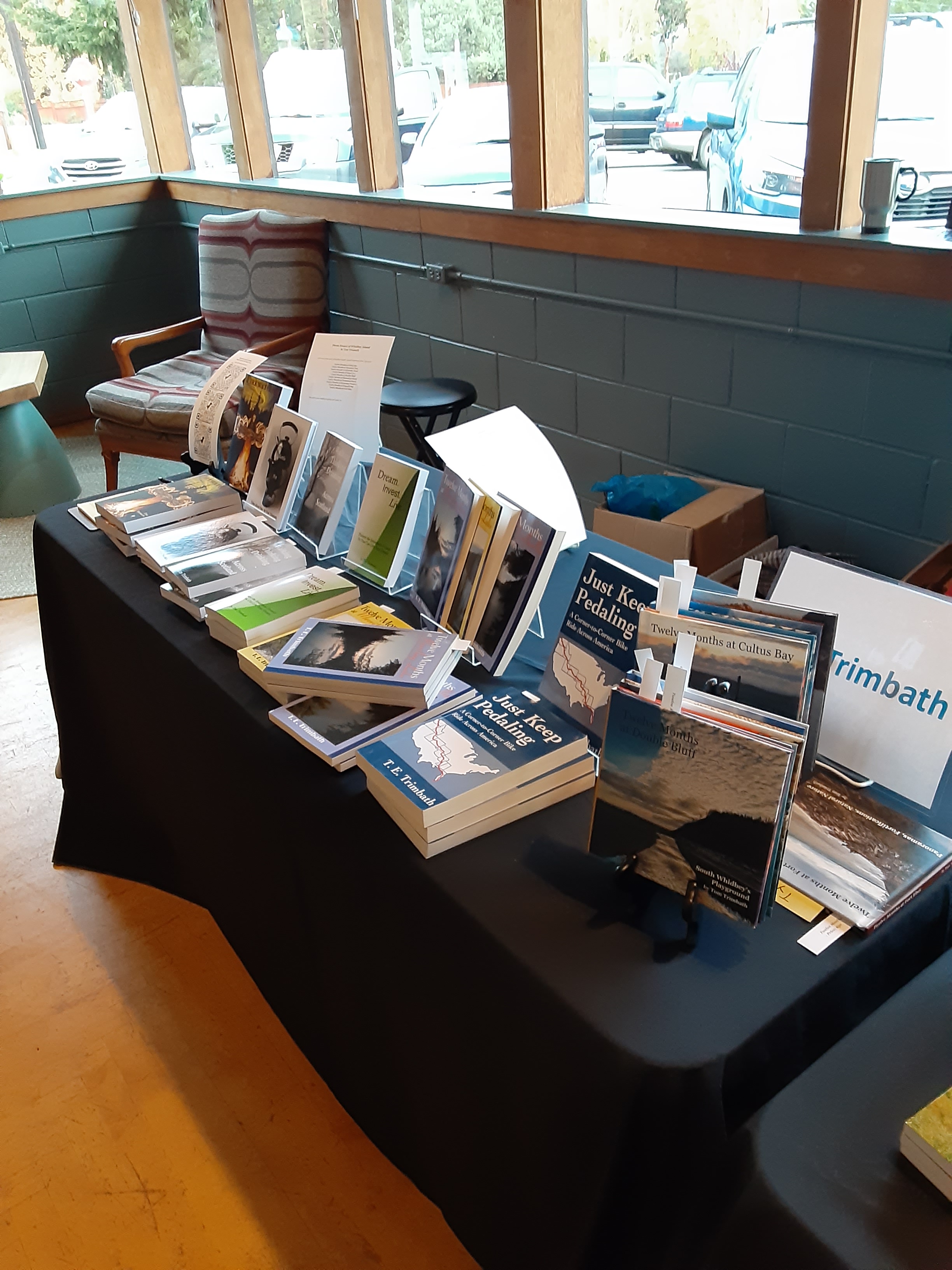
Speaking of which, can I also interest you in anything I’ve produced over the years? Some books, perhaps? America and bicycling, walking Scotland, hiking and skiing the Cascades? Some AI-inspired scifi, perhaps? Or how about photos of Whidbey Island’s natural shoreline? Available as prints, cards and even as books. But like many people I know, I’ve patiently been producing views of the world for decades. Who knows which, if any, people will care about? 

As a population, we’ve been working on a myriad of issues for centuries. Maybe with a bit of patience something positive, significant, and sustainable will arrive unsolicited but welcome. Sooner is better than later, and now can be better than sooner.

In the meantime, I think I’ll take a break for the evening. I want to be ready for what happens next.

Posted in Uncategorized | Tagged , , , , , , , , , , , , , , , | 2 Comments

Tom Got A New New Job

Well that was unexpected. Earlier this month I got an email, then a phone call, and then visited a company that likes my writing. (Echoes of Sally Field’s “They like me. They really like me.” come to mind.) Serendipity happens. The conversation happened as my brain has been considering too many scenarios – that have suddenly crystalized down to a few, like a super-saturated solution coalescing into something sweet. Yet another new era begins. I now have a job as a writer, and a writer about something I know something about, Whidbey Island.

Barack Obama was elected in 2008. This blog started about that same time because my book about personal finance, Dream. Invest. Live., was published then. Coincidence. Two memorable events in my life – and a recollection of a dance that was happening that night. A very dynamic day. I moved to Whidbey Island in 2005, so I was already was familiar with Whidbey. Since then, dozens, possibly hundreds of posts mentioned the island, particularly its community of nice people. So, there’s some history there.

Fast forward to 2017. This blog, which is supposed to concentrate on personal finance, was getting crowded for topics. That, and my decision to become a real estate broker, meant I should have a blog dedicated to Whidbey. Not a surprise; a broker has a lot to say about the area where they work. AboutWhidbey.com was launched. 

Skip ahead to the Spring of 2023 and I was no longer a broker and accepted a job at a non-profit that works to benefit the entire county, Island County. I was a Project Manager at the Economic Development Council for Island County. (Tom Got A Job) It sounds like a government job, but it is independent. Nice. It is also for all of Island County, which suggested that I remove bias from my public activities, so I gave up my Whidbey Island blogs (AboutWhidbey.com, WritingOnWhidbeyIsland.com) because they had the word ‘Whidbey’. 

That’s all normal and positive and progressive. But lately, people familiar with my writing mentioned to me that they noticed I wasn’t writing as much. What happened? I’m flattered and surprised that anyone noticed, but evidently, people do and did. Flattered and surprised.

And then came the call. Would I write about Whidbey Island for someone else? And get paid?! Uh, yeah.

But I have this job, you see…

But I have also not been able to work enough on my book (the sequel to Firewatcher), there’s a screenplay that I’ve been highly and repeatedly encouraged to write, several other projects like teaching classes (self-publishing, social media) and public speaking (see Events), a game about Whidbey, some inventions, and selling my books and my photos. I can’t fit that all in, even without a full-time job.

So, do I have faith in my abilities? With all of that going on surely something can generate more than enough income. That is more likely to happen if I work more on those ‘irons in the fire‘.

But, a full-time job with benefits. Stability. Respectability. Conventionality.

But, shouldn’t I be able to make more from what I’ve made? So far, no; but there are hints of hope.

This dilemma has been nudging me for weeks. I even considered selling my house, moving away from Whidbey Island, and buying a small house somewhere more affordable so I could be debt-free. I’d have to live off Social Security and a small pension, but debt-free is a nice place to be, so I’ve heard.

Ah, but a part-time job bridges full-time stability and solely entrepreneurial.

I’m not going to list all of my reasons and all of the scenarios because that can get dull, especially because I can be good at assessing lots of details and their interactions. Key for me, but boring to anyone else.

You may have noticed that I haven’t mentioned the other company. I’ll do that after papers are signed. Between the two jobs is a leap of faith and trust. 

There’s that leap away from stability and convention. I’m leaving a full-time job with benefits to return to gig work and its uncertainties, but relying on projets that may take months or years to complete. Of course, modern life is overflowing with uncertainties. AI, aliens, climate crisis, an un-uniting of the United States, the self-inflicted implosion of Russia, financial crises, and fill-in-the-blank with whatever is in today’s news. There is no escaping uncertainties – except maybe for an off-the-grid cabin in North Central Washington where the uncertainties are switched for uncertainties about power, water, sanitation, food, et al.

I’ll pass along the details about the new job as web sites, email addresses, and such come in. Besides, that’s one more opportunity to mention the work.

I chronicle this because this blog is about personal finances. Because of federal regulations it is safest for me to use me as an example. I am only one example, but each example has lessons. The work world has changed since I graduated college in 1980. I’ve been fortunate enough to witness the rise of the keyboard, which was also the diminishing of the secretary; the entry of electronic networks (at 300 baud), which meant fewer trips to deliver data; the introduction of the Internet, which became ubiquitous but which also shifted paradigms; the rise of the Gig Economy, and the resurgence of unions; the ability to work from anywhere, and the value of remaining socially connected IRL (and the use of texts, hashtags and TLAs); and the very welcome increase in diversity and awareness and trust in everyone in the workplace, ideally.

That long history also reveals a aspect of my life. I am getting older. Duh. Advice that made sense for a twenty-year old (get out of debt even if it takes years before launching your life), assumes a value of time; but that value that shifts with age. I’m over 60. Hopefully, I have many healthy years, still; but my 65th year will feel more precious than my 25th year. There’s less time to fit everything in between 65 and whenever. There’s also an appreciation of the value of things I was ignorant about forty years ago. Sunsets, conversations, dances, quiet times, times to celebrate have more feeling now, than then. 

I guess I’m part of some new shift. This is a major leap for me, but a small step for the economy and its workers who are similarly redefining work. And I am convinced that because of AI and the rest (even aliens?!) the economy is about to see its own major leap. 

Stay tuned because this story isn’t over.

Posted in Uncategorized | Tagged , , , , , | 1 Comment