My Jobs Report Month 9

I never thought I’d be writing this post. It’s been nine months now. At the end of August I began tracking my job applications. Despite press reports that claim that anyone who wants a job merely has to go looking for one, in nine months of daily searching I’ve received one job interview and that was for a part time job which stipulated that I couldn’t apply for a full time job. (Want to know more? Check my Bio for resumes.) The media talks about statistics and abstractions. I guess one thing this blog can provide is one real life example. I share it because I know that I am not alone.

The country needs aerospace engineers. Glad to hear it. I have a Masters in Aerospace and Ocean Engineering and worked at Boeing for 18 years. Companies need people who can exercise both halves of their brains. Great. I’ve written five books and produced series of photo series. Everyone can use hard workers. OK. I’ve been working hard enough that my friends don’t see me as much as they’d like. I’m scrambling – no doubt about it.

And yet, tomorrow my house goes on the market. It’s the prudent thing to do. My house, the only house that has ever felt like home, is going on the market to generate living expenses. If my finances don’t improve then money has to come from somewhere. I’ll check my lottery ticket later.

I’ll get to the optimism in a few more lines, but first I want to point out that my situation is better than others but they may not have a voice. I know people that have been looking longer, across a broader range, who are in houses that they can’t sell, and who have commitments that are significant. Kids and pets aren’t cheap and can’t just be ignored. After months of living like that, they are not very likely to speak up. I guess that telling my story in lieu of theirs is one thing that I get to do for all of us. They aren’t looking for a welfare state. They want to contribute and they need to be paid. Yet they haven’t found jobs either.

My job search has a regular schedule. Every day I check for jobs within about an hour and a half commute. Every week I look for jobs across the country. Every month I browse for jobs in various corners of the remnants of the British Empire. I’ll look at almost any job on the island, and as I reach farther I narrow my scope to my key technical skills and experience. It makes for an interesting job list, everything from secretary to analyst to engineer to manager to director, with offshoots into unique jobs. I’m sure everyone has their own approach. Sometimes I think luck is as important as effort.

Despite the theoretical appeal of diversity, almost every job application wants an expert within a very narrow field. Of course they do. What company would turn down someone who exactly fits their most stringent requirements and was passionate about working for them? They want perfection. They ask for it. Sometimes the job ads read like, “We have a job opening because Fred left. We want someone exactly like Fred, but better. And we want the new person to be named Fred.”

Welcome back to the optimism. I have some opportunities. One job might open up in a few weeks if everything works out. It isn’t a salaried job. It would be like a franchise, a business that will be solely dependent on me. If it makes money, I make money. Maybe it will pay my bills. Any money would help. There’s another job that is sweeter yet. They’ve asked for me personally, and it promises to pay a comfortable salary, but it won’t be available for months and until funding is available. Those two combined could do very well for me and my bills. And of course, I continue to work on my books, my photos, my classes, my consultations, and several (~twelve) other projects. If they succeed I don’t have to move. There’s even a game in development. Imagine that. I’ve built a scoreboard to track my progress on each of my efforts. It’s a big sheet of paper with post-it notes stepping their way along. Such a simple tool has kept me from being overwhelmed as I tried to keep track of my life.

A friend who had a struggling business, which is now such a busy business that he has a rough time taking a break, told me that the more an applicant expected to make in salary, the longer they’d have to search. As a rule of thumb, each $20,000 per year took an extra month’s search. Okay, I’m at nine months now. Nine months times $20,000/year is a $180,000/year job. That’s optimistic. Yeah. I know it doesn’t necessarily work that way; but it is a fun idea to play with.

None of us know how our lives will turn out. That’s always been the case and yet I’ve never had this many “if’s” in my life. If my portfolio returns me to thriving life, or doesn’t. If my business improves, or doesn’t. If my house sells, or doesn’t. If I get a job, or don’t. Those four simple if’s map into sixteen broad scenarios – and they aren’t the only if’s. The mathematician and logistician in me can handle the complexity by putting them into boxes, but even that is with the recognition that each scenario contains an infinity of real world subtlety. The emotional side of me sees the infinity and realizes that the best response is to be optimistic and not tied to any particular outcome. I’m trusting the universe, and working as hard as I can without hurting myself too much.

Realizing the odds within some of those scenarios puts the lottery in perspective. I’ll continue to buy tickets. The dream is worth the price of a dollar, and the jackpot seems about as likely.

To people who are in a similar situation, I sympathize with you. There are no guarantees. But I keep in mind how many of my friends went from dire to relieved within a month or even the space of a phone call. And that my most powerful investment available is time and my most available resource is me. I’ve invested a lot of time in me, and I’ve used me extensively. The time I’ve invested in me has been my most ambitious job, and that’s an investment that can positively benefit me in ways that exceed my expectations.

Pardon the lack of a closing pithy, but I have a few jobs to do. Well, maybe that is one. It is interesting how things work out.

PS: I just got a phone call from the garage. There goes another grand. Ouch.
Posted in Uncategorized | Tagged , , , , , , , , , , , , , , | 2 Comments

Eager And Anxious Expectations

Facebook (FB) has a $100,000,000,000 market cap? In so many ways that doesn’t make sense to me. People are expecting great things from them. That’s the nature of investing. Investing is about expectations. Use the past to extrapolate from the now to what is expected in the future. We do that in our daily lives, despite the fact that the only reality is the now. Sometimes we anticipate to excess.

I’ll begin with a short vocabulary lesson. Market cap is short for market capitalization. Does that help? Probably not. Roughly, capitalization can be a measure of net worth, cash in the bank, or the monetary fundamentals of a company. Small business failures are frequently attributed to being under-capitalized; i. e. they didn’t have enough money to build the product or advertise or hire enough people. My art photography is currently under-capitalized because my business account doesn’t have enough cash to pay for the photo processing, printing, matting, and framing. I might jump that hurdle by borrowing, by using credit to get capital at a cost. Market cap is a bit different. Market cap is what the market guesses is the value of the company, not its net worth. The net worth is on the balance sheet. The market cap is simply the price of the stock times the number of shares of the stock. As the price fluctuates the market cap fluctuates, even though nothing may have changed at a company. (For a more detailed description of Market Cap, go check out or buy my book, Dream. Invest. Live.) Market cap and net worth differ by the present value of the company’s future.

The market is thinking that Facebook is worth $100,000,000,000. There are only 7,000,000,000 people on the planet. Maybe it will work out somehow. Maybe Facebook will find a way to make $140 from every person on the planet, even the shepherds in Bangladesh. In the meantime, Facebook has only made $1,000,000,000 in a year. That’s a big number, but common for corporations. The price of Facebook divided by its revenues, its price to sales ration, P/S, is 100. Dull companies may have P/S down around 1 to 4. Growing companies may be more like 6 to 10. Exciting and disruptive companies may have P/S in the neighborhood of 20. Higher numbers are based on an eagerly anticipated future. A company may make no money in the current year, but expectations of their successful product launch next year can draw in some investors even though S is near zero now.

Then there is fear and greed. Emotions can negate logic. I think that’s one reason why some of my holdings (AMSC, DNDN, GIG, MVIS, and RSOL) have such poor stock prices. Investors fear the impact of the China spy scandal on AMSC. DNDN is feared to be the target of conspiracies or competition or both. GIG is fearless, but no one knows about them, and apathy can be as bad as fear. Investors fear that MVIS’s great products will fail because of operational and financial concerns. And as near as I can tell, RSOL is feared because it is in the same industry as Solyndra. Except for MicroVision, each of these companies are making tens or hundreds of millions of dollars per year. Yet each is only valued at P/S less than 6, not 10 or 20 which would be appropriate for such revolutionary companies, and definitely not 100. Investors are fearing the future of many small companies and are eager for the future of Facebook. That disconnect can be an opportunity, or a colossal “I told you so.”

The consequence of that disconnect means my investments are being sold too cheaply. I’m selling too much stock to pay my bills. If you’ve been reading this blog you’ve heard about it. Some have heard the tinges of fears. We are fractal. The same things that can happen in the market can happen within a human. Emotions can negate logic. Logically the probability that all of my stocks and efforts will financially succeed is very small. And yet, at various times it was easy to eagerly anticipate that possibility. Go back and check what I was writing on my original blog as DNDN rose, or as I released Dream. Invest. Live. Logically the probability that all of my stocks and business efforts will fail to support me is also very small. Yet it is too easy to dive into the anxiety of extrapolating from where I’ve been and where I am. My net worth is decreasing. Months of applying for jobs has only resulted in one interview, and that was for a part time job. My business is keeping me busy, but is not profitable. My recent financial past has a bad trend.

My portfolio may not be filled with enough for retirement at current valuations, but it still contains enough for months of living expenses. My house may be for sale, but it is still mine, I enjoy it, and a large enough financial improvement would mean I could keep it. My business may not be profitable, but my efforts have established a structure that can support impressive success. I’m glad I already understand frugality, because others find it is a lesson that is hard to learn when it is imposed. I can eagerly look ahead to a future that exceeds my past accomplishments. I can anxiously look ahead to a future that dives below my previous lows. Both efforts help me plan my actions. Eagerness encourages me to continue my efforts and shop for sailboats. Prudence encourages me to put my house on the market, maybe have a garage sale, and consider other options.

All of that is less important though than recognizing what’s here and now. Acknowledging what’s happening now is my lesson. As I sit here there is no reason to fear. I am comfortable. It is a beautiful spring day. I am healthier than I’ve been in a long time. Of all the places I’ve lived and visited, this is my home. I live amongst friends and community. If my life was extrapolated as a horizontal line from this moment I’d be pleased. My life today would be considered wealthy by billions of people. As I typed this, a friend dropped by to offer me a credit for a meeting space because they like having me in the space. Looks like I’ll be teaching Modern Self-Publishing on October 20th. Serendipitous events happen, large and small., and sometimes without planning or schedules.

Investing was only one word of three in the title of my book, Dream. Invest. Live., because investing shouldn’t consume all. Dreaming and Living are more important. Investing is merely a way to encourage dreaming and possibly enabling Living that Dream. Investing and Dreaming are anticipations. What do I want to do with this life? In this society it is necessary to ask how much money will that take. What’s a way to make more money if there isn’t enough already? They are valid questions, but anticipations can become traps because tomorrow is always a day away.

Living is reality. Whether it is living the dream or not, living is the here and now; and as I look around, the here and now are very nice. The here and now are the only things my senses and I can ever enjoy.

So, Facebook has an amazing market cap. I think each of my stocks should be valued my higher. I think Facebook’s valuation is driven by overly-eager investors. I think Dendreon’s valuation is driven by overly-anxious investors. I think the real answer is somewhere in between. I’ll use that as macro example of my situation. Don’t be too eager. Don’t be too anxious. A bit of both is fine, and expect something good enough.

Posted in Uncategorized | Tagged , , , , , , , , , , , , , , , , , , , , , , , | Leave a comment

Tools And Cobwebs

Themes arise. As a writer I love that. As an intuitive innovator I cheer it. I’ll pour the wine later. I’ll drink tea while I am writing. I happily guest blogged about the tools of my trade, a trade that seems one-sided considering my sales during this economy. I’m the frugal sort, so instead of impressive technical descriptions I philosophized about the how and why of using simple equipment. About the same time a comment came in from my “Cobwebs In The Car” post. I’d written about my use of simplicity as partial solutions to pervasive problems. Life doesn’t have to be complex to be good, and while I prefer simple, the unfortunate fact is that simple is sometimes imposed into fragile circumstances. Sound complicated? It ain’t, and the frailty may be temporary.

Angela Hemming  is the Digital Media Producer for Ahem Productions. We met at the conference I described in Collaborating for Causes. She suggested a simple collaboration, me as a guest blogger. Here’s how she describes the blog.
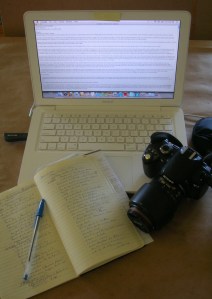
Welcome to a weekly series called “Tools of the Trade,” in which I invite creative professionals all over the world to share a little bit about what they do and where they do it. I encourage them to define “Tools of the Trade” however they like. ” Well, she said “however they like”, so I jumped in. My writing is based on notes on paper, composed in TextEdit (ala the PC’s Notepad), and only transferred to MS Word as necessary. My photography is based on a lower end Nikon, a D40, that has fewer pixels than some phone cameras. My teaching and consulting are almost technology free, but heating and lighting are appreciated. (Though I did just have two fine meetings outdoors today. But I digress.) Fancier technology may get me better gigs, be more impressive, but the extra costs can easily exceed the incremental benefits. I keep it simple.

And then there was my post about bicycling more and driving less, to the extent that the spiders were weaving the steering wheel to the rear view mirror. (Where would you place a front view mirror?) Using my car less decreases its pollution, cost of operation, and my anxiety over a high oil pressure anomaly. But Hannah Lee Jones made a comment about the underlying issue.  Here’s a snippet of her comment; “It seems that a lot of what we propose as solutions are dependent upon an infrastructure that is a lot more fragile than we could ever guess.

The world is a fragile place, at least in regards to supporting the human race. The biosphere is being challenged, and just like with the dinosaurs, it may evolve a solution that doesn’t involve the dominant species. Stay tuned. Very few things can disturb the planet. The human race, however, has lived a precarious life. A long while ago the population collapsed from millions until there were less than 20,000 of us on the planet. That’s the population of the southern half of my sparsely populated rural island stretched across the globe. Evidently agriculture saved us (though genetically my body hasn’t evolved to properly digest wheat, so the adaptation continues). Even after the rise of historical civilizations, life has been fragile. History has more examples of civilizations failing than it does of civilizations surviving. Now that the human race has gone global though we may have raised the sensitivities through numbers and technology. The majority of seven billion people do not have adequate power, water, food, education, health care, or security. Until we provide the basics to the vast majority, and do so sustainably, we as a species are fragile.

But I won’t say that I use simple solutions because I expect my solitary efforts to be a shining example. If some see it as a positive role model then great. Glad to be of service. I use simple solutions for two reasons.

One is what I described in my post on Angela’s blog. Pardon me as I steal from myself. “I am a minimalist, not through some grand plan, but probably because I was brought up in a family that had to be careful with money. That carefulness was handy during my aerospace career. If something is going to fly, every ounce counts and if something isn’t necessary it is left behind. Self-propelled tours of bits of the planet by hiking, skiing, and bicycling reinforced the notion. I’ve learned to live for days or weeks on what can fit into a backpack or panniers. Gear has to be simple, compact, rugged, and easily replaceable.

The other reason is that I must. My finances, my liquid net worth, are in such bad shape that I am applying for jobs and scrambling to make my efforts pay my bills. In general that means making money. I haven’t found any other way to pay the mortgage or the insurance. My situation is fragile. I am also an optimist. The odds of everything succeeding are very small. The odds of everything failing are also small. The most likely result is that something good enough will happen. Of course, I’ve been thinking that for months now. (Cheer up. Some good things are coming. Any day now. Really. Actually yes. Stay tuned. I look forward to blogging about good news, and in the meantime, go buy one of my books or photos or call for a consultation.) After my finances improve sufficiently I will get the car fixed, maybe get the sand out of the auto-focus mechanism in my favorite lens, probably add a travel computer for slideshows and such, and generally reduce the frailty in my life.

I am not alone. Many people are in tougher situations. I have specific reasons for hope. Most poor people have hope and whatever they can find at hand. Societies and governments built around them are built on fragile foundations. Governments and institutions work to maintain the status quo because we are in the blind habit of propping up dysfunctional processes. Our civilizations have rarely evolved out of that precarious situation. Something revolutionary might happen. That’s why I tend to invest in innovations and inventions that disrupt convention. To me, MicroVision‘s technology for fitting projectors into cell phones isn’t just a cute way to carry around a 100 inch monitor. It’s a way to abandon the habitual dysfunctional processes that go into digging up tons of sometimes toxic raw materials, to build enormous black boxes, that are shipped around the world in boxes in containers on ships, stored in warehouses, and then discarded after a few years. And the nice thing is that we can disrupt those wasteful practices and end up with the ability to show a wide-screen movie anywhere. Cool and positive. Okay, MicroVision (MVIS), do your stuff and do it soon so I can make my lifestyle much less fragile and help others too.

I am hopeful because the human race is adaptable. We’ve never had to turn around seven billion minds and lives before, but we will probably find a way. I suspect it will happen through innovations, inventions, and ingenuity. That is the basis behind my incubator. Others have similar and possibly better ideas. I’m glad to hear that. The more ideas the better. Now, as for the funding, well – anyone got a few million dimes?

Simple solutions will point us in the right direction. Respecting our frailty and working to reduce it is a necessary goal. And opening the channels for innovations, inventions, and ingenuity will make the effort easier, quicker, and our lives better.

I really should go clean the windshield in the car now. The cobwebs are cute, but more than a bit distracting. Maybe I’ll clean the camera lens too.

PS Even when I work from two of my previous posts, the words stretch out to over 1,300 words. So it goes. If I had more time I’d make it shorter. IIHMTIMIS

Posted in Uncategorized | Tagged , , , , , , , , , , , , , , , , , , | 1 Comment

Cobwebs In The Car

There are cobwebs in my car. Okay. It’s spring. Spiders are hatching everywhere, why not in my car? Evidently, they are using it more than me. Spring is partly to blame. So is $4.26 gas. I’m using a startling new technique for decreasing my gas costs. I drive less. It has its advantages, and I wonder if we’ll finally see a change in the way we live.

I like to start Saturday mornings by listening to Car Talk. Back when I hiked every weekend it was fun to listen to Car Talk on the way to the trailhead and A Prairie Home Companion on the way home. The hiking doesn’t happen as much anymore. Gas prices, ferry fees, and an aging car explain a lot of that. My house is shielded by a ridge, so my radio has a rough time pulling in a good signal. Fortunately, streaming happens and that’s good enough. I listen because Tom and Ray are entertaining and because I usually learn something. I might even call them this week if I can’t figure out an oil pressure issue. My ~150,000 mile Jeep has high oil pressure but isn’t burning any. Go figure.

With my current financial situation, ugh, I’m driving a lot less anyway. Much of what I do with writing and consulting can happen from home, so that’s handy. I can walk to Hammon’s Preserve where I am a Site Steward. And my neighborhood is on the water with marvelous views. Staying home is a treat. There are plenty of reasons to get out and drive: groceries, photographing Twelve Months at Double Bluff, managing exhibits, giving talks, socializing, etc. But now that spring has arrived and the days are longer it is easier to use my bicycle for some of the trips. If it wasn’t for one pesky hill and some skinny road shoulders I’d use my bike even more.

Some people shop for cars based on mpg and carbon footprint. I’m an engineer so I know data are good. But how something is used can be more important than how it compares to its competition. I know folks that custom design and hand build electric trucks. Amazing. They do it as a passion. Most folks though are likely to shop and buy instead of design and build. They need criteria and mpg and carbon are handy. But published criteria and data only make sense if the vehicle is driven the same way it was tested and measured. A commuter may benefit from a strict adherence to the numbers, but someone that only drives once a week won’t see the same benefit. They may spend a lot on something that looks like a good idea and is lauded by Al Gore, and yet have spent more money than necessary. It can take years to pay back such a seemingly good idea.

The easiest and cheapest way to decrease a car’s pollution and operating costs by 10% is to drive it 10% less. No new equipment required.

At last week’s conference, Collaborations for Cause, my team was tasked with coming up with a multi-media pitch for improving life in urban corridors. We focussed on commuters and came up with a slogan, My Commute Sucks, only to find that someone else already was using it. Oh well, at least that is proof that we were not alone. Ironically, most of the team members had given up the drive time commute by either using mass transit, moving within a walk or bike ride, or finding jobs that didn’t require commuting. We might represent a trend.

Trends can start from the fringe. I am familiar with frugality and bicycling. I’m Board Secretary of New Road Map Foundation (aka financialintegrity.org) and the author of Just Keep Pedaling, A Corner-to-Corner Bike Ride Across America. (By the way, I remembered there’s a slideshow online too.) Being conscious of how I spend my time and money, and being very aware of how far I can go on a bicycle mean I am comfortable with the notion of using a twenty year old bike instead of unnecessarily burning bubbling crude. Whidbey is hilly and the region is laughed at for being – moist. Yet, I am not as strong an advocate or as active a cyclist as others who are pedaling around our hills in the rain. Kurt Hoetling only used foot power for a year and chronicled it in The Circumference of Home. Hannah Lee Jones and Philip Renker Jones seem to use their bicycles for everything, including as fundraisers for their Ndoto Project (empowering youth in Africa).

Systemic changes do not require massive investments, revolutionary discoveries, or severe depravation. Changing the habits of a population require incentives, and I am not talking about tax breaks. Change happens quickest when people want to change. I watch trends and I am watching how news reports, facebook posts, and tweets are changing as gas prices increase. When the bulk of the text switches from complaining about the cost to proclaiming personal solutions, then change is being embraced.

Commuting costs, housing markets, trustworthy investments, health care options are all being challenged. Mass transit and people power can create more pleasant commutes. A sucky commute can become a lucky commute. Owning a small and comfortable house is winning out over buying a house so large that it owns the owner. Local and peer-to-peer lending is appealing to investors who trust their neighbors more than they trust the traditional markets. Businesses that advocate “alternative” healthcare are finding themselves busy as people distance themselves from western medicine – a trend which is entertaining because the “alternative” frequently is based on thousands of years of development, practice, and experience.

I watch such changes because I am an investor. I doubt that I’d invest in a car company. I don’t want to sell my house, but it might be a prudent financial decision (care to look, shop, and buy?); but as I dream of a better abode I envision something small and well-built in a very nice place. I’m still in the stock market because I am optimistic about and have invested in positively disruptive companies. (Unfortunately, the market see disruptive and thinks risky. Therein lies my financial situation.) And as for health care, I’ve been following friends’ advice and feel much better than any prescription ever managed.

Our world is changing. We know we can’t continue doing exactly what we’ve done before. We’re running out of planet. But some very powerful solutions are simple and pleasant. In my case, it means giving the spiders enough time to weave a cobweb from the visor to the steering wheel to the mirror, while I bicycle through spring days. The cobwebs are actually a good sign. The moss growing around the edge of the bumper – well, that’s just proof that I live in the Western Washington and that our local car wash shut down.

Posted in Uncategorized | Tagged , , , , , , , , , , , , , , , , , , , , , , , , | 3 Comments

My Nonsensical Realm

My world passed through ridiculous long ago. Now it is in a realm of nonsense. Companies do well, and their stocks drop. Do good hard work, and wonder if I’ll get paid. Apply diligently for jobs, and listen to the void. I admit to frustration, realize others are frustrated too, and yet I will persist.

It’s time to pay the mortgage again – within the grace period. I’ve been paying my bills by selling DNDN (Dendreon – a cancer vaccine company) at prices I consider to be a small fraction of the company’s worth. Each earnings announcement is an opportunity for good news, an increase in the share price, and a reason to delay my sale until the good news hits. Back in August they missed earnings by 20% and the stock dropped 80%. Since then they continue to increase earnings. The rest of the market is recovering. Surely DNDN’s valuation will return to the vicinity of those previous levels with each month’s good news. May 7th Dendreon reported results again. They hit their revenue numbers. They continue to grow. The treatments continue to work. The stock dropped 20% further. There are plenty of rationalizations, but to me, it doesn’t make any sense. It should eventually, maybe after I’ve sold all of my shares. Sigh.

Fortunately, I have skills and energy. I’ve been busy:

And then consulting showed up, and I’ve come to realize that I like it best. People and ideas are my passion and I am energized after each session. (Give me a call. We’ll probably have fun.)
Oh yeah, and each of us does charitable work too, right? So let’s remember being a site steward for Whidbey Camano Land Trust, and Board Secretary for New Road Map Foundation.
Okay, so maybe my energy level isn’t as high as it could be at the end of the week.
Unfortunately, all of that work has yet to pay the bills. Where’s the sense in that much effort producing so little reward? Many of those projects could pay the bills, and maybe someday they will, but the mortgage is already past due. (Thanks for grace periods.)

The good news is that there are jobs out there, so even if my entrepreneurial efforts don’t succeed perhaps a paycheck can make it all better. You can probably guess that my job search hasn’t been successful. (But if you want to help, here’s my resume.) A week or so ago I applied for another “rocket science” job, didn’t get it, and found out that there were 1,500 applicants. Even if I was more qualified than 1498 of them, and I don’t know if I was, coming in second is not good enough. It is a small comfort that I am not alone, but it can seem senseless to look for jobs every day with so little encouragement. I’m in my ninth month of daily looking and not yet finding.

At some point it seems to make more sense to do nothing. Sitting still for these months would have cost less, left me with more energy, been less stressful, and possibly had the same result.

The other evening I watched “My Man Godfrey“, a William Powell and Carole Lombard movie about wealth and poverty. It is a romantic comedy, but because it was filmed during the Great Depression (1936) it also acts as a societal commentary. Godfrey is homeless, except for a tin shack in the dump. He fell there from society’s heights, and then re-enters society by becoming a butler with style. They filmed it before they knew whether the Depression would ever end. I’ll paraphrase one quote; “They say prosperity is right around the corner. Which corner is that?” This was seven years after the crash and they still didn’t know where they were going. We know how it turned out, and hopefully the recovery doesn’t require a World War. I suspect the economy would’ve righted itself without the war. How close are we to turning the corner?

Picking good companies to invest in, doing good work which is nicely complimented, diligently applying for jobs at every level from secretary to director yet watching my net worth drastically dwindle is my recent frustrating history. It doesn’t make sense. And yet the optimist in me has not lost its voice.

The likelihood that everything will succeed is very small. The likelihood that everything will fail is very small. As I sell, my portfolio has a tougher time recovering, but the possibility exists. Come on MVIS and GIG. – you can do it and do it soon. The 10,000 Rule is working for me, I hope. My books and photos can sell themselves. If they do, then my work in the past pays me in the future. My classes are expanding. Consultations are becoming more common, especially as folks that have contacted me follow through. (Nudge.) Each of the other projects can surprise and there’s no way to know which to emphasize at the expense of the others. I’ll keep working on them all. The improving economy should be working for many folks eventually, including me. Young folks are getting job offers. Maybe my middle-aged friends and I will get such good news too. What’s most likely is that enough good things will happen, and that would be a sensible realm.

Posted in Uncategorized | Tagged , , , , , , , , , , , , , , , , , , , , , , , | 2 Comments

Collaborating For Causes

The supply of causes has increased. Thank you internet. The demand for solutions has increased. Thank you caring people. I just attended a two day conference called Collaborations for Cause, a retreat for advocates and communicators trying to deal with the new world that has been created by digital media. Supply and demand were the implicit themes for every aspect of the talks. One thing is certain, issues have a harder time hiding, individuals have an easier time finding a voice,  professional camera equipment is competing with smartphones, and technology and culture are continuing to change. Stay tuned.

Going to a conference within a fifteen minute drive is definitely convenient, especially when others are willing to travel from around the continent to attend. Thanks to everyone for coming to my corner of the world. They didn’t come for me. They came because a local firm, Fusion Spark Media, organized the event. My money is tight, so I hadn’t planned to attend, but New Road Map Foundation (hi, I’m the board Secretary) decided that someone should attend. How can we can take a subject like personal finance (aka financial integrity / intelligence / independence / literacy) and make it emotionally and visually engaging? Stay tuned for that too. (And feel free to pass along ideas via the web site.) They paid my way so I said yes. Besides, I’m a photographer too so I had additional common ground with the other attendees.

The world needs fixing. Every generation has known that, but hundreds of years ago “the world” that needed fixing may have only been the protecting the neighboring valley from seasonal floods. The world community now knows about the planet. Get an internet connection and read about any part of the world. Someone there is telling the story of the land, the people, the politics, or the culture – or at least whether there are any cute kittens there. Our supply has maximized and the outcry over recently-unobscured issues is proof that human compassion continues to rise to match the need.

Fortunately, in addition to solutions getting matched to needs, it is also possible to benefit from the trend by watching it and investing in it. To some that sounds cynical, but the Bill & Melinda Gates Foundation does such good work because a nice couple profited from the trends and used that money for something besides yet another mega-mansion. They aren’t alone. And being in America means being able to make money the same way, and use it for philanthropic work comes with the government’s blessing, or at least a tax break. CSCO, FFIV, MSFT, APPL, AMZN, et al have produced people who want to make the world a better place. For a while, I was doing the same, and I hope to yet again.

There is a disconnect though. Prior to the internet, professionals were employed to produce high quality messages through words, images, and events. In their competitive environment it made sense to act professionally and responsibly by backing up quality work with well-researched data. Many made a living, though few got rich. I suspect that much of the money they made went back into equipment and travel to produce better stories rather than for boat payments. Now, with the advent of ubiquitous embedded cameras, digital media manipulation, and free global distribution, it has become common for crowdsourced content to feed the demand for imagery and insight with less regard for verifying sources. A few professionals compete against the rest of the population. It is the classic quantity versus quality debate. I’m a fan of both. I wait for Scientific American to verify discoveries, and I frequent wikipedia for most of my curiosity based research.

I sat there listening to all of the points of view because many of them exist within my head. I was representing an organization recognized for being careful with money and time, while also sitting there as an advocate for other groups, and also with a business as a nature photographer. I’m a fan of crowdsourcing because it is cheap, pervasive, engaging, and based on diversity. I’m a fan of high-quality work because it comes with fewer caveats which makes it more reliable and therefore more useful. It is also easier to watch and listen to. Quality is a reflection of value, and reliable quality takes time, a portion of a person’s life, to create; and we should value people’s lives.

I sit here now, knowing that the professionals are in a difficult business environment. Yes, there is a great supply of causes that need to be advanced. Yes, there is a great demand for high-quality messages that deal with those situations and possible solutions, but there is also a much greater supply of free enthusiastic advocacy that doesn’t necessarily value well-established verifiable data and background documentation. Maybe there’s more than enough for everyone, but considering how many professional photographers are working regular day jobs too, it suggests that the demand for quality is not high enough. Maybe we professional photographers should take ourselves on as a cause, as proof that we know how to properly craft a persuasive and pervasive message.

One trend was apparent. My favorite seat in that venue (WICA) is in the back row. From there it was easy to see how many attendees were lit by a blue glow from their ever-present laptop, tablet, smartphone, whatever. Many people were multi-tasking, or as I prefer to think of it serially ignoring a rapidly shifting set of distractions. Electronics are ubiquitous, duh, and attention spans are measured in seconds and characters instead of hours and chapters. I, too, was guilty. There was a drawing, my card was picked, and all I had to do was come down on stage and correctly answer a question that would be simple for those who were paying attention. Unfortunately, I was checking the twitter feed to see what else was happening in the room. Fortunately, my made up answer was good enough. Yes! Whew.

The value of intangible things that are in great supply can easily be reduced to zero, except when the demand is sincere and essential. Words and images are easy to find, but the right words, the right images can be invaluable. I see this when I consult with people who decided to take the step and become a client. They’ve probably already received plenty of free advice. Sometime that’s good enough, but there’s a definite value in money and time when the need for a solution is a bit more than simply trivial. I saw that when I was a client (thank you Mike and Michelle), and I’ve seen that as a consultant. (Really, a bottle of scotch? Thank you for the nice tip.) I hope we find a way to blend the value available in the professionals and the energy and power available in the crowd called the human race. There are more than enough causes for us to collaborate on.

PS
Supply and demand also kicked in for an unexpected MicroVision moment. As part of an exercise ten of us were trying to put together a ten-minute presentation in ninety minutes. One of my team mates turned to me and said, “You know, if we only had one of this little pocket projectors this would be so much easier. I gotta get me one of those.” I told him I had one, but had left it at home. Oops. He’s eager, and he didn’t even know they were for sale. Demand, meet supply.

Posted in Uncategorized | Tagged , , , , , , , , , , , , , , , , , , , , , | Leave a comment

UW MVIS LMRA GGOX GIG

 The story of an idea. Okay, okay. It looks like I should finally spend a bit more time describing the most esoteric of my stock investments. GigOptix (GIG) is the company that I usually skip over when describing what I own because most electro-optical modulators are not a typical cocktail party topic. The stock and the company are good examples of overlooked opportunities, unexpected developments, and the persistence of a good idea – and we need good ideas and they need persistence.

UW MVIS LMRA GGOX GIG is just a string of acronyms and symbols that represent the changing addresses of an idea. Welcome to the jittery journey of an innovative idea.

Back at the University of Washington (UW), Dr. Dalton (I believe) and probably a team came up with a neat mix of chemicals that allowed for some marvelous physical manipulations. Here’s my slightly out of chronological order post:
“Wrap the right environment and wires around it and light can come in one end, get modulated by an electrical (RF?) signal and out the other end comes basically ones and zeroes of light. This is handy and necessary for things like fiber optic telecom cables and data transfer within a computer.
The current standard for a switch is about 2.5Ghz. I think he said that an interested tech company demonstrated Lumera’s product at over 200 Ghz. Lumera is also working on going up to the next step 1000 Ghz , otherwise known as 1 TeraHz (Thz). Evidently it operates on one-fifth the power of typical systems, “

I believe (and I’ll continue qualifying that because the history search would take more time than I have this morning) that UW and Dr. Dalton et al also helped develop MEMS projector and scanner technologies, a mirror on a chip that could vibrate and either send or receive images. They did some very interesting work back there, but being a university also meant that developing a commercial product would best happen elsewhere.

MicroVision (MVIS) was formed with UW’s ideas and someone else’s money. I wasn’t there at the time. I don’t know how it happened. MicroVision focused on the MEMS work. There were plenty of applications for possibly profitably disrupting the electronic display industry with some awesome competition. They didn’t ignore the electro-optical work, but it didn’t get center stage at any of the demos. MicroVision’s projector work continues in a saga I’ve mentioned in detail throughout this blog. Start with Micro Vision or the tag cloud for more. MicroVision needed money. Electro-optics weren’t their main interest. So, they spun off the division to raise some cash.

Welcome to Lumera (LMRA) a company that was the new home for the development of electro-optics. Whenever I checked in they had at least six product lines under development. The expectation was that if one was profitable, the company would solvent. If two did well, the company would grow. If three succeeded the company would thrive. That’s an oversimplification, but I’m not writing a book here, just a long blog post. They tried lots of things, and in general, whatever they tried managed to impress technically but not commercially. Sometimes I thought they were providing solutions without checking understanding customers’ needs. The company struggled. They winnowed down to a few products, but it didn’t matter.  They needed cash. Fortunately, someone needed them.

GigOptix was a small company that had products and ambition. They sold modulators but realized that the internet would eventually need faster ones than their technology could produce. They also wanted to become publicly traded. Lumera had the advanced tech and the stock trading symbol. GigOptix merged/acquired Lumera and traded under GGOX. The GigOptix management took over, moved most of the work elsewhere, and shelved almost every Lumera product except for the modulators. Revenues grew, but slowly. The company was overlooked because it was so small, and the stock price slipped low. They were threatened with delisting, and accepted it. GGOX became GGOX.OB. Investopedia does a god job of describing the .OB . As for investors, it meant the company was much less likely to be bought by institutions. The stock quieted.

The company, however, was busy. From what I can recall, their regular products continue to sell; and Lumera’s technology has finally hit the market too. Within the last three years, GigOptix’s revenues have doubled. According to Yahoo!, in 2011 GigOptix made $32,270,000 while MicroVision made $5,620,000. GigOptix made more than five times as much as MicroVision. Their market caps, the market’s guess at the companies’ values, were almost the same at the end of the year. It looks to me like GigOptix is undervalued. MicroVision, well, that story continues to cycle through great pessimism and great optimism. I suspect the market is as confused as the stockholders.

In the meantime, MicroVision received a delisting notice, went through a one-for-eight reverse split, and has announced layoffs. But they expect to do much better by the end of the year, so they’ve said for many years now. I hope they are right. The technologies, products, and potential profits are impressive. Stay tuned.

In the meantime, GGOX.OB has become GIG, a three letter trading symbol off the .OB and onto the American Stock Exchange. Their market cap has doubled, and may be proof that I underestimated the impact of their recent Dutch Auction, but is probably also proof of the value of persistence.

Why be interested? Well, if you’re not, then congratulate yourself for persistence to have read this far. The modulators are the speed limiters in the internet. Want to transfer massive files? Get fast modulators. Want to video chat? Get fast modulators. Want information to flow quickly and cheaply? Isn’t that the true value of the Internet on a personal and global level? Get fast modulators.

And what else do we need that is vital and boring, that is easily overlooked, yet that may take time and the right environment to come to fruition? Thanks to those who champion the vital yet innocuous.

PS Now that GigOptix is doing this well, I’d love to see them pull some of those other applications off the shelf: Steerable antennas without moving parts; and cheap, fast, bio-labs on a chip. Very cool. We could use those.

For reference: check my posts on Silicon Investor’s Lumera board.

Posted in Uncategorized | Tagged , , , , , , , , , | 1 Comment

I Like Unlikely Iceland

It will never happen, and yet it did. My friends thought that one of my ideas was ludicrous and that it could never happen. I disagreed. In times of severe economic crisis sacrifices must be made. I suggested that sometimes it makes more sense to sacrifice one piece of a system rather than make the entire system suffer indefinitely. What would happen if we sacrificed one segment of the economy, maybe the mortgage industry, as a way to generate cash flow and invigorate the rest of the economy? The response was that the inequities would be too great. No one would ever agree to it, regardless of how much discretionary spending it would make available. Yet, Iceland did it this week. The mortgage debt of all citizens have been forgiven. We are in an unlikely situation. Unlikely things happen.

Any system can be upset. Small upsets resolve themselves in a stable system. Large enough upsets may recover, but may take very long if there is a lot of inertia in the system. Extreme upsets may exceed the stability of the system, in which case a normal recovery may take too long or may never happen. If the system was never truly stable, then trying to make it recover using the same things that propped it up has no guarantee of success and may make things worse.

My idea was simple, and possibly naive. Imagine what would happen if instead of throwing money at the problem, or by bailing out the institutions, one industry was sacrificed. Farming is food and we need that. Utilities are necessities. Manufacturing can export goods. So, I wondered what would happen if there was a federally mandated default on something more abstract like home mortgages or student loans. Individuals would have much more discretionary income. Anxieties over underwater real estate values would vanish. Mobility would increase. People might begin to think that the government cares more about people than corporations.

It is an idea that is easy to dismiss because of the great inequities in the system. Someone with a brand new mortgage would effectively be handed a house for the price of the downpayment and taxes, while their neighbor who dutifully paid  thirty years of those bills did it for nothing. That is an inequity, but is that inequity smaller or larger than the inequities we’ve witnessed within trillion dollar bailouts? Is it more direct and effective to have the government print more money, or to have people redirect their own funds? The Icelanders bailouts were smaller because their country is smaller and yet they made the choice. (I wonder what the per capita comparison would show.) I enjoy repeating: The mortgage debt of all citizens have been forgiven.

I don’t expect it to happen here. I also don’t expect things to return to normal normally. We are in an unlikely situation and any recovery will encounter unlikely things. Long range plans based on extrapolations from the fifties are more likely to fail than plans that are flexible.

Countries Disband.
There is great debate about globalization yet the number of countries continues to expand. (I recommend Parag Khanna’s Ted Talk.) The number of countries has grown from about 100 after World War II to about 200 now. Much of that happened as African countries gained independence, but many were also formed when the Soviet Union broke up. That was unexpected at the time, though I am sure some think it is obvious in retrospect. Take a look at how maps have changed in that time. Big blocks of land have cracked like shattered glass. Two of the most prominent blocks of land remaining are China and the US. Some will say that they can never fracture. They’re too big to fail. The European Union is big too, but it doesn’t look very stable. China has great divisions within its borders. Financial and cultural disparities are more apparent now than ever. And of course common wisdom is that the US can’t fracture, except for the fact that it almost happened once and that many haven’t forgotten what happened generations ago.

Currency Collapse
Most money is abstract. If it isn’t based on gold or seashells, it is based on – well – an agreement that it is worth something. That seems to work. Yet, some suggest that it won’t, and that our problems are tied to money’s abstract nature. Currencies have collapsed, probably as long as there have been currencies. We are an evolving civilization and our method of trading value is trading too. We’ll get it right, and what we have may be right enough. But I keep in mind that it can go away too. True security is hard to buy for nations and people. Besides, money may come under assault. So much of the world’s finances exist as data, and enough hackers are hacked-off, that I wonder if someday I’ll wake up to find that someone flipped the bits and collapsed the currencies while I slept.

Enough For All
Unlikely things can be good. Much of technology has developed through laborious research, but discoveries can be strokes of luck or ingenuity. Fusion has been researched for decades, and yet aside from cold fusion, none of the designs seem scalable, cheap, or easy. Will cold fusion work? I don’t know. Maybe it is unlikely. But it was also unlikely when we learned that matter, the stuff we are made of, is less than 10% of the universe, and that the majority of the universe is dark matter and dark energy. They are ubiquitous. Maybe we’ll find a way for everyone to tap them. Maybe other discoveries will provide everyone with food, water, shelter and security. It appears unlikely, but so have most advances.

Trying to predict the unlikely can be fun. Trying to develop a financial plan that accommodates all the likely and unlikely scenarios can hurt a brain. Being aware of the possibilities and being flexible are my preferred middle path.

This week I applied for a job with Planetary Resources. (And anyone can check my resume.) They plan to mine asteroids. It sounds unlikely until it is compared against the extremes we already accept in deep sea mining and drilling. And mining asteroids does not require poking more holes in our planet. Will I get the job? (I hope so. See My Space Remorse.) I don’t know if it is likely or not. But Iceland has proved that even unlikely things can happen. I like that.

Posted in Uncategorized | Tagged , , , , , , , , , , , , , , | Leave a comment

Editing Out Humanity

The rains are back in town. There’s photo I’d love to take from where I sit. Low clouds are weaving through the tress on the opposite side of the bay. Each fragment of mist frames a different green vignette; either fresh leaves on resurgent deciduous or deeper mature needles on pines. No wonder I like my view home. But I won’t get out the camera because the photo would include powerlines. My eye can edit them out of my memory, but the camera would dutifully record them. Much of what we witness and discuss involves inconvenient reminders of humanity, and even though I won’t take the shot, I realize that humanity shouldn’t be ignored; especially, in finance and society.

When I take photos for my Twelve Month series, either for the narratives or the photo essays, I treat the digital photography as if it was film. When I used film I didn’t crop or colorize. I relied on positioning and lighting to create the effects that some produce with Photoshop. I don’t use software to remove powerlines because I find ways to keep the powerlines out of the picture. Especially with my photos I try to show the beauty in the everyday, nature’s arrangements that are easy to overlook while driving by in an automotive box. I walk around in somewhat inclimate weather, and sunny days too, and photograph clouds, landscapes, trees, shells, waves, and anything that happens along. It is too easy to only pay attention to the bits of the world that we have built. Even a drive through the mountains requires the driver to watch their speed and the road. I try to show what’s beyond our manufactured borders.

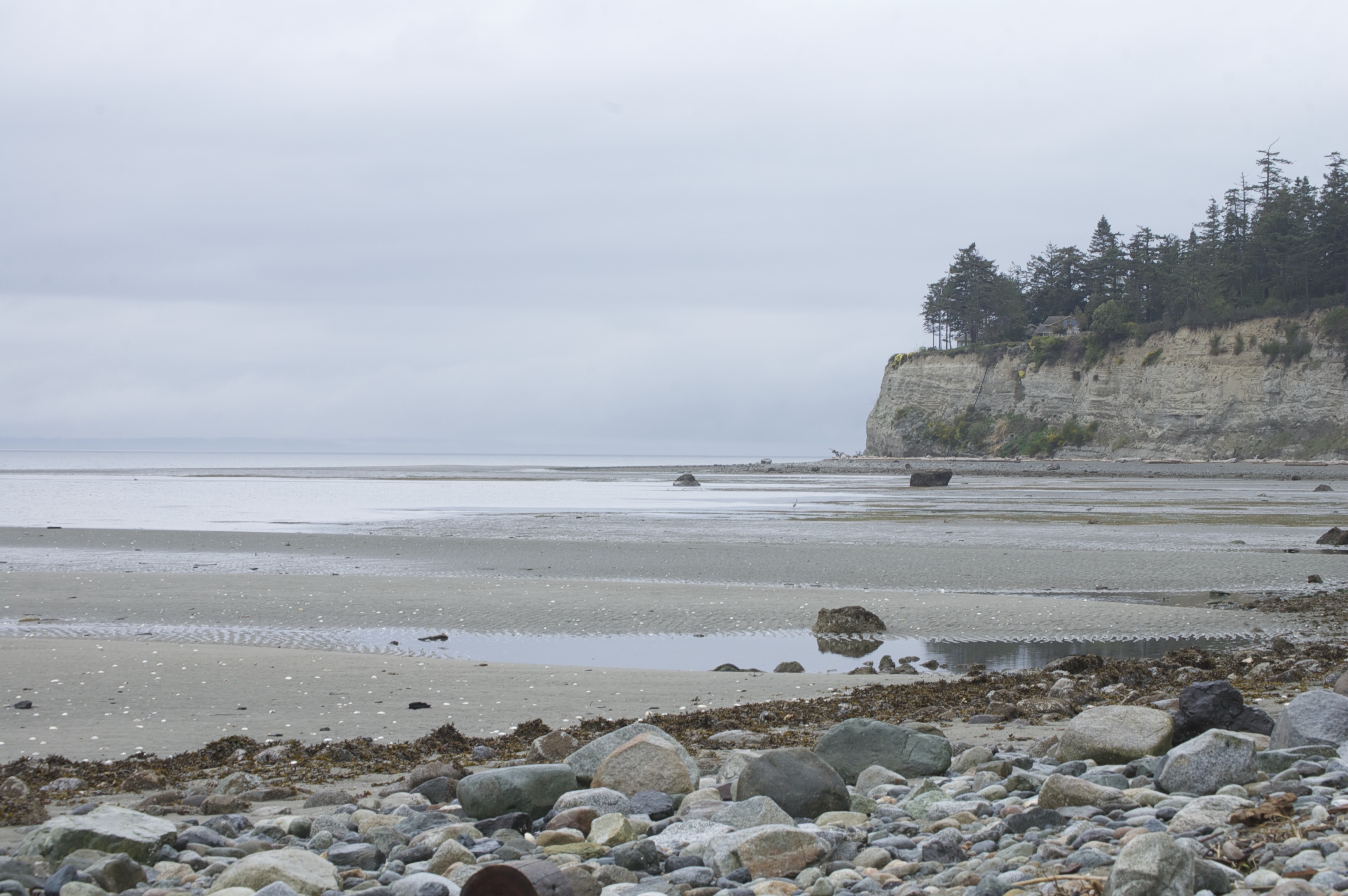
Yesterday my camera and I were busy at Double Bluff, a park on South Whidbey known for a dog park, views of Puget Sound, and an immensity of exposed beach at low tide. It is also known for bluffs that are made of sand that is perpetually sliding into the sea. The land is dynamic, and so is the water. It’s never the same, which is handy for a photographer. It is also bordered by private homes on either side and above. To show the nature without the structural distractions I count on fogs and mists, or conveniently tumbled trees, or an acceptance that I won’t take the shot. Here’s a picture I like, but after I loaded it into the computer I noticed a drain line draped down the hill. It probably won’t make the final cut. I liked the anemone shots better anyway. Stay tuned. The series will be complete this fall.

I edit out the humans because I want my photographs to show nature. I think there are people who want to edit the human species out of nature entirely, maybe because we’re too messy, but that’s another issue and possibly another post.

People edit humans out of personal finance too. Finance relies on mathematics, and mathematics is the ultimate well-ordered abstraction. It is easy to reduce everything to equations, logic, and optimal solutions. Put Personal in front of Finance though and each solution becomes unique. Real life can’t be reduced to equations. Job choices may be driven by proximity to family and friends. Spending choices may be driven by coping mechanisms that deal with unresolved childhood issues. Investment choices are affected by familiarity or availability. No one knows how long they’ll live or how their life will change. My life has taken dramatic shifts frequently, despite spending a lot of my life in stable and conventional environments. My personal finance solutions are plural because they change as my life changes.

I am hearing lots of people working their way through money choices. The underlying fear from the Dismal Decade persists, but they are beginning to act so maybe we are entering the Decisive Decade. When anyone asks, and I point out the benefit I received by working through the Nine Step program developed and popularized by Joe Dominguez and Vicki Robin. I followed the version in the original Your Money or Your Life (and am actually in the new edition.) What I liked about that approach is that it recognizes the human part of personal finance. Math is involved, but so are values; and values are personal. Following imposed values can lead to a dysfunctional life. Personal values are much more powerful. They may be hard to initially recognize, but recognizing them and living to them is engaging and empowering. When personal finance becomes an expression of personal values then personal finance is met with enthusiasm. No drudgery allowed – except for filling out taxes.

Of course I am a fan of the Nine Step program. That may be why I am Secretary for the New Road Map Foundation that acts as its repository of tools, examples, and community. The steps alone can transform your relationship with money, but I found that editing out every human except the individual misses an opportunity. My friends have similar concerns, but none of them have identical answers because they are individuals. Diverse community provides diverse examples. The Simple Living Forums are another group of like-minded people who work with each other to progress through the confusion. And sometimes it pays to work with a professional. I’ve mentioned my friend Mike Brady before because he is a good example of a portfolio manager who doesn’t impose solutions, but rather works from a person’s passions. Undoubtedly there are others out there. If you want help, ask for it. I am not a certified financial anything, but I have helped friends and businesses make choices – partly based on mathematics, but more strongly influenced by their values, goals, and circumstances.

One of the aspects of my book, Dream. Invest. Live., is that emotion can be an element of personal finance. Managing money doesn’t have to be reduced to math. Humanity can be involved. I don’t think investing shouldn’t go to the other extreme either. Investing purely based on emotion is simply gambling. My recent results haven’t been comforting, but I also know that over thirty years of data have convinced me that allowing emotion to have a voice also allowed me to identify very profitable opportunities that others overlooked. If nothing else, allowing a bit of humanity to seep into the equations makes it easier to be interested in what’s happening.

Punditry reduces the populace to statistics. People are grouped and their situations are generalized. The subsequent debates deal in abstractions, or absurdly exaggerate anecdotes and assume that everyone has to deal with the same issues. They tune me out.

People are individuals. The uniqueness of each individual is the ultimate diversity. While I may edit humans out of my nature photos, I don’t think we should edit us out of anything else. Why edit out something so wonderful?

Posted in Uncategorized | Tagged , , , , , , , , , , , , , , , , | Leave a comment

Huh Duh Yay

Someone sincerely asked about Dendreon and DNDN the other day. Their response to my synopsis was; “Duh. You should’ve seen that one coming.” Isn’t retrospection wonderful? It is 100% accurate, at least for a moment. History is a series of best guesses continually re-evaluated by proclaimed experts. Surprises happen. Unpleasant ones are greeted with “Huh?“. Pleasant ones are greeted with “Yay!“.

Christopher Columbus was a hero. Columbus was a villain. Columbus was lucky. Columbus was clueless. At the start he seemed foolish and yet people funded him because they were desperate. He almost didn’t make it and was lucky to find land when he did. He discovered America, but he was looking for India. He opened the New World, which he thought was the other side of the Old World, to his side of the Old World. That was great for the Europeans and lousy for the Americans and Africans. At the end of his life his accomplishments were challenged and uncompensated (though asking for 10% of the wealth of the Americas might be considered a bit much even if that was the agreement.)

During my life his story has changed dramatically. When I was a kid we celebrated his success. Yay! Then came the realization of the implications from the original American’s point of view. Huh? (When did we first realize how many died from smallpox?) And of course now some people dismiss him because, “Duh. Of course if he sailed far enough west he was bound to run into something.” No one could guess the outcome at the start. We’re not done revising his story yet.

Columbus had investors. They were willing to take massive risks because they needed massive profits. Wars were expensive then too. Investing may look much more refined and civilized today, even amidst the current turmoil, but investing has always embodied risks. Investments may begin with hope and enthusiasm, but there is no way to know if they will end up as a “Duh.“, a “Huh?“, or a “Yay!

American Superconductor, now known as AMSC, was building a business based on superconducting cable and its applications in powerlines, motors, and power regulators. It seemed like a good, long-term, power infrastructure investment. An auspicious opportunity arose and they bought a wind turbine company, that was in the right place at the right time to profit from the Chinese market. They started making hundreds of millions of dollars, “Yay!” from a non-mainstream division. Then the Chinese customer backed out “Huh?“, and the stock dropped 80%. During a chance inspection some AMSC technicians found some possibly pirated software running one of their customer’s machines. It turns out that there was a spy within AMSC who probably sold the technology to the Chinese, which meant the Chinese no longer needed AMSC and could actually compete with AMSC. Intellectual property theft in China makes many people say, “Duh. Didn’t you see that one coming?” This small company is now a prominent case in the Chinese courts over international patent protections. How did my little investment end up in the middle of such a large news item? I can’t guess which way it will go. AMSC is asking for over $1,000,000,000. In the meantime, the Chinese competitor can’t effectively sell outside China. Stay tuned.

Dendreon continues to make more money every quarter. They too are making hundreds of millions from a cancer vaccine, a technology that is so disruptive that it challenges the chemo and radiation industries. It appears to be more effective, cheaper, has far fewer side effects, and can possibly treat many more cancers. “Yay!” So, the stock, DNDN, should be trading high and at a premium, but it is not. It is barely trading above where it was before the FDA approved the treatment. “Huh?” The barrage of negative press is astonishing. Instead of celebrating a victory on the War on Cancer, the data are challenged. An earnings miss dropped the stock 80%. As I described it to my friend, some speculate that the negative press exists because solitary upstart Dendreon is challenging a crowd of multi-billion dollar corporations. My friend’s was response was, “Duh. Of course they’ll use every tool, ethical or not, against Dendreon. You should’ve seen that coming.” DNDN has become a story stock. In the meantime, I’m selling depressed stock to pay bills as the company grows.

MicroVision’s story is a long series of anticipated “Yay!” followed by”Huh?” followed by “Duh.” and repeated. The story looks good (the prototypes are awesome), and better news is about to be announced (memoranda of understanding are released with major companies), which fall through for some reason (poor assembly techniques, exclusive contracts are made and then reneged, technologies are lacking and are found to be too expensive). In retrospect, the various products and projects begin with enthusiasm, stumble into some unexpected pothole, and a chorus of “Duh.” arises. In retrospect I should’ve paid more attention during that tour of the Nomad assembly line. I should’ve asked more about the cables tethering the mobile devices during the demos. The company announces earnings on Monday. Maybe they’ll finally have some news that’s good enough to move the stock. Forget being down 80%. MVIS has dropped much more than that over the years. Despite that, demand may be high. I’ve seen plenty of evidence that there are crowds of possible investors waiting for that right bit of news.

It is easy to get demoralized when surrounded by a chorus of “Duh“s. Sometimes the chorus is right. Was the chorus from any Greek tragedy ever written to be wrong? In the real world though, anything can happen. We are each presented with choices. We choose. We take our chances, and then we have to live with them. We hope for “Yay“s and shouldn’t be surprised by a few “Huh“s. The “Duh“s are frequent. “I told you so” is a common theme, especially during troubled times.

The stories of AMSC, Dendreon, and MicroVision directly affect my life. My investing life is very public, and a choice I made when I decided to write my book, Dream. Invest. Live. I lay out the stories here because much of what is written about investing is abstract and theoretical. Specifics are always about the past. The future is described in ambiguous generalities. My portfolio has become a real world example. The stories of those three companies are only part of my story. I’ve maintained a diversified portfolio, as conventional wisdom recommends. And yet it has hit a poorly timed decline. Diversification is an acknowledgement that it is impossible to always pick winners, “Duh!“, and investing is an expectation that at least some choices will be winners, “Yay!“. It is easy to get agreement that the odds of everything succeeding is very small “Duh.“, but so are the odds of everything failing – though there are days when it feels like I may be in the midst of that.

Earlier this month I consulted with myself. My list of projects is long. Each may be able to provide me with a sustainable and thriving lifestyle, but it is impossible to predict which will be successes. The odds that everything will fail is very small. The odds that everything will succeed is very small. What is most likely is that something good will happen. There will be “Huh“s and “Duh“s, but with this much going for me, there will also be enough “Yay“s to make it worth all of that effort.

Stay tuned for that story.

Posted in Uncategorized | Tagged , , , , , , , , , , , , , , , , , , , , , | Leave a comment