Why I Blog

Unintended consequences happen. I am known for my blogging (at least according to LinkedIn), and also known for the stereotypical struggles of the modern entrepreneur. Considering all of the things I could be working on, I’m asked why I spend time blogging. On a simple, objective analysis of costs and benefits it can seem that blogging, and writing, isn’t the best use of my time; and yet, things happen that remind me of how little control we have over our lives, how luck plays a role, and how adding value to the world can be returned in unexpected ways. I had a phone call today that was basically a wrong number that might work out right.

Blogging and social media in general are part of the modern landscape. They have non-digital analogues, but many prefer the previous means of communication; especially for businesses. Stuffing envelopes, making cold calls, hanging posters, and shmoozing at cocktail parties or the country club still work well enough that many people rely on them for their businesses. For me, they cost too much time and money. I’d rather spend the time on Facebook, Twitter, trading emails and chats (no texts, though, my phone isn’t that new).Photo on 2014-04-06 at 18.42 It may look frivolous to some, but it is a way to communicate with people who care, rather than deluging crowds and hoping for a response. Socializing through social media can be fun. Sending out newsletters is a lot of work and can come across as spam.

And yet, while my consulting business has grown (frequently in unexpected ways), the total revenues aren’t sufficient to appease the Internal Revenue Service. So, why spend time blogging?

Then I got today’s call. Skip the suspense. No money was transferred – but a contact was made.

You probably know the feeling. You get a call from an unknown number and wonder if it is spam. Who’s trying to sell something to me this time? I actually enjoy those calls because I back sell my services to them.

Them: “Hi, we’d like to interest you in our service which we know you need.”

Me: “I’m so glad to hear from you. Let me tell you about what I can do for you. Have you seen my books on Amazon?”

It makes for some wickedly fun phone calls. Today’s call, however, was completely different.

Paraphrased because I don’t do transcripts of calls. That might be icky.

Him: “Is this Tom Trimbath?”

Me: “Yes.”

Him: “I’m trying to figure out something about my Make Me Move price on Zillow and it isn’t making sense.”

Me inside my head: “Why’s he calling me?”

Me: “What’s the problem?”

Him: “I’ve put in all the data, but it doesn’t seem to be working.”

Me: “Yeah. That can be frustrating. But, why did you call me?”

Him: “Well, I when I couldn’t find an answer or a contact number on Zillow’s site I did a search and you came up.”

Me: “Really?”

A few years ago I filled out Zillow’s Make Me Move price information. It is basically a way to say, “Hey, my house isn’t on the market; but if someone walked up and handed me this much money, sure I’d sell.” Briefly back in the summer, Zillow’s estimate of my house’s value exceeded my Make Me Move price. No one made an offer, but a friend who filled out the information did get some traffic. I took the opportunity to blog about my experience, partly to see if it would generate any interest, but mostly to describe how yet another industry is shifting.

DSCN5128

The caller found my name because, surprisingly, I’m one of the few who’ve actually blogged about Zillow’s feature. When he couldn’t find help from Zillow, I was next in line – simply because I blogged about it. As we closed the call I pointed out to him that one service I provide is helping people sort through technical issues. It isn’t my main emphasis, which is project management for creatives and entrepreneurs, but I’m happy to help because I enjoy helping people. Launch a Google Hangout, or some similar video conferencing, and I could work him through the issue, or at least make progress. He sounded encouraged. Whether he calls back or not, he at least knows he has an ally that’s more responsive than the company he thought he’d called.

I teach classes in Social Media, not because I am an expert (I’m not), but because I appreciate the frustrations of modern communications. I don’t have all of the answers, but I can help most people progress. (Check my Events page for classes and workshops or my Consulting page for personal attention.) Attendees frequently want to know the direct cause and effect of using social media. It is an appealing notion, but it is no more valid in social media that it was with socializing or advertising. We put the messages out there, make ourselves available, and hope. Hope sounds like a lousy strategy, but it underlies every campaign, old and new.

One of my clients has just begun blogging. At the beginning, blogging, sharing, tweeting, etc can seem like shouting into a dark, empty stadium. Echoes are all you get. Audiences arrive at their own timing, and in their own way. Growth starts slowly with friends, family, and your existing network. Compound interest kicks in (hopefully), which finance and patient types appreciate, but it takes time. After a few months of my client blogging, they still couldn’t point to any extra orders as a direct result. Patience. Patience. As I was about to leave, though; they pointed out that since they’ve been blogging their web site traffic has already exceeded last year’s traffic. Something is moving, but who knows how long it will take? But it is progress in the right direction.

I may have a new client for a short gig. I may only have a story. But I also know that today’s call could be an introduction to someone who could need more significant help. Today’s call could be an introduction a network of people and organizations that can use my services. There’s no way to know except to be patient and continue and hope. He called a number expecting to get Zillow and got me. He was trying to get the attention of a multi-billion dollar company, couldn’t find anyone there to talk to, and got my business and me. The cost to me: time and a bit of creative energy. The benefit to both of us: knowing that someone is out there and that questions and answers can be matched.

We can’t know the impact we have on others lives. The world is too complex for that. But occasionally we, or at least I, get a response that encourages me to continue trying to connect. After one of these posts that I wrote without much thought (and almost no editing), someone wrote back to thank me because they needed to read those words written with that emotion at just that time. Why do I blog? With a response like that, how could I not?

PS Saturday, November 14th, I’ll be part of a panel of authors talking about the realities of writing and publishing in the modern world, which includes using social media to get the message out. Check the link for details about the event at Freeland Library. Contact me if you have an event where you want to me to relay some of my stories about writing, social media, and communicating in the modern world. The old rules apply, but in new ways.

CSbxKy6UkAA91v4

Posted in Uncategorized | Tagged , , , , , , , , , , , , , , , , , | Leave a comment

Full Pantry

A storm is blowing in tonight. The peak will be before midnight, but the house is already creaking with the gusts. It shouldn’t be a problem, but this is November, the stormiest season for the Salish Sea. Power outages are possible, but unlikely. Tonight’s storm is a Storm. In a couple of days we’re supposed to get a STORM. At least this is happening as I’ve reached a milestone on my financial recovery. My pantry is full. It’s been a while since that was the case. At times like this, it is comforting. There are several comfortable necessities yet to come.

Sale is a nice word. I like it. I don’t go shopping because something is on sale, but when I’m shopping I hunt for 20% off, at least. A skill practiced by many frugal folk is stocking up when things are cheap. That sounds easy, but that tactic falters when money gets as tight as it was a few years ago. I ate my way through my pantry. It was a necessary culinary exploration and experiment. It costs money to go shopping, even if you don’t buy anything. I only shopped when I was running other errands. Even then, I didn’t buy in bulk because I had to steward my cash and try to not put anything on the credit card.

Fortunately, I like to cook from scratch, buying real instead of packaged food is frugal and healthy, and I have simple tastes. It is fun trying to see what combinations can be made from variations of beans, rice, potatoes, onions, carrots, some herbs and spices, a bit of oil, and whatever meat was on sale. The past-date meat bin is a place to be cautious, but my best find was a mislabeled steak. It was supposed to be marked down to $3.40, but they marked it down to $0.34. Steak with gravy and roasted veggies for dinner!

There are many ways to measure wealth or its lack. Shopping without regard for prices is marvelous for cooks. Pick up the seafood, mushrooms, organic produce, and a good bottle of wine, and create a treat of salmon with asparagus, sauteed mushrooms, and some quinoa tossed with pecans, top it off with freshly grated parmesan, and wash it down with something with a dusty cork and the meal becomes an event. Some people can do that every night. For a while there, I would make a meal from a can of tuna, pasta, frozen veggies, and the splurge was a sauce. Now, I’m in between.

I knew finances were improving the first time I bought enough of something that it was silly to store any more. Yes, pasta is on sale, but when there are already six boxes at home, it may be time to stock up on something else. Which, I did. I don’t think I recorded the event, because it felt like a fluke. Within the last month, though, the freezer, fridge, cupboards and closets are full enough that I realized I’d have to eat my way through some of it to make way for Thanksgiving. No, this isn’t a hoarding situation; but after an empty cupboard, having to shift things around on the shelves feels like wealth. It didn’t happen all at once. Each shelf filled as sales happened, until finally, filled.

There are other ways to measure wealth or its lack. Are things repaired as soon as they look like they might be getting a bit of wear, when they’re wearing out, or after they’ve broken? Or, are things only repaired when they absolutely must. Or, are they jury-rigged in layers of temporary solutions that must be repaired again, but hopefully not too soon. The list is long, but the fence is the easiest thing for people, especially my neighbors, to see. DSC_4910Of the twenty 8 foot sections, about half of them have fallen at various times. a few construction flaws before I got here, plus the inevitable wood rot, plus the storms we get on the southern half of the island means the fence gets repaired almost every year. With enough money, some would have the entire fence replaced. With some money, I could see hiring someone to do the job right. With a bit more than I have, and the time to do the work, it could be gratifying to properly replace and repair, only getting rid of the rotten pieces. As things are, I propped up a support or two buttressing the wobblier sections, particularly the piece that holds up the shed roof, which is attached to the side of the house; which, if it failed could pull the siding off the north wall.

As I wrote that, a gust blew through hard enough to trigger my neighbor’s car alarm. It’s dark. I’ll check the fence later.

Wealth and poverty hit the news as statistics and anecdotes. Either it’s factual governmental economic reports, or human interest stories and celebrity gawking. Numbers are necessary, but they miss the reality. The amount you have in your bank account isn’t as important as whether you have food available. Your retirement fund isn’t as important as whether you’ve been able to get health care, not just health insurance, and whether you can afford the treatments prescribed. If your car has steering and braking issues, they have to be fixed or everything else can become permanently moot – unless you can resort to walk, bike, or bus. Financial planning for the long term is important; but, when the power goes out it is good to have food at hand, when your body does something unsettling it is good to get advice and treatment from a professional, and when basics like transportation are threatened it is good to get it fixed and afford alternative transportation in the meantime.

I’m getting there, but for now, I am glad I have a full pantry. On the list of life’s necessities, food and water are vital. I’m glad I’m developing that basic resource again. It can even be fun giving myself the occasional splurge like my Maxwelton MealP82A0176, and the holiday feasts.

The wind is cranking up. The Edmond ferry is reporting 33 knots in the middle of the Sound, just a few miles south of me. The peak is a few hours from now. I’ll hit save and publish before the power flickers.

The heat is up a bit, so it starts higher if it has to drift down. I’m glad I can afford that. Dinner is made. A nice, frugal, lentil soup made with beans from a few years ago. Food is sitting outside in a cooler, so if the power goes out I don’t have to open the refrigerator door. Aside from that, it is a good time to back away from work and pull out some other valuable resources: a good book and a nice cocktail. One of these days I’ll get back to buying new books. Tonight’s read is something I bought about twenty years ago. One of these days I’ll get back to buying local hand-crafted whisky. Tonight’s drink will be home-steeped spiced vodka. Not as fancy as possible. Much better than what many have. It is all good enough, for now.

Posted in Uncategorized | Tagged , , , , , , , , , | Leave a comment

Startup Earnings Comparison – AMSC GIG And MVIS

I didn’t think they could manage it but they did it again. Well, actually, I thought they could; but surely with this much storied potential and decades of effort they were due for some good news. It is earnings season and three of my investments announced their earnings within the last few weeks. All of the companies had successes to celebrate. Only one of the stocks rose. The others definitely didn’t. Good news and positive management is not enough; especially, when investors were expecting better news and don’t care about management’s mood. My mood hung on the balance while I waited for today’s news from MVIS. It had great potential. Evidently, it continues to have great potential; eventually.

If investing was unemotional it wouldn’t require humans. That’s one reason to trust the computers, the math, and the data. Computers, math, and data, however, are not very good at understanding potential. Prediction and estimation is much more difficult than analysis and review. Hindsight is easy, and a skill computers excel at. Foresight is difficult, and a skill humans can claim but only imperfectly.

I am human. I am imperfect. I also am an investor. Large companies with lots of data and long histories are easier for computers to analyze. Rather than try to compete directly with them, or at least their institutional users, I focus on companies that are small because they have less data and can have impressive futures. Find their disadvantage and try to turn it into my advantage. Large financial institutions fight the equivalent of major battles. Individual investors can benefit from fighting skirmishes. The potential of investing in small companies is when they grow enough to catch the attention of the institutional investors. Buy stocks that are overlooked. Wait for them to become popular. Sell when the stock has risen enough, and possibly sell at a premium. That’s the plan. That’s how I’ve invested for decades. And then my Triple Whammy hit and only now is beginning to recover.

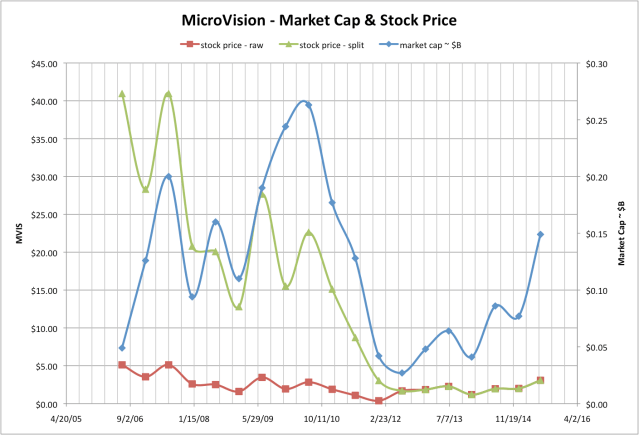
I’ve written about AMSC, GIG, and MVIS before. I’ve held each for years. Each was purchased before they were selling products. Each is now selling major commercial products and trending towards profitability. AMSC’s revenues grew 52%. GIG’s revenues grew 23%. MVIS’s revenues grew 150%. This is all good. Some of it even looks great. Since earnings were reported: AMSC’s stock was down 14.7%, GIG’s stock was up  16.7%, and in one day MVIS was down 9.3%. The company with the smallest revenue growth is the stock that went up.

Management was positive in every case. Of course, AMSC’s CEO makes $1.04M per year, GIG’s CEO makes $0.886M per year, and MVIS’s CEO makes $0.444M per year. They aren’t in the category of the mega-wealthy, but those salaries put them all in the 1% in America. With positive news in their companies, and compensation better than 99% of the populace, it might be easy to feel positive and confident. The investors can feel differently.

Even though it can seem capricious, the stocks moved based on basics, though not necessarily based on math. AMSC is making more money because of their wind power business, but there are doubts that they’ll win the intellectual property case in China, and the key technology that started the company, superconducting cables, isn’t sweeping through the industry. Maybe it just needs a bit more time. GIG is making more money (ironically, partly because of the technology they acquired from MVIS), but the key may be that they just became profitable as measured by one of the stricter accounting standards (GAAP). MVIS’s revenues sound great. A 150% increase is a dream number, but investors were expecting more revenue, more product releases this year, something besides RoBoHoN, and smoother operations.

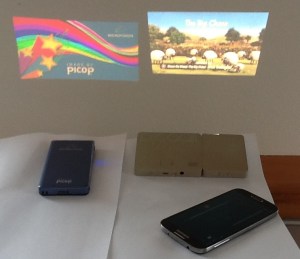
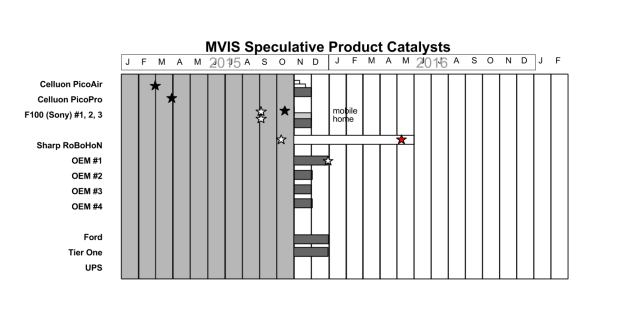
I listened to MVIS’s conference call (CC) as it happened because there was so much potential discussed in previous presentations. Congratulations on Celluon launching two devices. Congratulation on Sony launching a direct competitor to one of Celluon’s devices. Congratulations to Sharp for inventing a robot mobile phone, that’s also mobile enough to walk. What investors haven’t seen, but have heard discussed were additional products from Celluon, additional products from Sony, products from several customers (OEMs) that were privately impressing people back in January back at CES, Head Up Displays (HUDs) from two auto companies, and a inventory management tool for UPS.MVIS_Catalysts_103115 There’s also been hope that MicroVision was involved in Lenovo’s Smartcast and the crowdsourced Cicret. Unfortunately, there was no news about specific new products and there was a supply line problem with the Sony product. Technologically, there is great progress. Business operations are being managed well considering the new technologies. Investor relations are evidently being handled less professionally because the news was met with a sell-off.

One comment from the conference call surprised me. It turns out that MicroVision has yet to look inside the device Sony is selling. I can understand a small company not having enough resources to disassemble every competitor’s product, despite the valuable competitive knowledge available; but to not even investigate how the company’s components are being used it a massive oversight. Design specs, quality inspections, and trusting your business partners are all useful; but so is real world experience and making sure your contribution is being used the way you expect. That’s key to continuous product improvement. It is also more than a disappointment, and a worrying insight into MicroVision’s business practices.

I own more than these three stocks. Check my semi-annual portfolio review if you want to see the rest. These three happened to announce earnings within a short enough time and in technological industries that it was convenient to compare them. I concentrate on MVIS because the company has the greatest potential, in my estimation. GIG is harder to understand because the technology is harder to understand, the products and their markets are harder to understand, and the company’s merger and acquisition strategy makes the finances harder to understand. AMSC has always had the issue of selling a disruptive technology to a conservative industry, and then had the complication of intellectual property theft, the subsequent loss of a major customer, and a change in management and strategy. Three companies. Three disruptive technologies. Three management teams. Only one is succeeding in a way appreciated by the investment community. These three plus the others in my portfolio demonstrate why diversification is beneficial. There was and is no way to know which ones will succeed commercially, and as investments.

Despite MVIS’ great potential, I am considering selling some MVIS to buy some GIG. The day before MicroVision was going to announce earnings I decided to buy a few shares with some of my remaining, small, reserve. On those shares I lost about what some people spend on lunch. As someone commented, it looked like an emotional decision. Of course it was. I am human. To suggest I am acting without emotion is denying reality. At some level, their comment was emotional. Every person and their emotions, make personal finance personal. If we didn’t have needs, wants, and desires we wouldn’t be human. As if it wasn’t enough to manage the data, histories, futures, analyses, and estimates of investing, it is also necessary to manage the investor, especially when it is personal.

Today’s MVIS news was objectively positive. Their business is much better now that it was last year. For some investors, however, it wasn’t good enough, objectively; and definitely wasn’t good enough subjectively. They expected more, didn’t get it, and sold. I expected more, intend to sell some because it looks like others in my portfolio are objectively better; but will hold the majority of my MVIS shares because objectively and subjectively I think their issues are temporary. Surely, MVIS won’t under-deliver again. GIG didn’t. Right?

Posted in Uncategorized | Tagged , , , , , , , , , , , , , , , , | 2 Comments

Guest Post: Engineer to Inventor – In 3 Easy Steps – Part 2

The following is a guest post from the inventor I mentioned in my recent Friendly Good News post: Alan Beckley. We happened to hire into Boeing within six months of each other in 1980 and had almost identical jobs (as seen from the outside, at least). We both left Boeing eventually, though at different times and for different reasons. We, like so many other people, are redefining our work selves, which is why I am posting his story here. Regular readers have witnessed my story. Here’s part II of III of his. (For more of his story, check out his blog for inventors; Ideaworth.


Engineer to Inventor – In 3 Easy Steps – by Alan Beckley (aka @SavvyCaddy)

The American Dream: this is my journey and transition from what I did then to what I do now.

How I struck it Rich as an Inventor of a Sell On TV Product

In my first post, Engineer to Inventor I described my tumultuous and rocky journey transitioning from working as a full time engineer to becoming a full time inventor.

After a brief and successful two-year period selling my Savvy Caddy wallets on QVC ended, I soon found myself selling wherever and whenever I could as a vendor for my wallets. I worked 7 days per week selling at military bases in BXs and PXs, later at VA hospitals and at gun shows on weekends.

I met a lot of interesting people and made a lot of new friends, but my schedule was grueling, often working 16 hour days, including managing my online sales during the evenings. I was barely scraping by and paying the bills each month; I knew there was a better path for my product but my mounting debt and miniscule time gave me few options.

I saw DRTV (direct response TV or infomercials) as my last best chance to achieve my American Dream a means to enjoy the fruits of prosperity and get my life back.

I had a rock solid conviction that my wallets would be a hit selling on TV commercials, then in retail stores, catalogs and on home shopping networks. The esoteric world of the DRTV industry seemed a glitterati of a few uber-successful inventive products surrounded by a vast wasteland of wannabe winners – many good or even great products – not destined for DRTV success.

I vowed to do whatever it took to join the glitterati, not the wannabe winners; but how?

I assembled my marketing material and began contacting each of the key players in DRTV. There are perhaps a dozen companies that manufacture, produce and distribute the lion’s share of DRTV products. So, I approached one at a time, rather than submitting to several at once. I felt that if several rejected me simultaneously, others would be unwilling to even consider my product. It turns out that the rejection rate is so high and the success chances are so slim it didn’t much matter.

I persistently presented my product over a four year period to everyone of note in DRTV; not once, but multiple times.

The response was eerily similar with each company: my product was interesting but not a DRTV product. None of my contacts could enunciate why specifically the wallets were not suitable for DRTV. I was convinced that they were wrong; I just needed a champion, an advocate who believed in my wallets enough to give them a test drive.

In early 2014 I found my advocate: Bob Greenstone, CEO of Permission Interactive.

Unlike everyone I’d previously contacted, Bob saw the potential of my product for DRTV. He decided to risk his own money to test the wallets: first with a web test to thousands of recipients. When the web test was successful, he worked with a production company – more capital risk – to shoot a commercial and then do a TV test: run the commercial on live television. The TV test was also successful and Bob knew the product had strong potential for DRTV success.

He took it to Allstar Products, showed them the test results and they liked what they saw. We signed a licensing agreement with Allstar Products to manufacture, package, and distribute my product everywhere.

This year Allstar Products did a nationwide TV campaign for my product, now named the Wonder Wallet. After thirteen years of hard work, my product has joined the DRTV glitterati. Wonder Wallet sells in Walmart, Bed Bath and Beyond, CVS and many other retailers across the US and Canada and on home shopping giant HSN.

My American Dream has finally been realized: my product is a huge commercial success and my life has been transformed.

I no longer work 7 days a week; the license royalties cover all my expenses and more. I manage my new found prosperity carefully: I live on about 1/3rd of my income, I set aside another 1/3rd for taxes, and a final 1/3rd for debt reduction, investments and charities. If my royalty payments go up, that is great, but since I live on considerably less than I make, I am okay if the royalties decrease (which is very likely over time).

Since I no longer must work for a living in the conventional sense, I am now free to use my time as I see fit. I have done some traveling and will be working on home refurbishment. I now take the time to work out and get physically fit. Lastly, I have already begun working on developing other products for the market: my own and those of other inventors.

Life is good.

Posted in guest post | Tagged , , , , , , , , , , | Leave a comment

Tricks And Treats 2015

Halloween. Another excuse for costumes and candy. I think a three piece suit is a costume, and mine doesn’t fit anymore (in more ways than one.) Candy is sweet, but I prefer sweet things like liqueurs and cookies (preferably made by cooking with cannabis.) Halloween is also a time for spooky things, and when I think of spooky things I think of things that aren’t part of holiday displays – unless they’re put together by physicists, sociologists, or economists. Here are some of things that can be tricks played on humanity or treats, depending on how they arrive.

Asteroids and Comets
Big rocks falling out of the sky are bad. Bang goes a city, the species, the planet. Big rocks flying around in space can be good. Mine minerals there instead of here. Use the materials to create a backup colony in case Earth 1.0 has a critical failure. Every rock removed from orbit is one less rock that can hit us. There are a lot of rocks out there.

Digital Singularity
Some day soon the computers, the software, the Internet or whatever may wake up. When that happens, everything changes, possibly within seconds. The treat would be if it was benevolent and even compassionate. The trick would be if it was like something out of Terminator or The Matrix. (Some think this has already happened, and that the intelligence decided to either control subtly or ignore us.)

Aliens
I’m talking extraterrestrials. It’s a good bet that they are out there. It is a tougher bet that they’ll show up here. If all we do is communicate, then the risk and benefit is limited to what they can convince us to do, trick or treat. If they show up, we’ll probably be at their mercy. The trick will be if they are into conquest or self-centered enough to ignore our pleas. The treat will be if they are coaches and mentors who’ve already gone through all of this and are welcoming us into a sweet society. (Some think they’re already here. Some know they’re already here. In which case, considering our situation, are they trying to make it better or worse?)

Bell’s Theorem
Einstein knew about spooky action at a distance, also known as Bell’s Theorem. Change a particle here, and its entangled partner changes too, even if it is on the other side of the universe. It’s spooky for a lot of reasons but the key one is that we don’t know how or why it works. We’re experimenting with it because that’s what we do. The treat could be instantaneous communication. The trick could be that we’re effectively flipping switches in a power plant that we don’t understand. We wouldn’t want someone flipping random switches in a nuclear power plant. Are we doing the same thing?

Social Revolutions and Revelations
Since the Internet connected the majority of the population, we’re finally aware of the variety and diversity of people, problems, and potential. Conventional wisdom is being challenged, sometimes in debate, sometimes in revealing videos. It is now easier to care about far more people. It is also easier to be scared by far more people. That’s largely a personal choice, and lots of people are making that choice. The treat would be if we learn to think of each other as being born equal. The trick would be if we fracture into a near infinity of us versus them and them and them and them. Revolutions are usually bloody. Revelations are usually difficult, but transformative.

Old versus New Economy
We know the Old Economy, and can arguably prove that we don’t know how to handle it. Its familiarity is a comfort zone for many, even if it isn’t sustainable. A New Economy seems to be emerging, but we know even less about it, there’s more than one version to pick from, and there’s no guarantee that any of them are sustainable either. The trick will be if we can’t find something that’s sustainable. The treat will be if we can find something sustainable, and then manage to readily navigate from one to the other without massive disruption. Our historical record is not very encouraging.

All Tricks, No Treats
Some things are just spooky because they’re powerful and we don’t have any control over them: earthquakes, volcanoes, tsunamis, magnetic pole flips, solar storms, ice ages, mega-droughts, pandemics, ocean acidification, I think I’ll stop listing these. Eek! Oops. Just thought of nukes, grey goo, cascading satellite collisions, epic Internet hacks, and various terrorist actions. Double eek.

All Treats, no Tricks
Is there such a thing? Renewable energy seems to be heading that way. Cheap, clean power is always possible; whether it is cold fusion, hot fusion, anti-matter, somehow harnessing dark energy, or some discovery and invention, surely there’s something that works better than what we have now. Expanding consciousness is harder to track, but some are working on it. Medical advances that allow health without the cost by using the body and natural processes to maintain health and cure ailments are possible, especially, considering that we are only just beginning to understand biology, neuroscience, the biome, and nutrition.

Ghosts and goblins? Vampires and zombies? Yeah. They are spooky. What worries me more aren’t the things kids dress up as to knock on doors and ask for candy. I worry more about a different list; but I also watch because some of those things can be treats instead of tricks.

PS I hadn’t planned this but here’s a treat delivered by the universe. November 1 is the anniversary of the blog where I chronicle, “news for people who are eager and anxious about the future“, PretendingNotToPanic.com. I particularly rummage around for news that includes verifiable data. It helps put it all in perspective, good and bad, treat or trick.

PNTP

Boo!

Posted in Uncategorized | Tagged , , , , , , , , , , , , , , , , , , , , , | Leave a comment

You Have Value

You have value. That’s the essence of what I tell my clients. It may be a cliche, but it is true. A few don’t need to hear it and we move on to the next step in their project. Unfortunately, too many good people and good ideas are guarded and held secure, fearing rejection, fearing the appearance of egotism, or delaying the crafting of their message so it can be tightly controlled and managed. Very understandable. My job is to help people get over it. The world needs solutions now, not later. Paradoxically, the people with the greatest fears have the least to fear, and the ones who should guard against egotism don’t even consider it. (Explains a lot about American politics.)

My passion is for people and ideas. That’s why I enjoy consulting and strategizing; especially, when it is with entrepreneurs and innovators, artists and inventors. It is marvelous to watch someone describe their idea, watch the energy, watch their enthusiasm. Hearing about the idea is fun too, but watching the body language and mannerisms of someone who is bringing an idea to life is much more than listening to words. Even introverts shine. It is also sad to then watch them shrink as they consider other people’s reactions, to worry about looking arrogant, or finding that someone else already had the same idea, or looking like a fool if it fails. As much as America was built with a can-do spirit, America has also become a society that dismisses enthusiasm and fosters negativity. Flamers and trolls are far too common.

It is easier to speak from personal experience because less discretion is required. I can make a fool of myself really easily. That’s okay. I’m practiced at it. I’m single and no one else feels the consequences. And yet, I know that when I describe something that fascinates me, a concept that makes me exuberant, an optimism that is unconventional, I know that the majority of people will first point out the realities, the caveats, the failure possibilities. That’s why we don’t have electric lights, airplanes, or computers. Oh wait. We do. Evidently, something else is at play.

People aren’t purposely negative. They are purposely protective. Friends don’t want to see friends get hurt. Even in a community of coaches, guides, and teachers like the one I live in, advice can frequently be based on cautions rather than embellishments. It all comes from a positive place and a concern for others.

The result can be an internal dismissal of change, a delay in attempting something new.

I know impressive people. I always have. One of my favorite paraphrased quotes from Will Rogers is, “Everyone is equally ignorant, just in different areas.” because the corollary is that everyone is equally talented, just in different areas. Imagine what could happen if everyone’s talents were engaged.

Also keep in mind that there are numerous champions, supporters, and fans. Sometimes all they need to participate is the news of a new idea; especially one that benefits a community, not just one person.

Within our economic reality, it is too easy to measure an idea by money. Is it profitable? One main measure of sustainability is the financial balancing of income and expenses, and the possible imbalance where income exceeds expenses. When more money is coming in than going out, then most debates dissipate, regardless of the true value. When more money is going out than coming in, then the debates never end, even if the project had great value but ends first. During a recent day when I was depressed, a dear friend turned the talk around to me and pointed out that I have value. In the midst of paying (almost all of) my bills, my response was that decades of working hard and trying to do the right thing were valued by society at less than a living wage. I knew I had value. Economics, however, didn’t currently recognize it. We measure ideas by money, but we also measure people that way too. That’s more than sad.

Within my circle of family and friends, acquaintances and associates, and my electronic social network, I am overwhelmed with the expertise and potential. There are amazing repositories of skills and talents that are real and valuable in: art, growing food, caring for others, improving the future by considering the past, managing money and living frugally, developing solutions to environmental and technological and sustainability problems. Too many people are guarding themselves against looking like Donald Trump and trying to not look like they are competing with Mother Theresa, the Pope, or the Dalai Lama. (Really though, Trump is the analogy no one wants to event be tangentially seen to proximate.)

I confess to some of the same reticence and reluctance. Currently I am working on a possible invention for decentralized energy and a possible variation of a business model for coworks. In both cases I am being a bit cautious until I can say more, and yet having said that much I’ve said more than some of the most impressive people I know. During one client conversation it was pointed out that I’d just delivered a nice bit of wisdom – which was followed by a comment that I should raise my rates. Have I? No. But that interchange has made me think.

It is a common axiom to say, everyone is created equal, every life matters, no idea is stupid, ask for help and you will receive it. Yet, the caution I witness is evidence that the messages many receive are along the lines of, the tallest nail gets hammered down, don’t think too highly of yourself, if you thought of it someone else must have already, if it was such a good idea it already would’ve succeeded somewhere.

The world needs solutions. The world needs art. The world needs compassion. The world needs people who express their ideas while they’re alive, because what good are the ideas if they are buried emotionally or by eventuality?

You are impressive people, even the ones I disagree with. Let’s make the conversation more about what can be done instead of why it shouldn’t be tried. If you need someone to listen to your idea, give me a call. If nothing else, let’s see if we can find someone else who will listen as well. Defy the wind. Grow.

Posted in Uncategorized | Tagged , , , , , , | Leave a comment

My Washington Marijuana Anniversary

Washington State had its official one year anniversary for the sale of recreational marijuana back in the summer. This report is mine, because my first purchase of Washington marijuana was delayed until Autumn 2014 by the bureaucratic hurdles thrown up in front of the island’s shop. Whenever something dramatic shifts, it is good to check back and see what happened. This may not come as a surprise, but it has been a very mellow passage.

DSC_5109

To the rest of the folks in Washington, Colorado, Oregon, Alaska et al, you already know this stuff and have your own version of the story. To everyone else, I can tell you that the differences in my life have been trivial except for one or two effects. Aside from them, there’s almost no difference.

I didn’t expect much of a change. Even when marijuana was illegal, it was readily available – so I am told. People have spent decades figuring out how, why, when, and where to use it. Legal or not, it has been part of our culture. Making it legal simply made the criminal elements moot. That’s been true of enforcement, incarceration, and the concealment that used a lot of public and private resources. When it was illegal, some used it, some abused it. Now that it is legal, some use it, some abuse it. The main differences are that the police can spend more time doing something more useful, and the people can spend more time being relaxed about relaxing.

Washington State has benefited. Tax revenues were about $70,000,000, which means business revenues were much higher. The state gets more money. Businesses grow. People are employed, and tend to be employed by small firms instead of corporations. I’d like to see the job satisfaction reports. What’s it like to work in a pot shop?

The two big changes I’ve seen are: when people talk about marijuana it is most likely about recipes, and I am sleeping a lot better – and have the data to prove it.

I teach classes and consult with clients about social media.Entrepreneurs Toolbox Without getting into the details of strategies and cautions, advantages and disadvantages, I’ll relay a data source available to anyone with a Facebook account. For me, WolframAlpha.com is to numbers what Google is to words. Wolfram Alpha may be there for solving equations, but it can also analyze a person’s Facebook account. When the audience or client wants to get detailed enough about the machinations behind Facebook’s facade, I show them the Wolfram Alpha analysis of my account because it is the only one I can access.

Screen shot 2015-10-23 at 8.37.28 PM
Before marijuana was legal, the chart that showed the days and hours I was most likely to post showed dots on almost every day and almost every hour. Tuesday evening I gave the talk again. As the chart came up I had proof that I was sleeping better. There is was, a big block of blank spaces from about midnight to 6AM. Instead of cruising the web when I couldn’t sleep, I slept.

The difference? One or two homemade cookies before bed.

Tonight's cookie

Tonight’s cookie

Not the big party-style cookies they sell in the shop, but about three square inches (1X3) of oatmeal, raisin, butterscotch, ginger, marijuana cookies. I also have a small pipe, in case the day’s been particularly stressful and the unwinding looks like it will take a long time. My back spasms have subsided. My anxious time when the work is set aside, and the distractions are gone, typically allowing the worries to arise from the daily background noise. Now, when I think I need it, I have a cookie after work is done, but before I get into bed. I rarely notice any effect; but, when I fall asleep, I’m more likely to stay asleep – and am glad my dreams have returned.

In this first legal year, I bought about 2 grams per month. About a quarter to a third of that went to mostly failed culinary experiments. Of the rest, I’ve only smoked about 2 grams since the April sale (4/20 for those who celebrate the day). The rest were baked, but in a subtle way that didn’t bake me. And, of course, I haven’t used up everything I bought.

There’s no sudden public consumption. A cluster of smokers is still most likely using tobacco. Parties and potlucks aren’t full of pot products. It is largely a non-event.

Writing about it, however, proves to me that a lot of energy persists on both sides of the debate. I’ve received emails and messages from people who want my recipes and from people who want me to pass along publications warning of cautions and fears.

If there was more controversy, writing about it would generate more traffic and commentary. It would be fun to continue writing my Cooking With Cannabis series, but I don’t consume enough to report on more than one recipe a month, and then I can’t describe the effects because they hit when I’m asleep. My work schedule is easing a bit, but it continues to occupy every day and most evenings until about 8pm (instead of 9pm as before). I can see how writers can write with a drink at their side, but when I tried working after a puff or three, I just felt the silence was a better choice.

There are people who are addicted, at least according to an infographic or article or two, though I wonder if their definition of addiction is the same for alcohol or is the way some people are addicted to chocolate.

The bigger effects are easier to celebrate: fewer people being arrested for exercising personal freedom, drug cartels losing enough revenue to require shifting business models.

The local shop celebrated the day, as any business would. I don’t see the need, but after I post this and take care of a few chores I may light up the pipe for a bit. My stomach has been a bit upset today, and something to calm me may calm it. Such simple pleasures are worth a lot, even if they aren’t worth talking about much.

Posted in Uncategorized | Tagged , , , , , , , , , , , , | Leave a comment

Guest Post: Engineer to Inventor – In 3 Easy Steps – Part I

The following is a guest post from the inventor I mentioned in my recent Friendly Good News post: Alan Beckley. We happened to hire into Boeing within six months of each other in 1980 and had almost identical jobs (as seen from the outside, at least). We both left Boeing eventually, though at different times and for different reasons. We, like so many other people, are redefining our work selves, which is why I am posting his story here. Regular readers have witnessed my story. Here’s part I of III of his. (For more of his story, check out his blog for inventors; Ideaworth.


Engineer to Inventor – In 3 Easy Steps – by Alan Beckley (aka @SavvyCaddy)

The American Dream: this is my journey and transition from what I did then to what I do now.

I began life – after college anyways – working as an engineer for the Boeing Company in Everett, WA. The Boeing Company was (and is) a great company and the 747 – the project I worked on for three years – is a great airplane.

But, for me, working as a young engineer for a large corporation felt smothering. I needed a career environment that was more dynamic and ever changing where either instant gratification or humiliation resulted from my work. I found all of that when I moved to Dallas, TX and began working for a small company as a telecom project manager in the early 80s in the then nascent cellular telephone arena. Telecom in those days was entrepreneurial; every day was different and I developed many new skill sets. It was a fast paced environment; deadlines were measured in days, not weeks or months. I loved it.


Going from an engineer at a large company to a project manager at a small company was Step 1.

All good things must come to an end.

Over the next twenty years the telecom landscape transitioned from an industry dominated by many small companies serving the needs of a few large industry icons (like AT&T) to the large iconic corporations gobbling up many small competitors. I again found myself working for large corporations: my creativity was obliterated by bureaucracy and smothered by monolithic processes. I was back to where I had begun, working for large smothering corporations. It was time to plan my escape to a very small company – my own small business. If I could no longer find the career I wanted, maybe I could create it; I became self-employed as an inventor.


Going from a telecom project manager to an inventor was Step 2.

In 2002 I filed two patents on a thin, flexible wallet design that I felt was worth patenting. I had conceived of many product ideas over the years, but had never taken actions to develop any of them into products. I subsequently saw some of my ideas selling as products in retail stores and I would say to myself, “what if”? I decided it was time to see if my wallet idea could be successful as a consumer product and the first logical step was to patent it. At this point, I was employed full time in telecom and was a part time inventor tinkering with my product idea.

After a few years of attempting to license the product to a variety of manufacturers, I decided I could get some wallets manufactured and test market it myself. Once I finalized the design, I had a small run of 500 wallets manufactured and soon was selling them at flea markets, shows and events. Buyers loved the wallets because they were comfortable to sit on, held a lot of cards (up to 24), yet were still thinner than most wallets.

In 2009, I had to opportunity to take my Savvy Caddy wallets to a bigger platform: the home shopping network, QVC, with over 90 million viewers.

Telecom had become draining and it was time to do something else, so I left the security of my telecom job and became a full time inventor without fully realizing what I had gotten myself into. It was very exciting, but also scary. I had embarked on a new journey to destination unknown.


Leaving my telecom job to become a full time inventor was Step 3

 I had sold out in my QVC appearances in the winter of 2009 and QVC reordered for winter of 2010. Things did not go as well in winter 2010, I got less favorable air times and sold about half my inventory at QVC when I got what every vendor to QVC dreads: the RTV notice (return to vendor). This meant my remaining inventory was being returned to me and my QVC career was over.

In January 2011, I was faced with a very difficult decision. I was done on QVC, still had about 1,500 wallets to sell but had lots of expenses – bills, loans, credit cards, and living expenses – that had to somehow be paid. I wasn’t going back to telecom, so I needed to quickly rework my business. I hit the road and began selling as a vendor at military bases, various shows and events. I soon found myself working 7 days per week just to make ends meet. I was extremely frustrated, this was not my idea of the American Dream: working very long, hard hours but not making very much money. But my QVC experience had convinced me that the Savvy Caddy wallet was definitely a sell-on-TV product; after all, I had sold over 5,000 of them on QVC. I had to find a path to DRTV (direct response TV or infomercials) where I convinced my product could be a big hit, even though less than 3% of promising products succeed on DRTV.


Stay tuned.

Posted in guest post | Tagged , , , , , , , , , , | Leave a comment

Friendly Good News – October 2015

There’s more good news than I can write about. Discretion has its drawbacks. I have been heartened by the news shared by friends: new jobs, significant clients, unexpected opportunities, products that finally the market in a big way. The wave started a few months ago, and I’ve looked forward to sharing the good news here, but have been waiting for the public announcements so I didn’t break confidances by publicizing the news before the time they considered appropriate. I wonder how much good news remains uncelebrated from humility, caution, and an understandable desire for privacy. I decided to share what I can, even though it is only a spoonful from a much larger bowl.

Congratulations to Alan Beckley, one of the few folks who truly understands what my first few years at Boeing were like because we traded jobs, involuntarily, occasionally. He left the world of major aerospace fifteen years before I did. There was wisdom in that considering he ended up working for some odd new technology in 1983 called cellular telephones. Ah, but that will never go anywhere because they are too bulky, expensive, and only useful in a few places. Ha! He is restless because his mind is so active. He left the frenetic telecommunications world to prove himself as an inventor. Check out his blog. As I have chronicled personal finances ups and downs (and hopefully ups again) he has chronicled the struggles of inventors in America. The success rate of inventors is about the same as the success rate of writers, which probably has more to say about the creative economy than inventing or writing; but he recently became one of the success stories.

“Today, my product is one of the hottest selling new products on DRTV: the Wonder Wallet. It sells on TV commercials, on HSN, Walmart, Bed Bath and Beyond and soon other retailers all across the US and Canada. I have achieved the American Dream. Persistence pays!” – Persistence Pays

As someone in Silicon Valley has said, one way to become a billionaire is to do something good for a billion people. If Alan manages to relieve back pain for a million people, he will become a millionaire. Many people are trying to save the planet, but along the way there is great value in someone who makes a wallet that is slim enough that it can fit in a back pocket without throwing off a man’s ergonomics. The amount spent in treating injuries from bad ergonomics is in the billions. A slimmer wallet won’t make a difference to many of my friends because wallets bulk up from credit cards and cash. While many of my friends don’t have credit cards and are nearly cashless from choice or necessity, they are in the very small minority. Alan saw a need, saw a solution, and pursued it for years until finally, success. I believe a long vacation is due and deserved.

Congratulations to Dr. Craig Weiner and Alina Frank, a couple who’ve probably heard too many jokes about wieners and franks, but who are known on Whidbey for their healing practices. I’ve written about Dr. Craig’s work before, partly because of a session I had with him, but particularly because of a bit of wisdom he provided in a video. The video was about EFT, which I’ll quickly define in a bit, but the anecdote he relayed in the video was one of the best examples I’ve seen of how history and emotions can cause real physical pain – and also how to relieve it. Since then, he and Alina have made incredible progress spreading the message of what they do and how it works. EFT stands for (pardon me as I look it up again) Emotional Freedom Techniques.

The good news is that, after years of practice and an expanding network of clients, they’ve decided to take their offerings beyond the island, and beyond the region. His enthusiasm and awareness of risk were an interesting balance to hear playing together as he told me about his next venture, which is to make their teachings available in an online seminar. It is one thing to find a way to help friends, and friends of friends, but realizing you can help strangers regardless of location can be awesome and intimidating. And, they’re taking that step. They’re online event starts October 19, with them and a much wider array of instructors in various fields. They’re taking their knowledge and understanding, trusting in themselves, and taking a step too few take. Their schedule is what prompted this post.

In the same league as Alan, Craig, and Alina are easily dozens of friends who have recently attained levels of success they deserve and didn’t expect, or at least didn’t expect to have happen the way it did. Some are selling food, others are consultants, others have made connections that finally mean ideas are finding the right audience. One got to stroll the red carpet for real. One small (probably soon to be widely successful) company managed to be recognized for high-quality work by being personally, repeatedly, and authentically championed in front of the elite audience they’ve always tried to reach. The list goes on, and on. Some of it is public. Most is not. Too little is available for me to relay because I don’t want to exploit confidences, many people want to control every aspect of their message, and because I’ve lost track of who I can and can’t talk about freely. Information is power, and is necessarily guarded.

Unfortunately, humility, caution, and an understandable desire for privacy and control also mean we hear less good news. We need good news. There’s too much bad news. It is too easy for me to write about bad news, because, weird as it is, people are more likely to encourage the publication of bad news while trying to control good news. I know of lots of good news. It is one of the sources of my optimism. So much good news happens because of lots of honest, sincere work that finally finds an auspicious moment. Serendipity happens, and is wonderful. Sometimes it is a patron. Sometimes it is a customer. Sometimes it is basic capitalism, a demand finding a supply.

My life is a mix, as are all of our lives. I have lots of good news, but at least temporarily and monetarily, the balance falls on the bad news side. But I expect that to change. That expectation is based on logic and variations of the 10,000 hour rule, and also emotion and comments like the one I received today.

You are probably the most Renaissance man I’ve ever known because you manage to do so much intellectually, physically, and artistically.” (Paraphrased because I was whacking blackberries at the time – maybe the inspiration for the physical comment, though there is dancing, walking, hiking, and karate; so she may have a point.)

Too often we downplay the good news, even if it is stellar. It is easier to emphasize the bad news, because there are things that desperately need to be fixed. But, I think the only way we’re going to make progress on the bad news is to recognize the good news, share it, and celebrate it. So, to those who’ve shared good news that I didn’t include; my apologies. In the future, I hope to include more posts of good news, like this one. And to those I’ve cajoled, kidded, and encouraged to share their good news, know that we are waiting. We want to hear it. We need to hear it.

Doh! So here’s my bit of good news. Tuesday evening, October 20th, 2015, I’ll be giving a talk on Social Media at the Mill Creek Library (though the meeting is in the Annex, wherever that is). That’s good news because, 1) I enjoy helping people, 2) I enjoy public speaking, 3) they’re paying me, and 4) I’m finally taking my public speaking and consulting services off the island, stepping out ala Dr. Craig and Alina. Take this far enough and who knows, maybe I’ll give talks down Alan’s way in Texas. Stay tuned.

Posted in Uncategorized | Tagged , , , , , , , , , , , , , , , , , | 1 Comment

Walking Across Scotland – A Five Year Anniversary

I’ve been asked how I am able to remain positive while in the midst of financial turmoil. I thank my walk across Scotland. Here’s a post from the fifth anniversary of the book. Ah, but when’s the next trip…?

Tom Trimbath's avatarA Walk Across Scotland

Five years ago I arrived back home to my island north of Seattle after walking across Scotland. Since then, much has changed. And, of course, much has remained the same. Change is inevitable, and conscious travel amplifies it. Amidst the machinations of the world,  though, much would be the same if I did it again. And I look forward to doing it again, but possibly redefining what it is.

It is Fall 2015. My plan was to be walking, thinking, drinking across, around, or through some other country. My trip across Scotland was a ten year homage to my bicycle ride across America (Just Keep Pedaling)Just Keep Pedaling. Neither were supposed to become books, but when life changing events happen it makes sense to write them down before their significance is forgotten. It also makes sense to wait a while and let insights filter through. Change isn’t always immediate…

View original post 966 more words

Posted in Uncategorized | Leave a comment