Unexpected Favorite Gifts

“What was your favorite gift this year?”

I overheard that at the office, the day after Christmas. Thoughts run faster than words, and my mind sprinted along, but without gaining traction. About the time I was wondering at not having an immediate response, I began to hear the stories of kids and presents, of wrapping paper and emptied boxes. Getting older definitely changes things. Skip the Hallmark moments. My second reflection made me think deeper, and wonder a bit more.

There are plenty of correct answers: love, peace, community, et al. They’re popular because they are valuable, but in some ways they’re also too general. They may be at the core of what I appreciated, but the specifics are what give them meaning. Oh yeah, and there was some good stuff, too.

I’m about to become an official senior citizen, at least by clicking into the sixties. Most of my friends and family are older than me. Decades of accumulating things means most people don’t want more stuff. Experiences are hard to wrap, but food travels nicely.

Last week Whidbey Island was hit by a storm that knocked out power to everyone who relied on the grid. Folks with solar and wind backups were envied. People with generators were envied, but noted for being noisy. Our local power company had to restore power to 320,000 households. It took them days, but they got almost everyone back by Christmas Day. Thanks for the everyday overlooked gift of heat, light, hot water, and a reminder of neighbors helping each other while maintaining a sense of humor.

(By the way, the winds peaked at 117 mph at a local peak, Mount Baker; and hit at high tide, which you can see in this short video I uploaded.)

Walking through the neighborhood on Christmas Day it was nice to see an elderly neighbor. She came out with compliments for some help I provided earlier in the year. I was glad to see that she was okay, and had survived the storm and the outage. We were worried because she didn’t answer the door while the power was out. Some of us feared the worst. It turns out her hearing was probably out, too.

People visit people during the season, but the storm provided an extra reason and excuse to talk, plus ice-breakers for every conversation. How long were you out? Did you lose any food? Depending on the household, some need electricity for heat or well water, while everyone needs it for light. Conversations were about the basics of life, the things we take for granted the rest of the time.

My house is heated by propane, a story that continues, and I had a full tank; but it heats the house with water, water that is pumped around by an electric pump. Plenty of fuel, but one critical element lacking. But, I still had water, and plenty of lanterns and candles, and a well-stocked fireplace.

During the outage, gifts arrived. Food from the east coast, food packed in styrofoam with dry ice or ice packs inside, and big labels warning “refrigerate as soon as possible.” Well, they were already in the best place because I wasn’t about to open the kitchen’s fridge or freezer. The boxes stayed outside. Emergency backup food is usually freeze-dried or canned. Having filet mignon softens that situation, especially with some bottled wine that is ready for any event.

Because I am frugal, I am hard to buy for. I know that. So, every year I shop for myself. There’s one trip to the grocery store to buy cheeses or pretty popcorn that I wouldn’t normally buy. It’s a good time for smoked salmon. As a bonus, they’re all good when the power is out, too. Then, there’s usually a trip to the hardware store for some stuff. This year, lots of batteries because they provide a sense of security. The same with candles and lamp oil. Then I get things like an extra file, a special pot holder, and this year’s special treat – a sharpened lawn mower blade.

Silly? I can imagine that reaction. One advantage of truly understanding personal values and personal finance is finding those places where a little bit of monetary grease makes life much easier. The right tool? That can save hours. A pot holder? The right one at the right time saves food and a bit of skin – and may keep the smoke detector from squealing. A sharp lawn mower blade? Around here, the grass inevitably gets ahead when the spring storms are coming without a break. That first dry day can be a monstrous chore, especially of the blade is a blunt object trying to beat the grass back down. Silly? Of course, and that’s why I wouldn’t ask others for such gifts. But, I can ask and gift myself.

One time, someone with sufficient wealth asked me what I really wanted. They told me they didn’t want to hear about the small stuff. They asked for it. I delivered. I delivered a list of: paying off my mortgage, buying a new car, paying for full medical care, … You can imagine their very natural reaction. They were nice enough, however, to give me a generous cash gift – ostensibly to compensate for some emotional support I provided when it was most needed. Thanks and you’re welcome all in one.

I remember those years when the goal of opening presents included covering the living room floor in wrapping paper, ribbons, bows, and empty boxes – the sort of thing pets consider an overwhelming gift. Some of those gifts were grand, and still in my possession.

This year’s most entertaining gift is probably the combined efforts of a few folks who provided me tea. Thanks to one batch in particular, I now have 27 kinds of teas and infusions (mostly loose leaf) at home, to add to the 7 kinds (all in bags) in my desk at the real estate office. I may not have to buy tea for months. A marvelous mix of flavors. Thanks.

And here’s the Hallmark moment because it is true. My best memories of Christmas 2018 are of people, people being themselves, people sharing the basics, people living in family and community. I didn’t expect to come back around to that answer to the question asked in the office, but that’s something I value, and something I received. It may not fit into casual conversation, but at least I can fit it in here. Thank you, all.

Posted in Uncategorized | Tagged , , , , , , , , , , | Leave a comment

Four Leaky Customer Service Stories

Screen shot 2018-12-17 at 7.12.35 PM

See that intense blog on the radar? Blue is misty. Green is showery. Yellow is rainy. Red is oh deary, dear. My house and its somewhat aged roof is under a bit of that yellow and in the path of far more rain than I am comfortable with. Hence, an apology to friends at a Christmas lunch as I dashed off to run around the Web and local hardware stores. Thanks to some friendly people, I think the leak is sealed, at least for now.

I had work to do, real estate stuff; but sometimes homeownership issues get personal. My roof had a leak, and I hoped I patched it in time.

taken on a much sunnier day

Ten years ago, I balked at getting a new roof for the house. I had the money, but the money manager in me know that spending 3% of my net worth to protect my house could be expensive if it meant selling stocks that would appreciate far more. I was right, for a while. Within a few years, my portfolio doubled, and looked like it was ready to double again. Then, the Triple Whammy hit. My net worth dropped 80% in a few months, then was spent down as I paid bills without finding a regular job. My portfolio shrank, but a particular crack in the torch down fabric of my roof didn’t.

There was evidence that it had been a much bigger leak before. The roof was patched with tar that was getting brittle. The ceiling beneath it had a nice patch, too; so nice that it isn’t obvious to most people. Brittle materials can crunch and blow away. I saw a crack forming. Without knowing how long it had been there, and even whether rain could get through, I decided to act.

Torch down roofs are out of style. As I understand it, lay down some material, seal the seams, and melt it all into place with a large torch. It’s the large torch part that raises warnings about homeowners trying to do professional repairs. It’s too easy to fix the roof but burn down the house because the wood under the material ignited. Being out of style also means professionals would prefer to do complete re-roofing projects using new materials rather than hold onto obsolete equipment and stuff.

That’s why I used tape. It wasn’t my idea. I asked the folks at a local hardware store, found one employee who understood frugality, pragmatism, and the reality of the situation. I left with some pretty tough tape, Gorilla Tape, which seemed to work fine.

It worked so fine that I used several layers; adding a layer as I saw buckling after a storm season. Earlier this year the multiple layers from several seasos were lifted by the wind as a single, heavy sheet that slapped against the roof throughout a night – and pulled up the old brittle tar. Instead of a crack, I could now see into the attic. Maybe tape wasn’t good enough.

Luckily, I have frugal and pragmatic neighbors. One suggested an expanding foam sealant that is As Seen On TV. They watch TV. I don’t. I don’t care. It seemed like it worked. And yet.

A better repair using material, not goo, would make me feel more comfortable. I checked around the web and found a nice blending of the two: rolls of tape impregnated with waterproof sealant. I thought about buying online, but decided to shop local.

Here’s where the four stories start.

Business number 1

“You don’t want to use that.” said in a condescending voice. The place’s emphasis on contractors over homeowners has been reinforced several times, but shopping local encourages repeated attempts. Maybe something will change. Maybe some day I’d win their favors. Maybe I shouldn’t walk in there in sandals. Their advice was tough to take because I didn’t know if it was meant to fix my roof or quickly usher me out the door. I ushered myself out without buying anything.

Business number 2

“Oh man, that’s tough. Are you sure you can’t just re-roof? No? No surprise. Here. Take a tube of this, spread it down the seam, then take this tape and lay it on and across the crack. It will even work wet.” Wow. Sympathetic, understood my situation, and suggested a solution that would work, then, in those situations, without overselling it. Not only didn’t they oversell it, they gave me some extra material for free because fixing a leaky roof in a rainstorm is the worst and best time to do it – except for doing it months or years earlier. I left with everything I needed, but an uncertainty it would work because of the specifics of the damage. (Too many details to get into here.)

Business number 3

“Uh, I don’t think we have anything like that. Let me check. Nope. Sorry.” And they meant it. But sometimes I just don’t explain things well enough, especially to someone younger than the roof. So, I wandered around the store and stumbled across items similar to what was in the other store, possibly with an improvement or two. There are tapes that are meant to be outside, exposed, that seal various roofing elements like windows and chimneys. Maybe that would suffice. Besides, an all-in-one solution is a lot easier to haul up a ladder. Less than $20? Sure, I’ll take that. Two solutions for less than the price of a meal. Double the chance at comfort.

Business number 4

“Well, you know, I didn’t know we had that.” An affable helper steered me to the right shelf, but in a large hardware store it’s hard to know every item. They led me to the roofing section, then I pointed out their products to them, and I led them in a short lesson that I’d received from research and the previous three stores. The fourth didn’t have anything new, but they had a nice attitude. I made sure I bought something, even if it wasn’t for the roof.

Four businesses, four attitudes, two or three sales. Within the few hours after leaving the last store I’ve already told some of the stories, had others similarly echo my experience with theirs. They also confirmed that until I sell a few more houses, er, several more houses, patches will be my defense.

Normally at this point in the story, I’d like to give a shout-out to the best stores, but in today’s litigious world, I won’t. The people that helped me the most were the ones who understood what it’s like to own an old house, and who know how impractical it is to always follow all of the rules. They even showed compassion in providing part of the solution for free. It’s easy to imagine some corporate official hearing the story and making sure no good deed goes unpunished. Even shops that look local can have corporate partnerships. They make saying thank you more difficult. Fortunately, I can say so in person the next time I’m in their shop.

With a bit of good luck, my foamy patch is working fine. I’ll back it up, because engineers like having backup options, with some combination of the tapes and sealants; though I may wait until there’s a dry (ha!) day to give them the best chance of working. One motivation for the simpler approach is simple. The cost of applying a patch: ~ $20. The cost of getting a professional to repair it: ~$1,000, which is a guess because evidently they won’t even quote such jobs, which also makes it moot. The cost of re-roofing the house: ~$10,000. I think I’ll try the patch first.


Posted in Uncategorized | Tagged , , , , , , | 2 Comments

Expense Report – Winter Update

Out with the old.

DSCN1555

In with the new.

DSCN1553

It has taken more than ten months for me to hopefully improve my heating situation. Early this year, AmeriGas charged me $3.989 per gallon for propane. The competition was charging under $2. Appeals and talking to higher up the management change gave some relief, and even the promise of a $50 credit; but I was assured that the price was legitimate. I decided to find a legitimate alternative.

Those details are chronicled in the previous posts. Expense Report – Heating and Expense Report – Heating Update. Not exactly thrilling reading, but useful for other people who heat their homes with propane, and frugal folks in general.

Reduce your expenses, that’s one mantra of several for folks who watch their money. It sounds simple, but acting on it isn’t. Finding a more affordable supplier of propane is taking over ten months. Actually, finding a more affordable supplier only took a few days, though it did take several phone calls. Acting on it, however, meant judiciously using the expensive fuel already in the tank, then waiting for the right time to call. I guess I could’ve turned the thermostat up to 72F, but that’s sacrificing the atmosphere and my finances just to switch to a better supplier of a critical resource.

So, I waited. My new role as a real estate broker meant spending a lot more time working from an office instead of home. Keep the heat low and never notice the difference. A warm summer also helped.

Finally, following the instructions from the new supplier, Vander Yacht, I gave them a call when the tank got down to about 10% to 20% full. Twenty percent went by as November started and I was busy with some intense transactions. Thanksgiving was approaching and I realized that waiting until after the transactions closed and I got paid, and waiting until after the holiday may be best for me and the folks who would do the work of swapping out large steel tanks.

The beginning of December started with 10% left in the tank. There was also a chill. I called. Over the previous months, Vander Yacht had dutifully sent technicians to estimate and plan the task. My tank is in the back yard, fenced, and surrounded by neighbors who protect their property explicitly with flags or implicitly with very soggy soils. They remembered and would swap the tanks the next week.

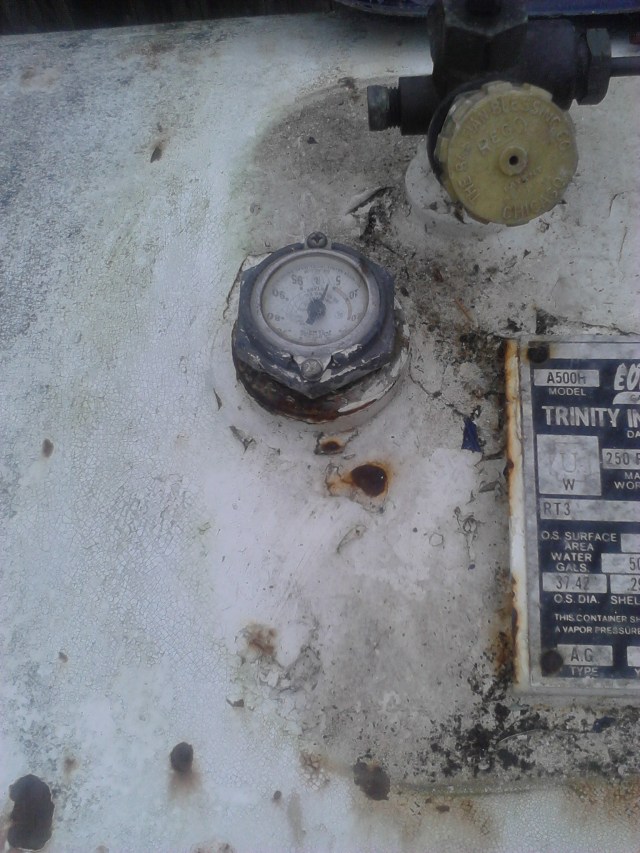
The next week arrived. Instead of a the team effort required to manually maneuver the old tank past some of the plumbing and hardware, they sent a tank, a man, a dog, and a crane. Unless that was an awesome dog, they’d have to go back and try again. The tank was at about 8%.

P82A0335

During the next few days, the tank began to empty, 5%, then lower. The last I saw was a needle down below the scale. But, they were scheduled, I trusted them, and dutifully dropped the thermostat to 56F, turned on two electric heaters, and began feeding the fireplace pieces of dead trees. It was a good thing that I’d bought parts of a cord a couple of times, and accepted the windfall, actually a chainsaw fall of an old pine tree close to the office. With everything working together, the temperature in the house could rise 2F every hour. Showers became a risky luxury because I couldn’t know how much fuel was left to heat the water.

P82A0336

Wednesday morning, today, the crew was scheduled to arrive. I stayed home to do the homeowner thing of pointing out things for them to remember, and answering their questions. No show; at least not when I expected. According to their schedule they arrived right on time. A small fleet of trucks dieseled its way up my street and began parking as I was getting ready to leave. Ironically, I was headed over to a client’s home to turn off their propane to save it for any cold snaps that may happen later.

Relieved, I left them to their work, went to my work, and had no idea if they’d succeeded.

As I drove up to the house in the dark I was disappointed not to see the old AmeriGas tank in the driveway. A quick trip inside to unload the day’s stuff, then a quick trip outside to see if a new tank was in place – and it was. The house was warm. The tank was full. That phase was complete. On my way back through my carport I saw the old tank sitting in the grass, waiting for AmeriGas to reclaim their property.

Finding ways to cut expenses is a continual task for frugal folk. As I said above, it sounds simple, but some expenses require significant effort. In addition to calling several suppliers, I also called contractors who installed things like heat pumps. Their estimates of the improvements were in the thousands of dollars, though with paybacks measured in several years. Some savings are only available to those with enough money.

Ironically, AmeriGas does have some satisfied clients. One I know only pays $1.45 per gallon. Evidently, business owners get a special deal. I wonder if people who can’t afford to fit into a special niche basically subsidize others. There’s precedence, considering some of the stranger tax policies passed lately.

Realistically, I don’t know the true savings, yet. That bill hasn’t arrived yet, and I wonder if AmeriGas will somehow try to bill me for – something. Stay tuned for yet another update.

Ideally, I look forward to solutions that I can afford that don’t rely on fossil fuels or dead trees. At least dead trees are romantic, and I do like having a low-tech option available for power outages. But, for a while, I’ll be glad for the easily overlooked luxury of getting hot water from a faucet, enjoying a hot shower, and having hot water radiate its heat up through my floors to warm my feet and house.

Now, even if you won’t excuse me, I’m going to enjoy one evening cranking the heat all the way up to 68F without having to worry about the gauge, or the bugs, smoke, and ash from the firewood. Tomorrow, back down to 65F, which seems quite comfortable after the last few days.


Posted in Uncategorized | Tagged , , , , | Leave a comment

Is Whidbey Changing

45810-WhidbeyChanging-LNG-POSTERHint: When a talk has a title that asks a question, be ready for either a one word answer, or a long, ambiguous, rambling response. In this case, Is Whidbey Changing? Yes. Change is a constant. In this specific case, the question was posed as the title of a talk and presentation held at the Langley Library. The topics were the island’s real estate, affordability, and trends as interpreted by an ex-engineer, writer, and real estate broker – me. If you missed it, don’t worry. I hope to make similar presentations at other places on the island. The hour and twenty minute live stream was also recorded on YouTube. Not short enough? OK. Here’s a synopsis of the summary of some data reduction and interpretation. Follow along on the slides available:

Is Whidbey Changing – December 2018

  1. Caveats – Folks make fun of statistics because people can play with statistics, and yet, data is real. Anecdotes are handy, but data is recorded history. Just be careful with definitions.
  2. If you think it’s tough nailing down a trend in the market, you’re right. Even getting various methods to agree on something as simple as one simple house generates a wide error band. Here’s the spread for my house. The good news is that, within statistics, the larger the dataset, the better chance that the errors cancel out.
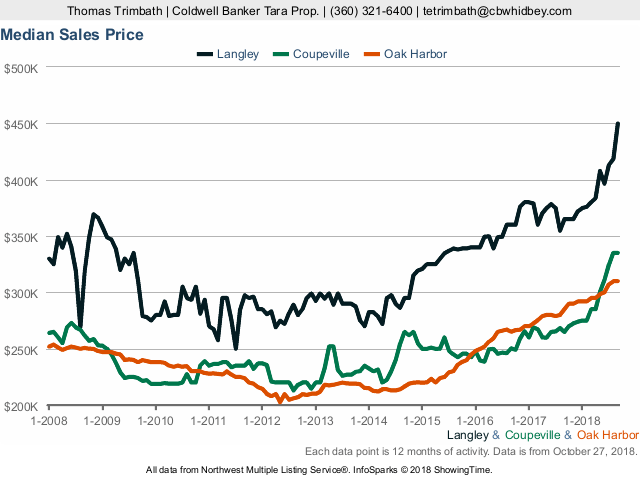
  3. Good news. One chart. Median house prices are up. Talk, done. Well, not quite. Whidbey Island prices have finally recovered and have continued to climb, somewhat. Depending on your optimism or pessimism, it’s possible to draw different conclusions from only looking at the last few years or the last few months. When it comes to buying or selling, the ‘now’ is what’s important, but that’s too recent to show up in data. That will be true of every chart, sadly.
  4. Prices may be up, but the number of houses for sale is down. That’s not saying the number of houses is down, just that the number of them being sold is down. Fewer houses for sale means lower supply. Even if the demand doesn’t change, that’s pressure for the prices to rise – and they have.
  5. Live on Whidbey long enough and notice the population shift with the seasons. It affects the housing market, too. If it seems like there aren’t many houses in the summer, that’s bad enough. In the winter, well, any house that gets listed suddenly has a better chance of being noticed.
  6. The number of houses for sale is down in all price ranges. While the million dollar ones are down by about 40%, that only influences about a dozen homes in the count. The biggest drop is the houses under $300,000, the ‘affordable’ houses. From over 800 for sale in a month to under 300 is a big drop in the most affordable category. The consequence is that, even though there are fewer million dollar houses, they now make up about 20% of the market.
  7. Fewer houses without a discernible change change in demand also means houses sell more quickly.
  8. The rule of thumb is that about six months of inventory is a balance between buyers and sellers (though some say four months is the new balance point). Whidbey Island is heading below that point. Whether it gets down to Seattle’s level of only about a month of inventory is uncertain, but it is heading that way.
  9. One way to take out the variation in the numbers based on house size differences is to look at prices per square foot. The price rise continues.
  10. It’s probably not a surprise to those familiar with the island that South Whidbey is pricier than North Whidbey. The price swings are bigger, too. The military economy stabilizes the North Whidbey economy, and real estate market.
  11. Whidbey may seem less affordable, but relative to the other major islands in the Puget Sound, Whidbey is the most affordable.
  12. Whidbey may seem less affordable, but relative to Seattle and Bellevue, Whidbey is more affordable.
  13. Seattle still swings the markets, even on the islands. That quick uptick at the tail of Seattle’s curve represents more houses entering Seattle’s market than exist in Whidbey’s houses for sale. That potentially creates more supply, possibly moderating prices here and there.
  14. Seattle may seem less affordable than before, and radically less affordable than Whidbey; but Seattle is relatively cheap to the rest of the Pacific Rim. Want to develop a business beside the Pacific Ocean? Seattle is a relatively affordable alternative, hence more demand without an increase in supply.
  15. Links provided for those who want to deep dive into reconciling real estate data reporting methods across countries and continents. Fun work for data geeks like me, but not for free.
  16. Island County Housing Needs Analysis is a great document for diving into the island’s data. No surprise, North Whidbey’s median age is much lower than South Whidbey’s. A sign of change is the rapidly increasing median age for South Whidbey. People aren’t immortal (yet), so there will be turnover in households where the next generation doesn’t want to keep the family house. New people, new culture, a new identity possibly.
  17. It was sad enough that it took >3.7 times median income to afford a median house in 2000. Now the ratio probably exceeds 5 times. Incomes aren’t keeping up with housing costs.
  18. While the supply of homes for the market is low, the vacancy rate is high. Except for North Whidbey, the vacancy rates exceed 20% for the rest of the island. That’s thousands of homes empty, waiting for owners to visit on the weekends or in the summer. They are also a source for short term rentals. Long term rentals are important, too. They deserve their own analysis that would equally as lengthy as this is for buying and selling.
  19. Thousands of empty homes stand in contrast to a growing homeless population measured in hundreds. It’s overly simplistic for vacant homes to be opened to people in need. Idealism and reality conflict. So do pragmatism and compassion. The struggle for a solution continues. The good news is that we only lack proper policies and procedures, not actual buildings.
  20. Whidbey Island has traditionally had limits to growth in septic systems, water supplies, and transportation. Technology may change those limits. Whether policies and regulations allow them may simply be an eventuality considering the local, regional, and global pressures.
  21. Tiny houses, modular homes, and even greater acceptance of manufactured homes are growing, with the primary barriers again being policies, regulations, and procedures.
  22. People don’t want to sell until they can find something to buy,
    but there’s little to buy because so few are willing to sell.
  23. The island is no longer as isolated as it was forty years ago. In another 40…?

Is that enough? Of course not, at least not enough to be comprehensive. No single presentation will cover all of the aspects of housing on Whidbey Island, but each can contribute to the conversation. I hope this helps.

You’re welcome and encouraged to share the video, the presentation, and this blog; and to contact me if you want to talk about such things in more detail. Every month brings new data, change is inevitable, and in real estate unpredictable.

Here’s another link to the video for the fuller story.

Formal Disclosure:
I am a real estate broker with Coldwell Banker Tara Properties in Bayview.

Informal Disclosure:
I’m happy to help.

Posted in Uncategorized | Tagged , , , , , | 1 Comment

Dream Invest Live – Ten Years Old

Just ask Amazon. Ten years ago, November 26, 2008, I published Dream. Invest. Live. – Pioneer the Investment Frontier So You Can Live Your Dream, which I’ve come to describe as “Personal Finance for Frugal Folk.” Books are static. Blogs are dynamic, hence the over 800 posts to this blog. The world of finance has passed through the Great Recession (the Second Great Depression, in my opinion), a dramatic recovery, and worries about another crash.

The basics of the book remain; “Spend less than you make. Invest the rest.” The world in which that happens has changed dramatically. Within the next few months I intend to begin writing the sequel that has the working title of From Middle Class to Millionaire to Muddling By – A Rollercoaster Ride Through America’s Wealth Classes. Conventional wisdom could use a review, and my experiences provide an opportunity to demonstrate perspectives on individual investing, income, wealth, inequality, frugality by choice versus necessity, health care, housing, entrepreneurship, community, and a variety of topics familiar to regular readers of this blog.

Thanks for coming along for the ride. It has been bumpy enough to jostle some folks out of the cart. Stay tuned for more. Considering the last ten years, it can be comical to extrapolate the next ten years – but of course, I’ll try.

Dream Invest Live cover

Posted in Uncategorized | Tagged , , , , , , , , , , , , | Leave a comment

Woo Hoo Health Care

Wow. Two pieces of good health care news in two days. Imagine that.

Today, I called Washington Health Benefit Exchange, also known as Washington Healthplan Finder, also known as wahbexchange.org. In less than five minutes I learned that I didn’t have to do anything about signing up for coverage in 2019. It took me more time to get through the voice mail menus than it did to talk to a real person who expertly found the quickest way to access my account, even though I’d forgotten my password. Shocked, shocked I was (really, she confirmed that she could hear it in my voice) that I didn’t have to do anything. Another bit of good news was that their ridiculously overly-secure password system has been replaced with something simpler and more permanent. All I have to do is get home, find the old password, and change to a newer, easier one. All of this happened from a quick call to their office from my office on a Saturday. It was in the middle of a break in my real estate shift that I noticed their help desk was actually open on a Saturday – for only twenty more minutes. I called, and was off the phone in enough time for her to repeat her performance before the end of her day. Impressive; especially, considering previous years’ experiences.

The day before was also a bit of good health care news. I visited my doctor, Molly Fox, ND, a naturopath. OK, so it isn’t like I’m suddenly phenomenally healthy; but coming up on 60 years old it is nice to hear that things aren’t as bad as I expected. Hey, everything’s relative. My diabetes has abated. There’s a long list of things for me to do; but most of it is in my control. Diet, exercise, and meditation are powerful tools. She’d appreciate it if I used a few more; but we agreed that I’d take the cheap route for a while. Maybe after a few more deals close I can step up the effort. Until then, stress relief and more exercise as feasible considering my work schedule. (Real estate takes a lot more time than most folks ever witness.)

That good news wasn’t the end of the good news. I’m also benefiting from her, really their, new service. She and her office partner, Dr. Kovscek, have instituted a Direct Primary Care practice. For $70 per month (for me in my situation), I get something so radical and innovative that it resonates with the style of care I recall from fifty years ago. (From their web site🙂

  • “a direct relationship between patient and doctor”
  • “Longer appointments, 30-60 minutes with each patient”
  • discounted supplements and services
  • convenient consultations, even if that’s over the phone
  • No extra cost for in-clinic procedures
  • and a list that goes on for two pages.

Getting rid of the folks in the middle dramatically drops the cost, increases the available time to talk, and greatly reduces the anxieties I feel around more traditional healthcare facilities. (Want a glimpse of those? They inspired my walk across Scotland, which inspired my book, Walking Thinking Drinking Across Scotland.)Walking Thinking Drinking Across Scotland

It can sound weird, but health care can be friendly, calm, and casual. The ability to have regular monthly appointments means progress can be measured more often and with smaller expectations. Rather than waiting a year for a ten minute conversation to check on weight gain or loss, strength increases or decreases, or general mood changes, every month is an opportunity to spend up to an hour talking about successes and hurdles, as well as how they interact. People are individuals, not statistics, and our messy bodies appreciate individualized attention particularly when it comes to putting them back into balance.

Pardon me as I take a break to pour myself a cup of green tea.

Ah. I’m back.

You may have noticed an apparent contradiction. I’m happy (or at least relieved) that I have insurance while also celebrating a subscription to a service that exists because it doesn’t follow the modern model that relies on insurance. It feels like the transition between using energy from fossil fuels while installing solar panels. The new way seems to be the way to go, but at least for a while, it makes sense to have a bit of both. If I was in a car crash and whisked to the emergency room while unconscious my first coherent conversation with the staff shouldn’t be having to describe an innovative and positively disruptive health care philosophy. I’d give them the name of my insurance company and the name of my naturopath. Debates about corporate influence on basic necessities would wait a day.

The service is new enough that; “*Enrollment fee waived for current patients if enrolled by November 30, 2018.” Molly has been my doctor for over a year, so I got to sign up early. This notice may be a short one, but considering typical health care costs, the enrollment fee is relatively small. Adding my conventional insurance payment to the subsidy I receive from Washington Health Benefit Exchange adds up to a monthly cost that exceeds my yearly costs from Direct Primary Care. I’m glad for Washington Health Benefit Exchange. I couldn’t afford insurance otherwise. Thanksgiving was two days ago and I give thanks that I’m finally financially able to have a bit of both, and the extra chance at a healthy life that they provide.

Now, to make sure I get home early enough to make something from the leftovers, get in some exercise, and rest and relax in front of a movie. But first I’ll check my real estate calls and emails. Something has to pay the bills, besides, it can be fun finding people houses. Stay tuned.


Posted in Uncategorized | Tagged , , , , , , , , , | Leave a comment

Sigh And Bye Asterias

Rats. It happened again. A corporation agreed with me. A company with great potential and an undervalued stock can be a great investment. In the case of Asterias, that meant BioTime is buying the entire company. Yet again, one of my tiny stocks gets absorbed before it succeeds. At least it means I had a good idea, but I’m not as likely to benefit from it. So goes one of the risks of owning stock in small companies. This time, however, I may yet benefit.

I’d like to take credit for discovering Asterias (AST), but it was delivered to me as a spin-off from another small company with great potential, Geron. I can’t even claim credit for my GERN holdings because it is one of the few times I followed a tip from a friend. And yet, I’ve held GERN shares for almost twenty years, was glad to buy more shares of AST recently, and was looking forward to buying more. Geron’s technologies, whether within Geron or those sold off to other companies, were the attraction. Geron has been developing treatments specifically targeting the extension of life. All curative medicine could be said to target the extension of life, but most do so implicitly by treating illness. Geron does so, too; but Geron also has technologies with the potential to regrow damaged organs. Their stem cell treatments were spun off to Asterias, which has successfully helped accident victims regain muscle control after nerves were damaged in accidents. That’s not just life extension. That’s life enhancing.

Asterias is only in Phase Two of their clinical trials. Unless there’s a compassionate acceptance by the FDA, there’s a typical progression to expect of Phase Three and the conventional approval process. Asterias could be years from approval in such a case, which can also be years of opportunity for speculative investing. The potential is great considering the large population of accident victims as well as the possibility of improving nerves damaged by disease. That potential is probably why BioTime bought back the part of Asterias they didn’t already own.

While the buyout is a good sign for the technology, it can be limiting for investors. As I replied on InvestorVillage.com;

“At a very cursory level, it means a $60M company is being absorbed into a $260M company, so the net impact of a positive event is roughly proportionally reduced.
Imagine a $60M company announcing $60M in profits.
Imagine a $320M company ($60M+$260M) announcing $60M in profits.
This is why I usually sell small companies when they are bought by larger ones. In this case, however, the ‘large’ company is relatively small and the potential profits could be larger than the $60M (based on opinion and historical biotech trends, not an analysis of Asterias).”

At least with Asterias, I’ll receive 0.71 shares of BioTime for every share of AST I own. The tidy part of me will probably respond by buying enough shares to even out that remaining 0.29 shares. It’s silly, but I like tidy portfolios.

This isn’t the first time such a buyout changed my portfolio. The hardware store, Eagle, was absorbed just as housing renovation boomed into the behemoths of Lowe’s and Home Depot. Something similar happened with the grocery store chain, QFC. Lands End was bought by Sears. More famously, Pixar was bought by Disney. More recently, GigOptix/GigPeak was bought by Integrated Device Technology just as Gig turned a profit. (Gig Goes Buy Buy) In each of those cases, I would’ve preferred to retain stock in a small company that would grow a lot, rather than watching a small company with great potential be absorbed into something so large that their contribution will barely be noticed. Starbucks, Microsoft, and f5 Networks are great examples of small companies disrupting their industries without losing their sovereignty. My classic case was buying America Online, holding it through great turmoil, and selling when it collided with Time Warner. (Want more details? Check out, read, and maybe even buy my book that inspired this blog – Dream. Invest. Live.)

Wealth concentration isn’t just a trend within the uber-rich. It’s also a trend within the corporate world. Companies buy companies to better invest their funds, but they also do it to buy out competition or acquire technologies or employees rather than developing them internally. If you’re about to lose your business to an upstart that’s a hundred times smaller than you, then it can be trivial to buy them now instead of investing the money in research that won’t be harvestable for years.

And it isn’t really companies buying companies. Companies are made of people (though there’s now a legal avenue that may allow an Artificial Intelligence to take over.) (Legal AI Personhood) People who represent a majority of shares in one company negotiate with people who represent a majority of shares in another company. It isn’t the majority of shareholders, just the majority of shares. When Disney absorbed Pixar, they only had to convince a few people. Steve Jobs owned almost half. Add in a few other key people and 51% is easy to reach. Rather than bid of the price of the stock as much as I thought it was worth, Disney offered shares of Disney plus great job titles to those few people. The great successes of subsequent Pixar movies just became part of the Disney empires revenues. Enjoyable, but not nearly as profitable to the shareholders.

It is important to evaluate a company and a stock based on the goods and services they provide. That helps in estimating the company’s potential. It is also important to evaluate the management team and their compensation packages. How likely are they to act selfishly? In America, all they have to do is represent the majority of the shares instead of the majority of shareholders. Are they building a company or a buyout package?

Buyouts are a caution I have about any small company. AMSC benefited from one, until they didn’t. Now, AMSC’s disruptive technology doesn’t seem to be disrupting anything. Maybe they won’t be bought out. Asterias just took the plunge. Geron has been a seller, not a buyer; and their most recent news hasn’t lived up to expectations. MicroVision’s potential continues about as high as ever, though dilution has diminished MVIS’ potential. MicroVision’s management, however, hasn’t instilled confidence that they have a long term strategy for the company. For the technology, yes. For the stock, no – at least from my perspective. Even the shareholders regularly discuss buyout prices, proving that everything has its price. In MVIS’s case, that price may be below my break-even price. NeoPhotonics is what I bought after Gig was bought out. I bought. It dropped. Now, it’s raising again. Maybe it will sustain and attain positively.

Not everything gets bought out. Look around at recent successes like Facebook, Amazon, Tesla. Charismatic leaders can sustain visions and attain great successes for themselves and their shareholders. Maybe BioTime’s leadership will lead on. If they do, I’ll be glad for the patients and myself; but I know my portfolio will reflect a much smaller portion of that success than it would have otherwise.

Posted in Uncategorized | Tagged , , , , , , , , , , , , , , , , , , , , , , | Leave a comment

Tom Trimbath Real Estate Broker – Year One

“Has it really been that long?” I heard that from several people today. November 9, 2018, my one year anniversary as a real estate broker on Whidbey Island. Welcome to yet another new view of the world we live in – a world that is changing, an interesting time to be involved in real estate, housing, and affordability.

It’s November, which means it’s no surprise that it’s raining as I sit in my office (Coldwell Banker Tara Properties in Bayview) waiting for someone who may come to the island to shop for a home for their healing space. Special needs need special places, and one way to make that happen is to start with ground and build a custom space. At least the ferries are on schedule, unless they have to slow to let orcas pass by. So goes life on the island.

How I got to real estate from aerospace engineering was something I described in last year’s post when I passed my test. Years of playing with data, years of writing and researching real estate, the industry and architecture, and years of living on the island added to a shift from designing airplanes and rockets to helping people design their lives. As I said before, learning that one of my core passions is helping people and their ideas is something that’s been common throughout. From the outside, it may look like a radical shift. From the inside, the change isn’t as dramatic – at least conceptually.

Change happens. No more shorts. Rats. No more commuting by bicycle. Alas. Maybe I’ll  be able to replace my truck with something that can actually turn around at the end of some of Whidbey’s dead-end drives. Eventually, no more flip phone as MicroVision-enabled projector smartphones are now available – for a price I’ll pay after another transaction or two. Say good bye to regular paychecks, but say hello to potentially being able to stay on the island. I retired here, but it was a semi-retirement that became an unretirement (details in My Triple Whammy), that may become a re-retirement with some luck and effort. Also, say hello for a great opportunity to talk to lots of people, hear about great needs and dreams, and helping people move on to the next stage in their lives. Now, if only I could do that without all of this pesky paperwork.

We’re seeing the planet, the country, and the world in general changing. Even an island in Puget Sound is affected by off-island forces like the Gig Economy, shifts in the military, trade disputes, and technological advances. Seattle’s growth pressures may be delayed but not negated by the moat that is the island’s surrounding waters.

Real estate is driven by people selling and buying houses. The market is shaped by economics: local, regional, national, and global. Whether a particular house will be sold or bought is determined by individuals, and individuals can’t be predicted. Few people buy or sell to outguess market forces. Most people buy or sell because they want to or have to. Being a broker means respecting privacy, so I won’t tell those stories here (unless a client doesn’t mind.) The data, however, help describe the environment, and is easier to talk and write about. Tune into my Facebook page, or Twitter or LinkedIn pages to track the trends I’m noticing. These aren’t dull times.

PUbW-S2A

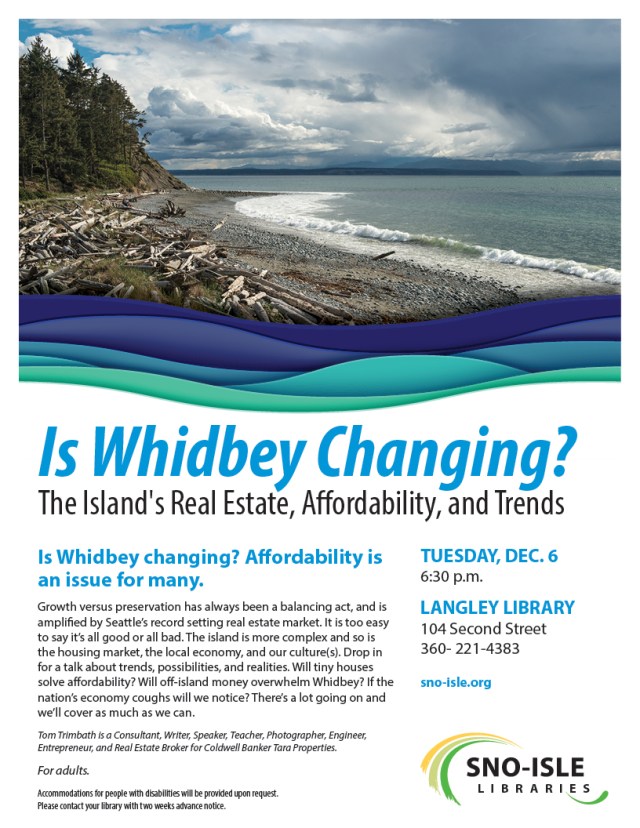
The trends are fascinating enough that I’ll be giving a talk about them at Langley Library on December 6th at 6:30pm. Decades ago, Seattle had a tough time getting people to move here. It was an issue HR described when I hired into Boeing in 1980. Whidbey Island was much quieter than, but so was the entire Puget Sound region. Since then, Microsoft, Starbucks, Costco, Amazon, et al have changed the area from an overlooked corner of the country into the center of a spotlight. What’s next? Stop by the for the talk and …

45810-WhidbeyChanging-LNG-POSTER

Pardon the interruption. A client called. Stay tuned.

Hey! That was fun, walking vacant land, checking out the view, considering the possibilities, and being visited by a flock of sheep.

And, getting an intriguing phone call from another broker who is interested in helping distribute the graphs I produce and share on social media.

And, before I set to typing again, another idea for creating a job opportunity. Got to make sure I talk to J and A about that. (Hey, life’s hectic and sometimes the best place to write a note is in the middle of something completely different.)

Welcome to the disjointed, always on, happy to help nature of real estate. Boredom rarely happens. Insights and perspectives from people who need whatever house they can find and afford to people who can add a vacation house so they get a chance to recuperate from a hectic lifestyle elsewhere. And, keep it all inside to respect privacy.

Real estate also represents a departure from my participation in the Gig Economy. I continue to consult with creatives to help complete their projects; and I continue to write, and take photographs for sale (Twelve Months at Maxwelton Beach is next); but most of my time is working with buyers, sellers, land, houses, and introducing them to each other.

This has not been an easy or obvious journey. Thanks to sharing in a half dozen deals, I’m still living on the island. Thanks to the costs of doing business, I have paid my bills, but not my taxes, yet. A few things have been fixed. Some new shirts have been added to my wardrobe. (Thanks, Lands End.) But, new (used) car money, major home repairs, and taking good care of my self are things to look forward to, not to spend money on – yet.

‘Yet’ is a frequently used word, but yet is closer now. Instead of relying on lottery tickets, I can look forward to being compensated for helping people. At last count, I’m working with over a dozen sets of clients, who represent a wide variety of interests, needs, and resources; and whose situations can change every day. This isn’t like engineering where a job assignment leads to a check. It’s more like a diversified portfolio of individual stocks, lots of potential which benefits from diligence and patience.

Few people except brokers want to talk about real estate every day, which is why I only mention it here, occasionally. Few people want to read about Whidbey Island every day, which is why I started a blog specifically for Whidbey, AboutWhidbey.com, Island living from a islander’s perspective. If you want to hear about both, drop by Langley Library for the talk I mentioned above. If you can’t attend, give me a call and tell me your story. Speaking of which, there’s a voice mail message I should respond to before the end of the work day (which can go until 9PM when things get busy.)

Here’s to the start of year number 2, and maybe even some stories that I can share.

Posted in Uncategorized | Tagged , , , , , , , , , , , , , | 4 Comments

Ten Years Of Dream Invest Live

It started the day after the election. Barack Obama had been elected. A dramatic change was taking place from the Bush/Cheney era. The world sighed in relief. America wasn’t as crazy as it looked. The ‘it’ in this case is this blog, the blog based on my book, Dream. Invest. Live., which I should’ve subtitled – “personal finance for frugal folk.” It is hard to imagine such dramatic changes could take place, and a reminder that ten years from now we may look back and be similarly surprised.

Dream Invest Live cover

My book was published as the market crashed. Even before Obama became President, the economy was already inexorably falling into the Great Recession. My investing philosophy of long term buy and hold (LTBH) of stock in positively disruptive companies helped me retire at 38, and looked like it would weather the market’s upset. That history and my evidently reasonable way to describe finance inspired friends to inspire me to write the book. Rather than draw a crowd as people sought solutions, the book languished (as most books do regardless of topic) partly because people avoided the suddenly painful topic.

About four years later, two or three stars in my diversified portfolio were beginning to shine. That’s when My Triple Whammy hit. Regardless of the economy:

  • AMSC had its renewable energy intellectual property stolen and its market gutted by a Chinese customer turned competitor,
  • Dendreon achieved FDA approval for a cancer vaccine which was than assaulted by apparently felonious actors who bankrupted the company and impacted the lives of patients,
  • MicroVision had a key supplier back out just before a significant product launch as the supplier decided to work on smartphone glass instead of green lasers.

My portfolio dropped 80%, and then dropped more as I tried to keep my house and pay my bills. The housing market meant no buyers for my house. The job market meant no jobs for me. Evidently, I didn’t win the lottery jackpot. My Backup Plans weren’t backing me up. I dove into the gig economy to swim through, somehow. Last year, I was finally convinced to become a real estate broker because I couldn’t be considered to be over-qualified, and the hurdles of age, gender, and address (really) wouldn’t be an issue. Now, those years of effort are switching from potential to reality – possibly.

This blog has chronicled that path and is acting as notes for a possible sequel; From Middle Class to Millionaire to Muddling By – A rollercoaster ride through America’s wealth classes. Stay tuned. I’m not sure how it ends.

Along the way, readers implicitly voted for their favorite topics. Writers take note. We may think one set of topics should be most important; but readers decide for themselves.

Here are the top ten posts from the last eight years. (Apple dropped support for the first few years, so the only data available are for the years that WordPress has hosted the blog.)

  1. One Confused ObamaCare Applicant
  2. A Bow To Drewslist
  3. Micro Vision
  4. Apple Pixar Dendreon
  5. Will Zillow Make Me Move
  6. Weed Changes Whidbey
  7. My Spreadsheet For Tracking My Stocks
  8. PicoAir Meets ShowWX
  9. MicroVision Begins 2018
  10. MicroVision And CES2017

I thought I was writing about personal finance for frugal folk, and what readers wanted to read was about: how to sign up for healthcare, a community-based version of craigslist, the little company that may someday succeed called MicroVision, Dendreon, marijuana, and a spreadsheet. I also wrote about writing, Whidbey Island, housing, consulting, and a wide array of future scenarios – but they didn’t rank, yet. Old posts can gain new readers.

Just as this blog inspired the possibility of a sequel, it has also inspired two more focused blogs:

Some may notice that, instead of posting twice per week to this blog, I’m posting once here and posting others over there as appropriate.

A lot has happened in the last decade. A lot will happen in the next decade. Someone today is guessing right, but we won’t know who that is for ten years.

That first post included this;

“The universe tends to disorder, chaos. So goes entropy. Order, construction, takes far more energy than destruction.”

So, here’s to the next ten years, a ride through ever-shifting scenarios and schemes, a journey that can benefit from some simple ideas that won’t change:

Spend less than you make.

Invest the rest.

Live according to your values.


Oh yes, and VOTE! It does make a difference.

Posted in Uncategorized | Tagged , , , , , , , , , , , , , , , , , , , , , , , | Leave a comment

Goodbye Netflix

Go to Netflix.com. Wait for the computer to load the page. Watch the page grab so much of the computer’s power that even opening a text file means having enough time to pour a cup of tea. So, why am I canceling my Netflix subscription after over a decade of use? Like many companies, they’ve improved it so much that it’s now useless – at least to me. But, there are simple success stories.

11:02
Ah, the site has loaded. Let’s see how long it takes to cancel the subscription.

Account
Cancel Membership
Cancellation will be effective at the end of your current billing period on Nov 13, 2018.
Restart your membership anytime. Your viewing preferences and account details will be saved for 10 months.
Finish Cancellation
Why
OtherMany years ago I signed up for Netflix for movies. Now, the emphasis seems to be Netflix content, fancier site dynamics that overwhelm my computer, annoying instant play, overly large graphics, and generally fewer of the movies I want to see. It looks like it’s working well for you. Congratulations. But not for me.
11:08

Well, that was painless. That part of the site is a great example of how it could operate simply and efficiently.

Diworsification is such a common corporate development that there’s even a word for it, at least in the investment community. Take something that succeeds. Celebrate that. Then grow and change as power accumulates. Add more, and more, and more. There’s a problem with more. Just go watch Key Largo, an old black and white Bogart/Bacall movie. Edward G. Robinson’s character, the gangster Johnny Rocco, wants more;

“Frank McCloud: He knows what he wants. Don’t you, Rocco?
Johnny Rocco: Sure.
James Temple: What’s that?
Frank McCloud: Tell him, Rocco.
Johnny Rocco: Well, I want uh …
Frank McCloud: He wants more, don’t you, Rocco?
Johnny Rocco: Yeah. That’s it. More. That’s right! I want more!
James Temple: Will you ever get enough?
Frank McCloud: Will you, Rocco?
Johnny Rocco: Well, I never have. No, I guess I won’t.”

– IMDB Key Largo

He’s never realized that more is never enough.

Companies fall into the same trap. Growth is more important than sustainability. New is mistaken for improved. Any company that is continuing to try to grow regardless of supply and demand is ultimately doomed. Doom can take a while to arrive, but it does arrive. Sure, Microsoft, Apple, Amazon, and Netflix are highly successful companies; but I’m finding myself drawn to simpler solutions like Google, Chromebooks, and longing for the days of ad-free, ready-when-I-am, DVDs. Similar things are happening with WordPress, that continually changes its interface (which is making maintaining this blog more difficult). Even though I liked Apple products for years, they’ve turned me off with file architecture changes, a monopolistic approach to the user experience, and a sales attitude that is more elitist than egalitarian. Google has even retracted “Do no evil”, a simple philosophy that seemingly got in the way of growth. Facebook has improved itself into something far less useful. I only use it now when I have a faster computer and internet connection, even though all I want to be able to do is post text, maybe a link, maybe a photo (#SeePoliticsPostArt), and maybe Like someone’s posts. Now, Facebook has so enough options to fill a laptop screen, and takes so long to load that I can watch each element make the computer pause before displaying it. I’m using Twitter and LinkedIn more, even though fewer friends are over there.

It doesn’t have to be that way. New features aren’t required for growth. A wise steady strategy can prevail. Look outside the corporate world. Craigslist and Wikipedia are great examples of simple ideas, concisely provided, that are just as essential, and more reliable.

One way to keep costs down in a business is to use standardized processes, and only change when a benefit has been identified. Every imposed change costs people and businesses money as we have to take time away from work to figure out how to get the work done, possibly reworking web sites and applications, and cleaning up any mistakes that happened in the process. I haven’t had that issue with Craigslist or Wikipedia, but corporations seem to be chasing the phantom that is more.

Such a tendency is one reason I like to sell small companies when they become large. Sure, Microsoft, Apple, Amazon, and Netflix are doing fine; but go back thirty years and look at the apparent solidity of Sears, Buick, and even GE.

At least for movies, I’m on a hunt. I’m trying Hulu, but only because they have Stargate SG-1 and Firefly. Their movie list looks slightly better, but not so appealing that I’m sucked in. The mute button is necessary for the anxiety-driven medical ads, and the fact that there are ads even though I’m paying for the service.

I wonder if this is all just another example of the bifurcation happening within our society. Those with the means can update hardware and software frequently, keeping up with the new features, and sending perfectly good equipment to the landfill. Someday I’ll get a smartphone. It almost happened this month until a business delay delayed my income. Don’t spend it if you don’t have it.

As technology incrementally leaves me behind, at least temporarily, I’m finding myself spending more time reading, writing, and walking. Two scenarios come to mind: 1) What would I be doing if I was a multi-millionaire again? and 2) What would I be doing if I was a mountain man in a cabin a hundred years ago? There’s a lot of overlap. Frugality by choice instead of necessity is appealing and liberating. Chasing my passions is better than chasing after someone else’s imposed improvements. Netflix and other companies, you’d be better able to keep my business if you provided the option of stability. If I like MS Word 2008, great; instead of dropping its support, provide it as a paid feature. If I like the old version of OS X, let me keep using it instead of forcing its obsolescence. If all I need is a list of movies, don’t force me to scroll past your animated ads for your TV shows of which you are so proud.

Enough is enough. More isn’t always better. Living simply is something society won’t encourage. Its best source is within. No company can improve on a person’s awareness of their values.

Now, let’s see how long it takes to drill down to my favorite WordPress editor.

Posted in Uncategorized | Tagged , , , , , , , , , , , , , , , , , , , , | 1 Comment