How could I Not write about this? I’m sitting in the lounge at the Port Townsend Film Festival, which I attend because I have a screenplay (true-life tall-ship growing-up buddy story from 1876), while one of my investments, QBTS, goes up 11.9% today, 52.3% for the week, 75.5% for the last month, and 2,700.0% for the most recent twelve months. It might be obvious that I’m making more money on the market than in the movies – so far.
Google Finance
D-Wave’s business (QBTS) has had good news, but I suspect its growth has been more about irrational pessimism replacing irrational optimism. Of course, irrational optimism may also be the feeling that helps some relationships cross early hurdles in relationships.
The stock is at $26.88. I bought most of mine around $1, with one batch down near $0.75 about a year ago. I’m pretty sure I’m doing better than the market average.
So what?
I tend to buy stocks for the long term. I’ve held GERN and MVIS since 1999/2000. My patience has not been rewarded. Other patient holds did provide rewards (SBUX, PIXR, FFIV, etc.). It feels a bit odd to have such a great return within such a short time. I’m not complaining. I’m also down 20% from where my holdings could be because I sold off enough to cover my investment as it first went up a few hundred percent. I buy stocks for the long term because I don’t want to have to time the market. GERN/MVIS on one side. QBTS on the other. And GERN/MVIS both have reasons to finally revive my hopes, and ideally, my net worth.
For years, QBTS languished in the space that is easy to fall into, an idea that is radical enough and early enough that it is hard to value. Within the last twelve months, QBTS has had news that even investing behemoths can’t squelch or ignore.
QBTS has gone from being a hope based on unknowns to being a possibility propped up by obvious successes. Investors don’t want to miss out on the next Intel or Nvidia, even though there’s no widely accepted valuation. They’re a $9B market cap supported by a few millions of dollars of sales, and the hope and expectation of early ownership of The Next Big Thing. I suspect few can explain quantum computing and annealing methods. But, hey, lots of people are excited about what’s happening. Maybe they should get some.
I am old enough and been investing long enough to not be excited, but to be hopeful. Folks laughed at AOL, which I bought at ~$1, watched go up to ~$80, and sold when it fell back to ~$40. Oh dear. I ‘lost’ 50%. Or. Cool. I made $39/share on a $1 investment.
I bought QBTS at ~$1. It is easier for me than most to imagine it rising to $80. I’d probably sell a bit along the way, but not yet.
Whoever sold any stock after a 20% increase in a year can celebrate successful investing.
I want to thank the person who intended to corner me about my investing failures by asking how much was the most I lost. That’s easy. I’ve held several stocks that fell 100%. That train of thought made me realize that those losses were small compared to the amounts I’ve missed out on. I misread FFIV, so I sold some at $44 after buying some around $4. FFIV closed at $328 today. For relationship reasons, I held back from buying ten times more AOL. There went a potential million. I almost bought two bitcoins at ~$200. It is now at $115,500. There’s more.
I do not advise anyone to invest the way I invest. However, I encourage people to look past the mystique and fear marketing and the fear of missing out marketing to better understand how they should invest. My style of investing is risky. I know people who are far riskier investors. They think I am overly conservative because I invest for decades instead of minutes.
Writers can be encouraged to write in simple declarative statements. Life is more complicated than that.
Investors can be encouraged to invest in solid financial situations. Most companies don’t start that way.
I’m willing to invest early in companies involved in innovative, positive technologies. They are risky. Most fail. The most they fail is 100% (for longs.) The most they can rise is far higher than that.
QBTS is an early enabler of quantum computing, which is a more radical technological shift from conventional computing than now-conventional computing was from tubes and Victorian difference engines. How big can that become? No one knows, but enough folks are guessing that QBTS has risen 2,700% in twelve months. Fine by me. Let’s see if it rises enough for me to buy a house, or if it falls (but since my holdings are pure profit, I won’t have a loss), or does something unexpected, which is the only real reality to expect.
There’s that thought, but where’d it go? There’s that feeling, and it’s gone, too. There’s a thread of reality that is winding its way through modern reality. I can’t think or feel my way into being able to describe it, and then I take a nap, and there it is – until I wake up. The world is changing, and I suspect it is changing in ways that aren’t familiar to us. So, we live by habit, assuming old assumptions remain valid. Some day, the disconnect will require abandoning old habits; but what habits will we find we must give up, and which new habits must we learn? Just casual thoughts from a couple of naps, eh?
Regular readers know I frequently mention that a thirty-year mortgage assumes the world doesn’t change much in thirty years, though with an assumption that a person’s pay will be better and the burden of a mortgage will be less. I think that was somewhat valid for returning WWII soldiers in the late 40s looking at paying off a mortgage in the late 70s. Reasonable in hindsight.
I got my first mortgage in 1988. It lasted about three years as I sold the house to get married. That house was my address for almost a decade. Not the next one, it was a rental. Then, another for a few years. Finally, my home, which I just sold, was home from 2007 to 2024. That home was just right, but the mortgage was not. Now, I have a tiny house and no mortgage, which is just right for other reasons. (MyTinyExperiment.com)
But what about younger people trying to buy a house in the 2020s? I watch trends. I think the next five years will be turbulent enough to defy prognostication and guessing. 2055? I’d be amazed if USA has the same fifty states, extraterrestrial life may have been found, we may have had our Magna Carta moment. (Maybe A Magna Carta Moment) Climate change will be undeniable, and social injustices will probably grind themselves smooth, though through painful effort. And then there’s AI, which will not be waiting for us to catch up. 2055? Good luck guessing at that one.
And yet, guess we must. Actually, guess they must. I intend to never have a mortgage again. (Be careful with ‘never.’) Amidst today’s turmoil, not having a mortgage means a major slice of instability and complexity has been removed from my life. Good. Stay tuned as love and money can change plans.
My investments, my personal finances, do not reflect my life. They reflect my expectations for subsequent generations. Older people don’t shop as much as younger people. Young people are having a harder time shopping and planning because their lives are much less certain and don’t show much sign of stabilizing, except into science fiction dystopias. Ugh.
But, of course, the thirty-year mortgage is not a commitment to thirty years of an unchanging life. Houses may only be held for a dozen years. Jobs change. Refinances happen. If inflation continues, a mortgage payment can shrink relatively and become a nuisance worth paying off.
And yet, the thirty-year mortgage provides me with a perspective to measure world changes against.
And I reflect back on those nap dreams, those tenuous fragments of insight that are possibly no better than a guess.
Climate change will drive people to higher ground and more temperate zones. Technology changes are driving people to enforced mobility within their careers. Power is shifting from governments to corporations. Energy is more likely to be renewable and decentralized.
Ebikes are gaining popularity. So are solar systems, as well as geothermal. Everything tech!, at least for careers and investments; though folks with farmable land may be the most stable. Handicrafts that benefit from human imperfections may gain popularity, but probably won’t be a major part of the economy. (Prove me wrong.) None of those are without struggles and hurdles. Investing involves risk.
And how will investing change as AI competes against humans?
My apologies that there is no clear resolution of these uncertainties. Predicting the future was difficult enough when change was measured in dynasties and generations. Change is accelerating to months, weeks, days, etc. A thirty-year mortgage? Maybe that’s one change worth predicting, the death of long-term debt instruments.
Twenty-five years ago, I started bicycling across the United States. I wasn’t trying to write a book or claim bragging rights. I wanted to give my wife a skinnier husband for Christmas, and I wanted it to be me. That didn’t work out as planned. As I wrote in the book, I can’t say that it was fun, but I’m glad I did it. A lot has changed since then.
For the billions of people who didn’t read the book (Just Keep Pedaling), I rode from an island north of Seattle to an island south of Miami, but didn’t lose any weight, waist size, or percentage body fat. Evidently, I was too efficient. Evidently, I did write the book, largely thanks to my friends who encouraged me to do so after I finished the ride. Thanks, folks.
Such a ride can define, or at least redefine, a life. Mine has certainly been different, but the bigger changes have been in all of our lives.
When I rode, I understood computers but found myself cut off from them soon after leaving Western Washington. Email was sporadic, with shared keyboards at truck stops covered in road grime. Cell phone service was occasional. Navigation was via paper AAA maps, calls home, and a lot of guessing and hoping. Head SE, young man (who felt old at 40).
I retired at 38, and was living an uncommon perspective with no role models. I had the somewhat rare opportunity to redefine a second life without having to wait for a retirement in my 60s. I confused many people. Friends and family were a bit confused. Strangers I met on the ride assumed I was riding for some noble cause, like raising money for cancer research. Riding because I could, didn’t register as valid. I rode anyway.
I saw a slice of the United States at less than 20 mph.
Last month, I drove from the Olympic Peninsula in Washington State to the Outer Banks of North Carolina. (Road Trip – August 2025) It was far less aerobic (#massiveunderstatement), and quicker (~60 mph). I did it to attend a family celebration, but I also realized I could see a slice of the United States at a time when news outlets tend to be biased or challenged. We seem like a fractured country. I think that’s right.
Twenty-five years ago, social media wasn’t popular. People doubted the need for the Internet, but were willing to invest a lot in it. Inequality had been rising for decades, and we were witnessing a new breed of wealth as the Internet Bubble boomed. It began to bust as I rode. For most people in the middle, the digital world was abstract. A nascent coworks in Kansas seemed just right to me, but was an oddity in its neighborhood. The founder was impressive. I wonder if it worked. Few things were recorded. Broadcast TV was still busy. We were still living within the fading echoes of the close of old wars. We also weren’t very aware of each other except through broadcast media.
Now, hotel TVs try to be so inclusive and expansive that one evening is not enough to educate myself on the control. That was okay because wi-fi is almost ubiquitous, and mostly what I watch is on YouTube and Amazon Prime. The AAA maps weren’t an issue because I could let the phone figure out where we were, give it a destination, and with some caution, trust it to steer me right. It is an imperfect system, but unimaginable 25 years earlier. Except for radio, everyone can see what everyone else is watching, which has exposed unseen barriers between our various cultures. Oops. Instead of emphasizing what we have in common, we’ve focused on our seemingly irreconcilable differences.
For decades, we thought we were a melting pot of people, and now we’re worried about the mix of spices as if they were pesticides. So much for ‘E Pluribus Unum’.
In those 25 years, the bubble burst, we’ve had a Great Recession, and a pandemic. We’ve watched the remarkable rise of Putin and China. Climate change has gone from arguable to logically undeniable. (A lack of logic can survive anything. Ask the flat-earthers.) AI is rising. Fossil fuels are falling. Cash is becoming so uncommon that some businesses don’t want it, and would be happy to avoid plastic in favor of online payments. Cameras, storage, and networks have become so cheap that it is easier to assume you’re being recorded. (Pardon me as I double-check my laptop’s camera indicator light. Off? Good. And yet I doubt it.)
We have replaced the existential threat of mutually-assured destruction by interposing more immediate threats of artificial intelligence, oligarchic controls, random actors, and the consequence of various histories and technologies which can’t wait to be dealt with – despite what deniers may think.
So now, look ahead 25 years. Shudder. Make it real. Think of taking out a 30-year mortgage. What will the world look like then?
Climate change isn’t stopping. Various studies suggest that conventional governments will be unable to stop the power shift to corporations. Autonomous operations will replace more humans. At best, social injustice will begin to resolve itself, but it is easier to imagine the worst-case scenarios.
And maybe, health care will improve lifespans to beyond 124 years, AI will find solutions to many of our otherwise intractable issues. We’ll be better established in space and less reliant on carving up our planet. Maybe we’ll finally meet or at least find aliens.
More radical of all, maybe we’ll figure out how to live with each other, take care of each other, and feel less alone.
I don’t have a 30-year mortgage. I don’t have any mortgage, and I’m glad.
I don’t know how long I’ll live, but wonders can happen; and maybe I’ll get to see what we have 25 or 30 years from now.
But, for much of modern life in America, guessing personal finance decades in the future hasn’t been predictable, but has been reasonable. The changes we are witnessing are radical enough to literally reshape land, what and where and how things can live, and how or if we’ll have to pay for it.
And yet, guess, we must. Good luck with that. In the meantime, and in the midst of all of that, frugal living remains valid and powerful. As a character said in Doonesbury in 1976, “Be firm. Fly low. Stay cool.” (And vote, assuming you can.)
“The Road goes ever on and on Down from the door where it began. Now far ahead the Road has gone, And I must follow, if I can, Pursuing it with eager feet, Until it joins some larger way Where many paths and errands meet. And whither then? I cannot say”
― J.R.R. Tolkien, The Fellowship of the Ring
The pause in my postings was from a road trip that interrupted my schedule. See the previous post for a lead-in to it. (Summer Break – August 2025) I needed, and wanted, a break. The previous time I took more than a week off was in the autumn of 2010 when I needed, and wanted, a break. That time, I avoided some medical tests that were going to prove that I was under a lot of stress. I walked across Scotland for about half the price of the tests. Got a book out of it. (Walking Thinking Drinking Across Scotland) A long vacation every decade or so? I gotta do this more often. So, I started by driving across the US from Port Townsend in Washington to a family event on North Carolina’s Outer Banks. And back, of course.
That Scotland trip became a book. I’m busy finishing one book about personal finance, and have started the third book in my sci-fi trilogy. I’m busy. This trip across the US could be a book, but I’m busy. I’m also forgetful, a human trait, so here are some of my notes from the trip for my own sake. IF, however, there’s enough interest in a book about what I saw in a coast-to-coast slice or two of the United States in August 2025, well, contact me. It was good to see the simplicities and complexities of reality instead of the snippets and sound bites that populate media, conventional and social. It is a big country, or is it big countries?
It would be nice to be scholarly and literary about my notes, but they’re notes. I can get fancy later, but I wanted to record my thoughts as they’re fresh. This may be unorganized, but hey, they’re here. Sort through yourself.
Data First, some data. Port Townsend, WA to Manteo, NC, and back was ~6,600 miles and ~103 hours of driving. Left on the 12th. Got back on the 25th. Stayed a couple of days with family for a celebration that was somewhat affected by a hurricane. I’m tired. My car may be too. My mechanics may report on any wear within the next month or so. They’re busy.
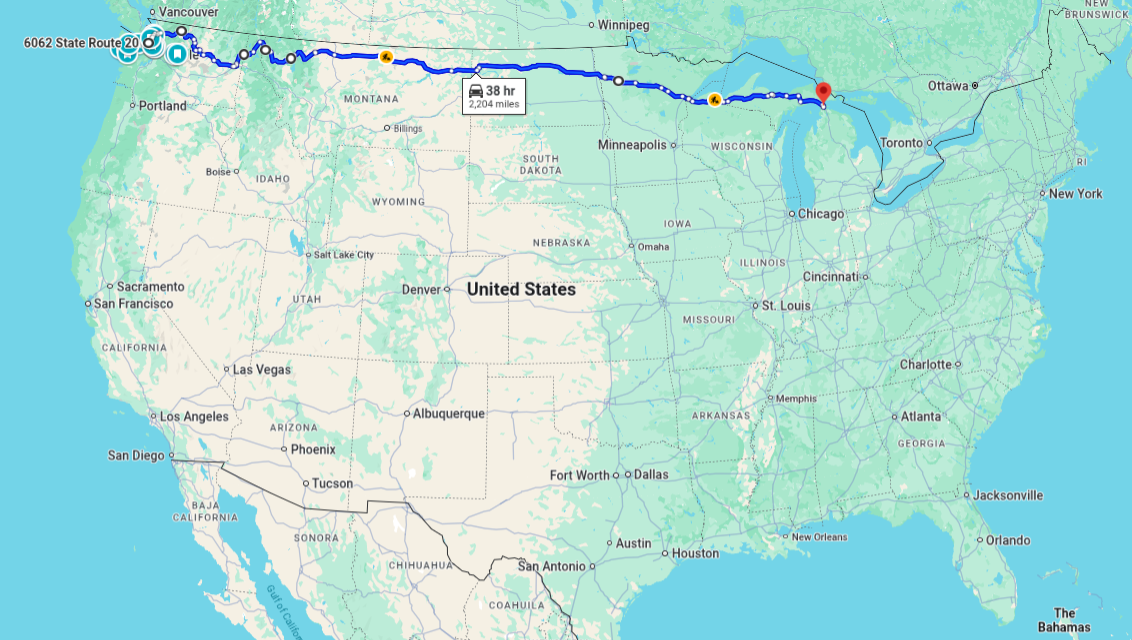
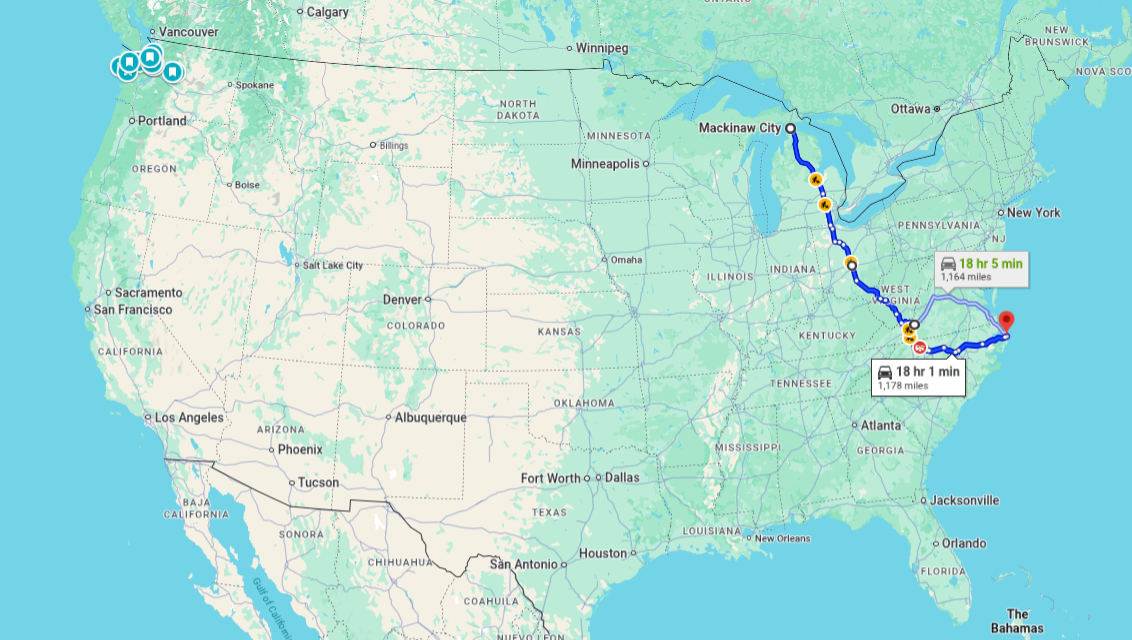
Route The route was based on a whim. WA Highway 20 starts near my home and gets routed across the northern tier of the state. It ends about the time it connects near US Highway 2, the highway system that is one notch less sophisticated than the Interstate system. East on 20, then 2 until 2 runs into the Great Lakes. Down the Michigan peninsula, diagonal down to my alma mater (VPI&SU) in Blacksburg, VA, then over to the coast.
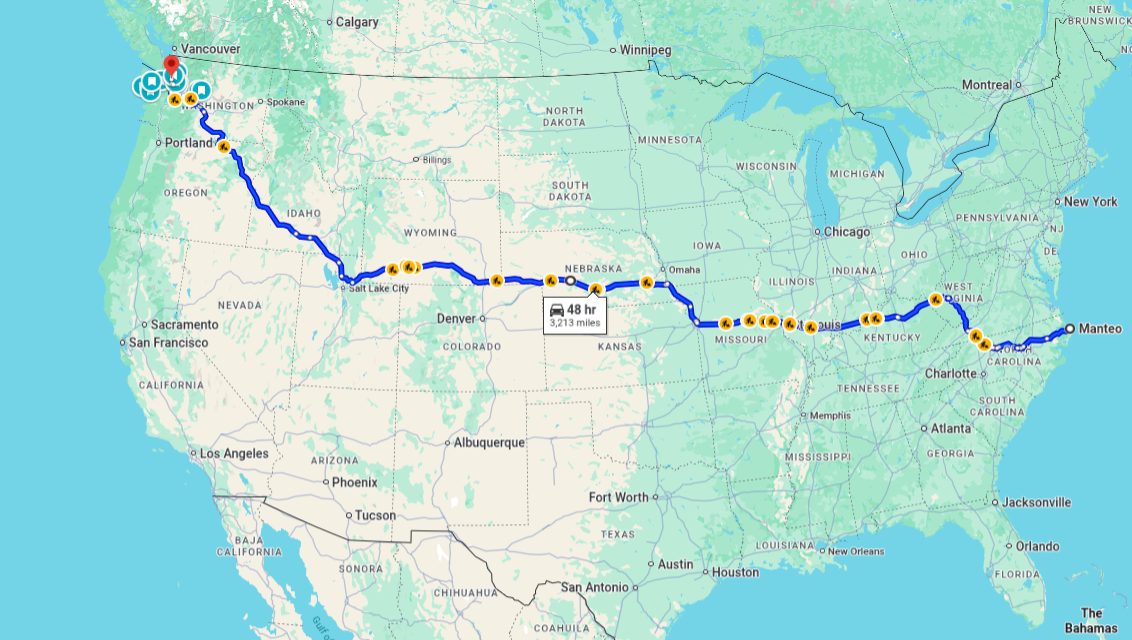
That was interesting and long, and provided an uncommon opportunity to compare the US route to the Interstate, so, return west on 64 in NC, up into Ohio, Louisville, I-70?, then I-29, then I-80, I-84, I-82, then a jumble of somewhat familiar routes close to home, like 410 over the pass east of Mt. Rainier, around the south Sound through Enumclaw and Auburn, up 3 past Bremerton, then home with a quick stop at my favorite (not a super-) market in Chimacum.
WA 20 & US 2 (estimated)I 75? to I? 64 (esimated)and back via I? 64, 70?, 29, 80, 84, 82, and a mess to avoid Seattle
There (Google estimate): 2,204 miles in 38 hours + 1,178 miles in 18 hours = 3,782 miles in 56 hours Back Again (Google estimate): 3,213 miles in 48 hours Difference (US vs Interstate, sort of): 569 miles shorter and 8 hours quicker on the Interstate TOTAL: 3782 + 3213 = 6,995 Odometer: 6,600 miles
That’s a lot of driving.
Old versus New – road systems The old highway system was impressive. It cared less about modern niceties like gradients and curves. Mountain roads set their own speed limits because if you don’t slow down, you hit a wall or get to fly. They were also usually two-lane, which meant that the slowest car or truck set the pace. Chill. Deal with it. Traffic is temporary.
The Interstate got rid of traffic signals, is straighter, shallower, smoother, and faster. And crazier. People drive Fast. Speed limits seem to matter less, which is basically saying laws matter less. Metaphors and insights delivered throughout the day.
The old system goes through towns that are more likely to be struggling. The new system passes almost everything, except when it drives right into urban rush hour traffic. The commuters know the route, the lanes, the laws, and they outnumber the travelers. I would find a lane and hope it led me through. Google Maps talked me through.
Google Maps Google Maps also got confused or simply more confusing on the old system, as it passed me from side road to you’ve-got-to-be-kidding road as it presented what it thought was the most efficient route. One road was labeled as 55 mph, but it was almost a continual set of 35, 25, down to 20 mph curves that were so abrupt that the pavement was carved by truck frames that gouged grooves in the deepest corners. I lost faith in the app after that.
Google got confused around accidents and road work, too. Just show me the Interstate. Ignore the five-minute benefit of the side road when all the trip needed was a bit of patience to get around a wreck or a work site.
Old vs New – shoulders The Interstate has shoulders, even when they’re marked “Emergency Parking Only”. The old roads were lucky to have a paint stripe, could be soft or abrupt shoulders, and were easy to block with an accident, or stopped by someone simply deciding to turn left.
Old vs New – food Romantically, we have an image of roadside diners and home-cooked meals. Yeah. And true romance may be hard to find. Diners and motels were likely to be abandoned. That romance is fading. I ate a lot of gas station snacks.
The Interstate system usually has signs for food, fuel, lodging, etc. Expect to find brands, which also means monotony. Most brands serve lots of wheat and sugar, which meant that I ate a lot of gas station snacks like Clif bars.
The US highway system was convenient with stores right beside the road, when there was a store. But even if the store was closed, I could stop in a cracked parking lot for a nap. Services were harder to find.
Old vs New – rest areas Rest Areas on the Interstate tended to be built, off the traffic flow which made it easier to exit and enter traffic; but there were fewer than I wanted. At least Rest Areas made it easier to remember where I was because the local marketing folks would proudly proclaim their high points.
Turn The Radio On – Or Not Every hour was roughly another sixty miles, which meant lots of station shifting. I took the opportunity to cruise the dial, rarely staying to one station for more than a few seconds. Thumping music, ads, emphatic declarations, noise and bluster dominated what I found. NPR was a sweet spot that drifted across the bottom of the dial, er, the lower numbers on the FM band. They’re scared and defending themselves rightly, usually with impressive local support. I might even send some money to the overall NPR org because they provided an almost-continual oasis. Some places didn’t even have that.
Silence was good, too. Few words may best describe the value of the silence.
Distractions What I heard and saw made me more aware of how much our society relies on distractions. Music, talk, ads, sports, religion, radio couples, and I’ll mention ads again all filled gaps where folks would otherwise have to sit and think. The pioneers sat and thought, or walked and thought, or maybe talked or sang a bit, but today’s cacophony is relentless, and if you want quiet, you stand out as odd. Odd.
Size It took me about fifty to sixty hours to cross the continent. Imagine the pioneers. I had roads. They had ruts, at best. Applause to those who tried. Apologies to the nations that were walked through and over. Did any of the original tribes walk all the way? They had over ten thousand years of possibilities. Did any walk back? Things to ponder as I sit here typing. Things were almost unimaginable while driving where they may have walked.
The Europe of America If we tried to form up the country from scratch, I doubt that we’d end up with our fifty states, united. Kansas ain’t California. What else would unite them except habit? I suspect the same is true for Canada and Mexico. North America would probably look broken up like South America. Stay tuned.
Urban vs Rural NPR made the bold move that many other media made; they made a West Coast post to balance the East Coast origin. I didn’t hear or see a balance between coastal vs inland, necessary densification vs necessary dispersion, interdependent vs independent by requirement. Jokes on late-night comedy shows are fun, but meaningless when the joke is about a subway and the listener is miles from their neighbor. As long as the middle has access to New Orleans and various rivers, they don’t need the rest of the coast.
We have no common enemy, so we fight each other. And yet, somehow we have a country.
Transportation A crazy amount of cars in the cities. Lots of pickup trucks in the country. 18-wheelers stitching it all together and dominating the highways. Surviving it all is an immense testament to pervasively good driving – which is dramatically interrupted by bozoes, self-centered people, and tourists that are just trying to get through the city to get to the next one. Thanks to anyone who survived driving near me, and apologies for a few bone-headed lane changes I made when the directions didn’t match my reality. No bumps. Good
Pickups rule in the spaces between the cities. Lots of roads that peeled off from the highway were gravel, pointed off over the horizon. For the rural folks moving from town to town, a Corvette finally looked appropriate. Long straight stretches of asphalt and 80 mph speed limits looked right for a long, low, fast car. My Jeep Renegade is a rounded box on wheels that could do 67 reasonably well, and could gulp gas up to and through 80. It works better on bumpy, curvy mountain roads, where it spends more time. In the cities, cars and sedans, but why not lots of buses and trains instead of using thousands of pounds of metal to carry one person a few miles? Oddly enough, there weren’t many RVs except near home. Hmm. My bicycle weighs less than me, and it carried me from Washington State to Key West in Florida. (Just Keep Pedaling) Maybe ebikes will make that more likely and commutes safer. We’ll still need the highways, though.
Transportation – EV vs gas vs diesel Diesel is everywhere because trucks need to go everywhere. I’m a fan of electrification, but only in the cities – so far. I typically drove 600 miles per day. An EV could do that, maybe, but it would be a stunt, not a commonplace option. A hybrid, perhaps? Ah, and this is one reason I am invested in the next generation of batteries, but I digress. (Semi-Annual Exercise – Mid 2025)
Restrooms In the meantime, gas stations will exist, which is an excuse for restrooms and snacks – and more things to drink, which must be managed a hundred miles down the road. And, no, there isn’t always a tree to step behind. Entire states lack much of that kind of access. I stopped more often to get rid of and load up on water than I did to get gasoline. The Interstates were more regular with the rest stops. Some were impressive. Some made a tree look attractive, pending no snakes, scorpions, or ticks in the grass. Carry handy-wipes. Ick.
Gas – prices I think the gas in my neighborhood was the most expensive on the trip at ~$5 earlier this year. The majority of what I could find was under $4, and frequently under $3. And people were complaining about those prices? Of course, most folks don’t get to other countries where $5 would look cheap.
Gas – octane Gas is gas, right? I almost always pick the lowest octane gas because it is cheaper. Ah, but some place notch down from 87 to 85. And then there’s the ethanol issue, which I ignore. And then there’s some other issue I’d never heard of. So, at one pump, I had five options. Gas isn’t gas. I guessed. The car worked fine. But I left two issues hanging there, on a pump that someone designed, implemented, and spread across at least one region. There is a limit to how many issues I can handle. Good luck with that one.
Gas – pump your own Of course, I pumped my own gas – except at one station just across a state line (Montana?) where an attendant did it for me. It felt odd, which was also ironic because I worked in one of the early pump-your-own gas stations in 1976. My how things have changed – and put that on repeat throughout this trip.
Boredom “Isn’t driving that far boring?” I heard that a lot. Every hour or so, I’d pass into another region, either from geology, commerce, temperament, history, whatever. Neighboring teams have rivalries. None are exact copies of the town at the next exit. Every state line was a change in politics, and frequently music. People live everywhere. Why are these people here? Who wants to move here? Who wants to leave? Keep asking those questions, and boredom can’t sneak in. Farms farm different produce. Smokestacks mean industry or at least power. Billboards mean businesses, and their lack may mean nothing going on or rigid regulations. Bored? How about those marks on the highway? Skid marks are common, and can lead off onto the shoulder and into a fence or cross the median. Those are stories that were dramatic in at least one person’s life, and probably involved other drivers, police, fire trucks, ambulances, and tow trucks. Wrecks and abandoned vehicles are stories. Did they walk to the next exit, or did a friend pick them up, or did the police or health staff? Bored? No. Tired, yes. Bored, no.
White Folks and Not White Folks There’s a lot of whiteness out there. There’s a lot of everything, really, but great swatches are easy to label as stereotypes. This was in 2025, so many non-whites could justifiably be hiding, but even the radio stations were primarily English. I assumed from Washington State radio that Spanish stations would be common. French stations along the northern border would make sense. Within Western Washington, I thought I’d found Chinese and Eastern European programming. But there’s a lot of whiteness out there. Still pondering that one, but there’s a lot to ponder after such a ride.
As I came west, I smiled when I saw my first billboard for Punjabi food. I don’t eat it, but I was glad to see it.
Cities were more diverse, which was welcome.
The PNW felt like a welcoming bubble, but that may also simply be familiarity.
I Did That? I bicycled across America, at least the part from Roche Harbor in Washington State to Key West in Florida. A few hours of my return trip took me along a few days of that route. I rode that? It is easy to forget a place. Towns grow and fade. Mountains and rivers don’t change. I know I rode my bicycle across those places, but couldn’t believe it. I’m glad I wrote a book about it. (Just Keep Pedaling) Hmm. That ride was partly in response to a health issue (weight) and a vanity issue (I was 6 foot 1 inch, 185 pounds, and felt fat), and a relationship issue (I wanted to give my wife a skinnier husband for Christmas, and I wanted it to be me. We got a divorce a few years later.) I guess I was just too young (40) and dumb (debatable) to know people didn’t do such things. And yet, people do. I’m glad I’ve been one of them. Now, let me reassess my near-term plans.
I guess some things haven’t changed. I’m 66 as I type this, so I expect less from my body. My resolve may not have changed. Bicycling solo across the great empty that is most of the world requires persistence. As I finished the drive, I realized waking up before dawn, then driving almost to sunset, required persistence, too. I wasn’t trying to prove anything. I simply wanted to get there and get back safely after visiting family. Simple. But evidently with enough resolve. Maybe that’s how I’ve written so many books, climbed some volcanoes, and ran some marathons. Pondering.
Break Free I’m lazy enough to not browse my words in Just Keep Pedaling, but I’ll paraphrase a bit. (Hey, if this becomes a book, I’ll do the research, but not right now.) Sometimes I’ve got to break out of my rut. Sometimes that rut gets so deep that I can’t see the ground. Then, it was adjusting to early retirement, a less-than-trivial exercise. Now, I’d just spent over a decade of struggling to survive poverty. I needed to free myself from convention. I could’ve flown and rented a car. I could also skip the machinations of reservations and schedules by picking a day, cleaning up the house, packing the car, and starting to drive. Why not? It’s not like I was going to bicycle across a continent or walk across a country.
My trip was treated as an odd thing, which it was, at least being uncommon. Partway through the trip, I broke myself free of that. Six thousand miles? What if there’s a breakdown? What? Did I expect the car to break down within the next 6,000 miles if I stayed home instead? I was sitting with the car in cruise control. Traffic was an effort, but it wasn’t as if every moment was a stressor. For most of it, I watched the country go by, a show for me produced by me. Cool! The food wasn’t very good, at least for me, compared to my cooking. The beds were better than my futon, which I think is fine. The choice of seating was limited, naturally. Every mile traveled was another episode I couldn’t find at home. YouTube is great, but being there is better.
Cash Who uses cash? Almost nobody. As remote as some of those places are, even there, cards rule. Tapping a card is not as pervasive, but I suspect it is getting there. Cash was handy for tipping someone when there wasn’t a bill. It was also handy if I thought the business was … less than scrupulous. That was uncommon and probably unnecessary. Still got change from enough purchases that my coin jar went clink when I got home.
Power My car used gasoline. Trucks used diesel. EVs went by. Houses used propane. Electricity ran across a grid of wires, and I wondered if the lines would fade as power becomes decentralized. Solar acres sat innocuously. Wind farms turned over country that many would stereotype as old-school. Data centers are rising, but if they have their own power, there’s less need for more wires. Small-scale operations were ubiquitous. (Did I spell it right? I got to see a geothermal site, and heard about a wave generator. I didn’t see any nukes.
Geology Thanks go out to Nick Zentner, a geology instructor and surprised YouTube success, for inspiring me to see mountains in layers and quakes, wide plains as ancient seas and flood detritus, and canyons as growing by sinking into the planet. It is slow, but immense, and kept the ride from being boring. Where’s the app that describes the stratus by pointing my phone at it? Fascinating stuff, even as I drove by.
Big sky is great, but one valley was ringed by ridges just right that the other side was 23 miles away. On flat land, the land drops at the horizon. On a bowl, the planet looks bigger. It also meant a hill to ride down, then twenty minutes later, a hill to ride up.
Weather The air is going to change across thousands of miles. I could pass through a band of clouds and rain in less than an hour, or from a rise watch a downpour at a distance as the highway curved across a plain. The hurricane in North Carolina didn’t hit land, but I drove through my second-worst rainstorm on a narrow road with traffic and no shoulder. Rumble strips were the only hint that I was leaving the road. I’m surprised I didn’t see tornadoes considering some of the clouds I spotted. There were signs, road signs, warning of dust storms. Mostly, the days were hot enough that I actually used air conditioning – but mostly east of the Mississippi. Humidity made the biggest difference. 95 degrees in Montana was easier than 85 and muggy along the East coast.
Pardon me as I get up to open the doors and windows to let in the cool evening air.
Bugs Short note. Many species are dying, but it was almost a welcome chore to have to repeatedly clean the windshield. They’re not dead, yet, but there are fewer than I remember.
Rural Recession It may not only be a rural thing, but I suspect much of the country is in a rural recession. Cities are busy, and there are people making a lot and people making not enough. It was hard to tell, except for evidence of insufficient tax revenue to clean up litter and trash in the city streets. The bigger effect was to witness small towns with vacant buildings or businesses barely getting by. Things don’t look good, economically. Someone’s making enough, or going into enough debt, to pay for those big pickups. I’m not surprised that entire regions aren’t pleased.
In some towns, it was easier to find a small casino, marijuana outlet, or liquor store than a restaurant. Churches were easy to find and obvious. I saw no shelters for the homeless or food banks. As a whole, the balance didn’t look like a vibrant economy.
Books I saw it on my bike ride, and it hasn’t changed. Some towns have nothing to read, not even a newspaper. Maybe the Internet is changing that. As an author, well, I’m sadly not surprised. Tourist towns and a few strip malls had bookstores. Whew.
Town Signs “Hey! Our team won __ in 2008!” Most towns have something like that. Why don’t they have signs that celebrate successes in business or services that aren’t military? Is this all that we’re proud of? Sad.
People Let me scroll through my notes. Partly thanks to a post I researched and wrote, and caused by some insane rush hour traffic, I noticed populations. We have a lot of empty space, but we also have a lot of people. (Again Is Gone – Population Trickle Down And Technology) As I write this, the US has over 340 million people. When I rode across it, there were 282 million. When I was born, there were about 178 million. The Interstate System was started in 1956. We’ve grown. I get the impression that we grew infrastructure more readily when there were more taxes, more open land, and fewer people. Now, more people are overcrowding some places, which makes it harder to build in those places. Much of what I saw looked unsustainable. I fear how this may play out.
Considering the craziness I saw in urban traffic, I’m not surprised at the freneticism in modern life. An exit or two later, and life slows down even as the speed limits rise. I’m glad I’m literally beyond most of that, here on the Olympic Peninsula – which has its own problems.
Views Pick a landscape and, except for glaciers and biyous, there’s a chance I got to see at least a glimpse of it. This planet is fascinating. People are fascinating. Politics is fascinating, though not in a good way. I started by salt water, drove to salt water, passed fresh salt water, and returned to salt water. Great open plains had subtle striations of colors and hues, with evidence of us. Rounded green hills marched forests along to horizons. Mountains were so close and tall that I couldn’t see the tops without stopping the car to peek at the peaks. ‘How wonderous’ is a trite saying, but such a ride is to travel from wonder to wonder. I’m not talking about awe and open-mouthed exclamations, but none of it was boring. And then, I decided to come home by avoiding Portland and Seattle, which put me up a mountain highway to see an old friend, Mt. Rainier. I’ve climbed it. I circumnavigated it, which took about as much time as it took to drive across the continent, but seeing the mountain fresh after seeing the rest of the country seriously surprised me. Maybe it is familiarity for me, but it was a reminder that for every part of the country, there will be someone who has met it and is still impressed by it, even after seeing the rest. I’ll take it.
Fun When I finished my bicycle ride from an island north of Seattle to an island south of Miami, I was glad. Folks have told me that it must have been fun. I’ve even heard that about marathons and writing books. Fun isn’t the only motivation in life.
I can’t say it was fun, but I’m glad I did it.
Some things in life are fun. (Want to go dancing?) But anything I’ve done that is close to epic was gratifying, but not necessarily fun. I’ve been surprised and glad to hear that others think the same thing, and a few have been glad that I used the words they couldn’t find. Driving, bicycling, running, walking can be fun, but to do it long enough to accomplish something uncommon may require something more, or at least different from fun. Gratifying may do it, but it has too many letters. Maybe I’ll find the right word if this ever becomes a book.
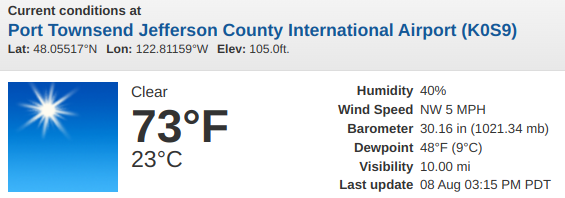
Doesn’t that just look perfect: temperature in the low to mid 70s, clear skies, calm winds? Ah. Time to take a break. I wonder how people do that? I guess I’ll have to do some research. Nah. Go! And yet, taking a break is another opportunity to explore and react to life in the modern world. In no particular order, here are some thoughts that are rolling around in my brain this sunny Friday afternoon.
Take a trip
It’s been a while.
The answer is probably in this blog, but I’ll let someone else do the research. I think, but do not know, that I haven’t taken a week off since I walked across Scotland. (Walking Thinking Drinking Across Scotland) I did that because my doctors and the doctors they referred me to, recommended >$8,000 of testing (2009 dollars). They suspected my issue was stress. I agreed. But, I didn’t need $8,000 of testing to prove that. Besides, that was for testing, not for curing. I took the trip for less than half of that. One day, I had a revelation, which inspired me to write about it. So, I got a trip, some exercise, and a book.
I just got back from a doctor, who was referred by a doctor, who was providing a second opinion about another doctor’s prognosis. They suggested different testing that touched on a separate complication. The testing would require mild surgery with the expected conclusion being that I should switch my medication for an unrelated condition, but which is related to the condition from 15 years ago.
Thousands of dollars to test, again? How about I try changing the medication?
How about I try relaxing?
To assist in their scheduling, I asked if I had time to take a trip first. They were so adamant about my condition that maybe I shouldn’t leave town. Fine, they said. No problem, they said. Come back in a month or so.
They triggered my anxieties for something that isn’t immediate? Is this all to appease insurance? Could be.
Maybe I’ll try relaxing.
Trip Preparation
I’ll spare you most of the details, but with that anxiety postponed, my mind went to the various details that go into getting ready for a trip.
Car
I have an aerospace engineering degree. Why do I want to drive? I’m 66. I’m in no hurry. I want to see the country and the people in it, not just point down at them from an airplane.
Yes, a car trip is more expensive, but measure the trip from when I leave until when I get back, and the car trip might be cheap. I’m heading to a tourist town to visit folks I know. Those extra days not driving might be spent at tourist prices. Motels in North Dakota may be cheaper, and if not, I can drive on to the next town.
A car trip is also handy. There’s no need to minimize what I carry because the car’s going to do the carrying.
One shop said the tires are okay. Another shop said the rest of the car’s okay. Okay. And if not, there are shops along the way.
By the way, someone joked about bicycling the coast-to-coast trip because I did that (WA to FL) in 2000/2001. Nah. Got too much to do.
My car may be looking forward to a Midwest rainstorm. The Seattle area gets dry in Summer. Time for a rinse.
House Prep
Have you been to my tiny house blog (MyTinyExperiment.net)? Prepping a tiny house for a vacancy because of a vacation is like prepping any house. The plants are the thing. A friend can come in and water them, check for miscellaneous stuff, and that’s it. Minimalism has its benefits.
Itinerary
Ha! Do you think I’m going to tell you exactly where and when I’m traveling? Of course not. But that’s largely because I don’t know. I’m 66. I’ve taken planned vacations, and finally realized that they weren’t vacations. The itinerary was an excuse for yet another to-do list. Be in this town, along this route, to see these sights, at these times. Or, generally head east and a bit south because that’s basically the option within the US borders from up here in the upper right corner. If I don’t get to the family event, well, rats, but compared to the other threats and challenges in the world, that’s not so bad.
Oh yeah, and return.
Me Prep
When was my most recent multi-week trip? I’m not even on my way yet, and I’m finding that I’ve become indoctrinated by debt to continue working, and I forgot how to not work. (Debt Free Again – One Year Later) I have forgotten how to see a day with nothing to do, then to fill it with relaxing or play. It sounds silly, but is actually sad. I get to crowbar myself out of my recent ruts, just as I did before I rode across the US.
Work may be natural, but working 361 days a year for more than 10 hours a day is only natural in response to imminent disaster. Fifteen years of that… Even typing those four words made me pause.
Yep. I need a break. I need a vacation. Life is for living, and each day is one fewer towards the end (assuming there is an end – which leads to decades of distractive considerations.)
I couldn’t take this trip until now. This most recent twelve months has been spent adjusting to being debt-free, living in a tiny house, living in a new community, and pondering what remains. Prior to selling my home, I was protecting my home.
It is time for me.
I do not expect to post photos or write blogs, or take notes for a book, but about half of my books weren’t planned. The world is too fascinating to be boring. I’m sure I’ll see moments of surprises amongst hours of monotony. Okay. I can like that.
Too many of us have to worry about work because it isn’t easy to live. Everyone gets the opportunity to explore, or at least consider, the appropriate balance between work and life. Intentional living is precious, and is the reason I feel sorry for people trapped in riches or who have fallen into corporate distractions. Riches can be comfortable, but they can also take someone away from the realities of life, both their life, and the lives of others. Road trips mean meeting more people than the two on either side of you in a jetliner’s middle seat.
Hmm. I suspect it will take more than one trip to remember how to truly relax. Maybe I never learned it. More trips? Okay, but after I get back from this one, finish the current manuscript, and next year’s book, and this year’s photo essay, and a few more of those, and there’s the screenplay, and…, and… I think I need a vacation. Good!
That nap was just about right. A mini-vacation. A few minutes to retreat from the day, knowing there will be a return to work and chores. But for just a few minutes, close the eyes, let the mind wind down, and rest – hopefully. It’s a fine idea for kindergartners, and I don’t see any reason why the rest of us can’t enjoy a short sleep too. It might even be good for more than a bit of sleep.
Snork. The sound that you’re ready for a nap, and are already taking one involuntarily. Trying to stay awake, sitting upright, but the eyes close, the head droops, and I let out a “Snork” that wakes me up.
How does that not happen in any after-lunch business meeting?
I retired at 38. It seems like a long-lost fairy tale, but I’ve been writing much of that time, so I know I quit Boeing and decided to try a very early retirement. That’s been an adventure. There weren’t many role models for me, so I made up a lot of adjustments and changes from the cubicle life. I always tried to sneak in a 10-minute nap at lunch, but now I could do it without time limits. Very nice. Also, an insight into social programming; my naps tend to be about ten minutes, even now, decades later.
I’ll skip the medical benefits and impacts of naps. Go Search those yourself to find what fits your life. For me, it was a necessary reset in the middle of a workday. After retiring, it was a treat I gave myself that didn’t require planning or a fee.
You probably know this is not just about naps. Pardon the obvious un-literary switch.
Work. Work. Work. That’s the American motto. Even if you’re not working, there’s probably a non-profit that wants your time because they have work that needs to be done. Take a break? That’s downright irresponsible. Isn’t it?
Over the course of a life, it is irresponsible to not take a break. Hitting a mountain with a hammer can make a tunnel, but it makes sense to step back and make sure you’re hitting the right mountain and are pointed in the right direction. Those of us who are human also know that the body needs time for food, and also to recuperate before the next day’s hammering.
It has been about 15 years since I took more than a week off. Some doctors said I should take about $8,000 worth of tests to see if my health issues were stress-related. I decided it would cost about half that to assume stress was the issue and use the money to walk across Scotland. (Walking Thinking Drinking Across Scotland) I’ve taken naps almost every day, but naps don’t add up to a vacation.
We live in an era when there is much more than enough work to do. I’ve just passed through a 15-year stroll through poverty with barely enough extra time for naps, not enough for longer vacations.
Look around. How many people do you see that are working multiple jobs, or are unceasingly demonstrating against unceasing injustice? We all need time to recuperate if we are going to sustain a struggle. Sure, the work might appreciate the workers, but the workers shouldn’t sacrifice themselves to the work. We have to remember why we’re working.
I’m fortunate. Selling my home last year was a major decision. It was almost solely based on finances.
My best source of increasing net worth was my home’s price rise; and, one of my most significant expenses was the increasing debt payment from my home equity loan. Jobs, writing books, selling photographs, speaking, and consulting added up to not enough. I sold my home, and launched myself into a one-year vacation from debt.
I did not, however, relax for twelve months. Moves are complicated. As with any house, there’s always something else to work on, and in my case, it’s taken about a year to realize what must be done. That realization is valuable.
The note I’m passing along has less to do with the details of my life and more to do with the freneticism I see in those around me.
I live in a vacation mecca beside a tourist town. Within an hour and a half, I can drive from sea level to a mile up the Olympic Mountains. This is Summer. It is definitely tourist season. It is so touristy that many locals find other places to go to get away from the folks who come here to get away from where they live. There’s a lot of traveling going on.
The last half hour of that drive to Hurricane Ridge is up a windy, two-lane road with steep drops on one side and cliffs on the other. It was dicey in Winter. Summer should be much better, but I’m not sure it is. Snow and ice limited the traffic in Winter. Most of the traffic was locals going skiing. They knew the road. Many drove faster than me at the speed limit, but we managed. In Summer, the traffic is mostly folks who’ve never been on the road before, may be maneuvering an RV, and who can be distracted by the view, the deer in the road, the rocks in the road, or the RV coming the other way. It gets to be a bit nutso. At least in Summer, the road is also open on weekdays.
You’re on vacation. Relax. Enjoy the drive. Stop to enjoy the view. The Ridge is not going anywhere. You can catch it even on a bicycle.
And yet, the drive can be treated as a commute with schedules. I feel sorry for those who get to the Ridge, park their cars, then sit in them with the engine running rather than step outside into the world.
In town, it can be more entertaining. Occasionally, I’ll eat at a sidewalk restaurant. The stream of pedestrians has switched from mostly locals to many folks wearing vacation wear. Their shirts, and sometimes their shorts, advertise where they’ve been, as if where they are is not a place to be, but another excuse to add another name to their wardrobe. Gotta catch them all. Gotta see it all.
But you can’t catch everything. You can’t see everything. Take a break.
Even as we try to take breaks, we frequently don’t. This year has made this apparent to me. I’m taking more breaks, but I’ve fallen out of the habit of how to set work aside. How many people are traveling to places they’ve been told to travel to, when what they really need is someplace to be, someplace to sit, someplace to nap?
After we connected the world, we became aware of an overwhelming array of issues. It is easy to feel compelled to contribute to each fight. It is also easy to become overwhelmed.
Naps and vacations should be more than attempts to temporarily recuperate before returning to the fights.
Before we connected the world, it was easier to find that time to nap, to sit on the porch, to chat with the neighbors, to slowly and maybe steadily take on tasks without each being an urgent call to action.
Life may be a chance, a consequence. Life may have a greater purpose. As a society, we still don’t know why we are here and whether there’s something specific we should be doing. Maybe that’s what the aliens will tell us, or maybe that’s what they’ll ask us.
Frugality is about respecting resources. Time is a resource. Respect it. I intend to take some time to remember and to experience that aspect of life that is not just a duty, but a joy. Otherwise, what are we fighting for?
Let’s see. Used it almost every day since 1992, and finally replaced it with a better one. Is that durable enough to make it a durable good? More than thirty years ago, I bought a futon without a frame. Now, a frugal fellow like me could be glad to use it for more years. But pardon me as I spend thousands of dollars on something that will probably outlast me. I bought a new organic mattress that fits my futon couch. An era passes. An era begins.
Look at a conventional bed. There’s a lot going on there. The mattress may have springs. A box spring may have more springs. Under that’s a frame. Probably a headboard and maybe a footboard. That’s a lot to move for a piece of furniture that does one thing once a day. Granted, it does it for hours, but I was glad to blunder onto a different way.
Where did that previous bed go? I don’t know. But after I bought my first house, I bought a futon mattress. I am curious about Japanese culture, so I decided to skip the wood and simply sleep on the wool – with bedding, of course. Worked for me! Roll it up in the morning so mold wouldn’t grow under it. Effectively toss the mattress every night, which may have helped its life by breaking up hard spots. As long as my back didn’t complain, I could get up and down without a problem.
Conventionality happened when I got married, as a frame was put under it, and the mattress became a futon couch sitting in the family room. Fine by me.
But divorces happen, and my futon couch became dual-function again. There were adjustments because it could be a bit tippy on one side, but I was trainable.
Fifteen years. Twenty years. Twenty-five years. Thirty years. About five years ago, my naturopath recommended getting a new mattress. The old one was firm and aging, and they suspected it and the way I slept was leading to bursitis.
Buy a new mattress? Ha! Nice idea, but I hadn’t won the lottery jackpot.
But about a year ago, I sold my home and moved into my tiny house. I’m glad there’s no video of me and my neighbor wrestling a floppy futon into such a tiny space. (video tour for those curious about the space)
Whew. I didn’t want to do that again. Heavy, floppy monsters. Shudder.
But I wasn’t being frugal. Or was I? Let’s work this out.
The mattress was good enough that it could probably outsurvive me. Not frugal buying a new one.
The old mattress was firm enough that it might be causing health issues. Not proven, but healthcare costs are costly. Two thousand dollars are a lot of dollars, except when compared to conventional medicine bills. Maybe frugal. Maybe no.
The old mattress has been the site of dreams, though more usually nightmares. It has also been the site of a few liaisons (details withheld because there are limits, eh?); and one spiritually-minded friend pointed out that leaving behind those memories and probably some personal organic residue can clear the way to a new era. Not frugal, but possibly more fulfilling.
Besides, I rarely sleep through the night, and maybe a softer and fresher mattress will help make that happen. Better use of my time is frugal, though the monetary balance will only be apparent after I’ve spent many nights on it.
Regardless of my decision, being 66 and having stripped down my possessions to fit into a tiny house is an excellent opportunity to see what has been durable.
The mattress was durable. I hope they find a good way to recycle or reuse it. I’m glad I didn’t have to stuff it into my garbage can.
My bicycle is durable. I bought it about the same time, and it carried me across the US, and led to my first book, Just Keep Pedaling.
Most of my books are durable, though some of the fifty-year-old paperbacks are showing age, especially ones like The Lord Of The Rings.
My cookware goes back forty-five years, though much is on hiatus as I temporarily switch to induction cooking.
I have tents and camping gear with slight rips and such, but the greatest hurdle to using them is my increased size and decreased flexibility. I’m working on that.
No electronics are durable. The manufacturers are making sure they become obsolete.
I wish I’d kept my first Jeep. It had a flaw or two, but I swapped it out more for family harmony than because it failed me. I can’t find anything to replace it, and that includes modern ‘Jeep’s.
I miss reliable film cameras, but their chemistry failed them. Digital is nice, but they continue to ‘improve’ them by making them more likely to get lost in menu mazes.
Clothes? Worn out, or I’ve grown too much.
Pause as I look around the room and think of what’s in storage.
There’s plenty more, but I’ll spare you the details.
What has proved to be durable has also been simple.
It might even be used every day. Complicated doesn’t last, usually by design. There’s a fifteen-year-old Mac on the counter behind me. Most of it works, but it is already out of date with current technologies. I hang onto it, though, as a bridge to computer files that are now forty years old. Some things like masters’ projects are valuable.
Just for grins, but now I’m interested…
The mattress I replaced has cost about twenty cents a day. That’s more than I expected, but probably worth it considering the value of good sleep. I hope I get some.
Stay tuned to see if I am better able to tune out.
Welcome back, I say to myself. My usual Friday post was delayed because I was a panelist at the Whidbey Island Comicon. Finally, Monday. Whew. I didn’t make much money. Such events rarely do, at least for me. So, why spend time and money on an event that looks unprofitable from a personal finance perspective? Why not?
Let me check on my Events page to see how many events have been listed.
Skip that. I don’t want to have to count that high. Classes, talks, presentations, etc., with the first listed on being the book launch for Dream. Invest. Live., the book that inspired this blog. December 11, 2008, just as the Great Recession (the Second Great Depression) began. Bad timing.
Every event can have specific goals and incentives, but all of them fit into the category of public awareness. Sometimes that’s for profit. Sometimes for fundraising. Sometimes for fun. Sometimes I give a talk because someone needs someone to give a talk. Fine. No fee? That’s probably ok.
My passion is for people and ideas. There is enough dispensed wisdom and shared memes about following your passion, but it wasn’t until about fifteen years ago that I realized my passion was for people and ideas. Sure, I have a degree in Aerospace and Ocean Engineering. I have a black belt in an old style of karate. I write and sell what I write. I take and sell photos. I teach. I consult. I do a lot of things that can be seen as passions, but I finally realized that my passion is connecting people to people and people to ideas. Connecting ideas to ideas alludes me.
The world doesn’t have problems. It’s spinning around regardless of us. We may have a direct impact now, but the human race is a transitory blip in the evolution of the universe. Our society and civilization, however, needs us to solve a variety of problems, mostly by we pesky humans sorting through ideas while we hunt for solutions.
Being a conduit between people, people, and ideas can be fun, or gratifying, or both. I was a guest again at the renamed Whidbey Island Comicon. ‘Guest’ means I didn’t have to pay. But there were costs.
Any event takes time. Time is precious and irreplaceable. We spend time. As I age, I become more aware of the preciousness of time. Unless we manage immortality, every day is one day lost to time. I am human, so I only have a finite number of days to spend.
Any event also takes more time than they have on the schedule. Commuting happens, which in my case included four round trips on the ferry, though I didn’t disembark for a couple of them. (Let’s see if I remember to add that bit of notes.) Eating happens. Getting ready to go takes time. Unpacking takes time. Catching up on delayed chores takes time. Gotta remember those personal hygiene moments like showers.
As an author and a presenter, I spent time preparing my books, their price sheets, business cards, display stands, notepads, pens, and whatever else has fallen into my boxes labeled Travel Kit. Gotta remember those professional presentation items like doing laundry so I can look business casual.
Three days on various panels stretch out over a variety of days before and after as I do public things like advertise the event on social media, and those private things like document income, expenses, and inventory.
Then there are those bits of merch that various authors share around. Sorry folks, mine exists as purchaseable merch. (Zazzle)
Hey. I mentioned income and expenses. Events take money, too.
Of course, I was happy to sell books. I was also surprised when someone wanted to buy one. I get swept up in the events and can lose focus. So it goes. (And thanks for the purchase.)
The rest of the money is expenses: food for me, fuel for the Jeep, ferry fees, office resupply (usually as I try to find what I am sure I have – somewhere), and maybe a trinket or two from the fellow presenters. I’m frugal, so there isn’t much of that.
On balance, I spent much more money than I made, and the time is irreplaceable. So it goes.
And, I’d do it again. Look back at the Event list. I’ve done it again, and again, and …
Miscellaneous
One year, an attendee proved to me that my screenplay about the true life story of a 14-year-old ancestor on a tall ship in 1876 is much easier (though still difficult) than I thought.
At other events, I’ve heard back from people whom I’ve helped without knowing that I’d done anything.
Evidently, simply listening without judgment is rare enough that they were encouraged to proceed and succeed. You’re welcome.
I’m not going to list the friends I’ve made or the ideas I’ve heard and shared. Both lists are so long that I keep going back to events, even if there are only a few in attendance. Every person has a story. Crowds are not required.
My reasons are not universal. Some want to feed their ego, make money, increase their cachet, build community, and find opportunities. Cool. How else are you going to spend your life, listening to people who are active in the world, or watching yet another sixty-second video?
But then, some say I am an optimist. Someone stole a book at this event, again. I celebrated it, again. It has happened before. Of all the books that were there, someone stole one of mine. That’s a compliment. It isn’t profitable in terms of cash, but someone who maybe couldn’t afford it otherwise (and who didn’t want to wait for their library to buy a copy), walked away with words I wrote. Not knowing their story gives me an excuse to wonder about their life. That’s precious.
Time is easy to measure, at least in human terms. Money is counted incessantly, so there’s no revelation there. People and ideas? They’re precious and worth the time and the money.
PS
Oh yeah, the ferry ride.
My Jeep doesn’t use keys. I get that it is common. It requires me to use a key fob, a piece of electronics that must work or the car won’t. On the drive back from the event, I eventually drove onto the ferry as usual. The ferry began its 35-minute trip from Whidbey Island to Port Townsend. I can’t recall why, but I wanted to do something like ‘roll-down’ a window (which no longer requires rolling anything.) The car displayed a message: Key Fob Not Detected. Not detected? Ok, but I can detect it right here – you silly machine.
I’ll spare you the details, but I tried it various times, made sure the rest of the electronics were working, but I couldn’t roll down the window or start the car. Ferries are tricky things. They run on tight schedules, and the drivers are eager to get going. But my car was naturally blocking every car in my lane. Anxiety. Ugh.
I popped the hood to see if something popped off. Nope. I changed the battery. Nope. I put the old battery back in. Nope. I flipped the battery over. Nope. I checked for cracks. Nope.
Finally, I found a ferry worker and pointed out my car, the one with the hood up. They’re practiced at this. Cars break down. Batteries run down. People lose keys. People walk off the boat, forgetting that they drove on. They had a battery pack and tried jump-starting it. And again, several times.
Each time they tried to start it, I pointed out that the display says, Key Fob Not Detected. I’ll simply say that it was several times before they realized that, as I’d already checked, everything else was fine, but that the car couldn’t detect the key fob. Oh. They weren’t practiced at that.
This also meant that I couldn’t put the car into Neutral for them to tow it off the boat, as they normally do. They managed to get everyone else off the boat, and then load the cars for the next run, going back to where I started – with my car pointed the wrong way.
And, ah ha. I ignored most of what we’d tried, tweaked one thing, and the car started. Yay! They docked back on Whidbey, off-loaded everyone as normal, and told me to drive to the front, just in case they needed to tow it onto the dock when we reached Port Townsend. I’m home, safe, and somewhat relieved.
Something in that fob broke. My spare at home works fine. I’ll replace the original. I’m an engineer, not a sparky (an electrical engineer), but there was no obvious damage. It is possible that some slice of silicon slipped up.
Jeeps were known for being rugged and reliable. Each one has failed me because of a too-fragile sensor of various kinds. Their reputation was valid, but no longer for me.
But back to the point as to why this anecdote is part of this post, the cost of that bit of bad design was emotionally more significant than any cost incurred for the event. Go to the events. Meet with people.
Share ideas. And maybe buy a car that uses real keys.
“Ding! went my brain.” That was a few days ago. Over for one of my other blogs, the one about tiny houses (www.MyTinyExperiment.com) I had a flash of brilliance or a long-delayed Duh! moment. Take your pick. I realized finding the right cable (success!) could mean watching videos from My Big Comfy Chair without changing any of my subscriptions or buying more furniture. An HDMI-HDMI cable is all it took. Cool. While it was a topic for my tiny house blog, I also realized it was an excellent example of frugality and intentional living, and therefore, good content for this blog. My apologies for taking so long for such an idea to pop to the top of my subconscious queue.
And, for those who want to link up with some of my other blogs and channels, here’s the long list. (I’ll spare you the Really Long List of blogs that I only awaken when there’s content relating to various books and classes.) Enjoy, or at least be mildly entertained as summer heat drives us indoors.
Happy 4th of July! A friend in Canada asked what we in the US say on the day. My reply: folks sometimes say on The Fourth (caps required), “Have a Happy Fourth!” or for the exuberant, fake a Southern accent, say each word with a bit of a pause;
“Happy! Fourth! Of! Juuuuly!” (Saying Yeehaw is optional.)
Hey, we had a revolution. Have you heard about it? History isn’t as popular as it was in the past, and there’s a circular irony there, so if you want an entertaining reminder, I recommend watching 1776, the musical. Go for the extended cut which includes the song that a certain President asked them to take out. As for revolutions, we aren’t the only ones.
That’s a lot of tabs, as I glance up at my browser’s bookmark bar. Politics are so contentious in the United States that I think we’ve become the Untied States. So, I was going to take the day off from posting as I do most Fridays. Ah, but I made the mistake or took the insightful step to check Wikipedia for a list of revolutions. Sure, there’s America’s (actually only a slice of the Americas), but I was also curious about the French one, the Russian, the Chinese, and a few others. A few? I didn’t count them, but the Wikipedia page includes hundreds starting back more than 4,700 years ago. Gee, humans really are revolting. Here are a few revolutions, rebellions, and wars, each of which was as important to them as any modern one is to us.
Overthrow of the Roman monarchy – 509 BC – get rid of the kings
Athenian Revolution – 509 BC – get rid of the oligarchs
English Civil War – circa 1650 – Parliament versus a king
American Revolution – circa 1776 – ‘nuf said?
French Revolution – circa 1790 – kick out the king and get rid of the oligarchs
Decolonization of the Americas – throughout the 1800s – Spain loses its New World grip
Mexican War of Independence – 1820-ish – kick out the monarchs et al.
Texas Revolution – 1835 – Texas aggressively secedes from Mexico
Russian Revolution – 1917 – No more Tsars
Ukrainian War of Independence – 1920 – same but different
Arab Spring – 2010s – decolonization plus
and hundreds more
and probably hundreds more to come.
Whoever organized the page added a simple yet important feature. They color-coded the conflicts to denote who won. They also supplied a short blurb about why.
A few things stood out:
Humans and their conflicts are messy. Clean, simple narratives aren’t history. Clean, simple narratives are convenient fictions. Someone won. Someone lost, and it could take decades to decide which way it went.
Many of the revolutions had prequels and sequels. Those that didn’t frequently involved countries that disappeared. Progress is chaotic, and each event is temporary. Few countries lasted hundreds of years. The countries with memorable names had a lot changing behind their name tag.
They all probably seemed like a good idea at the time.
Somehow, because of, or in spite of, so much chaos, we’ve gotten to here. Hopefully, we have enough momentum to get us past the rough patches.
Of course, none of them had to deal with Artificial Intelligence or artificial idiocy; they had the real stuff. While some won’t want to hear it, many of the revolutions were driven by climate change. Climate change back then wasn’t as global, but famines, droughts and floods move people; and sometimes other people don’t like having to live with new neighbors. And, of course, humans can make humans want to escape other humans simply by being human. Some will even cross an ocean on sailboats or rafts to get away from it all.
My apologies to those readers who are waiting for the flag-waving part or the screaming-at-the-sky part. For me, history makes me reflective. History makes me ponder where we’ve been and where we might be heading.
One of my ancestors signed the Declaration of Independence, Francis Hopkinson. I guess he could be considered one of the Founding Fathers, though I get the impression he was a guy who happened to have a job, and he showed up for it. In every revolution, there are the famous names, but there are also many more people who simply did what they thought was best. He didn’t know they’d win. By signing the document, he was also identifying himself as a possible subject of treason if they lost. Tough times.
I pause because such considerations cause reflections.
I thank past generations who built the civilization that supports me now. Construction is harder than destruction. There’s probably a Yoda quote about the Force for that because destruction is obviously more appealing to some (Boom! Bang! Crash!), but construction is what supports the future. Thanks to constructive people everywhere.





 Trimbathcreative's Blog (Tom Trimbath)