New Books With Friends

It is the season, the season for new books. Thanks to modern self-publishing, it’s always the season for new books. It’s possible to optimize publication dates, but any new book deserves a celebration, a celebration of the birth of an addition to civilization’s library. Look at it that way, and watch authors sat “Aw, shucks.” Let’s humor that response despite the fact that writing is one of the inventions that made civilization possible – some edits required. As for an income source, well, just because you furthered civilization does not mean you’ll be compensated for your work. But it could happen.

Tuesday evening was fun, at least for me. Don Scoby and I gave a talk at the Langley Library about self-publishing. Thanks to everyone who attended. Did you miss it? We live-streamed it, so all 90-ish minutes are available on YouTube.

Come back for more, because the industry continues to change. We intend to give updated versions of the same presentation at other local libraries, or wherever we reasonably can (including income and expense considerations, of course.)

The self-publishing industry has been changing in books, music, movies, art forms that were formerly gatekept by industries. Digital technologies have allowed artists to step around those gates and hurdles. When I published my first book, Just Keep Pedaling, Just Keep Pedalingfewer than 50,000 titles were published through modern print-on-demand presses.

According to the latest report from ProQuest affiliate Bowker, self-publishing grew at a rate of more than 28 percent in 2017, up from an 8 percent increase during the prior year. The total number of self-published titles grew from 786,935 to 1,009,188, surpassing the million mark for the first time.” – Bowker

That’s a twenty-fold increase in under twenty years.

Self-publishing is derided by some because the quality of the work and probability of success are highly variable. But then, the same is true with the traditional publishers. At least now, freedom of speech and freedom of the press have fewer people restricting those freedoms. As for making money at it, I see any art form as an opportunity for an artist to create their own lottery ticket. The odds are terrible, but sometimes it works. Keep that day job in the meantime.

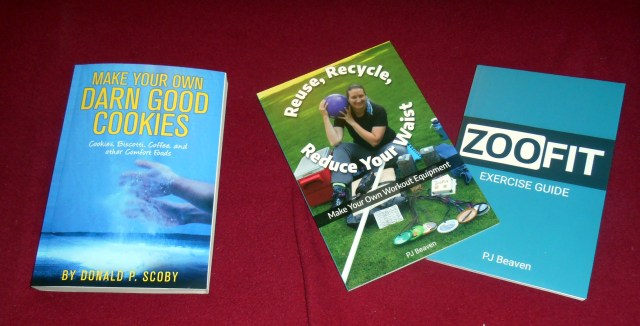
Add another title or three (and maybe four) to the list. Since Don and I made the presentation just before Thanksgiving, Don has published his new book, Make Your Own Darn Good Cookies. To those who think he should’ve shifted that title a bit, just wait.

DSCN1790 - Edited

In the audience was another friend who recently published two books: Reuse, Recycle, Reduce Your Waist & the ZooFit Exercise Guide both by PJ (Pattie) Beaven. In some ways, she’s spreading a similar message to Don’s; ala Make Your Own Darn Good Exercise Equipment. In a previous career, she helped zoo animals stay in shape. Why not do the same for humans? If a monkey can do it…

Everyone in the audience had projects in mind, and several were already published in some fashion. One of my joys is helping people complete their projects. My passion is for people and ideas, so helping writers become authors, helping ideas spread beyond the confines of one head, makes me happy. Considering the state of the world, we need more ideas, switching from thinking to doing.

By the way, send me a note if you or a group want our help working on your project. Check out Madrona Workshop Troupe for longer events that had more time to dive deeper into the details that don’t fit in 90-ish minutes.

New ideas frequently attract foes, or at least defenders of convention. Publishing my first books and selling my art photos revealed something about what readers and patrons were interested in. Writers can critique grammar, and then spend days debating amongst themselves about things like whether writers should use words like ‘amongst’ and ‘themselves’. (Or where a period should be placed in or out of parantheses.) They are valid argument(or)s. Photographers can critique resolution, exposure, cropping, and even camera choice. I found readers want stories and ideas and emotions; patrons of  photos want something pleasing to look at, something that elicits an emotion, something that relays an idea. Readers care about story. Photo patrons care more about matching the decor.

Commas and pixels matter to writers and photographers, but not necessarily to those who buy the work. Who are you creating your art for? That’s an open question with no right answer.

As I type this post, Joe at Fine Balance Imaging is working on uploading my latest book. Usually I do so, but my computers can’t keep up with the software and hardware requirements of higher-end art photo publishing methods. Besides, he helped me produce the previous five editions, has professional equipment, and has younger eyes. Self-publishing requires significant delegation. Don’t try to do it all yourself.

This latest work is the sixth in my series of photo essays on Whidbey Island: Twelve Months at Maxwelton Beach. A glance at the books I’ve written should provide a clue about an element of my style. I am a marathoner. I haven’t run one in a while, but I bicycled across America, walked across Scotland, and even my investing strategy is based on holding stocks for years or decades. My Twelve Month studies take a simple idea that is rarely exercised.

DSC_9020_clean_bright - Joe Edits 030719 - FRONT COVER

My few visits spread across twelve months are one small slice of a very long story, yet more than a single Saturday visit and therefore tell more of a tale. Visit it yourself and know that there is much more for you to see than I have shown. I hope you enjoy it all.

Also,

My books and photos are the products of my curiosity and my search for insights into our world, or at least my world. We live on a fascinating planet and in intriguing times. Whether that is for a reason, or just by chance, such a life is amazingly rich with experiences and connections. The best way to feel, to sense, the world and its complexities is the be active enough to get out into it, and quiet enough to observe it.

Modern self-publishing is helping deliver the ideas and inspirations the world needs. Whether the author gets paid in money, acclaim, or simply the satisfaction of helping spread the word has less to do with their work in the world and more to do with a disconnect between the world and our economy.

Keep writing.

DSC_8749_tilt_bright - Joe Edits 030719 - BACK COVER

PS

If you want prints of any of the photos, contact Joe at Fine Balance Imaging.

Posted in Uncategorized | Tagged , , , , , , , , , , | 3 Comments

But When You Say It

Selfish self-promotion? Trust friends. They can do a better job describing what you do better than you can because they have a better chance of seeing you the way others will. Too frequently, self-promotion becomes a litany of caveats, apologies, and disclaimers because the self sees the cracks from the inside, including the flaws that others will never notice. Don Scoby and I met for yet again because we’re cooperating on so many projects. Reading his blog about our discussion surprised me, and made me realize that most of us probably don’t realize how busy we are and how much we’re accomplishing.

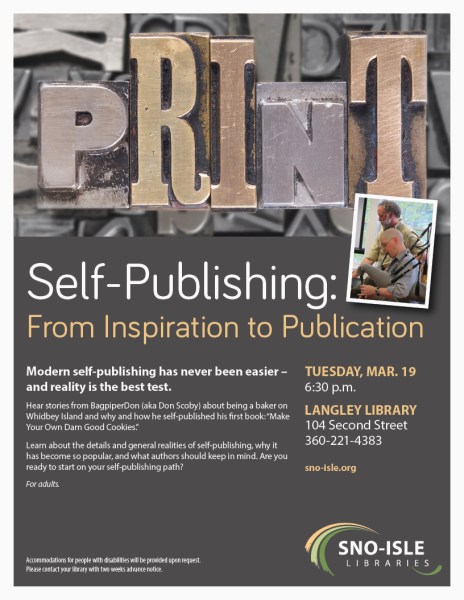
Before I forget, I’ll insert our next public event. Tuesday, March 19, 6:30, almost exactly a week from now as I type, Don and I will reprise our presentation about self-publishing. If you can drop by the Langley Library (the one on Whidbey Island, not the one for the CIA or the one in BC), drop in for about an hour of how the publishing world has changed, making it easier for writers to become authors.

47736 Self Publishing LNG POSTER

If you can attend, great! If not, check my YouTube channel. We may live-stream the event. Watch it real-time or later at your leisure.

In my head, he isn’t Don. He’s the bagpiping biscotti baker. There are a couple of clues. He plays the bagpipes professionally. (Got a gig that pays him appropriately?) He started Whidbey Island Baking Company, and launched a line of biscotti and cookies, at least. That led to his cookbook, Make Your Own Darn Good Cookies. (Available now!) Let’s see, comfortable on stage, current experience self-publishing, and a good reason to reprise my talks on Modern Self-Publishing, but as a duet (metaphorically.) But hey, we’re creative folks; so, we may take the presentation on the road, may extend it into a workshop, and may use this opportunity to reinvigorate the previous and grander workshop (Madrona Workshop Troupe). And, we’re writers so while we played with more ideas based on his bagpiping and baking, we also found overlapping interests in our independent sci-fi series that may work better in the same literary universe, as well as a foodie anthology that I’ve been working on.

Ironically, or maybe typically, I’ve been so busy with those various projects that I don’t mention them as frequently as marketing experts would recommend. It’s nice to have someone help, and it’s nice to see my efforts mentioned without all of the cracks I see from the inside.

After my “gee” and “aw, shucks” moments I laughed. He described the list he saw that we could work on in the time it took him to eat a burger (not as sloppily as he suggested) and for me to eat fish & chips (my standard choice when eating in a bar by the water.) I laughed because I know I am also working on the sequel to the Dream. Invest. Live. Dream Invest Live cover(the book that is the basis for this blog, a book that needs a new title, too), and my next book in the photo essay series of Twelve Months at fill-in-the-blank. I hope to have Twelve Months at Maxwelton Beach produced and published (but not necessarily delivered) by our talk on Tuesday.

What could get in the way of finishing a book within the next seven days? Real estate is getting busy as the snow melts away. I’m also writing for 360Modern.com, and considering a part-time writing gig (that probably pays well, but can I set aside my other tasks and get back to them later? Maybe not.) There’s also taking photos for the next essay, because twelve month studies require attending to them every month. In the meantime, I also am helping non-real estate clients with their promotions and art projects.

It’s all good. It’s also the source of inspiration for the previous post It Should Be Easier, because all of that work does not add up to paying all of my bills. The potential is there, and I’m in far better shape now that I’ve paid off my credit card; but potential doesn’t come with checks attached.

There are limits. I don’t expect anyone to remember that entire list of tasks. I can’t recall every item either. I simply jump from task to task to task, being thankful for sales and receipts that follow some of the work. Hopefully the rest of the compensation comes later, but not too much later. Taxes are too near.

I know that I am not alone.

Go back to that post I just mentioned; It Should Be Easier.  I have trouble remembering my entire list, and don’t give each endeavour the attention it deserves. Don (and others) help with that. I can’t know everything Don (and others) is working on. I can celebrate the bits I know, but each of us is working harder than others can know. Rather than take on the impossible task of understanding everything someone is doing, it’s easier to applaud them for things they may not emphasize enough, to introduce them to others who might help, and maybe even buy what they’re creating (as finances allow.)

Writers, artists, entrepreneurs, and advocates frequently ask me for advice about which tool to use, which web site is best, which marketing avenue to pursue. I’m impressed with people. The most powerful tool for such creative people is other creative people. They best understand the situation. They can help find what’s being overlooked. They can provide experienced advice, sympathy, and also know when to lend a hand to either support or applaud. I’m glad I live in a community of such people.

And, Don, don’t worry about sloppy burgers. I was concentrating on my own flaws and foibles. Imperfections are proof we are human. Celebrate that.

Posted in Uncategorized | Tagged , , , , , , , , , , | 1 Comment

It Should Be Easier

That’s the chorus I’ve been hearing, lately; “It should be easier.” Business owners, real estate brokers, artists, even retirees are echoing the same refrain. This much work and sacrifice should produce much more ease. Not luxury, not opulence, not even effortlessness – but at least progress after years of schooling, working, and saving. Is this the new normal? What do people have to look forward to? If I knew, I’d probably be in politics or starting just the right business. Maybe all of that work will create more than enough, later.

A recent meme showed a matrix of smiling faces, all were celebrities that were tragically depressed. They wore smiles and laugh lines, but fell in their struggles despite fame and fortune. I know many non-celebrities wearing similar facades by necessity. If your business deals with the public, keep smiling. If you’re running a non-profit and need to raise money, keep smiling. If you don’t want to bore your friends with yet another repeat of how your day/year/life is truly going, keep smiling. Keep smiling, and find two things: someone who will listen to the real story, and something that will truly make you smile.

I smile when I dance. Swing, waltz, latin, free-style, I like to go social dancing. Social dancing is social + dancing. It isn’t competitive. If you’re smiling, and you did the steps wrong, you did it right. If you did the steps right, but aren’t smiling, you’re doing it wrong. Dance to have fun with a partner and other people. I purposely don’t teach dance because I need to preserve it as something that is just fun. The socializing is good, too.

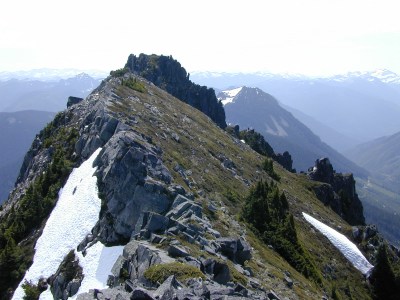
I smile when I’m climbing a peak. Some of my biggest grins have probably happened where no one could see them. Just me, a bit of rock, and a lot of sky. Blame the endorphins, I don’t care. It’s something that feels good. Don’t expect me to start a guide service. The only aspect that touches on business are a series of books and photos, work that is available but not something I’m actively selling.

DSCN0855

I smile when I meet with friends. People fascinate me. While I am a writer with many stories to tell, I find myself listening more. I already know my stories. The easiest way to hear new ones is to listen. I’ve confused some people who think I’m always happy because I’m always smiling when they see me. Flip that. I’m smiling because I saw them. The only business skill that comes from that is actually the most valuable: active listening with some insights thrown in as appropriate.

Unfortunately, I’m too busy working to dance as much as I want, spend time in the mountains, or hangout with friends. There’s that certain lack of ease.

Yet, it is from my friends that I’m hearing that refrain of; “It should be easier.” They’re saying it when chance puts us in the same place at the same time. The conversations are bracketed by tasks and chores wedged aside as we open up with similar frustrations – frustrations that are set aside as soon as a customer, client, or donor drop by. Up goes the facade as they return to managing their official duties.

We all have things we want to do that aren’t on the list of things we have to do. Lately, the consensus is that the list of things we have to do is long enough to overwhelm the time available for the things we want to do.

Yet, in there I find hope.

People fascinate me, and they impress me. So many people are working so hard on so many things that there’s a good chance something good will come from it. Much of the perseverance has been from necessity, not from choice; but the work has been meaningful. Today’s economy has disconnected work from compensation. If work was the main determinant of compensation, then inherited wealth wouldn’t be such a major determinant of the ultra-wealthy’s net worth. Monks rather than trust fund babies would make more money.

Within the last few years my net worth has increased to encourage me to take a day off every week (or so). My work has maintained my frugal lifestyle. My net worth has grown from passive asset appreciation; i.e. my house’s value increased significantly. I hope my various ventures lead to my efforts being compensated sufficiently to encourage more dancing, climbing, and socializing; but for now, that’s a hope, not an expectation.

Hope may be as necessary as perseverance.

The relationship between work and compensation is built into our economic model. There are no guarantees, but there are opportunities. Luck is a powerful force, and work can create opportunities. Maybe our economic model is about to change. Extremes of wealth and consumption versus subsistence and frugality are more visible thanks to the free flow of information. Maybe politicians will implement reforms, or even just re-establish best practices that were recently dismantled. Maybe disruptions will create chaos out of which innovations can advance our maturing civilization. Maybe things will stay the same, though I doubt it. The systems are too unstable. Change is inevitable. It always is.

The optimist in me sees great efforts temporarily unrewarded. The optimist focuses on ‘temporary’ and hopes those efforts will eventually bear perennial fruits, not just a one-time harvest. The pessimist in me knows that dysfunctional societies have amazing persistence. North Korea isn’t healthy, but it also has persisted for decades. In the meantime, it should be easier, but it isn’t.

Who knows? Maybe all of this work will lead to affordable day care, education, housing, health care, day care, retirements, and a more equitable society because their lack has reinforced our appreciation of their value. Maybe that will finally turn all of that work into sustainable ease.

Posted in Uncategorized | 1 Comment

HoloLens2 And MicroVision

What’s this worth? The news, the company, the stock. Microsoft announced the HoloLens2 yesterday. The MicroVision investment community began popping corks. The stock, MVIS, moved up; but not by as much as many expected. I am a bit disappointed, not surprised, and have seen such things happen before. Guessing which way a stock will go based on news about the company should be methodical and logical, but humans are involved so go back and emphasize the word ‘guessing’.

Congratulations to Microsoft. HoloLens2 looks like a logical evolution in the market of augmented reality (or mixed reality, or muddled reality, or yet another new set of headwear in the world of trying to make good and useful wearable computers.) To those not familiar with the concept, HoloLens2 is a transparent visor that allows a person to see a mix of the real world and a computer generated world. It may sound silly, or like some game, but Microsoft is targeting companies. The idea is to buy some for their employees, and make it easier for them to visualize things like: which part to fix, where a building will be built, or where a patient needs treatment. At $3,500, it’s expensive for most people; but that’s cheap for a company if it saves them one trip or avoids one mistake.

I’ll leave the intriguing consumer applications for another post, someday.

So, why would the MVIS community be popping corks? Look at one of the first graphics in Microsoft’s presentation.

Screenshot 2019-02-25 at 13.58.38

That looks very much like, and could very well be, MicroVision’s key component that they’ve been supplying to various companies. MVIS is the stock for MicroVision; but MicroVision has disclosed very little about the companies, the products, the quantities, and the contracts involved. This leaves MVIS shareholders (the owners of MicroVision) unaware of what their company is producing and selling. MicroVision management has even said the company’s involvement will probably be announced by someone who buys a product, tears it down, and posts the report. Don’t expect an announcement from MicroVision nor from their customers. So, investing becomes a guessing game, which means owning MVIS is more properly termed a speculation. It also means that an image in some other company’s presentation attracts a lot of interest from one of the most active investment/speculation communities I know.

Any announcement would be welcome. An announcement from a company like Microsoft pops those corks. A major announcement like HoloLens2 make owners giddy, even without consuming the bubbly.

Guessing, speculating, evaluating the possible stock price kept many busy on Sunday. Euphoria and optimism had a grand time with estimates of doubling give or take wide margins. I had hopes, but I had doubts (which were not welcomed in the midst of the celebration.)

Monday morning the stock started high, rose for about half an hour, then fell down to ‘only’ being up about 10%. Not, 100%. Just 10%. I admit, I’ve seen other stocks on similar news rise as much as 140% several times, 240% a couple of times, and saw someone else’s stock rise 640% – in one day. Those are heady days, and MVIS was a candidate for it to happen again.

Screenshot 2019-02-25 at 13.45.45

Why didn’t it?

There’s more than one reason because there is more than one investor.

Amidst the cheers and the encouraging news I noticed something, or a lack of something. There was no confirmation that MicroVision is specifically involved. It certainly looks like a MicroVision component, but patents aren’t perfect and can be circumvented. There are competitors, and there’s a strong reason to do whatever it takes to close such a deal with Microsoft. I didn’t expect Microsoft to mention MicroVision. There’s no reason to. I didn’t expect MicroVision to make an announcement given their demonstrated history of saying as little as possible. I did hope they would at least acknowledge Microsoft’s accomplishment, like a team member may applaud without asking for credit, or a neighbor cheering on an neighbor as the two companies are close geographically. One competitor at least confirmed that they were not involved, so that helped. Without confirmed involvement, investors may decide to not commit their investment capital.

But, let’s assume MicroVision is inside HoloLens2.

If MicroVision’s technology is inside HoloLens2, then tiny MicroVision may have enabled one of massive Microsoft’s key initiatives. That’s good for Microsoft, and also may make MicroVision’s technology attractive to Microsoft’s competitors. Excellent.

What’s that worth?

We don’t know.

Owning stock in small companies frequently involves that “Guessing, speculating, evaluating” mentioned above. Is MicroVision involved? How many HoloLens2’s will be sold? How much will MicroVision make on each one? When will revenues be recognized? There are four unknowns that are four reasons to not be as enthused about buying the stock. From the various guesses et al, the median seems to be that the early revenues are already accounted for as one of the unnameable customers, that near term revenues are also already accounted for, and that long term guidance has little to guide it. The most positive and verifiable observation is MicroVision’s CEO’s claim of profitability in the fourth quarter of 2019. This would explain that.

That’s good news for the end of the year, but what about now?

Dream Invest Live coverThere’s an aspect of market psychology that I refer to in my book (Dream. Invest. Live.). Some stockholders have a tendency to limit themselves to percentage changes in the stock price. If a stock is trading at $1, it is hard for them to imagine it quickly rising to $5. It is a powerful tendency, and one that is emphasized by reports of the biggest gainers and losers every trading day. Such assertions make more sense with large companies like Microsoft. They are highly unlikely to suddenly and sustainably increase revenues by 100%. Small companies like MicroVision, however, can see much larger rises in revenues and profits because they start with numbers that are much closer to zero.

I prefer to guess, estimate, value small stocks by doing the same for the company first. My preferred technique is to use ‘Present Value of Future Revenues Discounted for Risk’. If a company is about to make a lot of money, reflect that in the current value, with a discount based on how likely that revenue event will occur. It’s possible that major investors feel that 1) the value of the near term revenues are already included in the price, and 2) that the risk of MicroVision making that money is sufficiently large enough that the future revenues are discounted to zero. If so, the stock wouldn’t move much on news from an existing customer, while also providing an opportunity for investor/speculators who have more faith in the company.

Does today’s price properly reflect the stock’s and the company’s value?

Of course not, except by chance. There are so many unknowns that it is only by luck that a proper valuation can be made. Even the management doesn’t know which contracts will be expanded, added, or curtailed.

The market’s measure of a company is the price of the stock. Traders may only care about the stock price regardless of the company behind it. Investors, however, help value a company with every purchase and sale. Every purchase and sale was one person thinking the stock is worth buying and one person thinking the stock is worth selling. Their motivations may be more than financial, but stocks bounce around a lot because there’s little agreement about the proper price.

Screenshot 2019-02-25 at 13.46.46

MVIS closed today at $1.29. That’s up 10% from Friday’s close. In September 2017 MVIS was over $3. A 100% rise tomorrow wouldn’t bring MVIS up to the price many thought was proper back then. Ten years ago MVIS was over $20. Twenty years ago it was over $100. Those folks thought those prices made sense, too. (I was one of them, though the stock price as $35 for my shares, before the reverse split.) Those last twenty years were a long string of disappointments (hence the possible lack of credibility to future revenues), and massive dilution. As one shareholder shared, back then they owned 1% of the company. Now they own about 0.01%. And they continue to hold, just as I do.

Screenshot 2019-02-25 at 13.46.58

Buy 1% of a $30M company that you think will eventually be worth $3B and your $300K investment can make you worth $30M. That’s rather circular. I was happy enough to possibly work myself up to 0.01% and hope for $3M. MicroVision is currently a $132M company. If they become valued at $1.32B, then the stock (without further dilution or splits) will be worth $12.90. That’s an unbelievable percentage rise for folks fixated on today’s $1.29 stock price, reasonable value for an electronics component maker, and far below the very old estimates that were easily ten times higher.

At this point, I’ve bought more an invested a few years of living expenses into MVIS, which now has a value of a few months of living expenses, while my re-retirement plans require a few decades of living expenses. I doubt that MVIS can provide that soon, if at all. At least, it can greatly aid those efforts.

As I type, the debate continues. Shareholders continue to ask for clarification from the company. I suspect those with sufficient resources may find the best research will be to buy a unit, tear it down, and tell us what’s inside. The price may be low for a company and high for a consumer, but for some investors it may be an excellent piece of due diligence.

MicroVision and MVIS continue to be an archetype of investing/speculating in small companies in today’s America. Every company is different, but they all deal with balancing news, required disclosures, competitive pressures, and the investment community. Such stocks are risky. Hopefully, they are also sufficiently rewarding. I certainly hope so.

Posted in Uncategorized | Tagged , , , , , , , , , , , | 4 Comments

Small Frugal Emergency Celebrations

The power will probably stay on. Propane is in the tank. Firewood is in the shed. Water flows from the faucet when I turn it on. The toilet works. I don’t even have to watch for snow or ice on my deck or driveway. That’s normal, and rarely mentioned; but normal is highlighted by weeks of storms, outages, and road hazards. Maybe I should celebrate this.

Missed the news? For the last few months the Pacific Northwest (which is a misnomer from the perspective of the Pacific and places farther north and west of here), the area around the Salish Sea, was hit with wind storms and snow storms with barely breaks between them. Each storm knocked out power for hundreds of thousands, though that was shared around. Whether from downed trees or unplowable roads, thousands were trapped for days.

This region usually doesn’t get noticed by the Weather Channel. Our storms aren’t named. ‘Wind’ and ‘snow’ don’t gain the same recognition as Hurricane Whoever. The Pacific Ocean doesn’t care. It uses thousands of miles of open seas to build assaults that would regularly be headline news on the east coast. And that’s OK. We’re not trying to scare anyone away. Well, maybe.

I’ve been eating my way through my freezer and pantry. A couple of those outages helped partly melt some of the frozen goodies. Maybe marginally knocked the frost off them is more accurate. I didn’t open the freezer or the fridge when the power was out, and had at least one food cache outside in the cold, instead. Still, Use By dates are good suggestions, and a regularly clearing of the contents is a good idea. It’s also an excuse to experiment in the kitchen, but that can be a different post.

Emergency preparedness isn’t just a prepper’s hobby, not on an island in a tsunami zone, over a series of earthquake faults, with a line of volcanoes on the horizon. Food caches, backup heat and power sources, generally the stuff that mimics camping, but at home, are handy. As long as I was able to sit at home, the hazards were fewer than the discomforts.

The first day after the wind dies, the power returns, the snows melt off the roads it is easy to sigh in relief. Relief doesn’t come to everyone simultaneously. I can think of a few folks who probably still have trenches or obstacle courses for driveways. Relief is both emotional and practical as those out of danger (or just discomfort) relax and turn to helping those in need. I like people who treat people as people without judging whether they should or shouldn’t have been in their situation.

I sit here, in my most comfortable chair, typing this post while safe – and have to remind myself of what things were like just a few days ago.

I also sit here realizing that the room is a little chilly. In island fashion I didn’t flush as I let the yellow mellow (which it really doesn’t do, but a flush is inevitable). A few lights are on, which is easier thanks to LEDs. Dinner is simmering in the background, a mix of meat bought on sale with some veggies that probably never truly thawed. Except for little noises from the kitchen and a room heater, the house is mostly quiet.

Frugality and environmental sensitivity mean I’m wearing a vest rather than cranking up the heat. Some houses turn on every light inside and outside, and look like concentration camps if they’re also ringed by fencing. Later I’ll watch a show, letting the internet leak in on command. That will be the noisiest part of the day. Eventually, the evening will end and I’ll retreat to my futon couch, snuggling under a nice thick comforter.

To balance all the complaining and worrying during the recent interruptions would require more of a celebration. I’m warm, enough. I’ll be fed, well enough. I have bathroom facilities that would considered luxurious in most of the world. My house isn’t perfect, but I can be perfectly comfortable here.

I can be perfectly comfortable. That doesn’t mean I am. I’m too aware of the daily struggles to exist in this society. It’s too easy to focus on the lack rather than what’s available. I’m at least imperfectly comfortable enough.

I write this to applaud those who help provide all of the services I enjoy, both explicitly and implicitly. I also write this to applaud those who, in the midst of a series of disasters, saw downed trees as firewood and maybe an opportunity for art, piles of snow as refilling the aquifers and as an opportunity to make snow sculptures, and helped those around them as they could.

It is human nature to complain, or at least seems that way. Beowulf and the Iliad weren’t butterfly and rainbow stories. I wonder if our society will evolve to focus more on the positive than the negative, or at least to balance a complaint with a solution, turning problems into opportunities.

Being frugal provides those small reminders of what can be taken for granted. A vest, a culinary adventure, time spent writing rather than watching a story, maybe those are just another version of small celebrations.

52642954_10218246587735296_6040979288323260416_o

Posted in Uncategorized | Tagged , , , , , | Leave a comment

AMSC Delivers Hope

Thank you, whoever is buying AMSC. I don’t know why you’re doing it, but it is providing hope where hope’s been dwindling. This may be about stocks, but it is also about good times coming out of bad.

There are technologies that can positively disrupt entrenched industries. I try to invest in some of those. One is AMSC, which originally was called American Superconductor. Without getting into great detail (see my semi-annual portfolio reviews for links to that) the company has the potential to do for power what fiber optics did for telecommunications: use new tech to dramatically increase capacity, efficiency, and reliability. With superconducting cables that means better transmission lines, motors, and regulators. Great idea. It hasn’t worked as planned.

For years the company was shadowed by the financial implosion of a very lucrative market and one of their divisions: wind power. Unfortunately, one of their main Chinese customers decided to use the same tech to turn from customer to competitor. Court cases became more important than marketing and sales, at least within the investing community. Recently, the court case was solved. Damages were much greater than the award, but the case finally was resolved.

In the meantime, the company’s promise for its main product hasn’t been making headline news or disrupting anything. Regardless of the court case, the business could’ve progressed, but it didn’t exhibit stellar growth or gain attention from technological achievements. Hope faded, but my investment was in an IRA so there was no benefit to balancing the loss against some other gain. I continued to hold the stock.

There wasn’t another gain to balance against, anyway. My portfolio of potentially positively disruptive technologies wasn’t disrupting anything.

Despite that, in the last year AMSC has more than tripled from $4.68 to $15.42. Look back a bit further and the stock has almost quintupled from $3.13. All without making much of a headline.

Screenshot 2019-02-13 at 16.57.32

It’s tough watching good ideas languish. Whether in stocks, the arts, social justice, the environment, good ideas exist but most don’t receive recognition or traction. And then, something simple and quiet can happen that propels the idea. Without a real example, it can feel as if nothing positive is going to break through. And yet, we hope.

Hope is not a strategy. It is a gamble, a speculation, an attitude. And yet, people win the lottery.

My portfolio has become entertainment as much as investment. When stocks fall too low they can go through reverse splits, delisting, and dilution. I continue to watch my stocks because I am interested in how the system works, and how it is changing. I’m also interested because I have hope for energy efficiency, treatments for cancers and accidents, and the elimination of millions of resource-intensive computer screens. AMSC, AST, GERN, and MVIS represent some of those companies. All have great potential. All have languished – except AMSC’s price.

Distressed stocks can be like distressed houses, their prices may be much lower than their market value, or the market may actually be overvaluing them. It’s hard to tell. That’s why there is risk in investing, and in flipping houses.

Most of the stocks in my portfolio are at least somewhat distressed. If they were all to experience the same quintupling like AMSC that would be good, but it wouldn’t mean a re-retirement for me. Five times a small number can still be a small number.

Gains aren’t limited to simple figures that we have names for, like 5X = quintupling. FFIV, the holding I sold to pay for the downpayment on my home, rose from under $3 to almost $200. What do you call that? These things do happen; especially, with stocks that are undervalued by emotion rather than arithmetic.

I don’t know if something similar will occur with any of my other stocks, but they’re all targeted at large markets with high barriers to entry and large unmet needs. Such stocks can gain premiums. As I said over on the MVIS Reddit board;

And then, dilution. The top line revenue estimates are as impressive (and speculative) as ever. The number of shares, however, has ballooned to the point that $200 is more like $10; and I suspect many would accept a buyout at $5.

The upside potential isn’t necessarily limited by the market. Sometimes it is limited by the investment community.

Screenshot 2019-02-13 at 17.00.13

If, however, ideas are allowed to grow, gain acceptance, and become important in the new necessities of our world, then a $1 stock may rise much higher than $5. Whether they get to $200 or higher is less likely, but it would be very welcome. Then that re-retirement becomes much more likely. I can hope.

Screenshot 2019-02-13 at 17.01.20

Posted in Uncategorized | Tagged , , , , , , , , , | 1 Comment

Super Bowl Ads 2019

Silly as it sounds, I watch the Super Bowl ads for insights into personal finance. Want to see who has the biggest marketing campaign? Want to gauge the country’s mood? Want to check for trends in discretionary spending? Yep. Watch the ads. Want to skip the game? Watch the ads the next day after most of them have been uploaded to YouTube. Let’s see what this year reveals.

OK. I watched all of the Super Bowl 2019 ads that were on AdBlitz’s YouTube channel. Before I comment on anything else I have to give a shout out to Ram Trucks, not because of their trucks but because they expressed the same thing a few of us discussed last week. What ads can you remember from previous years? Millions of dollars go into these ads because corporations expect to get many more millions out. They probably don’t know how effective they are, either. Here are a few that I remember:

  • Apple’s 1984
  • Mean Joe Greene and a Coke
  • Herding Cats
  • Sock puppet for a pet store
  • …and that’s about it.

I can remember more if I work at it, but I am fascinated at how poorly these ads persist. Ironically, Ram’s two other ads are already fading from memory – and I marked one of those as “positively emotional.”

In general, it looked like almost everyone was playing it safe. There was a lot less of “we’re all in this together”, “looking forward to a brighter day”, and “we can do this”.

I don’t recall any military ads, but there were ads for vets. There were also ads for emergency responders, people who deserve more credit, and people who are also topically safe. Firefighters and nurses got exposure. Police didn’t.

Working class people were applauded, frequently at the expense of mentioning the thing being sold. Kia talked about carworkers, not much about cars. There was some of that thanks to one of those Ram ads (now that I look back.) Jim Beam, though their ad was about workers making it happen even though only one name is on the label, made me wonder if the profits were similarly skewed. Head & Shoulders made three ads about small businesses that couldn’t get exposure otherwise, a great reminder of opportunities, barriers, and how little it can take to reach out.

That positive Head & Shoulders series was another odd reminder of how little mention there is of the things being sold. Hey, ESPN. Who is Rick? H-E-B, is what, a food delivery service? Hyundai makes me think of fantasy elevators, not cars. Lexus’ ad was entertaining (and also provided some confirmation that projection is entering the common consciousness, but that’s only news for MVIS shareholders), but didn’t tell me anything about the car. Hey, Sleepnumber. How and why does your product work?

There were some that made a point. TurboTax thinks people are more valuable than robots. Microsoft’s ad for accessibility demonstrated its potential. Walmart’s grocery pickup service hammered the idea of delivery to your car, without being dull about it. Fabletics actually showed their product more than most: high-tech fashionable leggings. Tostitos showed – gasp – Tostitos, and was one of the few ‘foods’ to advertise this year. (I’ll get to the beer ads, later.) Devour frozen meals did so, too; but was a bit icky to me because they played with a relationship in the message. M&Ms, cute as usual.

Speaking of chips, let’s deal with the beers. This year, Budweiser decided to make fun of other mega-brewers instead of comparing themselves to craft beers. Stella Artois made it sound like drinking a bottled beer was a bold move, something others would shun as beneath them. Michelob’s “pure nature”… To me, Michelob’s true nature was getting a pitcher in college and knowing that the brewery was only a few hours away in eastern Virginia, not Hawaii. I applaud two companies that could benefit from the exposure because they’re new enough: Bon & Viv, that also looks like they’re evolving Starbuck’s mermaid; and Bubly water, though I still don’t know what that is.

The Bud Light ad that tied in with Game of Thrones was one of several ads that are acting like major motion pictures. Movies are now being made that have several production companies involved. T-Mobile & Lyft joined the cross-promotion camp. Have ads gotten that expensive that they must share the risk and cost?

Speaking of movies – I won’t, much. Partly that’s because of spoilers. Partly that’s because some of them are series that I haven’t been able to keep up with thanks to seven day workweeks. Aside from screeching tires and things blowing up, I am intrigued by the Handmaid’s Tale playing with the “Morning Again” motto from Reagan’s era. My, how things have changed. My, how sci-fi can wrap around from fiction to reality. The fiction being portrayed is not a happy place, nor a subtle place. Nuance didn’t show up. Even the animated movie for kids is about threats to the theme park. (Oh no, we must save the corporation’s assets!)

Fear showed up in security system ads, systems that alternately use robots and automation as threat and solution, a dilemma our society must solve.

Robots rule! And robots fail, and tech fails, and tech aids, and how long until the robots are the ones watching the ads? T-Mobile made fun of texting failures, and number hacks, while hinting they have a solution. Amazon had fun with Alexa fails, which is hopefully something we can always laugh at. Hopefully. Nordic Trak is incorporating coaches into its electronics. Why pay for a personal trainer when you can buy one? A few made the point that robots can’t help with taxes, enjoy beer, or chips – and maybe we should be sad about that? For good or not or just odd, companies are recognizing that robots will be a common part of our world.

There were also ads for another world, completely; or at least one that I’m not a part of. Rich people problems. Getting into relationship argument over body lotion? Skin care startling an attacker? Folks who’ve seen real attackers may miss the joke. A luggage company memorializing a rich family’s life rather than normal people traveling. Sprint talks about saving people $1,000 per year on cell phone service. Someone out there should be getting paid by them because I’m sure millions aren’t even spending $1,000 per year on phone service. By the way, car ads are frequently about breaking the law; which is OK if you can get away with it. Having mentioned the law, the law firm that claimed to be lawyers for everyone were shown in stereotypical suits, driving Mercedes, and boarding private jets. Please tell me it was a satire.

Finally, I get to the short list, the ads that I enjoyed watching. Let’s start with a personal bias. I like Jeeps. They’re arguably one of the few that can recycle World War II footage, and they did so without going too far. I’m glad to see that they’re bringing back the truck, but I’d rather see them bring back my 1987 Jeep (not-a-Grand) Cherokee. I trust that when Google says the most common phrases translated are “How are you?” and “Thank you.” that they do so from data. Humans remain humane more than the news makes it seem. Jeep talked about the nation. Google talked about humanity. Netflix reminded us that everyone on the planet is on the same team (though maybe we could use some better coaches.)

That’s not all of the ads, but it’s enough. As I said at the start, I do this to get investing ideas as well as understand trends. When I had more money I’d supplement this exercise with a similar exercise at the mall. Wander around and see what people are buying, and ignoring. Ads seem to be more directed to manipulating emotions, not selling goods and services. Ads. They’re selling a feel, not a reason. Reason is not in fashion. Is a Lexus better than a Kia or a Volvo? There’s no way to tell. Is a Stella Artois more drinkable than a Bud Light? One had two celebrities. The other had a cross-promotion with a celebrated show.

Every year I feel further removed from mainstream America. While it is easy to say that’s because I live on an island, I moved to the island because of what I saw happening in mainstream America. Style is dominant over substance. My investing strategy is based on understanding facts and data, with an understanding of trends and market psychology. That’s why I am glad to see those few seconds of an allusion to a projector. That’s the leading edge of a trend I’ve been watching for decades.

The dominant trend is towards impulse, indulgence, gratification, – or playing voyeur to those who can afford to impulsively indulge in self-gratification. Now, I know that my subconscious is going to digest this mix, and layer on it the situations I mentioned in a previous post: climate change, social injustice, technological advances, and economic inequalities and instabilities. The trends in these ads don’t suggest solutions to those situations. Maybe we’ll leave that to the robots while we tune in to watch yet another celebrity.

Posted in Uncategorized | Tagged , , , , , , , , , , | Leave a comment

Gathering Revised Plans

I laughed. I danced. I almost cried. What a weekend. For the last few days I attended a conference/seminar/think tank/gathering of diverse people. I learned more from what wasn’t said than what was said. A lot of assumptions, institutions, and conventional wisdoms are about to shift. This is no longer academic. This gets personal.

What we are seeing is a global awakening to the stark realities of climate change; increasingly polarized politics, exponential technological change, compounded by unstable socioeconomic systems.

It’s easy to imagine being deeply aware of at least one of the topics, somewhat aware of another, and have seen headlines about the rest. It’s also easy to imagine them colliding, which is why I spend time considering how they’ll interact; and what actions I should take.

There are advantages to living for decades. I remember the first Earth Day; watched a race riot sweep past me; am a political independent with friends at both extremes; have watched technology shift from slide rules to qubits, from isolated machines to a globally-interconnected web; and have been riding a personal rollercoaster through America’s wealth classes, from middle class to millionaire to muddling by.

Watch something daily and it can be difficult to see the changes. Thanks to My Triple Whammy, I involuntarily stepped away from years of these Gatherings. Working seven days most weeks makes it difficult to spend time and spend money while not making money. Thanks to a very generous friend, I was able to attend again (with the necessary interruptions to maintain my ventures.) Comparing today to five years ago makes it easy to see changes.

co2_trend_mloFive years ago the alarm about climate change was loudly ringing. Progress was being made, but the effort would’ve been much easier if we’d made the changes at that first Earth Day in 1970. Even then, some thought the need was urgent; otherwise, they wouldn’t have spent months or years organizing one day of awareness. About ten years ago there was concern that atmospheric carbon dioxide would exceed 350 parts per million. Now, it exceeds 410 parts per million. Glaciers and disruptive weather are proving the concerns to be more than academic. The good news is that electric vehicles, renewable energy, and the closing of coal plants are all happening faster than was expected five or ten years ago.

Five years ago there was hope in the fight against social injustice. Then, a major reversal happened. Progress is being made compared to the days of the passage of civil rights legislation, but it hasn’t come soon enough or gone far enough. Of all the trends to consider, social trends are the most likely to take generations or can turn on an insightful tweet.

Five years, even thirty years ago, ever since the rise of heightened partisan politics it has been more difficult to stand in the middle. Some of my conservative friends think I am far too socialistic. Some of my liberal friends think I am far too capitalistic. The parties seem to be more in favor of beating each other rather than solving problems. Early indications are that the next election cycle will be more rather than less chaotic. Of course, maybe we could use a bit of chaos before rearranging the rubble into something more solid.

Five, ten, twenty years ago, take your pick of time scales. Technology advances are so fast and continual that instant obsolescence is assumed. The idea of AI and robots running the world are assumed. People are turning over control of their cars, homes, and auto-corrected emails to algorithms that programmers no longer understand. We hope things work and hope things don’t run out of control. As uncertain as that is, the added control over our lives and the dramatic reduction in accident rates are enticing companies and people. To have a TV or a car or even a watch that isn’t connected requires buying 25 year old machines, antiques. Consumer purchases may shift to purchases by computers. Hello, Alexa…

783px-epsilon-theory-ben-hunt-westworld-may-11-2017-graph-wealth-inequalityFive years ago I was a few years into My Triple Whammy. Ten years ago I was looking forward to continuing my comfortable yet frugal retirement. Twenty years ago I had just retired thanks to following dull conservative financial wisdom: spend less than I make, invest the rest. Go back far enough and watch the rise from a lower income childhood that felt rich thanks to my resourceful parents, through college when it was affordable, to a career in aerospace engineering which I gave up when I had more than enough money and Boeing was laying off younger people who just happened to have families. In that time, wealth inequality has grown from the top 0.1% having less than 10% of the country’s wealth to now over 20% and climbing. Upward mobility is stalling as wealth accumulation is accelerating. Money is flowing out of the economy and into havens. Not sustainable.

The old rules don’t apply. Don’t be surprised that long term personal and societal plans need to be erased, or at least revised.

I assume climate change isn’t under control, that politics won’t suddenly return to running the country, that technological change will stop, or that wealth will freely redistributed.

I also assume that renewable energy will increase and pollution will decrease, that politics may shift to different power centers, that social injustice will reduce as awareness rises, that technology may provide more solutions than problems, and that unsustainable economic models will soon reach systemic limits that inspire change.

For years these issues have been academic and distant for many. The gathering proved that even just one of these issues could monopolize a community – yet, the other issues didn’t disappear in the meantime. Now, I am giving renewed thought to how I should act with regards to my personal finances, lifestyle, and expectations. What will these issues be like in five, ten, or twenty years from now. We aren’t going back, and never could. I ask myself how do we, or at least I, move forward.

Posted in Uncategorized | Tagged , , , , , , , , , , | 2 Comments

Recovery – Paying Off The Credit Card

I’ve been looking forward to getting this bill in the mail. Finally, my credit card balance is paid off – almost. I’ll start this blog by finishing a cup of black tea that’s a leftover from today’s work, and switch to a celebratory glass of wine (from a bottle!) by the end. Of the various milestones on my recovery path, this is one I’ve been approaching for years. It’s a path I started following because I am an optimist, which is what got me into trouble – maybe.

The biggest stumble in my financial history is probably My Triple Whammy. I reference it regularly because it was a pivot in almost every aspect of my life. Money isn’t the most important thing in life, but it is the most pervasive in this society. At the time it seemed like a big stumble, but one that would be definitely temporary. Bad times happen in long investing careers, and I was unlucky enough to encounter what some financial professionals have called a perfect storm of bad luck. Until then, I’d almost always paid off my credit cards every month. I was retired and my income was from my stock portfolio, a somewhat diversified portfolio that was suddenly deflated. The companies, however, were making technical progress. Surely they’d return and recover. It would be silly and stupid to sell something that was low just before it would become big, and possibly much bigger than before.

One answer, relax my stringent financial habits. Use the credit card and its credit limit for essentials for a few months. The credit limit was tens of thousands of dollars. My credit rating was in the top tier. Why suffer when I had resources that could ease ills, especially if used temporarily and prudently?

Obviously, that didn’t work. The companies progressed technically, but the investment community either abandoned or gutted them. I watched the bills accumulate, strengthened my frugality skills, energized My Backup Plans, and worked and waited. My mortgage was too expensive, yet I couldn’t sell my house. That housing hurt if chronicled in My Mortgage Modification Chronology. Dive in if you want financial slapstick episodes that are funniest in retrospect, but not at the time. Still, I had hope. I had trust in the SEC, the FTC, and my skills in the job market.

Then, the credit card company learned that I wasn’t paying my mortgage. Even though I was sacrificing the mortgage payment to make the credit card payment, the credit card company effectively halved my credit limit. With no notice, my credit score took yet another hit because my credit balance was now too big of a percentage of my credit limit, not because I’d spent more but because they dropped my limit.

Skip ahead a year or so as my consulting business increased. I paid hundreds of dollars every month to drop that balance, only to see it rise again when I had to pay income taxes. Those taxes were at an effectively higher rate than just a few paragraphs ago when I was living off my portfolio.

And yet, I made progress. Frugality has its benefits, even when income is far below the median wage. It looked like it would take years to retire the debt, and decades before I could re-retire myself.

The biggest help came about a year ago. A friend gave me a financial buffer, a substantial financial buffer. That, plus help with a new career as a real estate broker cleared the hurdle of one year’s taxes, freeing up the payments to cut the balance down by hundreds of dollars per month. Every month was a mini-celebration. Near the end of last year, I had enough to pay it off entirely, but prudence suggested caution because real estate income isn’t guaranteed. (Massive understatements available for free.)

Last month I paid something more precise than an round number of hundreds of dollars. I paid the balance to the penny. There was a small, quiet celebration, but I wanted to see the next bill before raising a glass or two – and telling you.

Today, the bill finally arrived. I knew it wouldn’t be zero. I purposely put my Hulu account on the credit card account, just to keep some money flowing through it. That may seem strange, but modern financial institutions aren’t constrained by common sense. They live in an uncommon world.

I’ve paid off my second largest debt. My largest financial debt continues to be my mortgage, which is also being paid down at a few hundred dollars per month. That will take longer, much longer. My largest personal debt is to those people who have supported me through my recovery.

Along the way, I’ve met too many others who are facing tougher struggles. The old adage goes, “It takes money to make money” which is true; yet for some reason, very few give those without money the money they need to make the money that will aid their recovery. It takes money to make money, so why is it a surprise that those without money remain poor?

It sounds simple; “Pay down your credit” which is really pay down your debts. The reality is more complicated with extra fees, dropped credit limits, penalized credit ratings, and a persistence that worsens without sacrifice. Even now, my bill isn’t simple and hasn’t necessarily recovered. Take another look at it. The balance is $8.67 and the minimum payment is also $8.67. The late fee penalty is $37.00. How about one month with a minimum payment of zero? I expect to pay in full and on time, which is now much more manageable, but the pressure persists – and so does the credit limit.

An experience like this sours the expectation of dealing with the financial industry. An experience like a threatened foreclosure reveals unseemly aspects that aren’t apparent until witnessed. It is amazing that any other industry acting this way would survive, yet they will.

I’m celebrating the relief of no longer carrying around an enormous boulder on my back. It will be easier to walk taller financially and in the real world. But don’t be surprised if you see me hop a bit. It still feels like a pebble from that boulder has fallen into my shoe, which may make me walk a bit more cautiously for a while.

Posted in Uncategorized | Tagged , , , , , , , , , , , , , , | 2 Comments

Turning Sixty

I can’t remember when I was born. There’s a birth certificate, which in today’s bureaucratic world proves it happened.

I can’t remember turning ten. There may have been a party, I can only remember one from childhood, but I don’t know if it was that.

Turning twenty happened in college, a time when I was averaging three hours of sleep a night, with no allowances for celebrations.

Turning thirty only had one main urgent message which was that, if I wanted to be a father, now was a good time to find a wife. I was married a few years later.

Forty approached with friends making fun of how they’d prank me. I had enough stress from work and home life that a series of practical jokes weren’t what I wanted. Instead, I took my first ski trip, three days at Silver Star Resort in British Columbia. That set the tone for several years. I was starting to see how the wealthy lived and played because I’d been retired for a little under two years.

Fifty came by after the divorce, and as money was getting tight. Optimism encouraged me to continue my new tradition of a ten-day ski vacation. Surely my stocks would recover. The companies were succeeding technically. But I felt restrained. My one indulgence of the year had become a time for introspection.

Sixty comes after My Triple Whammy, an entry into a new career (I’ve lost count because is a job a career if it doesn’t net a profit?), and my indulgence has been to only answer a few phone calls and several emails for work. (There’s some good news there, but that’ll be part of another post.) Proper introspection and retrospection take time, and time is a luxury.

I’m much more aware of time. One of the great lessons from frugality has been that time is the most precious resource. At least for now, I don’t know how to make more time. I’ve turned sixty, but mentally I feel like 42 while physically I feel like 52.

We sit in an era when it is possible, and debatably probable, that some people will live decades or centuries longer than what has been normal; and that, if they can live that long, then they are effectively immortal. (Though not invulnerable. Accidents do happen.) Despite that possibility, I recognize that such an advance will probably be expensive and limited, at first. Thanks to investing in Dendreon, Asterias, and Geron, I’ve seen such technologies advance without much public attention. Whether the breakthroughs happen when they can benefit me is unknowable.

Lifespan is an issue that is fragmenting into more precise understandings. Life expectancy is a number, but that number is different between rich and poor, changes with regions, and is only now being understood genetically.

There’s an obvious money aspect. Personal finance is quite abstract at twenty, but outliving one’s savings is very real for most of the population who can see the end from here. About a third of the elderly population (that’s not me, is it?) have little or no savings for retirement. I don’t have enough, but I’m rapidly approaching my own version of enough, again. Re-retirement is possible. Let me check those lottery tickets – and answer a few more client phone calls. Re-accumulating wealth is greatly enabled by living a frugal lifestyle. Among the many skills I’ve tried to learn, frugality is one that I’ve practiced well enough that an even more frugal friend decided to give me the title of Mr. Frugal. I bow to those who exceed my skills.

Time is on my mind, however. How do I spend my time? Nothing dramatic is planned to change with the passing of what is really just another day, but I am already able to count the seasons possibly remaining. I bicycled across America in 2000, walked across Scotland in 2010, hope to do something similar in 2020, but how about 2030? 2040? How many more ski seasons, hiking seasons, holiday seasons remain? Recovering from My Triple Whammy meant missing out on dozens of backpacking trips, a loss of physical fitness, and a drop in confidence. Some impressive friends have turned themselves from sedentary to athletic after they turned sixty. I know it’s possible, but I also know it took great effort and sacrifice.

dscn2778

How did I ever take care of a suburban house, and yet go backpacking or cross-country skiing almost every weekend? Will it take the same effort and sacrifice as then, or was that only possible by being thirty?

I wish I had the time to consider that more. But, re-retirement requires its own effort and sacrifice. Taking the time to think and plan takes time that could provide the income that could fund the time to think and plan properly. It is a common conundrum.

At least I’ve learned to trust my intuition, to recognize that one of my skills is persistence, and that a lifetime of questioning values means I know that I am chasing my goals, not those of everyone else’s expectations or some advertiser’s imaginary dream.

Will I make it to seventy, eighty, and beyond? Check back in ten, twenty, and more years.

In the meantime, I’m dining on left-over pizza (gluten-free) and getting ready to go dancing (in shorts, of course) while checking for any urgent emails (no? great!). Looking back and looking ahead is valuable, but enjoying now is all we can ever experience.

Posted in Uncategorized | Tagged , , , , | 2 Comments