Yay! Good news! Getting the loan on my house means a long string of long-delayed tasks can get done. Ah. What? A loan doesn’t equate to money in my account, which doesn’t translate to immediately paying off lots of bills, and many of those tasks aren’t instantaneous? What ever happened to instant gratification? Why are there so many question marks in this first paragraph? Ah, because answers and resolutions are rarely as easy as they seem in the stories. That’s true at a personal level and in the broader world. So, yay?!
I live in the US. Money cures all ills, so some say. The ads certainly make it seem that way. Hello, reality.
As I wrote, about three weeks ago I got a loan on my house. (A Home Loan To Retire Anxieties) Whew. Some things were immediate, partly because they were bills that were already due. It felt good to pay my homeowners dues. It was relatively easy to restock my pantry, but there has been a delay because I still wait for sales. A massage was not an indulgence; it was necessary because years of tension don’t evaporate within an hour or two. I foresee many more sessions before we can work past a surface of taught muscles to get to the necessary core work. Until then any massage will involve speed bumps as being uptight proves to be more than a euphemism. My portfolio has been restocked and rebalanced after filling gaps opened when I needed interim funds. I actually sold high(er) and bought low(er) for part of that. And, I found a counselor to help me work through the stresses, anxieties, and bad habits I’ve accumulated during a decade of frugality by necessity instead of choice.
Money can be an answer, but despite its seeming immediacy reality imposes real restrictions of such simple things as time and weather. So much rain, so few hikes.
A month after being issued a very nice line of credit, I’m barely through my initial list of deferred items. I still want to pay off my new old Jeep, donate my truck, get the chimney cleaned, submit myself to some medical tests, get a haircut (and looking forward to a professional beard trim), get a new credit card, fix things like a fence; and maybe even get around to some new sweats (though I did already get new hiking boots to go with the Jeep), a restocked liquor collection, a cord of firewood and a few yards of yard and garden soil. Oh yeah, and maybe I’ll listen to my various doctors and actually take a vacation. (I grinned at the unlikelihood of me actually managing that because I’m out of practice and have a rough time remembering how to let things be for a day. A week or a month is almost unimaginable.) Oh yeah, and I might even get some furniture to sleep on in my bed-less bedroom because I sold a lot of furniture nine years ago. Almost a decade of sleeping on a futon couch. (Which my doctor has also warned me about.)
But, that’s my life. Now for the rest of the world.
It is easier for me to see that things are getting better for me (keeping in mind that my improvements come from taking on more debt.)
There are reasons for optimism and pessimism in the world. (Crisis Fatigue And Hope) Fossil fuels are fading, regardless of subsidies. Death by violence is down; though death by ignorance of science is up, but that’s somewhat self-selected. Awareness of many issues is improving, even with faulty information. And people are acting as individuals to live more sustainable and enjoyable lives.
As I’ve written previously, electric cars, home solar systems, LED lighting, work/learn from home, gardening and crafts are becoming more popular simply because they make sense. Organizations can champion such initiatives, but people integrating changes into their lives make them sustainable.
It is going to take time, however.
The pandemic has been a major trauma and disruption, but it has also prompted and accelerated change. Archaic ideas and institutions are being abandoned. Why commute? Why not grow at least some of your own food? Why burn fossil fuels? Why should we assume that old laws, policies, and habits should be protected when they don’t protect who we are and who we are becoming?
The answers may be obvious, but the changes will take time. Knowing “thou shalt not kill” is a good idea, but we’re still working at kicking that habit.
My personal changes amidst the larger changes is providing me an opportunity to think ahead. We can’t predict the future, but plans for personal finances must at least make guesses, hopefully based on what’s been learned. I suspect some of the people who will be ahead later are those who are thinking ahead now. I’m thinking. I’m thinking.
I’m thinking, but I’m also in the midst of my personal changes. I am also, however, trying to decide which way to go rather than striving to return to the past. It ain’t easy. It won’t be easy for our society, either. (massive understatement)
It is powerful to write about definite actions and conclusions. Check out the popular media sources and politics. Nuances aren’t as popular as simple declarative statements. That works for spreading the word, even when oversimplification makes the message more useful for manipulation than effective implementation. I choose to pay more attention to the nuances. They may not make fun cocktail conversations, but we’re not having many of those events, anyway.
Over the next few months I plan to plan. Maybe I’ll end up living a life that blends into suburbia, but I intend to consider other possibilities, communities, – and more importantly for this blog, other investments.
My version of personal finance remains “Spend less than you make, and invest the rest.” That’s the basis of my book, Dream. Invest. Live., and this blog. I guess I could just post that one line every week and hit repeat; but the majority of readers tell me they are more interested in stocks and community and how they are changing. Stay tuned as I expand on those themes, particularly as the pandemic and politics change our world. This is going to take some time, but my hope is that things are getting better. I just guess I’ll have to accept that good news usually travels slowly.
But, but I have to write. It’s that time of night! Dinner is done, and for the past several months that’s meant turning off the ‘TV’ (really a Roku connected to a monitor and the internet, ‘TV’ takes fewer letters), opening the laptop, and opening the file that is my work-in-progress, my first science fiction novel. Why and why not? The frugal part of me likes the idea that writing doesn’t affect the checking account. Writing’s main cost is time, but time spent writing is much more gratifying than time spent watching yet another repeat of yet another show. Of course, my opinion may change if my book ever becomes a show – but I’ll leave that fantasy aside for now. Today I finished the third draft of my sci-fi novel, so tonight I have the time to write this post and get ready to take a break from my novel but working on my book about tea. Ha! The writing doesn’t end, and it probably shouldn’t for me and for many others.
You have a story to tell. I may not know who you are, and yet I’m sure you have a story to tell. Laptops and free software mean more people can write than did when writing involved cramped fingers from putting pen to paper, or tired fingers from hitting keys on a typewriter. Modern self-publishing means you can take what you’ve written, and put it up for sale on places like Amazon in less time than it takes to get a rejection letter from a publisher or an agent.
When I started writing books just after 2000, there were about ten times as many books published traditionally as were published in the new technology of Print-On-Demand. Within the last few years, there are as many as five times as many books self-published as traditionally published. Add in over a year of social distancing and there may soon be a surge of books written during the pandemic.
Are there too many books? There are over seven billion people, the world is hurting and could use new ideas. We don’t have time to let things work themselves out. We need those ideas, and books are one way to distribute them.
Ideas don’t have to just live in dry, pragmatic books of non-fiction. Serious is necessary, but frivolity may be just what is needed to get some ideas across. My novel is inspired by the dystopian elements of today’s projections, but then has plays with ideas of possibilities. Why not? There is already an over-supply of alien shoot-em-ups. How about a romance story between species? ‘They’, ‘them’, ‘others’, ‘aliens’ are not always going to be the bad guys, things, whatever they call themselves.
Writing costs a lot of time and has no guarantee of making any money. Almost all books have greater expenses than income, and that’s a very low bar that isn’t crossed often. But. Writing a book can be gratifying. Getting an idea out of the head, into a story, and out into the world is one less ‘someday’ thing. If it works, great! If not, at least you know.
In my case I didn’t intend to write a book. Pardon me as a copy and paste from myself via my Amazon Author Page.
“I fell into writing by trying to lose weight. That’s not an obvious career path. I decided to lose weight by bicycling, and figured it would take so much bicycling that I’d be able to cross the continent. So I did. By the time I was done, I’d sent out 15,000 words of emails, which a friend pointed out was more notes than most writers have when they start a book. So I wrote Just Keep Pedaling. The emails tell one story. The rest of the book gets into what really happened each day.
After the first book I realized that I could do a better job and decided to chronicle the life of the natural world in Washington’s Cascade mountains. I’d hiked there for a couple of decades and was surprised to find that, despite the excellent writer and adventurers in the area, no one had taken on the simple task of describing a year’s worth of visits to the mountains. And so the Twelve Month series swept into my life.”
Now, I have written and published six completed books, have produced eight nature photo essays, and am working on my sci-fi novel, a book about tea that I hope will be a fundraiser for folks in the field, and a sequel to my book on personal finance. Oh yeah, and I have helped dozens of writers become authors.
So far, none of my published books have become lottery ticket books. I consider writing a book to be similar to writing a lottery ticket. The odds of a book hitting the jackpot is small, but some of the wealthiest people took simple ideas, expanded them, write them well, sold them well, had some luck, and touched hundreds of millions of people.
I’m a fan of writing, writers, authors, and readers. My passion is for people and ideas, and this is a time in our history when we need more people playing with ideas that might solve our problems.
If you are tired of social media and its too short style of communication, then dive into writing a blog, articles, a book. Writing is an opportunity to express an idea without being interrupted. How glorious is that? You can take your time, edit, delete, save it for later, or share it around to make it better before the rest of the world sees it.
Here’s where my writing led me.
Just Keep Pedaling – a coast-to-coast bicycle road that was supposed to be about me trying and failing to lose weight, but became a pre- and post- 9/11 view of America
Twelve Months at Barclay Lake – from the wet side of Washington’s Cascades that is probably temperate rain forest
Twelve Months at Lake Valhalla – from the cold crest of the Cascades where the fish seem more months of ice than of blue sky
Twelve Months at Merritt Lake – from the dry side of the Cascades where smoke from forest fires can’t be ignored, and neither can the rifleshots
Dream. Invest. Live. – my take on my personal finances and investing for frugal folk like myself; which was published just as the Great Recession began, during which my portfolio survived – but until a perfect storm of bad luck arrived
Walking Thinking Drinking Across Scotland – my walk from the southeast corner of the country (Stranraer) to the northeast (Aberdeen), during which there was much more thinking and maybe not enough drinking
Twelve Months at Cultus Bay
Twelve Months at Deception Pass
Twelve Months at Admiralty Head
Twelve Months at Penn Cove
Twelve Months at Double Bluff
Twelve Months at Maxwelton Beach
Twelve Months at Possession Beach
Twelve Months at Possession Preserve
and then
Firewatcher – my sci-fi novel about an escape from dystopia and the adventure that follows
Tea (title in work) – a less-than-serious chance to play with the simple joys of tea and a few of the frustrations of trying to enjoy it in modern society
the sequel to Dream. Invest. Live – basically personal finance seen as a roller-coaster ride through America’s wealth classes
Twelve Months at Dugualla Bay- book nine of my five book series (do the math) of photo essays on Whidbey Island
That’s one of the things I enjoy about writing, one thing can lead to another thing, and another, and as many as I want – time allowing, of course.
My bookshelf of my books is growing. I lose track. But for about twenty years I’ve had an outlet for my ideas. Each book is an opportunity to make the next one better. Each book is a possibility of passive income, maybe even that self-written jackpot. I asked ‘Why and why not?’ You’re welcome to ask yourself the same.
Pardon me as I bring myself back to one of my failings. One thing I have to work on is sales. I wrote this post because I wanted to fill yet another evening of writing; but this is also the right time to start promoting them for the holiday season. So, since I’ve already written more than my carpal tunnel appreciates, (keeping in mind my motto of “If I Had More Time I Would Have Made It Shorter If I Had More Time I Would Have Made It Shorter #IIHMTIWHMIS”) here are links to the books I’ve written (Amazon) and the photo books I’ve produced (blurb). Enjoy.
The middle class was born about 650 yeas ago. It wasn’t by governmental decree, though there were probably some declarations declared. It wasn’t by some great grass-roots organization, though there was probably some organization. At its core was the simple sentiment, “We’re not going to take it, anymore.” And so economies, governments, and personal lifestyles change. And it may be happening, again.
The Bubonic Plague did it. The Bubonic Plague killed approximately 1/3 of the population of Europe. That’s worse than today’s pandemic, but not as severe as the epidemic that killed so many in the Americas a few hundred years later.
By losing so much of the population, peasants became in low supply but in high demand because they were the ones that supplied the essential services of things like food. Europe’s institutions either adapted to power shifting to the peasants, or the institutions simply faded. Monarchies continue, but there are few of them. Democracies had been talked about, but noting much happened until old power structures weakened. People’s perspectives changed. The world changed.
So what?
Well, for the people who survived that epidemic, their lifestyles could improve dramatically. The basic concept of personal finance became more personal because finances were finally involved. Lords and ladies weren’t as important as income and expense, assets and liabilities, taxes and inheritances. Families could build wealth. It didn’t work for everyone, but for those it worked for, it worked well enough to propagate around the planet and through the years.
Kind of a big thing. (understatement)
We’re going through a pandemic, not just an epidemic. Prior to the pandemic worker satisfaction was declining. Since about the early 80s there was a disconnect between a worker’s productivity and their income. Wealth began to accumulate in corporations, financial institutions, and the people who controlled them. Meanwhile, population is up, global problems intensified, but a greater percentage of the money flow flowed out of the economy and into havens. You may have noticed.
Prior to the pandemic worker satisfaction was declining to the extent that, while about half of the employees are at least somewhat satisfied with their jobs, many do not see them as careers, and many considered changing jobs. Even with ~50% satisfaction, only ~20% were enthused with their worklife. The trend was noticeable enough that the term The Great Resignation was born.
Then came the epidemic which we turned into a pandemic. If the crisis had been handled swiftly, the pandemic would’ve had less of a chance to mutate into worse strains. Because the pandemic has been going on for not just months but years, many habits and institutions have been challenged. The term ‘essential worker’ has become more than a label. Everyone from doctors and nurses to grocery clerks and delivery drivers are now seen as essential, and seen as deserving of appropriate compensation.
The peasants were essential and finally found an opportunity to change their lives.
Today’s workforce may be going through a similar transition.
Since the pandemic, job dissatisfaction has become less of a reason to gripe and more of a reason to act. Recent studies show over 40% of the working population is dissatisfied enough that they are considering quitting for another job or retirement. Few political movements generate that sort of size without great effort. This is an effort that is happening with a few slogans ($15/hour), organizations, government initiatives, or really not much more than enough people saying “We’re not going to take it, anymore.”
There are many enabling technologies, particularly the internet. Why show up at an office when all of the work is done online? Some places rely on teams and a physical presence, but enough do not, so why spend time and money to commute?
Enough businesses are adapting by increasing benefits because they realize that may be necessary to stay in business. It shouldn’t be a radical idea that treating your workers well does good things for your business, but some do not see the trend that’s been moving towards personal empowerment since the start of the middle class.
I am encouraged by such peaceful, legal, and quiet movements.
Governments may have subsidized renewable energy and electric vehicles, but it has been individuals deciding to make the choice to buy an electric car and install solar systems at home that enabled the undermining (an ironic choice of words) the fossil fuel industry.
Our situation is different from the Middle Ages. They had too few people but a lot of work to do. We have overpopulation and increasing automation. They didn’t know what caused the deaths. We do. They couldn’t coordinate their efforts as well as we can. And the pace of change back then meant change happened over decades, while today social changes can happen with a tweet.
Regardless of those and other differences, the fundamental change affects anyone with a personal finance plan that is based on old assumptions. Unfortunately, those people who know we need new economic models also know that no one knows that those models will be.
Will we have Universal Basic Income? Universal health care, and family care? Will mega-corporations be challenged as if they are modern-day sects and empires? While we work out these issues will the pandemic and the climate mean that nothing will be certain for decades? If nothing is certain, how does a personal plan?
Nothing has been certain for – ever. But, back then uncertainty happened over generations instead like the dramatic shift we are witnessing in the last two years.
By the time we get past this pandemic (optimism) electric cars will be much more common, there will be less need to connect to a grid for electricity and telecommunications. Work and school from home coupled with delivery services means urbanization may peak and rural areas can gain back population. Fundamental aspects of everyday life are being redefined.
When I get overwhelmed with trying to understand such change and how to manage it I remind myself of my simple rules and philosophy of frugality. (Dream. Invest. Live.)
Know and understand my values.
Spend less than I make.
Invest the rest.
Live my own life.
Those may not be grand schemes involving higher math and intricate spreadsheets, but my values and the way I handle my are in my control. There are still assumptions inherent in this approach. Spend less than I make is a goal, but if income is basically zero, then it becomes dangerous to spend less than what is required for the essentials. Advice makes more sense ‘As Long As You Can Pay Your Bills’ (#ALAYCPYB), or the more personal version ‘As Long As I Can Pay My Bills’ (#ALAICPMB).
The pandemic continues. Vaccines are making progress. So is masking and social distancing. But enough forces are actively keeping the graph from leveling off. Every day is another day removed from the old normal. Every day is another day of millions of people trying to find a new way to live. I’m discouraged by the pandemic’s trend. I am encouraged by the survivors’ trend. I wonder what this new world will look like. It may be that we’ll have to wait for the historians to tell us the full tale, but in the meantime I’ll do what I can – and hopefully my own eventual resignation when I re-retire.
A nice way to start the day, sending out a ‘thank you’ email, arranging to pay an overdue bill, contacting a doctor I actually enjoy visiting, and a hopefully scheduling a massage. Money makes things move. For several months I’ve done very little moving because there wasn’t much money to move, which meant I almost had to move myself. Now, thanks to a local bank, I have resources, cash, a loan. – And a better appreciation of the process and why it isn’t instantaneous.
That’s who the thank you went to, a loan officer. That may seem like an odd thing to celebrate, but I recognize some of what they have to do to make a loan work. Her efforts made a lot possible, possibly a lot more than she can realize.
My business is still busy, but it hasn’t been profitable. As I’ve written about before, when there are several offers for every house that’s for sale, then the seller and their broker may be happy, the successful buyer and their broker have reason to smile – but all of the other buyers and brokers must move on to the next listing or decide to do something else. It’s easy to imagine a crowd of disappointed buyers loading themselves into a bus to get delivered to the next possibility. Just prior to the pandemic I decided to concentrate on representing buyers. Bad timing, that was. (And, of course, the optimist in me knows it can all change with a phone call or email or chance encounter.) (Required Disclosure: I am a real estate broker with Dalton Realty, Inc. on Whidbey Island.)
Browse back through this blog and find when I started finding other sources of funds. Social Security came first. There was the interruption with the truck, the Jeep, and the good news that I had a great credit rating (which was a surprise considering almost losing my house about ten years ago.) For a while there I realized I might have to sell my house and move – somewhere.
The news about the credit rating meant I had another possible option or two: refinancing the house, or getting a Home Equity Line Of Credit. A quick talk with a friendly and patient banker was encouraging.
Refinancing – My mortgage was low to start with back in 2007, but the Great Recession and My Triple Whammy meant I almost lost my house, which led to a mortgage modification that dropped the rate (and extended the period) to historic lows. Now, the rates are even lower, which is why the refinance business and everyone in the process is busy, very busy. That’s certainly one way to get a lot of money out of the house, refinance for the max, take the money, and pay off bills and reinvest the rest maybe with some set aside for some fun. The mortgage payments reflect the new debt and terms. People can frequently lower their monthly expenses that way. Tempting.
Home Equity Line Of Credit – Sometimes I think refinancing is more popular than some of the other options simply because refinancing is one word instead of a phrase like Home Equity Line Of Credit – which also is called a HELOC, which sounds like someone in a superhero movie. (He-Man’s banker?) A HELOC utilizes the difference between the house’s mortgage and a conservative market value of the house. A refinance basically does that too, but as I understand HELOC, it doesn’t affect my existing mortgage, and it only calculates payments based on how much I borrow. Here’s the thing. I don’t have to borrow the maximum amount. If I get a HELOC for $100,000, but only use $1,000, I only pay interest on the $1,000. Then, if I want to borrow $10,000 later, I can get $10,000 from the HELOC, and the payments are adjusted on that, too. It is a nice way to create a buffer while giving me more control over how much debt I’ll deal with.
OK. Sounds simple enough. Sign me up! A HELOC sounds like a good choice for me.
Here’s why it is not instantaneous.
Pick a lender. I made it easy on myself by choosing local, not a national. It’s more personal that way. Good luck to all who do a much more thorough search.
Collect the paperwork. Fortunately, the paperwork I collected for Social Security was also used for my Jeep loan and was also what the bank needed. Those folders have been sitting on the kitchen table or shoved into a briefcase for months. Someday they’ll be put back in storage.
Deliver the paperwork to the bank after also signing some disclosure information, as I recall.
Await the answer of Yes or No, which was quick.
Yes! Well, yes; but provisionally. The bank verifies my information, so wait while they do that.
OK, that’s done; but only provisionally. The bank needs to verify my house’s information. That wait is longer, and expensive. Because there are so many people refinancing, appraisers are busy and have raised their rates. I could either spend $850 for an appraisal within about three weeks, $950 for one within ten days, or over $1,000 which wasn’t competitive.
Three weeks. Groan. I started this process because I needed the money. Social Security can help, but isn’t enough. A promising customer decided to buy somewhere else. I didn’t like having to do it, but I sold a sliver of MVIS from inside my IRA to fill that gap. In the last ten years I’ve done that so much that more than half my original position is gone. Sigh. Everyday, however, optimist me hoped the appraisal would come in early.
Ha! They stuck to their schedule. Well, at least it wasn’t late. Also, at least the bank will have everything they need in enough time to release the funds before the end of the month. Maybe that stock money can go right back into the account and get turned back into shares.
Nope. And watch the end of the month go whooshing by.
It takes a few days for the appraiser’s report, then there’s a required third party review period, then for my own additional protection I was given a few business days during which I could back out if necessary, but then finally I’ll have the money.
OK. Got through the protections layered on protections while I’m left vulnerable to the situation that prompted the actions. Finally, I can pay those bills.
Nope. Setting up a checking account was simple enough, and done earlier. We still had to wait for the County to record the loan. Then, it took some time for the bank’s system to set up the loan’s account. Then, it took a while for system to acknowledge my login, and my ability and authority to transfer the funds.
From the outside and from the eventual future, the process is remarkably straightforward and quick. From the inside while worrying about the possibility of failure and dealing with the reality of a large late bill and a desire to pay off a car loan, every day was an exercise in waiting while doing nothing. It is easy to assume that the loan will be approved. As the homeowner, though, I had to consider the possibility that the loan would not be approved, in which case I would have to sell my house.
For the last month and a few weeks before that, I prepared myself and my house in case I had to move. The sale would probably go quickly. The record I’ve seen was a house listed and sold within about two weeks. That part didn’t worry me. I’m a real estate broker. I’ve seen how much and how little is required of sellers in a market with more buyers than sellers.
My biggest task was to begin clearing the property of a decade of postponed projects. Old repurposed lumber wasn’t going to find a new purpose. Off it goes to the dump. Old concrete, same thing, recycled. The same for metal fencing. A heat-scorched garden, sad to see it not succeed; but dismal dried flowers don’t add to curb appeal. Lots of trips to recycle and dump yards cleaned up the lot, and would make it easier for me to move if I sold.
As a real estate broker, I also can not advertise the sale of my house until it is listed. So, for over a month I was on edge about finances, keeping myself busy by doing house chores, and wondering every day about whether I’d have to move. Partway through I’d run out of chores, had to be careful with my money, and found myself in limbo while waiting for news to come. I also couldn’t tell all my friends about what was going on, which shrunk the opportunities for social distractions.
In the midst of worry, a marvelous bit of generosity from long-time friends who actually knew what was going on, could guess the rest. They offered one of their well-equipped tiny houses as a retreat and refuge. Ah. A major anxiety managed.
Now that the money and the accounts and the uncertainties have been resolved, it is time to get busy, again. The adage of “It takes money to make money” comes to mind. Without money I spent a lot of time trying to not spend any money. Poverty means having insufficient funds. I can see the contrast between too little and hopefully enough. I’m glad this has worked out for me.
The processes involved in accessing funds sound supportive, but each avenue I’ve pursued has required significant effort, has impacted life in the process, and aren’t guaranteed. In the last three months I’ve listened to people who didn’t get their stimulus checks, to folks who haven’t been able to pay the rent, whose businesses are severely hindered, who’ve suffered from bureaucratic mistakes that suspended their benefits – and sometimes being threatened with fines as a result.
I am fortunate enough to have kept this house on this island and to be made aware of the possibilities. I hope others can take advantage of their situations, as needed; but I wanted to also chronicle what it may require procedurally, logistically, financially, and emotionally. If it feels like it is tougher than it should be, you’re probably right, and you’re undoubtedly not alone; but good things can happen. I wish you good luck.
I almost moved. I’m not surprised that others have found it a necessity, and that others find that they can’t. Three months of unexpected financial weirdness seem to be almost over. Somewhere in those three months are enough episodes for an album of country music songs, or maybe the basis for some dark comedy routine. In the end, it may seem that little has changed. Ha! And, yes, some day this will seem funny.
The overture was about when I signed up for Social Security in June, reached a clashing crescendo in July, swirled through August, and is finally settling out in September. From beginning to end it required daily maneuvering, or at least an excess of strategizing. It also involved hearing too many stories about too many struggles, and yet being glad that others would share. OK. So, maybe this entire period of our lives is going to generate entire bookshelves and film libraries of stories to amaze generations. Dust Bowls? Ha! We’ve had the literal and figurative equivalent of fires and floods.
Let’s see how concisely I can chronicle this so we can get on to the useful stuff like lessons and straight lines. (My note as I edit: Not concise, but as I’ve said before: If I Had More Time I Would Have Made It Shorter If I Had More Time I Would Have Made It Shorter. #IIHMTIWHMIS)
Covid – The pandemic confuses everyone and everything which also means real estate, especially in remote places like Whidbey Island, gets busy as few people want to sell and leave while far more people want to move here to get away from their version of ‘here’. Prices rise which is great for the brokers who help sell a house, and for the equal number who help buy a house; but with more brokers than houses many brokers don’t make much money. Ah, selling in a chaotic market while also wiping down the houses that clients visit. I look for another source of funds. (Required Disclosure: I am a real estate broker with Dalton Realty, Inc. on Whidbey Island.)
(MVIS fans can appreciate that this would’ve been a great time for great news or even a more dramatic short squeeze.)
Social Security – I signed up! A bit early, but more money later doesn’t matter if there isn’t enough money now. Wait a while and I get my first deposit. That was easier and harder than I expected, but at least I got exercise pulling every old box of old official papers out of the attic crawlspace. The payments aren’t enough for retirement, but they’ll take care of my mortgage plus a bit. Time to relax, but while also maintaining the business. So, don’t look scruffy, but don’t spend much money; sort of seeing if mildly distressed jeans are mildly in style.
Hacked – I rarely sign up from Notifications from businesses because they spend more time selling than helping; but this time the credit card company notified me, we caught it in time, and they’ll issue and send me a new credit card. It was probably just a result from a global database hack, but I get the opportunity to update every web site I use that needs my credit card information. Oh fun. Oh joy. Oh, what were those passwords, again? The hacker may know.
The Truck – Covid relaxed enough, or at least the data relaxed enough, that street dances began, again. Yay! I smile, I dance, and I needed to smile. Alas, none of my dancing friends were there and ready to dance, so I left early. And about a half a mile later the truck breaks down at a rather important intersection in the tourist town of Langley. It is a pity that no one grabbed the video of me directing traffic while on the phone answering twenty questions with the AAA dispatcher who has a new questionnaire to try out. It is a weekend night (a good time for a dance, duh), which also meant no garages would be open until Monday. Oh well, get it towed, and catch a ride home in the tow truck. Oops. Covid. Only the truck gets a ride. (Resourceful friends get me home. Thanks.)
Typically, temporarily replace a broken vehicle with a rental vehicle – but I don’t have a credit card.
On Monday find out that, because of Covid and summertime in a tourist town, the first garage that can even have time to see if the truck is out of gas is more than thirty five miles up the island.
The Jeep and My Credit Score – I contacted that specific garage because they are on the bus line, and beside a Jeep dealership. My business requires a vehicle. The truck is becoming too unreliable. Grit those teeth. Prepare to implode my IRA to find the funds for a new used car, preferably one that can carry four, drive down long and rutted gravel driveways (and mountain roads, but they come later), and turn around tight enough to not have to back up the entire way. Their used car selection was as strained as the housing inventory. But, there’s a bright red Renegade which will do well. I ask about a loan, get them some data, and rather than wait for days find that within a few minutes that, as they put it, I “…have the highest credit rating they’ve ever seen.” I can qualify for two of those used Jeeps. One will suffice, but the image is entertaining. From a big white pickup, I find myself with a little red Jeep; or for islanders, I go from paying a surcharge to use the ferry because the truck is so big to getting a discount.
Credit Card – The credit card arrives a few days later; just late enough that it was as if the universe wanted to force me to buy the Jeep. OK.
The Truck Second Act – The truck and the Jeep and the credit card successfully bring me back to ‘normalcy’, but with two vehicles and over $20K in new debt.
Credit Score and Loans – With such a stellar credit score, maybe it makes sense to get a loan on the house to take care of the Jeep, some unpaid bills, and create a buffer if my business continues to languish. Why, yes! My house is worth about 50% than what I paid, more than 100% more than the remaining mortgage. Ah. With such low interest rates, this is a nice opportunity – to take on a new loan to pay off a loan that is only days old. Paperwork and emails begin to fly back and forth to a confusing degree. All it takes is a month (a month?!) but they need to check out me and my house. OK. OK. Such is life being prudent and responsible. All I have to do is wait – after paying over $800 for an appraisal in a few weeks or over $900 for an appraisal within ten days. Wait. Wait. Wait.
MVIS – The waiting isn’t easy or cheap, so I sell some stock out of my IRA (which also means taxes) just in case the loan takes too long, or doesn’t come through.
House – Doesn’t come through? Another real estate client or two either back out of the market or buy somewhere outside my region. If that loan doesn’t come through, and business doesn’t pick up, and MVIS doesn’t suddenly rise, and I don’t win the lottery jackpot, then I might have to sell the house. So, while waiting and worrying, I start cleaning and clearing my stuff, the house, and the yard. Maybe at least it will look nicer for the appraiser – who will show up when?
Loans – You know how it goes. Spend money in one place – and start get unsolicited offers from too many places. I got so many offers from so many places that I started to think that my car loan was already being sold off to other loan companies. The loan company on the paperwork hadn’t sent me a statement. Maybe that’s what was happening. Cue the scene where the person is buried in “Important Document” envelopes.
Governmental Meetings – I also started getting emails, letters, and texts referring to meeting with various government agencies. Eep! I called on one or two (I won’t go into those details but some agencies sound more like bill collectors, even when they’re just asking for data), got so confused that I resorted to advice I received from a counselor about a decade ago; only pay attention to the mail. Still overwhelming, but more manageable, and something to handle while I handle the earlier things, like the loans I know I applied for.
Time to Stew and Simmer – No news is good news, right? Nope. No news is an opportunity to consider all of the possibilities, including having to sell the house. So, keep cleaning and clearing, and almost get sweetly tearful when a couple of dear friends offer their excellent tiny home as a refugee for either a little while or as long as I need – within reason, of course. At least I wouldn’t be homeless, I’d be with friends, and get to enjoy a panoramic view. (I just realized, their view covers more territory than the view from many million dollar homes, and they got it by enjoying a tiny house and a barn.) Hey, but at least my house is lighter, and ten years of abandoned projects have been swept away.
Jeep Loan – No news went on too long. If there was a problem with the Jeep loan I wanted to be prepared to buy it if necessary. But, that means paying the balance by the end of the month, which means having the funds in the right account by a day or two ahead of that, which means selling some stock and transferring those funds days before that. Just a few hours before that I call the loan company to ask about my statement. Oh, a statement? They don’t send those out. They just expect people to either have auto-pay set up, or call to pay. Whew. The Jeep is good. That loan is good. One hurdle cleared.
House Loan – Still waiting on that appraisal, oh and then a review period that should delay things about another week. Another week means another month which means bills that need to be paid without a loan.
Governmental Meetings (hacked) – I finally got a consistent series of text messages from a .gov account, confirmed the meeting, then saw something odd about the notification. Someone else’s name was on it, which I assumed was my contact in the agency. Nope. That was where my name should be. A day before the meeting I called the agency to find out what was happening. They didn’t know either. The note had my phone number and email address, but that name was someone else who was trying to schedule a meeting. Hello Fraud Department, which after a day tells me that someone needed a phone number and email address to schedule meeting, probably didn’t want to give theirs, found mine somehow (not hard considering how many business cards real estate brokers hand out), and expected to have the meeting that way. The Fraud Department said I didn’t have to worry about it. Another hurdle crossed.
House Loan – Signed! Today I signed the paperwork for a Home Equity Line Of Credit (HELOC, which sounds like some superhero or villain). So, do I immediately pay bills? No. ‘For my protection’ the government instituted a required waiting period (for money but not for guns?) in case I decide to back out of the deal.
Next Week – Next week will be another flurry of financial activity. Get the funds. Pay off the Jeep and get title to it. Pay off my credit card. Pay one outstanding but not critical bill. Refill some checking account buffers. Buy back some stocks to re-establish stock positions. Get a new credit card because the old one won’t change my interest rate even though my credit score is ‘stellar’. And start preparing the house for winter rather than preparing my house to sell. And do what I can to find the funds to pay down the debt.
Serious Note – Also set up appointments with a mental health counselor. Sorry for the downer, but one reason for this blog is to point out the realities of personal finance. While this chronicle can make an excellent farce, it also has a real cost. The stresses we joke about can reach the point where the side effects are more than something a massage can handle; and a good massage can also be necessary to alleviate some physical side effects (and while I am a fan of openness, those details are Too Much Information and I know some don’t want internal disturbances described in graphic detail.) About the time of the beginning of the pandemic I was retiring anxieties. Their bigger cousins just had an opportunity to take over and I am going to fight them, and I don’t plan on doing it alone. Sadly and ironically, I can only sign up to help resolve financial anxieties when I have healthy enough finances to address those anxieties. It costs money to be healthy.
Second Serious Note – Throughout this, as I’ve shared aspects that are commonly taboos, I’ve heard too many stories from too many people who are in such vulnerable situations that they can’t mention them to co-workers, customers, or even friends. We continue to live in a society that blames victims, and equates wealth with self-worth. My story isn’t the worst or the weirdest, but I tell it because too many others can’t tell theirs.
Serious And Positive Note – Throughout this I found support from expected places, but also from people who are unexpectedly incredibly generous. Some are generous with buffers of money. Some with hugs, hugs that last as long as needed and without reservation. Some with epic listening skills. Some with experience who may have gone through the same or at least similar things. Some who can tell when the main thing to do is to do anything except remind you of what you’re going through; consider it a conversation vacation from unpleasantness. It is unrealistic to expect one person to do it all.
Next Moves – I’m going to follow my doctor’s orders. She’s finally found a prescription that I’m likely to actually follow: Go for a hike a week. That’s one reason why I bought new boots today. It is time to schedule those various healing sessions – after the funds arrive. It is always a good time to thank my friends. And I guess it would be handy if someone could help me get those boxes of papers back up into the attic crawlspace. The spiders might want to go back home.
Hmm. Imagine seeing these three months from the multiple eyes of a spider that was born in a folder, then borne to various meetings, then borne back again. Well, at least my creativity hasn’t hit a hurdle.
Which story is more important, yours or someone else’s? Civilization provides overwhelming opportunities to watch someone else’s story. That’s true with news, sports, shows, even documentaries. There’s more than enough out there, and yet, sometime there’s nothing to watch. I’ve decided to take a hint from watching nothing by switching the perspective to creating something. The good news that it is cheap to do, may create something valuable, and provides an opportunity to say something without being interrupted. Writing, it’s an exercise in frugality, in a good way.
Think back a century, or find a friend who was alive then. There were options, but I suspect many people were still more likely to create their own music, trade stories with friends, maybe watch one of the best shows on Earth – a sunset, maybe a fire inside the hearth or outside in a firepit. With enough light and time it was possible to work on art or a craft – though it was probably considered a chore, and probably created something functional. Radio would start to change that. So would record players. Things got done. Skills were developed. Friends and family were included.
The simple introduction of three broadcast networks on television swept that aside, and that was for content that ended around midnight.
People blame governments and institutions for the decline of community and social interactions. I think it is more likely that it became simpler to listen to scripted strangers than listening to each other.
I catch myself doing the same thing.
Living alone means not knowing whether calling someone is interrupting them. People living in the same house announce their activities simply by living. Bumps in the hallway, dishes clattering in a sink, water running in a shower, a puppy running back and forth trying to visit everyone at once are all unscripted, and can be more readily engaged.
People move about the planet, so time zones get in the way. Schedules aren’t coordinated because businesses, schools, and events happen at times convenient to them. Robo-calls train people to not pick up the phone at all, or at least wait to see if the caller has hung up or has started to leave a message. CallerID makes it easier to check for real people, but that’s been spoofed, too.
Calling a friend can be a scheduling task trying to squeeze between both people’s dinners and bedtimes.
Visiting a friend has become uncommon enough that, instead of dropping by and knocking on a door people will text before calling to arrange a visit before knocking on the door. So much for spontaneity.
For the last year I’ve found myself less limited by what’s being presented. The available content on the internet is effectively infinite compared to my lifespan, but the real limit is how long it takes to find something that I want to watch. Social media could fill the gap, but social media is being filled with repeated headlines and outrageous claims instead of truly social things happening to people inside my social circles. Me, I’m writing a couple of books, producing a photo series, and finding myself better entertained.
Last September I finished the first draft of my first science fiction novel. The inspiration came suddenly, about a decade ago. Developing the story in my head took over seven years. The first draft took over a year and a half. (Science Fiction Novel 1 – First Draft) Partly because of Covid, I was able to devote more time to it, so the second draft took seven months. I’m halfway through the third draft in less than two months. Each draft takes less time. It looks like I have several more drafts to do.
And I am enjoying it. That’s one of the best reasons to keep doing it.
I look forward to working on the book. Keep in mind that I rarely edit blog posts, partly because I don’t enjoy it, partly because the important part is that the message usually doesn’t get lost because of typos, and partly because much of what I write about is topical and delays can make the writing moot. I look forward to visiting my characters, and letting them help me tell their story. I enjoy using my mind to create instead of consume.
Whether anyone will ever read, or buy, or be inspired or entertained is almost, almost, secondary. Caring about the story and the readers gives me reasons to care about what I have to say and how I say it.
By the way, for those who are curious about why there are so many drafts, here’s an analogy. Imagine making a chair. (Furniture builders note that I am terrible at woodworking, but this is just to give folks an idea.) Draft 0 = deciding to make a chair. Draft 1 = cutting a bunch of lumber into about the right sizes and shapes. Draft 2 = getting closer to the right shapes enough to be able to tie or tape the pieces into something that looks like a chair. Draft 3 = making enough progress to maybe be able to sit on it while it wobbles. Draft 4 = all the right pieces and shapes, but in desperate need of sanding. Draft 5 = more sanding, polishing, maybe even adding fasteners. Draft 6 = painting, staining, and maybe even finishing it.
For this first novel, I can tell the story, now; but the characters don’t have names, the settings need better descriptions, and there’s a lot of literary sanding to get rid of phrases that would cause splinters for readers.
And then there’s the first draft of the light-hearted book about tea, and the ongoing series of twelve month photo essays of Whidbey Island, and blogs, and, and…
And it has been a long time since I’ve been bored after sunset.
We’re spending more time at home, with fewer opportunities to be with people, in an economy that means tight times for too many. One of the benefits of studying history is learning from it, and sometimes the lesson is simple, creative, and frugal.
A note about writing: As I write this I know I will have #WritersRemorse after I hit ‘Publish’. Don’t be surprised if it happens to you, too. And don’t let it stop you. Write. And then write some more.
It was been a tough week, month, year, yeah whatever. Some friends invited me over for tea, ah, just to visit. They were courageous enough to ask “So, how are things?” Silly people. I actually answer questions like that, but only with close friends.They heard a lot. One of my main hopes is to visit and share good news, which is something that can happen at any time. Crises, however, are easier to notice. Crises are more dramatic, can require more thought and action, and trigger those skills our species has developed to continue the existence of the species. It is how we’ve gotten this far. But. There have been so many obvious crises that it is not a surprise that people are experiencing crisis fatigue. Hope and progress happen, too; but we’re so accustomed to crises that sometimes hope and progress are met with criticism and scorn. This all made me go, hmm. How do we get by? How do people plan and live?
One of my almost-daily tasks is searching for “news for people who are eager and anxious about the future” to feed one of my other blogs, Pretending Not To Panic. The traffic has slowed over the last five years because too much of the news doesn’t fit the criteria of socially significant, factual, apolitical, and based on logic. After the first few years, some of the news is so repetitive that it has already been covered. There’s more news, but too little of it is new.
Maintaining that feed can be demoralizing, especially as a lack of morals and compassion in the world has become evident.
As we sipped our tea and the conversation slid into some current crisis, I realized that crisis has become our norm. It was easy to create a list that covers the past sixty years.
Pandemic Political Unrest Climate Change Great Recession (Second Great Depression) 9/11 Internet Bubble 1987 Crash Cold War Iran/Iraq/Afghanistan/Syria/Serbia/Crimea/ Iran Contra/Iran hostage crisis Watergate Vietnam MAD Cuban Missile Crisis
You are welcome to add to the list, but my list already convinced me that I’ve always lived in crisis. Even when I was too young to notice, I paid attention to the location of Fallout Shelters and the likelihood of my neighborhood getting nuked. So much for a Disney childhood.
And yet, despite those crises or maybe because of them, we continue on. Here are some observations. (I limited the sources to one aggregator OurWorldInData.Org simply to keep my life simple.)
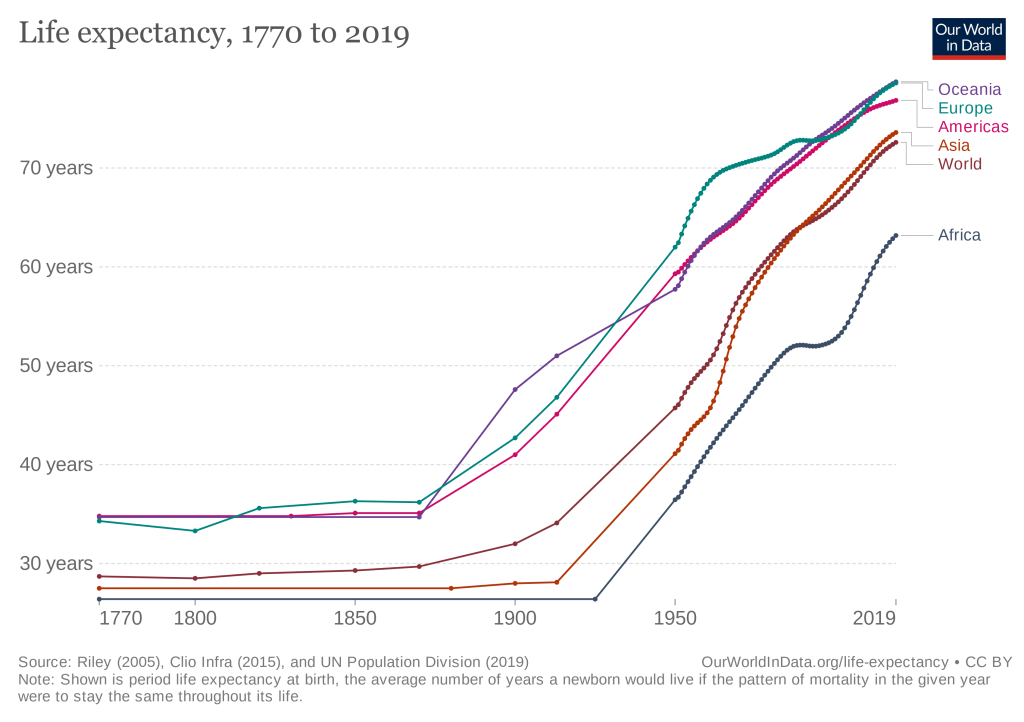
Life expectancy is up. “Globally the life expectancy increased from an average of 29 to 73 years in 2019.” An optimist says, “Yay!” A pessimist cries, “Overpopulation!”
Child deaths are down. “In less than three decades child mortality has more than halved…” That’s a hard one for folks to complain about, though it is part of that overpopulation issue, but it also ties into people no longer needing to have larger families.
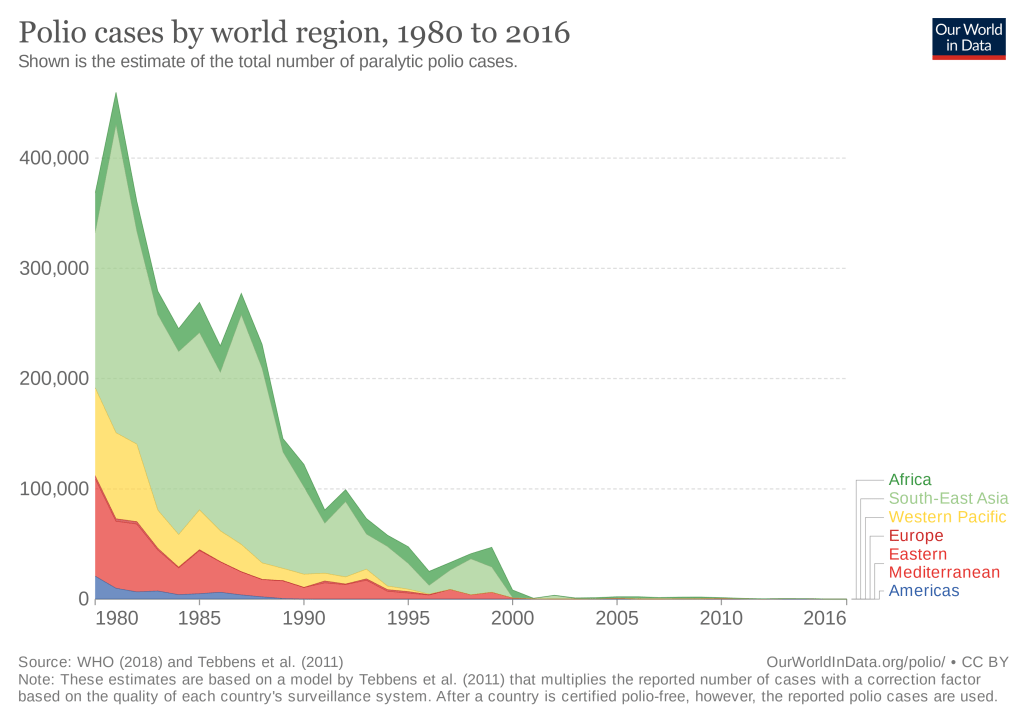
Diseases are down. Some diseases are not only down but are eradicated. Vaccines can do that. I still have the scar from my polio vaccine and am glad for that small price.
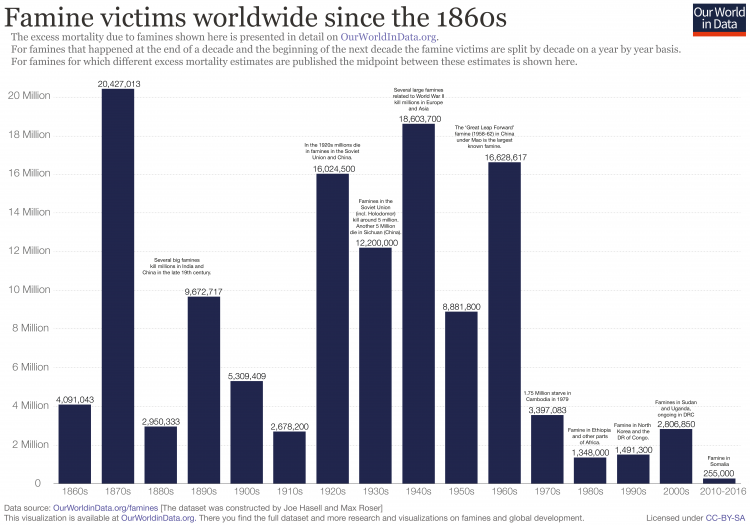
Famines are smaller. Famines continue to exist, but in the past they have been ten times worse, and that was in a smaller population so the percentages were higher.
Sanitation has improved. Globally, it has almost doubled in about twenty years, from 28.6% to 54.0%.
Air pollution is down. We continue to pollute the air, but that, too, is down by about 40% in just over two decades.
Renewable Energy is up, way up. Since 1965, about the time of the first Earth Day, renewable energy has risen seven-fold and is growing.
Fossil Fuel use also grew during that time, but recently fossil fuels are finding themselves caught in a financial spiral. As renewables gain market share, the large fixed costs of fossil fuel production and distribution are spread over fewer customers, thereby raising their per-capita costs, which make renewables more competitive and attractive.
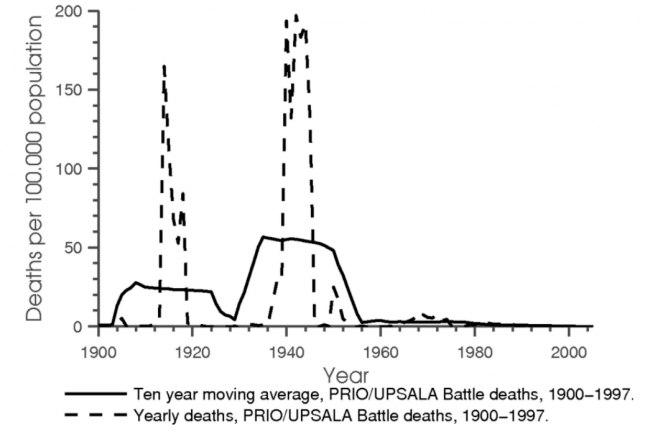
War is killing fewer people. War, what is it good for? Nothing. And governments are learning that. War gets the headlines, but even if governments think war is necessary, people and businesses have learned that peace is cheaper, lasts longer, and is good for jobs. Investors might like stocks in weapons companies, but even some governments are realizing that commerce is a better way to make a change.
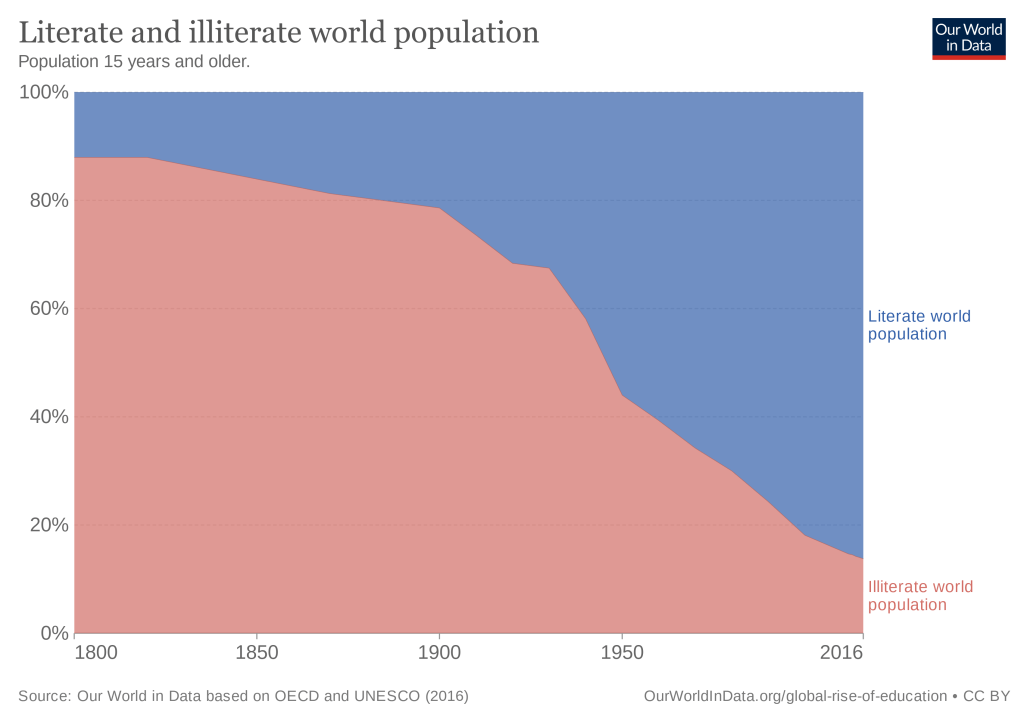
Literacy is up. More people can read. What they read may be worrisome, but this may just be a phase in the maturation of our society as we communally learn who to trust and respect for important information. Within the last two hundred years, the world’s population has gone from 20/80 where only ~20% are literate, to 80/20 where ~80% are literate. Whether we agree on anything, well, we’re still human.
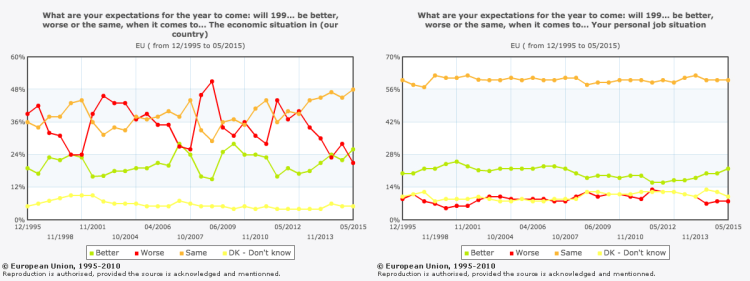
Optimism and Pessimism continue to be about the same. The balance of the two has not changed much compared to the dramatic shifts in some of these other issues. Is that a sign of how adaptable we are, or how much we don’t pay attention outside personal bubbles?
Happiness is making progress. Happiness is improving, more in some places than others; which shouldn’t be a surprise. Some places are in deeper crises while others may be farther along in recovery from theirs.
I see news like billionaires going to space and watch the technological progress and the backlash. I think billionaires launching themselves out of the atmosphere is proof that there’s a need for a lot more maturation; but I’m glad they’ve able to do so. Elon Musk is a better model, as silly as that sounds. He focuses on orbital issues, even if it is launching a car to(wards) Mars. Collectively they are taking the steps necessary for the lifeboats we may need, as well as enabling the advance of more sustainable and less-polluting industries. There are businesses that are turning threats (asteroids) into opportunities. Why dig up the planet when we can turn potential colliders into raw materials?
I think back to where we would be with resources, pollution, and global overshoots if we hadn’t abandoned progress in space made in the 60s and 70s. Imagine if Earth Day had inspired today’s level of action fifty years ago? If civil rights for all hadn’t stalled? If the UN had been given authority (and maybe a different structure) at its inception? I’m sure you can add your own to the list.
We can all list optimisms and pessimisms; things we are eager and anxious about. And yet, such thoughts distill down to what will you do about them, as well as what will you do with decisions in your daily life?
At some point such issues come down to the personal level. When I am in financial crisis, I have to concentrate on the basics of personal finance: assets, liabilities, income, expenses. As I come out of crisis it becomes easier to think and act more broadly. When I come out of crisis it is also easier to see the basic optimism that our society and civilization have always been in crisis, and somehow we manage to continue and grow. Past performance is no guarantee of future performance, but it is encouraging.
Now, pardon me as my mind deep dives into choices I’ve made through all of these times, what I’m in the midst of, and how I hope things will go – and how silly and important decades of plans can be.
(Isn’t it amazing what can come from a visit with friends and some cups of tea?)
How much do you know that you don’t even know you know? I’ll wait if you have to read that a few times. College degrees, professional licenses, certificates are the things that are hung on walls and listed on resumes. They are accomplishments and in many cases necessary. I know when I fly I prefer the pilot to be properly trained, tested, and licensed. But not every question needs to be answered by someone who clocked a lot of hours in class, or checked all the right boxes in tests. Communities are valuable because many of life’s problems can be solved by friends who have enough experience and insight to have your answers, even if neither they nor you realize it. The idea for this post started with tea.
OK. So sometimes a tea bag is handy. Maybe it is time for me to educate a local coffeeshop or two.
I am Not a tea sommelier. I simply like tea. I’m writing a book about tea, but one that has more to do with the quirks of being a tea fan in a Starbucks world. I tweet about tea often enough that a friend inspired the hashtag #TomTea. It isn’t trending, yet. I am not an expert, but I am known for knowing enough about it that I get tea questions, occasionally. A simple question inspired a much longer answer than they asked for, but it made me think.
Question (paraphrased): What is the difference between black and breakfast tea?
Answer (edited because I’ve learned more since responding):
There’s stuff commonly called ‘tea’.
That breaks into ‘tea’ = usually hot water over dead leaves from a particular species of plant (camellia sinensis). and infusions = herbal tea, basically any other dead leaves in hot water.
Tea breaks into: black tea = same plant but different process than green tea = same plant but different process and white tea, pu-erhs, oolongs, etc. (I’m saving you from my ignorance of the details and the deep dive that happens after this.)
Except for diving into: breakfast teas which are blends of black teas grown in different regions on slightly different strains of the plant, primarily Assam (Indian) and Keemun (China).
I think English Breakfast is two parts Assam and one part Keemun. Irish and Scottish blends use different proportions.
Then there’s Chinese Breakfast but I lose the thread there. Early Grey is an example of flavored teas (Bergamot), and spiced teas which become a very wide set of choices.
I buy Assam and Keemun in bulk, then mix them by dumping a bit of each into the teapot depending on my mood that morning.
Ah, that more than answered their question.
A few days later I was talking about the details with a friend who understands teas far better than I do. (Visit Dandelion Botanical for that source.) I realized that I could’ve gone into more detail about other varieties, blends, flavorings (Earl Grey, hot) and preparations. I think tea bricks are fascinating, particularly because of their history as money.
My knowledge of tea is hardly exemplary or valuable. Some people follow tea careers like some follow wine careers to become sommeliers. I’m guessing the wine industry has more to spend on such expertise considering the cost of a bottle of wine versus the price of a pot of tea. Evidently tea sommeliers can make >$50,000/year, but there aren’t many jobs out there for such a skill. A friend who knows a bit about tea might suffice.
I had an electrical problem earlier today. I flipped switches, toggled things in the breaker box, tested various possibilities, but still had lost power to three outlets. Not an emergency, and I didn’t want to call an electrician for such a simple problem. So, I called a friend. Evidently, I’d done the right things, but I reset something in the opposite order. Problem fixed without much drama, or expense.
There are definitely times when certified and licensed professionals are necessary, but sometimes someone, like the person in the hardware store, can show how to fix a faucet by changing a washer, or fix a crack with just the right adhesive, etc. They know these things without requiring the same training, and without requiring the same fees.
Every time we ask a question we have the opportunity to learn something. Ask enough questions, learn from enough answers, and eventually begin giving back by helping others – with the caution that always know you might be wrong and that critical judgment is called ‘critical’ for good reasons. I’m willing to try fixing a drain because the drain may be limited to how much water is in the sink. I’m less willing to fix a faucet because the inlet is limited to how much water is in the water tower.
And, of course, as part of my profession as a real estate broker I advise everyone to use licensed and bonded professionals because any such situation is much more important: more people are involved, it is probably part of a contractual obligation, a record of the work may be required, lawsuits happen. (Required disclosure: I am a real estate broker with Dalton Realty, Inc. on Whidbey Island.)
This week I resigned as Site Steward after over 12 years of volunteering for the Whidbey Camano Land Trust. It wasn’t about them. It was about me, but that story won’t be told for a while. There were no classes involved. Much of the training was verbal and sporadic. But spend twelve years working on something and something sinks in, besides dirt and scratches. I’m much more familiar the challenges of preserving and stewarding lands for this and following generations. I’m definitely much more aware of noxious and invasive weeds, how they’re supposed to be removed, how some pragmatism can be required, and how massive the problem is. I’m not a fan of blackberries, anymore; but I also know how gratifying it can be to uproot Engish Ivy. I even learned how to make baskets from the vines.
Emphasis is placed on college degrees, and for good reasons; though I think it has gone too far. Training and education are valuable, but some skills, even some advanced skills can be learned in less time by people with the right talents. I’m glad I finished my Masters in Aerospace and Ocean Engineering that helped me in my career in aerodynamics and flight controls at Boeing. That involves flight safety issues. I suspect some counselors can benefit from years of psychology and such, but their listening skills may be inherent and more important.
Communities are impressive when overlapping skills create a network of support that is unofficial, informal, and based on shared benefits instead of certificates and invoices.
You may not know how much you know that you don’t even know you know. That knowledge may seem trivial to you, but it may be crucial to someone else. Volunteer organizations exist because of that fact. One way to contribute is to respect yourself, your experience, and your energy. You may be far more valuable than you know.
For now, I know that I’m ready for another cup of tea. Lapsang Souchong is today’s choice. I don’t even know how to spell it properly or where it comes from or whether it a straight or blended tea, but I can find the answers. You see, I know a someone…
Two days ago I looked forward to writing this post to celebrate significant progress in my recovery from my Triple Whammy of August 2011. Back then, three major events imploded then depleted my net worth. My net worth has not regained those levels, but within the last 18 months my net worth improved enough for me to begin relaxing anxieties. One bureaucratic mistake two days ago severely threatens enough aspects of my life that I do not, and to some extent can not relay them here. This blog, however, is about personal finance; and not just personal finance but personal finance that challenges taboos to some extent. It’s easy to tell the stories when the news is good. The lessons from when news is bad can be more valuable.
As someone put it, “If you want to learn about sex, don’t ask someone who has always been celibate.” (Variations on that theme can be tuned to your needs. I know I can think of several alternatives.)
Hindsight is handy. In 2011 my bad news seem to come from several directions, each largely uncoupled from each other. Back then a friend researched instead of just reacted to the parts of my news. As they put it, I was hit by a perfect storm of bad luck. The odds that someone is bound to have five dice rolls all go their way is about the same as someone having those dice rolls go the wrong me. (Bad) lucky me.
Ironically, this happened after the Great Recession began. I’d just released my book on personal finance (Dream. Invest. Live.). After the initial global market impact, my portfolio began to rise because three of my investments were in positively disruptive technologies that weren’t affected by the markets as much.
Then (and pardon me for forgetting the exact order),
American Superconductor (AMSC), a developer or more efficient electrical infrastructure components, found that their biggest customer decided to steal the intellectual property and become a competitor. The loss of several hundred millions a year almost eliminated the company. Fast forward and find that AMSC won the court case; but only after several years and only receiving a fraction of one year’s revenue. I lost about 40% of my portfolio within weeks.
Dendreon (DNDN) developed an FDA approved cancer vaccine. Reread that one that most folks don’t know. They were succeeding, though at a somewhat slower pace than expected; not surprising considering how revolutionary their treatment was. Shareholders commented on machinations that seemed criminal. Regardless, a takeover of the company bankrupted the company. Fast forward and find that the takeover was challenged in court, it was confirmed that some were found guilty; but the damage was done. Allow me to copy and paste the closing line from the previous paragraph. I lost about 40% of my portfolio within weeks.
MicroVision (MVIS) was expected to produce a projector that could fit in a smartphone, a projector only slightly larger than the cameras already showing in them. According to a Wired interview, the CEO of Corning was going to demonstrate to the CEO of Apple the key subcomponent that Corning was developing with MicroVision. Apple felt that a stronger glass was more important and MicroVision’s effort was stalled. Shareholders didn’t know why things were delayed until years later. MVIS eventually fell to as low as $0.15 in April 2020. (Thankfully, it is recovering, but that’s a much longer story.)
As those three issues played through, all of my fallback positions of getting a better job or selling my house, or various other “lines in the water” fell through thanks to the Great Recession. Soon, I had to sell off almost my entire conventional and IRA portfolios. I ended up down 98%within a few years. I almost lost my house. (Another long story.)
As I wrote in various posts within the last 12 months, my net worth has been increasing thanks primarily because of my house’s value and MVIS’ recovery.
Within the last few months, I also learned that my credit rating has recovered to almost the maximum possible. That meant it would be easier to refinance, or get some equity out of my house, or generally relax and celebrate at least that accomplishment. I also started receiving Social Security, another anxiety relaxer.
Here is where the celebration has been postponed.
I don’t know all of details yet, which is why I will write about those later when they are facts rather than speculations. But, from the high of an anticipated celebration to a low from a surprise pronouncement – well – I feel devastated. The oddest part remains that I don’t know the entire story, either.
I have become a larger proponent of loosening that taboo about talking about money, at least with close friends. In today’s internet, revealing much more can put assets and livelihoods at risk. In person, however, and as I asked for help, people shared their situations, too.
There are far too many having to deal with problems that are too large, but which have no ready resolution. Move to a better job? That takes money. Pandemic hurt your business? You’re not alone, and the recovery may be painfully slow. As lifestyles change because of health care and housing issues, the solution may be to move – which again leads to ‘move where?’ I only have me to worry about. Others are dealing with families, generations, and generally compassionate responses to others without support.
I’ve been described conflicting ways. Some say they are impressed with my optimism. Some say they are dismayed by my pessimism. Maybe I can carry both of those perspectives in my head simultaneously. I’ll go with that.
Learning about the biographies of many famous people, almost all mention some bit of good luck that was out of their control. We get to hear about the people who’ve benefited from such encounters. We don’t get to hear about the others as readily. Luck, whether good or bad, can happen in an instant. Some developments take longer. I wish I wrote down a phrase someone used earlier today. Something like, “Plans are useful; and you have to have them; and all you can do is what you can when it’s necessary because you don’t know what’s really going to happen.” They extended that old adage more eloquently.
It is difficult to ascribe everything to luck. It is also unrealistic to ascribe nothing to luck. The world is too chaotic and random. We are not in as much control as pundits may make it sound.
I’ll continue the blog. Only the Triple Whammy updates will end. Ten years are enough, I’m now over 60, the pandemic changed so much, and I am sure the pandemic will not be the largest change I’ll witness. I think technology, economy, climate, and society are all being redefined by necessity. Each is a big enough topic to overwhelm most people. Combined, I think their effects become a guessing game.
How’s my life, our lives, going to turn out? It’s a guess, but I intend to continue writing about it. Stay tuned.
Yesterday was a good day. By the end of it, my Jeep was dusty, I was sweaty, I’d spent four hours driving and another three hours sitting in traffic delays, and I had a lot of laundry to do. I was waiting for my knees to cast their vote. I went on a hike and I felt the best I’ve felt in months. I’d like to do that again, which I intend to do.
Barclay Lake
A friend once said something like; “After reading your book, you’ve convinced me to never go hiking, again.” That’s one of the issues with writing about hiking and nature, human communication is best at describing drama and struggle, not at describing serenity and peacefulness. Think of the classics. Dante’s Inferno is well known. It’s about Hell. Dante’s other two books in the series are less well known. They’re about Purgatory and Paradise (as I recall from college days.) The last one is particularly repetitive and dull. Bliss, bliss, bliss. Great, but it didn’t sell as well. Think of social media. Cute cat videos are popular, but drama and conspiracy are so dominant that major governments are being destabilized. The good parts about hiking? They’re harder to convey.
The good parts of hiking are easier to experience, though.
Thanks to the recent good fortune of my truck breaking down and someone stealing my credit card – yes, this good news started with that country-music kind of bad news (A Jeep Dancing And Credit) – I went on a hike yesterday.
I need more than a hike. That’s gone from missed opportunities, to broken habits, to getting out of shape, to not just a want but a need, to affecting many aspects of my health. Hiking is not the issue. Time to heal and time to enjoy and time to relax is the issue. Nature is a healing place. I’ve spent too little time there. I intend to spend much more time there, again – which is much easier now that I have a Jeep.
Video ads show SUVs bouncing along gravel roads, churning up rooster tails of dust as people hit the power while letting the wind blow in the open windows and through their hair. Ads can be so funny. Drive that fast on many trail head roads and find that potholes are more abrupt than most realize, wheel rims less forgiving, and letting all that dust in means turning the car into a job for a detailer and turning hair into an excuse for many showers or for wearing a very tight hat, and glasses, and maybe a shirt buttoned up and sleeves rolled down.
A typical drive to a hike in Western Washington can be a hundred miles on highways, followed by a slow, bouncy, and squiggly drive up a scratch of gravel that might have room for two vehicles. Much of that width may be taken up by having to maneuver from the far left to the far right just to get a few miles to the trailhead. It can take concentration to avoid going terribly off-road as in into-the-forest or over-the-edge, or into a confrontation with another driver’s skills and grill as they try to drive the same way. It’s enough to make you want to take a break between driving and hiking when you get to the trailhead.
Now imagine a small, organic parking lot and greater demand than supply for places to park. My Jeep ended up with its red nose in the bushes, just to fit in. (Another comment about SUV ads. Big brawny trucks look powerful, but if they can’t fit between the edges of the gravel or can’t turn around at the end, they begin to look silly, like a football player trying to tackle a task by fitting into a space ideally dealt with by a petite plumber.) Whew. At least I didn’t have to turn around and try the next trail.
Hiking is seen as frugal, and it definitely benefits from that mindset. Only carry what you need; that includes emergency materials, but it also includes snacks. Hiking is not cheap, however. Gas and gear can add up to enough for a cheap hotel stay instead. That’s the cost, not the benefit. Too many conversations only look at one or the other.
This was a short hike because I try to be careful. Everything takes practice, even walking in the woods. Did I bring the right gear? Am I in good enough shape? My new Jeep is designed differently than my previous Jeeps. Can it handle the reality of Forest Service roads that may not have enough budget for maintenance? (I’ll save you the suspence. Yes, it all worked out well, or at least well enough.)
For two hours (see, I said it was short), my concentration was on walking without stumbling. Sounds simple? Sure; but I was also part of a rescue operation because one person injured their ankle. Getting them out involved dozens of volunteers. Things that are easy to take for granted in the paved part of the world can be vitally serious in the reality we’ve yet to flatten.
Concentrating on walking is meditative, for me. Hiking along a trail through natural forest is a long string of opportunities to stop and notice the world (and pant and catch some breaths.) These flowers are blooming. Those streams are trickling. Sunshine is coming into this meadow now, but not earlier and not later.
Getting to the destination is an accomplishment which varies for every individual. Some are there for lunch. A few were there like me, testing what it will take to get back in shape, or into a new shape. A family was camping, introducing a child to something beside a video game. One couple reportedly BASE jumped off Baring Peak, almost four thousand fee above the lake. Another was there to try summiting it for the first time, for them. Another wanted to explore rumors of a third lake, which we talked about when I mentioned that I wrote a book about Barclay Lake in 2004.
Barclay Lake & Baring Peak – a pair of destinations in the #WACascades that were also tests for my new 2016 Jeep, my out-of-shape knees, and remembering what to pack after a too-long #hiking hiatus. A good day. It's good to be back on the trails. pic.twitter.com/5Jk2WtO99I
The overwhelming and shifting collection of lifestyle, economic, and worldly issues in my thoughts didn’t immediately evaporate. Maneuvering around tree roots, uneven rocky spots, or long and hopefully strong log bridges over streams quickly reassign priorities. Thinking about stocks? Bump. Good thing my boots protect my toes. Wondering how my business will recover? Bonk. Forehead, meet a fallen tree that’s sticking out. Wrapped up in my thoughts? Scratch. Vines can have thorns, you know.
Eventually, I realize there’s nothing to do about any of those everyday issues while I’m beyond the trailhead. Inspirations may come, but that’s almost by accident.
A nature walk is not an escape. A nature walk is a return to reality.
What’s that worth?
What’s it worth to see a dozen families heading to the lake, each with pre-teens in tow?
What’s it worth to be glad that I’m not camping there that night?
What’s it worth to talk to people who are more likely to talk about bugs instead of politics?
What’s it worth to find a self-selected group of strangers who have at least something in common with you?
Construction hassles, a long ferry line, and a hotter than usual day made the drive home memorable in a different sense. Logging on after I got home refreshed too many of those anxieties, reminded me of so many societal issues. It reminded me of a lack of manners and tolerance. A literal stack of bills was a reminder of a different reality that must be dealt with. There was also a lot of laundry thanks to dusty roads, my sweat, and then baking it all on the drive.
There’s a saying about personal growth; “Chop wood. Carry water. Reach enlightenment. Chop wood. Carry water.” My modern version uses, “Pay Bills. Do Laundry.”
Here I sit, the day after the hike. Things are better than I expected. The Jeep may not be the same, but it did much better than I expected. It wears road dust well. The need for ibuprofen didn’t arise. That was a surprise. My knee that’s been causing such a problem with my running and even with my dancing actually feels and moves better. Maybe it needed more natural movement. Maybe I needed more natural movement. Maybe I needed more nature. There’s no ‘maybe’ about that need.
This blog is about personal finance. It is about personal values, and resources. Money and time are important in our daily lives. Time is naturally vital. Money is arbitrarily vital. I’ve spent so much time trying to make enough money that I’ve spent some of my health. It is easy to say, “Duh, just hike more.” I hear such things said, as if it was obvious. Just as it can be difficult to describe the peacefulness and serenity of nature, it can be difficult to describe the reality of the struggle of people who can’t pay the bills. That was me, and in some ways still is me; but I’m now able to get back into nature because I have a Jeep (that I had to go into debt to buy), and some income thanks to Social Security, and time thanks to business being so slow that I could hike for a day without missing any vital calls.
I’m glad I’m having a good day. Those days have been too few. Now, I can at least trade off priorities enough to afford a few, and hopefully more. I am also reminded of how many are told to “Just Do It” as if that’s simple and trivial. It can be;
As Long As You Can Pay Your Bills #ALAYCPYB
That’s a reality, too.
(Disclosure: I wrote Twelve Months at Barclay Lake. It’s available for sale online, though possibly through some stores. This post was not about plugging the book – which may partly explain my financial situation – but it and the others in the series are for sale, Twelve Months at Lake Valhalla, and Twelve Months at Merritt Lake, a simple chronologies of pockets of nature, two of many places that have affected my perspective. Don’t be surprised if they don’t match what you see in the ads.)