
Irrational exuberance again? The stock market is up again? But it sounds and looks like the world is in turmoil. Isn’t it? Not-exactly-a-news-flash = the market is not the world, and a crowd of supposedly intelligent investors can act like a mob of wannabes. We humans are so silly. Or, maybe this time is different.
Was it really back in 1996, almost thirty years ago, when the Fed chairman, Alan Greenspan, warned about a market that was possibly irrationally exuberant? Note that ‘possibly’ because the comment was made in public and Fed chairmen are rarely emphatic. They use wiggle words to allow a way out of conversational traps.
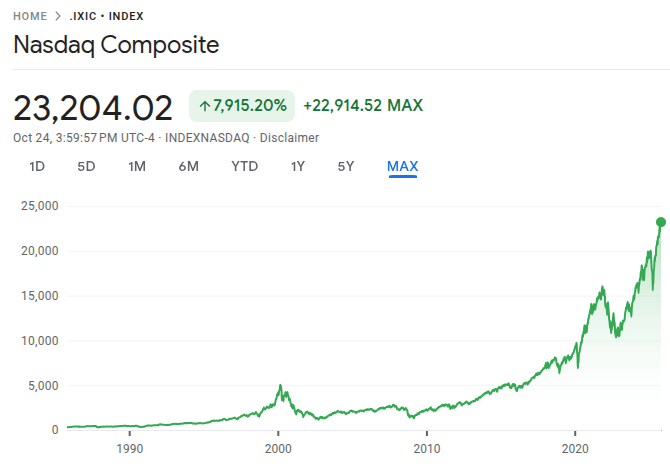
He was right. The dotcom bubble burst. The markets tumbled. People lost money.
And, the general economy recovered. Many dotcoms became today’s monopolies. The markets rose, again. People made money.
And then there was the Great Recession (the Second Great Depression in my opinion). And then there was the … a continuing string of booms and busts.
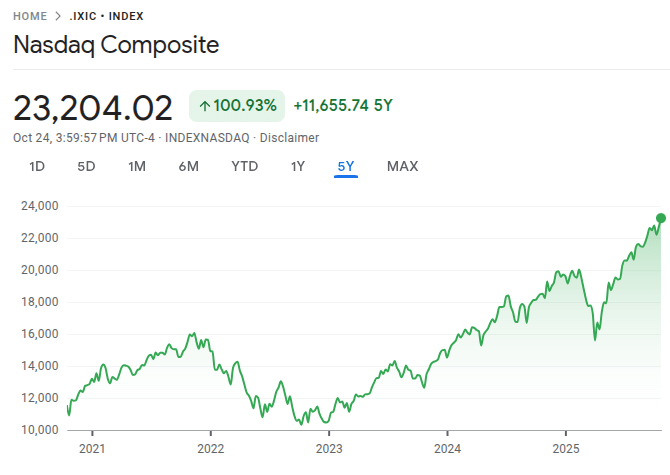
The markets are booming again. In the most recent five years, the NASDAQ index has doubled. That’s roughly a 15% increase every year, which is about double the historical average. Look at the data in more detail and see a much more turbulent ride. That’s normal. Wars, elections, crises create swings in the markets.
Currently, the AI possibilities are creating a lot of enthusiasm and worry. If AI is effective, economies, businesses, and most lives will change. If so, now is the time to reposition portfolios (and careers) to take best advantage of the situation.
The problem now is like the problem then. The enthusiasts knew, or at least strongly guessed, that great things were coming. When the bubble burst, they might have been hurt. Many guesses at investments faded even as the technology advanced. Some, however, guessed right. And I contend that ‘guess’ is the proper word for what felt like intelligent declarations.
I do not own any AI stocks. I suspect the same technological trends will repeat, but the benefits may be indirect as existing companies improve their companies. There will be profitable and pure AI investments, but I’m not guessing which they will be.
I am invested in quantum computers (QBTS). AI is catching a lot of the news, but quantum computers are also positively disruptive and hard to guess. At least for now, I’ve guessed right by buying QBTS. Even with a drop from ~$46 to ~$32, the stock has risen >2,700% in the most recent twelve months. Fine. I sold a bit. As I type, it is an ~$11B market cap based on – let me check again – ~$9M revenue. Note that is revenue, not profit. The company lost ~$144M in that time.

What? Why would someone invest in such a company? History.
Quantum computing potentially – potentially – is a greater positive technological improvement than the PC, in my opinion. I see it as more like the introduction of the transistor. That was 1947. There were decades of disruption to come. There were decades of progress to benefit from.
The problem with such disruptive technologies is – pardon – ‘a’ problem with such disruptive technologies (and there are always more problems) is that there is no industry to compare them to. How big will AI or the quantum computing industry become? Probably not nothing, because they’ve already made a non-zero impact. Probably not everything, because there’s still an economy of people doing things only people can do. The likelihood is probably something. As an investor, guessing at the ‘something’ without the aid of history can mean estimating growth based on the progress of transistors. Investing in MSFT, AAPL, AMZN were very good investments. This could be bigger than those. Or not.
Big ideas can start in businesses that don’t make much money – yet. Good. That makes those stocks cheaper to buy.
As the technologies make progress, and as their companies project their potential impact, risky investors, really speculators, can bid up the price based on little data. Hey, if it works, why worry the details?
The problem is that a lot of money is spent on enthusiasm. At an extreme, an irrational exuberance.
What is it that is said about heroes and fools only being different based on someone’s definition of success?
As I type, QBTS is up >2,800% for the last twelve months. (Note that number changed since I started typing this post.) By conventional wisdom, it is irrational to buy stock in an $11B company that had revenues of less than a few million. By history, such a paradigm-shifting company could potentially be worth hundreds of billions, if not trillions of dollars – eventually. Could.
QBTS and other stocks are into teetering territory. Prices have risen high enough that stockholders rush in and out like waves, not like tides. A random comment from a CEO or politician can swing a stock without any fact-checking. Within the most recent month, QBTS hit a low of ~$24 and a high of ~$47, almost a 100% gain. Then the crowd went away, and then a spurious news item drove it back up to – let me check – ~$33.
The precise price movement is not as important as the fact that, without much rationality, the prices can move that much that quickly.
Irrational exuberance is not rational. Duh. I also call it irrational optimism because humans can also experience irrational pessimism.
I’m not saying this is a time to invest or not invest. I am not a certified financial person. As an individual, though, I am reflecting on history, psychology, and technology to help me decide what to invest in, and how much to invest. Turmoil is uncomfortable, but I’m old enough to have witnessed and experienced booms and busts, profits and losses, missed and captured opportunities. (I coulda and shoulda bought COST, AMZN, yada, yada.)
Throw in the extra-market turmoil that is politics and this is a time to pay more attention to factual news.
Irrational exuberance. We’ve seen this before. This time will be different, as every time is; which also means a lot of it will be the same. Hang on for the ride. Remember where the emergency exits are. Remember your goals. And, if you don’t have goals or exits, this is a good time to find them. It already is a bumpy ride.

 Trimbathcreative's Blog (Tom Trimbath)