
And another innovative startup grows phenomenally, disconnects from its foundations, and leaves loyal users behind. If it wasn’t for their protection as a monopoly, their next step could be an apologetic revelation, or a fall from grace. Ah, but this is the era of monopolies and oligarchs. I doubt anti-trust will bring back customer service. Conventional wisdom assuming conventional choices has become a bad assumption, in my estimation. We’ve entered a louder echo of the previous Roaring Twenties, with tones of the French and Russian Revolutions. As if there wasn’t enough turbulence swirling the world…
I’m a fan of innovations, possibly because I am enough of an innovator that my aerospace engineering career was hampered by “being too comfortable with new ideas.” An interesting commentary while working in research and development at Boeing. I buy stock in innovative companies because I feel that I understand them better than some other investors. I even buy innovator’s products.
Imagine a couple of folks with an idea who pursue it and massively succeed. I haven’t mentioned any company specifically because I’ve seen so many: Gates and Allen for Microsoft, Jobs and Wozniak for Apple, Page and Brin for Google. Microsoft claimed the innovator title when compared to IBM. Apple claimed the innovator title when compared to Micrsoft. Google claimed the title when compared to Yahoo (Yang and Filo, and I had to look that one up.)
Microsoft only impressed me until the Macintosh was released.
Apple impressed me enough that I bought shares early, and bought a Mac 512K, and continued to upgrade. I continued to upgrade until they went from innovator to asserted so much control that I couldn’t control how my work was handled. They even orphaned the first 200 posts to this blog (2007?). I was glad to switch to Google’s Chromebooks because they were more affordable, said they wouldn’t be evil, and were practical while doing almost everything I needed. Now, it is time to begin looking for a new innovator. Is there a two-person team working who love their idea, and will positively be surprised by it, and so will we?
Almost everything I’ve produced in the most recent two decades have been at least partly built on and in Google’s ecosystem: blogs, books, and videos (YouTube).

Google, which is now Alphabet (does anyone call them that?), recently announced that they won’t update my older laptops. (“This browser version is no longer supported.”) The laptops use their software, which means that they have unilaterally abandoned the product I bought from them. I think it may be coincidence, but I now get a warning message that “…If you run out of space, you can’t save to Drive or use Gmail”, because I’ve used >71% of my storage space. Of course, managing my storage space on Macs was easy until it wasn’t. Managing my storage space on a Windows machine had great tools, powerful tools, but not very user-friendly tools.

OK. OK. I’ll use Chrome’s tools to manage my storage; and I found out that Chrome had been duplicating hundreds of large files. Each one had to be found, compared, marked for deletion, and then persist with the above warning because deletion takes time in the Chrome universe. So, they caused the problem, provide bad tools to resolve it, then continue to display the warning message for possibly weeks – maybe.
Google’s suggested solution to the hardware and the software issues? Buy a new Chromebook. Buy a new Chromebook? My newest one is less than a year old. I have about six in various stages of abandonment – just like my Mac.
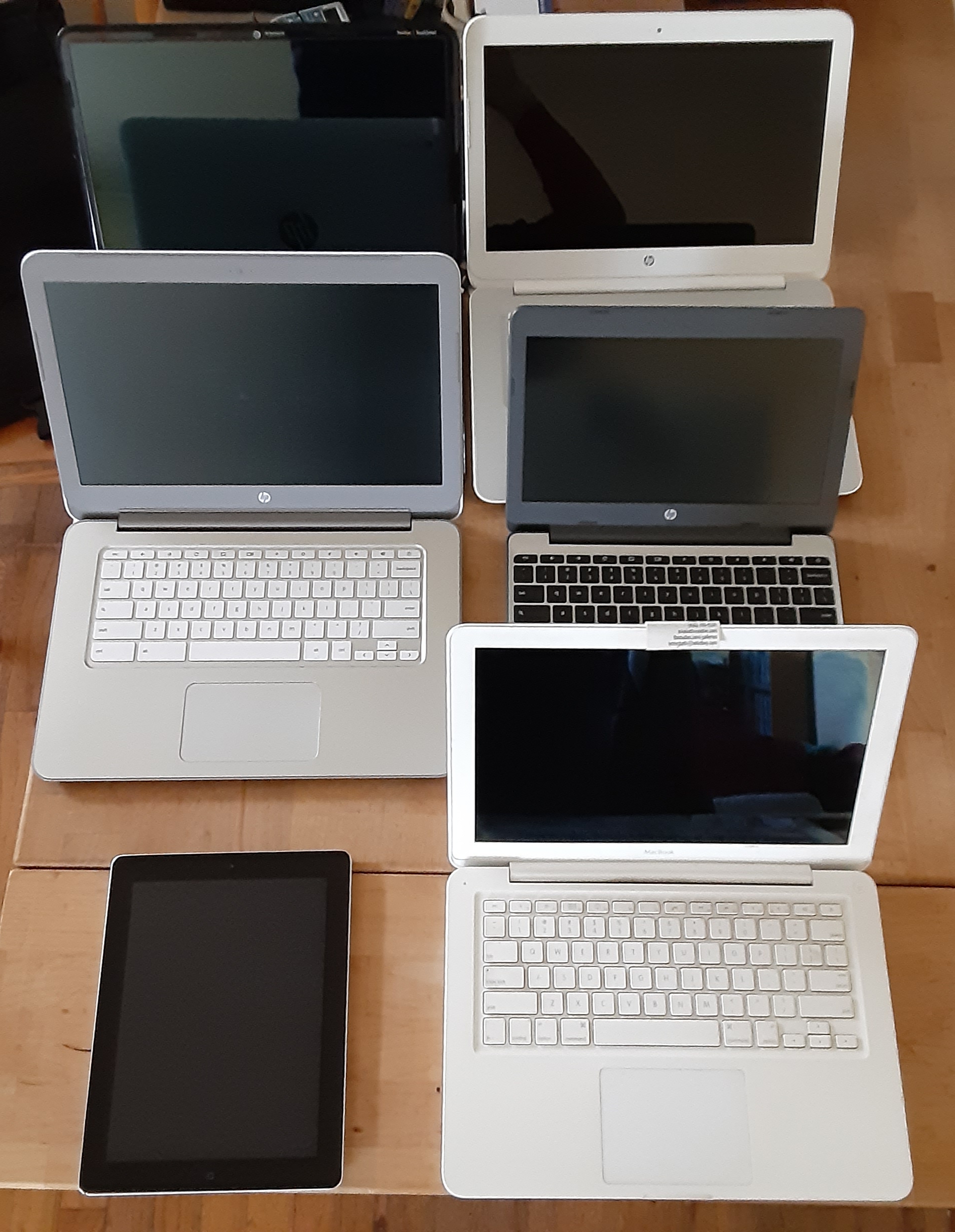
Imagine car companies deciding to obsolete your car without warning. Why buy when someone else controls the power?
Someone else controls the power.
Someone else controlling the power to vital systems seems to be the current trend. The customer is no longer king or queen. The company is royalty that we are subservient to. Lately, it seems that the company is also likely to be subservient to oligarchs who are reverting to being treated like monarchs.
Sigh. And I haven’t even explicitly made any allusions to politics.
Oligarchs eat oligarchs, but first, oligarchs reinforce oligarchs as they accumulate power. In the meantime, I, we, have work to do. Evidently, I also have shopping to do.
But what to do?
Being frugal and obstinate, I’ll make these machines work as well as they can for as long as they can. If necessary, I’ll trust libraries to keep technically current for the more important work. I’ll also watch and listen for innovators who slide in beneath the notice of the mega-corps. I’ll also begin learning and maybe buying something like a Linux machine, Linux, the perpetual geek’s innovative solution, kind of like Esperanto, an idea that will catch on anytime now – for the previous few decades.
While I work on personal solutions, I’m also watching oligarchs begin to turn on each other. Crowds mass against them, but I doubt that they notice or care.
The ancient Greeks fought against oligarchy, so the idea isn’t new. The Magna Carta was a response to over-reach by a monarchy, and that wasn’t bloodless. The American Revolution abolished a monarch (temporarily?). The French Revolution was fought against oligarchs, succeeded, then devolved into authoritarianism. Ironically, the Russian Revolution was considered to be a fight against both a monarchy and an oligarchy, and succeeded in creating communism, which has devolved into oligarchy. Will we have a Second American Revolution, or will our checks and balances check the monopolies and oligarchs, or will we innovate to some hopefully bloodless and peaceful solution?
Large movements start from simple events. Estranged customers and voters may finally find common enough ground that a solution will be found.
In the meantime, I don’t think I’ll invest in any of the monopolies because they have far to fall and can’t grow forever. In the meantime, I’ll find ways to become less reliant on their products and services. In the meantime, I’ll play along as practical. And, in the meantime, I wonder and worry about whether we’ll witness truly mean times.

 Trimbathcreative's Blog (Tom Trimbath)