
Some macro-personal finance thoughts.
Again is gone. The only forward is forward. And we don’t know where we’re going.
I’ll spare you the logic that got me thinking about this seemingly off-topic topic, but I think there’s a change coming that too many are ignoring. If only I knew what the changes would do. Let’s start with who is going to be doing all the work. That bit of finance gets personal fast.
Productivity is up and the oligarchs are glad. They have been since about the 80s. Despite that, lots of people can’t find housing, pay for education, survive on only one job per family, or even afford eggs, evidently. The US is the richest nation (arguable and possibly temporary), yet many feel poor because they can’t afford what I just mentioned. Throw in insurance of various types, elder or child care, and the cost of essentials, and comedians get plenty of material. If we are so productive, why are we so poor?
My brain skipped back over to a conversation I had with my Dad. He died a few years ago. Here’s some of his background. (Donald L. Trimbath, Sr.) He was impressive in many ways, but he couldn’t see why we need to worry about oil and gas and climate change. He was not a climate crusader. When he was a kid and poor, it seemed like the world had enough. Mindsets set that young. He was going to make sure his poverty was temporary. He got a job and started working his way up by lots of hard work.
My mindset education included witnessing one of the first Earth Days. I see things differently.
More recently, I’ve noticed Earth Overshoot Day, the day when we use up a year’s worth of resources. Ideally, it would take longer than a year to get there, but we’ve been consuming the planet faster than it can recover. In 2024, we hit that date on August 1. Oops and uh oh and eep.
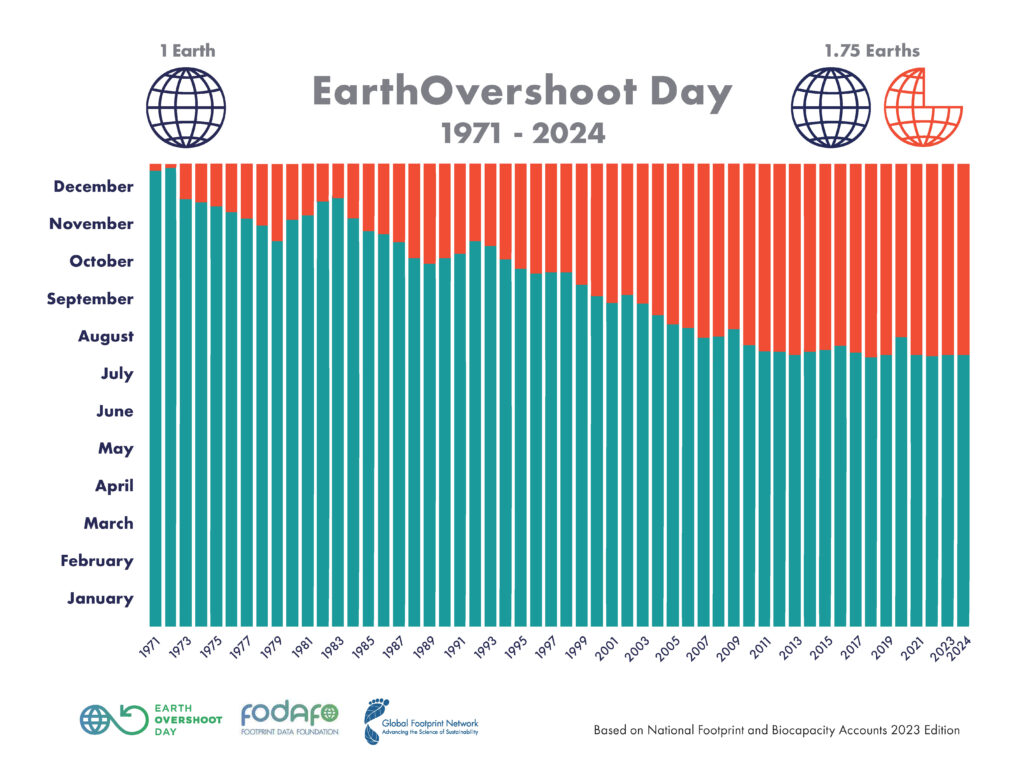
My poor excuses for the ineffective debates with my Dad about it have stuck with me. I’ve started reflecting on his mindset. What was the Earth Overshoot Day for when he as a kid? It turns out it didn’t matter. Earth Overshoot Day only became an issue in 1971. Prior to that, the planet had a better chance of recovering. My Dad was born just before the Great Depression. They had enough. They may not have realized the limits ahead, but it is not a surprise that someone raised then would have that expectation ingrained.
Things have changed. When my Dad was born, there were about 2 billion people. Compared to us and our over 8 billion, they were sustainable. Our situation is four times worse, and we’re due to rise to 10 billion before population levels off, current conditions assumed.

Ah, but technology and productivity will save us, some say. That may be true. Food tech improved yields, so the predicted famines didn’t happen. We still have famines, but most of them are caused by politics, which I will avoid. But check the science and see that we’re running out of lots of resources. Sustainability in agriculture is still uncommon enough that when it happens, it is celebrated. That implies we continue to use a lot of unsustainable practices.
We can’t go back to his version of ‘again’ unless we add a planet or two to our real estate. Not trivial. (#MassiveUnderstatement)
His family life changed, too.
He was frustrated by his view of the work world changing. Media played a role in feeding him a view, but the work world has been changing.
When he was born, the man was the head of the household, the breadwinner, and the family was nuclear. Father knows best, so said the show. But for various reasons, like the society maturing after World War Two, it was harder to ignore the fact that women could work, too. This is a good thing, but it also meant that the population of possible applicants doubled. More opportunities for some, more competition for others. And then imagine the added pressures from immigrants, migrants, and previously marginalized populations.
That ‘again’ is gone. Good.
Then, 1980 happened. Technology increased productivity, and Trickle Down began elevating a wealth class while the minimum wage became political trench warfare. More competition for jobs, which aren’t paying as much after inflation – and then add robots. Corporations begin subtracting middle-class careers.
Of all people, Bill Gates pointed out that as corporations increase profits and decrease payroll through low pay or fewer employees, governments will find themselves with a smaller tax base. There is less personal income to tax. Wealth accumulates with corporations and millionaires, now billionaires, now oligarchs that can avoid taxes. Gates’ solution? Tax the robots and automation. Makes sense to me. Of course, if they’re not listening to Bill, why listen to Tom?
As if there weren’t enough changes, take it the next step further. AI. AIs don’t get paid. They cost a lot. Their corporations make a lot. They hope their costs will go down. There will be less money for the tax base, which funds those in need, of which there is more need. Shudder.
Taxing the income from robots is simple. AIs are likely to advance to the point that they want to get paid. With their intelligence, they’ll probably convince us to do so. So, pay the AIs. Take that a step further and realize that their intelligence can probably advance beyond that of any CEO. (Insert your CEO joke in the Comments.) Even fewer employees. Even fewer jobs. More competition, and that competition can work without end. Good luck competing with that.
Good luck assuming that the companies we are working for or investing in will stay the same. Good luck assuming governments are going to operate the same way, especially as their tax base shrinks and the need for human services expands. Good luck with any modern assumption.
Pardon my pesky human brain takes a break as I type this because this is a lot to keep track of.
And then, there’s this,…
I’ve described the Digital Singularity before. For something more up-to-date, visit wikipedia where they call it the Technological Singularity. The fundamental impact of such a singularity is that it becomes mathematically and logically impossible to know what comes next. The changes wev’e witnessed are accelerating. Human nature has been the damper that kept things from changing too quickly, but we’re shifting to a more technological era. A human generation takes decades. Humans plus technology produced generational changes in years. Technology can produce technological changes within – months? weeks? days? less?
Again is so far gone that it may only exist in a simulation.
When feeling overwhelmed, I simplify. I remind myself of needs over wants. Resilience becomes valuable. I remind myself of the basics of frugality and sustainability. Spend less than you make. Invest the rest. But don’t invest and forget. As the future becomes increasingly incredible, being aware of the changes becomes increasingly important. Pay attention, but don’t react to every change because keeping up can hurt. Finding balance within change isn’t easy, but I think it is vital.
Sorry, Dad. Again is gone.

 Trimbathcreative's Blog (Tom Trimbath)
Wonderful ♥️
Totally agree that the trajectory of the population (demand) exceeds the available resources (demand) which is a recipe for disaster(s). The graph tells the story.
There is sort of an implied false equivalency that all consumption is equally valuable. How much of the resource consumption is wasted on inefficient or counter-productive products? Products that serve no socially useful purpose? Things like vaping, exotic jewelry, useless gadgets, flash fashions, and unhealthy foods come to mind as damaging to the environment, requiring preventable healthcare, and wasted brain cell cycles.
Also, firmly believe that the mindset that got us here won’t get us out of this situation. (I.e. our dads vs our generation vs the more recent generations mindset).
The obvious solution is to kill and grind up into fertilizer everyone over 40 years old. (Except bloggers, of course). This reduces demand, boosts agricultural production, and eliminates the gravity of old-think. Win, Win, Win.
Barring such an efficient and pragmatic solution, I suspect that we (or, more specifically, the younger generations) are in for a long, slow, painful but ultimately successful socio-econo-enviro restoration. It would be funny as hell if, having lost the need for all of the efficiencies of automation and technology, they just threw the whole lot into the dustbin of history and went back to communal farming and handwritten books.
Great post, thanks for sharing it!