
Welcome to another story and another video in my One Company One Story series.
This time, Rocket Lab (RKLB).
Here comes the amateur legalese.
I began investing in companies and their stocks in the late 70s, but am Not a certified investment professional.
My style and history of investing is described in Dream. Invest. Live., a book I wrote by request – which came out as the Great Recession (the Second Great Depression) began. Don’t underestimate luck. Oops.
My personal finance blog (a blog about my finances) is: https://trimbathcreative.net/
I am Not an investment professional. This is Not financial advice.
It’s throwback time, so pardon an excursion from writing about companies worth less than a billion-dollar market cap. Rocket Lab has about a two-billion-dollar market cap (as I type on November 17, 2023). It also has a strong resonance with my professional career. Once upon a time, I was an aerospace engineer at Boeing Commercial Space working on reusable launch vehicles. Researching Rocket Labs has been a familiar walk through concepts the Big B threw away, that I am now glad to see RL building. Pardon the digression. Now, less about me and more about Rocket Lab.

Rather than save it to the end, I’ll recommend now that YouTuber Scott Manley has a more extensive, technical, and understandable deep dive into the company’s history, technology, finances, and implications.
https://www.youtube.com/@scottmanley/search?query=rocket%20lab
My video here is intended to be more of an overview for folks who aren’t familiar with the company or the industry.
Rocket Lab is an innovative rocket manufacturer. Space X has inspired many competitors. Rocket Lab is one. Many such companies get started with small rockets, naturally. Rocket Lab did that with their existing rockets, like the Electron. For several years, they’ve been launching their Electron rocket. Don’t be confused. It is not an electric rocket. Apparently, Rocket Lab is naming their rockets after atomic particles. I’ll get to Neutron soon; and then I have questions about whether they’ll have a Proton, which was also the name of a Soviet rocket.
Commercial rockets are becoming common, but each supplier can distinguish itself from the others in a variety of ways. Rocket Lab seems to be focussing on reusability and, subsequently low cost. Innocuous things that are important are the simplicity of their support structure. Look at almost any NASA rocket from the old days, and there will be a massive structure wrapped around it to supply the necessary systems. Look at a Rocket Lab launch and actually see the rocket much more alone. Look at the girth of the Neutron rocket and see something that is fatter. Fatter means better interior volume, which means shorter, which means less need for complicated structures to hold it up. Fatter means cooler on re-entry. Remember the Space Shuttle with its complicated tiles? Flying back into the atmosphere can melt almost anything, so wrap the Shuttle in tiles, but be very careful with them. The Shuttle (actually Shuttles) were rounded, but some of those edges were sharp in comparison to Neutron’s chubby girth. The air gets hit by something more gradual, and doesn’t heat up as much. Not as hot means simpler materials, faster turn-around, and longer life for the structure.
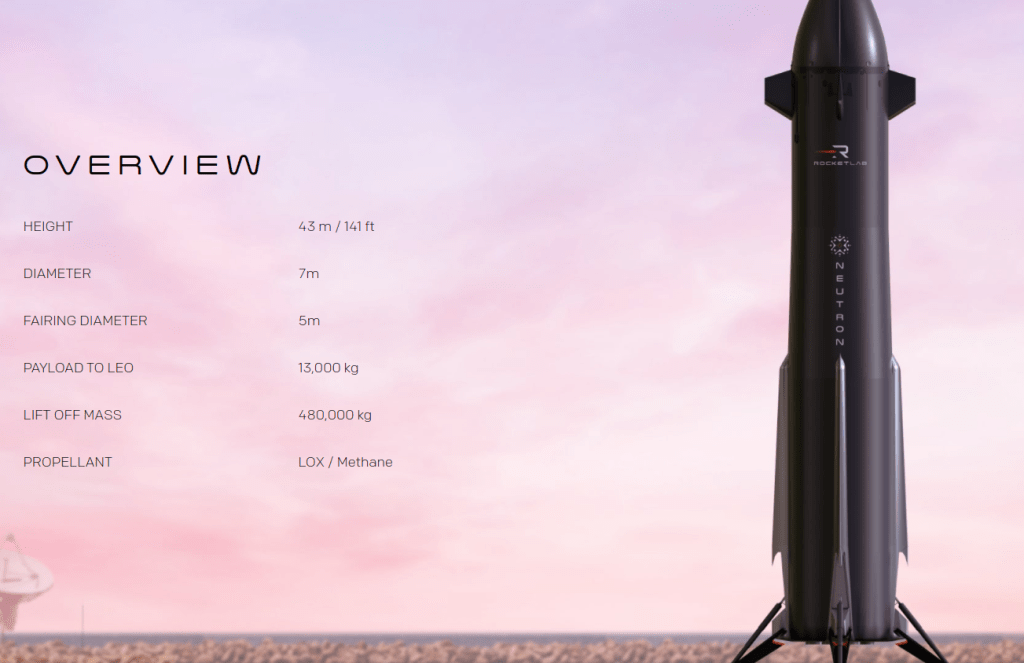
I’ll pause here because the intent is to make this short, and my history with reusable launch vehicles like the second-generation space shuttle (never built) and DCX means I can go on for years. At least it can feel that way.
Suffice it to say Rocket Lab is attempting to grow into a competitor to Space X, even into the very large payload market. Space X has first-mover advantage in the reusable market (first users in the non-reusable market were NASA and the Soviets). That may be sufficient to claim and gain an effective monopoly. Rocket Lab could be a valid contender either as the dominant provider or as the other member of a duopoly akin to Boeing and Airbus’s positions in the commercial airplane market.
Or Rocket Lab could blow up. Rockets blow up. I was glad to work in the field for a few years (and impressed with those who worked in it for decades), but the launch I was most associated disintegrated over the Pacific. So it goes.
Rocket Lab’s CEO is not the wealthiest person on the planet. That can be a positive and a negative. But, a CEO does not have to be a celebrity to do good enough work.

As for the stock, RKLB has only been on the market for a few years. Two billion dollars is a lot, and that’s roughly its market cap, but that’s the price of a few Really Big satellites. The small satellite end of the market is more affordable, but Rocket Lab is poised to take that big risk big reward gamble. It would be rare if they don’t have a rocket blow up on occasion. That’s the nature of the physics of rockets launched by burning fuel. The stock will probably fluctuate. But I am impressed with what they’re doing, how they’re doing it, and where they can go with it.
I don’t know what’s going to happen; but, I hope they survive and thrive. I’ll be watching.
The video:

 Trimbathcreative's Blog (Tom Trimbath)