
Welcome to another story and another video in my One Company One Story series.
This time, D-Wave Quantum Inc (QBTS).
Here comes the amateur legalese.
I began investing in companies and their stocks in the late 70s, but am Not a certified investment professional.
My style and history of investing is described in Dream. Invest. Live., a book I wrote by request – which came out as the Great Recession (the Second Great Depression) began. Don’t underestimate luck.
My personal finance blog (a blog about my finances) is: https://trimbathcreative.net/
I am Not investment professional. This is Not financial advice.
For this post particularly I add that I am certainly not a quantum computer expert. I Think I understand the concept, and I know that I don’t understand the process.)
Sometimes trading symbols are easier to write than the company’s official name. That’s true with D-Wave Quantum, Inc. Quantum computing generates enough mind-numbing questions that I don’t want to parse their use of ‘D-Wave’ and how it relates to ‘Quantum’. Instead, I’ll refer to D-Wave Quantum Inc. by its trading symbol, QBTS.
And even QBTS deserves an explanation. Quantum computing is a revolutionary computer architecture and business approach. Our ubiquitous computers are binary and digital. They operate on bits that are either ‘Yes’ or ‘No’, ‘1’ or ‘0’, high-voltage pr low-voltage, ‘And’ or ‘Or’ or equally arcane choices – a very black and white world. Something is either this or that. That’s true for mainframes, laptops, and smartphones. Traditional computers use bits. Quantum computers use quantum bits, q-bits, (QBTS, get it?) devices that trap and use quantum particles and concepts. Quantum computing operates on probabilities and the reality that quantum computers can consider two truths are once; something can temporarily both Yes and No, effectively. There are very few companies building quantum computers. QBTS is one of them.

I am Not a financial professional and I am certainly not a quantum computer expert; but I think I understand quantum computing’s advantage. It is all about probabilities. Something could be black and could be white simultaneously. One sign of a human’s intelligence is their ability to consider two contradictory possibilities before making a decision. Quantum computing allows many possibilities to be considered, and considered in conjunction with probabilistic influences.
The time difference may not be significant with small problems, but as problems become more complex digital models can be forced to consider all possibilities and their combinations one at a time. Model something complex like the planet’s weather and massive computers with millions, billions, (trillions?) of transistors are required. Quantum computers can resolve the possibilities with much fewer processors (a couple of thousand instead of billions), and the work faster, and do the work without requiring another era of mainframes.
Quantum computers are necessarily complex in other ways. A traditional computer can have billions of transistors because they’re simpler and relatively robust. A quantum computer can involve quantum effects that can be influenced by local disturbances like vibrations, electrical fields, – things that are difficult to control – and necessary.
D-Wave (QBTS) is a company working in the quantum computing field since 1999, which usually means someone else was working on it before that.
For years, developers of quantum computers cheered when a machine grew from four qubits to eight to twelve to – now, 2,048. Progress.
Ideally, such machines should be much more efficient at modeling messy things like climates and stock markets. Maybe there are biotech options for analyzing drugs and treating diseases. Whether the computers are already successful or not (depending on your criteria), they’ve reached a level of sophistication at the same time that artificial intelligence is reaching a new level. News items containing both may be too much for the news to handle.
As a result, IF QBTS succeeds, THEN it may be overlooked temporarily as investors try to understand such a complicated and esoteric technology and business model. At least within the human part of the investment world, it is understandable why an analyst is more likely to research coffee rather than high-tech.
Is ignorance keeping QBTS’s stock price down? I only see data from August 2022, despite the company being founded in 1999. That’s a long time starting up to get to be a start up. Alone, quantum computer could become an old overnight success; and, ironically, could possibly fade as nothing more than a technological curiosity.
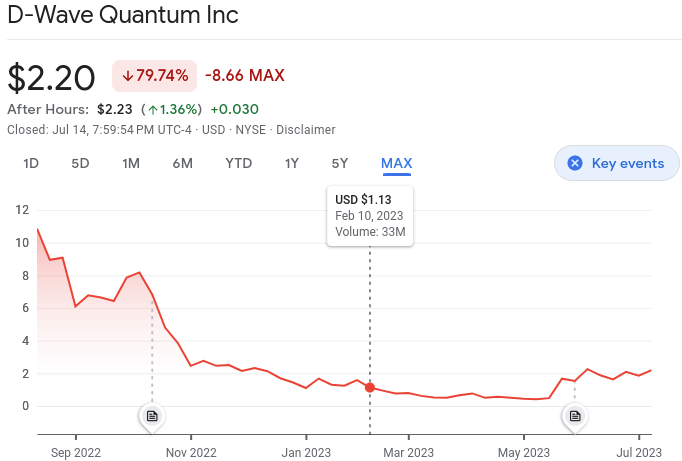
Coincidences happen. Welcome artificial intelligence timely entrance. I am sure researchers in both fields are aware of each other. Each involves revolutionary implications and consequences. Each is basically struggling with finding sustainable and profitable business models. Together their capabilities could be mutually amplified in ways we can’t imagine. And ‘can’t imagine’ is one of those things that are scaring some people.
Unknowns are risks. Rewards are not guaranteed. The adage about risk versus reward is heightened. Companies like D-Wave (QBTS) intrigue me because of the technical challenge, the unknowable potential, and the celebration of decades of work from persistent humans.
I don’t know what’s going to happen; but, I hope they survive and thrive. I’ll be watching.
The video:

 Trimbathcreative's Blog (Tom Trimbath)
Nice high level description of quantum computation and how QBTS is in the hunt.
The issue that keeps QBTS stock price in the penny stocks list is that they are in a crowded field, including that well healed international company that has been building computers since the days of automated adding machines.
QBTS best hope is to happen upon and patent the winning solution before someone else does and then begin considering offers in multiples of 1000x their current market cap. It would take a quantum computer to determine the probability of this happening I suppose.